




Blog
When to Start Retinol: Age, Skin Signs and Routine Tips

Retinol is often recommended for people in their twenties, but skin doesn’t follow age rules. Two people of the same age can have very different skin issues and sensitivities that affect their need for retinoids.
Instead of asking when to start using retinol, the better question is whether your skin needs it and if you have a stable routine. Someone in their early twenties might use retinol to address clogged pores and breakouts. In contrast, another person might not notice uneven texture or fine lines until their thirties, making retinol more useful for them. If someone has sensitive skin, it might be better to wait until irritation is under control before using retinol.
Retinol can be very effective, but it isn’t a must-have for everyone. It’s more important to start at the right time, choose the right strength, and allow your skin to recover than to start using it when you’re young.
The Best Time to Start Retinol Is When Your Skin Has a Reason to Use It
There’s no set age for starting cosmetic retinol.
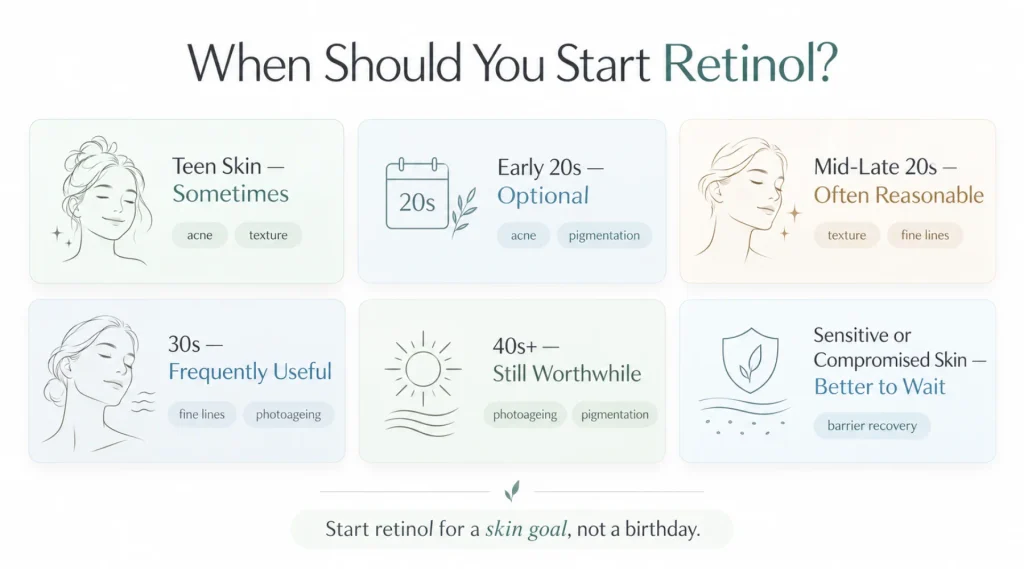
Most adults should consider retinol when they have specific skin goals, like dealing with clogged pores, rough texture, post-acne marks, sun damage, or early signs of ageing.
A good way to think about when to start is this:
| Life stage or skin concern | Is retinol worth considering? | Main reason |
| Teen skin | Sometimes, but professional guidance may be preferable | Acne and clogged pores |
| Early twenties | Optional | Acne, texture, pigmentation |
| Mid-to-late twenties | Often reasonable if there is a skin goal | Early prevention and texture support |
| Thirties | Frequently useful | Fine lines, pigmentation, uneven texture |
| Forties and beyond | Still very worthwhile | Collagen support, photoageing and texture |
| Sensitive or compromised skin at any age | Often better to wait initially | Barrier recovery should come first |
Starting retinol in your twenties doesn’t mean your skin will age better than someone who starts at 35. Factors like sun protection, smoking, genetics, UV exposure, sleep, overall health, and regular skincare also affect ageing.
Starting retinol later doesn’t mean you’ve missed out. Retinoids can still improve signs of ageing even if you start them later in life.
What’s important is to use retinol when you really need it, not just because social media says you should.
Age Changes: Why You Might Use Retinol, Not Whether You Are “Allowed” to Use It
Age gives helpful context since skin changes over time, but it shouldn’t dictate a fixed retinol schedule.
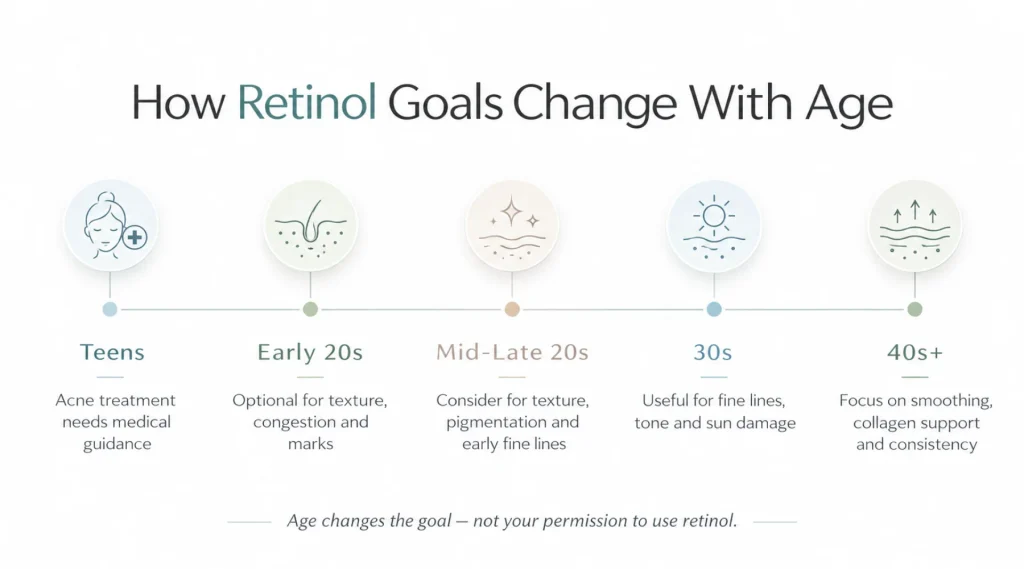
Teenagers and younger skin
Teen skin doesn’t need retinol to prevent ageing.
Acne is different. Doctors often use retinoids, like adapalene or tretinoin, instead of cosmetic retinol for treatment.
This difference is important.
A teen with severe acne, painful spots, or scarring usually needs proper medical advice rather than trying stronger cosmetic retinol products.
While cosmetic retinol may help mild acne, it is less reliable than medications approved for acne treatment.
Your early twenties
Retinol is optional in your early twenties.
If your skin looks clear and feels good, you don’t need to use it to prevent wrinkles later on. Using broad-spectrum sunscreen offers better immediate protection against sun damage.
However, consider retinol if you have:
- Frequent closed comedones
- Ongoing blackheads
- Rough or uneven skin texture
- Dark spots from acne
- Excess oil and congestion
- Early signs of sun damage
Your choice should depend on your skin’s needs, not just your age.
Your mid-to-late twenties
This is often seen as the best time to start using retinol, but it depends on your situation.
As we age, collagen production and skin renewal slow down, and sun damage becomes more noticeable. Retinoids can boost collagen and help skin renewal, which is why they are often recommended at this age.
However, not every 25-year-old needs to use them.
If you have a good routine with cleanser, moisturiser, and sunscreen and want to improve skin texture, dark spots, or fine lines, your mid-to-late twenties might be a good time to try a low-strength retinol.
If your skin is often irritated or if you change your routine frequently, adjusting to a retinoid could be very hard.
Your thirties
Many people find that retinol is especially helpful in their thirties.
You might notice:
- Fine lines that stay visible even when your face is relaxed
- Uneven skin tone
- Rough skin texture
- Slower healing from blemishes
- Dull skin
- Changes in firmness
- More noticeable sun damage
Retinol can’t stop ageing, but it can affect some processes that lead to visible signs of ageing from the sun. Starting to use retinol at 30, 35, or 39 is perfectly fine. It’s more important to be consistent in your routine than to worry about starting earlier, like at 24.
Your forties, fifties and beyond
Retinol is effective even after fine lines start to appear. At this point, the focus is on improvement rather than prevention.
Retinoids can help make skin feel smoother, reduce the appearance of fine lines, improve uneven skin tone, and promote collagen production.
As skin matures, it often becomes drier. This means retinol should be introduced carefully. Higher strength isn’t always better.
Using a richer moisturiser, applying retinol more slowly, and using fewer other active ingredients can help you use retinol more consistently.
What Retinol Actually Does to Your Skin
Knowing what retinol does for your skin helps you decide if you need it.
Retinol is part of the vitamin A family called retinoids. When you apply retinol, your skin converts it in the following steps: retinol → retinaldehyde → retinoic acid.
Retinoic acid is the active form that works with skin cell receptors. Prescription tretinoin is already retinoic acid, making it stronger and often more irritating than regular retinol. Retinaldehyde, or retinal, is in between retinol and retinoic acid in this process.
This difference matters when comparing retinol and retinal. A retinal product is usually an alternative to retinol, not something to use on top of it. Retinoids can influence various processes that affect how your skin looks.
It helps normalise skin-cell turnover
Skin cells grow in the lower layers of the epidermis and move up to the surface over time. Retinoids help manage this process, making the surface smoother and reducing dead cells that can clog pores. This is why retinoids are effective for acne-prone skin and uneven texture.
It can reduce comedonal congestion
Dead skin cells and oil can build up in hair follicles, causing blackheads and closed comedones.
Retinoids help stop this build-up.
So, does retinol help with acne? Usually, yes, especially for clogged pores. However, cosmetic retinol might not be the best choice for moderate or severe acne, and results can differ based on the formula and strength used.
It supports collagen-related activity
Retinoids are well-known for boosting collagen in the skin. When used regularly, they help the skin make more collagen and slow down its breakdown.
The effects are gradual. Retinol won’t quickly tighten skin or erase deep wrinkles.
But over time, better collagen structure and skin renewal can soften fine lines and make the skin look smoother.
It can improve uneven pigmentation
Retinoids can make skin pigmentation look more even by speeding up skin cell turnover and altering pigment distribution.
They are helpful for:
- Dark spots from previous skin injuries
- Uneven skin tone from sun damage
- Dull skin
- Pigmentation after breakouts
Pigmentation does not improve well without consistent sunscreen use. Daily sun protection is essential, even if retinol is working overnight.
When to Start Retinol for Acne Is Different From When to Start It for Ageing
Retinol is important for both acne and ageing. How you use it depends on your reason for starting.
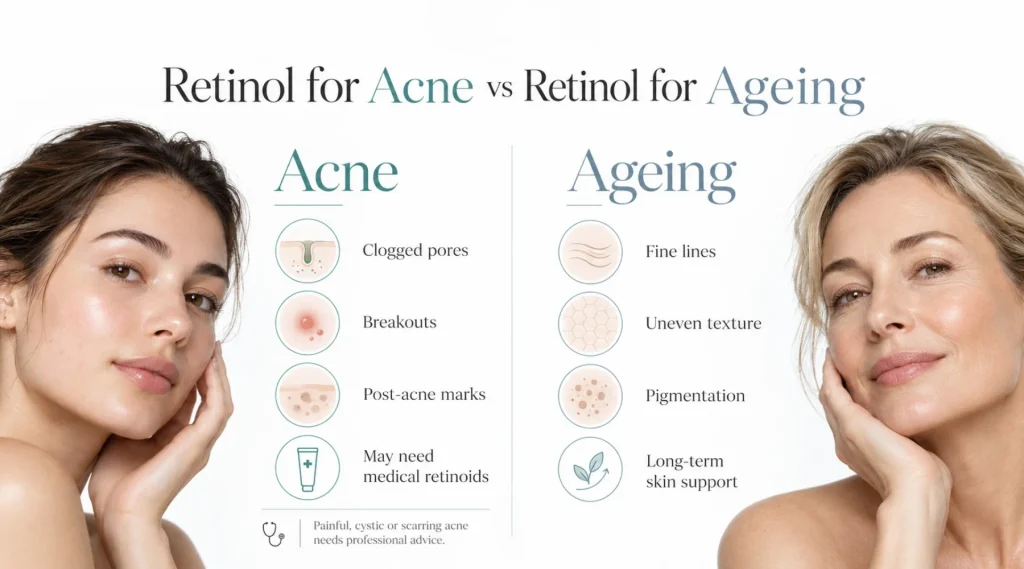
If you have acne, you might want to prevent clogged pores, reduce breakouts, and help marks fade. If you’re concerned about ageing, you’ll focus on fine lines, skin texture, colour spots, and long-term skin support.
If your main concern is acne, you might start using retinoids sooner than someone just looking for wrinkle prevention. However, don’t make cosmetic retinol your first choice for acne treatment.
Acne can involve inflammation, excess oil, blocked pores, bacteria, and hormonal issues. You may need different treatments based on the type and severity of your acne.
See a doctor if your acne is:
- painful or cystic,
- causing scars,
- affecting large areas of your skin,
- harming your confidence, or
- not improving with over-the-counter treatments.
A dermatologist or healthcare professional might suggest a stronger retinoid instead of just cosmetic retinol.
Skin Signs That Suggest Retinol May Be Worth Introducing
You don’t need every sign on this list; even one can be enough.

Recurring Blocked Pores
If blackheads and small bumps keep appearing despite gentle cleansing, retinol can help.
Uneven or Rough Texture
Retinoids can help smooth skin by improving how dead skin cells shed. However, scarring and large pores may not fully improve with topical products.
Early Fine Lines
Retinoids can make fine lines from sun damage less noticeable over time. But lines caused by muscle movement will not go away just because you use retinol.
Persistent Post-Breakout Marks
Retinol may help fade dark spots from acne, especially when used with daily sunscreen. Red marks can take longer to fade than brown ones.
Sun-Related Uneven Tone
Years of sun exposure can cause uneven skin tone and texture. Retinol can help, but sunscreen is crucial to protect your skin and support improvement.
Oily Skin with Congestion
Retinol is not just an oil absorber. It helps manage oil and clogged pores by improving skin cell turnover.
Signs You Should Probably Wait Before Starting Retinol
Sometimes, the best time to start retinol is not yet.
Retinol is easier on your skin when your skin barrier is healthy.
Wait to start if your skin is:
- Burning after using a basic moisturiser
- Red and inflamed
- Cracked or very flaky
- Recovering from too much exfoliation
- Reacting to other products
- Experiencing an eczema flare
- Severely windburned or sunburned
- Healing from cosmetic procedures
Using retinol on irritated skin won’t help and may cause more discomfort, forcing you to stop your routine.
A simple regimen with a cleanser, moisturiser, and sunscreen may be better until your skin calms down.
People with eczema, rosacea, or sensitive skin can still use retinoids, but everyone’s tolerance is different. Seeking professional advice can be especially helpful if your condition is active or hard to manage.
When to Start Retinol for Beginners: Make the Rest of Your Routine Boring First
A complicated routine can prevent successful retinol use.
Before you start, ensure you have three skin-friendly products:
- A gentle cleanser
- A moisturiser
- A broad-spectrum sunscreen
You don’t need multiple serums or extra products like exfoliating toners, peeling solutions, or brightening treatments. Keeping it simple helps you see if retinol irritates.
Having a basic skin care routine gives you a fallback if your skin feels uncomfortable. Treat retinol as the main active ingredient in your skincare routine, not just another product among many.
How to Use Retinol Without Overwhelming Your Skin
Knowing how to use retinol is just as important as knowing when to start. Apply retinol at night because it can be sensitive to light. Nighttime use also helps with sun protection.
Beginner Routine
Your routine can be simple:
- Cleanser
- Moisturiser (if needed)
- Retinol
- moisturiser
Or just:
- Cleanser
- Retinol
- moisturiser
Choose the version that feels best for you.
Start Small
Use a small amount about the size of a pea for your entire face. More product doesn’t speed up benefits; it just increases the chance of irritation. Apply tiny dots on your forehead, cheeks, and chin, then spread it evenly. Avoid putting it on sensitive areas like the corners of your nose, eyelids, corners of your mouth, and broken skin.
Let Your Skin Dry
Let your skin dry completely before applying retinol. While damp skin can absorb products better, it can lead to irritation. You don’t need to wait a specific amount of time; avoid applying it to wet skin.
moisturiseris Helpful
Using moisturiser before retinol, called buffering, can help reduce irritation. Another method is the “moisturisersandwich”:
- moisturiser
- Retinol
- moisturiser
These techniques can make retinol easier on sensitive or dry skin. A product you can use consistently is more valuable than a stronger version that irritates your skin and makes you stop.
How Often to Use Retinol When You First Start
You don’t win a prize for using nighttime products fast.
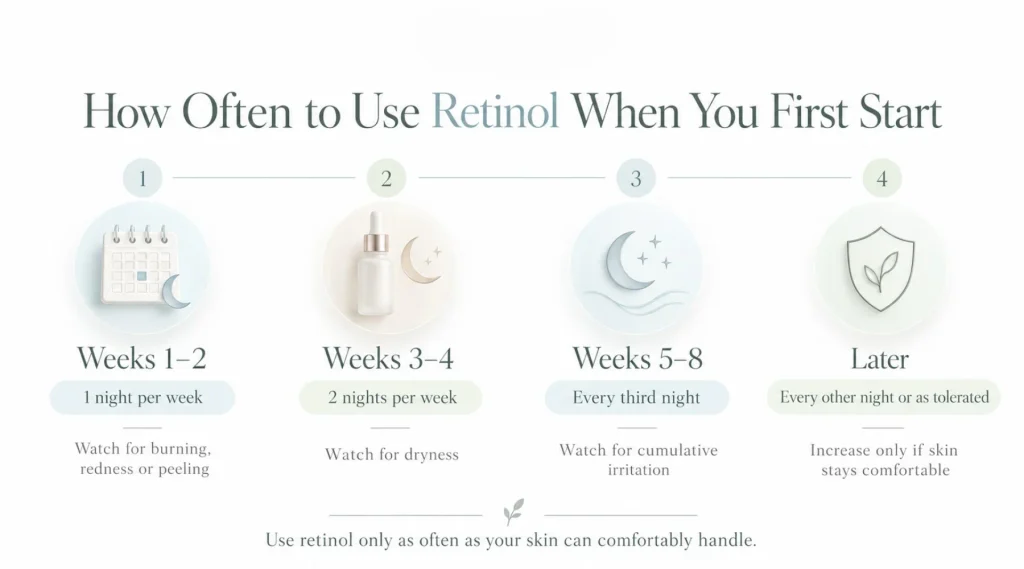
When people wonder how often to use retinol, the best answer is to use it as much as your skin can handle while still seeing gradual improvement.
A safe schedule might look like this:
| Stage | Suggested frequency | What to watch |
| Weeks 1–2 | 1 night per week | Persistent burning, redness or significant peeling |
| Weeks 3–4 | 2 nights per week | Dryness between applications |
| Weeks 5–8 | Every third night if comfortable | Cumulative irritation |
| Later | Every other night or as tolerated | Whether increased frequency adds benefit without discomfort |
This timetable is not required.
Some people can see results faster, while others may use retinol twice a week for months and still improve.
Your skin doesn’t get extra benefits from using retinol every night.
You should only increase how often you use it if your current routine feels too easy.
What Normal Retinol Adjustment Looks Like and What Does Not
Retinol can cause dryness, flaking, and temporary sensitivity when you first use it. This is sometimes called “retinisation.”
A little dryness in the first few weeks is normal, but severe irritation doesn’t mean the product is working.
If you experience any of the following, reduce how often you use it or stop for a bit:
- Persistent burning
- Bright redness
- Swelling
- Painful peeling
- Cracking
- Skin that hurts when wet
- Worsening irritation
It’s a myth that you must endure severe irritation for retinol to be effective. Inflammation does not make it work better.
When to Start Retinol for Sensitive Skin
Sensitive skin needs a different approach, but not necessarily different ingredients. If your skin is reactive, start when it’s calm. Choose a simple formula and don’t try too many new products at once.
Here are some tips that might help:
- Start once a week.
- Apply moisturiser first.
- Avoid areas around the nose and mouth.
- Use a thin layer instead of a thick one.
- Don’t use exfoliating acids on nights when you apply retinol.
- Keep fragrance to a minimum if it irritates your skin.
- Gradually increase how often you use the product.
The strength listed on the packageing matters, but percentages can be hard to compare because different products have varying formulations. A lower percentage in a good product can be a better starting point than just picking the highest number.
Do not confuse tingling with effectiveness
A retinol product shouldn’t cause stinging.
Many good retinoid creams and serums feel like regular products when you apply them.
If you think that strong sensations mean better results, you might use too much product on your skin.
When to Start Retinol for Oily Skin
Oily skin usually handles active ingredients well, but it can still have a weak barrier. A common mistake is mixing retinol with harsh oil-control routines that include:
- Strong foaming cleansers
- Daily salicylic acid
- Exfoliating toners
- Clay masks
- Scrubs
- Alcohol-heavy mattifying products
This can lead to skin that is both oily and dehydrated. If you start retinol for congestion, simplify other exfoliation methods to see how your skin reacts. Use a lightweight moisturiser, even if your skin is oily. Sebum (oil) and skin hydration are not the same. Retinol can improve congested, oily skin over time, but excessive stripping can make it worse.
How Retinol Fits With Hyaluronic Acid
One of the easiest combinations is retinol and hyaluronic acid.
Can you use hyaluronic acid with retinol? Yes, in most routines.
Hyaluronic acid is a humectant. It attracts and keeps water in the top layers of your skin. It does not make retinol less effective.
A simple routine could be: Cleanser → hydrating serum → moisturiser → retinol → moisturiser.
If you prefer applying retinol to clean, dry skin, you can use your hydrating products afterwards.
Focus on comfort instead of trying to get the perfect order.
If your hydrating serum has more than just hyaluronic acid, check the full ingredients. Some products may still contain exfoliating acids, fragrances, or other active ingredients.
Can You Use Niacinamide With Retinol?
Yes, niacinamide and retinol usually work well together for most people.
Many ask if they can use niacinamide with retinol because older skincare advice often said to avoid mixing active ingredients. However, niacinamide doesn’t cancel out retinol. It can help your skin’s barrier and reduce dryness from using strong products.
You can apply your skincare like this:
Cleanser → niacinamide serum → moisturiser → retinol.
Alternatively, you could use a moisturiser that has niacinamide in it instead of a separate serum.
There’s no need to complicate your routine to include both. Also, higher percentages of niacinamide aren’t always better. If a 10% or stronger serum irritates your skin, using it with retinol can make it hard to tell which product is irritating.
Retinol and Vitamin C Do Not Always Need Separate Days
Vitamin C and retinol are often seen as incompatible, but that’s not entirely true. Many people use vitamin C in the morning and retinol at night without any issues:
Morning: vitamin C → moisturiser → sunscreen
Evening: retinol → moisturiser
This method works well because vitamin C provides daytime protection, while retinol is the main active ingredient for the evening. Beginners usually don’t need to combine vitamin C and retinol in one routine. The main concern is not that they negate each other, but that using both can cause skin irritation.
Retinol With AHAs and BHAs Requires More Restraint
Glycolic acid, lactic acid, and salicylic acid are helpful for skincare. However, using them too much with retinol can irritate. Beginners usually do better by alternating these products.
For example:
- Monday: retinol
- Tuesday: recovery routine
- Wednesday: exfoliant if needed
- Thursday: recovery routine
- Friday: retinol
You can gradually use more products, but there’s no need to rush. People with acne often think they need salicylic acid and retinol every night since they both help with breakouts. However, too much treatment can lead to dryness and inflammation, making your routine harder to stick to.
Benzoyl Peroxide and Retinol Need a Thoughtful Routine
Benzoyl peroxide is a common acne treatment.
Using it with cosmetic retinol can cause more dryness and irritation. Some retinoid products do not work well with oxidising agents.
If both treatments are needed, use benzoyl peroxide in the morning and retinol at night to keep things simple.
For serious acne, it’s best to follow product instructions or a clinician’s plan instead of creating your own strong combination.
Retinol vs Retinal: Do Not Stack Them
Retinaldehyde, often called retinal, is one step closer to retinoic acid than retinol. This makes it more helpful to compare retinol and retinal instead of asking which one goes on top of the other. They both provide retinoid benefits in different ways.
A product like Vita A Retinal Shot Tightening Booster should be used as your retinoid treatment, not just an additional layer over another retinol. If you switch from retinol to retinal, start by using it less often; don’t assume you can handle it the same way you did with retinol.
The same goes for a retinol moisturiser like Difuman Retinol Anti Ageing Dragon Blood Cream. If this is your main retinol product, you usually don’t need to use another retinol serum underneath. Using two vitamin A products often doesn’t double the benefits; instead, it’s likely to cause more irritation.
Retinol vs Bakuchiol Is Not Simply Strong Versus Gentle
Bakuchiol is often advertised as a natural alternative to retinol. However, the comparison is not straightforward.
Bakuchiol is not a retinoid and does not turn into retinoic acid. Some studies suggest it may affect pigmentation, collagen, and oxidative stress. It is usually recommended for those who cannot tolerate regular retinoids.
The research supporting retinoids is much more extensive. If you want the most proven topical treatment for skin ageing, retinoids are hard to beat.
If your skin doesn’t react well to retinol even with careful use, you might prefer bakuchiol. It’s gentler and can be used more often, which may work better for your lifestyle.
Skincare isn’t improved by choosing the strongest ingredient if your skin can’t handle it.
When to Start Retinol With Other Skincare Products
If you already use many active products, the best way is to add retinol to a simpler version of your routine.
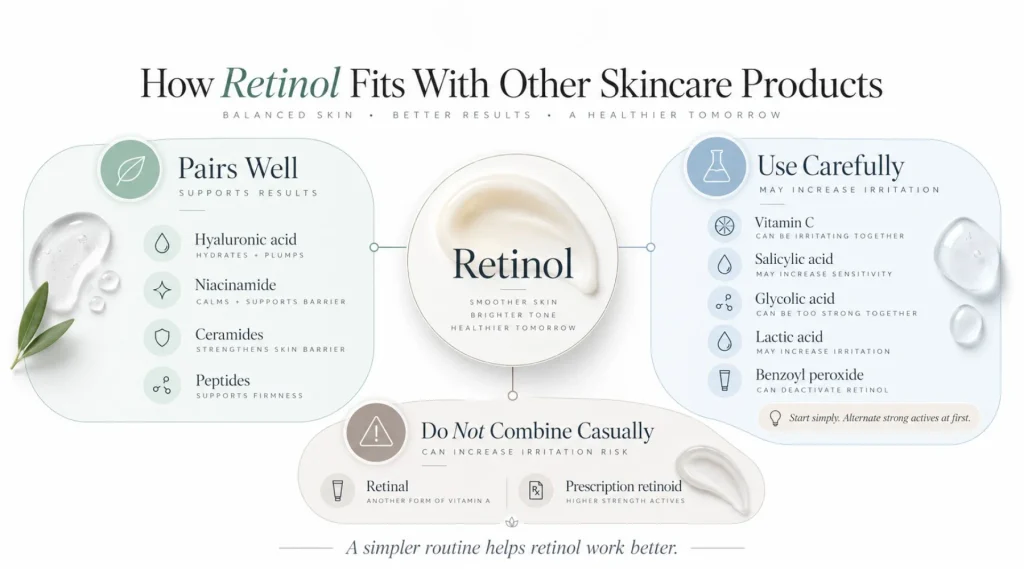
Don’t introduce it in the same week as a new exfoliant, vitamin C serum, or moisturiser.
Give yourself time to see how your skin reacts.
Here’s a helpful interaction guide:
| Ingredient | Usually compatible with retinol? | Beginner approach |
| Hyaluronic acid | Yes | Use freely for hydration |
| Niacinamide | Yes | Useful in serum or moisturiser |
| Ceramides | Yes | Helpful for barrier support |
| Peptides | Usually | Keep the routine simple |
| Vitamin C | Yes | Morning vitamin C, evening retinol is easiest |
| Salicylic acid | Potentially | Alternate initially |
| Glycolic/lactic acid | Potentially | Use on separate nights |
| Benzoyl peroxide | Depends on formula | Separate by time of day if appropriate |
| Retinal | No need to combine | Choose one retinoid |
| Prescription retinoid | No | Follow medical guidance |
Reading the full ingredient list is important.
The front of a bottle might show one soothing ingredient, but it could also have harsh acids or another retinoid.
If you’re using a serum like 24K Gold Serum, check the complete ingredient list instead of just believing the name. This applies to any new serum you use with retinol.
Your serums should have a clear purpose. Adding more bottles doesn’t make a retinol routine better.
A Beginner Retinol Routine Can Be Surprisingly Simple
A practical evening routine is often enough.
On Retinol Nights:
- Cleanse your skin gently.
- Let your skin dry.
- If you’re sensitive, apply moisturiser first.
- Use a pea-sized amount of retinol.
- Add more moisturiser if needed.
On Recovery Nights:
- Cleanse your skin.
- Apply a hydrating serum if you want.
- Moisturise well.
You can also use a hydrating treatment like Bio-collagen Real Deep Mask if it suits your skin. It doesn’t have to be used with retinol to be effective.
Remember, recovery nights are valuable. They help make long-term retinol use successful.
Morning Skincare Matters Just as Much as the Retinol Itself
Retinol is often seen as a nighttime product, but your morning routine is crucial for its effectiveness.
At the very least, you should:
- Cleanse your face gently or rinse it.
- Apply moisturiser if needed.
- Use broad-spectrum sunscreen.
Choose SPF 30 or higher and use enough to cover all exposed skin.
Even if retinol helps repair skin at night, you still need sun protection.
Sun exposure leads to:
- Collagen breakdown
- Dark spots
- Uneven skin texture
- Loss of elasticity
- Increased risk of skin cancer
If you’re using retinol to fight photoageing, not using sunscreen will work against your goal.
Retinol Purging Is Possible, but Not Every Breakout Is Purging
When you start using retinoids, your acne-prone skin may briefly get more breakouts. This is often called purging and usually happens in spots where you already have acne.
However, new breakouts don’t always mean the product is removing impurities.
Look out for irritation or product issues if breakouts:
- Appear in unusual places
- Come with burning or redness
- Keep getting worse over time
- Are accompanied by itching
- Start after using several new products at once
Retinol doesn’t remove toxins from the skin. The idea that breakouts help detoxify your skin is incorrect.
How Long Does Retinol Take to Work?
Retinol takes time to show results.
People often expect changes in just two weeks, which can make them use too much too often. You may notice texture changes before seeing improvements in pigmentation or fine lines.
Here’s a rough timeline for what to expect:
- First few weeks: your skin adjusts and gets used to retinol.
- Two to three months: you might see better texture and less congestion.
- Three to six months: expect more noticeable changes in skin tone and some fine lines.
- Six months and beyond: continued improvement with regular use.
These timeframes are general and not guarantees. Results depend on the product you use, how often you apply it, your skin type, sun exposure, and what you’re aiming to treat.
Taking photos in the same lighting every couple of months can be more helpful than checking your face closely every day.
Starting Stronger Does Not Mean Getting Results Faster
Many people wrongly believe that stronger retinol means better results. A stronger product might work faster, but it can also cause irritation that forces you to take breaks. The best dose for your skin isn’t just about the percentage on the bottle; it’s about how much your skin can handle consistently.
Consider these two routines:
- Routine A uses high-strength retinol twice, leading to ten days of irritation.
- Routine B uses moderate-strength retinol twice a week for six months without much discomfort.
Routine B is more likely to give you lasting improvements. Remember, skincare results come from regular use over time, not from using the strongest product.
More Peeling Does Not Mean More Collagen
Peeling is just a side effect, not a sign of success.
Retinoids may cause some flaking as your skin gets used to them, but you don’t need to peel to see benefits. Once your skin builds tolerance, many people can use retinol with little to no visible change. This doesn’t mean the product isn’t effective.
You often don’t need to keep increasing the strength of the product.
If your skin no longer tingles, that’s usually okay. Feeling comfortable can mean your routine is working well.
Retinol Does Not Permanently Thin Healthy Skin
This myth arises because retinoids can cause peeling and dryness at first.
Retinoids speed up skin turnover and may thin the outer layer of dead skin, but they do not make healthy skin weak or permanently thinner.
Using retinoids over a long time can lead to positive changes in the skin, including improvements in the outer layer and collagen.
Skin can feel thin and sensitive due to too much irritation from overuse.
This is a common issue and not proof that regular retinol use harms the skin.
Retinol Cannot Replace Every Anti-Ageing Treatment
Retinol has a strong reputation because of its well-researched benefits. However, it has limitations.
Topical retinol cannot fully fix:
- Deep wrinkles
- Loose skin
- Loss of facial volume
- Deep acne scars
- Broken blood vessels
- Major sun damage
Professional treatments might be better for some problems.
Dermatologists may suggest options such as:
- Prescription retinoids
- Chemical peels
- Microneedling
- Laser therapy
- Devices for specific issues
- Injectable treatments
Retinol can support professional care but should not replace treatments that work differently.
Lifestyle Still Influences How Your Skin Ages
It’s easy to get caught up in retinol percentages and miss more important factors.
Sun exposure is one of the biggest causes of early skin ageing.
Smoking speeds up visible ageing through stress on the skin, blood vessel changes, and effects on collagen.
A good diet, enough sleep, and treating skin conditions are important too, but they don’t work like topical retinoids.
No food or supplement can replace what retinol does for skin receptors.
Likewise, retinol can’t fix years of sun damage, especially if sunscreen is ignored.
Effective skincare comes from using simple, proven habits instead of looking for one miracle ingredient.
When Retinol Should Be Avoided or Discussed With a Professional
Be careful with retinoids during pregnancy. It’s best to avoid topical retinoids, even though they absorb less into the body compared to oral retinoids.
If you are pregnant, trying to get pregnant, or unsure about using a vitamin A product, talk to a healthcare professional.
Breastfeeding advice depends on the type of retinoid and how you use it, so getting professional guidance is a good idea.
Seek medical advice if:
- You have severe eczema or rosacea.
- Your skin condition is not well controlled.
- You are on prescription acne medication.
- You use prescription tretinoin, adapalene, or another retinoid.
- You need to stop active skincare before a procedure.
- You have ongoing swelling, blistering, or serious dermatitis.
Do not use cosmetic retinol over a prescription retinoid unless your doctor specifically says it’s okay.
Waxing, Peels and Cosmetic Procedures Can Change Your Retinol Schedule
Retinoids can make your skin more sensitive to some treatments.
Facial waxing is a key concern because skin treated with retinoids could be more vulnerable to lifting or damage.
If you plan on having professional peels, laser treatments, microneedling, or similar procedures, you may need to stop using retinoids beforehand.
The time you need to pause depends on:
- which retinoid you use,
- its strength,
- the procedure,
- your skin type,
- your practitioner’s guidance.
Always follow your clinician’s instructions instead of relying on general online advice.
The Most Common Mistakes People Make When Starting Retinol
Most issues with retinol come from how you use it, not the ingredient itself.

Start Gradually
Using retinol every night right away isn’t necessary for beginners. Skin takes time to adjust.
Avoid Using Too Much
Putting on a thick layer doesn’t help retinol work better. It can cause more irritation.
Add New Products Slowly
If you experience burning, you won’t know if it’s from retinol, exfoliants, or other products. Introduce one new product at a time.
Don’t Skip Moisturiser
Even if you have oily skin, it can still get dehydrated and irritated.
Stop If Irritation is Severe
Some mild dryness is normal, but significant burning means it’s time to stop.
Exfoliation Isn’t Mandatory
You don’t need to use acids just because you’re using retinol. Retinoids can be effective without weekly peels.
Always Use Sunscreen
If you’re worried about pigmentation and ageing, skipping sunscreen defeats your efforts with retinol.
Don’t Chase Stronger Percentages
The strongest product won’t help if you can’t use it regularly.
Be Patient with Results
Retinol takes time to show results. Switching products every two weeks makes it hard to see what works.
Questions People Ask Before Starting Retinol
What age should I start using retinol?
There’s no specific age. Many people start in their mid-to-late twenties or thirties. The best reason to use retinol is if you have skin issues like acne, uneven texture, or early fine lines. If your skin is clear, you don’t need retinol just because you’re in your twenties.
Is 20 too young to start retinol?
Not necessarily. A 20-year-old with acne or clogged pores may benefit from retinol. However, someone with clear skin doesn’t need to use it just because they turned twenty. For serious acne, other medical treatments may be more effective.
Is 30 too late to start retinol?
No. Many people start in their thirties. Retinol can improve uneven texture, pigmentation, and fine lines. You can also begin using it in your forties, fifties, or later.
Should I start retinol before I see wrinkles?
You can, but it’s not required. Retinol can help with issues like acne and uneven skin. To prevent premature ageing from the sun, wearing sunscreen is more important than using retinol early.
What does retinol do for skin?
Retinol transforms into retinoic acid in the skin. It helps with cell turnover, pigmentation, and collagen production. This makes it useful for acne, uneven texture, and signs of ageing.
Does retinol help with acne?
Yes. Retinoids can help normalise skin cell behaviour, reducing clogged pores. Mild acne might improve with cosmetic retinol, but more severe acne may need prescription treatments.
How often should a beginner use retinol?
Start with once or twice a week. You can increase use if your skin stays comfortable. Some people may eventually use it every other night or nightly, while others are fine with two or three times a week.
Can I use retinol every night?
Yes, if your skin can handle it. You don’t have to use it nightly. If using it every other night works for you, there’s no need to push for daily use.
Can you use hyaluronic acid with retinol?
Yes. Hyaluronic acid is hydrating and generally works well with retinol. You can apply it before or after retinol, depending on your skin’s reaction.
Can I use niacinamide with retinol?
Yes. Niacinamide and retinol usually work well together. Niacinamide helps support skin barrier function so that you can use a niacinamide serum or a moisturiser with it.
Should I use retinol before or after moisturiser?
Both methods can work. Applying retinol first gives it direct contact with the skin. Putting on moisturiser first can reduce irritation, which may be helpful for beginners. Choose the method that lets you use it comfortably.
Should retinol go on wet or dry skin?
Beginners often tolerate retinol better on dry skin. Damp skin may increase absorption and irritation. Once you know how your skin reacts, follow product-specific instructions.
Can I use retinol if I have sensitive skin?
Maybe. Start when your skin is calm, use a low-strength product, and apply it infrequently. Consider using a moisturiser alongside it. If you have eczema or rosacea, consult a professional before starting retinol.
Can I use retinol while pregnant?
It’s best to avoid retinoids during pregnancy. If you’re pregnant or trying to conceive, stop using retinol and consult a healthcare professional about your products.
How long should I use retinol before deciding if it works?
You should give it several months. Improvements in texture and congestion may take weeks, but pigmentation and fine lines often require three to six months or more. Consistent use is key for seeing real results.
Deciding When to Start Retinol for Your Own Skin
The best time to start using retinol isn’t about a specific age. Begin when you have a skin issue that retinol can help with, when your basic skincare routine is already working, and when you’re ready to add retinol slowly.
For one person, that issue might be acne at 22. For another, it might be uneven skin tone at 29. Some might not feel the need for retinol until they notice fine lines in their late thirties or forties. All these timelines are fine.
What’s important is understanding what retinol can do. It can help improve skin texture, clear pores, even out skin tone, and boost collagen production over time. However, it can’t stop ageing, fix inconsistent sunscreen use, or repair damaged skin overnight.
Start with a small amount, use it less often than you think you should, moisturise well, and protect your skin from the sun every day.
The aim isn’t to start retinol as soon as possible. Instead, it’s to start when your skin is ready for the right amount and frequency to gain lasting benefits.