





Blog
Retinol vs Retinal: Key Differences and Best Uses for Skin

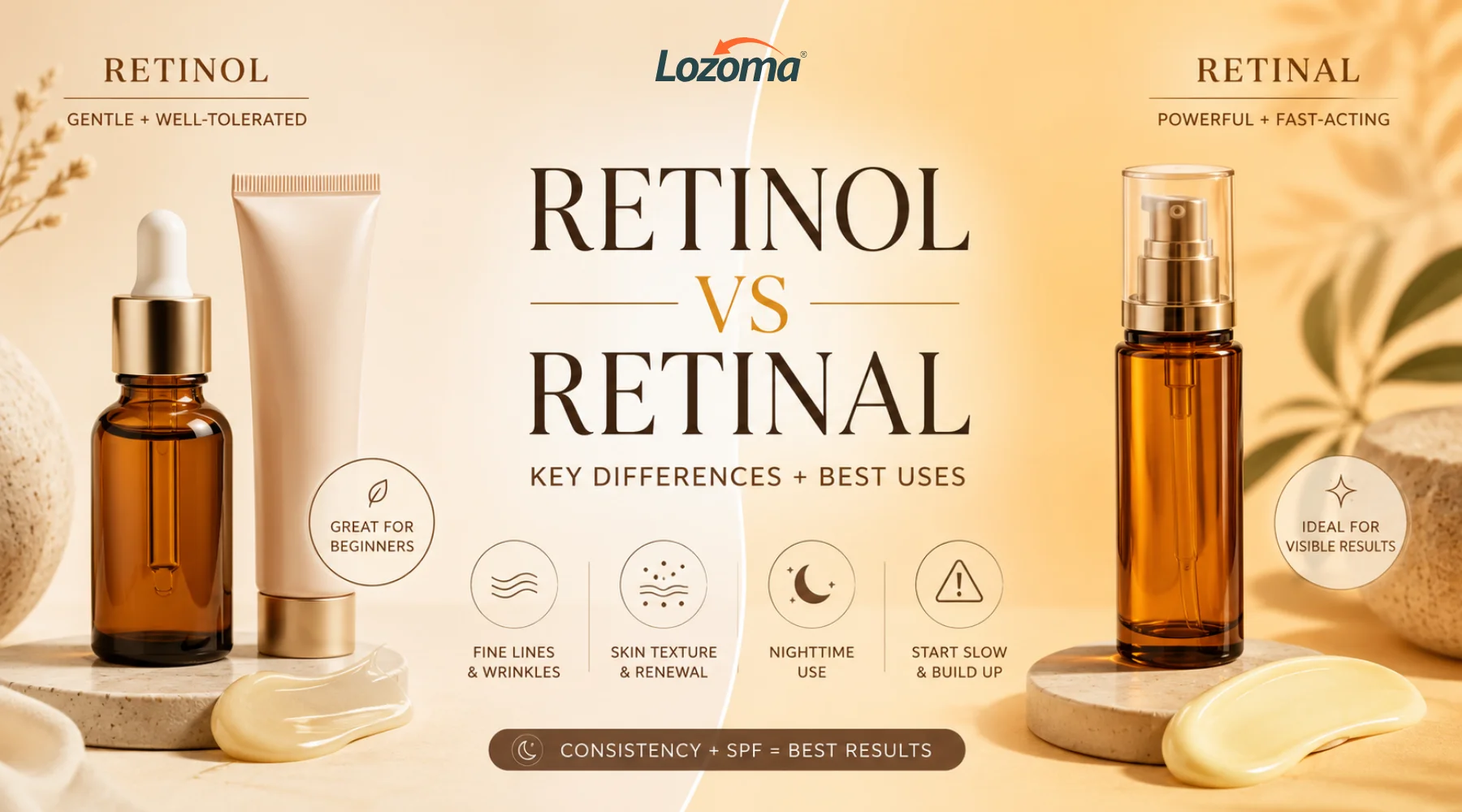
Retinol and retinal are both part of the vitamin A family, but they are often seen differently in marketing, one as a beginner ingredient and the other as a stronger option. However, the truth is more complicated.
Both can help reduce fine lines, uneven skin tone, rough texture, and congestion. They both need to be turned into retinoic acid to work effectively on the skin. The main difference is that retinal only needs one conversion step, while retinol needs two.
This means retinal can work better at lower strengths, but it doesn’t make every retinal product automatically superior to every retinol product. Factors like formula stability, delivery method, extra ingredients, how often you use it, and your skin’s condition are just as important as the type of retinoid on the label.
So, when comparing retinol and retinal, it’s important to look beyond strength. The best choice is the one that meets your needs and is comfortable enough for regular use.
Retinol vs Retinal at a Glance
| Feature | Retinol | Retinal |
| Full ingredient name | Retinol | Retinaldehyde, usually shortened to retinal |
| Vitamin A family | Cosmetic retinoid | Cosmetic retinoid |
| Conversion pathway | Retinol → retinal → retinoic acid | Retinal → retinoic acid |
| Relative position | Two steps from retinoic acid | One step from retinoic acid |
| Typical product strength | Commonly around 0.1% to 1%, although labels vary | Commonly around 0.05% to 0.2%, although labels vary |
| Expected pace | Usually gradual | May work more efficiently at a lower percentage |
| Beginner suitability | Often easier to find in low-strength formulae | Can suit beginners when used at a low concentration |
| Sensitive-skin suitability | Depends on strength and formula | Depends on strength and formula; not automatically gentler |
| Main uses | Fine lines, uneven tone, texture and mild congestion | Fine lines, uneven tone, texture and mild congestion |
| Acne evidence | Helpful, but weaker than evidence for prescription retinoids | Promising, including some antibacterial activity, but not a replacement for established acne treatment |
| Can they be used together? | Usually unnecessary | Usually unnecessary |
The percentages in this table are not the same. A 0.1% retinal formula is not the same as a 0.1% retinol formula. They are different molecules, and how the formula is made impacts its stability and how well it reaches the skin.
The Difference Between Retinol and Retinal Begins with One Chemical Step
Retinol and retinal are natural forms of vitamin A. Retinol is an alcohol, while retinal is an aldehyde. In the skin, enzymes turn retinol into retinal and then into retinoic acid.

Retinoic acid directly interacts with nuclear retinoic acid receptors. These receptors help control genes that affect skin cell behaviour, skin thickening, collagen production, and other skin functions.
The process is often shown as:
Retinol → retinal → retinoic acid
Since retinal is one step closer to retinoic acid, it can work effectively at a lower percentage. Retinol needs two conversions to become active, and not all of it completes this pathway.
This doesn’t mean retinol is useless. Studies show that applying retinol can reduce fine wrinkles and boost collagen when used regularly. In one study, 0.4% retinol improved fine wrinkles and increased collagen after 24 weeks.
Retinal also has research supporting its use. Studies with 0.05% and 0.1% retinaldehyde showed improvements in signs of sun damage, like texture and overall look. Interestingly, both concentrations showed significant improvements, with few differences between them.
This finding highlights an important point: stronger retinoids don’t always yield better results.
Why One Fewer Conversion Step Matters Without Settling the Whole Comparison
Retinal is often called “stronger” or “faster” than retinol. This is based on science, but there’s no single rule for how much stronger one is than the other.
Claims that retinal is ten or eleven times stronger than retinol are usually too specific. Studies use different formulae, concentrations, methods, and measures. A stable retinol may work better than an unstable retinal, while a well-made retinal product might be effective even at a lower percentage.
Several variables shape real-world performance:
- The concentration of the retinoid
- Whether it is encapsulated or delivered through a lipid-based system
- The stability of the formula after opening
- The type of packaging
- Exposure to air, heat and light
- The moisturising or irritating ingredients around it
- How frequently it is applied
- Whether the user can continue without developing dermatitis
Retinol and retinal are sensitive ingredients. To protect them, formulators use methods like encapsulation, antioxidants, opaque packaging, and air-restrictive pumps. Products exposed to air and light can lose their effectiveness more quickly than those in protective packaging.
This is why the name on the front of the bottle should start your assessment, not end it.
What Does Retinol Do for Your Skin?
Retinol influences several processes that affect the visible surface and deeper support structure of the skin.
With regular use, it may:
- Improve the appearance of fine lines
- Support collagen production
- Smooth uneven surface texture
- Help pigment appear more evenly distributed
- Reduce the accumulation of dead cells around pores
- Support the management of mild comedonal acne
- Make skin appear firmer and more refined over time
Retinoids don’t just exfoliate like glycolic or salicylic acid. They change how skin cells grow and move in the outer layer of skin. Any flaking you see during the adjustment period is due to irritation, not proof that retinoids are working.
Research shows that topical retinoids improve both visible and microscopic signs of ageing from sun damage. The best evidence supports prescription retinoic acid, especially tretinoin, but over time, cosmetic retinol and retinal can also help.
Knowing what retinol does for your skin helps set realistic expectations. It can make fine lines look softer, but it can’t fix deep wrinkles, restore lost volume, or replace results from injections or surgery.
What Retinal Does Differently
Retinal operates through the same process as retinol but is closer to retinoic acid. This means that a good retinal product can show noticeable changes even at lower concentrations.
Its main cosmetic uses are similar to those of retinol:
- Supporting smoother-looking texture
- Reducing the appearance of fine lines
- Improving uneven-looking pigmentation
- Refining the appearance of pores
- Supporting clearer skin
- Helping photoaged skin look more even and resilient
Retinal has shown it can directly fight Cutibacterium acnes, a bacterium linked to acne, in lab and clinical studies. This suggests retinal might be beneficial for acne-prone skin. However, an over-the-counter retinal serum is not a substitute for a proper acne treatment plan.
Prescription retinoids like adapalene and tretinoin are much better established for managing acne. A review found these topical retinoids effective, especially when used in combination. Adapalene is known for being gentle on the skin.
Retinal may be a good option for those concerned about ageing and mild acne. However, people with serious acne, nodules, scarring, or widespread blackheads should not depend solely on a cosmetic retinal product.
Is Retinal Better Than Retinol?
Neither ingredient is clearly better. Retinal may work faster, while retinol offers more options in strength, texture, and price.

Retinol may be the better fit when:
- You are completely new to vitamin A skincare
- Your skin reacts easily to active ingredients
- You want a low-strength introductory formula
- You prefer a cream or moisturiser rather than a concentrated treatment
- You want to increase strength in small steps
- You already own a retinol that works comfortably
Retinal may be the better fit when:
- You have already tolerated retinol but want a more efficient option
- You want to address fine lines and texture with a lower labelled percentage
- Your skin is accustomed to active ingredients
- You want one product for early ageing concerns and mild congestion
- You are prepared to introduce it gradually
- You can choose a well-stabilised formula
A better question to ask is, “Which product can my skin use regularly without causing irritation?” A strong formula that keeps causing burning and redness will often give worse results than a milder formula that you can use comfortably for a year.
Retinol vs Retinal for Fine Lines and Photoageing
Both ingredients help reduce fine lines, smooth rough skin, and create a more even skin tone.
Retinoids boost collagen production and slow down its breakdown. Over time, this can lessen fine lines and improve the look of sun-damaged skin. The changes happen gradually because rebuilding collagen takes time, not just a quick fix.
Retinal has an advantage because it converts to retinoic acid more easily. Studies show retinaldehyde works well for sun-damaged skin and causes less irritation than retinoic acid.
However, retinal won’t make wrinkles disappear overnight. Early results may improve skin texture and hydration. Seeing changes in fine lines takes several months, and deeper wrinkles might improve only a little.
Retinal is still a great option for long-term skin care. It works well on naturally aged skin and comes in many gentle creams and serums.
Retinal might be a good choice for someone who has built up tolerance and wants to move up from milder treatments without switching to a prescription retinoid.
Retinol vs Retinal for Uneven Tone and Dark Marks
Retinoids can help even out skin colour by speeding up skin cell turnover and redistributing pigment. They may gradually reduce acne marks and some sun-related discolouration.
Results vary based on the cause of pigmentation. For example, a superficial acne mark may fade faster than deeper melasma or ongoing sun damage. Hormones, inflammation, UV rays, and visible light can keep stimulating pigment, even when using a retinoid.
Retinol and retinal should be part of a broader skincare routine, not quick fixes. Daily broad-spectrum sunscreen is crucial. Some skin tones might benefit from tinted sunscreen with iron oxides, especially if visible light worsens pigmentation.
Stronger retinoids aren’t always better for brightening. Irritation can worsen post-inflammatory hyperpigmentation, especially in medium to dark skin tones. Starting too strong may lead to more discolouration than improvement.
For skin prone to pigmentation, comfort is important for effectiveness.
Does Retinol Help with Acne, and Is Retinal Better?
Retinol helps mild acne by encouraging better cell shedding around hair follicles. This can lessen clogged pores and make it harder for small blemishes to turn into blackheads or whiteheads.
Retinal might work similarly and has shown antibacterial properties against acne-causing bacteria. However, the proof for cosmetic retinol and retinal isn’t as strong as for prescription retinoids.
For occasional breakouts, a cosmetic retinoid can improve your skincare routine. But for ongoing acne, treatment often needs to tackle more issues like oil production, inflammation, bacteria, hormones, and the severity of the lesions.
Seek professional advice when acne is:
- Painful or cystic
- Leaving scars
- Affecting large areas of the face, chest or back
- Persisting despite several months of appropriate skincare
- Causing significant distress
- Accompanied by sudden hormonal symptoms
A dermatologist or qualified prescriber may suggest treatments like adapalene, tretinoin, benzoyl peroxide, azelaic acid, hormonal therapy, antibiotics, or isotretinoin based on the type and severity of the acne.
Retinol or Retinaldehyde for Sensitive Skin?
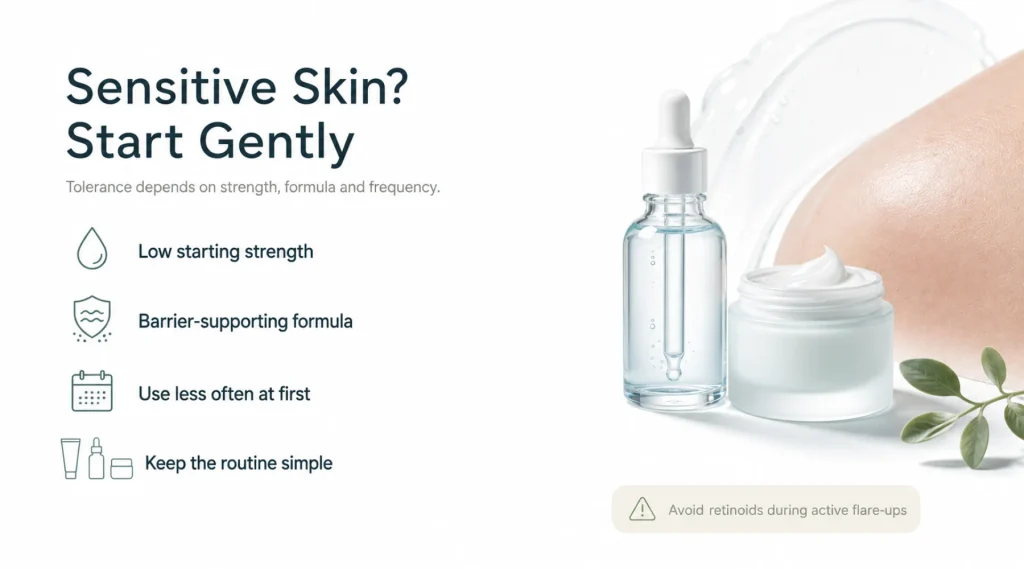
Sensitive skin can use retinoids, but it needs a gentler approach.
Some older studies showed that retinaldehyde is easier to use than retinoic acid and works well for sensitive skin on the face. Concentrations of 0.05% and 0.1% were generally well accepted in clinical settings.
People sometimes say retinal is gentler than retinol. However, this isn’t straightforward. Most studies looked at retinal against retinoic acid, not all retinol types.
A low-strength, encapsulated retinol in a moisturising base may feel softer than a strong retinal serum. On the other hand, a well-made low-dose retinal product might be easier for sensitive skin than a potent retinol.
Sensitive skin should prioritise:
- A low starting concentration
- Fragrance-free or low-fragrance formulae
- A short, simple ingredient list
- Barrier-supporting lipids and humectants
- Protective packaging
- Infrequent initial use
- A bland moisturiser
- Minimal exfoliation
People with rosacea, eczema, and chronic dermatitis need to be careful. Some can use retinoids, but applying them during flare-ups can increase burning and inflammation.
For those who cannot use vitamin A products, bakuchiol may be a better option. A study showed that both bakuchiol and retinol helped improve signs of ageing, but retinol users experienced more scaling and stinging. While bakuchiol is different from retinoids, it can be a good alternative for sensitive skin routines.
Retinol vs Retinal for Beginners
Retinol is a good choice for beginners because it’s easy to find in low strengths. New users can start with a gentle cream or serum and use it more often over time, instead of jumping to a strong formula right away.
Retinal can also work for beginners. A good 0.05% retinal product used once or twice a week can be suitable for healthy skin.
Your starting choice should reflect your baseline routine.
Retinol may suit a beginner who:
- Has dry or reactive skin
- Rarely uses active ingredients
- Is worried about irritation
- Wants a moisturiser-led routine
- Prefers gradual adjustment
Retinal may suit a beginner who:
- Has normal, combination or oily skin
- Already tolerates niacinamide or gentle acids
- Wants to address early fine lines and congestion
- Is willing to start slowly
- Understands that faster is not the same as immediate
There’s no specific age when everyone needs retinoids. The choice should depend on skin issues, sun exposure, acne history, tolerance, and personal choice. When to start using retinol should focus on need, not age.
Teenagers with acne should use proven acne treatments guided by a professional instead of picking anti-ageing products just because they’re popular online.
How to Compare Concentrations Without Being Misled by the Label
Retinoid percentages can be confusing. A product labelled 1% “retinol complex” might not have 1% pure retinol. Instead, it could refer to a mixture or container that has less active retinol.
Retinal labels can also be misleading. A product might focus on the percentage of retinal liposome or delivery complex, rather than showing the amount of pure retinal.
Check whether the manufacturer specifies:
- Pure retinol or retinal percentage
- A retinoid complex percentage
- Encapsulated ingredient percentage
- Liposomal blend percentage
- Total vitamin A derivative percentage
These descriptions are not the same.
Beginners usually find retinol in concentrations of 0.1% to 0.3%. Experienced users often pick 0.5% or 1%. Retinal products typically start at 0.05%, with 0.1% being more active and 0.2% needing more caution.
These percentages are not medical standards; they are common in cosmetics. The formula can affect how a percentage works.
For example, a 0.3% retinol in a light, alcohol-heavy serum might feel stronger than a 0.5% encapsulated retinol in a cream that supports the skin barrier. A 0.1% retinal formula with peptides and moisturising ingredients could be easier to use than a simple formula with the same strength.
Formula Quality Can Matter More Than the Retinoid Name
A retinoid product is a complete mix, not just one ingredient sitting alone.
Humectants like glycerin and hyaluronic acid help keep water in the skin. Ceramides, fatty acids, cholesterol, squalane, and plant oils help reduce dryness. Niacinamide and panthenol may make the skin barrier feel better. Encapsulation can enhance stability and delivery.
Irritants can make your skin react poorly. High levels of denatured alcohol, fragrance, essential oils, or too many exfoliating acids can make retinoids harder to use.
Texture also matters. A thick retinol cream works well for dry or mature skin but may feel heavy for someone with oily skin. A light retinal emulsion suits oily skin but might be too weak for dry skin.
If you prefer a moisturising retinol instead of a separate serum, consider a cream like Difuman Retinol Anti-Ageing Dragon Blood Cream. However, introduce it slowly and don’t treat it like a regular moisturiser just because it’s a cream.
A targeted product like the Vita A Retinal Shot Tightening Booster is good for people focusing on fine lines and texture. It has retinal and other helpful ingredients, but you should still use it gradually.
When looking at skincare, don’t just pick the one with the highest number. Pay attention to the packaging, supporting ingredients, and how they fit into your routine.
How to Use Retinol or Retinal Without Overwhelming Your Skin
Retinol and retinal are best used at night. They are sensitive to light, and using them in the evening helps avoid mixing them with irritating products you might use during the day.
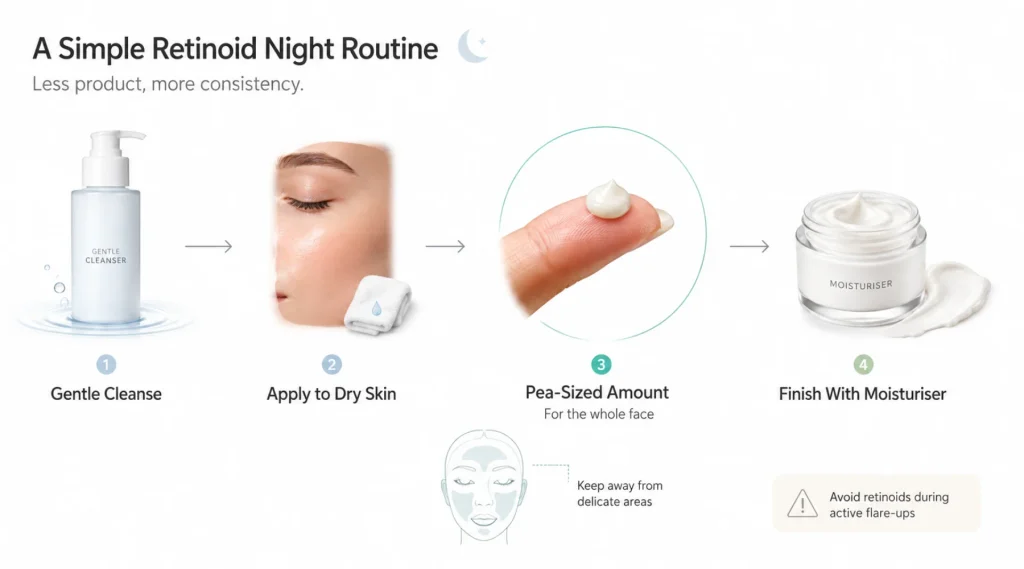
A simple evening routine looks like this:
- Cleanse with a gentle, non-stripping cleanser.
- Pat the skin dry.
- Apply a light hydrating serum if needed.
- Apply a pea-sized amount of retinol or retinal across the face.
- Follow with moisturiser.
A pea-sized amount is normally enough for the entire face. More product does not accelerate collagen production. It mainly increases the chance of irritation.
Avoid placing the product directly onto:
- Eyelids
- Lips
- Corners of the mouth
- Creases beside the nose
- Broken or freshly shaved skin
Retinoids can spread a bit after you apply them, so you don’t need to put them close to your lash line. The skin around your eyes is thin and can get irritated even if the product is a little further away.
Letting your face dry before applying retinoids can help reduce stinging. Damp skin absorbs products better, which is good for gentle moisturisers, but not ideal for active products that may irritate.
You don’t have to wait a specific number of minutes. Just apply the retinoid when your skin feels dry.
The Moisturiser Sandwich Can Make Retinoids Easier to Tolerate
The moisturiser sandwich means applying moisturiser before and after using a retinoid:
Moisturiser → retinol or retinal → moisturiser
This method can help with dryness and make it easier for beginners or those with dry skin, especially if they’ve had irritation before.
Using moisturiser doesn’t make the retinoid ineffective. Sticking to a routine you can follow regularly is often better than getting the most benefits one time and then dealing with a week of irritation.
You can also use a partial buffer:
- Apply moisturiser around the eyes, nose and mouth
- Apply the retinoid to the rest of the face
- Finish with moisturiser across the whole face
Pick a moisturiser that doesn’t have strong exfoliating acids, benzoyl peroxide, or another retinoid. It’s usually better to use a product with ceramides, glycerin, panthenol, or squalane for skin support.
Thick ointments can help other products sink in better. If your skin is sensitive, don’t cover a new retinoid with a heavy layer of petrolatum all over your face. Instead, try using a small amount of ointment only on sensitive areas; this can be helpful.
How Often to Use Retinol or Retinal
Frequency should depend on how your skin reacts, not on the harsh routines you see online.
A cautious schedule might look like this:
Weeks 1 and 2
Use the retinoid on one or two non-consecutive nights each week.
Weeks 3 and 4
Increase to two or three nights if there is no persistent burning, redness, or peeling.
Weeks 5 to 8
Move towards alternate nights if the skin remains comfortable.
After Two Months
Use the product more often only if your skin is calm, moisturised, and not irritated.
Using it every night isn’t necessary. Many people see good results with three or four times a week. The best frequency is the most your skin can handle without irritation.
If you skip a few nights, don’t use double the amount. Just go back to your normal routine.
After a long break, like several weeks, start using it less frequently. Your skin may not tolerate retinoids as well after illness, travel, cold weather, professional treatments, or changes in other skincare products.
Can You Use Hyaluronic Acid with Retinol or Retinal?
Yes, you can use hyaluronic acid with retinol and retinal.
Hyaluronic acid attracts and holds water in the skin’s upper layers. It does not interfere with vitamin A products.
A suggested order is:
- Cleanser
- Hyaluronic acid serum
- Retinol or retinal
- Moisturiser
Apply the serum on slightly damp skin and let it dry before using the retinoid. This helps the serum draw in water without applying retinoid on wet skin.
You can also use hyaluronic acid in the morning to simplify your evening routine. The order isn’t as important as keeping your skin moisturised and preventing pilling.
Hyaluronic acid may not be enough on its own. In dry conditions, follow it with a moisturiser that has emollients and occlusive ingredients to prevent water loss.
Can I Use Niacinamide with Retinol?
Niacinamide and retinoids can work well together in a skincare routine.
Niacinamide helps strengthen the skin barrier, keeps skin hydrated, and balances oil production. This makes it helpful when retinol or retinal causes dryness.
One routine could be:
Cleanser → niacinamide serum → retinol or retinal → moisturiser.
Another could be:
Cleanser → retinol or retinal → niacinamide moisturiser.
Some retinoid products already have niacinamide, so using a separate niacinamide serum may not be needed, especially for sensitive skin.
The combo isn’t usually irritating, but some products can be. A fragrant niacinamide serum or one with high concentration may complicate things.
When trying both ingredients for the first time, use them separately. Once you’re comfortable with each, it’s easier to combine them.
Acids, Vitamin C and Benzoyl Peroxide Need More Thought
Many skincare ingredients are chemically capable of existing in the same routine. The bigger concern is cumulative irritation.
Glycolic, lactic and salicylic acid
These acids can help with dullness, congestion, and uneven texture, but using them with a new retinoid might be too much for the skin barrier.
Start by alternating nights:
- Monday: retinoid
- Tuesday: recovery routine
- Wednesday: acid
- Thursday: recovery routine
- Friday: retinoid
After tolerance is built, some experienced users might use both products more often. It’s usually unnecessary to apply a leave-on acid directly under retinol or retinal.
Vitamin C
Vitamin C and retinoids don’t completely negate each other. However, vitamin C serums can sting when used with a retinoid.
Using vitamin C in the morning and the retinoid at night is a straightforward arrangement:
- Morning: cleanser → vitamin C → moisturiser → sunscreen
- Night: cleanser → retinol or retinal → moisturiser
Benzoyl Peroxide
Benzoyl peroxide is great for treating inflammatory acne, but it can dry out your skin. Some retinoids might react to oxidation based on how they are made. Unless your doctor suggests otherwise, use benzoyl peroxide in the morning and retinoids at night, or switch between them on different days.
Prescription Treatments
Do not use cosmetic retinal or retinol with prescription tretinoin, adapalene, or tazarotene unless your doctor says it’s okay. Adding more vitamin A usually won’t help and could worsen skin irritation.
Can You Use Retinol and Retinal Together?
Using retinol and retinal together is usually not needed. Both target the same results. Layering them doesn’t create added benefits; it mainly increases retinoid exposure and makes irritation harder to predict.

Avoid combinations such as:
- Retinol serum followed by retinal cream
- Retinol moisturiser over a retinal booster
- Retinol eye cream alongside full-face retinal without checking overlap
- Alternating several retinoid products without tracking frequency
Choose one main retinoid and use it for several months.
Switching from retinol to retinal is not the same as layering them. You can replace retinol with retinal after getting used to it, but do so slowly. Don’t assume your old routine will work with the new product.
If you use retinol nightly, you might need to start retinal only twice a week.
Common Mistakes That Make Both Ingredients Harder to Use
Starting with the Strongest Formula
A high percentage might seem better, but it can cause irritation and slow progress. Start with a strength that you can handle.
Applying Too Much
Putting on a thick layer won’t give you better results. It can irritate your skin without speeding up healing.
Increasing Frequency Too Quickly
Your skin may handle the first few uses, but irritation can happen later. Retinoid dermatitis can build up over time, so wait before using more often.
Using Several New Actives Together
Starting multiple products, like retinol, an acid toner, and vitamin C at once makes it hard to know what’s causing redness or breakouts.
Treating Peeling as a Goal
Flaking doesn’t mean your skin is producing more collagen. If you’re peeling a lot, it’s time to change your routine.
Skipping Moisturiser Because the Skin is Oily
Oily skin can still be dehydrated. A light moisturiser can help your skin tolerate other products without feeling greasy.
Applying to Irritated or Sunburnt Skin
Don’t use retinoids on skin that is already irritated or sunburnt. Let your skin heal first.
Ignoring the Neck
The neck can be more sensitive than the face. Don’t just use your facial routine on your neck. Start with less frequent applications or gentler products.
Forgetting Sunscreen
Retinoids can’t stop ongoing sun damage. You need daily sunscreen to prevent pigmentation and collagen breakdown.
Retinoid Irritation, Purging and an Allergic Reaction Are Not the Same
Retinol and retinal may cause short-term adjustment symptoms, but not every negative reaction should be called “purging.”

Expected early irritation may include:
- Mild dryness
- Slight tightness
- Light flaking
- Brief sensitivity
- Subtle redness that settles
These symptoms should remain manageable and improve when frequency is reduced.
Possible purging may look like:
- Small clogged bumps developing into blemishes
- Breakouts in areas where you commonly get acne
- A temporary increase after beginning a product that affects follicular turnover
Purging doesn’t mean you should experience intense burning, swelling, or entirely new skin lesions. It’s also not required. Many people start using retinoids without going through a purge.
Signs of excessive irritation include:
- Persistent burning
- Bright or spreading redness
- Pain when applying water or moisturiser
- Cracking
- Shiny, tight skin
- Severe peeling
- Increased sensitivity to products that were previously comfortable
Signs that need medical attention include:
- Facial swelling
- Blistering
- Hives
- Weeping skin
- Eye swelling
- Difficulty breathing
Stop using the product if symptoms are severe. For mild irritation, stick to a gentle cleanser, moisturiser, and sunscreen until your skin feels normal again.
Don’t keep using the retinoid to force your skin to adapt if it’s damaged. Ongoing inflammation will not help your skin adjust faster.
How to Restart After Retinol or Retinal Irritation
Wait until the stinging, redness, and sensitivity clear up. This can take several days or more, depending on the reaction.
During recovery:
- Use lukewarm water
- Avoid scrubs and cleansing brushes
- Pause acids, strong vitamin C, and benzoyl peroxide
- Use a plain moisturiser
- Protect the skin from sun
- Avoid picking flakes
- Minimise fragranced products
When restarting, reduce at least one variable:
- Use a smaller amount
- Apply once weekly
- Switch to a lower concentration
- Apply over moisturiser
- Change to a creamier formula
- Remove other active ingredients
- Avoid the eye, nose and mouth area
If you keep having the same reaction after restarting, the product might not be right for your skin. Switching from retinol to retinal isn’t always the solution. You might need a gentler retinol, bakuchiol, or a prescription plan from a professional.
Sunscreen Determines How Much Progress You Keep
Retinol and retinal are best used at night, but daytime protection is still important.
UV rays can damage collagen, cause uneven skin tone, and speed up ageing. While retinoids can help repair skin, they won’t be effective if the skin is still exposed to UV rays without protection.
Use a broad-spectrum sunscreen with at least SPF 30 every morning. Make sure to apply enough to cover your face, ears, and exposed neck. Reapply it if you’re spending a long time outside, sweating, or wiping your face.
Sunscreen also helps prevent irritation from retinoids, which can cause redness or dark spots.
While retinoids can improve skin, they do not make it safe to sunbathe, and sunscreen won’t make tanning protective.
When a Cosmetic Retinoid Is Not the Right Next Step
Retinol and retinal are helpful in cosmetics. However, sometimes it’s better to get professional advice than just trying out different products.
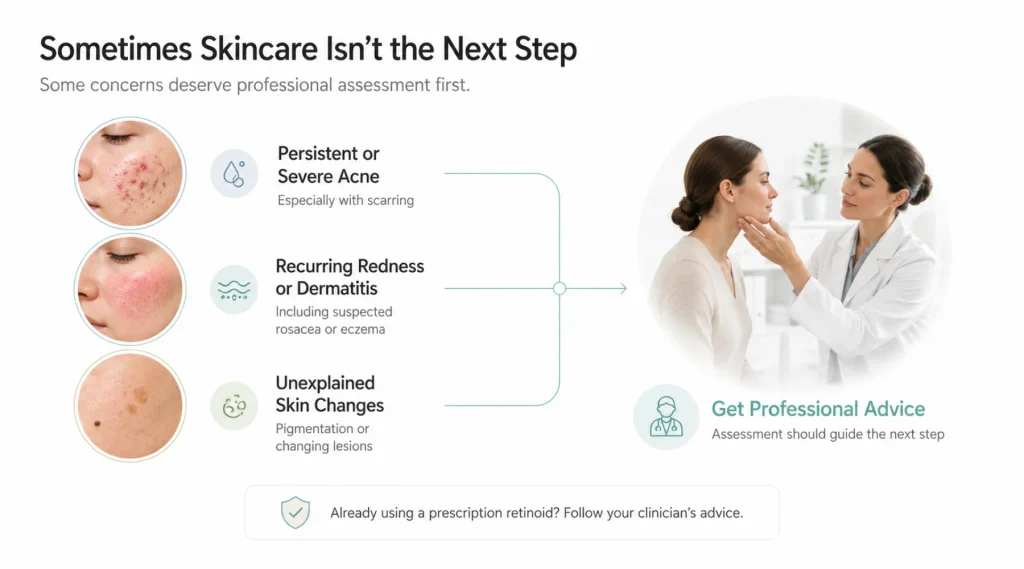
Speak with a dermatologist or qualified healthcare professional when you have:
- Moderate or severe acne
- Scarring acne
- Persistent melasma
- Suspected rosacea
- Eczema around the face
- Recurrent dermatitis
- Unexplained changes in pigmentation
- A rapidly changing skin lesion
- Severe sensitivity to skincare
- A prescription retinoid already in use
Professional treatment might include strong retinoids, but there are other options too.
Deep wrinkles and loose skin often improve with procedures like chemical peels, microneedling, fractional lasers, radiofrequency treatments, neuromodulators, or fillers. Each procedure has its own risks and should be chosen based on skin type, concerns, and medical history.
Cosmetic retinoids can help the skin before and after some procedures, but you might need to stop using them. Always follow your professional’s advice instead of relying on general online schedules.
Pregnancy, Breastfeeding and Retinoid Precautions
Taking retinoids by mouth can seriously harm a pregnancy. Topical products are absorbed in much smaller amounts, and studies on accidental topical use don’t usually show a higher risk of major birth defects. Still, experts recommend avoiding topical retinoids during pregnancy and when planning for a pregnancy as a safety measure. This includes cosmetic retinol and retinal, even those sold without a prescription.
If you become pregnant, stop using the product and talk to a healthcare professional. Accidental topical use is different from taking oral isotretinoin, so avoid making assumptions without medical advice.
If you are breastfeeding, consult a healthcare professional to see if a topical retinoid is safe. Avoid applying products to areas where your baby might come into contact with the skin.
Be cautious using retinoids on skin that is inflamed, broken, recently waxed, or healing from a procedure.
How Long Before Retinol or Retinal Produces Visible Results?
The first noticeable change is often smoother surface texture, but improvement varies widely.

A realistic pattern may look like this:
First Few Weeks
The skin may feel drier or more sensitive. Some people notice no visible improvement yet.
Around Two to Three Months
Texture, mild congestion and overall clarity may begin to improve if the product is being used consistently.
Around Three to Six Months
Fine lines, uneven pigmentation and photoageing may show more meaningful changes.
Beyond Six Months
Continued use can help improve and keep results.
Most clinical studies on retinol and retinal look at changes over three to six months, not just a few days.
Before-and-after photos in different lighting can make results seem faster. Moisturisers can temporarily fill in lines, making them look softer before the retinoid has a chance to affect collagen.
To track progress, take photos in the same spot, with the same lighting and time of day every four to eight weeks.
Questions Readers Ask Before Choosing a Retinoid
Is retinal stronger than retinol?
Retinal is one step closer to retinoic acid, so it might work better at lower strengths. However, “stronger” isn’t a clear term. How well a product works depends on its strength, stability, delivery method, and how often you use it.
Is retinol better than retinal for beginners?
Low-strength retinol is often easier for beginners because there are gentler options. A low-dose retinal can also work for those with healthy skin. Start slowly with either one.
Can you use retinol and retinal together?
It’s usually not needed to use them together. They both act on the same vitamin A pathway, which can increase irritation without clear benefits.
Which is better for sensitive skin: retinol or retinal?
Neither is automatically better. A gentle, low-strength retinol might be easier on sensitive skin than a strong retinal. Alternatively, a carefully made low-dose retinal may work better than a harsh retinol.
Does retinal work faster than retinol?
Retinal may show results quicker since it needs one less conversion step. However, visible changes in fine lines or pigmentation still take months.
Does retinol help with acne?
Retinol can help mild congestion by promoting healthy skin cell turnover. For persistent acne, treatments like adapalene, benzoyl peroxide, azelaic acid, or prescription options are usually more effective.
Is retinal good for acne?
Retinal can help clear pores and fight acne-causing bacteria. It’s useful for mild acne but shouldn’t replace medical acne treatments.
Can I use niacinamide with retinol or retinal?
Yes, niacinamide works well with both and can improve skin comfort. Use a moderate amount and avoid mixing too many active ingredients at once.
Can you use hyaluronic acid with retinol?
Yes, hyaluronic acid adds moisture and doesn’t deactivate retinol or retinal. Apply it before your retinoid and then use a moisturiser.
How often should I use retinol?
Start using retinol once or twice a week. You can increase to every other night if your skin feels okay. Using it nightly is optional.
Should retinal be used every night?
Not initially. Start with once or twice a week and gradually increase. Some people can use it every night, while others do well with three times a week.
Can retinol or retinal thin the skin?
Retinoids can cause temporary dryness and peeling, making skin feel sensitive. Long-term use can improve skin structure rather than thin it. Persistent irritation can harm your skin’s barrier and should be addressed.
Can retinol make wrinkles look worse at first?
Yes, dryness can temporarily make fine lines more noticeable. Reduce how often you use it, moisturise well, and avoid harsh cleansers. This doesn’t mean wrinkles are getting worse forever.
Should I stop retinol in summer?
Not necessarily. You can use retinoids year-round if your skin is comfortable and protected. If heat or sun makes your skin reactive, reduce usage and keep wearing sunscreen.
Is retinal the same as tretinoin?
No. Retinal still needs to change into retinoic acid in the skin. Tretinoin is retinoic acid and works directly on its receptors. Tretinoin is a medicine with stronger proof, more power, and a higher chance of causing irritation.
Choosing Between Retinol and Retinal for the Skin You Have Now
Choose between retinol and retinal based on how your skin reacts, not just because you think you should always use the strongest product.
Retinol is a good option for beginners, people with dry skin, and those who prefer a gradual approach. It effectively helps with fine lines and boosts collagen when used regularly for several months.
Retinal is better for those who want a stronger retinoid, already have some tolerance, or wish to tackle early signs of ageing and minor skin issues. While it’s close to retinoic acid, patience is still important.
Whichever retinoid you choose, use only one at a time. Start slow, apply a small amount, support your skin barrier, and use sunscreen daily. Only increase how often you use it when your skin feels calm.
The best retinoid isn’t the one that converts the most effectively; it’s the one that improves your skin without causing too much irritation so you can keep using it.