





Blog
What is Retinol? Benefits, Risks, and Skin Tips That Work

Retinol is often said to be the best ingredient for smoother, clearer, and younger-looking skin. However, it’s a bit more complicated. It can help with fine lines, uneven texture, clogged pores, and some types of pigmentation, but it can also make the skin dry, inflamed, and uncomfortable if used too harshly.
It’s important to know what retinol really is because it refers to different vitamin A ingredients. A retinol serum is not the same as retinal, prescription tretinoin, or oral isotretinoin. They are all part of the vitamin A family, but they differ in strength, stability, and use.
A good retinol routine should progress slowly, not quickly. Feeling persistent burning, heavy peeling, or damaged skin is not a sign that the retinol is working. It usually means you need to adjust the dose, formula, frequency, or your overall skincare routine.
What is Retinol and How is it Different From a Retinoid?
Retinol is a form of vitamin A found in over-the-counter skincare products. It is part of a larger group called retinoids.
The term “retinoid” includes various ingredients like retinyl esters, retinol, and retinal, as well as medications like tretinoin, adapalene, and tazarotene. Oral isotretinoin is also a retinoid, but it’s a strong prescription drug used under a doctor’s care, not a cosmetic product.
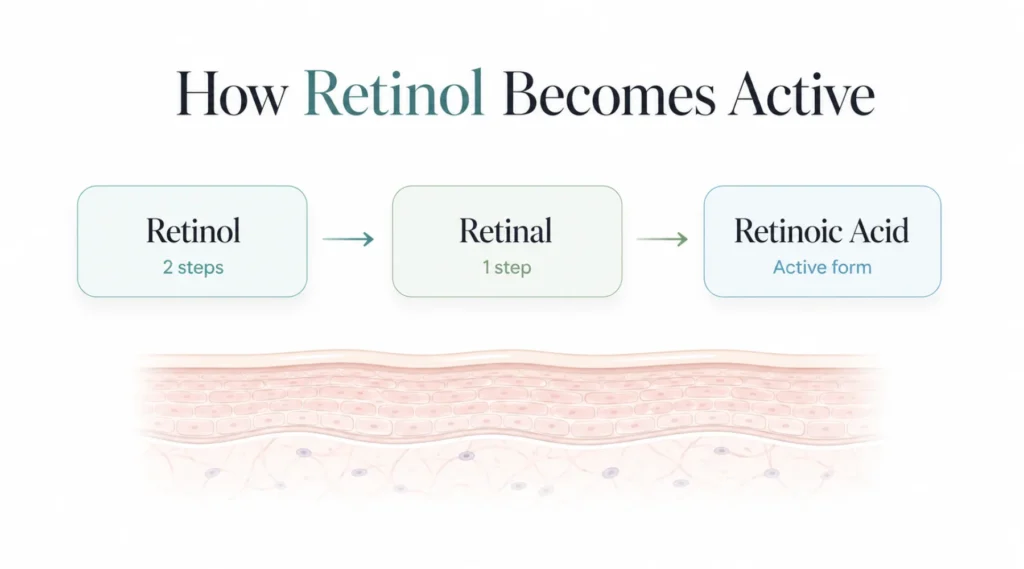
Retinol doesn’t directly connect well to the skin’s receptors. After you apply it, skin enzymes first change it into retinaldehyde (or retinal) and then into retinoic acid. Retinoic acid is the active form that affects skin cells.
Each conversion step makes less retinol available for action. This is why over-the-counter retinol usually works more slowly and is less irritating than prescription tretinoin. Retinal needs one conversion step, while retinol needs two. Understanding the difference between retinol and retinal helps clarify why products with similar names can act differently on your skin.
| Vitamin A ingredient | Where it is commonly found | Conversion needed | General character |
| Retinyl esters | Gentle cosmetic creams and serums | Three steps | Usually mild, but evidence and results vary |
| Retinol | Non-prescription skincare | Two steps | Gradual, moderately active and widely available |
| Retinal or retinaldehyde | Non-prescription skincare | One step | Often faster acting than retinol, with greater irritation potential |
| Tretinoin | Prescription medicine | None | Directly active, well studied and more likely to irritate |
| Adapalene | Acne treatment; availability varies by country | None | Designed primarily for acne and comedones |
| Tazarotene | Prescription medicine | None | Potent treatment used for selected skin conditions |
| Isotretinoin | Prescription capsules | Not comparable to topical conversion | Systemic medicine for severe or persistent acne |
You can’t compare the percentages on the labels directly. A 0.1% retinal product is not the same as a 0.1% retinol formula, and it’s different from 0.1% tretinoin too.
The way a product is made is important. Factors like encapsulation, packaging, moisturisers, stability, and the amount used affect how a vitamin A product works. A lower-strength retinol that’s well-designed may be easier to use regularly than a stronger one that causes skin irritation.
What Does Retinol Do for Your Skin?
Retinol changes how skin cells grow, mature, and organise. It’s not just about “removing dead skin.” When it becomes retinoic acid, it interacts with receptors in skin cells. This can affect how quickly skin renews, how cells behave around pores, and how collagen is maintained. Over time, this can lead to smoother skin, more even pigmentation, and fewer fine lines.
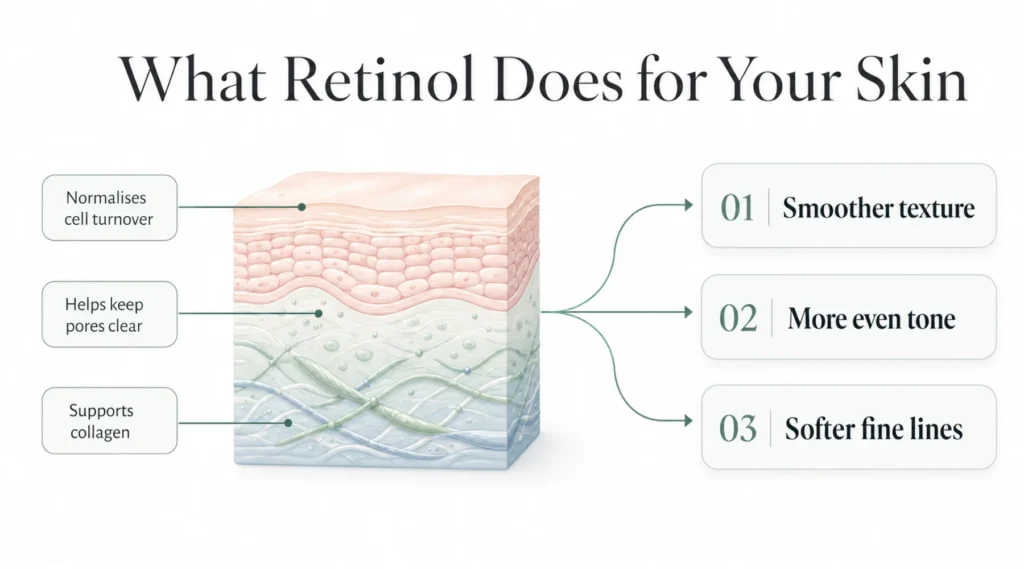
Retinoids help with comedones, which form when dead skin cells and oil build up in a pore. By normalising how skin cells shed, retinoids can reduce blackheads and closed comedones.
In ageing skin, retinoids can improve both the outer and deeper layers. Studies show they can reduce fine wrinkles and increase collagen, but prescription retinoids have more evidence supporting their effectiveness compared to regular cosmetic retinol. Tretinoin is better studied for ageing from sun damage than normal over-the-counter retinol.
What does retinol do for skin? It can help:
- Smooth rough or uneven textures
- Reduce clogged pores
- Improve mild acne
- Soften fine lines
- Make skin look firmer over time
- Fade some post-acne marks and uneven skin tone
- Brighten dull skin from uneven cell turnover
- Make pores less noticeable when they’re congested or loose
However, it can’t permanently erase pores, lift sagging skin, remove deep scars, or replace procedures for volume loss. It also can’t fix damage from repeated sun exposure.
Why Retinol Has Become an Anti-Ageing Staple
Skin ageing happens due to multiple factors, not just one. Genetics, UV rays, pollution, smoking, repeated facial movements, hormone changes, and natural loss of proteins all play a role.
As we age, the skin’s ability to renew itself slows down. Collagen production decreases, the outer skin layer may thin, and pigmentation can become uneven. Years of sun exposure further damage the skin, causing spots, rough texture, and fine lines.
Retinoids are useful because they can address many of these visible changes at once. They don’t just moisturise the surface; they also influence how cells communicate, giving them a wider range of effects than ingredients that only hydrate.
A study on topical retinol for ageing skin showed it can improve fine wrinkles, with increased collagen production being a key factor. Reviews of retinoids also note improvements in skin texture and signs of ageing from sun exposure, but results vary based on the type of retinoid, its formulation, and how long it’s used.
Not all retinol products work the same way. Reviews of over-the-counter vitamin A creams show mixed quality of evidence. Product claims may seem more precise than what independent research supports.
Realistic expectations include gradual improvement. Fine lines may look less noticeable, skin may feel smoother, and tone may appear more even. However, serious issues like deep folds and major sun damage often require more than just a cosmetic serum.
Benefits of Retinol for Skin
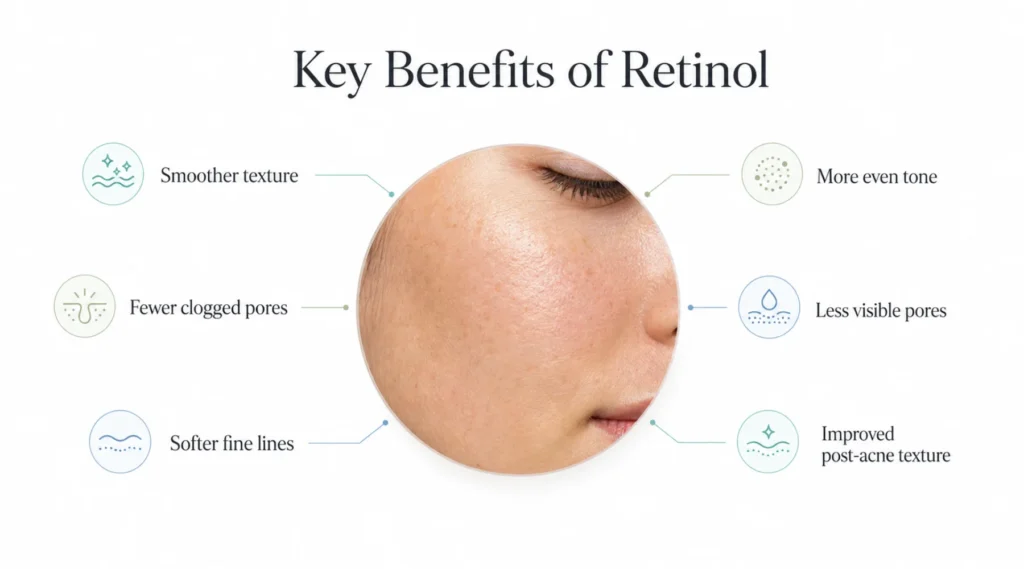
Smoother Surface Texture
Retinol can make skin feel smoother by promoting new skin cell growth. This helps when skin looks dull or when makeup sticks to dry spots. However, too much retinol at first can cause irritation, leading to peeling and roughness. Smooth texture comes from regular use, not from forcing skin to peel.
Fewer Clogged Pores
Retinoids stop dead skin cells from building up in pores, which helps with blackheads and clogged skin. Retinol is usually slower to work on acne than specific acne treatments. People with many breakouts or scars shouldn’t rely on retinol as their main treatment.
Softer-Looking Fine Lines
Retinol can reduce fine lines from ageing and sun damage when used consistently for a few months. Moisturisers can provide quick plumping, but real changes take time. Lines from dehydration improve quickly with a good moisturiser, while those from collagen loss may take longer and may not disappear completely.
More Even-Looking Pigmentation
Retinol can help fade dark spots by speeding up skin cell turnover and helping excess pigment move through the skin. However, it can’t replace sunscreen. Without it, sun exposure can worsen pigmentation and harm collagen. Too much retinol can also make pigmentation worse, especially in darker skin.
Improved Appearance of Enlarged Pores
Pores don’t open and close like doors. Their size can seem larger when clogged with oil or when skin loses firmness. Retinol may make pores look smaller by reducing congestion and tightening the skin around them, but this is a visual improvement, not a permanent fix.
Support for Post-Acne Texture
Retinol may help improve some unevenness after acne, including post-inflammatory marks and texture issues. However, deeper indented scars may not improve with retinol alone. For those, treatments like microneedling or chemical peels may be more effective.
Does Retinol Help With Acne?
Retinol can help treat acne, especially if clogged pores and uneven skin shedding are issues. It may reduce blackheads, closed comedones, and mild congestion.
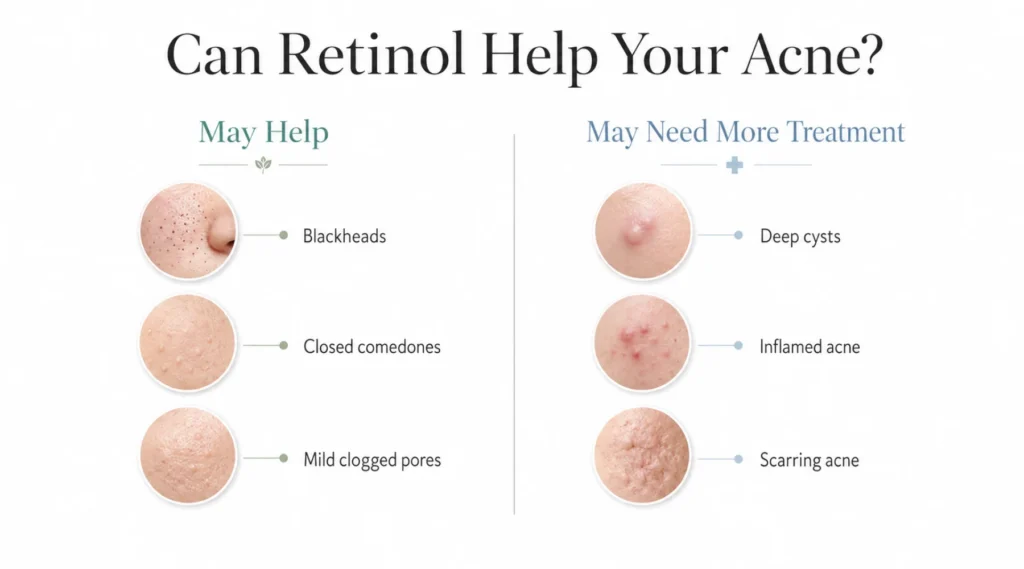
There is a key difference between cosmetic retinol and medical retinoids. Doctors recommend topical retinoids like adapalene and tretinoin because they are proven acne treatments. Over-the-counter retinol can be helpful, but it is usually weaker and may not give the same results.
Retinoids should be applied to the entire acne-prone area, not just on visible spots. Their main benefit is prevention; they stop new clogged pores from forming before they turn into noticeable blackheads or inflamed blemishes.
Retinol is most effective for:
- Closed comedones
- Blackheads
- Mildly clogged pores
- Uneven skin texture after acne
- Frequent small breakouts from blocked pores
- Maintenance after stronger acne treatments
However, it may not work well for:
- Deep cysts or nodules
- Widespread inflammatory acne
- Rapidly scarring acne
- Hormonal acne from significant internal factors
- Acne linked to a medical condition
- Breakouts from products that clog or irritate the skin
People with ongoing acne may benefit more from treatments like adapalene, benzoyl peroxide, azelaic acid, or other options recommended by a dermatologist. The best choice depends on the type and severity of acne, medical history, future pregnancy plans, and skin tolerance.
Can acne look worse after starting retinol?
Not every early breakout is a purge.
Retinoids can speed up changes in clogged pores, making hidden blemishes appear sooner. This can temporarily increase breakouts in areas where acne usually happens.
A breakout is less likely to be a normal adjustment if it:
- Shows up in places where you usually don’t get acne
- Causes intense itching, swelling, or a rash
- Comes with widespread burning or tenderness
- Gets worse without showing signs of getting better
- Follows the use of several new products at once
- Is mostly made up of irritation bumps, not typical acne
Retinoid irritation can damage the skin barrier, raise inflammation, and worsen acne-prone skin. Pushing through severe discomfort isn’t a good approach to managing acne.
Retinol, Retinal and Prescription Retinoids Are Not Interchangeable
Product names can make vitamin A skincare confusing.
Retinol is an ingredient that needs two steps to change into retinoic acid. Retinal needs just one step, while tretinoin is already retinoic acid and doesn’t need changing.
This doesn’t mean that retinal is always better or that tretinoin works for everyone. Stronger products can cause more dryness and irritation. How a product is made and how well a person can tolerate it are still important.
A specific retinal product, like the Vita A Retinal Shot Tightening Booster, should be used as a retinal treatment, not just as a regular retinol moisturiser. Don’t layer it with another retinol just because the names differ.
Prescription retinoids have strong proof for treating acne and sun damage, but they require careful evaluation. A dermatologist will choose the right strength and how often to use it based on the specific issue being treated.
Cosmetic retinol is better for gradual improvements in texture and fine lines, especially if someone prefers not to use prescriptions. Prescription treatments are better for serious problems like acne or significant sun damage that need careful management.
Retinol vs Bakuchiol for Easily Irritated Skin
Bakuchiol is a plant-based alternative to retinol but is not a retinoid and does not turn into retinoic acid.
Some studies suggest bakuchiol may reduce signs of ageing and might be easier on the skin than retinol for some users. One small study showed similar improvements in signs of ageing, with less irritation in the bakuchiol group. However, this study was limited and doesn’t prove that all bakuchiol products work like retinol.
Choosing Between Retinol and Bakuchiol:
The choice depends on your skin type, the product formula, and your goals.
Consider Retinol When:
- You tolerate vitamin A well.
- Clogged pores are a concern.
- Addressing fine lines and ageing is a priority.
- You prefer an ingredient with a long history of use.
Consider Bakuchiol When:
- Retinoids cause irritation for you.
- Your skin is dry or sensitive.
- You want a milder, antioxidant-focused routine.
- You wish to avoid vitamin A derivatives.
Bakuchiol can still irritate some people. Just because it’s plant-based doesn’t mean it’s hypoallergenic, won’t clog pores, or is safe for pregnancy.
When Should You Start Using Retinol?
There isn’t a specific age for everyone to start using retinol. You don’t have to begin at 18 just to fight ageing. Younger skin usually focuses on issues like acne, skin barrier health, and using sunscreen. Starting an unsuitable active ingredient too early doesn’t really help.
A better question is whether your skin has a problem that retinol can help with. Reasons to start using retinol include:
- Ongoing acne
- Clogged pores
- Early fine lines
- Uneven texture
- Mild sun spots
- Long-term anti-ageing care
Many people think about retinol in their late twenties or thirties when they notice early signs of ageing. Some start earlier for acne with a dermatologist’s help, while others begin later and still see benefits.
Your age is less important than your skin’s condition, health history, pregnancy status, sun habits, and commitment to using the product regularly. When to start retinol should depend on your skin’s needs, not on marketing fears.
Before using retinol, set up a basic routine that includes:
- A gentle cleanser
- A good moisturiser
- Daily broad-spectrum sunscreen
If you don’t follow these steps, you may struggle with irritation and won’t protect the improvements that retinol can bring.
Is Retinol Good for Sensitive Skin?
Sensitive skin may sometimes tolerate retinol, but it isn’t always the best choice.
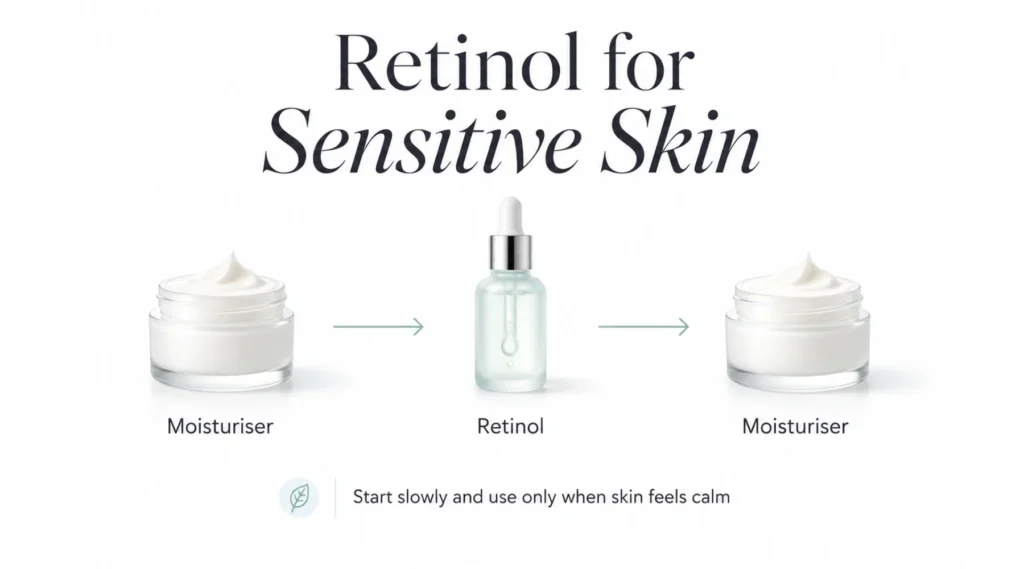
“Sensitive skin” can mean different things. Some people feel stinging from strong products, while others have conditions like eczema, rosacea, or skin allergies. Each case is different and should be treated as such.
The American Academy of Dermatology recommends caution for those with redness, inflammation, dryness, or skin allergies. They suggest seeking professional advice, especially for conditions like rosacea.
Sensitive skin is likely to handle retinol better when it is calm, moisturised, and not experiencing any flare-ups. Avoid starting retinol during times of burning, cracking, or severe redness.
For sensitive skin, consider these tips:
- Use a low-strength or encapsulated retinol.
- Choose a cream instead of a fast-drying serum with alcohol.
- Apply it once every five to seven nights to start.
- Use a moisturiser before and after applying retinol.
- Avoid acids and scrubs while your skin adjusts.
- Use a small amount, about the size of a pea, for the whole face.
- Stop using it if irritation continues or gets painful.
The “moisturiser sandwich” method can help:
- Apply a thin layer of moisturiser.
- Let it settle.
- Apply a small amount of retinol.
- Add another layer of moisturiser if needed.
This may slow down how quickly the retinol works, but comfortable and regular use is better than quick results that lead to skin damage and a long recovery.
How to Choose a Retinol Product That Suits Your Skin
Retinol strength is just one factor to consider when choosing a product.
A 0.1% formula can be hard to use if it has irritating chemicals, fragrances, or many exfoliating ingredients. A higher percentage might feel better if it’s in a balanced cream. Labels don’t always show how much retinol stays active over time.
Look for Protective Packaging
Retinol can break down when exposed to light and air. Use opaque, airtight packaging instead of clear jars that let light in. Good packaging won’t fix a bad formula, but it can slow down degradation. Store the product as directed, keep it away from heat, and close it tightly after use.
Consider the Product Type
Creams may be better for dry or sensitive skin because they mix retinol with soothing ingredients. Lightweight serums are good for oily skin, as long as they aren’t harsh. For those who prefer creams, the Difuman Retinol Anti-Ageing Dragon Blood Cream is a simple option. Always check the ingredient list, retinol strength, and your personal tolerance before using it regularly.
Don’t Judge by Percentage Alone
Retinol percentages vary widely, and there’s no perfect strength for beginners. How a product is formulated affects its effectiveness, and brands may not share all the details. Beginners should start with a mild formula and use it consistently. Jumping to a higher percentage may increase the risk of skin irritation without improving results.
Check the Ingredient List
A “retinol serum” might also include exfoliating acids, fragrances, and other active ingredients. These can affect how well your skin tolerates the product. When creating a skincare routine, always check the ingredient list, even if the product name sounds good.
Choose One Vitamin A Product
Avoid using multiple retinol products like a toner, serum, and cream at the same time, as this can lead to overexposure. Pick one primary retinoid and give your skin time to adjust before changing the strength or how often you use it.
How to Use Retinol in Skincare Without Damaging Your Barrier
Use retinol in the evening. This avoids sun exposure and morning antioxidants.
Keep your routine simple.
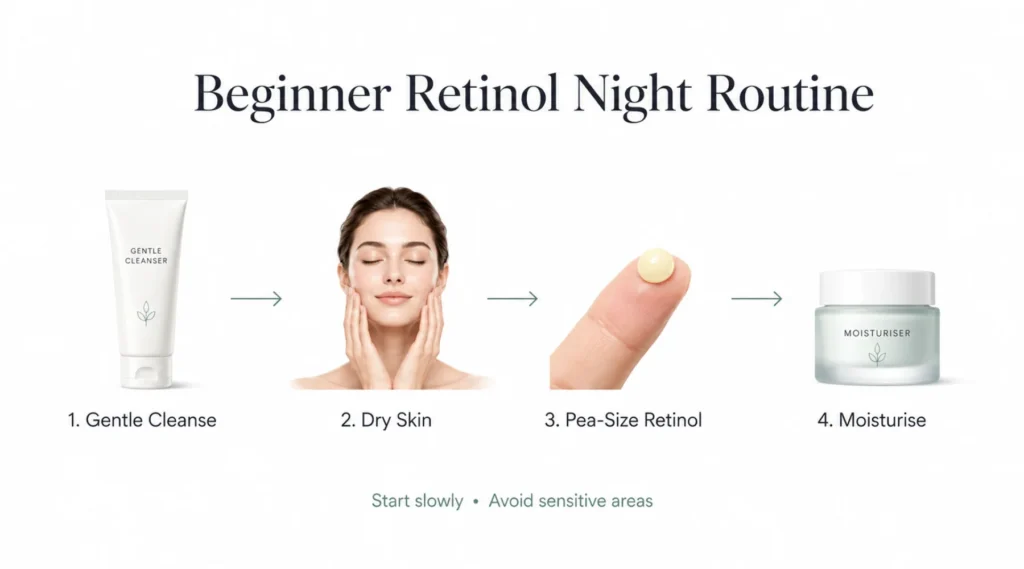
A beginner retinol skincare routine at night
- Cleanse gently.
- Pat the face dry.
- Allow the skin to dry fully if it is easily irritated.
- Apply moisturiser first when using the sandwich method.
- Spread a pea-sized amount of retinol across the face.
- Apply moisturiser.
- Use a plain lip balm around the lips if those areas become dry.
Use a pea-sized amount for your whole face, not for each area. Lightly dot it on your forehead, cheeks, and chin before spreading it out evenly.
When you start, keep it away from your eyelids, nostrils, and corners of your mouth. The product can move after you apply it, and these areas can get irritated easily.
A simple morning routine
- Rinse or cleanse as needed.
- Apply a hydrating or calming serum if used.
- Apply moisturiser.
- Finish with broad-spectrum sunscreen.
Sunscreen is essential when using retinol. UV rays cause fine lines, dark spots, and changes in collagen that many want to fix.
The American Academy of Dermatology advises using a broad-spectrum, water-resistant sunscreen with an SPF of 30 or higher every day.
Use retinol on dry skin if you’re worried about irritation.
Damp skin can make some products absorb more, which may help moisturisers but can intensify active ingredients. Applying retinol to fully dry skin can reduce stinging for beginners. You don’t have to wait a full twenty minutes after cleansing, but your skin should be dry.
Avoid using retinol on damaged skin.
Skip retinol on sunburned areas, raw spots, open wounds, recently waxed skin, or heavily peeling skin. Retinol is not a disinfectant or quick fix for injuries. Using it on damaged skin can cause more irritation instead of helping it heal.
How Often to Use Retinol
How often to use retinol varies by the product, skin type, and overall routine. Daily use isn’t right for everyone. Using it less often can still be effective if done consistently.
A practical schedule is:
| Period | Suggested starting frequency | What to monitor |
| Weeks 1–2 | Once or twice weekly | Burning, persistent redness, rash or excessive dryness |
| Weeks 3–4 | Twice weekly | Whether dryness settles between applications |
| Weeks 5–8 | Every third night if comfortable | Texture, congestion and overall barrier comfort |
| After week 8 | Every other night or as tolerated | Whether more frequent use adds benefit without irritation |
This is a guideline, not a strict schedule. A person with very dry skin might use the product twice a week for several months. Someone with stronger skin using a gentle formula may increase their use more quickly.
You should only use the product more often if your skin feels comfortable between applications. Some mild tightness is normal, but if you experience daily stinging, redness, or increased sensitivity, you are likely increasing the use too fast.
You don’t have to use the product every night. The best frequency is whatever your skin can comfortably handle over time.
What if you miss several nights?
Don’t use extra product to make up for missed nights. Go back to how often you used it before. If you took a break for weeks, start at once or twice a week and build up slowly.
Does more peeling mean better results?
No. Peeling shows irritation, not collagen growth. Some light flaking may happen as your skin adjusts, but if you see large flakes, pain, or shiny red skin, your skin barrier needs time to heal.
Can You Use Hyaluronic Acid With Retinol?
Yes, you can usually use hyaluronic acid and retinol together.
Hyaluronic acid helps draw in and keep moisture in the upper skin layers when paired with a good formula and a moisturiser. It does not interfere with retinol or stop it from becoming active.
Here’s a good order to follow:
- Cleanse your face.
- Apply a hydrating product with hyaluronic acid.
- Let your skin dry.
- Apply a moisturiser if needed.
- Apply retinol.
- Finish with moisturiser.
Alternatively, you can use hyaluronic acid in the morning and retinol at night.
Hyaluronic acid alone won’t fix severe skin irritation from retinol. If your skin feels burned or peels a lot, stop using retinol for now and use a simple moisturiser with ingredients like glycerin, ceramides, fatty acids, or petrolatum.
You can also try a hydrating treatment like a Bio-Collagen Real Deep Mask to ease discomfort, but don’t use it to ignore an irritating dose of retinol.
Can You Use Niacinamide With Retinol?
Yes, niacinamide and retinol work well together.
Niacinamide helps with many functions that benefit retinol users, like improving the skin barrier, providing hydration, and managing uneven skin tone. It does not interfere with retinol.
A routine that combines both could look like this:
- Morning: cleanser → niacinamide → moisturiser → sunscreen
- Evening: cleanser → retinol → moisturiser
They can also be layered in the same evening:
- Cleanse.
- Apply niacinamide serum.
- Let it settle.
- Apply retinol.
- Apply moisturiser.
Some retinol products have niacinamide in them already, so using a strong niacinamide serum might not be needed.
When people ask, “Can I use niacinamide with retinol?” they usually worry about skin irritation, not chemical mixing. It’s better to ask if the two products feel okay together. A heavily scented niacinamide serum or one with many acids can irritate the skin.
Retinol With Vitamin C, Acids and Acne Treatments
Many ingredients can work together in a routine, but just because they can mix doesn’t mean they will be gentle on the skin.
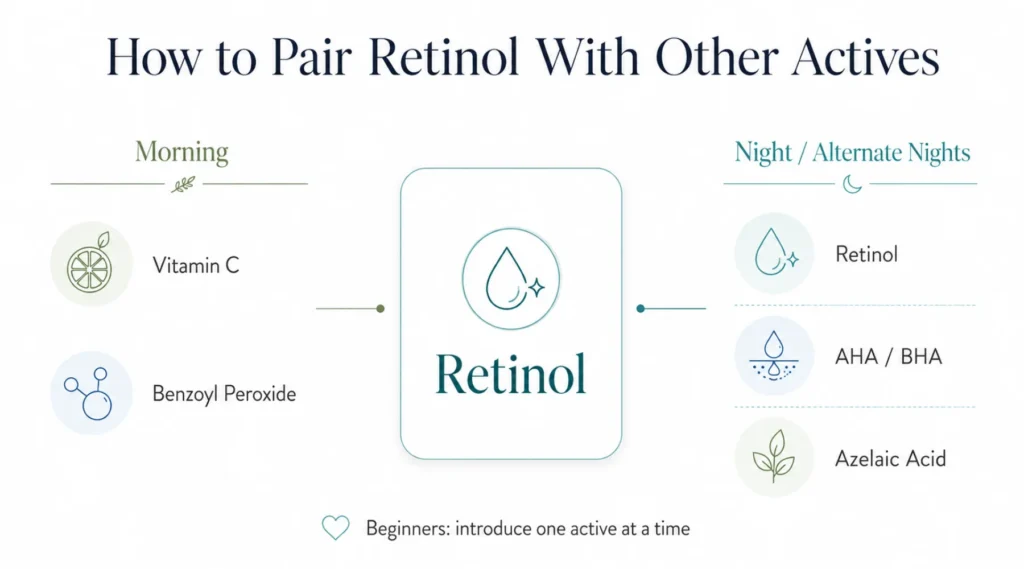
Vitamin C
People often use Vitamin C in the morning and retinol at night. This routine is simple and minimises irritation by reducing steps in one application.
Experienced users might use both products together, depending on the type of Vitamin C, acidity, and retinol strength. Beginners usually don’t benefit much from using them together.
Start with one active ingredient. Once your skin adjusts, add the second one, either on alternating days or at a different time of day.
Glycolic and lactic acid
Alpha hydroxy acids help remove dead skin from the surface. Using them with retinol can cause dryness and irritation.
Beginners should use acids and retinol on different nights. Most people don’t need both. Retinol improves skin texture over time, while acids offer quick exfoliation.
A weekly schedule might be:
- Monday: retinol
- Tuesday: moisturiser only
- Wednesday: moisturiser only or a mild acid if established
- Thursday: retinol
- Friday: recovery
- Saturday: hydration
- Sunday: retinol or recovery, depending on tolerance
Salicylic acid
Salicylic acid helps with oily skin and clogged pores. However, it can make your skin drier when used with retinol.
Using a salicylic cleanser in the morning for a short time might be gentler than using a strong leave-on BHA with retinol. If you have sensitive skin, start with just one acne treatment instead of two.
Benzoyl peroxide
Benzoyl peroxide treats acne well but can dry out the skin. Some products mix retinoids and benzoyl peroxide for safe use together. Don’t assume regular cosmetics act the same way.
A straightforward routine is to use benzoyl peroxide in the morning and retinol or a prescribed retinoid at night. Always follow your doctor’s instructions when using prescription combinations.
Azelaic acid
Azelaic acid and retinoids can work well together for acne and pigmentation. However, they might irritate the skin.
Start by using them at different times of the day or on alternate nights. Those prone to dark marks should be cautious, as irritation can worsen their condition.
Scrubs, cleansing brushes and peels
Physical scrubs and home peels don’t really help a new retinol routine. Scrubbing off more skin cells doesn’t improve how retinol works.
Don’t use strong peels, rough brushes, and powerful retinoids together without professional help.
Retinol Side Effects: What is Normal and What is Not?
Common side effects of retinol are dryness, tightness, mild flaking, redness, and temporary sensitivity.

These side effects usually happen in the first few weeks, especially if you use the product too often. They should be easy to handle and will improve if you use it less often or add more moisturiser.
Mild adjustments may include:
- Light flaking around the mouth or nose
- Slight dryness
- Temporary tightness
- Mild sensitivity that settles quickly
- A small increase in familiar clogged-pore breakouts
Warning signs include:
- Burning that continues after application
- Painful or bright-red skin
- Swelling
- Cracking or weeping
- A widespread itchy rash
- Severe eyelid irritation
- Sudden sensitivity to previously comfortable products
- Darkening marks caused by inflammation
- Symptoms that continue after retinol has been stopped
Irritation matters for deeper skin tones because inflammation can lead to dark spots. To lower this risk, start gradually and use a moisturiser.
Allergies to retinol are rare, but you can be allergic to other ingredients in the product. Fragrances, preservatives, plant extracts, and solvents can cause problems.
If you experience swelling, blisters, a severe rash, or difficulty breathing, stop using the product and seek medical help.
Retinol Purging Versus Barrier Damage
Purging is often misunderstood in skincare.
A retinoid can make hidden blemishes show up faster from clogged pores. This usually leads to acne in known areas and should clear up over time.
Barrier damage is different. It happens when the skin can’t handle too much exposure or when the routine has too many irritating products.
| Clue | Possible adjustment-related breakout | More likely irritation or incompatibility |
| Location | Usual acne-prone areas | New or widespread areas |
| Blemish type | Similar to normal breakouts | Tiny rash-like bumps, inflamed patches or mixed lesions |
| Skin sensation | Mild dryness | Burning, itching, tenderness or strong stinging |
| Pattern | Gradually stabilises | Continues worsening |
| Other products | Routine remains simple | Several acids, scrubs or new products used together |
| Barrier signs | Mostly comfortable | Shiny, tight, cracked or unusually sensitive skin |
Not every reaction needs to be called purging. This label can lead people to keep using products that cause skin rashes.
If you’re unsure, cut back on or stop using retinol and simplify your skincare routine. A real acne treatment shouldn’t cause uncontrolled inflammation.
How to Calm Skin After Using Too Much Retinol
Stop using retinol until your skin feels normal again. This may take several days or longer, depending on how bad it is.
During recovery:
- Use a gentle, fragrance-free cleanser.
- Wash with lukewarm water.
- Avoid acids, scrubs, and cleansing brushes.
- Apply a plain moisturiser several times if needed.
- Protect dry areas with a thin layer of ointment.
- Use broad-spectrum sunscreen.
- Avoid waxing, peels, and strong facials.
- Do not pick at peeling skin.
Keep your skincare routine simple during recovery. Adding many new products can make it harder to see what your skin can handle.
Once your skin is comfortable for several days, start using retinol again, but less often. Use less product and avoid strong ingredients.
If the original product causes a reaction again, it may not suit your skin. Switching between strong retinoids won’t fix the problem.
The Retinol Mistakes That Cause Most Problems
Starting Every Night
Using retinol every night right away can lead to retinoid dermatitis. Retinol takes time to work, so using it daily without letting your skin adjust won’t speed up results.
Applying Too Much
You don’t need a thick layer of product. Extra product can build up around your nose, lips, and eyes, causing irritation. A pea-sized amount is enough for your whole face.
Applying to Wet Skin
Putting retinol on wet skin can make it stronger. If you’re new or have sensitive skin, wait until your skin is dry to apply it.
Using Multiple Retinoids
Retinol, retinal, retinyl palmitate, and tretinoin are all Vitamin A products. Just because they have different names doesn’t mean they can be used together safely.
Chasing Visible Peeling
Peeling isn’t the goal. A routine that keeps your skin barrier healthy is more likely to help your skin improve over time.
Using Acids Every Non-Retinol Night
Don’t automatically make every other night an exfoliation night. Your skin needs time to recover.
Ignoring Sunscreen
Retinol doesn’t protect against UV damage. A good nighttime routine won’t help if you don’t use sunscreen consistently.
Applying as a Spot Treatment
Retinoids work best as preventive treatments for areas prone to acne. Putting a lot on one inflamed spot can dry it out without helping it heal quickly.
Changing Products Too Soon
Fine lines and pigmentation take time to improve. Switching products too often makes it hard to see what works for you.
Trusting the Front Label More than the Formula
Words like “clinical” or “maximum strength” don’t guarantee quality. Check the formula for stability and proof of effectiveness.
Adding Luxury Treatments on the Same Night
Using multiple treatments, like a serum and retinol, can irritate your skin. Test luxury products separately to avoid conflicts with your retinol.
Retinol Routines for Different Skin Types
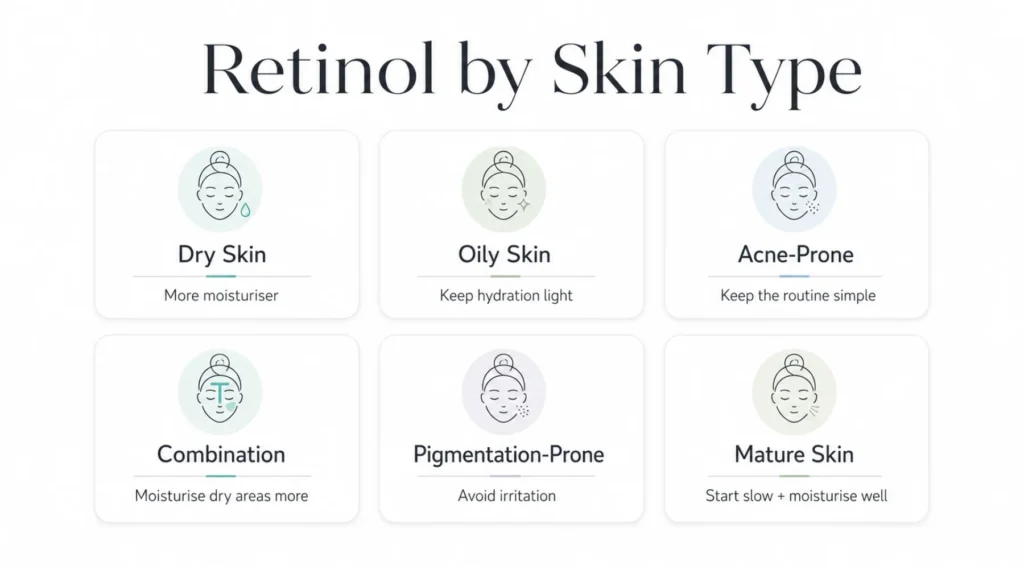
Dry Skin
Dry skin needs a creamy cleanser, a nourishing moisturiser, and a slower skincare routine. Start with retinol once or twice a week. Apply moisturiser before and after using retinol. Avoid foaming cleansers that make your skin feel tight, and skip exfoliating acids until your skin adjusts.
Oily Skin
Oily skin can still get dry and irritated. Choose a light retinol product but don’t assume you need the highest strength. Use a non-comedogenic moisturiser even if your skin feels greasy, as barrier damage can worsen oiliness.
Acne-Prone Skin
Keep your routine simple with a gentle cleanser, one acne treatment, moisturiser, and sunscreen. This makes it easier to monitor results. If you have painful or scarring acne, seek professional help instead of increasing retinol use.
Combination Skin
Apply a thin layer of product across your entire face, adding more moisturiser to dry areas. Avoid applying extra retinol to your oily T-zone unless your skincare expert advises you to.
Pigmentation-Prone Skin
Avoid irritating your skin. Inflammation can darken spots, even if retinol is meant to lighten them. Start slowly, use sunscreen every day, and keep retinol separate from acids and strong vitamin C products.
Mature Skin
Mature skin can benefit from retinol but often needs more moisture. Lower oil production and dryness make strong routines hard to handle. Pick a moisturising formula and give it a few months. Retinol may reduce fine lines and improve skin texture but won’t restore lost facial volume.
Rosacea-Prone or Eczema-Prone Skin
Retinol might not be suitable if you have active rosacea or eczema. A dermatologist can help you decide whether to use a gentle retinoid, another product, or skip retinoids altogether. Avoid applying it to inflamed or broken skin.
How Long Does Retinol Take to Work?
Retinol works at different rates for different skin concerns.
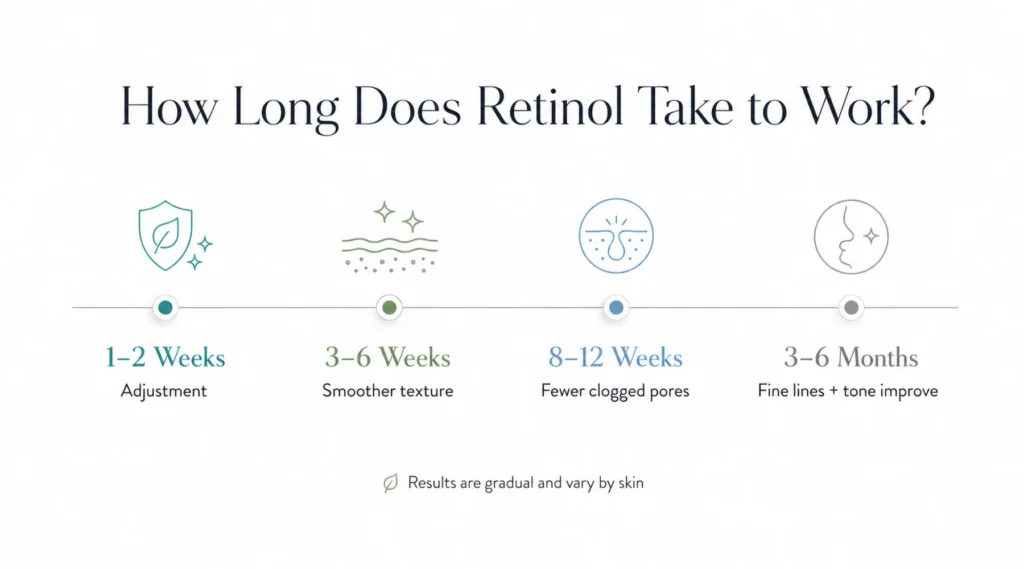
The hydration in the base formula can make your skin look smoother within days. Changes from retinol take longer to appear.
A realistic timeline is:
| Time using retinol | What may happen |
| First 1–2 weeks | Dryness or mild sensitivity may appear; visible benefits are usually limited |
| Weeks 3–6 | Texture may begin to feel smoother; congestion may fluctuate |
| Weeks 8–12 | Some users notice fewer clogged pores and more even texture |
| Months 3–6 | Fine lines, pigmentation and overall smoothness may show clearer improvement |
| Beyond 6 months | Continued use may help maintain and build gradual results |
These are estimates, not certainties. The strength and stability of cosmetic retinol can vary, and everyone’s skin reacts differently.
Prescription retinoids may show more consistent results but can cause more irritation. In both cases, you should evaluate progress over several months, not just a few days.
Take photos under the same lighting every four to eight weeks if it’s hard to see progress. Checking your skin in the mirror every day makes it hard to notice small changes.
Retinol During Pregnancy, Breastfeeding and Fertility Treatment
Retinoids need special care during pregnancy. Oral retinoids like isotretinoin can harm the baby, so strict measures are in place to prevent their use. Topical retinoids are absorbed less, but dermatology experts usually advise against using retinol or retinoid products during pregnancy.
You should stop using cosmetic retinol and talk to a doctor, pharmacist, midwife, or dermatologist if you are:
- Trying to conceive
- Undergoing fertility treatment
- Pregnant
- Unsure if your vitamin A product is topical or oral
- Using a prescribed retinoid
Breastfeeding advice depends on the specific ingredient and where it’s used. Don’t apply retinoids to the breast or areas that might touch the baby. Always seek personal medical advice before resuming use.
If you’ve used a small amount of cosmetic retinol before finding out you’re pregnant, stop and contact your healthcare professional. It’s better to assess risks individually than to panic.
Retinol Around Waxing, Peels, Laser and Other Treatments
Retinoids can make the skin more vulnerable to irritation during procedures that remove or heat the surface.
Tell the practitioner about all retinoid use before:
- Facial waxing
- Chemical peels
- Laser resurfacing
- Intense pulsed light
- Microneedling
- Dermabrasion
- Strong extraction facials
Waxing on skin treated with retinoids can remove both hair and top layers of skin. This might lead to raw patches, scabs, and changes in skin colour.
There is no standard waiting time because retinoid strengths and treatments vary. Always follow the guidance of your qualified professional.
After a treatment, don’t start using retinol again just because the redness is gone. Your skin might still be healing underneath.
When a Dermatologist Is More Useful Than a Stronger Retinol
Cosmetic skincare has limits.
Arrange professional assessment when:
- Acne is painful, cystic, or scarring
- Breakouts affect the chest or back extensively
- Pigmentation is rapidly changing
- A rash develops whenever retinol is used
- Rosacea or eczema is suspected
- Fine lines are not the main concern and a skin lesion is changing
- Irritation continues despite stopping active products
- Prescription-strength treatment is being considered
- Pregnancy or fertility plans affect treatment choices
A dermatologist can tell the difference between acne, folliculitis, rosacea, perioral dermatitis, and contact dermatitis. While these conditions may appear similar in pictures, they need different treatments.
Getting professional care can give you access to prescription retinoids, acne combinations, pigment treatments, and procedures. Stronger treatment isn’t always needed, but an accurate diagnosis can save you from using the wrong products for months.
Questions People Ask Before Starting Retinol
Can I use retinol every night?
You can use retinol every night if your skin can handle it and the product allows for regular use. However, nightly use isn’t for everyone. Start with once or twice a week. Gradually increase only if your skin feels fine between applications. Using it twice a week for a year is better than nightly use that causes irritation.
Should I apply moisturiser before or after retinol?
You can do either. Applying moisturiser before retinol can reduce irritation. Using it after gives extra hydration. If you have very sensitive or dry skin, consider using moisturiser both before and after.
Can you use hyaluronic acid with retinol every night?
Yes, if both products feel good on your skin. Hyaluronic acid does not deactivate retinol. Apply hyaluronic acid first, let your skin dry, and then use retinol and moisturiser. If your skin gets inflamed, stop using retinol; extra hyaluronic acid won’t fix too strong a dose.
Can I use niacinamide with retinol in the same routine?
Yes, niacinamide and retinol usually work well together and often appear in the same product. Niacinamide can help with skin comfort, but a strong niacinamide serum can still irritate. Check the full formula, not just the main ingredient.
Does retinol thin the skin?
Retinol can make the outer layer of dead skin more compact, which might cause temporary sensitivity. This doesn’t mean it permanently thins healthy skin. Studies show that retinoids can actually thicken the epidermis and improve skin over time. But using too much can harm the skin barrier, so use it correctly.
Does retinol make you more sensitive to the sun?
Retinol can make sensitive or adjusting skin more prone to irritation and sunburn. UV rays can also counteract the benefits of retinol by causing pigmentation and collagen damage. Always use broad-spectrum sunscreen, seek shade, and wear protective clothing. Don’t avoid daylight completely; practise smart sun safety.
Can retinol remove deep wrinkles?
Retinol may soften fine lines and improve skin texture, but it usually won’t remove deep wrinkles. Deep wrinkles involve collagen loss, muscle movement, changes in facial volume, and other factors. More effective procedures may be needed for greater improvement.
Does retinol help acne scars?
Retinol can improve post-acne marks and mild surface bumps but is less effective for deeper scars. A dermatologist might suggest treatments like subcision, microneedling, laser resurfacing, punch techniques, or chemical reconstruction based on the type of scar.
Can teenagers use retinol?
Teenagers can use retinoids for acne, but medical treatments are often better than anti-ageing products. A pharmacist, GP, or dermatologist can recommend effective options and guidance. Teenagers without acne don’t need retinol for anti-ageing.
Should retinol be applied under the eyes?
Some retinol products are made for the eye area. Regular retinol may irritate the skin near the eyelids. Start applying it around the orbital bone, not directly on the lash line. Stop using it if your eyes become dry, swollen, or irritated.
Can I use retinol on my neck?
Yes, but neck skin may react worse than facial skin. Start with a small amount once a week and use moisturiser. Don’t apply a facial dose generously on the neck and chest.
What should I do if retinol burns?
If it burns a lot, wash it off and apply a plain moisturiser. Stop using retinol and other active ingredients until your skin heals. For persistent pain, swelling, blistering, or rash, seek professional advice.
Is a higher retinol percentage always better?
No, a higher strength can cause more irritation and may lead to inconsistent use. A well-formulated lower percentage used regularly can be more effective than a high-strength product that harms the skin barrier.
Can I use retinol after exfoliating?
It’s better to avoid using retinol and strong exfoliants together, especially when you start. Use them on different nights and include recovery days. Some skin may not need both regularly.
What happens when you stop using retinol?
Retinol doesn’t permanently change the ageing process. Improvements may fade gradually after stopping use, while natural ageing and sun exposure continue. There’s no withdrawal effect; the skin simply stops receiving retinoid signals.
Understanding What Retinol is and Whether It Belongs in Your Routine
Retinol is more than just “a vitamin A ingredient for wrinkles.” It is a skincare ingredient that helps improve fine lines, skin texture, clogged pores, and uneven tone when used correctly and when the skin can handle it.
Retinol works best when used properly. It shouldn’t cause severe peeling, cannot replace sunscreen, and shouldn’t be combined with too many exfoliating products. Stronger isn’t always better, and nightly use isn’t the only way to see results.
Start with one product, use a small amount, and apply it less frequently. Cleanse gently, moisturise well, and always protect your skin with sunscreen in the morning. Look for progress over several months instead of expecting quick changes.
For the right skin, retinol can be a reliable long-term treatment. If your skin is very sensitive, inflamed, or has medical issues, consider gentler options or consult a dermatologist. This choice can help keep your skin healthy enough for any treatment to be effective.