





Blog
How to Use Hyaluronic Acid Serum: Step-by-Step Skin Guide

Hyaluronic acid serum can make dry skin feel softer and more comfortable, but how you apply it is important. If used alone or with products that don’t trap moisture, it might leave your skin feeling sticky or tight.
Using hyaluronic acid serum isn’t complicated. Start with clean skin, apply a small amount, then use a moisturiser and sunscreen during the day. For many, this simple routine works well.
The serum shouldn’t tingle or require an adjustment period to be effective. It mainly hydrates the skin, helping to reduce the look of dry lines and improve softness.
For the best results, think of hyaluronic acid as part of a complete moisturising plan. It provides hydration while the moisturiser helps keep that moisture in.
How to Use Hyaluronic Acid Serum in the Correct Order

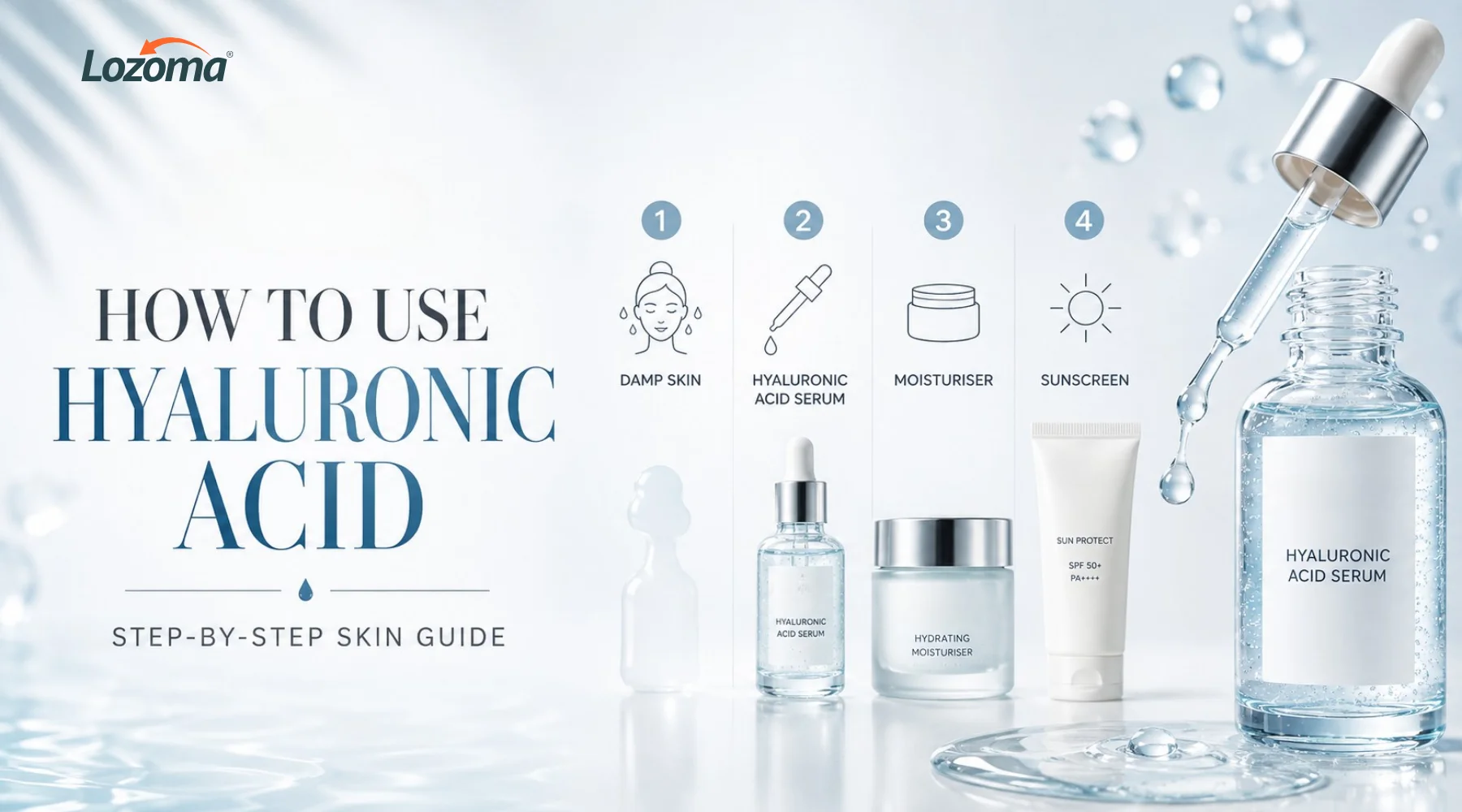
A straightforward routine looks like this:
- Cleanse the skin gently.
- Leave the face slightly damp or mist it lightly.
- Apply two or three drops of hyaluronic acid serum.
- Spread a thin layer over the face and neck.
- Follow with moisturiser before the serum dries completely.
- Apply broad-spectrum sunscreen in the morning.
After cleansing and using watery toners, apply serum before creams, oils, and sunscreen. Dermatologists usually recommend applying treatment products first, then moisturiser, and finally sunscreen. If you’re using prescription medicines, follow the specific instructions provided.
Hyaluronic acid moisturisers are a bit different. Since the humectant is already in the cream or lotion, use it during the moisturising step. Always consider the product’s texture and instructions, not just the main ingredient listed on the bottle.
| Product type | Typical place in the routine |
| Hyaluronic acid toner or essence | After cleansing |
| Thin hyaluronic acid serum | Before moisturiser |
| Gel-cream containing hyaluronic acid | Moisturising stage |
| Rich hyaluronic acid cream | Near the end of the routine |
| Hyaluronic acid sunscreen | Final skincare step in the morning |
| Hyaluronic acid mask | Used according to the mask instructions |
What Hyaluronic Acid Actually Does Once It Reaches the Skin
Hyaluronic acid, also known as hyaluronan, is a natural substance found in the body, especially in the skin. In cosmetic products, it works as a humectant, helping to attract and hold water in the skin. This action can make the skin feel softer and look better. When the outer layer of the skin has enough water, it appears smoother, reduces roughness, softens lines, and reflects light evenly.
Research on creams with hyaluronic acid shows improvements in hydration, elasticity, and fine lines. However, results vary depending on the entire formula, the types of molecules used, and how studies are designed. So, think of hyaluronic acid as a helpful way to hydrate, not as a permanent solution for wrinkles or a replacement for medical treatments.
It’s important to understand the difference between hydration and moisture retention. Hydration means the skin’s water content, while moisture retention is about keeping that water from evaporating too quickly. Hyaluronic acid mainly aids in hydration, while other ingredients in moisturisers, like petrolatum and ceramides, help soften the skin and reduce water loss.
This is why using a hyaluronic acid serum under a moisturiser usually works better than using it alone at the end of a skincare routine.
Step 1: Cleanse Without Stripping the Skin
Start with a gentle cleanser that wipes away makeup, sunscreen, extra oil, and dirt without drying your skin.
A harsh cleanser can make a hydrating serum less effective. If it strips away too much oil, your skin might lose moisture and feel uncomfortable, even with multiple skincare layers.
Use lukewarm water instead of hot water. Massage the cleanser with your fingertips and rinse well. Avoid scrubbing with a facial brush or rough cloth, especially if your skin is dry, sensitive, inflamed, or you’re using retinoids and exfoliating acids.
Your cleanser should reflect your skin type:
- Dry or sensitive skin often suits a fragrance-free cream, lotion, or low-foaming cleanser.
- Oily skin may prefer a light gel or gentle foaming cleanser.
- Combination skin can use a balanced gel cleanser without trying to make the entire face feel squeaky clean.
- Acne-prone skin may need a medicated cleanser, but using it at every wash is not automatically necessary.
Hyaluronic acid can’t fix skin irritation caused by harsh cleansing. If water, basic moisturisers, or sunscreen sting your skin, focus on a simple routine to repair the skin barrier before adding more products.
Step 2: Apply It to Slightly Damp Skin
After rinsing, gently dry your face but don’t wait for it to feel completely dry. It’s okay for your skin to stay slightly damp, not dripping.
Applying the serum now helps the humectant work better because there’s water on your skin. Most hyaluronic acid serums are water-based, so damp skin isn’t required but can help the product spread easily.
If your skin dries before you apply the serum, lightly wet your hands and press them on your face. A water mist can also work, but you don’t need a special one.
The key point about using serum on wet or dry skin is finding balance. Skin that is too wet can make the product run unevenly, while very dry skin can also work well if the serum has enough water and you use a good moisturiser afterwards.
Sensitive skin might react better to some active ingredients on completely dry skin because dampness can increase irritation, especially with retinoids and exfoliating acids. This is less of a concern with basic hyaluronic acid serums, but if your serum has other strong ingredients, treat it according to the entire formula, not just as a hyaluronic acid product.
Step 3: Use a Small, Even Amount
Use two or three drops of serum for your face. Add another drop if you apply it to your neck. More product won’t hydrate your skin better. Too much can cause pilling and make it hard for sunscreen and makeup to stay put.
Apply the serum to clean fingertips instead of using the dropper on your face. If the dropper touches your skin, it can transfer oil, bacteria, or leftover product back into the bottle.
Spread the serum on your forehead, cheeks, nose, chin, and neck. Use light strokes or gently press it in. Rubbing hard isn’t needed and can irritate sensitive skin.
Focus on dry areas, but don’t layer thick amounts over them. Flaking may indicate irritation, eczema, sensitivity to retinoids, or damage to your skin barrier, not just a lack of hyaluronic acid.
Step 4: Follow With Moisturiser Before the Skin Feels Tight
Don’t wait for the serum to dry completely. Once it’s spread out evenly, apply your moisturiser.
This step is key to knowing what to put on after hyaluronic acid serum. A moisturiser adds moisture and helps keep your skin from losing water.
Pick a moisturiser that suits your skin type instead of searching for one that works for everyone.
For Oily or Acne-Prone Skin
Use a lightweight, non-comedogenic lotion or gel-cream. Look for ingredients like glycerin, panthenol, niacinamide, ceramides, or squalane. Oily skin still needs hydration and support. The American Academy of Dermatology recommends moisturising even if your skin is oily and suggests gentle cleansing instead of harsh washing.
For Dry Skin
Choose a cream with stronger ingredients like humectants, emollients, and occlusives. Ingredients like ceramides, petrolatum, dimethicone, shea butter, fatty alcohols, and squalane can help. A serum followed by a light gel may not be enough during winter, after travel, in air-conditioned rooms, or if your skin barrier is weak.
For Sensitive Skin
A short, fragrance-free ingredient list is usually easier on sensitive skin. Don’t assume that “natural,” “botanical,” or “unscented” means irritation-free. The AAD reminds us that unscented products may still have ingredients that mask smells, while fragrance-free products are often better for sensitive skin.
For Combination Skin
Use a lighter moisturiser on your entire face and apply a richer cream only to dry areas. You don’t need the same type or amount of moisturiser everywhere on your face.
Step 5: Finish the Morning Routine With Sunscreen
In the morning, apply sunscreen over your serum and moisturiser.
Choose a broad-spectrum sunscreen with SPF 30 or higher. Use enough to cover your face, ears, neck, and any other exposed skin. Reapply it if you spend a long time outside, sweat, or swim.
Hyaluronic acid doesn’t make your skin too sensitive to the sun, but it doesn’t protect against UV rays either. The hydration may make your skin look plumper, but it won’t prevent sun damage.
Let your moisturiser absorb before applying sunscreen, especially if it tends to roll off. It’s often better to press or smooth sunscreen on in sections rather than rubbing it heavily over damp layers.
Should Hyaluronic Acid Go on Wet or Dry Skin?
Usually, slightly damp skin is the best choice, but using it on dry skin isn’t always bad.

A good serum has water, solvents, and hydrating ingredients, helping hyaluronic acid work well without needing extra water. Applying it to damp skin provides more water for the product to use and often helps it spread better.
The main question is whether your entire routine keeps your skin feeling good several hours later.
| Application method | Likely result |
| Damp skin, followed by moisturiser | Usually comfortable and easy to spread |
| Dry skin, followed by moisturiser | Often works perfectly well |
| Very wet skin | May dilute or move the serum unevenly |
| Thick serum layer without moisturiser | Greater risk of tackiness or tightness |
| Serum over irritated, over-exfoliated skin | May sting despite hyaluronic acid itself being gentle |
| Serum sealed with a suitable cream | Better moisture retention for dry skin |
Many people believe that hyaluronic acid pulls moisture from the skin, making it drier in low-humidity conditions. However, it’s more complex than that. Humectants work with water in the formula, the outer skin layer, and the air, while other ingredients also affect how much moisture evaporates.
Instead of checking humidity each time you apply a product, use a simple approach: apply a thin layer of water-based serum and then add a moisturiser. If your skin still feels tight, change the serum or moisturiser rather than just adding more product.
When Should You Use Hyaluronic Acid Serum?
You can use hyaluronic acid serum in the morning, at night, or both. The best time to use it depends on your skincare routine and your skin’s needs.

Morning use
Morning application works well when you want:
- A smoother base beneath sunscreen or makeup
- Lightweight hydration without a rich daytime cream
- More comfort in air-conditioned or heated environments
- Support alongside a vitamin C serum
- Hydration after a morning cleanse
A simple morning routine may be:
Gentle cleanse → vitamin C or another treatment → hyaluronic acid serum → moisturiser → sunscreen
When two serums feel alike, you can apply them in any order. Start with the serum that works best on clean skin, or put on the lighter product before the heavier one. Don’t stick to strict rules just based on the ingredient names.
Night-time use
Night application is useful when you want:
- Extra hydration after cleansing
- Support alongside a retinoid
- Comfort after acne treatment
- A simple recovery routine on nights without strong actives
- A richer moisturiser over the serum
A basic evening routine may be:
Cleanser → hyaluronic acid serum → moisturiser
A retinoid routine may be:
Cleanser → allow skin to dry → retinoid → hyaluronic acid serum or moisturiser
or:
Cleanser → hyaluronic acid serum → moisturiser → retinoid
The second approach suggests applying moisturiser before the retinoid to help reduce irritation for beginners. The technique varies based on the type of retinoid, the product instructions, and your skin’s tolerance.
Using it twice daily
Applying hyaluronic acid twice a day is okay for many people because it doesn’t peel skin like stronger treatments. However, using it twice isn’t necessarily better than using it once. If your moisturiser, toner, or sunscreen already has hyaluronic acid or glycerin, adding another serum might not help much. Use the product as often as it feels good, but avoid any issues like pilling or making your routine too complicated.
How Often Should You Use Hyaluronic Acid Serum?
Most simple hyaluronic acid serums can be used once or twice a day. Beginners should start with once a day for a week. This helps you spot any reactions to the product easily.
A reasonable schedule is:
| Skin situation | Starting frequency |
| Normal, balanced skin | Once daily |
| Dry or dehydrated skin | Once or twice daily |
| Oily skin | Once daily or as needed |
| Sensitive skin | Every other day for the first week |
| Retinoid-related dryness | On retinoid and recovery nights |
| Damaged or burning skin | Simplify first and assess the cause |
Look at the complete formula. A serum named “hyaluronic acid” might include exfoliating acids, vitamin C, retinoids, fragrance, essential oils, or plant extracts. These ingredients can affect how often you should use the product.
How to Use Hyaluronic Acid Serum for Beginners
Beginners often make skincare harder than it needs to be. A three-product foundation is enough to judge whether the serum suits you:
- Morning: gentle cleanser or water rinse → hyaluronic acid serum → moisturising sunscreen
- Evening: gentle cleanser → hyaluronic acid serum → moisturiser
Use this routine for one to two weeks before trying something new. Pay attention to comfort, breakouts, redness, and how the serum works with sunscreen.
If you have sensitive skin, a patch test is smart. The AAD suggests applying a new product to a small area twice a day for seven to ten days. Look for redness, itching, or swelling before using it more widely. While it can’t predict all breakouts, it can help find immediate reactions.
Don’t do a patch test with just one drop for ten minutes and think it’s fine. Test leave-on products as they will be used.
What Is Hyaluronic Acid Good For?
Hyaluronic acid is most useful for dehydration and the textural changes that come with it.
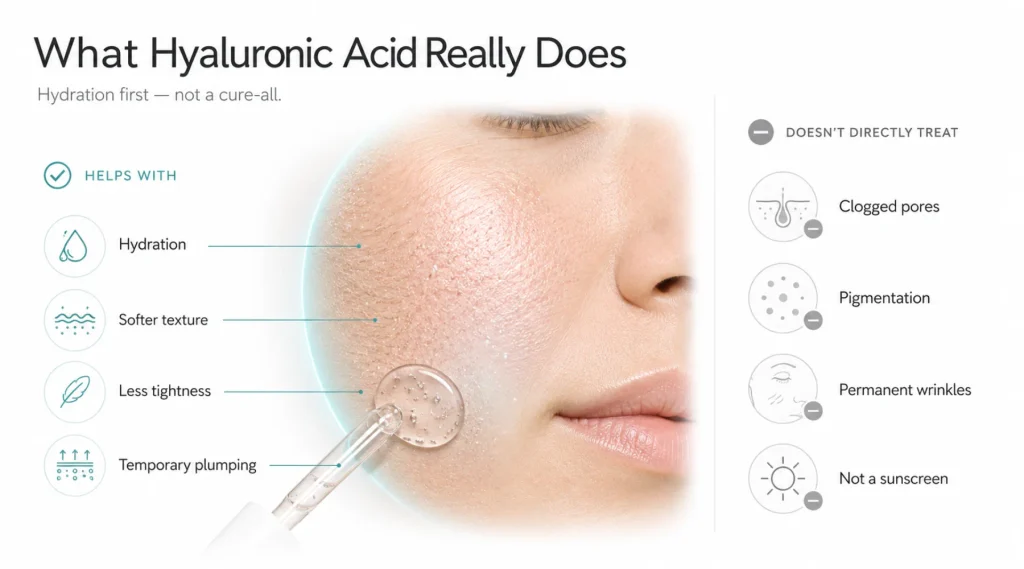
It may help with:
- Tightness after cleansing
- A dull or crepey surface caused by low water content
- Temporary fine dehydration lines
- Roughness
- Dryness associated with cold weather or indoor heating
- Supporting comfort alongside potentially drying treatments
- Adding hydration without a heavy oily feel
- Improving how moisturiser sits on the skin
A clear explanation of what hyaluronic acid does for skin helps distinguish its real benefits from the exaggerated claims often made about it.
Hyaluronic acid does not directly:
- Exfoliate dead skin
- Unclog pores
- Treat bacterial acne
- Permanently fill wrinkles
- Remove pigmentation
- Replace sunscreen
- Rebuild lost facial volume
- Cure eczema or rosacea
- Repair every form of barrier damage by itself
Drinking enough water can help improve some skin issues for a short time. For example, well-hydrated skin can make fine lines and rough spots less noticeable. However, this does not mean the serum has fixed deep wrinkles or rebuilt collagen.
Hyaluronic Acid Is Not the Same as a Dermal Filler
Topical hyaluronic acid serum and injectable hyaluronic acid filler come from the same ingredient family but work very differently.
A serum is put on the skin’s surface to provide hydration and improve its feel. Different molecular weights in the serum may stay on the surface or interact with the epidermis, but it cannot give volume or long-lasting effects like an injection can.
A dermal filler is injected under the skin by a trained medical professional. It adds volume to the tissue and carries risks that a topical serum does not have.
Research shows that the size of the molecules affects how topical hyaluronic acid works. Larger molecules mainly hydrate the surface, while smaller ones can go deeper into the skin. However, terms like “deep filler effect” do not mean that a topical product works like an injectable treatment.
Can You Use Hyaluronic Acid With Vitamin C?
Yes. Hyaluronic acid and vitamin C can be used in the same routine.
Vitamin C and hyaluronic acid serve different purposes. Vitamin C mainly helps with antioxidant support and issues like uneven skin tone and ageing from sun exposure. Hyaluronic acid helps keep the skin hydrated. Reviews of topical vitamin C highlight its role in antioxidants and collagen, but its effectiveness varies based on its form, concentration, pH, stability, and packaging.
A common morning order is:
- Cleanse.
- Apply vitamin C.
- Apply hyaluronic acid serum.
- Apply moisturiser.
- Apply sunscreen.
Use vitamin C first if it’s a thin serum with low pH. Apply it directly to clean skin, then add hyaluronic acid after it dries.
If the hyaluronic acid is much thinner and the vitamin C is a lotion or cream, switch the order. The texture and product instructions matter more than strict rules.
The combination should not sting just because both ingredients are used together. If you feel burning, it might be due to the acidic vitamin C, skin damage, fragrance, or something else in the product.
For sensitive skin, try separating the two products:
- Morning: vitamin C → moisturiser → sunscreen
- Night: hyaluronic acid serum → moisturiser
This cuts down on layers and helps you find what may be causing irritation.
For a vitamin C eye treatment, like Dr Rashel Vitamin C Brightening and Anti-Ageing Eye Serum, use it only on the area around your eyes as directed. Apply a small amount, avoiding the lash line, and use your facial hyaluronic acid serum on the rest of your skin. You don’t need multiple layers of serum around your eyes.
Can You Use Hyaluronic Acid With Retinol?
Yes. Hyaluronic acid is generally compatible with retinol and other topical retinoids.
Many people like this combination because retinoids can cause dryness and irritation, especially at first. Hyaluronic acid doesn’t cancel out retinol; it just adds moisture to a routine that might feel dry. Doctors know that retinoids can irritate the skin and often suggest starting with a milder version or using it less often until your skin adjusts.
There are several ways to combine them.
Method 1: Retinol first
Cleanse → allow skin to dry → retinol → hyaluronic acid serum → moisturiser.
This gives the retinol relatively direct contact with the skin. It suits experienced users who already tolerate their product.
Method 2: Hydration first
Cleanse → hyaluronic acid serum → moisturiser → retinol
This buffered method may reduce penetration and irritation. It often suits beginners, dry skin and people returning to retinol after a break.
Method 3: Moisturiser sandwich
Cleanse → moisturiser → retinol → another thin layer of moisturiser
A hyaluronic acid serum can be used before your first moisturiser, as long as it doesn’t leave your skin too wet.
If you are using prescription tretinoin, adapalene, or any medical retinoid, follow your doctor’s instructions. Some instructions say to apply them to clean, dry skin.
The question “Can I use hyaluronic acid with retinol?” is mostly about how to apply them, not whether they can be used together. They can be used together; how your skin reacts will guide the order and timing.
Don’t expect hyaluronic acid to stop all irritation from retinoids. Use retinoids less often, apply the right amount, and stop using other irritating products when needed. Hyaluronic acid can’t fix a routine that uses too much retinoid each night.
Retinoids should generally be avoided during pregnancy unless a healthcare professional says otherwise. The American Academy of Dermatology recommends staying away from both prescription and over-the-counter retinoids during pregnancy.
Can You Use Hyaluronic Acid With Niacinamide?
Hyaluronic acid and niacinamide work well together and are often found in the same products.
Hyaluronic acid hydrates the skin, while niacinamide helps support the skin barrier, control oil, and improve uneven skin tone. Together, they are great for dry, oily, combination, and acne-prone skin.
When using separate serums, apply the thinner one first. If they feel the same, you can use them in either order.
A simple routine might look like this: Cleanser → niacinamide serum → hyaluronic acid serum → moisturiser.
You don’t need two separate serums if one product already has both ingredients. Always check the label before buying more.
Some high-percentage niacinamide products can cause stinging or redness. Hyaluronic acid won’t always prevent this. Choose your niacinamide strength based on how your skin reacts, not just on the percentage.
Can You Use Hyaluronic Acid With Exfoliating Acids?
Yes, the exfoliating acid guides the routine.
Glycolic, lactic, mandelic, and salicylic acids help dead skin cells come off the skin or pores. Hyaluronic acid doesn’t exfoliate, even though it has “acid” in its name.
A simple routine could be: Cleanse → exfoliating acid → hyaluronic acid serum → moisturiser.
Follow the instructions for the exfoliant. Some are rinse-off masks, some are cleansers, and others are liquids you leave on.
Hyaluronic acid may help with comfort, but it won’t fix over-exfoliation. If your skin feels shiny, tight, painful, red, or sensitive to water, stop using exfoliating products and simplify your routine.
On nights when you don’t exfoliate, hyaluronic acid and moisturiser can help your skin recover.
Can You Use Hyaluronic Acid With Benzoyl Peroxide?
Hyaluronic acid can be used alongside benzoyl peroxide.
Benzoyl peroxide helps treat acne by killing bacteria and reducing skin buildup. However, it can cause dryness and irritation. Use it as directed, and then follow up with hydrating and moisturising products.
Depending on the benzoyl peroxide format:
- A benzoyl peroxide cleanser is rinsed away before the serum.
- A leave-on gel usually goes onto clean skin before moisturiser.
- Sensitive skin may tolerate moisturiser before and after the treatment.
- White towels and pillowcases are sensible because benzoyl peroxide can bleach fabrics.
Hyaluronic acid doesn’t treat acne directly. It helps keep the skin hydrated while acne treatments work on the blemishes.
Can Hyaluronic Acid Be Used With Azelaic Acid?
Yes, this combination works well for skin with redness, blemishes, post-acne marks, and dryness.
Use azelaic acid first as a treatment, then apply hyaluronic acid for hydration. A common routine is:
Cleanser → azelaic acid → hyaluronic acid serum → moisturiser.
If azelaic acid pills when layered, either simplify the routine or use hyaluronic acid at a different time. Pilling usually doesn’t mean the ingredients don’t work together; it often comes from the textures in the products.
What to Apply After Using Hyaluronic Acid Serum
Moisturiser is the key product to use afterwards.
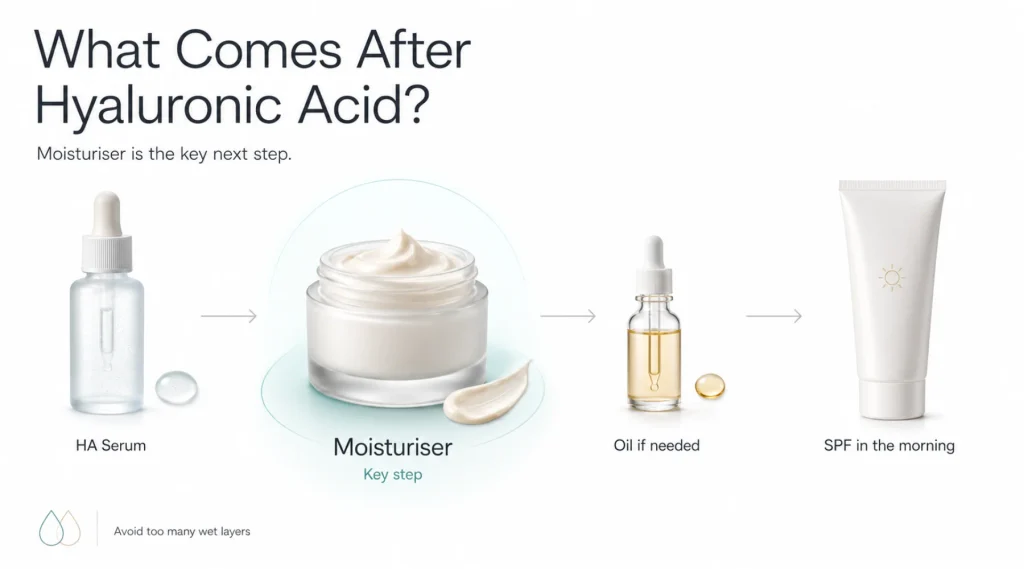
In the morning, apply sunscreen after moisturiser. In the evening, you can add facial oil after moisturiser if your skin is dry and needs extra moisture.
The typical order is:
Hyaluronic acid serum → moisturiser → facial oil (if needed)
You can put oil over a water-based serum, but oil alone might not protect your skin as well as a good moisturiser.
Other products that can follow hyaluronic acid include:
- Ceramide cream
- Gel moisturiser
- Barrier balm on dry patches
- Eye cream
- Sleeping mask
- Facial oil
- Sunscreen
- Makeup
Avoid applying so many layers that the products remain wet, roll off, or prevent sunscreen from forming an even film.
How to Use Hyaluronic Acid Serum for Different Skin Types
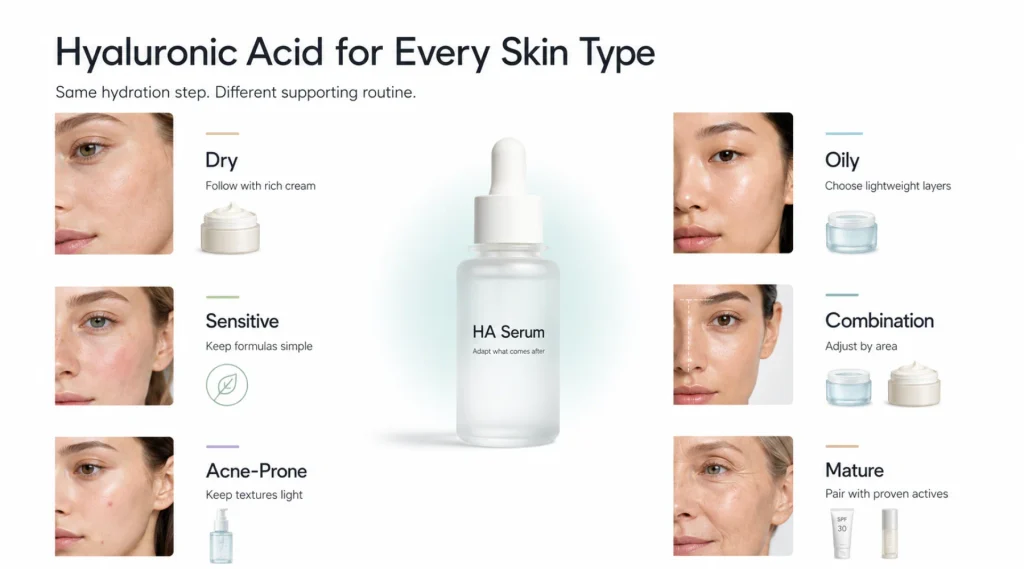
Dry skin
Dry skin has too little oil, while dehydrated skin doesn’t have enough water. You can have both issues at once.
For dry skin, use hyaluronic acid under a cream with moisturising and sealing ingredients. Applying several watery serums without a thick layer on top might make your skin feel plump temporarily, but it will feel dry again quickly.
- Morning: Cream cleanser → hyaluronic acid serum → rich moisturiser → sunscreen
- Evening: Gentle cleanser → hyaluronic acid serum → ceramide cream → balm on very dry areas
Oily skin
Oily skin can get dry, especially after using strong cleansers, acne treatments, or exfoliating often.
Pick a light serum without a strong scent and use a fluid lotion or gel-cream afterwards. Don’t think the serum alone is enough to moisturise just because your skin makes oil.
- Morning: Gentle gel cleanser → hyaluronic acid serum → lightweight moisturiser → sunscreen
- Evening: Cleanser → acne treatment if used → hyaluronic acid serum → gel-cream
Combination Skin
Apply a thin layer of product to your entire face. Use a richer moisturiser on your cheeks and a lighter one on your oily T-zone. Don’t try to dry out the oily areas; this can make your routine uncomfortable without changing how your skin works.
Sensitive Skin
Look past just the main ingredient. Fragrances, alcohol, essential oils, and certain plant extracts can cause reactions even if hyaluronic acid is fine for your skin. Start using it every other night and patch test first. Apply it under a simple moisturiser. Stop using it if you get itching, swelling, hives, or a spreading rash.
Acne-Prone Skin
Hyaluronic acid isn’t always pore-clogging, but no product is guaranteed to suit everyone. Choose lightweight, non-comedogenic products and consider the full formula. Some rich oils may be too heavy if you’re prone to breakouts. Introduce new serums slowly, one at a time. If breakouts happen, look for patterns rather than assuming it’s just your skin clearing out. Hyaluronic acid usually doesn’t cause significant breakouts.
Mature Skin
Hyaluronic acid can help with dryness and improve surface texture, but use it with sunscreen and proven treatments like retinoids. A moisturising serum doesn’t replace treatments for collagen, pigmentation, or deeper wrinkles. Hydrated skin looks smoother and handles treatment routines better.
Common Mistakes When Using Hyaluronic Acid Serum
Applying Too Much
Using too much serum can make it sticky and clump under moisturiser or sunscreen. Just two or three drops are usually enough.
Skipping Moisturiser
A serum isn’t always a complete moisturiser. Always follow it with a lotion or cream unless the serum is designed to be an all-in-one product.
Layering on Wet Skin
A little dampness helps, but too much water can cause the product to run or not absorb evenly. It can also collect around your eyes.
Waiting for Tightness
Apply moisturiser after the serum has spread and settled. Letting it dry tightly does not add any benefits.
Using Multiple Hyaluronic Acid Products
Things like cleansers, toners, essences, serums, moisturisers, and sunscreens can all have hyaluronic acid. More layers don’t mean more hydration. Check the ingredients in your routine before adding more products.
Ignoring Other Ingredients
Even products with hyaluronic acid can irritate your skin. Fragrance, strong acids, retinoids, or certain plant extracts may cause irritation, not the hyaluronic acid.
Expecting It to Solve All Problems
Hyaluronic acid won’t clear blackheads, fade dark spots, or treat cystic acne. Use it for hydration and look for specific treatments for other skin issues.
Applying Too Close to the Eyes
Keep serums away from your lash line unless the label says they are safe for the eye area. They can cause watering or puffiness if they get too close.
Using on an Unknown Rash
Redness or burning could signal eczema, contact dermatitis, or rosacea. Applying more serum won’t diagnose or fix the issue.
Confusing Tightness with Effectiveness
True hydration should make your skin feel comfortable. A tight and shiny finish doesn’t mean the serum is working to lift or firm your skin.
Rubbing until the product balls up
Pilling is usually a formulation and layering issue. Use less product, allow brief settling time, and reduce the number of polymer-rich serums.
Changing the routine too quickly
A new cleanser, serum, cream, and active introduced together make it almost impossible to identify the cause of a reaction.
Can Hyaluronic Acid Dry Out Skin?
Hyaluronic acid is used to improve hydration, but a product containing it can leave some people feeling drier.
This may happen when:
- The serum is used without moisturiser.
- The formula leaves a tight film.
- Too much product is applied.
- The cleanser is stripping.
- Retinoids or exfoliants are already irritating the skin.
- The moisturiser is too light for the environment.
- The skin barrier is damaged.
- Another ingredient in the serum causes inflammation.
- The user mistakes underlying dry skin for temporary dehydration.
- Several humectant-heavy layers are used without enough emollient support.
The claim that hyaluronic acid “steals” water from the skin in dry weather is too simple. Instead of fearing this ingredient, use it as part of a balanced skincare routine.
To see if hyaluronic acid is drying out your skin, use less of it on slightly damp skin. Then, apply a thicker moisturiser and cut back on irritating ingredients.
If your skin still feels tight, stop using the serum for one to two weeks. You can skip the product, but comfort is essential.
How to Choose a Hyaluronic Acid Serum
The ingredient list tells you more than the percentage printed on the front.

Look for a formula that suits your skin type and routine.
Useful ingredient names
Hyaluronic acid may appear as:
- Hyaluronic acid
- Sodium hyaluronate
- Hydrolysed hyaluronic acid
- Sodium acetylated hyaluronate
- Hydrolysed sodium hyaluronate
- Crosslinked hyaluronic acid
- Potassium hyaluronate
These forms differ in size, stability, texture, and how they act in the formula. A multi-weight product may use larger forms for surface hydration and smaller ones for deeper skin interaction. Research shows that molecular size can affect how well ingredients penetrate and perform, but there’s no agreement that one size is always better. For instance, a 2024 study with older adults pointed out that there isn’t strong evidence supporting the idea that low-molecular-weight hyaluronic acid always hydrates better than high-molecular-weight versions.
Supportive ingredients
A balanced hydrating serum may also contain:
- Glycerin
- Panthenol
- Betaine
- Urea at an appropriate cosmetic concentration
- Amino acids
- Ectoin
- Niacinamide
- Ceramides
- Squalane
- Aloe vera
- Oat-derived soothing ingredients
Hyaluronic acid doesn’t have to work by itself. Products that combine it with other hydrating ingredients can feel better than those that focus only on one popular ingredient.
Fragrance and Essential Oils
Fragrance isn’t harmful to everyone, but it adds little to hydration serums and can irritate sensitive or eczema-prone skin.
Alcohol
Fatty alcohols, like cetyl and cetearyl alcohol, are different from denatured alcohol. Fatty alcohols help soften and stabilise moisturisers. High amounts of denatured alcohol or ethanol can dry out the skin and may not be ideal for dry or sensitive skin. The overall formula affects the result.
Packaging
Using an opaque pump or a good dropper bottle can reduce contamination. Hyaluronic acid is less likely to oxidise than pure vitamin C, but protective packaging still helps the supporting ingredients.
Percentage Claims
A higher percentage isn’t always better. Pure hyaluronic acid absorbs a lot of water, so most cosmetic products use small amounts. Marketing often highlights the blend concentration, not just the amount of pure hyaluronic acid. Instead of focusing on percentages, judge the product by how it feels, how well it hydrates, and how it layers with other products.
Product Collection
A well-chosen collection of facial serums is most effective when each has a specific function. Having multiple overlapping hydration serums often doesn’t improve a routine as much as selecting one good formula and a quality moisturiser.
Why Hyaluronic Acid Sometimes Pills Under Makeup
Pilling happens when your skincare forms small flakes or balls on your skin.
Hyaluronic acid serums usually have special ingredients that create a layer on the skin. If you use multiple products with similar ingredients, rubbing can cause these layers to lift off your skin.
To reduce pilling:
- Use fewer drops.
- Apply one thin layer.
- Avoid rubbing after each product begins to set.
- Allow a brief pause between layers.
- Use fewer total products.
- Check whether sunscreen and primer are compatible.
- Press makeup on rather than repeatedly buffing it.
- Skip a separate serum if the moisturiser already provides enough hydration.
Waiting longer isn’t always the solution. A thick serum can still pill after ten minutes. What really matters is how well the products work together and the amount you use.
How to Apply Hyaluronic Acid Around the Eyes
The skin around the eyes is thin and can show dryness quickly. A small amount of hydrating serum can temporarily reduce a crepey look.

Use just one drop for both eyes. Tap it around the bone area with your fingertip, staying away from the eyes and lashes.
Avoid applying a thick layer of serum. Products that hold moisture can spread, and using too much can cause puffiness.
If your skin feels dry, follow up with a light eye cream or moisturiser. If you have ongoing swelling, itching, or flaky eyelids, don’t cover them with more products, as these may indicate irritation or eyelid dermatitis.
Seasonal Changes Can Alter How the Serum Feels
A routine that works in a humid summer may feel inadequate in winter.
Cold air, heat, air conditioning, wind, hot showers, and frequent washing can all affect skin comfort. You might not need to replace the hyaluronic acid serum; instead, adjust the moisturising layer on top of it.
During warmer, more humid months:
- Use a thin serum.
- Follow with a light lotion.
- Choose a comfortable sunscreen.
- Reduce heavy oils if they feel congesting.
During cold or dry periods:
- Cleanse less aggressively.
- Apply serum to lightly damp skin.
- Use a richer ceramide or lipid-containing cream.
- Add balm only to dry areas.
- Avoid excessively hot water.
Skin changes due to medication, hormones, illness, travel, and age. It’s better to adjust your routine instead of sticking to one product all year.
How Long Does Hyaluronic Acid Take to Work?
You may notice immediate benefits from surface hydration after applying the serum and moisturiser. Your skin may look smoother and more glowing.
For lasting improvements, you need to use the products regularly and follow a good skincare routine. Clinical studies on topical hyaluronic acid show results over several weeks to months, but they often test full formulae instead of just hyaluronic acid alone.
A realistic timeline is:
- Within minutes: softer, more slippery or plumped surface
- Within several days: improved comfort if dehydration was mild
- Within two to four weeks: more consistent softness with regular barrier-supportive care
- Over several months: possible improvement in fine surface lines and texture, depending on the formula
Hydration results are not permanent. When you stop using the product, your skin is still exposed to the environment, gets cleaned, and loses water naturally.
How to Tell Whether the Hyaluronic Acid Serum Is Working
A good hyaluronic acid serum should make the routine easier, not more dramatic.
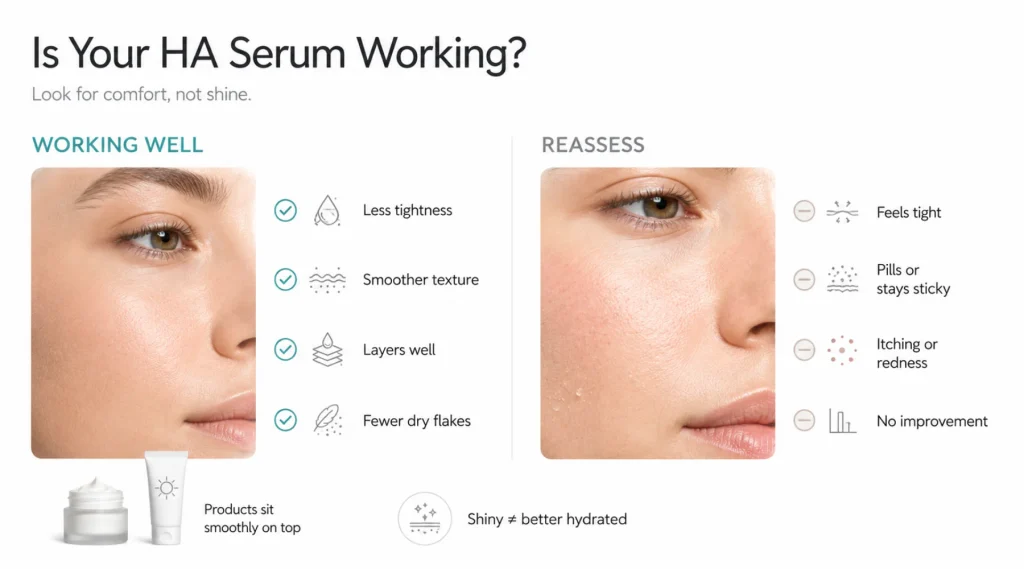
Signs it is helping include:
- Less tightness after cleansing
- Smoother application of moisturiser
- Reduced flaky appearance
- Better comfort beneath sunscreen
- A softer, more flexible skin surface
- Temporary softening of fine dehydration lines
- No persistent stinging, rash or congestion
Signs the product or method may need changing include:
- Tightness after it dries
- Persistent stickiness
- Pilling beneath sunscreen
- New itching or redness
- Eyelid puffiness
- Clusters of closed comedones
- Burning that lasts beyond application
- No improvement despite a suitable moisturiser
A serum doesn’t need to make your skin shiny to work well. That shine usually comes from ingredients that create a film and reflect light, not from how healthy your skin really is.
Myths That Make Hyaluronic Acid More Confusing
“Hyaluronic acid exfoliates the skin”
It does not behave like glycolic, lactic, or salicylic acid. Its main cosmetic function is hydration.
“It must be applied to a soaking-wet face”
Lightly damp skin is enough. A water-based serum can also work on dry skin when followed by moisturiser.
“It can replace moisturiser”
Occasionally, a serum is formulated richly enough to act as a moisturiser, but most thin hyaluronic acid serums benefit from a cream or lotion above them.
“More drops create deeper hydration”
Excess product usually creates stickiness rather than stronger effects.
“Low-molecular-weight hyaluronic acid is always better.”
Smaller molecules may go deeper into the skin, but how well they work, their irritation potential, and hydration depend on the full formula. Different molecular weights have different uses.
“It permanently fills wrinkles.”
Topical hydration can soften fine lines, but it doesn’t act like injectable fillers or restore volume permanently.
“Everyone needs a separate hyaluronic acid serum.”
Many cleansers, essences, moisturisers, and sunscreens already contain hyaluronic acid. A separate serum is only helpful if it enhances your skincare routine.
“A reaction means the skin is purging.”
Hyaluronic acid usually doesn’t cause purging. Itching, burning, swelling, or breakouts may indicate irritation, an allergy, congestion, or a reaction to another ingredient.
When to Stop Using the Product
Discontinue the serum if it causes:
- Persistent burning
- Swelling
- Hives
- Itchy red patches
- Crusting or weeping
- Worsening eyelid irritation
- A rash that spreads beyond the application area
- Significant acne that begins after introduction and improves when the product is stopped
Rinse the product off gently and make your routine simpler. If you have severe swelling, trouble breathing, or quickly spreading hives, get medical help right away.
If a reaction is severe, keeps happening, or is hard to identify, talk to a dermatologist or healthcare professional. Allergic contact dermatitis can be caused by preservatives, fragrances, or other ingredients, not just what’s on the label.
If your skin stays very dry despite gentle care, especially with painful cracks, intense itching, widespread scaling, or frequent inflammation, seek professional advice.
Practical Hyaluronic Acid Routines
Minimal routine for beginners
Morning
- Water rinse or gentle cleanser
- Hyaluronic acid serum
- Moisturiser
- Sunscreen
Evening
- Gentle cleanser
- Hyaluronic acid serum
- Moisturiser
Routine for dry, flaky skin
Morning
- Cream cleanser
- Hyaluronic acid serum on damp skin
- Ceramide-rich cream
- Moisturising sunscreen
Evening
- Gentle cream cleanser
- Hyaluronic acid serum
- Rich moisturiser
- Thin layer of balm on flaky areas
Routine for oily, dehydrated skin
Morning
- Gentle gel cleanser
- Hyaluronic acid serum
- Lightweight lotion
- Non-comedogenic sunscreen
Evening
- Cleanser
- Acne treatment when required
- Hyaluronic acid serum
- Gel-cream
Routine with vitamin C
Morning
- Cleanser
- Vitamin C serum
- Hyaluronic acid serum
- Moisturiser
- Sunscreen
Evening
- Cleanser
- Hyaluronic acid serum
- Moisturiser
Routine with retinol
Morning
- Gentle cleanser
- Hyaluronic acid serum
- Moisturiser
- Sunscreen
Retinol nights
- Cleanser
- Allow the skin to dry
- Retinol
- Hyaluronic acid serum or moisturiser
- Additional moisturiser if needed
Recovery nights
- Cleanser
- Hyaluronic acid serum
- Barrier-supporting moisturiser
Routine for sensitive skin
Morning
- Water rinse or fragrance-free cleanser
- Hyaluronic acid serum if tolerated
- Bland moisturiser
- Sensitive-skin sunscreen
Evening
- Fragrance-free cleanser
- Hyaluronic acid serum every other night
- Bland moisturiser
Keep the routine stable before adding exfoliants, retinoids or highly acidic vitamin C.
Questions People Ask About Hyaluronic Acid Serum
Do I apply hyaluronic acid before or after moisturiser?
Use hyaluronic acid serum before moisturiser. The moisturiser locks in hydration and prevents water loss. A thicker hyaluronic acid cream can be used as a moisturiser. If your skin is still dry, consider adding another cream on top.
How many drops of hyaluronic acid serum should I use?
Two or three drops are enough for your face. Use one more drop for your neck. Using too much can make your skin sticky and may cause pilling without improving hydration.
Should I use hyaluronic acid serum every day?
Most basic formulae are safe for daily use. Start with once a day and only switch to twice a day if you see clear benefits. Check the ingredient list for any active ingredients that may need less frequent use.
Can I use hyaluronic acid serum morning and night?
Yes, you can use it in both your morning and night routines. In the morning, it helps hydrate your skin under sunscreen. At night, it works well under moisturiser or with drying treatments.
How long should I wait after applying hyaluronic acid?
You don’t need to wait a specific amount of time. Once the serum is evenly spread and settling on your skin, apply moisturiser. This usually takes under a minute. Don’t wait until your skin feels tight.
Does hyaluronic acid go before vitamin C?
Usually, apply a thin vitamin C serum first, then use hyaluronic acid. If the hyaluronic acid is thinner and the vitamin C is a cream, switch the order. Follow product texture and instructions.
Can I use hyaluronic acid after retinol?
Yes, you can apply it after retinol for hydration, then apply moisturiser. People with sensitive skin might want to use moisturiser before retinol.
Can I use hyaluronic acid on dry skin?
Yes, you can use it on dry skin. Applying it on damp skin helps, but a water-based serum can still work if you follow up with moisturiser.
Why does hyaluronic acid make my face feel tight?
You might be using too much, which can dry into a tight film, or your moisturiser could be too light. Try using less on damp skin and follow with a thicker moisturiser. Stop if you still feel tight.
Does hyaluronic acid help acne?
It doesn’t directly treat acne, but it can help keep your skin hydrated while using acne treatments. Choose a lightweight formula if you’re prone to breakouts.
Can hyaluronic acid cause spots?
Hyaluronic acid itself usually doesn’t cause breakouts, but some serums may contain ingredients unsuitable for your skin. Thick or heavily scented products can be uncomfortable. Stop using it and see if the spots improve.
Is hyaluronic acid safe for sensitive skin?
It’s generally safe but can still irritate sensitive skin. Do a patch test and choose fragrance-free products with simple ingredients.
Can I use hyaluronic acid after exfoliating?
Yes, use it after a leave-on exfoliant and before moisturiser. It can help comfort your skin but won’t prevent damage from overly exfoliating.
Do I need facial oil after hyaluronic acid?
Not really. Most people need moisturiser instead of just oil. If your skin is very dry, you can use a little oil.
What happens if I use hyaluronic acid without moisturiser?
Some people feel comfortable, especially if the serum has a moisturising base or if it’s humid outside. Others may feel tightness or only brief hydration. Using a moisturiser afterwards is a better choice.
Making How You Use Hyaluronic Acid Serum More Important Than the Hype
Using hyaluronic acid serum is simple:
- Cleanse your skin gently.
- Use a small amount of serum.
- Apply it to slightly damp or dry skin.
- Follow with a moisturiser.
- If it’s daytime, add sunscreen.
The serum should make your skin feel comfortable without burning or causing breakouts. You don’t need a complicated routine or the most powerful formula.
For beginners, one good hydrating serum with a moisturiser is better than using several products. For more experienced users, hyaluronic acid helps skin tolerate vitamin C, retinoids, and acne treatments without replacing them.
If your skin still feels tight, check your routine. Your cleanser may be too harsh, your moisturiser too light, or your treatment too intense. Hydration usually involves more than just one ingredient.
When used properly, hyaluronic acid serum is a simple and effective part of your skincare routine.