





Blog
Retinol vs Bakuchiol: Differences and Best Uses for Skin

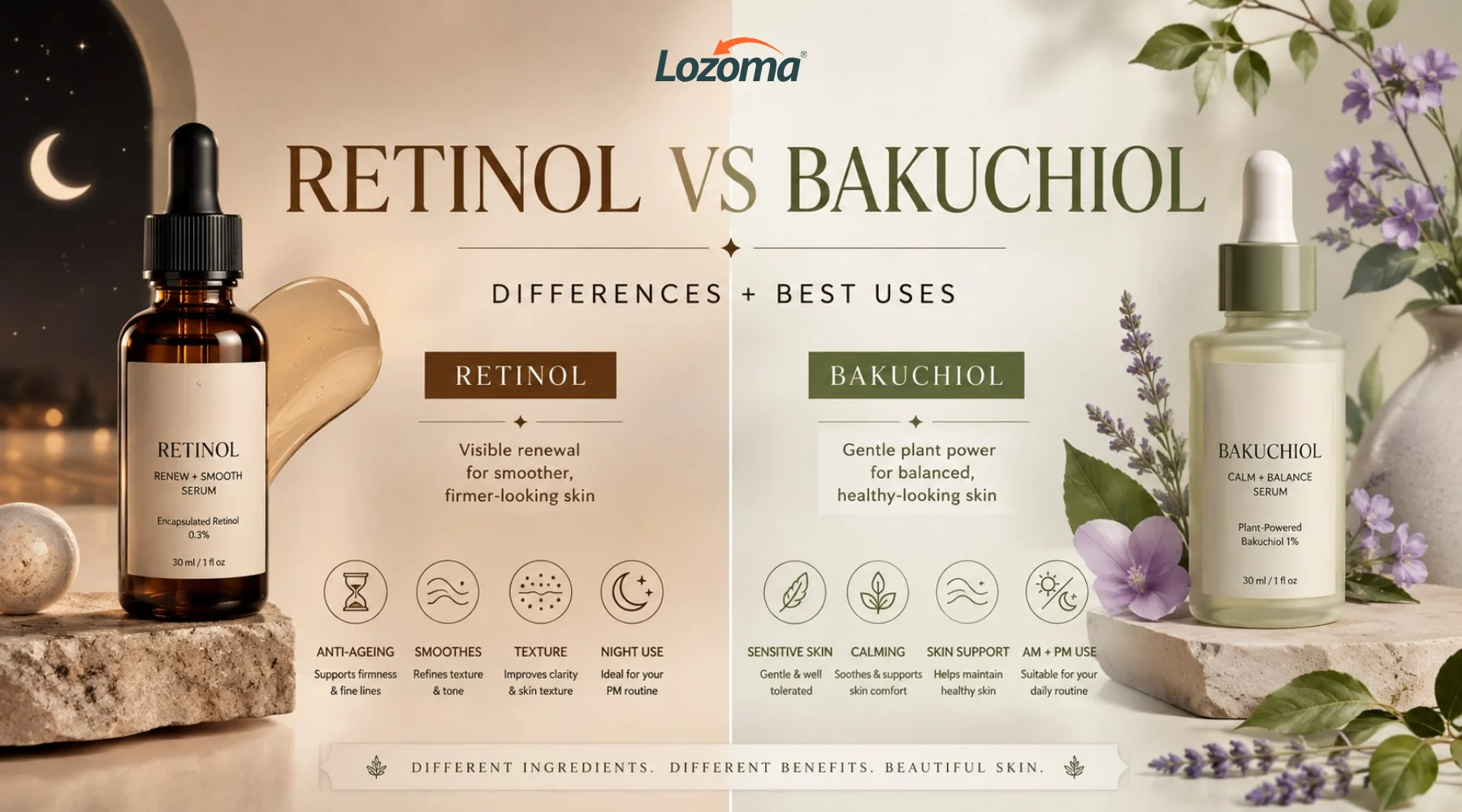
Choosing between retinol and bakuchiol can be tricky. Both are often recommended for fine lines, uneven skin tone, rough texture, and blemishes, but they serve different purposes.
Retinol is a type of vitamin A and has a lot of research showing its benefits for skin renewal and ageing. Bakuchiol comes from plants and addresses similar skin issues but does not work like a retinoid. It’s often called “natural retinol,” but that oversimplifies their differences.
Instead of asking which ingredient is better, consider which one fits your skin type, main concerns, and how much irritation you can handle.
Retinol usually provides stronger results for ageing skin, uneven texture, and clogged pores. Bakuchiol might be a better choice if you have sensitive skin, dryness, or struggle to use retinoids regularly.
Retinol vs Bakuchiol at a Glance
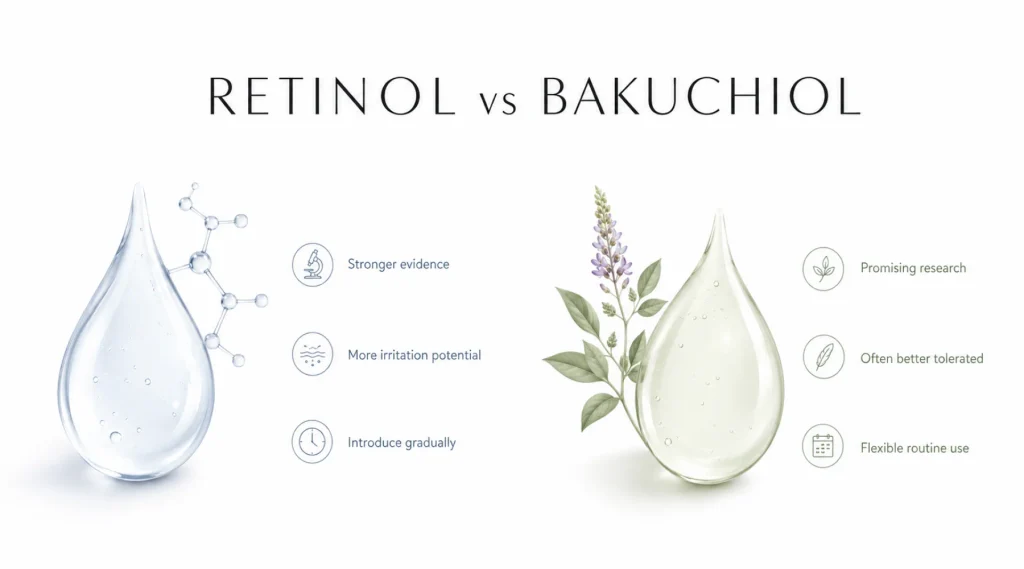
| Feature | Retinol | Bakuchiol |
| Ingredient family | Vitamin A derivative and cosmetic retinoid | Plant-derived meroterpene phenol |
| How it works | Converts within the skin towards biologically active retinoic acid | Influences several ageing-related and inflammatory pathways without converting into retinoic acid |
| Best researched for | Fine lines, photoageing, texture, pigmentation and pore congestion | Fine lines, uneven tone and general skin-ageing support |
| Evidence strength | Extensive retinoid research, with multiple controlled retinol studies | Promising but considerably smaller body of human clinical research |
| Irritation risk | Can cause dryness, peeling, redness and stinging | Usually better tolerated, although irritation and allergy remain possible |
| Typical frequency | Introduced two or three nights weekly, then increased gradually | Often used once or twice daily, depending on the formula |
| Acne suitability | Can help prevent clogged pores, although prescription retinoids have stronger acne evidence | May support blemish-prone skin, but should not replace established acne treatment |
| Sensitive skin | Possible with cautious introduction and a supportive routine | Often the easier starting point |
| Pregnancy | Topical retinoids are generally avoided | Not automatically proven safe; professional advice is still appropriate |
| Time of application | Usually used at night | Can generally be used morning or night |
| Sunscreen needed | Essential | Essential, particularly when treating pigmentation or photoageing |
A small trial compared 0.5% bakuchiol used twice a day with 0.5% retinol used once a day for 12 weeks. Both groups improved in wrinkle size and skin discolouration, but more people reported scaling and stinging with retinol. This trial suggests bakuchiol is a good option, but it doesn’t prove that all bakuchiol products work the same as all retinol products. The study was small, short, and had different usage schedules.
What Retinol Does Once It Reaches the Skin
Retinol is part of a larger family called retinoids, which includes retinyl esters, retinaldehyde (or retinal), and tretinoin.
Retinol isn’t the final active form. The skin changes it into retinaldehyde and then retinoic acid. Retinoic acid impacts how skin cells grow and produce structures. This is why cosmetic retinol is usually less powerful than prescription tretinoin, but it may be easier on the skin.
Understanding what retinol does within the skin also explains why results are gradual. It doesn’t scrub the skin’s surface; instead, it alters cell behaviour over time.
With regular use, a good retinol product may help:
- soften the appearance of fine lines;
- improve rough or uneven texture;
- support a more even-looking complexion;
- reduce the formation of pore-blocking dead-skin plugs;
- improve the appearance of some post-acne marks;
- support collagen-related changes associated with photoageing.
Studies show that stabilised topical retinol can improve visible sun damage over several months, with ongoing benefits from long-term use. Research on 0.1% retinol has shown changes in wrinkles and other signs of ageing caused by sun exposure, but results vary based on product formulation, stability, and study design.
It’s important to distinguish between retinol and retinal. Retinal is one step closer to retinoic acid and may act differently at similar concentrations. This difference matters when comparing products like a retinol cream and the Vita A Retinal Shot Tightening Booster. A 0.1% retinal formula is not the same as a 0.1% retinol formula, even if the names look similar.
What Bakuchiol Is and Why It Is Not a Retinoid
Bakuchiol comes from the seeds and leaves of the Psoralea corylifolia plant, also known as babchi. It is not vitamin A, retinol, or a retinoid.

Bakuchiol does not need to turn into retinaldehyde or retinoic acid. Early lab and clinical studies suggest it may help with collagen, reduce oxidative stress, fight inflammation, affect pigmentation, and slow skin ageing.
One early study found that bakuchiol and retinol affect genes in similar ways. Researchers call bakuchiol a functional analogue, meaning it works like retinol but in different ways.
Referring to bakuchiol as “plant retinol” is more of a marketing term than a scientific truth. A better description is that it is a plant-based active ingredient with some similar effects to retinol.
Bakuchiol may help improve:
- the appearance of fine lines;
- uneven-looking pigmentation;
- dullness;
- loss of firmness;
- mild textural irregularity;
- signs of environmental stress.
Research on bakuchiol is limited compared to the extensive studies on retinoids. A review of human trials showed that bakuchiol was studied for issues like ageing, acne, and dark spots after inflammation. However, the authors noted that the research is small and varied.
This doesn’t mean bakuchiol doesn’t work. It means we should be careful about making claims. A good bakuchiol serum might be a great option for some people, but it shouldn’t be advertised as a universal substitute for all retinoids, whether cosmetic or prescription.
The Difference Between Retinol and Bakuchiol Goes Beyond Irritation
Retinol is a retinoid, while bakuchiol is not. This key difference affects how well they work, their reliability, how easy they are to use, and their place in a skincare routine.

Retinol’s Strong Research Background
Retinoids have been studied for years for acne, sun damage, skin discolouration, and ageing. Prescription retinoids have the most solid evidence, but over-the-counter retinol also shows benefits for ageing skin in human studies. Bakuchiol shows promise in lab studies and more clinical trials, but its evidence is less robust and often linked to other ingredients.
It’s important to note that a skincare product’s effectiveness isn’t judged by its main ingredient alone. For instance, a serum with bakuchiol, peptides, niacinamide, and antioxidants can’t prove that bakuchiol is responsible for all its benefits. Similarly, a specific retinol cream may perform differently than a simple oil-based retinol.
Retinol’s Clear Connection to Vitamin A
Retinol converts to retinoic acid, which is key to its effects. Retinoic acid receptors help with skin cell growth, collagen production, and other structural aspects. In contrast, bakuchiol seems to affect similar outcomes but doesn’t follow the same conversion process. Its effects are broader but not as well understood as those of retinoids.
Bakuchiol Generally Causes Less Irritation
Retinol can disrupt skin comfort, leading to dryness, tightness, flaking, and stinging, which often causes people to stop using it before seeing results. Bakuchiol is usually easier on the skin, and trials show fewer reports of scaling and stinging. This tolerance makes consistent use of bakuchiol more beneficial than using a potentially stronger ingredient sporadically.
However, being less irritating doesn’t mean bakuchiol is free from reactions. Products with bakuchiol may still contain fragrances, essential oils, or exfoliating acids that could irritate sensitive skin. The plant itself could also cause allergic reactions in some individuals.
Retinol for Pore Congestion
Retinol is well-known for helping with clogged pores. It helps the skin shed cells properly, which can lower the chance of early blockages that turn into blackheads or whiteheads.
Retinol vs. Bakuchiol
Cosmetic retinol differs from prescription retinoids like adapalene or tretinoin, though they are related. Bakuchiol could help with inflammation or bacteria, but it’s not widely recommended for acne yet.
Using Bakuchiol
Bakuchiol can be used in morning or evening routines, while retinol is usually used at night to avoid irritation and light sensitivity.
No matter which ingredient you use, sunscreen is essential. Both retinol and bakuchiol can’t protect against sun damage, and treating dark spots without sun protection can lead to poor results.
Is Retinol Better Than Bakuchiol for Fine Lines?
For those seeking a well-researched option for visible photoaging, retinol is often the best choice.
Studies on retinol last six months to a year. These studies show that using a stable formula regularly can gradually improve fine lines and other signs of sun damage.
However, retinol doesn’t provide dramatic lifting or remove deep wrinkles. Skincare can enhance the look of fine lines and texture, but it can’t mimic the effects of injectables, resurfacing treatments, or surgery.
Bakuchiol is a good alternative when:
- retinol repeatedly causes irritation despite careful use;
- the skin is naturally dry or reactive;
- the routine already contains potentially irritating acne treatments;
- the person is unwilling to tolerate an adjustment period;
- consistency is more likely with a gentler product.
The trial shows that bakuchiol can help reduce wrinkles, but it doesn’t prove that bakuchiol works as well as retinol in all situations.
It’s worth noting that retinol might be more powerful, while bakuchiol could be easier to use daily. The best choice depends on what matters more to each person.
Does Retinol Help With Acne More Than Bakuchiol?
Retinoids are key treatments for acne because they help prevent clogged pores. They target abnormal skin cell growth in hair follicles.
The American Academy of Dermatology recommends topical retinoids like adapalene, tretinoin, tazarotene, and trifarotene for acne. These are strong medications, not just regular cosmetic products, and they effectively address pore issues.
Does retinol help with acne? Cosmetic retinol can benefit mild congestion, uneven skin texture, and some post-acne discolouration if used regularly. However, it doesn’t treat moderate inflammatory acne as well as proper acne medications.
Bakuchiol has shown potential for treating acne. Lab studies suggest it may have anti-inflammatory and antimicrobial effects. However, the evidence isn’t strong enough to place bakuchiol above established acne treatments.
For occasional clogged pores and mild sensitivity, bakuchiol can be a good option. But for stubborn blackheads, widespread whiteheads, inflamed bumps, or recurring cysts, it’s better to use proven treatments.
- adapalene;
- benzoyl peroxide;
- salicylic acid;
- azelaic acid;
- prescription combination therapy;
- oral treatment when clinically appropriate.
The choice should match the acne type. A person with deep, painful nodules does not simply need a stronger beauty serum.
Retinol or Bakuchiol for Sensitive Skin?
For sensitive skin, bakuchiol is often the best first choice. It typically causes less peeling and stinging, and it doesn’t need the slow adjustment that vitamin A products require.
However, sensitive skin is not a single diagnosis. It may describe:
- naturally reactive skin;
- a damaged barrier;
- rosacea-prone skin;
- eczema-prone skin;
- over-exfoliated skin;
- irritation caused by an overcrowded routine;
- an allergy to a particular ingredient.
If your skin burns after cleansing, don’t rush to choose between retinol and bakuchiol. Focus on simplifying your routine first and making your skin comfortable.
When considering retinol or bakuchiol for sensitive skin, look closely at the entire product. A low-percentage retinol in a fragrance-free cream with ceramides might be easier on your skin than a heavily fragranced bakuchiol serum with essential oils. The texture, delivery method, and other ingredients are just as important as the main active ingredient.
A cautious retinol plan may still work for sensitive skin when it includes:
- a low-strength product;
- application once or twice weekly;
- a pea-sized amount for the whole face;
- moisturiser before or after application;
- no exfoliating acid on the same night;
- gradual increases based on comfort rather than a fixed schedule.
Bakuchiol can be introduced in a similar way, but more people tend to tolerate it. Patch testing is helpful for both ingredients, especially for those with a history of eczema or contact dermatitis. Dermatologists recommend testing new anti-ageing products on a small area first before using them widely.
Retinol vs Bakuchiol for Beginners
Beginners are often advised to start with the “strongest product their skin can handle.” This leads to unnecessary trial and error. A better choice for beginners is a product they can use consistently without needing to fix skin issues later.
Retinol may suit a beginner who:
- wants the most established cosmetic option for photoageing;
- has normal, combination or oily skin;
- is comfortable introducing it slowly;
- already uses sunscreen every day;
- has a simple routine without several exfoliating products;
- wants support for both texture and clogged pores.
Bakuchiol may suit a beginner who:
- has dry, reactive or easily irritated skin;
- has previously struggled with retinol;
- wants a morning-and-evening-friendly active;
- prefers a gentler introduction to age-supporting skincare;
- already uses an acne treatment that causes dryness;
- values comfort over maximum potency.
You don’t need to switch from bakuchiol to retinol if bakuchiol works well for you and your skin feels good. Just because retinol is stronger doesn’t mean it will improve your routine.
Starting with bakuchiol doesn’t guarantee that you won’t have any reactions. Use one product for a few weeks to see how your skin responds before adding more.
Your age shouldn’t be the only factor in your choice. The best time to start using retinol depends on your skin concerns, the health of your skin barrier, and whether you can stick to daily sun protection. Someone in their twenties with stubborn acne might need retinol more than someone in their forties who has calm skin and is happy with bakuchiol.
How to Use Retinol Without Turning Mild Dryness Into Irritation
Knowing how to use retinol is as important as picking the right product. Many bad experiences happen when users apply too much, use it too often, or mix it with too many other ingredients.
Apply Retinol to Clean, Dry Skin
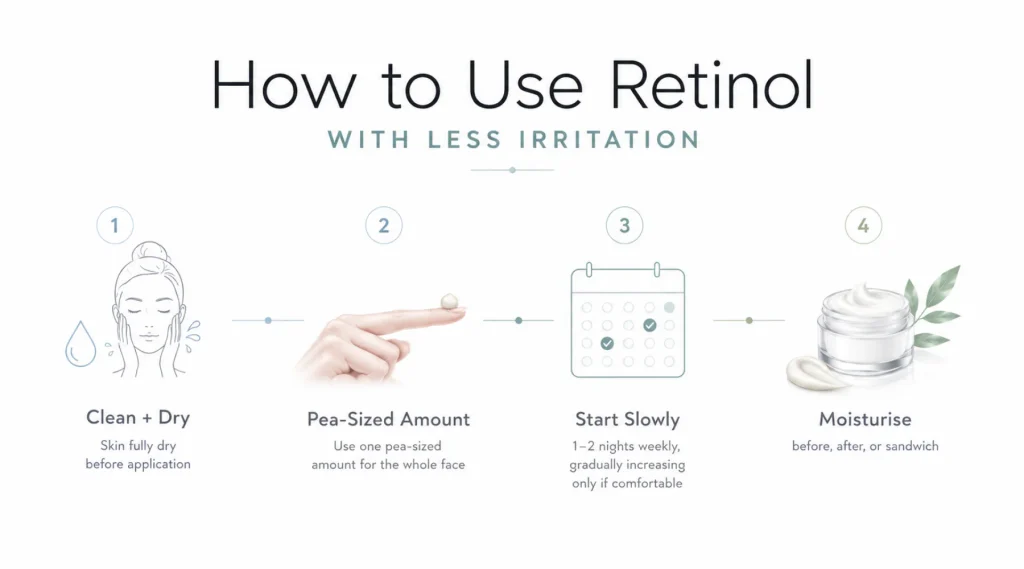
After washing your face, let your skin dry before using retinol, especially if you have sensitive skin. Applying it on damp skin may increase irritation.
You don’t need to wait a long time for everyone. If your skin is very sensitive, waiting 10 to 20 minutes can help. But if your skin feels fine, you can apply it as soon as it’s dry.
Use a Pea-Sized Amount
A pea-sized amount is enough for your whole face. Dot it on your forehead, cheeks, and chin, then spread it evenly.
Using more than this won’t double the benefits and may cause more dryness, especially around your nose, mouth, and eyes. To protect these areas, apply a little plain moisturiser before using retinol. Avoid the eyelids unless the product is specifically made for that area.
Start with two nights each week.
How often to use retinol depends on the strength, formula, and skin response. A practical starting schedule is:
- Weeks 1–2: one or two nights weekly;
- Weeks 3–4: two or three nights weekly if comfortable;
- Weeks 5–8: every other night if needed and tolerated;
- Later: nightly use only if the skin remains calm and the product instructions support it.
Not everyone needs to use retinol every night. Using it three times a week can be more effective than using it every night and then taking long breaks.
Use moisturiser strategically
Three approaches can work:
- Retinol before moisturiser: suitable for experienced users with comfortable skin.
- Moisturiser before retinol: reduces direct intensity and may help beginners.
- The sandwich method: moisturiser, retinol, then another light layer of moisturiser. This is useful when dryness appears easily.
Applying moisturiser before retinol doesn’t make it ineffective. It might lower how well retinol absorbs, but it can help you use it more regularly without irritation.
Researchers have studied ingredients like ceramides, cholesterol, and niacinamide for their ability to lessen irritation from retinol and improve skin comfort.
Can You Use Hyaluronic Acid With Retinol?
Yes, hyaluronic acid and retinol can work well together because they have different roles.
Retinol helps speed up skin renewal and reduces signs of ageing from the sun. Hyaluronic acid is a humectant, meaning it attracts and keeps moisture in the skin’s surface. It doesn’t cancel out the effects of retinol or interfere with its function.
A simple evening order is:
- gentle cleanser;
- hydrating serum on slightly damp skin;
- allow the skin to dry;
- retinol;
- moisturiser.
For sensitive skin, start with the hydrating serum and moisturiser. Wait until your skin feels dry, then apply retinol.
Hyaluronic acid serums can’t stop all retinol reactions. These ingredients work best with a moisturiser that prevents water loss. If you only use a sticky hydrating serum, your skin might still feel tight and dry.
On nights without retinol, a hydrating mask like the Bio-collagen Real Deep Mask can be a good choice, especially if you already have several products on your skin. A mask should enhance comfort, not act as a fix for overusing retinol.
Can I Use Niacinamide With Retinol?
Yes, you can use niacinamide and retinol together, which helps with dry or uneven skin.
Niacinamide benefits retinol users by improving the skin barrier, reducing redness, controlling oiliness, and promoting an even complexion.
There’s no solid evidence that niacinamide deactivates retinol. They can be found in the same product, and studies on such combinations show benefits for ageing and pigmentation.
They can be layered as:
- cleanser;
- niacinamide serum;
- retinol;
- moisturiser.
Use niacinamide in the morning and retinol at night. This makes your routine lighter and is better for sensitive skin.
More isn’t always better. A 10% or 15% niacinamide serum can irritate some skin types, especially if the skin barrier is damaged. A lower concentration in a balanced formula may work better with retinol.
Which Ingredients Need More Care Around Retinol?
Retinol doesn’t have to be used alone. However, combining too many irritating treatments at once can be too much for the skin.

Glycolic acid and lactic acid
Alpha hydroxy acids (AHAs) exfoliate the skin. They work well with retinol to improve skin texture and colour. However, using both together at night can cause stinging, peeling, and skin barrier issues.
Beginners should alternate:
- Monday: retinol;
- Tuesday: recovery routine;
- Wednesday: exfoliating acid;
- Thursday: recovery routine.
Once the skin is stable, experienced users can often use them in the same weekly plan. There is usually no need to layer them directly.
Salicylic acid
Salicylic acid helps with blackheads and oily skin. You can use it with retinol in acne treatments, but start with one product first.
Using a salicylic acid cleanser in the morning and retinol at night can be gentler than using both products at the same time.
Benzoyl Peroxide
Benzoyl peroxide works well for inflammatory acne but can dry out the skin. It may also make some retinoids less effective. A typical routine involves using benzoyl peroxide in the morning and retinoids at night. Adapalene is more stable than tretinoin, and there are also prescription combinations available. Always follow medical advice for the best plan.
Vitamin C
Vitamin C and retinol can be used together in a skincare routine. A simple schedule is to use vitamin C in the morning and retinol at night. They aren’t harmful when used together; separating them often feels more comfortable and is easier to follow.
Scrubs, Cleansing Brushes, and Strong Peels
Using scrubs or cleansing brushes can increase irritation from retinol. If your skin is already renewing well, harsh scrubs and frequent home peels won’t help much. Avoid trying to replicate professional peels by using multiple strong consumer products.
How to Use Bakuchiol in a Daily Routine
Bakuchiol is easier to use than retinol, but follow the product instructions for best results.
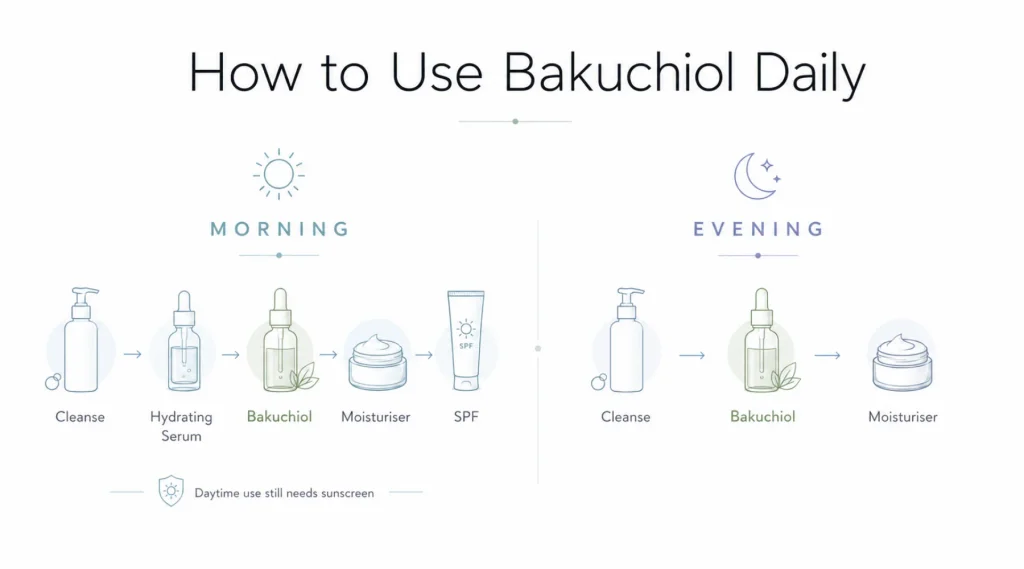
Most bakuchiol products are meant for use once or twice a day. A beginner can start with once a day for a week or two before trying a second application.
Morning bakuchiol routine
- Gentle cleanser or water rinse
- Hydrating or antioxidant serum
- Bakuchiol product
- Moisturiser
- Broad-spectrum sunscreen
Evening bakuchiol routine
- Cleanser
- Bakuchiol serum or treatment
- Moisturiser
When using bakuchiol oil, apply it after your water-based serums and before or mixed with moisturiser. If it’s a cream, it can replace your moisturiser.
Many serums have different active ingredients. Check if your serum has exfoliating acids, vitamin C, peptides, or fragrance. A reaction that seems linked to bakuchiol might actually be from another ingredient.
Bakuchiol is considered safe for daytime use because it doesn’t react to sunlight like some retinoids. However, you still need to use sunscreen in the morning. UV exposure leads to fine lines and pigmentation, and no antioxidant or plant extract can substitute for UV protection.
Can You Use Retinol and Bakuchiol Together?
Yes, you can use retinol and bakuchiol together. The key question is whether this combination benefits your skin.
Bakuchiol doesn’t cancel out retinol’s effects. Some products are designed to mix retinoids with bakuchiol or other plant-based ingredients to help with ageing.
Here are three smart ways to use them together.
Use a formula that combines ingredients.
A well-made product controls the levels, stability, and delivery method. It’s usually easier than using two strong serums.
Use bakuchiol in the morning and retinol at night.
This sets a clear routine and reduces the number of layers at night. It’s great for someone who already handles retinol but wants extra antioxidants or anti-ageing ingredients during the day.
Alternate retinol and bakuchiol nights
This approach is useful for sensitive skin:
- Monday: retinol;
- Tuesday: bakuchiol;
- Wednesday: recovery routine;
- Thursday: retinol;
- Friday: bakuchiol;
- weekend: adjust according to comfort.
You don’t have to use bakuchiol every night that you don’t use retinol. Sometimes, just using a cleanser and moisturiser is better, especially when your skin is dry.
Avoid mixing products just because they seem advanced. If your current routine is working and helping your skin, adding something new can make it hard to pinpoint any irritation.
Retinol vs Bakuchiol for Pigmentation and Post-Acne Marks
Both ingredients can help improve skin tone, but treating pigmentation requires a broader approach.

Retinoids can even out skin colour and help lighten superficial dark marks. The American Academy of Dermatology recommends retinoids for fading dark spots, especially when used with sun protection.
Bakuchiol also shows promise for treating hyperpigmentation. A trial found that both bakuchiol and retinol improved pigmentation over 12 weeks.
Neither ingredient can effectively manage pigmentation if the skin is frequently exposed to sunlight. Visible light can also cause pigmentation in some skin types, making tinted sunscreen with iron oxides useful for certain melasma and discolouration.
Pigmentation treatments should avoid excessive irritation. Inflamed skin can lead to more pigmentation, especially in medium-to-deep skin tones. A strong retinol routine that causes ongoing redness may counteract the desired results.
Bakuchiol is a better choice for minimising inflammation. Retinol may be better if pigmentation occurs with significant texture, ageing, or congestion, provided the skin can handle it.
Choosing a Product by Formula Rather Than Marketing Language
The words “retinol,” “bakuchiol,” and “anti-ageing” on the label don’t tell you much about how the product works.
In a good skincare routine, keep these details in mind.
Concentration
Retinol products can have percentages from very low up to 1% or more. A higher percentage isn’t always better. A stable 0.1% or 0.3% formula might be more effective than an unstable 1% product that causes irritation. Studies on prescription tretinoin show that higher strengths can irritate the skin without offering much more visible improvement.
Bakuchiol typically comes in concentrations of 0.5% to 1%, but product designs vary. The 0.5% concentration used in one study should not be seen as the best choice for all formulae.
Packaging
Retinol breaks down when exposed to light, air, and heat. It’s better to use opaque, airtight packaging instead of a clear jar that gets opened often.
Bakuchiol can be more stable in some situations, but the full formula can still lose its effectiveness. Antioxidants, oils, and plant extracts also require the right packaging.
Supporting ingredients
Helpful companions include:
- ceramides;
- glycerine;
- squalane;
- cholesterol;
- panthenol;
- hyaluronic acid;
- niacinamide;
- soothing plant extracts with a low allergy risk.
Potentially irritating companions include:
- strong fragrance;
- essential oils;
- multiple exfoliating acids;
- high alcohol content;
- additional retinoids not clearly disclosed.
You should evaluate products like Difuman Retinol Anti ageing Dragon Blood Cream based on their ingredient list, retinol concentration, packaging, and application instructions, rather than on the flashy name.
Texture
Oily skin often likes light emulsions or serums. Dry skin usually does better with cream. If a product peels under moisturiser or feels bad, people are less likely to use it regularly.
How Often to Use Retinol Compared With Bakuchiol
Use retinol based on how your skin tolerates it, not on your goals.
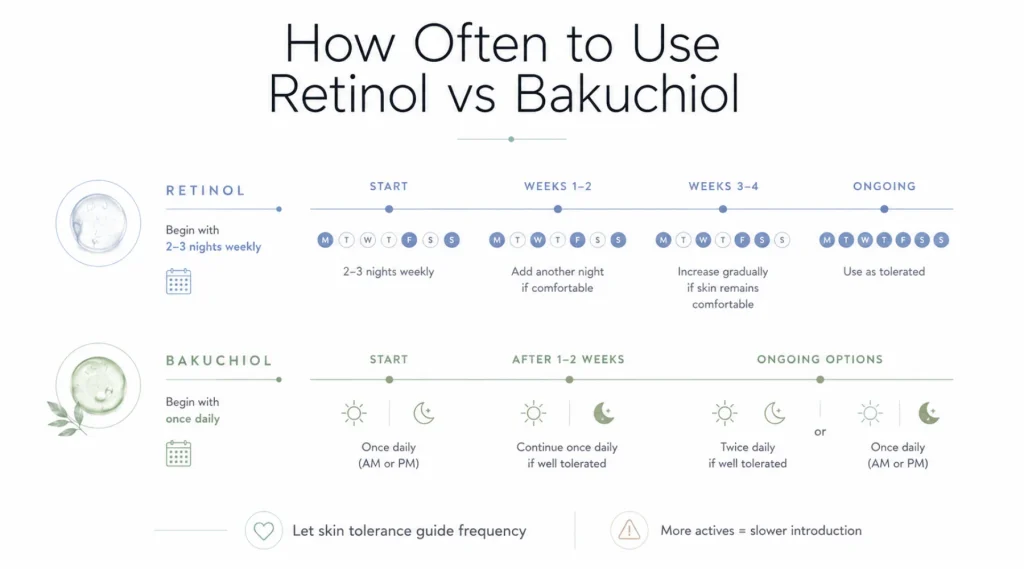
Most people can apply it two or three times a week during the first month. Increase the frequency only if your skin doesn’t stay red, burning, or peeling.
A good sign that things are going well is when your skin feels normal. You shouldn’t always feel tightness from the treatment.
You can usually start bakuchiol once a day, and some products can be used twice daily. However, start slowly if:
- the product contains several actives;
- the skin is eczema-prone;
- a prescription acne treatment is already being used;
- the barrier has recently been irritated;
- the person has a history of botanical allergies.
Frequency should match your full routine. Using bakuchiol daily, along with an acid toner, vitamin C, a salicylic cleanser, and benzoyl peroxide, could cause more irritation than using retinol twice a week in a gentle routine.
Retinol Irritation, Purging and Allergy Are Not the Same
Retinol reactions are often labelled “purging”, even when the symptoms point to irritation.
Expected early dryness
You may feel mild tightness or light flaking while adjusting. This should get better if you use less often and add more moisturiser.
Irritant dermatitis
Warning signs include:
- burning during cleansing;
- persistent redness;
- shiny, tight-looking skin;
- cracking around the mouth or nose;
- widespread flaking;
- stinging from previously comfortable products;
- worsening discomfort after every application.
This doesn’t mean the retinol is working better. Temporarily stop using it and switch to a simple cleanser, moisturiser, and sunscreen until your skin feels comfortable.
Acne Fluctuation
People often blame retinoids for worsening acne. A review found little evidence that topical retinoids usually cause a flare-up. Some worsening might just be the natural progression of acne or irritation.
New spots in areas where acne usually appears might be part of the adjustment period. However, widespread itchy bumps, burning, or breakouts in unusual areas could signal a reaction to the product.
Allergic Contact Dermatitis
Itching, swelling, blistering, or a rash similar to eczema may indicate an allergy instead of normal irritation. Stop using the product and consult a doctor if symptoms are severe.
Bakuchiol can also cause allergies. “Natural” ingredients have active molecules and are not always hypoallergenic.
What to Do When Retinol Has Damaged the Skin Barrier
Don’t use bakuchiol right away on damaged skin. Even gentle products can irritate sensitive skin.
Pause retinol, exfoliating acids, scrubs, benzoyl peroxide, and strong vitamin C products. Use:
- a mild fragrance-free cleanser;
- a simple moisturiser containing humectants and barrier lipids;
- broad-spectrum sunscreen;
- lukewarm water;
- no cleansing brushes or facial scrubs.
Once your skin feels normal and the redness is gone, wait a few more days before using active products again.
Start using them less often than before. If retinol caused issues at four nights a week, try once a week instead of three.
You can think about using Bakuchiol later, especially if retinol hasn’t worked for you. Don’t use it as a quick fix for irritated skin.
If you have ongoing burning, swelling, oozing, or eczema, see a professional. This could be dermatitis instead of just temporary skin sensitivity.
Retinol and Bakuchiol During Pregnancy and Breastfeeding
Topical retinoids are usually not recommended during pregnancy. Although some studies show that accidental use doesn’t significantly harm pregnancy outcomes, this evidence isn’t strong enough to support intentional use. Dermatology guidelines advise avoiding these products during pregnancy.
Bakuchiol is often labelled as safe for pregnancy because it is not a retinoid. However, this claim goes beyond what the evidence supports. Just because it isn’t a vitamin A derivative doesn’t mean it’s safe for pregnant women. We have limited data on topical bakuchiol during pregnancy, and many products contain other plant extracts or essential oils.
Pregnant women, those trying to conceive, or breastfeeding mothers should always check the full ingredient list with a doctor, midwife, or pharmacist instead of trusting marketing claims on the packaging.
Common alternatives for skincare concerns during pregnancy include azelaic acid, niacinamide, and vitamin C. However, which option is safe depends on the product’s formulation and the individual’s medical history.
When Neither Ingredient Is the Best First Step
Retinol and bakuchiol are helpful cosmetic products, but they are not solutions for everyone.
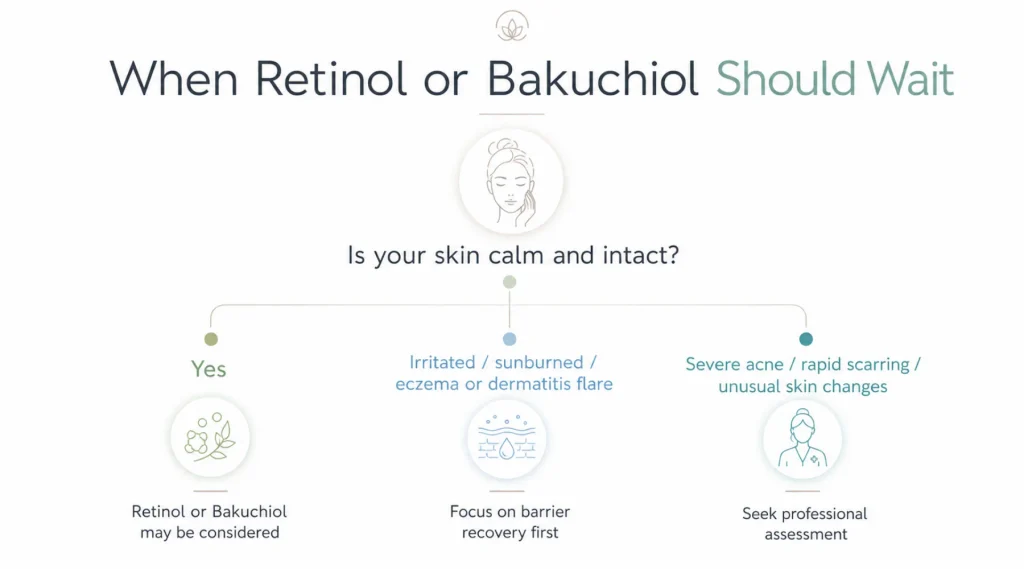
You shouldn’t use them if you have:
- An active eczema flare
- Uncontrolled rosacea
- Sunburn
- Broken or infected skin
- Severe acne
- Unexplained facial swelling
- Ongoing dermatitis around the mouth or eyes
If you have deep acne, rapid scarring, or widespread inflammation, focus on an acne treatment plan instead of comparing serums.
Also, if you notice sudden changes in a mole, a non-healing sore, or unusual pigmentation, see a doctor.
For serious skin concerns, professional treatments may be better. Options like chemical peels, microneedling, lasers, light therapy, prescription retinoids, and injectables work differently and need careful risk assessment.
Retinol and bakuchiol are useful for long-term skincare, but they can’t achieve all the results of a dermatology clinic.
Common Retinol and Bakuchiol Myths That Distort Product Choices
“Bakuchiol is exactly the same as retinol”
It is not the same. Bakuchiol can create similar results, but its chemical structure and how it works are different. The supporting evidence also varies.
“Retinol must make the skin peel”
Peeling happens as a side effect, not the main aim. Retinol can make your skin better without constant flaking.
“Bakuchiol cannot cause irritation because it is natural”
Plant-based ingredients can irritate or cause allergies. The overall formula is important.
“Retinol thins the skin”
Retinoids might cause dryness and flaking at first, making the skin feel weak. Over time, they have more complex effects that involve changes in skin function and collagen levels. Calling this just “thinning” can be misleading.
“Higher retinol percentages work faster”
Stronger products can cause more irritation without significantly improving results. It’s important to focus on formulation, stability, and consistency.
“Bakuchiol is only for older skin”
Bakuchiol is good for younger adults looking for gentle help with skin tone, mild blemishes, or early signs of sun damage.
“Retinol should never be used with niacinamide”
They can work together and often show up in the same product or routine.
“You do not need sunscreen when using bakuchiol”
Bakuchiol does not replace sunscreen. Using sunscreen is essential to prevent further ageing and dark spots from the sun.
“Using retinol and bakuchiol together doubles the results”
There’s no straightforward math connection. Mixing ingredients can make routines more complicated without showing clear benefits.
How Long Results Usually Take
Skincare changes occur at different speeds.
During the first month
Retinol users might feel dryness before seeing results. Bakuchiol users may feel smoother or more hydrated if the product has moisturising ingredients, but this doesn’t mean their skin is changing structurally.
Around eight to twelve weeks
You may notice slight improvements in texture, brightness, and surface colour. The comparison between bakuchiol and retinol looked at changes after 12 weeks.
Around three to six months
Fine lines and uneven skin may start to improve. Retinol studies usually check results over months, not just days.
Beyond six months
Using retinol regularly can keep improving sun damage. A one-year study showed that 0.1% retinol leads to ongoing improvement over time.
Bakuchiol might also help with long-term effects, but there are not as many long-term studies comparing it to retinol.
To track progress, take photos in the same lighting every eight to twelve weeks. Checking in the mirror every day can make normal changes in skin feel bigger than they are.
Questions People Still Ask About Retinol and Bakuchiol
Is retinol better than bakuchiol?
Retinol is well-known for improving wrinkles, skin texture, and clogged pores. Bakuchiol is usually gentler on the skin. If the main goal is strong results, retinol is often the better option. However, if you have sensitive skin and want to use something regularly, bakuchiol might be the best choice.
Neither ingredient is always the best. A bakuchiol serum used daily can be more effective than a retinol cream that irritates your skin and leads you to stop using it.
Can you use retinol and bakuchiol together?
Yes, you can use them together in the same formula, at different times of day, or on alternate nights.
Start with one ingredient to see how your skin reacts. Once your skin is okay, slowly add the second ingredient. Using both is optional, not required.
Is bakuchiol as effective as retinol?
A small trial showed that bakuchiol and retinoids had similar results in reducing wrinkles and dark spots over 12 weeks. People reacted better to bakuchiol. However, there is much less evidence for bakuchiol compared to retinoids. So, it’s more accurate to say bakuchiol acts like retinol rather than claiming it is the same as retinol.
Which is better for beginners: retinol or bakuchiol?
Bakuchiol is often better for beginners with dry or sensitive skin. Low-strength retinol works well for those dealing with clogged pores, rough texture, or visible ageing signs.
Keep the routine simple, no matter which ingredient you choose.
Can bakuchiol cause purging?
Bakuchiol doesn’t work the same way as retinoids in speeding up skin cell turnover. A sudden breakout is usually caused by irritation, another ingredient, a heavy formula, or normal acne changes, not necessarily a detox process.
If acne becomes persistent or worse, it doesn’t mean the product is ineffective.
Does retinol help with acne scars?
Retinol can help reduce post-acne marks and minor texture issues, but it doesn’t fully eliminate deep scars like ice-pick, boxcar, or rolling scars.
To treat atrophic acne scars, you may need procedures like microneedling, subcision, laser treatment, or a mix of therapies. It’s also important to manage active acne to avoid new scars.
Can retinol be used every night?
Some people can use the right retinol formula every night, but it’s not necessary for everyone. Increase use only if your skin feels comfortable. Using it three nights a week may be enough, especially if you also use acne or pigmentation treatments.
Can bakuchiol be used every day?
Many bakuchiol products are meant for daily or twice-daily use. Always follow the product instructions and consider all the ingredients. Using the product daily might be uncomfortable if it has acids, fragrance, or a high amount of another active ingredient.
Can I use niacinamide with retinol and bakuchiol?
Yes, you can use niacinamide with either ingredient. It can help strengthen your skin barrier, even out skin tone, and make your routine easier on your skin. If high percentages irritate your skin, choose a moderate-strength niacinamide formula.
Can you use hyaluronic acid with retinol and bakuchiol?
Yes, hyaluronic acid can add moisture when used with either active. Apply it to slightly damp skin and then use a moisturiser. If applying it to damp skin causes irritation, let your face dry before using retinol.
Is bakuchiol safer than retinol for sensitive skin?
Bakuchiol is usually easier for people to use, but whether it’s “safer” depends on the full product and the person. A bakuchiol serum without fragrance may work well for sensitive skin, while a strongly scented one might not. It’s still a good idea to do a patch test.
Should retinol or bakuchiol go before moisturiser?
A serum or light lotion usually goes on before moisturiser. An oil-based bakuchiol product should be applied after water-based products and before or with moisturiser.
Retinol can be used before moisturiser, after moisturiser, or between two layers of light moisturiser. The best method is the one that your skin tolerates well and doesn’t cause pilling.
Can I alternate retinol and bakuchiol?
Yes. Alternating nights is a good choice for anyone who wants the benefits of retinol without using it every night. Make sure to include one or two recovery nights in your routine to prevent dryness.
Is bakuchiol suitable for oily and acne-prone skin?
Bakuchiol may help with inflammation and uneven skin tone, especially in a light, non-greasy formula. However, it shouldn’t replace effective acne treatments for ongoing blackheads, active breakouts, or scars.
The base product is important too. A thick oil blend might not work for all acne-prone skin types, even if bakuchiol is fine for them.
What happens if I stop using retinol or bakuchiol?
The skin won’t become “addicted” to either ingredient. However, the benefits may decrease when treatment stops due to ageing, UV exposure, and pigment changes.
If irritation occurs, it’s okay to stop. Restart only after the skin heals and use a gentler routine.
Choosing Between Retinol vs Bakuchiol for Your Own Skin
The best choice isn’t always the most practical one.
Retinol is the top pick for those looking to reduce fine lines, sun damage, uneven texture, and clogged pores. It takes time, a careful routine, and proper use of sunscreen to see results.
Bakuchiol is a gentler option for people with dry or sensitive skin who struggle with vitamin A. It can help with fine lines and uneven skin tone without causing much irritation, but it doesn’t have as much research backing it as retinol.
For beginners and those with sensitive skin, bakuchiol can be a good choice instead of just a short-term fix. If you have stubborn acne, serious sun damage, or want something well-researched, retinol or a prescription retinoid is often the better option.
Ultimately, the best choice between retinol and bakuchiol is the one you can use safely and consistently. Strong skincare shouldn’t irritate your skin, and gentle skincare shouldn’t make big promises. The ideal routine is balanced, backed by evidence, comfortable, and realistic enough to stick with.