





Blog
Hyaluronic Acid on Wet or Dry Skin? Best Way to Apply It


Hyaluronic acid is a popular skincare ingredient, but its use can be confusing. Some routines say to apply it on wet skin, while others suggest dry skin. Both methods can work, but they might give different results.
For most people, what’s more important is to apply hyaluronic acid on skin that has some moisture and then put on a good moisturiser. A slightly damp face is usually best for using hyaluronic acid. Dry skin can also work if the product has enough water and oils, or if a moisturiser is used right after.
This matters because hyaluronic acid pulls in water, but it doesn’t stop it from evaporating. If used alone, especially in dry conditions, it can make skin feel tight once it dries.
The best way to apply it is on clean skin that’s slightly damp, using a small amount of serum, and following with a moisturiser to keep the water in.
Should You Apply Hyaluronic Acid on Wet or Dry Skin?
Apply a hyaluronic acid serum to slightly damp skin, not soaking wet. Then, use a moisturiser before your skin dries completely.

A damp surface helps the serum spread and bind to your skin. It can also prevent the sticky feeling that can occur when a thick serum is applied to dry skin.
However, hyaluronic acid still works on dry skin. Most hyaluronic acid serums are water-based and can add moisture to your skin. Many also include ingredients like glycerin or panthenol, which can still improve hydration even on dry skin.
The main difference is comfort and how much water your skin retains.
| Application method | What usually happens | Who may prefer it |
| Slightly damp skin | The serum spreads easily and may feel plumper and less sticky | Most beginners, dry skin and dehydrated skin |
| Completely dry skin | Still works if the formula is hydrating and moisturiser follows | People layering vitamin C, retinoids or prescription treatments |
| Very wet skin | The product may become diluted, run into the eyes or pill under later layers | Rarely necessary |
| Damp skin without moisturiser | Skin may initially feel hydrated, then tight as water evaporates | Usually best avoided |
| Dry skin followed by a rich moisturiser | Can be effective when wet application would disrupt another active | Retinoid users and sensitive routines |
Consider damp skin as a helpful tip instead of a strict rule. The serum’s formula, your skin barrier’s health, the weather, and what you put on after all affect the outcome.
Why Slightly Damp Skin Often Feels Better
The outer layer of skin, called the stratum corneum, consists of flat cells and lipids. It controls water levels in the skin and how quickly water escapes.
Hyaluronic acid is a humectant that helps increase water content in the stratum corneum by attracting water. Emollients smooth out gaps between cells, while occlusive ingredients help keep water from evaporating.
Applying a humectant on damp skin works well because it adds extra water at the surface. The serum can spread easily instead of drying in patches.
Research shows that hyaluronic acid in creams can improve hydration, plumpness, and the look of fine lines. However, the overall formulation matters more than just the hyaluronic acid.
Using a serum on damp skin makes it easier to spread. You need less product to cover your face evenly, reducing the risk of feeling sticky or getting clumps instead of better hydration.
Your skin shouldn’t be dripping. If water runs down your face, the serum might get too diluted or move towards your eyes and hairline. The best dampness is like when you lightly pat your face with a towel, no visible drops, but the skin isn’t completely dry.
What Does Hyaluronic Acid Do for Skin?
Hyaluronic acid is a natural substance found in the skin, joints, and eyes. In the skin, it helps keep water balanced and supports the area around cells.
Topical hyaluronic acid doesn’t fully replace the deeper layers of hyaluronic acid in the skin. It mainly works on the surface, increasing water content, creating a flexible layer, and making fine lines look softer for a short time.
Knowing what hyaluronic acid does helps set realistic expectations. Its main benefits include:
- Boosting surface hydration
- Making rough, dry skin feel smoother
- Reducing tightness from water loss
- Supporting comfort with drying treatments
- Giving skin a temporary plump look
- Helping moisturisers spread better
- Improving the appearance of dry or creased makeup
Hyaluronic acid is not an exfoliant, acne treatment, pigment corrector, or a substitute for sunscreen. Any glow usually comes from better hydration and a smoother surface, not from removing dark spots.
While hyaluronic acid can make fine lines from dryness less visible, it does not create the lasting changes that prescription retinoids, resurfacing treatments, or injectable fillers do. Topical serums and injectable fillers serve different purposes and work at different levels in the skin.
Hyaluronic Acid Does Not Simply “Pull Moisture from the Air”
Hyaluronic acid’s ability to pull water from the air into the skin is an oversimplified view.

A topical humectant can draw water from different sources:
- Water already in the product
- Water left on the skin after washing
- Water stored in the upper skin layers
- Moisture in the air
Which source is most important depends on the product and its environment. In a humid room, moisture from the air can enhance how a humectant feels on the skin. In dry places, there is less moisture available.
Humectants alone may cause water to move to the skin’s surface and evaporate without proper support from other ingredients. Therefore, experts recommend using humectants alongside emollients and occlusives instead of relying on just one ingredient.
This doesn’t mean hyaluronic acid will always dry out skin in low humidity. A good serum may have various moisturising ingredients, and a cream on top can help keep water in. The caution mainly applies when using a concentrated serum alone without a finishing product.
How to Use Hyaluronic Acid on Damp Skin Step by Step
A good hyaluronic acid routine should be easy. Your face shouldn’t stay wet for a long time, and you don’t need to mist it again and again between layers.
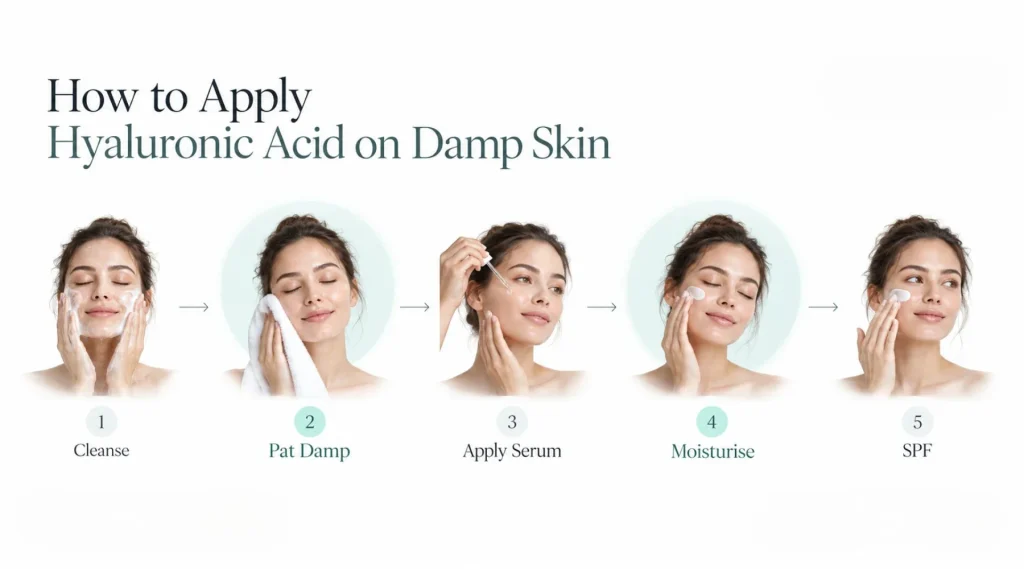
1. Cleanse without stripping the skin
Use lukewarm water and a cleanser that effectively removes sunscreen, makeup, oil, and daily dirt without making your face feel tight or squeaky.
Hot water can make your skin uncomfortable and highlight dryness. Strong foaming cleansers can leave your skin dry, which no serum can fix.
In the morning, if you have dry or sensitive skin, you might only need to rinse with water if there’s no heavy residue from the night before. Oily skin may still benefit from a gentle cleanser.
2. Remove excess water
After rinsing, gently pat your skin with a clean towel. Don’t rub it.
Your face should feel a little damp, without any water droplets. If it dries before you apply the serum, lightly mist some clean water or a fragrance-free spray on your skin.
Using a mist is optional; it’s not better than the water left after cleansing.
3. Apply a small amount of serum
Use the amount suggested by the product, usually two or three drops or a thin layer for your face.
Rub it between clean fingers and gently press it on your cheeks, forehead, chin, and neck. Don’t rub too much until it feels sticky.
Using hyaluronic acid serum is mainly about controlling how much you use. More serum makes a thicker layer but doesn’t mean better hydration.
4. Apply moisturiser while the skin still feels comfortable
Don’t let the hyaluronic acid dry, stiffen, or become sticky. As soon as it spreads evenly, apply your moisturiser.
Choose a moisturiser with emollients and occlusives to help keep moisture in. Look for helpful ingredients like:
- Ceramides
- Glycerin
- Squalane
- Dimethicone
- Petrolatum
- Shea butter
- Cholesterol
- Fatty acids
- Panthenol
Moisturisers with ceramides can help your skin hold onto water and strengthen its barrier, especially when it’s dry or damaged.
If you have oily skin, a light gel-cream might be enough. If your skin is dry, choose a cream with more lipids or occlusives. Products like COSRX Advanced Snail 92 All in One Cream can work well if they match your skin’s needs.
5. Finish the morning routine with sunscreen
Apply broad-spectrum sunscreen after your moisturiser. Staying hydrated helps sunscreen stick better, especially if your skin tends to be dry and patchy. Let the moisturiser soak in first to ensure the sunscreen goes on smoothly without too much rubbing.
How Long Should You Wait Between Hyaluronic Acid and Moisturiser?
You don’t need to wait a specific number of minutes.
Apply moisturiser when the serum feels even and no longer looks runny. This usually takes about 20 seconds to one minute.
Waiting until the serum is completely dry can defeat the purpose of applying it on damp skin. You want to keep the hydration from the water and serum, not let it evaporate before adding the next step.
Long waits are usually unnecessary in a basic hydrating routine. They can also make layering harder because dry layers may roll or pill when rubbed.
Pilling often happens due to:
- Too much serum
- Too many layers
- Rubbing instead of pressing
- Ingredients that don’t work well together
- Not letting sunscreen set
- Applying a water-heavy product over a dry layer
Use less of each product before increasing wait times.
Hyaluronic Acid on Wet or Dry Skin for Beginners
Beginners often think more complicated routines are better for hydration. However, a simple routine with just a few steps works best.
Morning:
- Gentle cleanse or rinse with water
- Apply hyaluronic acid on damp skin
- Use a moisturiser
- Apply broad-spectrum sunscreen
Evening:
- Remove makeup and sunscreen
- Gently cleanse
- Apply hyaluronic acid on damp skin
- Use a moisturiser
Start with the serum once a day for the first week. This helps you see if it causes any itching, redness, or tightness.
Hyaluronic acid is usually safe, but other ingredients in a serum, like fragrances or oils, may not work for everyone.
Don’t try several new products at once. If you start a cleanser, serum, cream, and mask on the same day, it can be hard to figure out what caused any skin reaction.
You don’t need the strongest formula or various molecular weights. Different hyaluronic acid products may not compare directly because they have different sizes and forms.
A comfortable product you use consistently is better than a fancy one that makes your face sticky or irritated.
Hyaluronic Acid on Wet or Dry Skin for Dry and Dehydrated Skin
Dry skin produces less oil and often needs more fats and softeners. Dehydrated skin lacks enough water and can affect any skin type: oily, combination, or dry.
Common signs of dehydrated skin include:
- Tightness after washing
- Fine lines on the surface
- Dull or paper-like look
- Makeup separating or clinging
- Oiliness with tightness
- Stinging from basic products
For dry or dehydrated skin, applying products on slightly damp skin often feels best. Use a cream after applying serum instead of leaving it as the last step.
- A good evening routine includes:
- Cleansing with lukewarm water.
- Leaving the face slightly damp.
- Applying a thin layer of hyaluronic acid serum.
- Adding a moisturiser with fats and barrier-supporting ingredients.
- If needed, gently apply a small amount of petrolatum on very dry spots.
Petrolatum isn’t necessary for everyone and may feel heavy for acne-prone skin. It is best for dry areas around the mouth, nose, or cheeks.
If your skin still feels rough, stings, or flakes even after hydrating, the issue might be more serious than just needing serum. Over-exfoliating, harsh cleansers, irritants from retinoids, or skin conditions could weaken the skin barrier.
In this case, focus on safely repairing the skin barrier instead of just adding more hydrating products.
Hyaluronic Acid for Oily and Acne-Prone Skin
Oily skin can still be dry. Acne treatments with salicylic acid, benzoyl peroxide, retinoids, or foaming cleansers often cause surface dryness while producing oil.
The Role of Hyaluronic Acid
Hyaluronic acid does not fight acne directly. It doesn’t clear pores, kill acne bacteria, or speed up cell renewal. Instead, it helps make acne treatments easier to use and reduces dryness from those treatments.
Choosing the Right Products
Pick a light serum without extra oils or fragrances. Always follow with a non-greasy moisturiser instead of skipping it.
Morning Routine
A simple morning routine can include:
- Gentle cleanser
- Morning acne treatment
- Hyaluronic acid serum
- Lightweight moisturiser
- Sunscreen
Night Routine
At night, your routine might be:
- Cleanser
- Prescription or over-the-counter acne treatment
- Hydrating layer
- Moisturiser
Remember, the order might change based on your medication. Always follow your doctor’s instructions.
Breakouts and Hyaluronic Acid
Don’t assume every breakout after starting hyaluronic acid is a “purge.” Hyaluronic acid isn’t an exfoliant, so it shouldn’t cause typical purging.
Causes of New Breakouts
New spots may come from:
- Using a heavy formula
- Irritating fragrances or extracts
- Changes in your routine
- Too many layers of products
- Hormonal or environmental changes
- Applying with dirty hands
- Using old or contaminated products
Stop using the new product if breakouts occur in unusual places, feel itchy, or your skin is red and burning.
Hyaluronic Acid on Wet or Dry Skin for Sensitive Skin
Sensitive skin doesn’t need more steps; it needs less chance for irritation.
Apply hyaluronic acid to slightly damp skin if water doesn’t sting. Choose a fragrance-free product with few, clear ingredients, then use a gentle moisturiser.
If water causes burning, your skin barrier may be irritated. Don’t keep misting your face just to follow the damp-skin rule. Use a plain moisturiser on dry skin and stop using non-essential serums until your skin calms down.
Sensitive skin might react to other ingredients around hyaluronic acid instead of the acid itself. Watch out for:
- Fragrance
- Essential oils
- Denatured alcohol high on the list
- Strong exfoliating acids
- High amounts of vitamin C
- Multiple plant extracts
- Cooling or warming agents
- Harsh preservatives that irritate
Patch testing can help find immediate reactions. Apply a small amount of the product near your jaw or behind your ear once a day for a few days before using it on your face.
A patch test can’t promise a product won’t clog pores or cause delayed irritation, but it can show obvious redness, swelling, itching, or burning.
If you have eczema, rosacea, contact dermatitis, or are undergoing medical treatment, follow advice from a dermatologist or healthcare professional. A hydrating product can help comfort your skin but won’t treat the underlying condition.
The Formula Matters More Than the Hyaluronic Acid Percentage
Consumers are often told to compare hyaluronic acid percentages, but the number alone doesn’t show how well a product works.
Hyaluronic acid can go by different names, including:
- Hyaluronic acid
- Sodium hyaluronate
- Hydrolysed hyaluronic acid
- Sodium acetylated hyaluronate
- Cross-polymer forms
- Hydrolysed sodium hyaluronate
These forms differ in size, how they feel on the skin, and how they dissolve. High-molecular-weight hyaluronic acid stays near the surface and forms a moisturising layer. Smaller forms might penetrate better, but being smaller doesn’t always mean they work better.
Research on molecular weight is ongoing. Studies show that different sizes of hyaluronic acid can affect inflammation in various ways, but not all small molecules irritate the skin. Factors like concentration, purity, formulation, and skin condition are important.
Using multi-weight hyaluronic acid can be beneficial but doesn’t guarantee better quality. A formula with one effective form, combined with glycerin and panthenol, might work better than a concentrated multi-weight serum that feels sticky.
To evaluate a product, consider:
- Does it reduce tightness for several hours?
- Does it feel comfortable under moisturiser and sunscreen?
- Does it cause redness or itching?
- Does it pill?
- Does it have enough supporting moisturising ingredients?
- Can you use it easily without complicating your routine?
The effectiveness of skincare depends on the whole product, not just the most noticeable ingredient on the label.
Can Hyaluronic Acid Dry Out Skin?
Hyaluronic acid hydrates skin, but some people feel drier after using it.

This feeling is real, but it doesn’t mean the acid is removing water. Here are some common reasons why:
You’re not using moisturiser.
A watery serum can add hydration, but that water can evaporate if you don’t apply moisturiser afterwards. Always add moisturiser right after.
The air is dry.
Heating, air conditioning, cold weather, and dry climates lower humidity. Using only humectants may not feel comfortable in these conditions. Try a cream with moisturising ingredients instead of just layering serum.
You’re applying too much.
Using too much serum can form a film on your skin. When this film tightens, it can make your face feel tight. Use a light layer instead.
Your cleanser is too harsh.
A strong cleanser can strip your skin’s natural oils, and a serum alone can’t fix that. Switch to a gentler cleanser and use lukewarm water.
Another product is causing irritation.
Ingredients like retinoids, exfoliating acids, and benzoyl peroxide can lead to dryness and redness. Hyaluronic acid might sting if your skin is already irritated. Check your entire skincare routine instead of removing just one product.
Your product has irritants.
Fragrance, alcohol, acids, or certain plant ingredients can cause reactions.
Understanding why hyaluronic acid can sometimes make skin feel dry is more helpful than thinking all hyaluronic acid products will act the same way.
Can You Use Hyaluronic Acid with Vitamin C?
Yes, you can use hyaluronic acid and vitamin C together.
Vitamin C is mainly an antioxidant. It can help with collagen production and uneven skin tone. Hyaluronic acid adds moisture and makes the vitamin C application more comfortable. Many reviews show that vitamin C is effective, but its stability and delivery can affect how well it works.
Using L-ascorbic Acid:
- Apply vitamin C serum to clean, dry skin. Damp skin may cause stinging for sensitive users.
- After the vitamin C settles, apply a thin hydrating serum if needed.
- Follow with moisturiser.
- Finish with sunscreen in the morning.
You don’t need to apply hyaluronic acid to damp skin since the serum already contains water. Avoid spraying water on strong vitamin C serums, as this can lead to uneven application.
Using Gentle Vitamin C Derivatives:
If using a non-acidic vitamin C, you can layer products based on texture, starting with the thinnest.
For targeted products like Dr Rashel Vitamin C Eye Serum, follow the specific instructions. Keep facial serums away from the eyelid and lash line unless they are meant for those areas.
Morning Routine with Vitamin C:
- Cleanser
- Vitamin C serum
- Hyaluronic acid (if needed)
- Moisturiser
- Sunscreen
You may not need hyaluronic acid if your vitamin C serum, moisturiser, or sunscreen is hydrating enough.
Can You Use Hyaluronic Acid with Retinol?
Yes, hyaluronic acid and retinol usually work well together. Using hyaluronic acid can help make a retinoid routine easier on your skin.
Retinoids help with skin cell turnover, collagen production, and acne, depending on the type used. However, they can also lead to dryness, peeling, burning, and irritation, especially in the first few weeks or if used too often.
Hyaluronic acid does not stop retinol from working. The key point is which one you apply first.
Should I use retinol or hyaluronic acid first?
In a regular evening routine, first apply retinol to clean, dry skin. After the retinol has absorbed, use a hydrating moisturiser. This order works for those who already tolerate retinol.
- Cleanse.
- Let the skin dry fully.
- Apply a pea-sized amount of retinol over the face.
- Apply hyaluronic acid serum if it layers comfortably without re-wetting the skin.
- Finish with moisturiser.
Don’t mist your face right after using retinol. Water can make the product move too much and could spread it to sensitive areas like your eyes, nose, and mouth.
For many people, using a moisturiser with humectants is easier than adding a separate hyaluronic acid serum after retinol.
The moisturiser sandwich for sensitive skin
If retinol makes your skin dry, try this:
- Cleanse your skin and let it dry.
- Apply a thin layer of moisturiser and let it soak in.
- Use a pea-sized amount of retinol.
- Add another light layer of moisturiser.
The first moisturiser can have ingredients like hyaluronic acid, glycerin, or panthenol. This helps reduce irritation but might slightly change how the retinol works.
Using hyaluronic acid earlier in the evening
You can also put hyaluronic acid on wet skin, cover it with moisturiser, and wait until your skin is dry before using retinol. This works well with retinoids meant to go over moisturiser.
Always follow the product instructions or your doctor’s advice. Some retinoids have specific ways they need to be applied.
If you are pregnant, planning to get pregnant, or breastfeeding, talk to a healthcare professional about using retinoids.
When to Use Hyaluronic Acid: Morning, Night or Both?
You can use hyaluronic acid in the morning, at night, or both.

The best time depends on what suits your routine.
Morning Use
Applying it in the morning helps sunscreen and makeup go on smoothly, especially if your skin is dry. Use a thin layer to avoid clumps. A good morning routine is:
- Cleanser or a rinse with water
- Hyaluronic acid on slightly damp skin
- Moisturiser
- Sunscreen
- Makeup
If your sunscreen is already moisturising, you might not need a separate cream.
Evening Use
Using it in the evening is great after cleansing, especially if your skin feels tight from removing makeup or using acne treatments. Apply it before your moisturiser. On nights when you use retinoids, consider using a moisturiser with hyaluronic acid instead of a separate serum.
Twice-daily use
You can usually use the product twice a day if it’s gentle and your skin feels good. Using it more often isn’t always better. Reapplying serum often can mess up your sunscreen, make your skin sticky, and lead to too much touching of your face. If using it once a day keeps your skin happy, you don’t need to use it more.
Adapting the Routine to Humidity, Heating and Air Conditioning
In humid weather, a light hyaluronic acid serum is often enough under sunscreen. Heavy creams can feel thick and make makeup slide off. Use the serum sparingly and finish with a gel-cream or hydrating sunscreen.
Cold Weather
Cold air and indoor heating can make your skin dry. After applying the serum, use a thicker moisturiser and avoid washing your face with very hot water. Apply moisturiser right after cleansing instead of letting your face air-dry for too long.
Air-Conditioned Rooms
Air conditioning dries out indoor air, making skin feel tight, even in warm weather. Choose a moisturiser with emollients and occlusives. Just misting your face won’t help much; it can leave your skin feeling drier once the water evaporates.
Very Dry Climates
In very dry climates, a hyaluronic acid serum is optional. Some people find a good cream with humectants, lipids, and occlusives works better. If a serum causes tightness even when used correctly, stop using it. Skincare should fit your environment, not make your skin uncomfortable.
How Much Hyaluronic Acid Serum is Enough?
For most faces, two or three drops are enough. The right amount should create a thin, even layer without leaving any residue. Your skin may feel soft, but it shouldn’t feel wet or sticky.

Using more product won’t help your skin absorb more water. Too much can cause:
- Pilling under moisturiser
- Uneven sunscreen application
- A sticky feeling
- Buildup around the hairline
- A higher chance of getting the product in your eyes
- A tightening film as it dries
- Unnecessary rubbing
Dropper sizes can vary, so follow the instructions on the packaging. For your neck, just add one extra drop instead of using a whole second dropper. Use any leftover product on your hands instead of applying a thick layer on your face.
Facial Mists, Toners and Essences: Do You Need Them First?
You don’t need a toner or essence to use hyaluronic acid. Just plain water from your cleansing is enough to create a damp surface. Toners or essences can help if they have ingredients that your skin likes, but they are optional.
A longer hydrating routine might include:
- Cleanser
- Hydrating toner
- Hyaluronic acid serum
- Moisturiser
This may work well for dry skin that needs extra hydration, but it can be too much for oily or acne-prone skin. Using many humectants can feel sticky. Many toners, essences, serums, and creams already have glycerin or sodium hyaluronate. Using multiple products with the same function usually doesn’t give you four times the benefit.
Before buying another hydrating product, review your entire skincare routine. You might just need a better moisturiser instead of more water-based products.
Where Masks Fit into a Hyaluronic Acid Routine
Hydrating masks give a quick moisture boost for dry skin, especially after travel, cold weather, or a tough week. However, they shouldn’t replace daily skincare like exfoliating or using the right cleanser.
On mask night:
- Clean your skin.
- Apply the mask as instructed.
- Remove it after the recommended time.
- Gently press in any leftover essence, if needed.
- Add moisturiser if your skin requires more hydration.
- A Bio-Collagen Real Deep Mask is best used occasionally, rather than under multiple serums.
Make sure to read the instructions, as some masks are for short wear, while others, like hydrogel or overnight masks, have different guidelines.
Stop using the mask if you feel burning, constant redness, swelling, or an itchy rash. Leaving it on longer doesn’t always mean better results, especially if it contains fragrance or active ingredients.
The Most Common Hyaluronic Acid Application Mistakes
Applying on Wet Skin
More water isn’t always better. A dripping face can dilute the serum too much and make it go on unevenly. Pat away excess water first.
Leaving It Unsealed
A serum isn’t always enough as a moisturiser. Follow with a suitable cream or lotion.
Using Too Much Serum
Applying a thick layer can make your skin sticky and cause pilling. Use just enough to lightly cover your skin.
Waiting Too Long
Put on moisturiser before the serum dries and feels tight.
Misting Over Active Ingredients
Re-wetting your face can affect how the serum spreads and may irritate sensitive areas. Apply dry-skin products first, then use a compatible moisturiser.
Assuming All Serums Are Safe for Sensitive Skin
Even gentle ingredients like hyaluronic acid can have irritants in the full formula. Always check the ingredient list.
Overdoing It with Layers
Burning, redness, and peeling don’t always mean you need more serum. They might mean you should cut back on exfoliants, retinoids, or cleansers.
Skipping Moisturiser for Oily Skin
Oily skin can still lose water. Use a lighter moisturiser instead of skipping it altogether.
Expecting Long-Lasting Results
The plumping effect from a topical humectant is temporary. It improves surface hydration but doesn’t replace the volume from injectables.
Choosing the Highest Percentage
A higher percentage doesn’t always mean a better product. Texture, supporting ingredients, and your skin’s tolerance are more important.
What to Do When Hyaluronic Acid Feels Sticky
Stickiness often happens when the layer is too thick, or the formula has too many film-forming ingredients.

Here are some changes you can try:
- Use half the amount of serum.
- Apply it on slightly damp skin.
- Press it into the skin instead of rubbing.
- Use moisturiser right after the serum.
- Skip one hydrating toner or essence.
- Let each layer sit briefly before applying sunscreen.
- Switch to a moisturiser with hyaluronic acid instead of using a separate serum.
Some serums can feel tacky. If it still feels unpleasant after using less, try a different serum. A product may look good, but if it disrupts your sunscreen or makeup, it’s not the best choice for your routine.
What to Do When Hyaluronic Acid Pills
Pilling happens when small rolls or flakes form on the skin’s surface. It’s not usually from dead skin.
Common causes are:
- Using too much product
- Layering many silicone or polymer-rich products
- Rubbing the skin after applying products
- Putting oil-based products under water-based ones
- Mixing incompatible sunscreens and moisturisers
- Using too much skincare under makeup
To reduce pilling:
- Use thinner layers.
- Keep your morning routine simple.
- Pat products onto your skin instead of rubbing.
- Let moisturiser soak in before applying sunscreen.
- Don’t touch sunscreen too often; it needs to form a protective layer.
- Test the serum and sunscreen together before important events.
If pilling only happens after sunscreen, the issue might be between your moisturiser and sunscreen, not the hyaluronic acid.
Why Hyaluronic Acid May Sting
Hyaluronic acid usually doesn’t cause much burning. A little tingling might happen with some products, but if it stings a lot, the product might not be right for you, or your skin may be damaged.
Potential causes of irritation include:
- Over-exfoliating your skin
- Irritation from retinoids
- Dryness from benzoyl peroxide
- Windburn or sunburn
- Fragrance in the product
- Alcohol or acids in the serum
- Applying it right after shaving or hair removal
- Skin conditions like eczema or rosacea
- Cracked or broken skin
If you keep feeling discomfort, stop using the serum. Use a gentle cleanser, a simple moisturiser, and sunscreen instead.
Get medical help if you experience swelling, blisters, a widespread rash, eye issues, or trouble breathing. Don’t keep trying a product that has already caused a strong allergic reaction.
Does Drinking More Water Replace Topical Hyaluronic Acid?
Drinking enough water is important for health, but drinking more than your body needs won’t fix a damaged skin barrier or replace a good moisturiser.

Skin hydration depends on:
- Skin barrier strength
- Humidity in the environment
- Cleansing routines
- Skincare products
- Age
- Skin conditions
- Medications
- Overall health
- Fluid intake
If you are truly dehydrated, you might experience dry lips, fatigue, thirst, or dark urine, along with skin changes. This is different from tightness on your face caused by washing or weather.
Use topical skincare to reduce water loss from your skin and drink enough fluids for good health. Avoid extreme claims about water as a skincare solution.
When a Moisturiser Is More Useful Than a Separate Serum
You can skip the hyaluronic acid serum; a moisturiser is usually more important.
Choose a moisturiser-only routine if:
- You don’t like sticky layers.
- Your skin reacts to many serums.
- Your moisturiser already has several humectants.
- You use prescription treatments.
- Your sunscreen doesn’t work with multiple products.
- You live in a dry area.
- You want a faster routine.
- Your skin barrier is damaged or sensitive.
A good moisturiser has ingredients that retain water, smooth the skin, and hold moisture all in one product. This can work better than just using one humectant under a weak cream.
Moisturisers serve three main functions:
| Function | What it does | Common examples |
| Humectant | Increases water in the outer skin | Glycerin, hyaluronic acid, urea, sodium PCA |
| Emollient | Smooths and softens the surface | Squalane, fatty alcohols, oils, shea butter |
| Occlusive | Slows water evaporation | Petrolatum, dimethicone, waxes |
Balanced formulae often feel more comfortable than products built around one fashionable ingredient.
When Persistent Dryness Needs Professional Assessment
Hyaluronic acid can’t fix all types of dry, tight, or flaky skin.
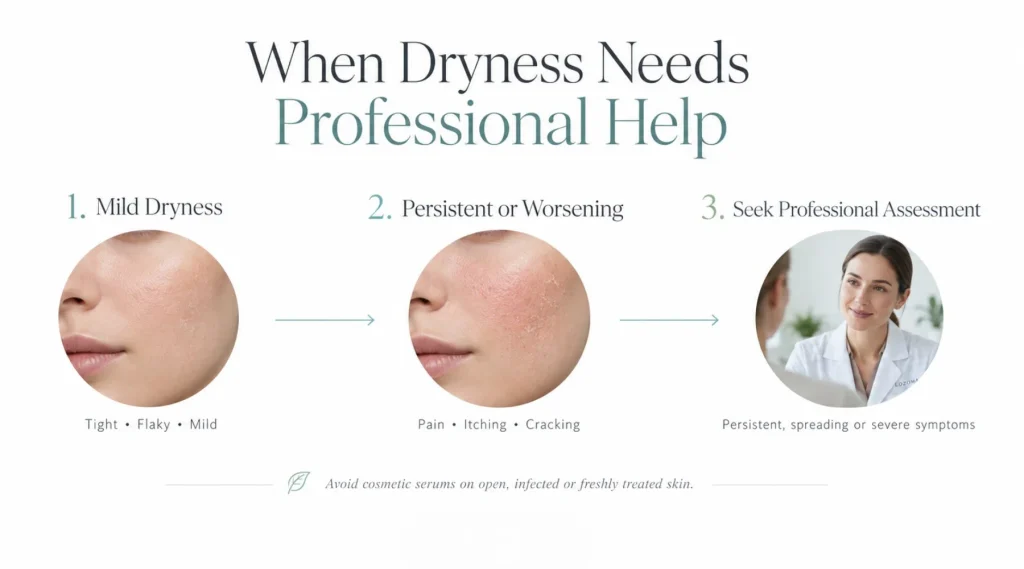
See a doctor, pharmacist, or dermatologist if your dryness is:
- Persistent
- Painful
- Causing cracking or bleeding
- Accompanied by significant itching
- Oozing or crusting
- Causing swelling
- Resulting in a spreading rash
- Leading to thick scaling
- Causing repeated eyelid irritation
- Making you suddenly sensitive to many products
- Interfering with sleep
- Suspected as eczema, psoriasis, rosacea, or contact dermatitis
Get professional help if prescription acne treatments or retinoids are causing ongoing irritation. You might need to adjust your treatment frequency, strength, or skincare routine.
Do not put cosmetic hyaluronic acid serum on open wounds, infected skin, or freshly treated skin unless your clinician allows it.
After procedures like chemical peels, laser treatments, or microneedling, only use the aftercare products your practitioner recommends. Other serums may have ingredients unsuitable for your treated skin.
Questions People Often Ask About Hyaluronic Acid Application
Is it better to apply hyaluronic acid to wet or dry skin?
For best results with a simple hyaluronic acid serum, apply it to slightly damp skin. This allows the serum to spread evenly. You can also apply it to dry skin if the serum is water-based and you follow up with a moisturiser.
How wet should my face be before applying hyaluronic acid?
Your face should feel slightly damp, not dripping wet. After cleansing, pat away any visible droplets and apply the serum before the moisture dries.
Can I apply hyaluronic acid to completely dry skin?
Yes, hyaluronic acid stays active on dry skin. Use a small amount and put moisturiser on top. Applying it on dry skin works well, especially after using vitamin C or retinoids.
What happens if I do not apply moisturiser after hyaluronic acid?
The serum can give temporary hydration, but its water can evaporate. This may cause some people to feel tightness or a sticky feeling. A moisturiser helps keep the extra water.
Can I wet my face after applying hyaluronic acid?
You can apply water over a serum, but it’s often not needed. Using water can cause the serum to run or affect other products. It’s easier to start with slightly damp skin and then apply moisturiser.
Do I apply hyaluronic acid before or after moisturiser?
A regular hyaluronic acid serum should be applied before moisturiser. If your cream already contains hyaluronic acid, use that as your moisturiser.
Can I use hyaluronic acid every day?
Yes, most people can use it every day if their skin tolerates it well. Start with once daily if you have sensitive or acne-prone skin, and only increase when you see clear benefits.
Can I use hyaluronic acid twice a day?
Yes. You can use it in the morning and evening, but you don’t have to. Applying it once a day may be enough if your cleanser, moisturiser, and sunscreen already keep your skin hydrated.
Can you use hyaluronic acid with vitamin C?
Yes. First, apply an acidic vitamin C serum to dry skin. Then, use hyaluronic acid and moisturiser if needed. Finish with sunscreen in the morning.
Can I use hyaluronic acid with retinol?
Yes, hyaluronic acid can help make using retinol more comfortable. Apply retinol to dry skin as instructed, then use a suitable moisturiser. You can also add a hyaluronic acid serum if you want.
Should I use retinol or hyaluronic acid first?
Apply retinol first on clean, dry skin if you can handle it. Then, use hyaluronic acid or a moisturiser. If you have sensitive skin, put on a moisturiser before and after the retinol.
Does hyaluronic acid cause purging?
No, hyaluronic acid does not speed up cell turnover like retinoids or exfoliating acids. Breakouts are more likely caused by the entire product formula, irritation, or changes in your routine.
Why does my skin feel tight after using hyaluronic acid?
You might be using too much product, letting it dry without moisturising, applying it in dry air, or using it on damaged skin. Use less and add a good cream.
Is hyaluronic acid suitable for sensitive skin?
Most people tolerate it well, but sensitive skin might react to fragrance, alcohol, preservatives, or other active ingredients in the serum. Always patch-test the entire product instead of basing your decision on just one ingredient.
Can hyaluronic acid replace moisturiser for oily skin?
Usually not. A serum mainly adds moisture. Oily skin may still need a light moisturiser to prevent moisture loss and support the skin barrier.
Making Hyaluronic Acid on Wet or Dry Skin Work for Your Routine
You can apply hyaluronic acid on wet or dry skin, but damp skin is best for hydration.
Here’s how to do it: Cleanse your skin, gently pat off excess water, apply a thin layer of serum, and then use a moisturiser before your skin feels tight. In the morning, finish with sunscreen.
If you need to use another product like Vitamin C or retinol, it’s better to apply it on dry skin first. You don’t need water underneath every hyaluronic acid product.
What matters is what happens after you apply it. Hyaluronic acid holds water, and a good moisturiser keeps that water from escaping. When you balance both, your skin should feel soft and comfortable, not sticky or tight.
If hyaluronic acid makes your skin feel worse, even when you reduce the amount or simplify your routine, stop using it. It’s helpful, but not essential. Good hydration comes from a full routine that supports your skin barrier, not from forcing one rule.