





Blog
Sunscreen or Suncream: Is There a Difference? Expert Tips


When you go into a British chemist, you will see bottles labelled “sun cream,” “sun lotion,” “facial SPF,” and “sunscreen” all on the same shelf. The names change, but they all serve the same purpose. This raises the question of whether selecting sunscreen or sun cream affects skin protection.
In terms of skincare, sunscreen and sun cream are the same. Both refer to products that help block ultraviolet radiation from harming your skin. “Sun cream” is often used in the UK, while “sunscreen” is common in global skincare and beauty markets. The Cambridge Dictionary even equates sunscreen with sun cream.
The label on the bottle doesn’t determine how well it protects your skin. Protection relies on the SPF rating, the level of UVA coverage, how much product you apply, how evenly it’s spread, and how often you reapply it.
A well-made facial sunscreen may feel different from regular family sun cream, but neither guarantees better performance or gentleness. The label, formulation, and application are much more important than what it’s called.
Sunscreen and Suncream Are Two Names for the Same Type of Product
The term “sunscreen” is widely used around the world. You’ll find it in scientific articles, skincare advice, and product branding. “Suncream” is a common British term, especially for lotions or creams used on vacations, at the beach, or in warm weather.
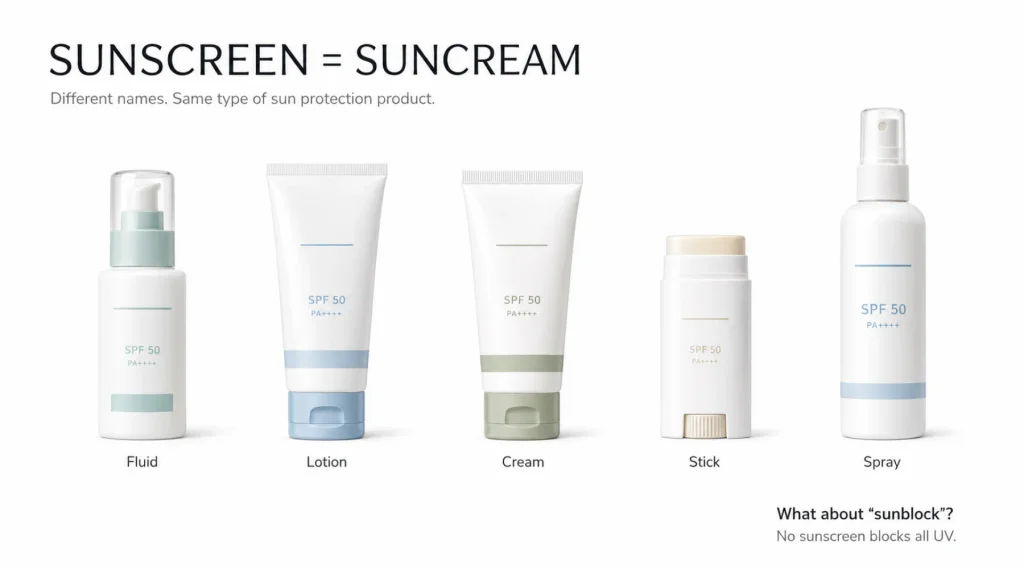
Neither term represents a separate scientific category.
A product called a sunscreen might be:
- A lightweight facial fluid
- A thick body lotion
- A mineral zinc oxide cream
- A spray
- A stick
- A gel
- A moisturiser containing tested SPF
A product called suncream might have exactly the same range of textures and UV filters.
The word “cream” might sound rich, but there’s no standard naming rule for products. Some sun creams are light and soak in quickly, while others labelled as sunscreens are thick and hard to spread. You can’t count on the name to tell you how the product feels.
The same goes for terms like “sun lotion,” “sun protection,” “UV shield,” and “daily SPF.” These are mostly marketing terms. Focus on the real protection claims instead.
What about sunblock?
“Sunblock” suggests total protection from the sun, but no product can block all UV rays, even if applied perfectly. European guidelines advise against terms like “sunblock” and “total protection” because they can give a false sense of safety.
Many people call zinc oxide or titanium dioxide products “sunblock,” which is misleading. These mineral UV filters don’t create a complete barrier. Rather, research shows they primarily absorb UV radiation instead of just reflecting it.
The terms “sunscreen” or “suncream” are more accurate. This applies whether the product uses mineral, organic, or mixed UV filters.
What Matters More Than Whether the Bottle Says Sunscreen or Suncream
A good sun protection product should block both types of ultraviolet radiation: UVA and UVB.

UVB mainly causes sunburn. UVA goes deeper into the skin, leads to tanning and early skin ageing, and can easily pass through windows. Both types can harm skin DNA and increase the risk of skin cancer.
The details below provide more information than just the product name.
| Label information | What it tells you | What to look for |
| SPF | Tested protection against sunburn, driven mainly by UVB exposure | At least SPF 30 for general UK sun protection |
| UVA stars | How balanced the UVA protection is compared with UVB protection | Four or five stars |
| UVA circle | Indicates that the product meets a recommended minimum relationship between UVA and UVB protection | The letters UVA inside a circle |
| Broad spectrum | Indicates protection across UVA and UVB wavelengths | Useful wording, particularly on international products |
| Water resistant | Shows that protection has been tested after a defined period in water | Useful for swimming, sport and heavy sweating |
| Application directions | Explains how and when the product should be used | Follow the stated quantity and reapplication advice |
| Period-after-opening symbol | Indicates how long the product should be used after opening | Commonly shown as an open jar with a number of months |
UK health organisations suggest using sunscreen with at least SPF 30 and four or five stars for UVA protection. Use sunscreen along with clothing and shade, not as an excuse to stay in strong sunlight for a long time.
Knowing what SPF means helps you understand how to protect yourself daily. While SPF is important, it doesn’t cover all kinds of sun damage.
The UVA circle and star rating are not identical.
British shoppers might notice a Boots-style UVA star rating, a circled UVA symbol, or both.
The star system shows how well a product protects against UVA compared to UVB. More stars mean better overall protection relative to the SPF.
The circled UVA logo follows European guidelines. It means the UVA protection is at least one-third of the listed SPF and meets other standards.
Some products can meet UVA standards without the British star rating, especially if they were made for international markets. Still, UK guidance often recommends choosing products with four or five UVA stars when available.
How Sunscreen Protects the Skin From UV Damage
All approved UV filters protect the skin by interacting with UV energy before it can cause harm.
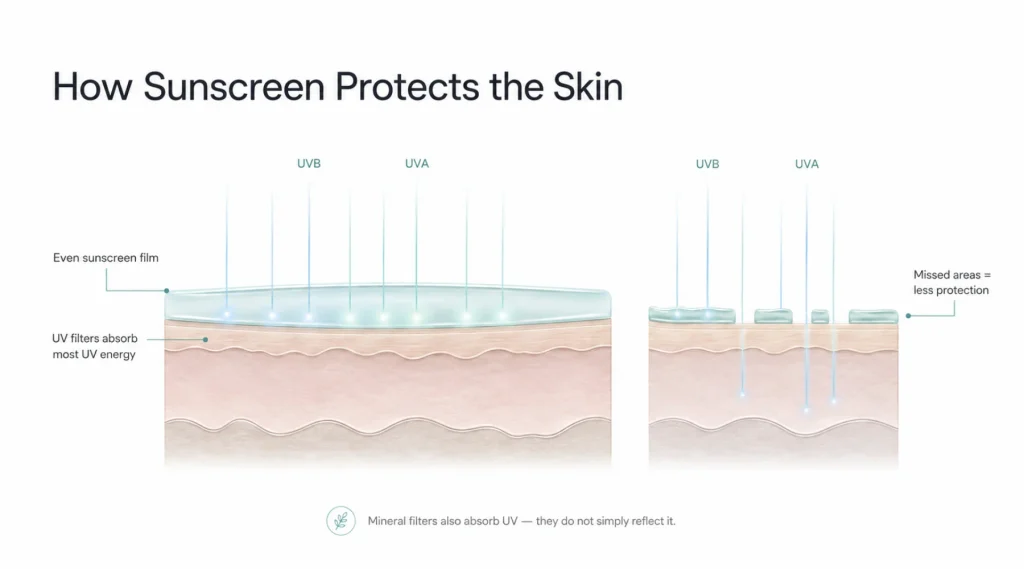
Organic filters, or chemical filters, absorb UV energy and turn it into a small amount of heat. Examples include avobenzone, octocrylene, bemotrizinol, bisoctrizole, and diethylamino hydroxybenzoyl hexyl benzoate. Different regions have their own lists of approved filters.
Mineral filters, which use zinc oxide and titanium dioxide, mainly absorb UV radiation, but they also scatter some light. It’s too simple to say that chemical sunscreens absorb UV while mineral ones just reflect it.
When applied, sunscreen must create a continuous layer on the skin. This layer is important because even the best UV filters can’t protect effectively if the product is too thin, rubbed off, mixed poorly, or missed around the hairline and eyes.
This is why the formulation is important. Ingredients like emulsifiers, film-formers, powders, oils, silicones, humectants, and thickeners determine how well the filters stay distributed. A sunscreen is more than just active filters; it is a complete system designed to form a protective layer.
Why missed areas burn first
Many people forget to apply sunscreen on their nose, ears, temples, hairline, sides of the face, eyelids, lips, neck, and backs of their hands. These areas don’t get any protection from the SPF used on other parts of the body.
Sunscreen only protects where you apply it. For example, putting SPF 50 on your cheeks doesn’t protect your hairline if it’s not covered. A thick layer on your forehead won’t make up for a thin layer on your nose.
Applying sunscreen is not just about using the right amount. It’s more important to cover all areas evenly without leaving any gaps.
Sunscreen or Suncream for Beginners: How to Choose Your First Formula
A beginner doesn’t need the fanciest or most expensive sunscreen. The best choice is one that offers good protection and feels nice to apply in the right amount.
Begin with four questions:
- Does it provide at least SPF 30?
- Does it offer strong UVA protection?
- Can you apply enough without excessive stinging, greasiness, or pilling?
- Will the formula suit the activities you have planned?
For daily commuting, school runs, or short outdoor activities, a comfortable SPF 30 or 50 sunscreen works well if applied correctly. For a full day outside, like during a holiday, sports, gardening, or working under the sun, it’s better to use a water-resistant SPF 50 or higher.
When choosing SPF for daily use, think about your skin type, UV exposure, and how you apply it. A higher SPF provides extra protection, but you still need to apply it generously and reapply often.
Choose by behaviour, not aspiration.
People often choose products they believe they should like instead of ones they will actually use.
A rich mineral cream might seem good for sensitive skin, but it won’t help if you don’t like the white residue and only use a little bit. A lightweight fluid might feel nice, but it’s not the best for swimming unless it is water-resistant.
Think about your real routine:
- Do you wear makeup most days?
- Does sunscreen usually sting your eyes?
- Do you sweat heavily?
- Will you be outdoors for ten minutes or several hours?
- Do you prefer a dewy, natural or matte finish?
- Are you likely to reapply a cream, stick, mist or compact?
- Does your skin become congested under rich products?
- Are you applying it to your face, body or both?
The best sunscreen on paper isn’t always the most effective in real life. It’s better to use a formula that you apply generously and often than one you use sparingly because it feels uncomfortable.
The Best Routine for Sunscreen or Suncream
Put sunscreen at the end of your morning skincare routine.
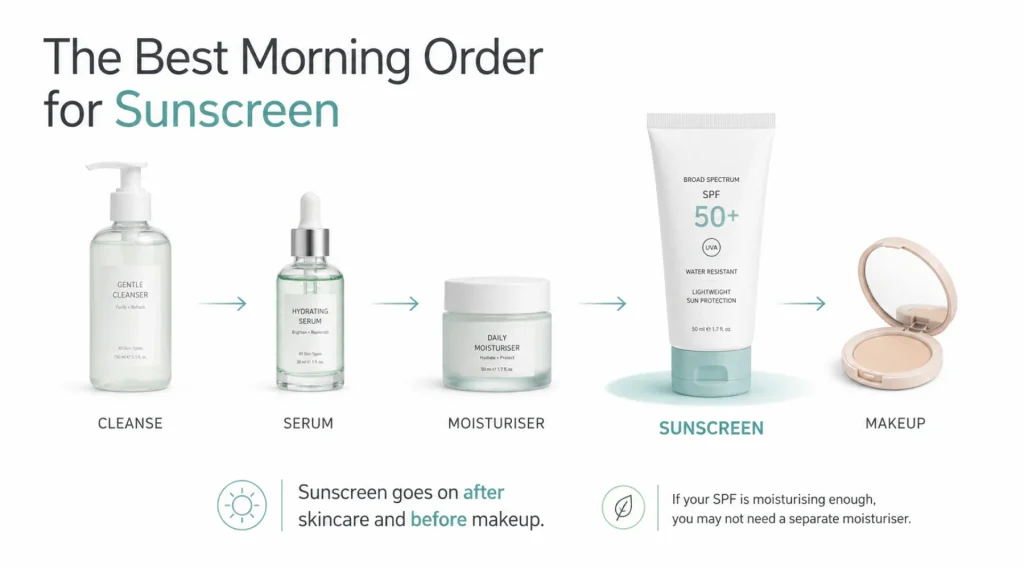
A simple order is:
Cleanser → treatment serum → moisturiser (if needed) → sunscreen → makeup.
Not everyone needs all these steps. Oily skin might only need a hydrating sunscreen over a light serum. Dry skin may need a separate moisturiser underneath. Sensitive skin may benefit from fewer layers.
Sunscreen should be the last step because applying oils or creams on top can ruin its protective barrier. You can apply makeup once the sunscreen has settled.
A practical morning routine
Step 1: Cleanse Gently
Use a mild cleanser or rinse with water suitable for your skin. Harsh cleansers can dry out your skin and make sunscreen sting.
Step 2: Apply Treatments Sparingly
Use vitamin C, niacinamide, and similar serums under sunscreen. Let watery products absorb before applying more.
Step 3: Moisturise for Comfort
Use a moisturiser only if sunscreen alone doesn’t relieve tightness. Pick a compatible texture and let it absorb before the SPF.
Step 4: Use Plenty of Sunscreen
Apply sunscreen generously on your face, ears, and neck. Extend it to your chest if it’s exposed.
Step 5: Let It Settle
Wait a few minutes before applying makeup to avoid streaks and clumps. Settling time can vary by product.
Step 6: Reapply During Exposure
Don’t rely on your morning application all day. Sweat, movement, touching, and water can break down coverage.
Should sunscreen go before or after moisturiser?
Sunscreen usually goes on after moisturiser. If your sunscreen is moisturising enough, you might not need a separate cream. Adding extra layers can make sunscreen slide, pill, or feel heavy. Don’t mix sunscreen with moisturiser in your hand. This can lead to uneven coverage. Apply each product separately.
Can foundation with SPF replace sunscreen?
Foundation with SPF is tested for a specific amount. Most people apply much less than needed for effective protection. Use SPF foundation as an extra layer, not as your only defence. Apply a dedicated sunscreen first, let it dry, and then put on makeup. Powder SPF has similar issues; it can help with touch-ups but isn’t enough on its own to provide even protection.
How Much Sunscreen Is Enough?
Sunscreen testing usually applies 2 milligrammes of product per square centimetre of skin. European guidelines suggest that an adult needs around six teaspoons, or about 36 grams, to cover their body properly.
Most people don’t need to measure their sunscreen every day, but they should realise that a pea-sized amount is usually not enough for the face and neck.
Practical approaches include:
- Applying two generous lines along the index and middle fingers for the face and neck
- Applying the product in two separate passes to reduce missed areas
- Using approximately half a teaspoon for the face and neck, adjusted for individual size and product consistency
- Using around six teaspoons for an average adult body when most skin is exposed
The finger method is an estimate, not a precise scientific measurement. Nozzle width, formula density, finger length, and the area to cover can all differ.
Using two thin layers is often easier than spreading one thick layer. The first layer covers the area, and the second layer fills in any small gaps.
Why underapplication changes the protection
SPF is tested under controlled conditions. If the sunscreen layer is too thin or uneven, it may protect you much less than the number on the bottle suggests.
You don’t need to apply a thick, uncomfortable layer. A good sunscreen should spread evenly. If a product is hard to apply generously, try a different texture instead of using less.
When Sunscreen Needs to Be Reapplied
UK guidelines recommend reapplying sunscreen every two hours, and right after swimming, sweating heavily, or towel drying.
The two-hour mark isn’t a strict rule; it’s a safety guideline. It allows for issues like rubbing off, missing some spots, and ongoing sun exposure.
Reapply sooner when:
- You have been swimming
- You have dried yourself with a towel
- You are sweating heavily
- Clothing or equipment has rubbed the product away
- You have wiped your face repeatedly
- You have been touching or blotting oily skin
- Sand has stuck to the skin
- The product is visibly patchy
Water resistance doesn’t mean waterproof. It shows how well a sunscreen worked in a specific test. Always read the label and reapply after getting out of the water.
Do you need to reapply indoors?
If you work away from windows in a low-UV indoor space, you might not need to reapply sunscreen as often as someone sitting by a bright window or driving for hours.
UVA rays pass through regular window glass more easily than UVB rays. Car side and rear windows offer less UVA protection than laminated windshields.
You should reapply sunscreen more often if sunlight hits your skin directly, the UV index is high, you have a condition that worsens with light, or you’re taking medication that makes your skin more sensitive.
For an ordinary day indoors with little exposure to sunlight, applying sunscreen in the morning should be enough. However, if you’re sitting in a sunny spot or driving for a long time, treat it like outdoor exposure.
Sunscreen or Suncream for Sensitive Skin
Sensitive skin doesn’t always need mineral sunscreen, and mineral sunscreen isn’t always gentle.
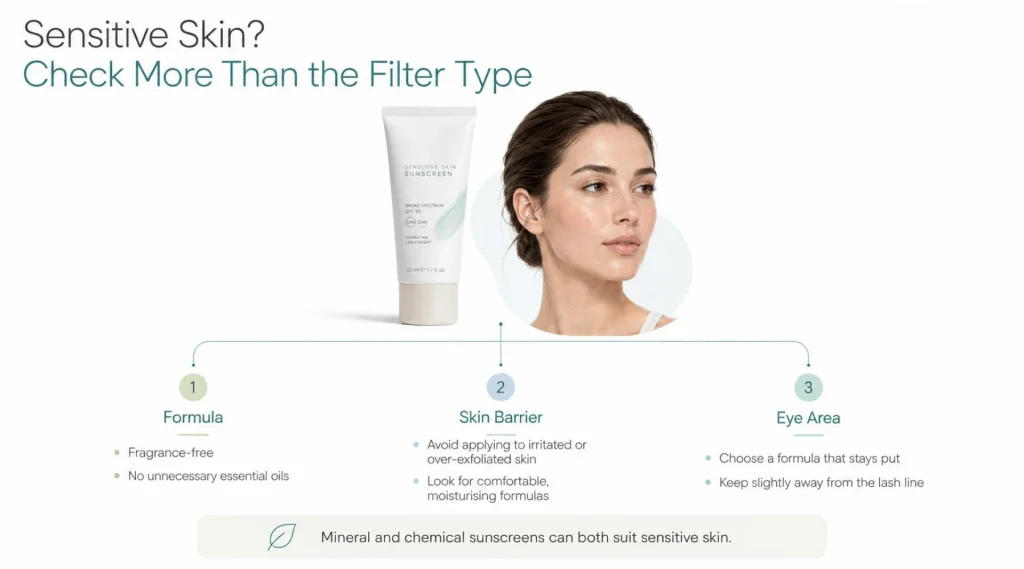
Both mineral and chemical sunscreens can work well. Irritation can come from UV filters, but it might also be caused by fragrance, preservatives, alcohol, plant extracts, or the mix of ingredients.
A sunscreen for sensitive skin is more likely to be effective when it is:
- Fragrance-free
- Comfortable around the eyes
- Free from unnecessary essential oils
- Easy to remove without aggressive cleansing
- Moisturising enough to prevent tightness
- Compatible with eczema, rosacea or acne treatments when relevant
- Applied to an intact skin barrier
Stinging happens more often when your skin is already irritated. Things like recent exfoliation, too much retinoid use, sunburn, shaving, eczema, and strong cleansers can make a usually fine sunscreen feel painful.
Patch testing has limits.
Put a small amount of sunscreen on the side of your face or behind your ear for a few days. This can help you see if you have any irritation or allergic reaction. However, it won’t show how the sunscreen works on your full face, near your eyes, with makeup, or when you sweat.
After testing on a small area, try the sunscreen on your whole face on a calm day before using it for an event or trip.
If you have swelling, hives, blisters, or ongoing skin issues after using sunscreen, consult a doctor. A dermatologist may suggest allergy tests if needed.
Eye stinging does not necessarily mean the whole formula is unsuitable.
Sunscreen can get into your eyes from sweat, facial oils, or if you apply it too close to your lashes.
Useful adjustments include:
- Using a more water-resistant formula around the eyes
- Applying a mineral sunscreen stick to the orbital area
- Leaving a very small margin beside the lash line
- Allowing the sunscreen to set before exercise
- Wearing sunglasses and a hat for additional protection
- Avoiding heavily fragranced products near the eyes
Protect your eyelids. The skin around your eyes is sensitive to UV damage, so use a gentle product with your sunglasses and stay in the shade.
Matching the Formula to Your Skin Type
The best sunscreen isn’t based on just one ingredient. The texture, formula, and other ingredients often determine how comfortable it feels on your skin.
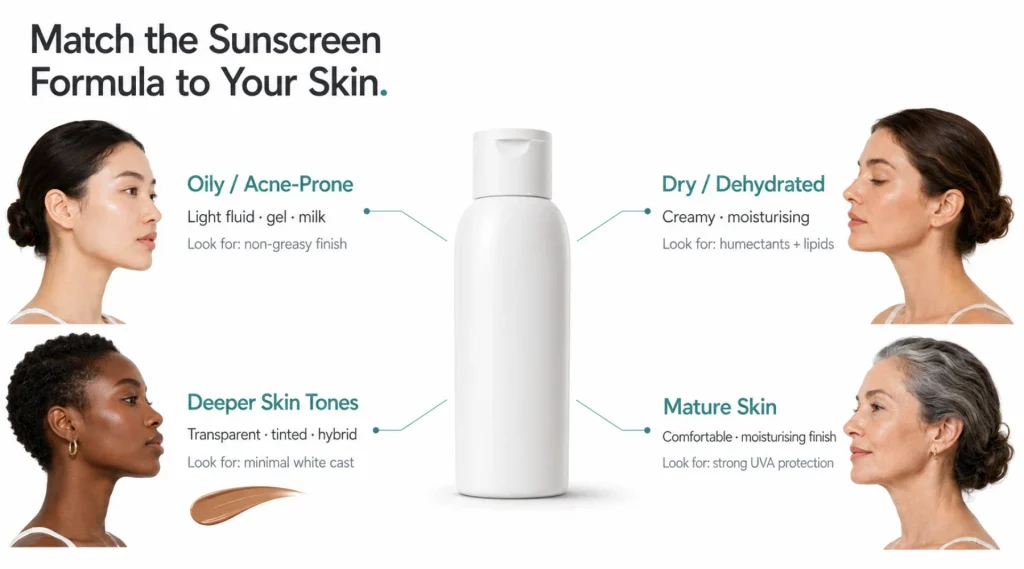
Oily and acne-prone skin
Choose fluids, gels, milks, or light lotions that dry without feeling greasy. The term “non-comedogenic” can be helpful, but it doesn’t ensure that everyone with acne will stay breakout-free.
A sunscreen may appear to cause acne when the real issue is:
- Inadequate cleansing at night
- A very occlusive base
- Heavy makeup layered over SPF
- Sweat trapped under the product
- Friction from hats, straps or masks
- A new acne cycle unrelated to the sunscreen
- Irritation that resembles small breakouts
Introduce one new formula at a time and assess it over several days. Remove it gently but thoroughly at night.
Dry or dehydrated skin
Creamy sunscreens with humectants, emollients, and protective lipids can eliminate the need for a separate moisturiser. Ingredients like glycerine, squalane, ceramides, and some oils can increase comfort.
Matte formulae can highlight dry, flaky skin. If you use retinoids or exfoliating acids, treat dryness first before thinking you need stronger products.
Deeper skin tones
White cast is a big usability issue, especially in products with high levels of zinc oxide or titanium dioxide. A sunscreen that leaves a grey or purple layer can be hard to apply in the needed amount.
Consider:
- Tinted mineral sunscreen
- Transparent organic-filter fluids
- Hybrid formulae
- Products designed and tested on a broad range of skin tones
- Iron-oxide tints when visible-light protection is relevant to pigmentation
Tinted formulae help with melasma and stubborn dark spots because iron oxides provide extra protection against visible light. The tint must match the skin closely for effective coverage.
Mature skin
Comfort and consistency are more important than just picking a product called “anti-ageing.” UVA rays cause uneven skin tone, loss of firmness, and visible signs of ageing, so good protection against UVA is crucial.
A moisturising finish spreads more evenly over fine lines than a matte product. Antioxidants are helpful, but they can’t replace well-tested SPF.
Mineral vs Chemical Sunscreen Is a Formula Choice, Not a Language Difference
Sunscreen and suncream are the same. Both can refer to mineral, organic, or mixed protection.
The difference between mineral and chemical sunscreens lies in the UV filters and how they’re made, not in the word “cream” on the package.
| Formula type | Typical strengths | Possible drawbacks |
| Mineral | Often suitable for reactive skin; protection begins once an even film is present; zinc oxide can provide broad UVA and UVB coverage | White cast, thicker texture, pilling or dryness |
| Organic-filter | Often lighter, clearer and easier to wear under makeup; modern filters can provide strong UVA protection | May sting some eyes or irritated skin |
| Hybrid | Can balance cosmetic elegance, coverage and filter stability | Suitability still depends on the complete formula |
Mineral sunscreen is often called safer or more natural, but this needs explanation. Zinc oxide and titanium dioxide are processed minerals, while chemical filters are carbon-based molecules. The term “natural” doesn’t really reflect how well sunscreen works.
Both types can be effective if the product is well-formulated, tested, and applied correctly.
Ingredients alone cannot prove the SPF.
Just seeing zinc oxide on an ingredient list doesn’t show how effective the sunscreen is. Its performance depends on concentration, particle properties, how it spreads, and the rest of the formula.
This matters especially for handmade balms, facial oils, and products that claim to have “natural SPF.” Ingredients like raspberry saeed oil, coconut oil, and shea butter should not replace a tested sunscreen.
When looking at a zinc-based balm like Beef Tallow Sunscreen with Zinc Oxide, check the package for the SPF level, UVA protection, water resistance, and application instructions. Zinc oxide alone doesn’t guarantee protection.
Browsing sun protection products can help you compare options, but always rely on the label for SPF and UVA information.
Can Sunscreen Prevent a Tan?
Sunscreen can reduce tanning by blocking some UVA and UVB rays, but it won’t completely prevent skin colour changes. No sunscreen offers 100% protection. Some UV rays can still reach your skin if you don’t apply enough, apply it unevenly, rub it off, or forget to reapply.
Tanning doesn’t mean your skin is healthier or stronger. It’s a reaction to UV damage. When you get UV exposure, your body produces more melanin to protect your skin from further harm.
While a tan might hide sunburn, it doesn’t make sun exposure safe. Both sunburn and tanning are signs of skin damage, according to British dermatology guidelines.
Does sunscreen keep you from tanning completely?
Usually not.
A good SPF 50 sunscreen with strong UVA protection can greatly reduce tanning. However, several factors affect the results:
- The strength of UVA protection
- The amount applied
- Reapplication
- Time spent outdoors
- UV index
- Skin tone and tanning response
- Sweat and water exposure
- Whether protective clothing is worn
- Whether the skin is exposed through windows
Someone who sunbathes for hours might still tan even with sunscreen because it doesn’t block all the UV rays, and they still get a lot of UV exposure.
Can you still tan with sunscreen?
Yes, you can still get a tan while using sunscreen. This doesn’t mean the sunscreen doesn’t work.
Sunscreen lowers your exposure to UV rays, but it doesn’t block all sunlight. Even a little UV can add up over a long day.
Using sunscreen to tan is not a safe choice. Staying outside until your skin changes colour still exposes it to harmful rays.
Does sunscreen stop you from tanning if you reapply?
Reapplying can boost protection and may lessen tanning, but it can’t ensure full prevention.
The most effective approach combines:
- High UVA and UVB protection
- Generous application
- Reapplication
- Shade
- Protective clothing
- A wide-brimmed hat
- UV-protective sunglasses
- Avoiding deliberate tanning
Sunscreen is one part of photoprotection, not a licence to maximise sun exposure.
Can You Tan Using Sunscreen SPF 50?
You can still get a tan while using SPF 50, especially if you spend a lot of time outside.
SPF 50 means that, in tests, around one-fiftieth of the sunburn-causing UV rays reach your skin when using the sunscreen compared to not using it. It doesn’t mean you’re protected for 50 hours or that all UVA rays are blocked.
Although SPF 30 filters about 97% of UVB rays and SPF 50 filters about 98%, the difference matters. SPF 30 lets in about one-thirtieth of harmful rays, while SPF 50 lets in about one-fiftieth. This difference can be important for people with fair skin, skin sensitivities, or those who are in the sun for a long time. High SPF still needs to be applied correctly.
SPF 50 may reduce tanning better than a lower SPF if both offer similar UVA protection and are applied properly. UVA protection is key because it strongly affects immediate and lasting tanning.
If you apply SPF 50 poorly, it may provide less protection than a well-applied SPF 30. Choose a higher SPF when needed, but remember that it doesn’t replace good sun safety habits.
Which is the Best SPF Sunscreen?
There isn’t one perfect SPF sunscreen for everyone. A good sunscreen should provide proven protection, feel good on the skin, and be right for the occasion.
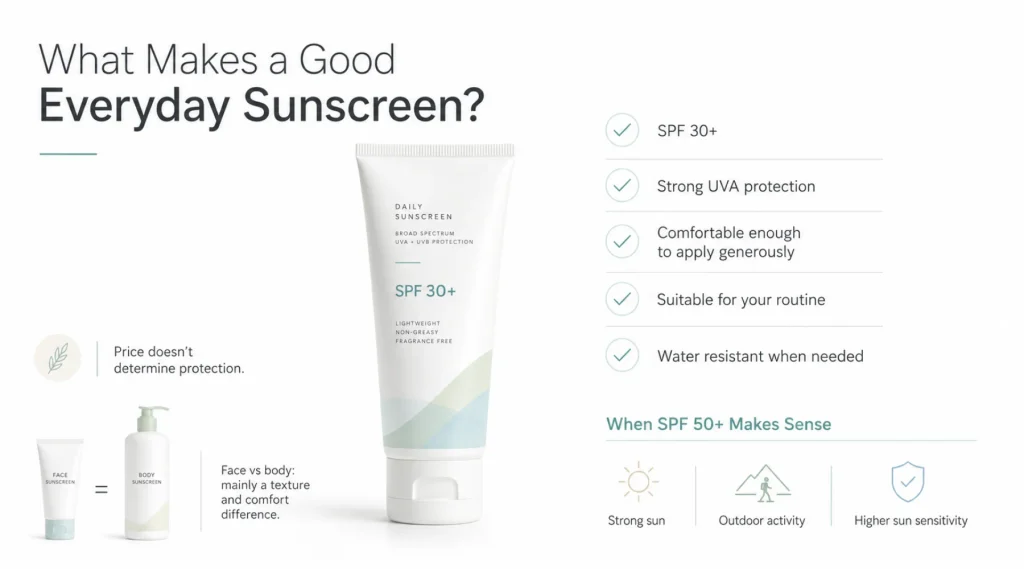
For most adults, a strong everyday choice has:
- SPF 30 or higher
- Four- or five-star UVA protection, or a recognised UVA symbol
- A texture that can be applied generously
- Acceptable comfort around the eyes
- Packaging that supports regular use
- Water resistance when swimming or sweating
- A finish compatible with makeup or facial hair when relevant
SPF 50 or 50+ is often preferable for:
- Holidays in sunny climates
- Outdoor work
- Hiking, sport or gardening
- Very fair or easily burned skin
- A history of skin cancer
- Photosensitive medical conditions
- Medication that increases sun sensitivity
- Melasma or stubborn pigmentation
- Use after certain dermatological procedures, following professional advice
Price doesn’t guarantee protection. A budget sunscreen that meets standards and is used correctly can work better than an expensive one used lightly.
Face and body sunscreens do not need different protection systems.
Facial sunscreen is made to look nice on the skin. It is often less greasy, has less scent, and is easier to wear under makeup.
Body sunscreen usually comes in larger bottles and can often be used on the face, depending on how your skin reacts to it. The difference isn’t in the sun protection but in how your skin tolerates the products.
You can also use facial sunscreen on your body, but it may be pricey for larger areas. It’s best to choose different products if it helps you use them more regularly. There’s no strict rule that you need different types of UV filters for your face.
UK Weather Does Not Make Sunscreen Unnecessary
Cool weather and clouds can make you think you’re safe from the sun. Heat and UV rays come from sunlight but are different things.
On a breezy spring day, the UV index can still be high even if it feels cold. Thin clouds can block visible light but let a lot of UV radiation reach us.
Instead of just checking the temperature, look at the UV index. Protect yourself more when the UV index is 3 or higher, especially if you’re outside for a long time.
In the UK, UV rays are usually strongest around midday in spring and summer. Cancer Research UK recommends finding shade, especially between 11 am and 3 pm, wearing protective clothing, and using sunscreen with at least SPF 30 and four or five stars for UVA protection.
Do you need sunscreen in winter?
Winter use depends on location, activity, and personal risk.
Routine facial sunscreen remains valuable when:
- You spend time outdoors during daylight
- You use retinoids or treatments that increase sensitivity
- You are managing melasma or post-inflammatory pigmentation
- You sit beside windows
- You are at altitude
- Snow is present
- You have a history of sun damage or skin cancer
If you stay inside in northern Britain on a low-UV winter day, using sunscreen all over your body might not help much. It’s important to think about your actual sun exposure.
Using sunscreen daily is a good habit, but remember it should relate to the conditions it aims to protect against.
Mistakes That Reduce Sunscreen Protection
Applying Too Little
A thin layer of sunscreen won’t give you the protection you need. Apply enough for full, even coverage.
Relying on SPF in Makeup
Most people don’t use enough foundation to get the sunscreen benefits. Use dedicated sunscreen underneath.
Missing the Edges of the Face
Don’t forget to apply sunscreen to your hairline, ears, jaw, eyelids, and neck.
Mixing Sunscreen with Moisturiser
Mixing can weaken the sunscreen. Apply each product separately.
Applying Facial Oil Over Sunscreen
Oil can disrupt the sunscreen’s protection. Use oils earlier in your skincare routine or at night.
Skipping Reapplication Because of High SPF
SPF 50 won’t last forever against sweat, friction, and water. Reapply based on your activity and the label.
Using an Old Bottle from a Hot Car
Heat and long storage can damage sunscreen. Check the expiration date and replace any products that smell off or have changed texture.
Assuming Water Resistant Means Waterproof
No sunscreen stays effective after prolonged water exposure. Reapply after swimming and towel drying.
Using Sunscreen as the Only Protection
Shade and clothing can protect you better than relying solely on sunscreen.
Avoiding Sunscreen Due to Vitamin D Concerns
Using sunscreen doesn’t guarantee vitamin D deficiency. If you’re worried, talk to a healthcare professional about diet and supplements instead of risking UV damage.
Common Sunscreen and Suncream Myths
“Suncream is thicker and sunscreen is lighter”
Sometimes, but not by definition. The words do not follow a regulated texture classification.
“Mineral sunscreen stays on the skin, while chemical sunscreen absorbs into the bloodstream”
Both types create a layer on the skin and respond to UV rays. The idea of “reflect versus absorb” is outdated. You should choose a sunscreen based on the whole product and its safety data.
“SPF 50 is only slightly better than SPF 30”
The percentage comparison doesn’t show the difference in UV protection. SPF 50 can offer extra safety, especially since people often apply sunscreen imperfectly.
“Dark skin does not need sunscreen”
Dark skin has some natural protection from sun damage, but it can still burn and develop issues like hyperpigmentation and skin cancer. People with darker skin may delay seeking help for skin cancer because they think they are safe.
“A base tan protects you”
A tan offers very limited protection and shows that your skin has been damaged by UV rays. It does not make sunbathing safe.
“Natural oils work as sunscreen”
Natural oils might block a small amount of UV rays, but they cannot replace a sunscreen that has been tested for SPF and UVA protection.
“Once-a-day sunscreen never needs reapplication”
Sunscreen labelled as “once-a-day” still needs reapplication. Sweat, swimming, and uneven application can weaken its effectiveness. UK cancer guidelines recommend reapplying sunscreen regularly, even if it claims to last all day.
“Sunscreen is only necessary when it is hot”
You should wear sunscreen even when it’s not hot. UV rays can still harm your skin on cool, sunny days.
Building a Sun-Safe Routine That Works Beyond Skincare
Sunscreen works best as part of a larger sun protection plan.
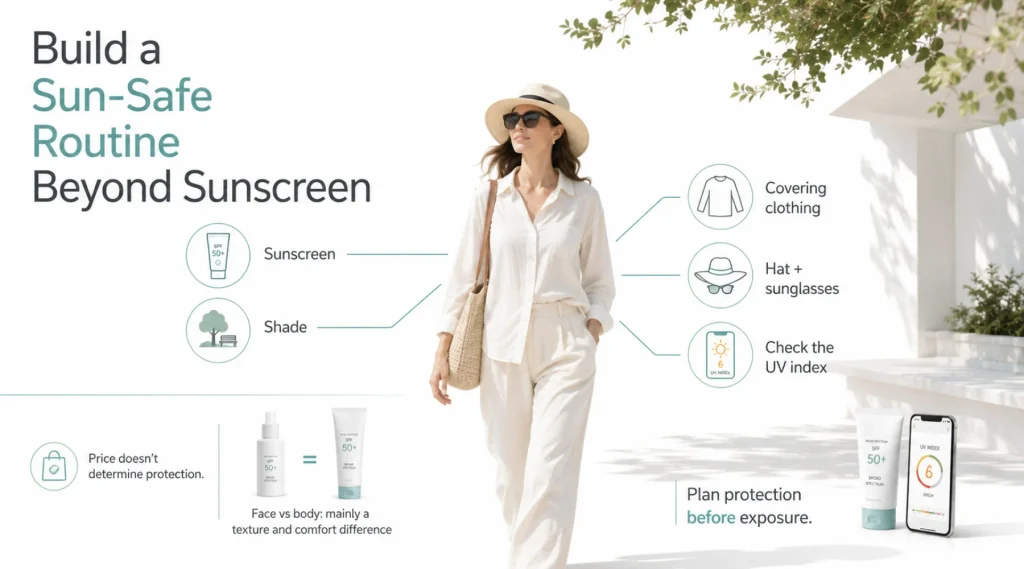
Stay in the shade during peak sun hours. Wear tightly woven clothes that cover your shoulders and chest. Use a hat to shield your face, ears, and neck. Choose UV-protective sunglasses.
Clothing is especially helpful for kids, outdoor workers, and anyone who finds it hard to reapply sunscreen frequently. Unlike sunscreen, clothes don’t miss spots due to sweat or application errors, but loose or wet fabric may offer less protection.
Plan your day to avoid sun exposure instead of waiting until your skin feels hot. Check the UV index before going for walks, playing sports, gardening, or travelling. Bring enough sunscreen for reapplication, rather than a nearly empty bottle.
When you get home, remove sunscreen gently. A cleansing oil, balm, or micellar water can help break down water-resistant sunscreen. Follow up with a mild cleanser if needed. Avoid scrubbing to protect your skin barrier.
Your overall skincare routine should support sunscreen use, not interfere with it. If multiple products cause pilling, simplify your morning routine. Sun protection offers long-term benefits over trying to use every ingredient at once.
Questions People Still Ask About Sunscreen and Suncream
Is sunscreen or suncream better?
Both terms are the same. They refer to sun protection products. Focus on factors like SPF, UVA rating, water resistance, texture, and skin compatibility instead of the name on the label.
Is suncream the British word for sunscreen?
Yes, “suncream” is common in British English, while “sunscreen” is used more internationally. Both terms are understood in the UK.
Can sunscreen prevent a tan?
Sunscreen can reduce tanning by blocking UV rays, but it can’t completely stop it. No sunscreen offers full protection, especially if it’s not applied enough or if exposure is too long.
Does sunscreen keep you from tanning at SPF 50?
SPF 50 can lower UV exposure and might limit tanning, especially if it has good UVA protection. However, some UV rays still reach your skin, and real-life application is often imperfect.
Will you still tan with sunscreen on holiday?
Yes, you might still tan. Being outdoors for long periods increases UV exposure, even with sunscreen. Reapply regularly, seek shade, and cover your skin instead of trying to tan.
Does sunscreen stop you from tanning through a window?
It can lower UVA exposure through windows if it offers good UVA protection. Normal glass blocks most UVB rays but lets some UVA through, especially in car windows.
Can you tan using sunscreen without burning?
Yes, you can tan without burning, but that doesn’t mean it’s safe. UVA rays can tan the skin and cause cellular damage without immediate redness.
Can you tan safely with SPF 50 sunscreen?
There’s no completely safe way to deliberately tan using UV rays. SPF 50 reduces exposure but doesn’t eliminate the DNA damage from tanning. Self-tanners can add colour without UV exposure, but check that they provide SPF if needed.
Should sunscreen be applied every day in the UK?
Yes, use sunscreen daily if the UV index is high, you spend time outside, sit near bright windows, or have a sun-sensitive condition. Your actual sun exposure matters more than just the season.
Is SPF 30 enough for everyday use?
SPF 30 with good UVA protection is a minimum for sun protection in the UK. SPF 50 offers better protection and is better for long exposure, fair skin, pigmentation issues, or sensitivity to sunlight.
Is mineral sunscreen better for sensitive skin?
Sometimes yes, but not always. Zinc oxide sunscreens can be good for some sensitive skin types but may feel heavy or irritating to others. Fragrance, preservatives, and the skin barrier’s condition can also affect how well your skin tolerates it.
How long should sunscreen settle before makeup?
Let sunscreen dry and form an even layer before putting on makeup. Most formulae need just a few minutes. Don’t rub too hard, as this can cause gaps or pilling.
Can moisturiser with SPF replace sunscreen?
It can if you apply the right amount and it has good UVA protection. However, people often apply moisturiser too thinly. A dedicated sunscreen may be easier to apply generously.
Should you apply sunscreen before going outside?
Follow the product instructions. Many UK health sources suggest applying it 15 to 30 minutes before going outside and reapplying regularly. Mineral sunscreens don’t need time to activate, but applying early helps even out the coverage.
Why does sunscreen pill over skincare?
Pilling happens when too many layers are used, products don’t mix well, they aren’t fully dry, or the skin is rubbed too much. Use fewer morning products, apply thin layers, wait for each to settle, and gently press on makeup.
Choosing Sunscreen or Suncream Without Overcomplicating It
The debate about sunscreen and suncream is mainly about words. In the UK, both terms mean products that protect the skin from UV rays. Neither one is automatically better, safer, or more suitable for the face.
Evaluate the product based on its SPF rating, UVA protection, water resistance, and how easily you can apply it. Use additional protection like shade, clothing, and a hat, and remember to reapply it regularly.
For beginners, keep the routine simple. Use sunscreen as the last step in your morning skincare routine, cover all exposed skin, and don’t mix it with other products. Choose a texture that suits your skin rather than following trends.
For sensitive skin, check the full ingredient list and your skin’s condition. For acne-prone skin, choose comfortable and easy-to-remove formulae. If you’re concerned about pigmentation, focus on UVA coverage and consider a tinted option. For long days outside, use SPF 50 or higher, water-resistant products, and additional physical protection.
Whether you say sunscreen or suncream, it only works where you apply it and as well as the layer you maintain.