




Blog
Mandelic Acid for Sensitive Skin: Benefits and Safe Use

Sensitive skin has a tricky relationship with exfoliation. Exfoliating acids can help with rough texture, clogged pores, and marks from blemishes, but they can also make sensitive skin feel tight, hot, or red if used too harshly.
Mandelic acid has gained attention for sensitive skin. As an alpha hydroxy acid (AHA), its larger structure makes it easier to tolerate than other faster-acting AHAs.
However, “gentler” doesn’t mean it won’t irritate. Mandelic acid still exfoliates, and sensitive skin can become over-exfoliated, especially when combined with other strong products like retinoids and vitamin C. The advantage of mandelic acid is that it provides a balanced option for those seeking smoother, clearer skin without resorting to harsh exfoliants.
The best approach is to start with a gentle formula, introduce it slowly, protect the skin barrier, and allow time for it to work.
Is Mandelic Acid Good for Sensitive Skin?
For many people, yes. Mandelic acid can be a good choice for sensitive skin if your skin barrier is healthy and you start using it slowly.
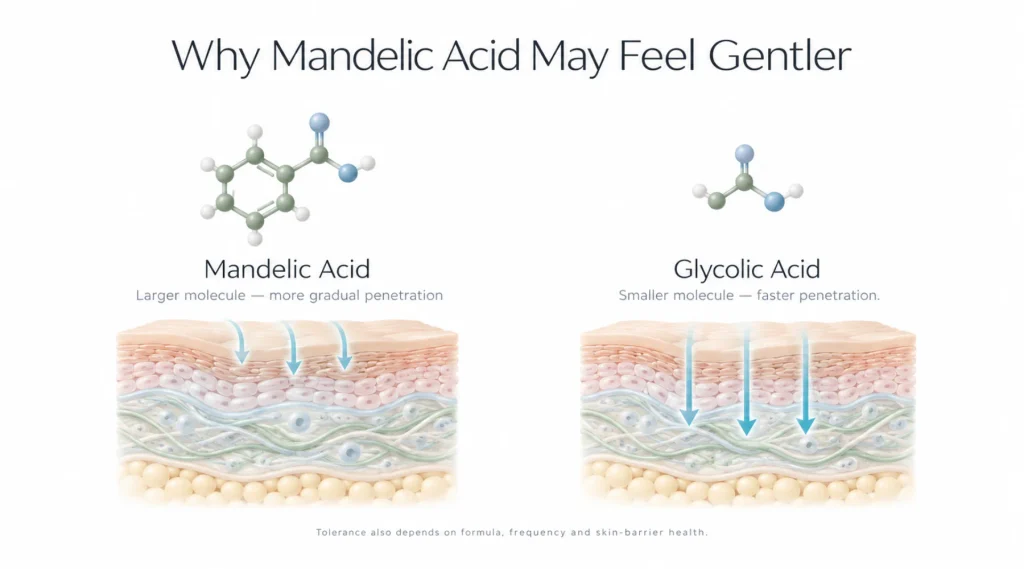
Mandelic acid has a molecular weight of about 152.15 g/mol, making it larger than glycolic acid, which is small and penetrates the skin quickly. This size difference is one reason why mandelic acid is seen as a gentler exfoliant.
However, how irritating mandelic acid feels also depends on:
- its concentration
- the final pH of the formula
- how much free acid is present
- the delivery system
- whether it is a wash-off or leave-on product
- how often you use it
- what other active ingredients you have in your routine
- the state of your skin barrier.
A well-made mandelic acid serum used twice a week may feel good on sensitive skin. But a stronger peel used too often could irritate.
So, it’s better to say that mandelic acid is usually easier to tolerate than many traditional AHAs, but it isn’t guaranteed to be safe for all sensitive skin.
Sensitive skin is not one single skin type
“Sensitive skin” can refer to a few different cases.
Some people have skin that reacts strongly to acids, fragrances, or harsh cleansers. Others may experience temporary sensitivity after too much exfoliation, using retinoids, sun exposure, or a damaged skin barrier.
There are also conditions like eczema, rosacea, and contact dermatitis that can cause significant sensitivity.
These cases need different treatments. If your face burns with regular moisturiser, adding mandelic acid probably won’t help. Exfoliation is most effective when your skin is stable enough to handle it.
What Mandelic Acid Actually Does to the Skin
Mandelic acid is a type of alpha hydroxy acid (AHA) that helps the skin shed dead cells. This process makes the skin look and feel better.
Healthy skin keeps renewing itself. New skin cells form deeper in the epidermis, move up, and create the outer layer called the stratum corneum, which protects the skin. Eventually, these outer cells are shed.
When shedding isn’t smooth, the skin can feel rough or look dull. Dead cells can also clog hair follicles.
AHAs help cells stick together less tightly, making it easier for the skin to shed old cells.
Regular exfoliation can make the skin look:
- Smoother
- Brighter
- Less flaky
- More even
- Less congested
This method is different from using physical scrubs, which rely on friction. Mandelic acid works chemically, so you don’t have to rub your skin hard.
Mandelic acid is still a real AHA
Mandelic acid is often seen as a “gentle acid,” which makes some people think it acts like a hydrating serum. It does not.
You don’t need to see visible peeling for it to work, but it still helps with exfoliation. Too much use can cause dryness, burning, redness, tightness, and increased sensitivity, just like with other acids.
The FDA says cosmetic AHAs can make your skin more sensitive to UV rays, so sunscreen is essential while using them. For sensitive skin, sunscreen and moisturiser are not just extras; they are necessary for a comfortable routine.
Why Mandelic Acid Can Suit Reactive Skin Better Than Faster AHAs
Mandelic acid is appealing not because it avoids the skin’s surface, but because it allows for a gentler way to exfoliate. Smaller, more penetrating acids can work well, but they might cause stinging for sensitive skin.
Mandelic acid has a larger structure, which makes it less irritating. However, not all studies show it is less irritating than other AHAs. The formulation is key, and many studies focus on strong professional peels rather than the lower-strength products used at home.
This is an important distinction. Research on professional peels shows that treatments with mandelic acid are effective for issues like acne and pigmentation, with some studies noting good tolerability. One study compared 45% mandelic acid peels with 30% salicylic acid peels for mild-to-moderate acne and found similar improvement but fewer side effects with mandelic acid.
These results highlight mandelic acid’s benefits, but a professional 45% peel does not mean you should try high-strength acids at home.
What Sensitive Skin Can Realistically Gain From Mandelic Acid
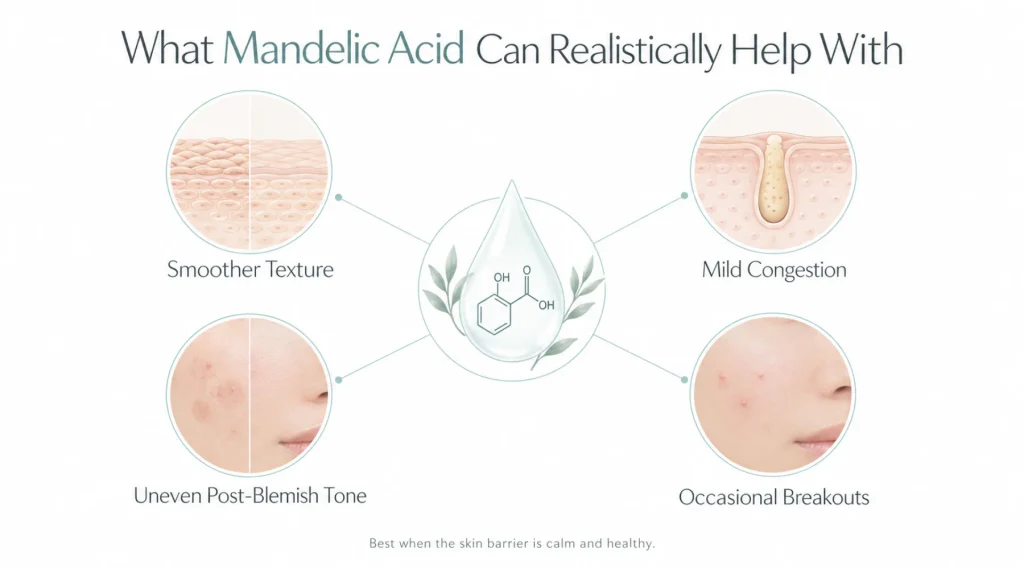
Mandelic acid is best for treating skin issues with too much surface buildup, not for serious inflammation or a damaged barrier.
Smoother texture without aggressive scrubbing
Mandelic acid is a simple solution for rough skin. It helps the skin shed dead cells, making uneven areas feel smoother over time. This can be helpful for dull skin or when makeup clings to rough patches, but it won’t help if dryness is the main issue.
It’s important to distinguish between different types of rough skin. If the roughness is due to too many dead cells, exfoliation can help. However, if the skin is rough because it is dehydrated and cracked, exfoliating may make it worse.
If roughness comes with burning, scaling, redness, or tightness after washing, focus on moisturising instead.
Help with mild congestion
Mandelic acid helps prevent surface buildup that can clog pores. It’s useful for people who have:
- Small bumps
- Mild closed comedones
- Occasional blemishes
- Uneven skin texture after acne
However, it may not be the best choice for stubborn oily blackheads. Salicylic acid works better for oil-rich pores and can treat pronounced blackheads and oily skin. For persistent acne, a broader treatment may be necessary, which emphasises the importance of matching the right ingredient to the blemish type.
People with sensitive skin and a few blocked pores might prefer the gentler approach of mandelic acid.
Gradual improvement in post-blemish uneven tone
Mandelic acid helps improve uneven skin caused by old blemishes. It gently removes dark cells as they rise to the skin’s surface, and regular skin renewal makes light spots less noticeable over time.
Clinical studies on professional peels with mandelic acid show positive results for post-acne dark spots. However, these studies are small and often use combinations, like salicylic acid mixed with mandelic acid, instead of just mandelic acid alone.
These findings suggest you should have realistic expectations, as mandelic acid won’t fix pigmentation overnight. It can help create a more even skin tone, but daily sunscreen is crucial. Sun exposure can slow down the improvement of uneven skin tone.
Support for acne-prone sensitive skin
Mandelic acid is a helpful choice for those who need something between no exfoliation and a strong acne treatment.
Research on professional mandelic acid peels shows benefits for both inflammatory and non-inflammatory acne, but studies vary widely in quality.
For someone with a few recurring spots, mandelic acid can be a good addition to their skincare routine. However, for painful nodules, cystic acne, or breakouts that may leave scars, it’s not sufficient.
Sensitive Skin and a Damaged Skin Barrier Are Not the Same Thing
This distinction can prevent a lot of irritation.
You may have sensitive skin but still have a functioning barrier. Your skin might react to strong products, but it can stay comfortable with a simple routine.
A damaged barrier is different.
The outer layer of skin usually keeps water in and blocks irritants. When this layer is disrupted, you may lose water, and products that used to feel fine may start to sting.
Signs of a damaged barrier include:
- Moisturiser feels like it’s burning;
- Skin feels tight after washing;
- Unusual flakiness;
- Redness that lasts for hours;
- Skin feels oily but dry;
- Tenderness when touching your face;
- Products that were fine now sting;
- Skin looks shiny and smooth after too much exfoliation.
Don’t use mandelic acid to try to fix these symptoms.
Take a break from acids and irritating treatments. Use a gentle cleanser, a simple moisturiser, and daily sunscreen until your skin calms down.
Only think about restarting exfoliation when your regular skincare routine feels comfortable again.
How to Use Mandelic Acid for Sensitive Skin
The safest routine is rarely the one that reaches daily use fastest.
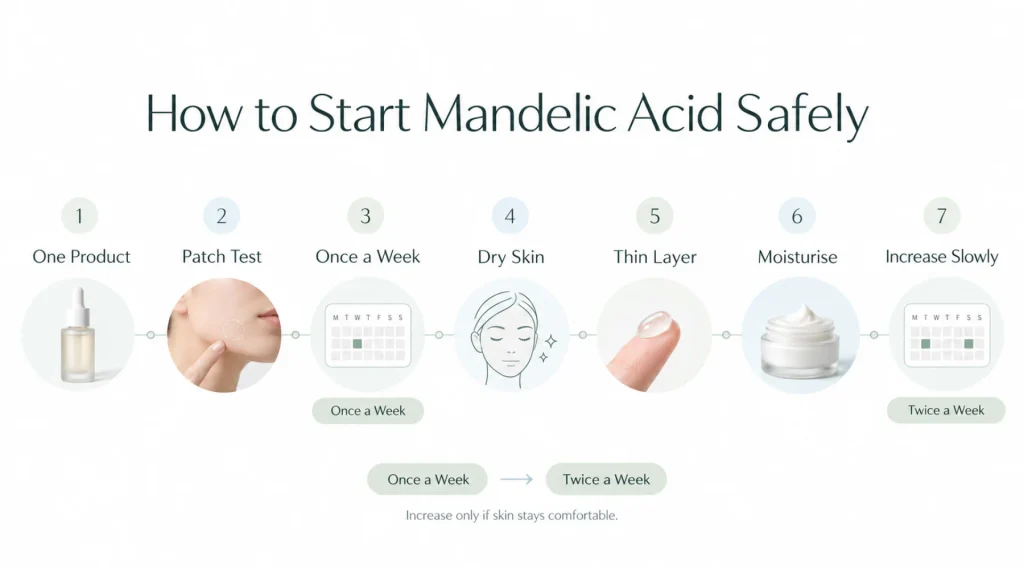
Sensitive skin benefits from having enough time between applications for you to identify delayed dryness or irritation.
1. Start with One Product
Choose one mandelic acid product, like a toner, serum, or cleanser. Using one at a time helps you see how your skin reacts and prevents a harsh routine.
2. Patch Test First
Try a small amount of the product on a hidden spot. This won’t guarantee you won’t have a reaction later, but it can show if you might react. Don’t test on freshly shaved or irritated skin.
3. Begin Once a Week
If your skin is very sensitive, start using the product once a week. Keep your evening routine simple:
- Gentle cleanser
- Mandelic acid
- Moisturiser
No need for extra exfoliants or strong treatments.
4. Apply to Dry Skin
Put the acid on dry skin to avoid irritation. After cleansing, gently pat your face dry. You don’t need to wait too long unless the product says so.
5. Use a Thin Layer
Apply a light layer of acid as directed. Avoid using too much and skip sensitive areas like eyelids, lips, and broken skin.
6. Follow with Moisturiser
Always apply moisturiser after using an exfoliant. A simple moisturiser with humectants and lipids works best. If the acid stings, try this order: cleanser, moisturiser, mandelic acid.
7. Increase Gradually
After several weeks, you can move to twice a week if your skin feels good. Don’t rush to increase based on the calendar. If your skin stays soft and free from redness, a second application may be okay.
The Best Routine Using Mandelic Acid for Sensitive Skin
A good mandelic acid routine contains surprisingly few treatment steps.
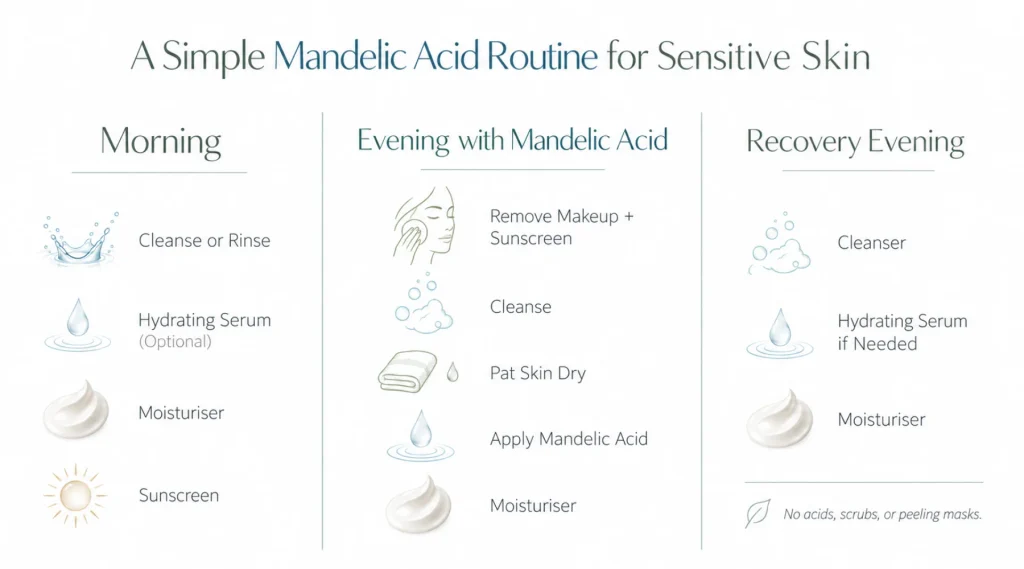
Morning:
- Cleanse or Rinse: If your skin is dry or sensitive, rinse with water instead of using a full cleanser.
- Serum (Optional): You can use a hydrating serum if you like, but it’s not necessary. Choose serums based on your skin’s needs instead of mixing too many active ingredients.
- Moisturiser: Apply enough to keep your skin comfortable, not greasy.
- Sunscreen: Always wear broad-spectrum sunscreen, especially when using AHAs, as they can make your skin more sensitive to the sun.
Evening with Mandelic Acid:
- Remove Makeup and Sunscreen
- Cleanse Gently
- Pat Skin Dry
- Apply Mandelic Acid
- Moisturiser
Recovery Evening:
Recovery nights are important. Use:
- Cleanser
- Hydrating serum if needed
- Moisturiser
Avoid acids, scrubs, and peeling masks. Sensitive skin often heals better with simpler care on recovery nights.
How Often Should Sensitive Skin Use Mandelic Acid?
No single frequency works for everyone.
A useful progression is:
| Stage | Suggested starting pattern |
| Weeks 1–3 | Once weekly |
| Weeks 4–6 | Once or twice weekly if comfortable |
| After 6 weeks | Two to three times weekly only if genuinely needed and well tolerated |
| If irritation appears | Reduce frequency or stop temporarily |
This approach is careful.
The product instructions are important, and stronger formulae may need to be used less often.
Using an acid daily is not the aim. The goal is to improve your skin without irritation.
How Long Does Mandelic Acid Take for Sensitive Skin?
Mandelic acid works better over weeks than days. There is no set timeline for results because factors like concentration, formulation, skin type, and the issue being treated can affect outcomes.
Here’s what to expect:
- Smooth skin: You might notice improvements in several weeks.
- Mild congestion: This often takes weeks of regular use to improve.
- Post-acne marks: Usually, this needs several skin cycles and can take months.
- Recurring acne: Evaluate results over 8–12 weeks, not just after a few uses.
These points are helpful for evaluation but not guarantees. Trying to speed up results by using more product or applying it every night usually leads to more irritation rather than better results.
Research shows that most studies on mandelic acid are short and small. Many also focus on combinations of peels rather than low-strength serums. Consistency is important, but so is knowing when the product isn’t solving the main issue.
Choosing a Mandelic Acid Product When Your Skin Reacts Easily
The percentage on the bottle shows only part of the information.
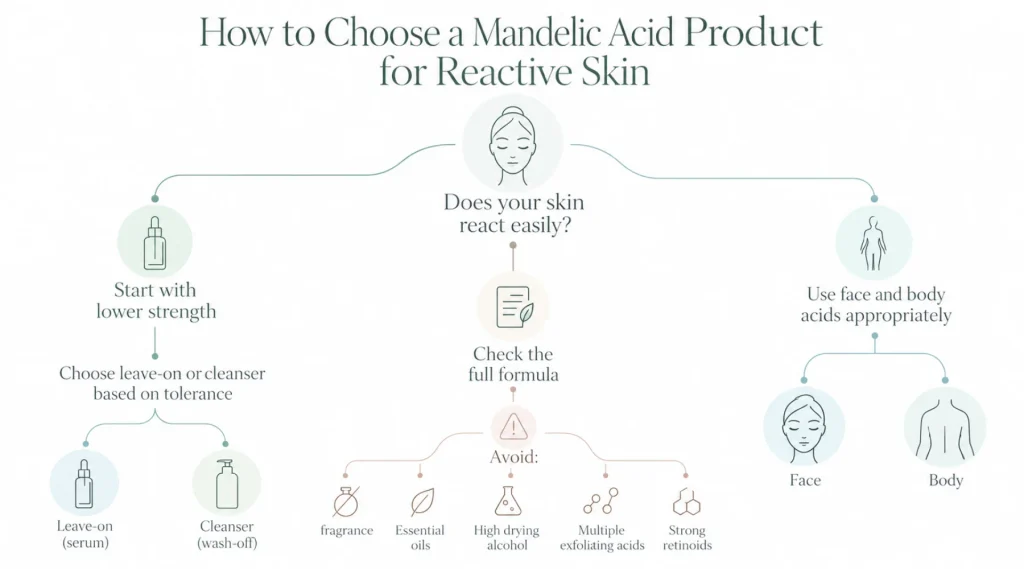
Lower-strength products are usually easier for beginners.
A gentle leave-on formula is better for sensitive users than jumping straight to a strong peel.
Strong mandelic acid peels, like those at 30% or 45%, are meant for professionals and should not be copied with high-strength acids from online stores.
Look beyond just the acid.
Check the entire formula.
A product might have mandelic acid but still irritate your skin if it also contains:
- fragrance
- essential oils
- high amounts of drying alcohol
- other exfoliating acids
- strong retinoids
Sensitive skin does better when you understand what each product does.
Leave-on vs. Cleanser
A cleanser has short contact time because it is rinsed off, making exfoliating cleansers easier to handle. However, the formulation still matters.
A serum stays on the skin for hours, providing longer contact but needing careful use.
Neither option is automatically better.
Face vs. Body Acids
Skin on the body can handle stronger formulae that might be too harsh for the face.
If you have rough or uneven skin on your arms or legs, a body lotion with AHA may be better than using a facial mandelic acid serum on those areas.
Always follow the product’s instructions rather than assuming every AHA formula is suitable for every part of your body.
Mandelic Acid vs PHA: Which Is Gentler for Sensitive Skin?
For sensitive skin, polyhydroxy acids (PHAs) can be a gentler option. PHAs, like gluconolactone and lactobionic acid, have larger molecules, so they penetrate the skin more slowly. Studies show they are less irritating than traditional AHAs and might be safe for sensitive skin.
While both mandelic acid and PHAs can enhance skin texture, they are not the same.
| Feature | Mandelic acid | PHA |
| Family | AHA | Polyhydroxy acid |
| Main role | Exfoliation, texture, mild congestion, uneven tone | Very gentle exfoliation, hydration and texture support |
| Sensitive-skin potential | Good when introduced carefully | Often particularly useful for highly reactive skin |
| Congestion | Usually stronger fit | More modest |
| Hydrating properties | Not its main strength | Often more pronounced |
| Best for | Sensitive skin that still needs meaningful exfoliation | Very dry, reactive skin needing a gentler approach |
If your skin can’t handle mandelic acid even once a week, try using a PHA instead of forcing your skin to get used to it. You shouldn’t need to deal with ongoing irritation to build tolerance.
Mandelic Acid vs Urea: Exfoliation or Barrier Support?
Mandelic acid and urea are not equally matched exfoliants.
Urea is naturally found in the skin and helps keep it moisturised. At low levels, it holds water; at higher levels, it helps remove dead skin. Studies show it improves hydration and skin barriers, especially for dry or flaky skin.
Choose based on your skin’s needs:
Use mandelic acid when:
- Your skin feels good.
- You have rough patches from dead skin.
- You have mild congestion.
- You want to even out your skin tone.
Use urea when:
- Dryness is your main issue.
- Your skin is flaky, not congested.
- You need more hydration and softer skin.
- Your skin barrier needs support rather than exfoliation.
For facial skin, high levels of urea can also be very effective at removing dead skin, so concentration matters.
If your sensitive skin is dry and a little congested, you don’t have to stick to just one treatment. You can use a low-strength urea moisturiser for hydration while occasionally using mandelic acid.
Mandelic Acid vs PDRN: Completely Different Jobs
PDRN is popular and often compared to many skincare ingredients, but mandelic acid and PDRN have different uses.
PDRN, or polydeoxyribonucleotide, comes from DNA fragments and is being studied for its benefits in skin healing and aesthetic treatments. Recent reviews show that PDRN may help with skin rejuvenation and healing wounds, but reliable clinical evidence is limited, with few participants and different treatment methods. Most studies focus on injections rather than topical products.
Mandelic acid is primarily used for exfoliation.
In summary: use mandelic acid for improving surface texture, mild congestion, and skin tone. Use PDRN products for supportive or regenerative skincare, but keep in mind that topical PDRN may not work like injectable treatments.
Mandelic Acid vs Honey: Controlled Exfoliation Versus Conditioning
Honey and mandelic acid often come up in discussions about “gentle skincare,” but they work very differently.
Mandelic acid is a specific chemical that helps exfoliate the skin. Honey is a natural product made up of sugars and other active compounds. Medical-grade honey is mostly studied for wound care, where it has shown antibacterial and healing properties. However, results vary for different wound types, so findings shouldn’t be applied to regular cosmetic honey masks.
For everyday skincare:
- Mandelic acid is a reliable choice for exfoliation.
- A good honey-based product can be moisturising.
- Kitchen honey should not replace proper exfoliants or medical treatments.
Sensitive skin usually does better with dependable products rather than home remedies.
Mandelic Acid vs CoQ10: Exfoliant Versus Antioxidant
Coenzyme Q10, or CoQ10, serves a unique purpose in skin care. It helps with energy production in cells and protects against damage from free radicals. Research shows that when applied to the skin, CoQ10 can boost antioxidant levels, mainly benefiting against sun damage and oxidative stress, not for exfoliating or clearing pores.
There’s no need to choose between mandelic acid and CoQ10. You can use:
- Mandelic acid to smooth rough skin and remove surface buildup.
- CoQ10 to focus on antioxidants.
You can easily include a gentle antioxidant moisturiser in your routine alongside mandelic acid on different nights.
Mandelic Acid vs Sulfur for Blemish-Prone Sensitive Skin
Sulfur has been used in dermatology for a long time. It’s found in products for acne, seborrheic dermatitis, and other skin issues. Its effects depend on the concentration and formulation.
For skin with blemishes, it’s useful to know the differences between ingredients.
Mandelic acid mainly helps with rough texture, mild congestion, and uneven skin after blemishes.
Sulfur is often used in products for oily skin with inflamed spots.
Neither sulfur nor mandelic acid is always gentle. Sulfur can be drying, and too much mandelic acid can harm the skin barrier.
Sensitive skin typically does better by introducing one ingredient at a time instead of using both at once.
Mandelic Acid vs Ectoin: Treatment Versus Protection
Ectoin is beneficial for reactive skin because it helps with hydration and resilience instead of exfoliation. A review of ectoin-containing products for inflammatory skin showed improvements in dryness and symptoms, though there were not many studies.
When comparing mandelic acid and ectoin: mandelic acid promotes shedding, while ectoin emphasises hydration and protection. They can work well together. Sensitive skin may adapt better if an exfoliating night is balanced with soothing products.
Retinol vs Mandelic Acid: Which Should Sensitive Skin Start With?
Retinol and mandelic acid both improve skin texture, but they work in different ways.
Mandelic acid mainly exfoliates the outer skin layers. Retinoids affect skin cells more broadly, helping with acne, fine lines, pigmentation, and signs of ageing. However, they can irritate when you first start using them.
If you’re new to skincare and mostly worried about slight roughness and dull skin, mandelic acid may be easier to start with. For ongoing acne, ageing, or long-term texture issues, a retinoid might be more effective.
It’s a mistake to think you need both from the start. A simple routine could be:
- Monday: mandelic acid
- Thursday: retinol
- Other evenings: focus on moisturiser
However, even this may be too much for beginners. It’s usually best to get used to one ingredient for several weeks before adding another.
Mandelic Acid, Salicylic Acid and Azelaic Acid Are Not Interchangeable
When looking for clearer skin, it’s easy to pick the gentlest acid. Instead, focus on your specific skin issue.
Choose mandelic acid for texture issues.
Mandelic acid is great for:
- Dull skin
- Mild roughness
- Light congestion
- Surface post-acne marks
- Skin that struggles with stronger AHAs
Choose salicylic acid for blackheads and oily pores.
Salicylic acid targets blackheads and oil. If blackheads are your main problem, using salicylic acid is more effective than just trying stronger AHAs.
Choose azelaic acid for redness, acne, and pigmentation.
Azelaic acid is not just another exfoliant. It reduces inflammation, fights bacteria, and helps with pigmentation. This makes it useful for sensitive, acne-prone skin that has redness and dark spots. A 12% azelaic acid cream offers a different type of care than mandelic acid, not just a stronger option.
For sensitive skin, picking the right acid is often more effective than using many different ones.
What Can You Safely Combine With Mandelic Acid?
Not Every Combination Needs Separation. Some skincare combinations work well together, but simple routines are easier to manage.
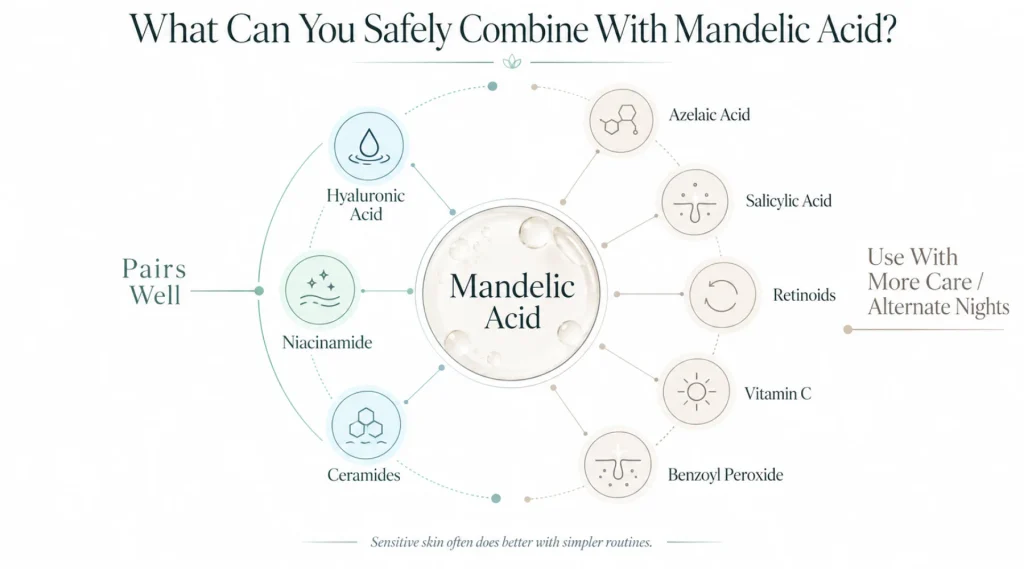
Hyaluronic Acid
Hyaluronic acid pairs well with mandelic acid because it mainly hydrates rather than exfoliates. Use mandelic acid as directed, then layer on your hydrating products and moisturiser.
Niacinamide
Niacinamide works well with mandelic acid routines. You don’t need to use them at different times of day. However, if you have sensitive skin, it might be better to use fewer products on exfoliating nights.
Ceramides
Moisturisers with ceramides are great post-exfoliation, as they help keep your skin barrier intact. They won’t lessen the effects of mandelic acid.
Azelaic Acid
Mandelic and azelaic acid can be used together in a routine, but sensitive skin should avoid applying them at the same time. For example, use azelaic acid most mornings and mandelic acid once a week. This keeps each product’s purpose clear.
Salicylic Acid
Salicylic and mandelic acid can work well in some products, but using both separately can be tricky. If you use salicylic acid for acne, try mandelic acid on another night if needed.
Retinoids
Start by alternating their use. Retinol and mandelic acid can be used together, but mixing two strong treatments can irritate your skin while it builds tolerance.
Vitamin C
Many vitamin C products can be used with mandelic acid, but acidic L-ascorbic formulae may irritate sensitive skin. Try using vitamin C in the morning and mandelic acid at night to keep your routine simple.
Benzoyl Peroxide
Benzoyl peroxide can cause dryness and irritation. If you’re using it for acne, keep mandelic acid for another night until you see how your skin reacts to both.
Common Mandelic Acid Mistakes That Make Sensitive Skin Worse
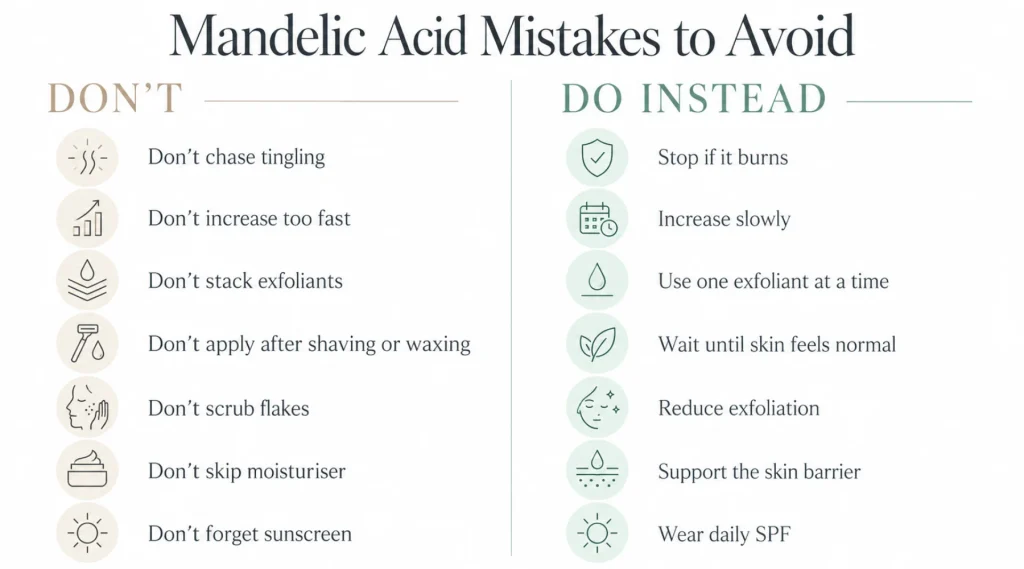
Treating a tingle as proof that it works
Effective skincare should be comfortable.
Some acidic formulae may cause a brief mild sensation, but ongoing burning is not okay. If a product continues to burn, rinse it off immediately.
Starting every other night
Sensitive skin doesn’t respond well to harsh treatments. Start slowly so you can spot irritation before it becomes a bigger issue.
Increasing frequency after one good application
Irritation doesn’t always happen right away.
Your first use might feel fine, but dryness can show up after using it four or five times.
Be patient and give your skin time to adjust.
Using multiple exfoliating products without counting them
Your “mandelic acid night” might include:
- an acid cleanser
- an exfoliating toner
- a mandelic serum
- a peeling mask
Each product may seem gentle, but combined, they can be too much. Focus on the number of exfoliating steps, not just the product names.
Applying it after shaving or waxing
Hair removal can make your skin more sensitive for a while.
Applying acid to freshly shaved, waxed, or threaded skin can hurt a lot.
It’s best to wait until your skin feels normal again.
Scrubbing away the flakes
If mandelic acid causes flaking, adding a scrub can make it worse. Flaking means you should reduce exfoliation, not scrub more.
Skipping moisturiser because you have oily skin
Oily skin can still be dry and irritated. Using a light moisturiser can help make an acne treatment routine easier to handle.
Assuming mandelic acid cannot over-exfoliate
It can. No exfoliating ingredient is gentle enough to ignore how much and how often you use it.
Ignoring sunscreen
AHAs can make your skin more sensitive to sunlight. Therefore, sunscreen is important, even if you only use mandelic acid at night.
Can Mandelic Acid Help Sensitive Skin Safely if You Have Rosacea or Eczema?
Be cautious; mandelic acid does not treat eczema. During an eczema flare, exfoliating can increase burning and harm the skin barrier. Stick to your treatment plan and use recommended moisturisers instead of trying to scrub away flakes with acid.
Rosacea is trickier. Some people with stable rosacea can handle certain acids, while others have strong reactions. PHAs are often recommended for sensitive skin, including rosacea and atopic dermatitis.
Get assessed if needed. If you have recurring facial flushing, burning, pustules, or visible blood vessels without a diagnosis, see a professional before starting a routine with strong acids.
When a Professional Mandelic Acid Peel Makes More Sense
Home skincare and chemical peels should be seen as different things.
Studies have looked at professional mandelic acid peels for treating acne, pigmentation, and signs of ageing. For instance, one study found that a 45% mandelic acid peel worked as well as a 30% salicylic acid peel for mild to moderate acne, but patients tolerated the mandelic acid better. Other research has explored mandelic acid for pigmentation issues.
Consider a professional peel if:
- You have stubborn pigmentation;
- You have mild to moderate acne that won’t go away;
- Your skin texture hasn’t improved enough with home care;
- A healthcare provider thinks a peel is right for your skin type.
Getting a professional treatment isn’t the same as buying a peel online with the same strength.
The effectiveness of a peel depends on its strength, pH level, application time, skin prep, and how it’s neutralised. Strong acids can cause burns, long-lasting inflammation, and discolouration if not used correctly. This is especially important for sensitive skin and darker skin tones, as inflammation can lead to lasting marks.
When Mandelic Acid Is Not the Right Answer
A gentler exfoliant might not help if your skin needs a different treatment.
Consider other options when:
- Your skin barrier is damaged.
- You have a flare-up of eczema or rosacea.
- You have deep, painful, or scarring acne.
- Your pigmentation is changing quickly.
- You have an itchy or spreading rash.
- Bumps group around your mouth or eyes.
- Regular skincare makes your skin burn.
- Irritation continues despite using products less often.
Conditions like perioral dermatitis, rosacea, folliculitis, and allergic contact dermatitis are often confused with “texture” issues. Acid won’t solve every bump. When the diagnosis is wrong, using stronger exfoliants can make things worse.
Questions People Commonly Ask About Mandelic Acid and Sensitive Skin
Is mandelic acid good for sensitive skin?
Yes, it can be. Mandelic acid has a larger structure, making it easier for some sensitive skin types to handle than faster-acting AHAs. Introduce it slowly since it’s still an exfoliant. If you have eczema or significant sensitivity, stabilise your skin first.
How do I use mandelic acid for sensitive skin?
Start with one mandelic acid product once a week on clean, dry skin. After applying, use a moisturiser and wear broad-spectrum sunscreen every morning. If your skin stays comfortable for a few weeks, you can try using it twice a week. Don’t increase frequency if you’re already seeing results with weekly use.
How long does mandelic acid take to work on sensitive skin?
You might notice smoother skin in several weeks. Changes in congestion and uneven tone usually take longer. Give the routine a few weeks before judging, and look for pigmentation changes over two to three months. Results depend on the product and your specific skin issues.
Can mandelic acid help sensitive skin safely?
Yes, as long as “sensitive” doesn’t mean your skin is actively damaged. Use a gentle formula, start slowly, moisturise well, and avoid combining it with other harsh treatments. Stop using it if you experience burning, persistent redness, or unusual tenderness.
Does mandelic acid cause purging?
Mandelic acid can speed up skin cell turnover, which may lead to temporary blemishes if you have blocked pores. However, not every breakout is a purge. Symptoms like rashes, red bumps, and burning suggest irritation or an unsuitable product. Don’t continue using it just because it’s labeled as a purge.
Can I use mandelic acid every day?
Some products can be used daily, but daily application isn’t necessary for most people with sensitive skin. Once or twice a week is usually enough. Follow product instructions and listen to your skin’s response rather than assuming more use equals better results.
Should mandelic acid be used in the morning or at night?
You can use it either time, but evening is often best for sensitive skin. Nighttime application avoids issues with sunscreen and makeup. Always use sun protection during the day.
Should mandelic acid go before or after moisturiser?
Most mandelic acid products should be applied to clean skin before moisturiser. If it stings, you can try applying a light moisturiser first to ease the sensation. Always check specific product directions.
Is mandelic acid better than glycolic acid for sensitive skin?
Mandelic acid is usually gentler on reactive skin because of its larger structure and gradual action. This doesn’t mean glycolic acid is bad; if you tolerate it well, there’s no need to switch.
Mandelic acid vs. PHA: which should I choose?
Choose mandelic acid for gentle exfoliation that helps with texture and mild congestion. Go for a PHA if your skin is very reactive or dry and you need a more hydrating exfoliant.
Mandelic acid vs. urea: which is better for rough skin?
It depends on the cause of roughness. Mandelic acid is good for dead skin buildup, while urea helps with dryness and scaling. Treating dry skin without addressing hydration can worsen roughness.
Can I use mandelic acid with retinol?
Yes, but sensitive beginners should alternate them instead of using both at once. Start with one product, and once your skin adjusts, add the other on a different night. If irritation occurs, reduce how often you use them instead of adding more products.
Can I use mandelic acid with azelaic acid?
Yes, they work differently, so using both can help with acne, pigmentation, and uneven texture. Sensitive skin might do better using azelaic acid regularly and reserving mandelic acid for one exfoliating night per week.
Can mandelic acid remove blackheads?
It can improve mild congestion, but salicylic acid is generally better for tougher blackheads. Don’t use stronger mandelic acid if you need a different ingredient.
Can mandelic acid fade acne marks?
It may help reduce superficial pigmentation over time, but it won’t erase scars. Diligent sun protection is essential, and some may benefit more from other treatments like azelaic acid.
What should I do if mandelic acid burns?
Rinse it off if the burning is significant. Stop using exfoliating acids, retinoids, and scrubs. Stick to gentle cleansing, moisturising, and sunscreen until your skin feels normal. For serious symptoms like swelling or severe pain, seek medical advice.
Making Mandelic Acid for Sensitive Skin Work Without Over-Exfoliating
Mandelic acid is great for sensitive skin because it allows gentle exfoliation instead of harsh scrubs.
When used carefully, mandelic acid can smooth rough skin, clear mild congestion, and even out tone. It’s a good option for those who struggle with stronger AHAs.
However, it’s important to follow good skincare rules. Start with healthy skin and add new products slowly. Make sure to moisturise well, keep stronger ingredients separate as you build tolerance, and protect your skin from the sun.
Evaluate your skin’s progress over weeks, not after just a couple of uses. If your skin stays calm with one or two applications a week, you shouldn’t feel pressured to exfoliate daily.
Sensitive skin doesn’t need complicated routines. It benefits from the right treatment at a level the skin can handle.