





Blog
What Is Salicylic Acid? Uses, Benefits, and Mistakes to Avoid

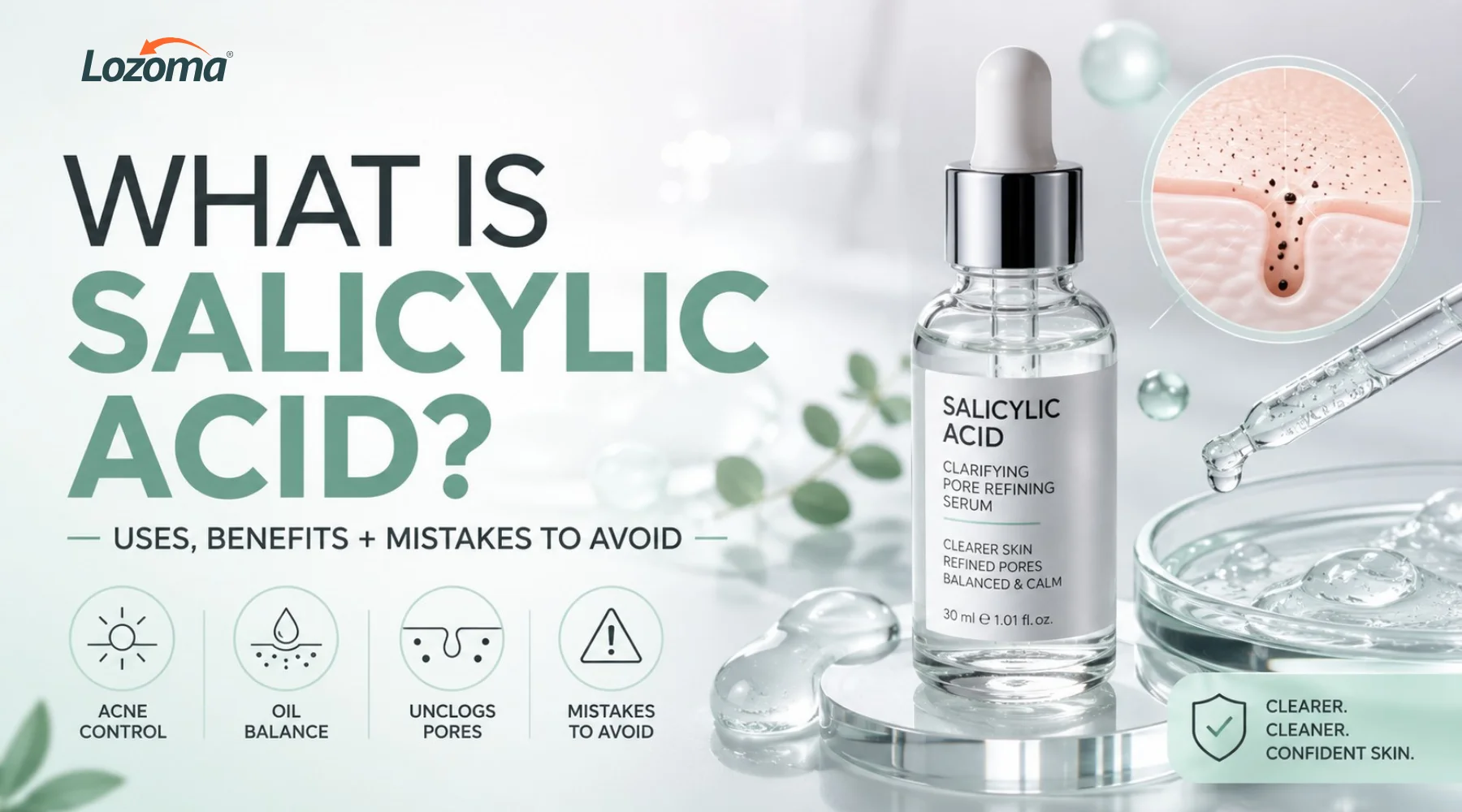
Salicylic acid is found in many products, like acne cleansers, toners, scalp treatments, and chemical peels. Its popularity comes from its ability to tackle oiliness, blackheads, whiteheads, and clogged pores.
However, people often misuse salicylic acid. When used too often or with other exfoliants, it can make the skin feel tight, flaky, and inflamed instead of clearing pores.
So, what is salicylic acid? It’s an exfoliant that helps remove dead skin cells that block pores. It works best for oily, combination, and acne-prone skin, but the concentration, formulation, and how often you use it are important.
When used properly, salicylic acid can smooth the skin and reduce blackheads and some acne. If overused, it can harm the skin barrier and complicate your skincare routine.
What Is Salicylic Acid?
Salicylic acid is a common exfoliating ingredient in skincare. It belongs to the beta hydroxy acid (BHA) family and is also called 2-hydroxybenzoic acid. Unlike alpha hydroxy acids like glycolic acid, salicylic acid works better in oily areas, making it effective for oily skin.
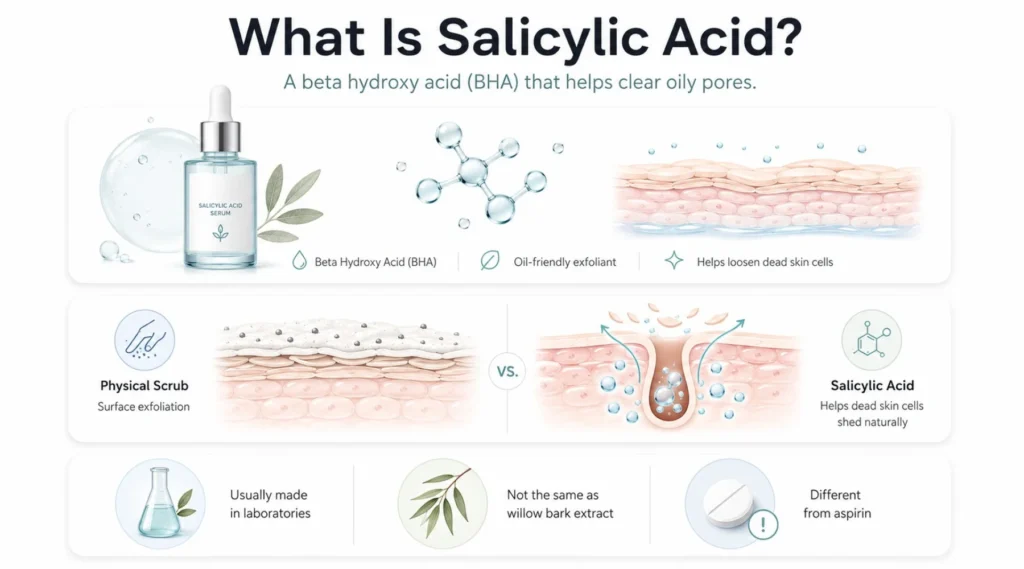
Its main job is to help skin cells shed more easily. Instead of just scrubbing off loose flakes, salicylic acid weakens the bonds that hold skin cells together. This process is known as keratolytic or desmolytic.
This difference matters. While physical scrubs remove surface flakes through friction, salicylic acid helps compacted cells come apart, making them easier to shed without scrubbing.
Most salicylic acid in skincare products is made in labs. Although some salicylic compounds come from plants like willow, products labelled “willow bark” aren’t always the same as properly made salicylic acid treatments. Being plant-based doesn’t make an exfoliant gentler or safer.
Why Salicylic Acid Is Called a BHA
BHA is a common term in cosmetics that refers to salicylic acid, which is different from AHAs. The main difference is how these ingredients work in formulae and where they are most effective.
AHAs are often used to improve skin texture, brightness, and uneven colour. Salicylic acid is chosen when the issue is oil buildup in or around pores.
Salicylic acid doesn’t go deep into the skin as marketing suggests. Its benefit lies in its ability to work well in oily areas, such as pores and hair follicles.
Salicylic Acid Is Not the Same as Aspirin
Aspirin is also called acetylsalicylic acid, and salicylic acid is a similar but different substance. People who are sensitive to aspirin or salicylates should talk to a pharmacist or doctor before using salicylic acid products, especially on large areas or in high strengths.
Don’t treat a facial serum with salicylic acid like a medicine you take by mouth. Do not swallow it, apply it inside your mouth, or use it near your eyes.
What Does Salicylic Acid Do to the Skin?
Salicylic acid helps dead skin cells shed from the skin and pores. This can reduce the buildup that causes blackheads, whiteheads, and rough skin.
A pore gets blocked when oil mixes with trapped skin cells. This can create a small plug before a blemish appears. If the pore stays closed, it may turn into a whitehead. If the material is exposed, it darkens and becomes a blackhead.
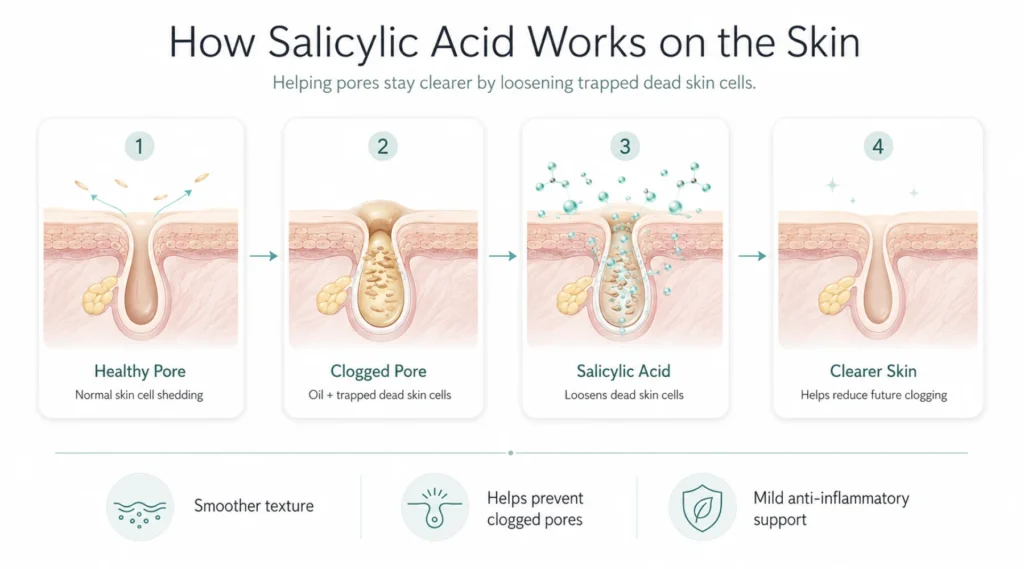
Salicylic acid doesn’t “suck out” pore contents. It loosens the packed cells that cause blockages, allowing the pore to clear naturally over time. This is why acne guidelines recommend salicylic acid as a helpful topical treatment.
It Helps Reduce Retained Dead Skin Cells
Skin cells grow, move to the surface, and fall off. In acne-prone skin, this process can get stuck. Cells may stick together and build up instead of coming off smoothly.
Salicylic acid helps to break up these cells. Using it regularly can make the skin feel smoother and reduce the chances of clogged pores.
It Works Around Sebum-Rich Pores
Salicylic acid is often called “oil-soluble,” which is a handy but not exact term. It attracts oil better than common AHAs, making it effective in oily parts of the face and inside hair follicles. This is why it works well around the nose, chin, forehead, and other areas where buildup can happen easily.
It Has Modest Anti-Inflammatory Activity
Salicylic acid can reduce inflammation, but it’s not the best option for treating inflamed acne. It may lessen redness around small blemishes, but its main job is to clear dead skin cells and prevent clogged pores.
A large, painful acne nodule is not just a blocked pore that needs exfoliation. Deep, inflammatory, and hormonal acne often needs treatments that tackle other causes, like inflammation of hair follicles, bacteria, or hormonal oil production.
Salicylic Acid Benefits for Skin
Salicylic acid has many benefits, but they work best for specific issues. It is most effective for excess oil, uneven skin shedding, and clogged pores.
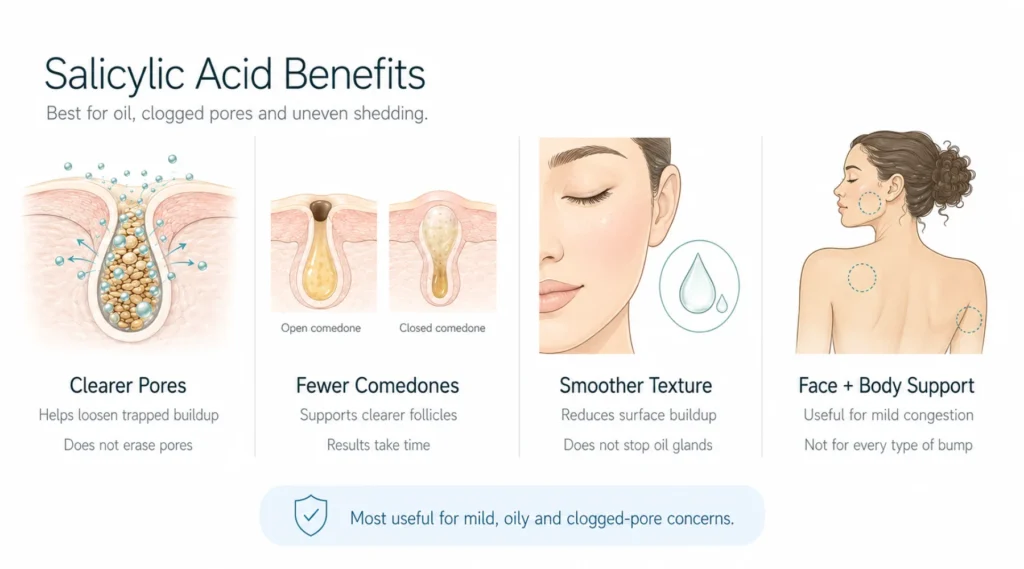
| Skin concern | How salicylic acid may help | Important limitation |
| Blackheads | Loosens compacted cells contributing to open comedones | Does not permanently remove pores or prevent every blackhead |
| Whiteheads | Helps reduce closed follicular blockages | Persistent closed comedones may respond better to a retinoid |
| Mild acne | Helps keep pores clearer and may calm minor inflammation | Often insufficient for cystic, nodular or scarring acne |
| Oily skin | Reduces the accumulation of oil and cells on the surface | Does not permanently stop sebaceous glands producing oil |
| Rough texture | Encourages smoother shedding of surface cells | Overuse can create more roughness through irritation |
| Visible pores | Clears material that can make pores look more noticeable | Cannot physically close or erase pores |
| Body congestion | Can help with blocked follicles on the chest, back and shoulders | Some body bumps may be folliculitis or keratosis pilaris rather than acne |
Fewer Blackheads and Whiteheads
Salicylic acid works well for treating comedonal acne, which includes blackheads and whiteheads caused by blocked follicles. When used regularly, it can clear existing blockages and prevent new ones.
Blackheads may take time to improve, rather than disappearing immediately. The dark colour is caused by oxidation, not dirt, and scrubbing harder won’t fix the problem and can irritate your skin.
Using salicylic acid consistently is usually more effective than squeezing pores or using harsh tools.
Support for Mild Acne-Prone Skin
Salicylic acid is a good choice for mild acne, especially for oily skin, small bumps, and clogged pores. The American Academy of Dermatology suggests it as a helpful topical treatment, but stronger options like topical retinoids and benzoyl peroxide are usually more effective for many cases.
The best treatment depends on the type of acne. Using salicylic acid can help with surface issues, but for inflamed spots, painful lumps, and hormonal breakouts, a more comprehensive plan may be necessary.
Smoother-Looking Skin Texture
Salicylic acid helps smooth rough areas by loosening compacted cells. You’ll see this benefit mainly around the nose, chin, and forehead, where oil and dead skin build up.
But there’s a difference between real smoothness and too much exfoliation. If your skin feels tight, polished, or squeaky after washing, it might be too dry. That feeling does not mean the product is working well.
Healthy skin should feel comfortable after washing, not dry.
Less Noticeable Congested Pores
Salicylic acid cannot permanently change the size of a pore. Pore visibility is affected by genetics, oil production, sun damage, age, and debris in the follicle.
Clearing blockages can make some pores look smaller because the opening isn’t stretched or darkened. This is just an appearance improvement, not an actual closure of the pore.
Toners cannot seal pores, and cold water cannot shrink them permanently. The best goal is to keep follicles clear, protect the skin from sun damage, and avoid treatments that cause long-term inflammation.
Better Control of Surface Oil Buildup
Salicylic acid can help reduce greasiness by lowering oil and dead skin cell buildup on the surface. Some newer products with salicylic acid have improved oil levels and acne while keeping the skin hydrated. However, the results depend on the overall formula, not just salicylic acid.
It doesn’t stop the oil glands from working. Genetics, hormones, climate, and age still affect how much oil the skin makes. Trying to “dry out” oily skin with many acids can cause irritation without effectively decreasing oil production.
Help With Body Acne and Follicular Congestion
Salicylic acid body washes and sprays can help with acne on the back, chest, and shoulders, where sweat, tight clothes, and oily skin can cause problems. A wash is handy because it covers larger areas without sticky residue. Letting the cleanser sit on your skin for a short time before rinsing can help, as long as the instructions permit it.
Not all skin bumps are acne. Itchy spots might be folliculitis, and rough bumps on the upper arms and thighs could be keratosis pilaris. If a salicylic acid wash worsens your condition or doesn’t help after consistent use, it’s better to get a professional diagnosis instead of just using a stronger product.
Indirect Support for Post-Acne Marks
Salicylic acid isn’t mainly used for correcting pigments. It helps prevent new blocked pores and reduces picking, which can lower the number of new post-acne marks. It also makes skin look less dull through exfoliation. However, stubborn brown, grey, or red marks often need ingredients that specifically target discolouration and inflammation.
Azelaic acid is a good alternative or supplement since it treats acne, inflammation, and post-acne pigmentation in different ways. Using a well-formulated 12% azelaic acid cream may be more effective than adding another exfoliating acid if you’re mainly concerned about marks.
Is Salicylic Acid Good for Every Face?
Salicylic acid helps the face only if it’s suited to your skin type. Its popularity doesn’t guarantee benefits.
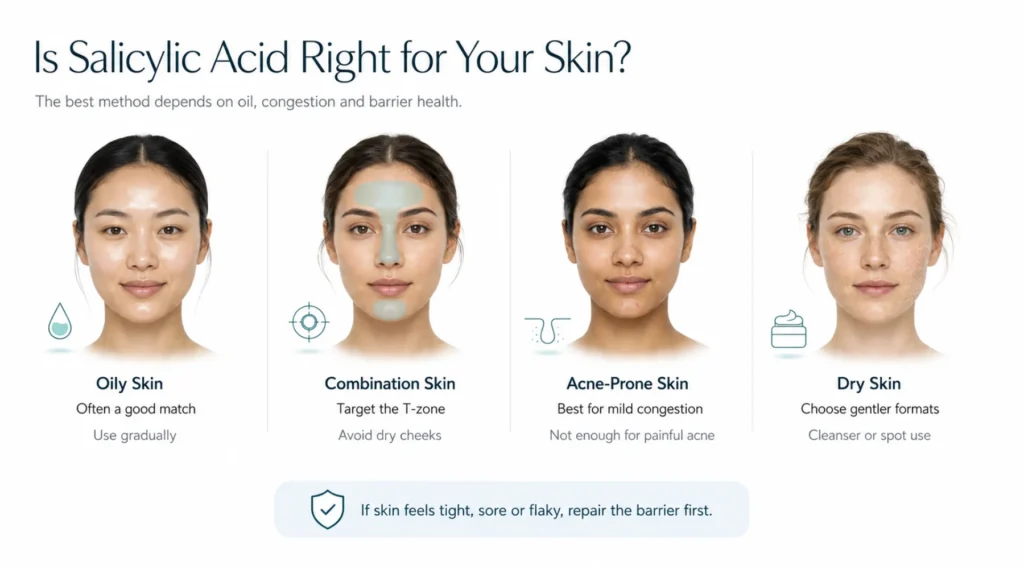
It’s best for people with oily or combination skin, frequent blackheads, mild acne, or congestion mainly in the T-zone.
Those with dry, sensitive, or damaged skin can still use salicylic acid, but should use it less often, in rinsing products, or only on problem areas.
Oily and Combination Skin
Oily skin usually responds well to leave-on salicylic acid, but it’s important to test it first. Use a 1% or 2% formula two or three times a week to help reduce congestion.
For combination skin, apply the product only to certain areas. Focus on the forehead, nose, and chin while leaving the dry cheeks alone.
This targeted method often works better than applying the same routine to the whole face.
Acne-Prone Skin
Salicylic acid is useful for treating blackheads, whiteheads, and small bumps. It can be part of a routine for mixed acne, but it shouldn’t replace proper medical treatment for painful or scarring breakouts.
Persistent acne is a skin condition, not about poor hygiene. Washing more often or using stronger acids usually won’t fix a problem caused by inflammation, genetics, and hormones.
Dry Skin
Dry skin doesn’t mean you should automatically avoid salicylic acid. Instead, focus on whether your skin is congested and if the barrier is healthy.
A creamy salicylic acid cleanser used once or twice a week may be better for dry skin than a 2% toner. After cleansing, use a moisturiser with humectants, emollients, and barrier-supporting lipids.
If your skin feels tight, flaky, or sore, soothe it before adding an exfoliant.
Is Salicylic Acid Good for Sensitive Skin?
Sensitive skin can sometimes handle salicylic acid, but it needs to be introduced slowly. Sensitivity describes how skin reacts and isn’t just one condition. Some people might feel a bit of stinging, while others have rosacea, eczema, or allergic reactions.
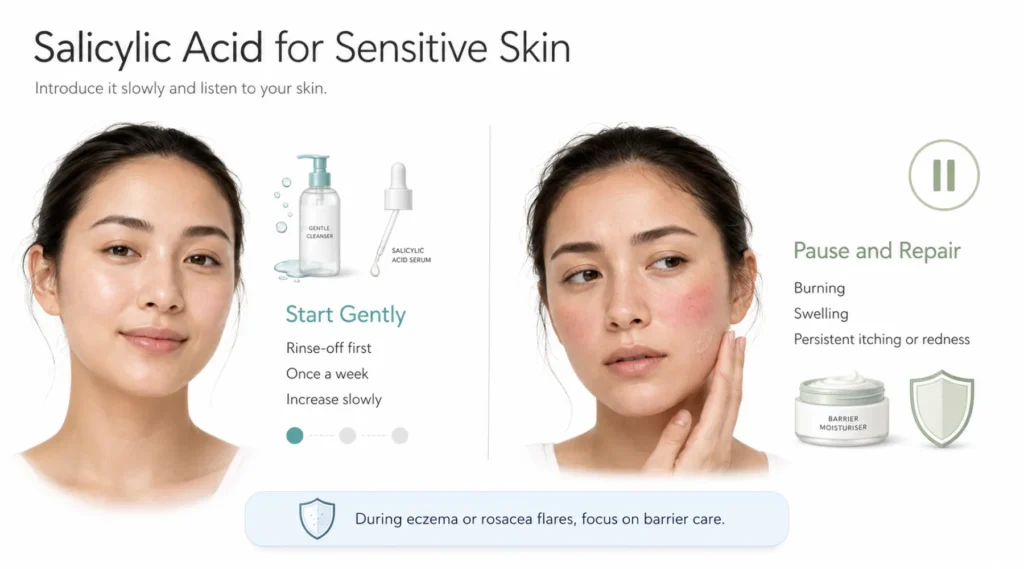
Start with a rinse-off product or a low-frequency leave-on option. Use it once a week for a few weeks before increasing the frequency.
A new formula that controls delivery may be less irritating than a basic version, showing that the number on the label alone doesn’t determine how well your skin can tolerate it.
Stop using the product if your skin becomes persistently burned, swollen, itchy, or red. These reactions are not normal adjustments.
Rosacea, Eczema, and a Damaged Skin Barrier
If you have active eczema, a rosacea flare, cracked skin, or damaged skin, be careful. Salicylic acid can irritate more when your skin barrier is weakened. Studies show that skin damage affects how salicylic acid gets absorbed.
This doesn’t mean that people with rosacea or eczema should avoid it entirely. They just need to find the right timing and product, often with help from a dermatologist.
When experiencing a flare, focus on gentle cleansing, moisturising, and using prescribed treatments rather than exfoliating.
Choosing Between a Cleanser, Toner, Serum, and Peel
Two products with the same amount of salicylic acid can perform differently. Factors like contact time, pH, solvent system, supporting ingredients, and skin condition all affect the outcome.
| Product format | Best suited to | Typical advantages | Possible drawbacks |
| Cleanser | Beginners, sensitive skin, body acne | Short contact time; easy to rinse | May be too mild for stubborn comedones |
| Leave-on toner or liquid | Oily, congested skin | Even coverage and sustained contact | Easy to overuse |
| Serum or gel | Targeted congestion and controlled application | Often includes hydrating or calming ingredients | May pill when layered heavily |
| Spot treatment | Occasional small blemishes | Limits exposure to surrounding skin | Less useful for preventing widespread comedones |
| Pads | Convenient application | Portable and pre-dosed | Rubbing and repeated swiping may irritate |
| Mask | Occasional oil control | Short, planned contact time | Often combined with drying clay |
| Professional peel | Selected acne, pigmentation or texture concerns | Higher-strength controlled treatment | Greater irritation and pigment risk |
Salicylic Acid Cleansers
A cleanser is a simple first step. Since you rinse it off, it stays on your skin for less time than leave-on products.
Apply it gently, let it sit for a short time as directed, and then rinse well. You don’t need to scrub it into your skin.
A cleanser can work well for mildly oily skin or if you have occasional breakouts. It’s also helpful if you’re already using a retinoid, benzoyl peroxide, or other treatments that may irritate your skin.
Leave-On Liquids, Toners and Serums
Leave-on products work better for blackheads since they stay on the skin longer. However, they can also cause dryness and irritation.
Toners vary in strength. Some are just hydrating liquids, while others are strong exfoliants. Always check the ingredient list and directions instead of assuming you can use them anytime.
Serums should ideally combine salicylic acid with soothing ingredients like glycerin or panthenol. While these won’t fix overuse, they can make the product more comfortable to use.
Spot Treatments
Salicylic acid spot treatments help with small, surface blemishes, especially when you feel a blocked pore rather than deep inflammation.
Putting on a thick layer many times a day won’t make a blemish go away faster. It can actually create a dry ring that’s hard to hide and takes longer to heal.
To prevent acne, it’s usually better to treat areas prone to breakouts instead of waiting for every spot to appear.
Professional Salicylic Acid Peels
Professional peels use much stronger ingredients than typical home skincare products. Salicylic acid peels can help with acne, blackheads, uneven skin colour, and sun damage, but they must be chosen and applied carefully.
A professional peel is not just a stronger toner. The clinician looks at the strength, application time, treatment area, skin type, medical history, and any medications or skincare used before the treatment.
Do not buy high-strength peels for home use without proper guidance. They can cause serious problems like chemical burns and skin discolouration, especially if applied unevenly or on damaged skin.
What Strength of Salicylic Acid Should You Use?
Over-the-counter acne products in the U.S. are allowed to contain salicylic acid in concentrations from 0.5% to 2%. This range is also common in facial cosmetics worldwide.
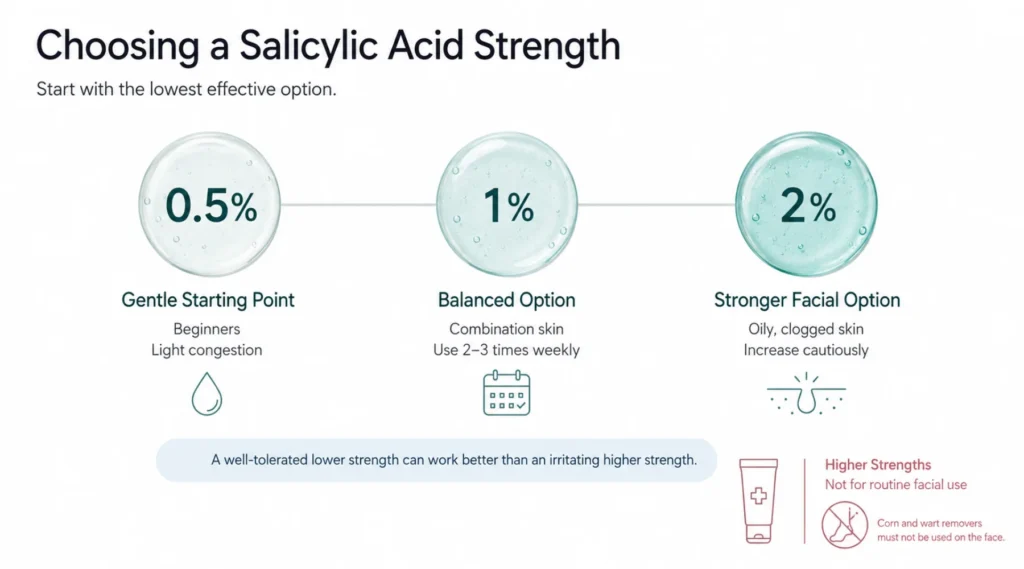
A higher percentage isn’t always better. A 0.5% product used regularly might work better than a 2% product that causes irritation and is stopped after just one week.
0.5% Salicylic Acid
This strength is good for beginners, slightly congested skin, and products meant for regular use. It can also work well with other active ingredients when salicylic acid is included.
A lower concentration doesn’t always mean a product is gentle. Ingredients like alcohol, fragrance, harsh cleansers, and the pH level can still cause irritation.
1% Salicylic Acid
A 1% leave-on formula works well for combination or slightly congested skin. It gives enough exfoliation without being as strong as daily treatments. Start by using it two or three times a week instead of assuming you need to use it every day.
2% Salicylic Acid
Two percent is common in acne cleansers and exfoliants. It can help oily skin, blackheads, and ongoing breakouts, but using it every day might be too much for some.
The entire formula is important. Studies on new 2% cleansers show that good delivery systems can improve acne-prone skin without harming the skin barrier. However, not every 2% cleanser works the same way.
Higher Strengths
Stronger concentrations are used for specific medical purposes, like treating psoriasis, corns, warts, and for chemical peels. They should not be used for facial acne products.
Do not apply wart or corn removers on your face. These products are designed to break down thicker skin and can harm normal facial tissue.
How to Use Salicylic Acid on the Face
To use salicylic acid safely on your face, start with one product. Use it a few times a week, and only increase the frequency if your skin feels comfortable.
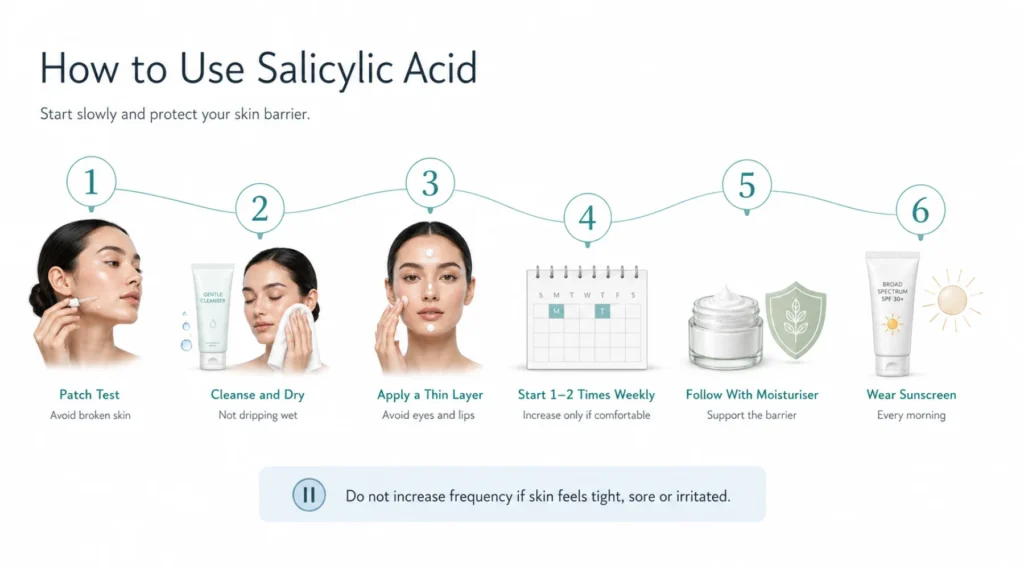
1. Patch Test the Product
Apply a small amount to a hidden spot, like the side of your jaw, a few times. One patch test won’t show all possible reactions, but it can catch immediate burning, swelling, or a rash.
Avoid patch testing on broken or recently shaved skin.
2. Start With Clean, Dry Skin
For a leave-on product, cleanse your skin gently and pat it dry. Applying an acid on wet skin can make it spread more and penetrate deeper, which might cause more stinging on sensitive skin.
You don’t need to wait a specific time unless it helps you feel more comfortable. Just avoid applying the product to dripping-wet skin.
3. Use a Thin, Even Layer
Using more product won’t get it deeper into your pores. Put on just enough to lightly cover the area you want to treat.
For your whole face, you usually need a few drops of liquid or a pea-sized amount of gel, depending on the product. Always follow the instructions, as the dispensers and textures can differ.
Don’t apply the product to your eyelids, lips, the corners of your nose, or any cracked or irritated skin.
4. Begin Once or Twice a Week
Use the product once or twice a week for the first two to three weeks. If your skin stays calm, you can use it every other evening or follow the label’s advice.
You don’t need to use it every day. Many people keep their pores clear with just two or three applications each week.
5. Follow With Moisturiser
A moisturiser is important to use, not just when your skin gets irritated. It helps protect your skin while acids do their job.
Choose moisturisers with ingredients like glycerin, ceramides, squalane, panthenol, and fatty acids that match your skin type.
Letting the acid dry for a short time before applying moisturiser can help, but you don’t need to wait long.
6. Wear Sunscreen During the Day
Daily broad-spectrum sunscreen prevents UV damage and helps keep acne marks from darkening or lasting longer.
Salicylic acid doesn’t have the same effect as AHAs on UV sensitivity, and saying it always makes skin very sensitive to the sun is too simple. However, irritated or peeling skin is more at risk, so sunscreen is crucial for any routine aimed at improving acne, skin texture, or pigmentation.
Should Salicylic Acid Be Used in the Morning or at Night?
You can use salicylic acid in the morning or at night. Nighttime is often easier because it avoids layering too many products under sunscreen and makeup.
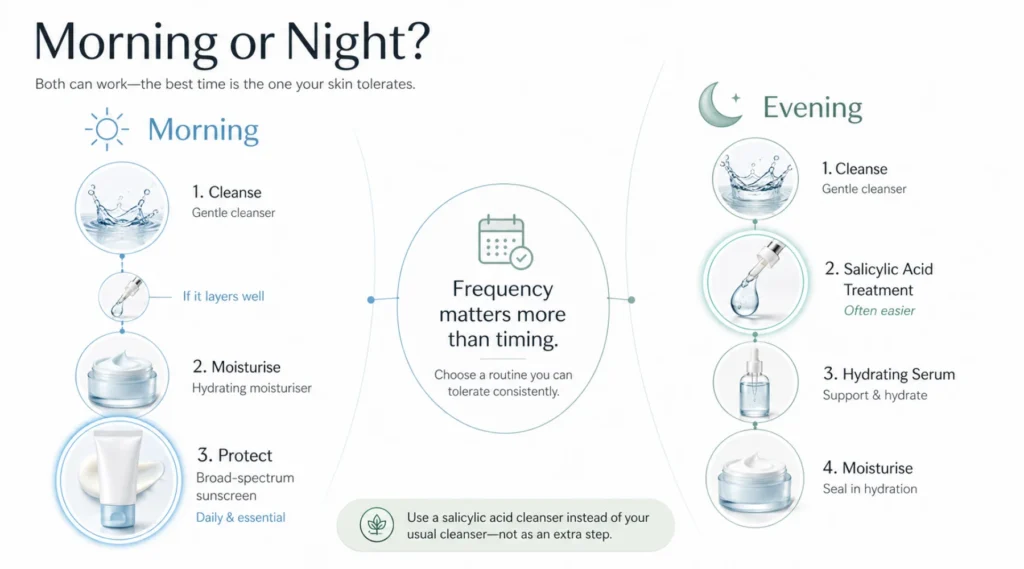
You can use it in the morning if your skin handles it well and the product layers properly. After applying, use moisturiser and broad-spectrum sunscreen.
The time of day is less important than how often you use the product, how well it works with your skin, and being consistent. A product that your skin tolerates well and is used three evenings a week is usually more effective than one that irritates your skin when used every morning and night.
A Simple Evening Order
- Gentle cleanser
- Salicylic acid treatment
- Hydrating serum, if needed
- Moisturiser
A Simple Morning Order
- Gentle cleanser or water rinse
- Hydrating treatment
- Moisturiser
- Broad-spectrum sunscreen
You can use a salicylic acid cleanser instead of your gentle cleanser on some days, not as an extra step.
Salicylic Acid Skincare Routines for Different Skin Types
A good salicylic acid skincare routine is easier than many think. The acid has a specific role, while the other steps keep the skin hydrated and healthy.
Beginner Routine for Congested Skin
Morning
- Gentle cleanser
- Lightweight moisturiser
- Broad-spectrum sunscreen
Evening
- Gentle cleanser
- Salicylic acid once or twice weekly
- Barrier-supporting moisturiser
Stick to this routine for a few weeks before trying something new. Changing products too often makes it hard to know what helps and what causes irritation.
Oily and Blackhead-Prone Skin
Morning
- Gentle foaming cleanser
- Niacinamide or hydrating serum
- Lightweight moisturiser
- Sunscreen
Evening
- Cleanser
- 1% or 2% salicylic acid two to four times weekly
- Gel-cream moisturiser
On nights without salicylic acid, use only hydrating products. Oily skin still needs time to recover.
Dry Skin With T-Zone Congestion
Morning
- Creamy cleanser or water rinse
- Hydrating serum
- Richer moisturiser
- Sunscreen
Evening
- Gentle cleanser
- Salicylic acid only on the nose, chin, or forehead once weekly
- Moisturiser over the full face
Zone application stops dry cheeks from getting unnecessary ingredients.
Sensitive Skin Routine
Morning
- Fragrance-free gentle cleanser
- Simple moisturiser
- Sunscreen
Evening
- Gentle cleanser
- Salicylic acid cleanser once weekly
- Soothing moisturiser
If you can handle it for a few weeks, use the cleanser twice a week. Don’t switch to a leave-on acid just because it seems trendier than a rinse-off formula.
Body Acne Routine
Use a salicylic acid body wash on problem areas while showering. Rinse well and apply a non-comedogenic body lotion if your skin dries out.
Change out of sweaty clothes quickly, wash your sports gear often, and avoid tight straps when you can. These habits won’t cure acne, but they help prevent it from getting worse.
Keep your overall skin care routine gentle. Using an acne body wash, scrub, exfoliating mitt, and acid lotion together can be too much for your skin.
Can Salicylic Acid Be Used With Other Ingredients?
Salicylic acid works well with many skincare ingredients. The key question is not if two ingredients can mix, but if the entire routine is suitable for each person.
Salicylic Acid and Niacinamide
You can use niacinamide and salicylic acid together. Niacinamide helps with the skin barrier, controls oil, and improves skin tone, while salicylic acid targets dead skin and clogged pores.
Apply salicylic acid first, then use a niacinamide serum and moisturiser. You can also use them at different times.
There’s no need to separate them based on old myths about pH.
Salicylic Acid and Hyaluronic Acid
Hyaluronic acid draws in moisture but doesn’t exfoliate. You can use it with salicylic acid to boost hydration.
Start by applying salicylic acid to clean, dry skin, then add a hydrating serum and moisturiser. Humectants are most effective when a moisturiser helps keep the moisture in.
Salicylic Acid and Ceramides
Ceramides are great for exfoliating routines. They support the outer skin barrier.
A ceramide moisturiser won’t affect salicylic acid or its effectiveness. It can make regular use easier by reducing dryness.
Salicylic Acid and Azelaic Acid
Salicylic acid and azelaic acid work well together. Salicylic acid clears clogged pores, and azelaic acid reduces acne inflammation and uneven skin tone.
If you have sensitive skin, using both at the same time might irritate you. Instead, try using salicylic acid two nights a week and azelaic acid on the other nights.
Another option is to use a salicylic acid cleanser and a leave-on azelaic acid product. This way, you limit exposure to just one ingredient at a time.
Salicylic Acid and Benzoyl Peroxide
Salicylic acid and benzoyl peroxide treat acne in different ways. Salicylic acid helps clear clogged pores, while benzoyl peroxide fights bacteria linked to inflammation.
You can use them together, but starting both at once may cause dryness.
A good way to use them is to alternate:
- Salicylic acid on Monday, Wednesday, and Friday
- Benzoyl peroxide on Tuesday and Saturday
- Use a recovery routine on the other nights.
For tougher skin, try a benzoyl peroxide wash in the morning and salicylic acid at night.
Salicylic Acid and Retinol or Retinoids
Salicylic acid and retinoids can help prevent blocked pores, but they work differently. Retinoids speed up cell turnover and affect comedone formation, while salicylic acid helps remove stuck cells on the skin’s surface and in follicles.
For beginners, using both on the same night might cause irritation. Start by using the retinoid two nights a week and the salicylic acid on a separate night.
After a few months, some people can use both together. However, if alternating nights gives good results, there’s usually no need to combine them.
Salicylic Acid and Glycolic Acid
Salicylic acid and glycolic acid often show up together in professional products. Using separate BHA and AHA products in the same routine can lead to over-exfoliation.
Choose based on your main issue:
- Use salicylic acid for blackheads, oiliness, and clogged pores.
- Use glycolic acid for dull skin, rough texture, and some pigmentation.
Using both acids is not necessarily better than sticking to one consistently.
Salicylic Acid and Vitamin C
Salicylic acid and vitamin C can be used together, but they might sting sensitive skin depending on the products.
You can use vitamin C in the morning and salicylic acid at night. This separation is helpful but not required.
If your skin is new to active ingredients, get used to one before trying the other.
Can Salicylic Acid Cause Purging?
Salicylic acid can sometimes cause more blemishes temporarily, known as purging. This happens because it helps remove dead skin and can make hidden clogged pores show up sooner.
Purging does not happen to everyone. It’s not proof that all bad reactions are normal.
Purging typically:
- Shows up in areas where you usually get breakouts
- Looks like blemishes you’re familiar with
- Starts after using a product that exfoliates or increases cell turnover
- Gets better over time
You might have irritation or an unsuitable product if:
- Blemishes appear in new areas
- There’s widespread itching or burning
- You develop a rash, swelling, or raw patches
- It keeps getting worse without improvement
- You feel severe tightness and peeling
Knowing if salicylic acid is causing purging is important because the response differs. Mild congestion may improve with less frequent use. If there’s barrier damage, stop using the product and let your skin heal.
Don’t keep suffering through a painful reaction for weeks just because social media calls it “purging.”
Salicylic Acid Side Effects
The most common side effects of salicylic acid are dryness, redness, stinging, and peeling. These side effects usually depend on the strength of the product, how often it’s used, the formula, or if you use other irritating products at the same time.
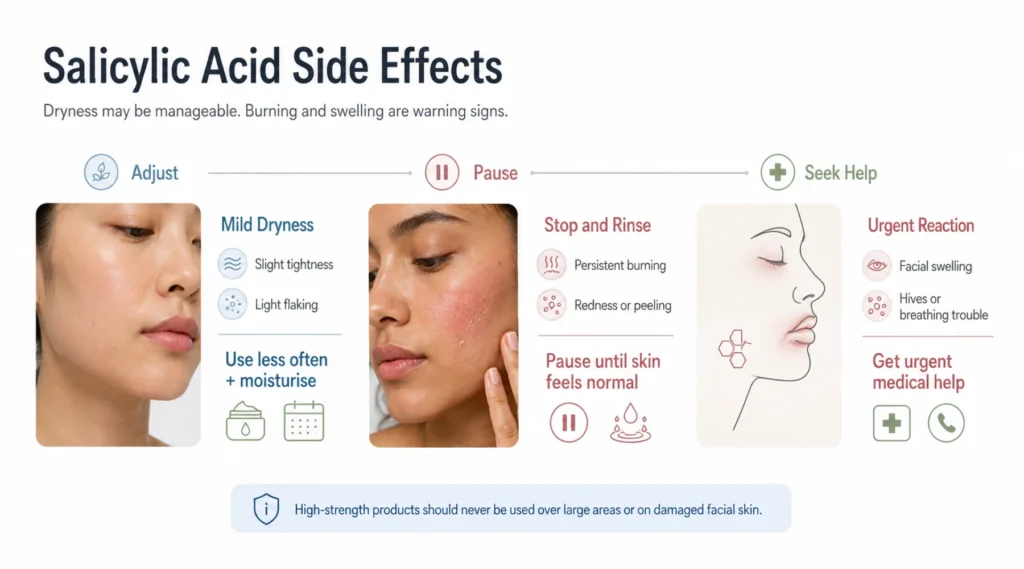
Mild Dryness
When starting treatment, you might notice a slight increase in dryness. Instead of quickly adding facial oils, sleeping masks, or many recovery serums, use moisturiser more often and reduce the number of applications. This simple change helps you see if you can handle the acid better.
Persistent Burning
A brief tingling sensation might happen with an acidic product, but if you feel continuous burning, it’s a warning. Rinse it off and stop using it until your skin feels normal.
If you experience severe pain, blistering, or swelling, seek medical advice right away.
Redness and Peeling
Visible peeling isn’t needed for salicylic acid to be effective. Flaking shows that your skin is shedding too quickly and struggling to maintain its barrier.
To help, reduce how often you use it, switch to a rinse-off product, or take a break for a while.
Allergic or Sensitivity Reactions
An itchy rash, swelling in the face, hives, or trouble breathing can show a serious reaction. Stop using the product and get emergency medical help if you have breathing trouble or serious swelling.
People who are sensitive to salicylates should get medical advice before using products with salicylic acid.
Salicylate Toxicity
Systemic toxicity from regular cosmetic facial use is rare. However, the risk goes up when strong salicylic acid is used on large areas, covered up, on damaged skin, or improperly on children.
Do not use high-strength products over large areas, and always follow the warnings on medicated products. Treatments for warts, corns, psoriasis, or scalp issues may have concentrations that are not safe for everyday facial use.
How to Recognise Over-Exfoliation
Over-exfoliated skin might not peel a lot, but it has some early signs:
- Products that used to feel fine now sting.
- The face feels tight right after washing.
- Skin looks shiny but feels dry.
- Redness lasts longer than normal.
- Small red bumps show up in areas that were clear.
- Moisturiser stings on contact.
- Makeup separates on dry patches.
- Skin feels oily but still dry.
Don’t use more exfoliants to fix the problem. Stop using salicylic acid, scrubs, retinoids, and other acids. Instead, use a gentle cleanser, a plain moisturiser, and sunscreen until your skin feels better. Recovery can take several days to a few weeks.
When you start using salicylic acid again, use it less often than before. Going back to your old routine too quickly can cause the same issues.
The Most Common Salicylic Acid Mistakes
Using It Every Day From the Beginning
Many product labels suggest daily use, but not everyone should start using them every day.
To build tolerance, watch how your skin reacts instead of hoping for the best. Begin with a small amount and only increase use if your skin does not feel tight, burn, or peel.
Assuming 2% Must Be Better Than 0.5%
Concentration is just one part of the formula. The delivery system, product pH, contact time, and supporting ingredients affect how the skin responds to the acid. The best concentration improves the skin without harming its barrier repeatedly.
Layering Several Exfoliants
A salicylic acid cleanser, glycolic toner, exfoliating serum, and weekly peel may seem like different steps, but they work together on your skin.
Pick one main exfoliant. Use other products to address different skin issues instead of repeating the same function.
Scrubbing After Applying Salicylic Acid
Salicylic acid helps cells to shed. Using it with cleansing brushes, rough scrubs, or harsh washcloths increases skin irritation.
More shedding doesn’t lead to quicker healing. Inflamed skin can show more texture and darker spots after the inflammation.
Applying It to Freshly Shaved or Waxed Skin
Hair removal can temporarily upset the skin barrier. Using salicylic acid right after may cause burning and redness.
Wait until your skin feels calm and normal again. How long to wait depends on the hair removal method and how sensitive the area is.
Treating Only Visible Spots
Spot treatments can help with occasional pimples, but comedonal acne starts before you see a blemish. Treating the congested areas may be better for prevention.
Don’t apply salicylic acid all over your face if you only have breakouts on your nose or chin. Focus on preventing spots in those specific areas.
Skipping Moisturiser Because the Skin Is Oily
Dehydrating oily skin doesn’t always lower oil production. It can make your skin feel uncomfortable and lead you to use heavier products later.
Instead of skipping moisturiser entirely, pick a lightweight, non-comedogenic one.
Changing Products Too Quickly
Acne treatments take time. Dermatologists recommend using a product for at least six to eight weeks to see early improvement. Full clearing may take several months.
Changing treatments too often can confuse your skin and doesn’t give any product a chance to work.
Expecting Salicylic Acid to Treat Deep Cysts
Deep, painful bumps won’t flatten just from using an exfoliating toner. Regularly applying acid can harm the surface while inflammation stays below.
It’s important to get professional help early if acne is painful, covers a wide area, or is starting to scar.
Using a Strong Peel at Home
Professional salicylic acid peels are done in safe, controlled settings. Trying to do them at home with strong acids can burn your skin, cause lasting redness, and lead to changes in skin colour. Just because a product is sold online without needing an appointment doesn’t mean it’s safe.
Salicylic Acid Myths That Lead to Poor Routines
“Salicylic Acid Dissolves All the Oil in Your Pores”
Salicylic acid helps break down the mix of trapped cells and oil that cause clogged pores. It doesn’t clear every pore or permanently take away the skin’s natural oil.
Healthy oil keeps the skin flexible and prevents water loss. The goal is to manage shedding and keep the skin comfortable, not to remove all oil.
“If It Burns, It Is Working”
Burning means irritation, not effectiveness.
An acid can work even if you don’t feel it. The best routine is often one that feels easy enough to keep going for months.
“Pores Open and Close”
Pores do not have muscles that open with steam and close with cold water. Heat can soften the skin’s surface, and cold can reduce redness for a short time, but neither changes the pore structure.
Salicylic acid can make pores appear smaller by clearing out blockages.
“Natural Salicylic Acid Is Always Gentler”
Plant extracts with salicylate compounds can still irritate the skin, and their active ingredients may vary in strength.
Synthetic ingredients are not always harsher. When made with controlled purity and precise concentration, lab-produced ingredients can be safer and easier to use.
“Salicylic Acid Cures Every Type of Acne”
This product is great for clogged pores and mild acne. Hormonal acne, nodular acne, and acne caused by medications or folliculitis may need different treatments.
No single cosmetic ingredient can target all the causes of acne.
“Salicylic Acid Cannot Be Used During Pregnancy”
The American College of Obstetricians and Gynaecologists says that you can use topical salicylic acid during pregnancy. However, not all peels or strong applications are safe. During pregnancy, use topical products only on small areas as directed, and talk to a healthcare professional before using stronger treatments or getting professional peels.
“You Must See Peeling Before Blackheads Improve”
Visible peeling isn’t needed. Salicylic acid can help with shedding in the follicle without causing visible flakes.
Frequent peeling might mean the treatment is too strong.
How Long Does Salicylic Acid Take to Work?
Salicylic acid can quickly make the skin feel smoother, but to see real improvements in acne and blackheads, you need to use it consistently for several weeks.
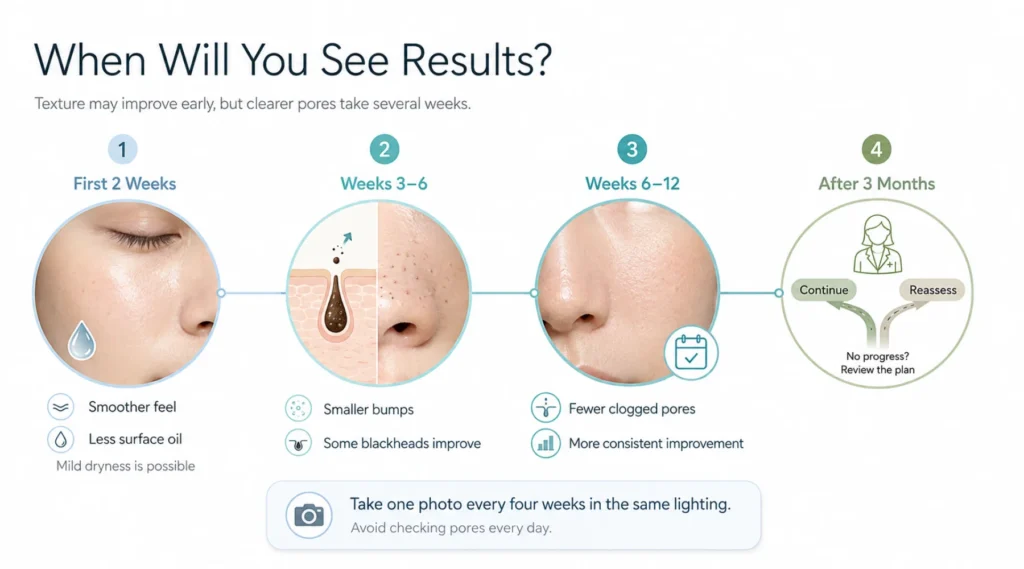
Here’s a typical timeline:
- First two weeks: Your skin may feel smoother or less oily. You might notice some mild dryness as your skin adjusts.
- Weeks three to six: Some blackheads and small bumps may start to shrink. New blemishes might appear since acne takes time to develop.
- Weeks six to twelve: If you follow a good routine, you should see clearer skin with fewer clogged pores and breakouts. Experts usually suggest waiting six to eight weeks to evaluate progress with topical treatments.
- After three months: If there’s no noticeable change, you may need to reconsider your diagnosis, product, or treatment plan.
To track your skin’s progress, take a photo in the same lighting every four weeks instead of checking your pores in a mirror every day. Daily changes are hard to notice and can lead to unnecessary changes in products.
When Salicylic Acid Is Not Enough
Salicylic acid is helpful but has its limits. A dermatologist or GP should evaluate acne that is:
- Painful, deep, or cystic
- Causing scars or lasting dark marks
- Widespread on the face, chest, or back
- Affecting confidence or mental health
- Not improving after eight to twelve weeks of treatment
- Linked to irregular periods, unwanted facial hair, or other hormonal issues
- Appearing suddenly after starting a new medicine
- Infected or very inflamed
Depending on the severity and individual situation, treatments such as topical retinoids, benzoyl peroxide, azelaic acid, antibiotics, hormonal therapies, and isotretinoin may be considered. It’s recommended to combine different treatments instead of relying on just one.
A professional assessment is also useful if bumps don’t look like typical acne. Conditions like rosacea, perioral dermatitis, fungal folliculitis, keratosis pilaris, and contact dermatitis can be confused with breakouts.
Using too much salicylic acid on the wrong condition can slow down healing.
Questions People Still Ask About Salicylic Acid
Can I use salicylic acid every day?
Some people can use a good salicylic acid cleanser every day, but it’s not needed for everyone.
Start using it once or twice a week and slowly increase the frequency. If your skin stays clear and feels fine with three times a week, there’s no need to use it more often.
Is salicylic acid good for skin that is oily but dehydrated?
It can relieve congestion, but you also need to manage dehydration. Use salicylic acid less often and combine it with a gentle cleanser, a hydrating serum, and a moisturiser that supports the skin barrier.
Skin can be oily but still lack water and have a damaged barrier.
Is salicylic acid good for the face if I do not have acne?
Using this product might help with blackheads, rough skin, or an oily T-zone. However, don’t use it just because it’s trendy. Normal, healthy skin doesn’t need regular exfoliation. Pick ingredients that address your specific skin concerns.
Should I wash salicylic acid off?
Rinse off salicylic acid cleansers or masks as directed. Toners, gels, and serums are meant to stay on your skin.
Don’t leave a rinse-off peel on overnight to try to make it stronger.
Can I apply salicylic acid to a popped pimple?
Do not apply it directly to raw, bleeding, or newly damaged skin. The acid may cause burns and slow healing.
Gently clean the area and use a hydrocolloid patch or simple protective product until it has healed.
Can salicylic acid remove acne scars?
It can’t get rid of deep, indented, or raised scars. However, it can improve surface texture and help prevent new acne, which is important before starting scar treatment.
For older atrophic or hypertrophic scars, professional procedures are usually required. Make sure to control active acne first.
Does salicylic acid help dark spots?
It can brighten the surface a little and help reduce new breakouts that cause marks. However, it’s not the best option for treating pigmentation.
Ingredients like azelaic acid, retinoids, and vitamin C may be better choices for treating pigmentation, depending on your skin type and the cause of the marks.
Can I use salicylic acid around my nose?
Yes, it’s fine as long as the skin is unbroken. The nose often has blackheads and sebaceous filaments.
Avoid rubbing the sides of the nostrils too much, as products can build up there and cause irritation.
Does salicylic acid remove sebaceous filaments?
Sebaceous filaments can limit the build-up of oil and cells, which helps reduce visibility. However, they are normal features that allow sebum to move through the pore. They often come back because the follicle keeps working. Regular extraction can harm the skin without permanently removing it.
Can teenagers use salicylic acid?
Teenagers often use over-the-counter salicylic acid acne products. Check the age guidelines on the label and start with a basic routine.
For children, use caution with strong products and apply them carefully. A doctor should evaluate severe or scarring acne in teenagers promptly.
Can salicylic acid make acne worse?
Using the product might make breakouts look worse at first because of purging, but irritation, using it too much, or using the wrong formula can also cause new bumps.
If your skin feels tight or sore, use the product less often. Stop using it entirely if you notice an itchy rash, swelling, or burning that doesn’t go away.
Can salicylic acid be used with sunscreen?
Yes. In the morning, apply salicylic acid first, then use moisturiser and sunscreen.
Don’t mix the acid into the sunscreen, as it can affect how well it spreads and protects your skin.
Is salicylic acid good for sensitive skin?
It’s possible, but use a gentle formula and apply it less often. A weak product that you rinse off once a week is a better first choice than a strong product used daily.
Make sure any active rosacea, eczema, or skin barrier problems are under control before using it.
Can I use salicylic acid while pregnant?
ACOG allows the use of topical salicylic acid during pregnancy. Only apply it as directed on the product label.
Talk to your healthcare provider if you’re considering high concentrations, professional peels, or applying it to large areas.
What should I do if salicylic acid burns my skin?
Rinse it off. Stop using all exfoliants and use a gentle cleanser, a simple moisturiser, and sunscreen. Don’t try to fix it with other DIY ingredients.
See a doctor if you have severe pain, blisters, swelling, or if the area doesn’t improve.
Understanding Whether Salicylic Acid Is Right for Your Skin
Salicylic acid is a targeted treatment for skin issues like dead skin cells, oily skin, blackheads, whiteheads, and mild acne.
However, it won’t fix every skin problem. It can’t permanently shrink pores, stop oil production, or replace professional treatment for severe acne.
The best skincare routine isn’t always the most aggressive. Pick one salicylic acid product and start using it slowly. Always use moisturiser and sunscreen. Monitor your skin for changes over six to twelve weeks instead of reacting to every pimple.
Consistent use leads to clearer pores. When your skin stays calm, salicylic acid can work effectively.