




Blog
Vitamin C for Dark Spots: Benefits, Results and Safe Use

Dark spots can stay long after the original issue has gone. When a blemish heals or summer ends, uneven skin tone might remain. This persistence is one reason people use vitamin C to brighten their skin.
Vitamin C can help lessen dark spots and boost skin brightness. However, it doesn’t work instantly and isn’t a replacement for sun protection. Its effectiveness depends on the cause of the dark spots, the type of vitamin C used, how often it’s applied, and if the rest of your skincare routine stops new spots from forming.
Research shows that topical vitamin C can reduce pigmentation, but results can vary based on the formula, concentration, and duration of use. A review of studies found clear improvements with longer use of vitamin C.
When used wisely, vitamin C can be very effective for dark spots. It provides morning protection, helps with uneven skin tone, and works well with other ingredients like niacinamide, hyaluronic acid, and azelaic acid.
Why Dark Spots Form in the First Place
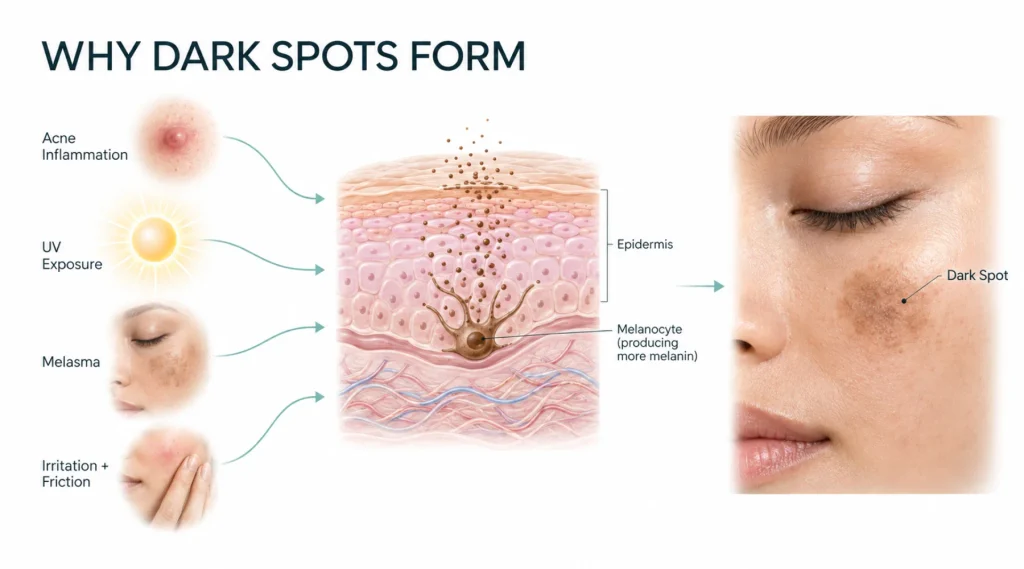
A dark spot on the skin shows where more melanin collects than in the surrounding areas. Melanin is natural and gives skin its colour while protecting against UV rays. Problems happen when melanin-producing cells, called melanocytes, become too active in certain spots.
Post-Inflammatory Hyperpigmentation
One common cause is the flat brown or grey marks that appear after a pimple heals. Acne inflammation can lead to more pigment, especially in medium to darker skin tones. Picking or irritating the blemish can make the mark darker and last longer. These marks are different from true acne scars. colour changes are just pigmentation, while scars involve changes in the skin’s texture.
Sun-Induced Pigmentation
When skin is exposed to UV rays, it makes more melanin as a defence. Over time, regular sun exposure can cause uneven pigmentation and sun spots, which are also called age spots. These spots tend to stay longer than the temporary darkening from a tan.
Melasma
Melasma appears as larger, irregular brown or grey patches, often on the cheeks, forehead, and upper lip. It can be affected by hormones, genetics, UV rays, and visible light. Melasma is more complex than post-acne marks and may need long-term care, as it can return even after improvement.
Irritation and Friction
Pigmentation can also occur from:
- Eczema
- Shaving irritation
- Waxing
- Insect bites
- Harsh exfoliation
- Rubbing
- Tight clothing
- Other skin conditions
- Burns or minor injuries
Treating the cause is as important as treating the dark spots. If irritation continues, adding more brightening products can worsen the problem. Knowing the type and cause of hyperpigmentation helps in selecting the right treatment instead of using strong products on every dark area.
Is Vitamin C Good for Dark Spots?
Yes, vitamin C can help with dark spots, especially those caused by sun exposure and inflammation. It works slowly by affecting how melanin forms and protects the skin from environmental damage.
The key point is that it works gradually. Vitamin C doesn’t remove melanin like wiping paint off a surface. Instead, pigmented skin cells must move up through the skin layers and eventually shed as skin renews. In the meantime, vitamin C helps reduce factors that cause too much pigment.
Research on topical vitamin C shows promise, but it isn’t perfect. Studies have found improvements in uneven pigmentation, melasma, and sun-damaged skin, but the research is not as extensive or standardised as for some prescription treatments.
Vitamin C is a well-regarded cosmetic ingredient, but it should not be advertised as a guaranteed solution for all types of pigmentation.
How Vitamin C Works on Dark Spots
Vitamin C does more for skin pigmentation than just “brightening.”
Melanin Production
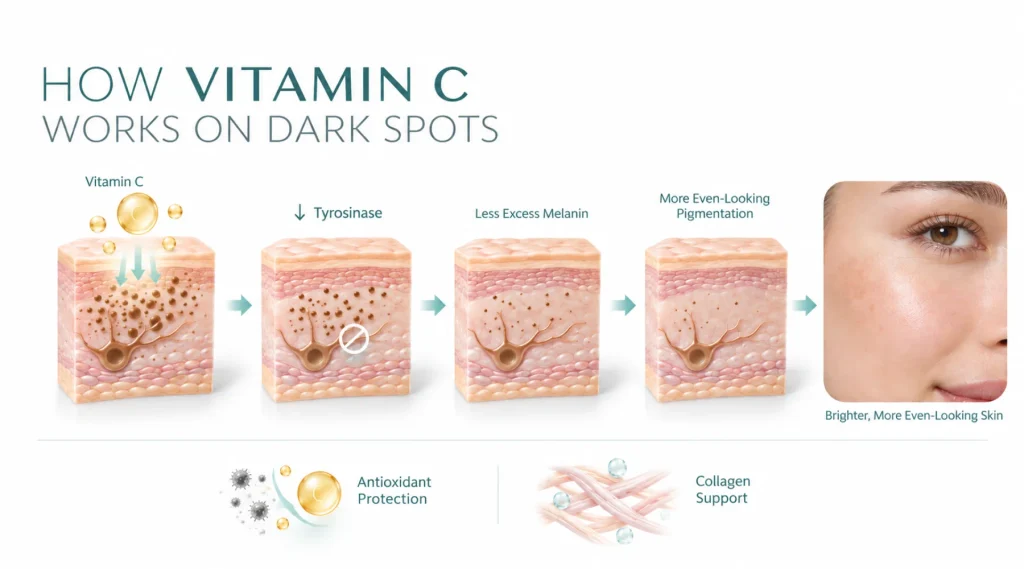
It impacts how melanin, the pigment that colours skin, is produced. Melanin forms through several reactions involving an enzyme called tyrosinase. Vitamin C can block this process and reduce oxidation, helping to improve the look of excess pigmentation over time. Studies show that its effect on tyrosinase is a key reason it reduces pigmentation. However, it doesn’t stop normal skin colour; instead, it helps balance uneven areas without removing the skin’s natural tone.
Antioxidant Properties
Vitamin C also acts as an antioxidant. UV rays, pollution, and normal cell activity create harmful reactive oxygen species. Too many of these can stress the skin, leading to ageing and pigmentation issues. Vitamin C neutralises these harmful molecules, making it a common ingredient in skincare aimed at protecting the skin. This antioxidant role is especially helpful when dealing with pigmentation since environmental factors can trigger the problems you’re trying to manage.
Collagen Support
Additionally, Vitamin C supports collagen production. While it doesn’t erase brown spots directly, this benefit makes it valuable for overall skin health. A good Vitamin C product can help with uneven skin tone and signs of ageing, not just pigmentation issues.
Initial Brightening
Many people notice their skin looks brighter before individual marks fade significantly. This change is essential to track when evaluating results. Brightening refers to reducing dullness and enhancing overall glow, while fading pigmentation means lightening specific spots. Brightness can appear sooner than complete fading of pigmentation.
Does Vitamin C Lighten Skin or Brighten Skin?
Vitamin C brightens and evens skin tone, rather than bleaching it.
It can reduce dark spots but won’t change your natural skin colour.
Can vitamin C lighten skin?
Yes, it can lighten dark spots but won’t affect healthy, normally pigmented skin.
Does vitamin C brighten skin?
Absolutely. It boosts radiance and helps create a more even complexion, which is why it’s popular in skincare products.
This is especially important for darker skin tones. The goal should be to achieve an even appearance, not to alter natural melanin.
Which Vitamin C Is Actually in Your Serum?
The label “Vitamin C” on a bottle doesn’t say much. Different forms of vitamin C act differently on your skin.
L-ascorbic Acid
L-ascorbic acid is the most researched and active form of topical vitamin C. However, it has some challenges. It dissolves in water, is somewhat unstable, and doesn’t easily penetrate the skin’s outer layer. To help with stability and absorption, formulators use an acidic environment. Products with a pH below 3.5 are better for L-ascorbic acid absorption. This low pH can also cause some serums to sting.
Vitamin C Derivatives
Some products contain other forms like:
- Sodium ascorbyl phosphate
- Magnesium ascorbyl phosphate
- Ascorbyl glucoside
- 3-O-ethyl ascorbic acid
- Tetrahexyldecyl ascorbate
- Ascorbyl palmitate
These derivatives are often made to be more stable or easier on the skin. They can be great for those who find L-ascorbic acid too harsh. However, not all derivatives are equally effective. Many need to be converted in the skin to work, and some don’t have much clinical research backing them.
Using a derivative doesn’t automatically mean it’s weaker or better. The whole formulation is important.
Is 20% Vitamin C Better Than 10%?
Not automatically.
Skincare marketing often misrepresents the science.
More ingredients don’t always lead to better results.
For L-ascorbic acid, concentrations of 10–20% are typical in skincare. Studies show that using more than 20% doesn’t always improve delivery to the skin and can cause irritation.
So, concentration is just one factor to consider.
A stable 10% product used daily for six months can work better than a 20% serum that irritates your skin and leads you to stop using it after just a couple of tries.
Consider:
| Vitamin C level | Who it may suit | What to consider |
| Lower-strength formulae | Beginners, reactive or dry skin | Often easier to introduce consistently |
| Moderate-strength formulae | Most established routines | Balance of efficacy and tolerability |
| 15–20% L-ascorbic acid | Experienced users with tolerant skin | Greater potential for stinging or dryness |
| Above 20% | Rarely necessary | Higher strength does not guarantee better absorption |
If your skin can handle stronger antioxidants, a 20% vitamin C serum might work well for you. An ampoule serum with 20% vitamin C is another option, but being an “ampoule” doesn’t mean it’s better.
If you have sensitive skin, don’t feel like you need to go for the highest percentage on the label.
How to Use Vitamin C for Dark Spots
The easiest and most sustainable skincare approach is:
- Cleanse gently.
- Apply vitamin C.
- Add hydration if needed.
- Moisturise.
- Use sunscreen during the day.
Consistency is more important than a complicated routine.
Start with a Clean Face
Use a gentle cleanser that removes sunscreen, makeup, and excess oil without making your skin feel tight. If cleansing irritates your skin, treating dark spots will be harder.
Applying Vitamin C
You don’t need to scrub your face to help vitamin C work. Apply vitamin C serum before thicker creams. Use a lightweight water-based serum first, then add a rich moisturiser, oil, or sunscreen. Spread a thin, even layer without soaking your skin. Just enough to cover your face is enough; using more won’t speed up results.
Let the Product Settle
You don’t need to wait long between layers of skincare. Just let the serum settle briefly so the next product can apply smoothly.
Moisturise According to Your Skin
Vitamin C alone isn’t a moisturiser. If your skin feels dry or irritated, use a moisturiser with glycerin, ceramides, or hyaluronic acid. A comfortable barrier can help you use more active ingredients consistently.
Finish with Sunscreen
This step is crucial if you’re working on pigmentation. Sunshine can undo your efforts against dark spots. Always use a broad-spectrum sunscreen with SPF 30 or higher. If pigmentation is a concern, consider tinted sunscreen with iron oxides for extra protection, especially for darker skin tones. Remember, vitamin C works with sunscreen but does not replace it.
When to Use Vitamin C Serum: Morning or Night?
Vitamin C can be used in the morning, evening, or both, based on the formula and how your skin reacts.
Using vitamin C in the morning is especially helpful for dark spots. It offers protection against UV rays and pollution.
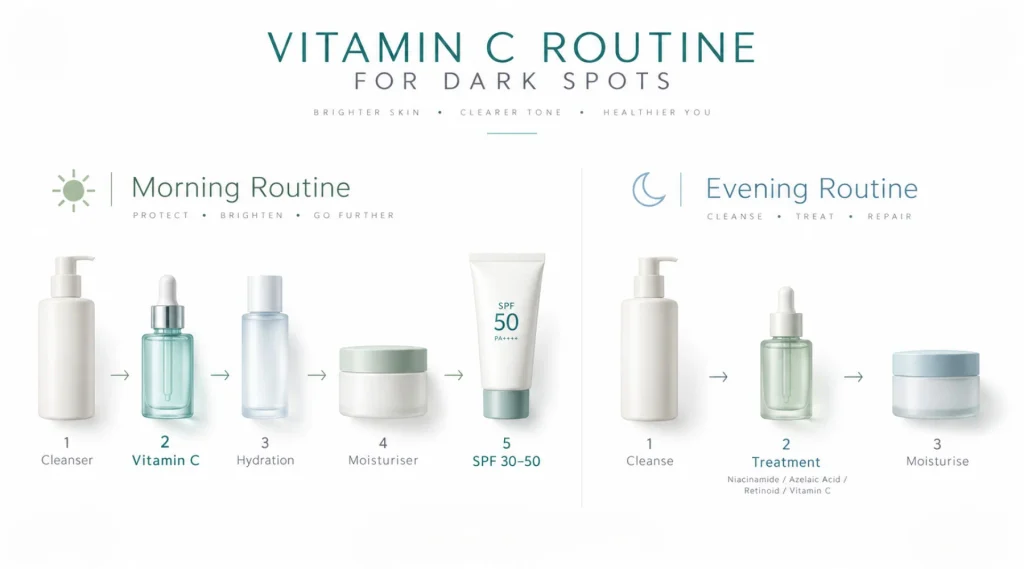
A simple morning routine could be: Cleanser → Vitamin C → Moisturiser → Sunscreen.
Using it at night is also fine. Some prefer it in the evening due to a busy morning routine, while others use retinoids or exfoliants at night and use vitamin C in the morning.
There’s no strict rule about using vitamin C at a specific time. The key is to use it consistently without irritating your skin.
The Best Routine Using Vitamin C for Dark Spots
Dark spots respond better to a routine than to a single ingredient.
A good routine focuses on four goals:
- Reduce pigment signals.
- Prevent new triggers.
- Support skin turnover when needed.
- Minimise irritation.
A simple morning routine
1. Gentle Cleanser
Pick a cleanser that fits your skin, not just one labelled “brightening.”
2. Vitamin C Serum
Evenly apply it to areas with uneven skin tone.
3. Hydrating Serum or Essence
Use this if your skin feels dry or dehydrated.
4. Moisturiser
Choose a texture that matches your skin type.
5. Broad-Spectrum SPF 30–50
Apply enough to all exposed skin and reapply after long outdoor exposure.
If you’re starting a skincare routine, try different serums without feeling you need to layer them all.
A simple evening routine
1. Cleanse Well
If you wear heavy sunscreen or makeup, use a cleanser that removes them easily.
2. Apply Your Treatment
Choose a treatment like niacinamide, azelaic acid, a retinoid, or another dose of vitamin C based on your needs.
3. Moisturise
This helps if your skin is a bit dry from treatments targeting pigmentation. Separating treatments for morning and night doesn’t mean the ingredients don’t work together; it just makes your routine easier.
Can You Use Niacinamide With Vitamin C?
Yes, you can use niacinamide and vitamin C together in your skincare routine. The old belief that they cancel each other out or create harmful effects is not accurate for today’s skincare products.
Niacinamide has benefits for reducing dark spots. It helps strengthen the skin barrier and limits pigment transfer. Vitamin C works differently as an antioxidant, so using both can be beneficial.
Here are three ways to use them:
- Option 1: Layer both in the morning. Apply vitamin C first, then niacinamide, followed by moisturiser.
- Option 2: Use vitamin C in the morning and niacinamide at night. This is often best for sensitive skin.
- Option 3: Apply a niacinamide moisturiser after vitamin C. This keeps your routine simpler with fewer products.
Using both can be especially helpful for dark spots from acne since it not only targets pigmentation but also soothes the skin. It’s important to understand niacinamide’s broader role in treating hyperpigmentation, especially if irritation or post-acne marks are frequent issues.
Can You Use Hyaluronic Acid With Vitamin C?
Yes, Hyaluronic acid and vitamin C work well together. Hyaluronic acid helps draw in and hold water, keeping the skin hydrated. It does not affect how vitamin C functions as an antioxidant.
This pairing is great when vitamin C serum makes your skin feel tight.
A simple routine is:
Cleanser → vitamin C serum → hyaluronic acid → moisturiser → SPF.
You don’t have to wait for a chemical reaction between these products.
If your vitamin C serum already has humectants like glycerin or hyaluronic acid, you may not need an extra hydrating serum. More layers don’t always mean better skincare.
Can You Use Azelaic Acid and Vitamin C Together?
You don’t have to use azelaic acid and vitamin C at the same time.
Azelaic acid is great for treating pigmentation connected to acne because it reduces inflammation and targets pigment. Use vitamin C in the morning and azelaic acid in the evening.
For example:
- Morning: vitamin C + moisturiser + sunscreen
- Evening: azelaic acid + moisturiser
Using them at different times can help prevent stinging on sensitive skin. If you handle both well, you can use them together based on the products.
A 12% azelaic acid cream can work differently than vitamin C, rather than competing with it. When pigmentation is tough to treat, it’s better to focus on different ingredients rather than looking for just one strong brightener. Ingredients like vitamin C, niacinamide, and azelaic acid target pigmentation in unique ways. Choose ingredients based on the cause of your hyperpigmentation to avoid overlap.
Vitamin C and Retinoids: Do You Need Both?
You can use both, but you don’t have to.
Retinoids and vitamin C tackle issues like sun damage and uneven skin tone in different ways.
For those already familiar with both:
- Use vitamin C in the morning
- Use retinoids at night.
This creates a simple routine.
The issue is when a beginner uses vitamin C, retinol, exfoliating acids, and acne treatments all in one week.
If irritation occurs, it becomes hard to determine the cause. This can worsen dark spots.
When dark spots are a problem, a gentle routine is often better than a harsh one.
How Long Does Vitamin C Take for Dark Spots?
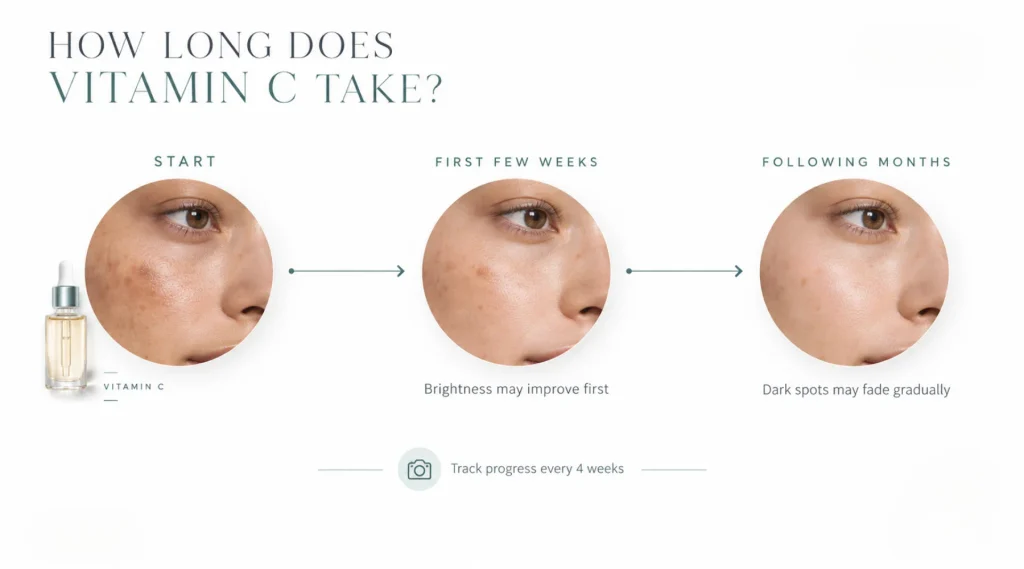
Expect results to take weeks or months, not days. Some people see brighter skin in a few weeks, but dark spots may take longer to fade. A good way to track changes is to take a photo of the area in the same lighting every four weeks instead of checking in the mirror multiple times a day.
Visible changes depend on factors like:
- How old the mark is
- How deep the pigment is
- The cause of the mark
- Your natural skin tone
- Ongoing sun exposure
- Active acne or irritation
- Vitamin C formulation
- How consistently you use the treatment
- Other products in your routine
Clinical studies on vitamin C have used different treatment times, but reviews suggest that using it regularly is key for noticeable improvement. Dermatologists note that some dark spots can take months to fade, especially if the pigment is deep in the skin. Therefore, a two-week before-and-after comparison isn’t a reliable way to measure a stubborn dark spot’s progress.
What Results Should You Expect After One, Two and Three Months?
Skincare Timeline
First Month
You might notice smoother application of your products, more radiance, and slight improvements in dull skin. Don’t worry if stubborn spots don’t change; this doesn’t mean the serum isn’t working.
Six to Twelve Weeks
You may start to see clearer tone changes if the pigmentation is mild and controlled. Post-acne marks may look softer and blend better with your skin.
Three Months and Beyond
You can evaluate persistent dark spots more clearly. If they haven’t changed with proper sun protection and treatment, consider changing your diagnosis or treatment. Remember, spots like moles or keratoses won’t respond like post-inflammatory pigmentation. Melasma may also need a more comprehensive treatment plan.
Why Sunscreen Determines Whether Vitamin C Works
This part of pigmentation skincare is not glamorous, but it’s very important.
You can’t effectively treat pigmentation from the sun while exposing your skin to the sunlight that causes it.
Sunscreen is not just for preventing sunburn. UVA rays can speed up skin ageing and cause pigmentation issues, while visible light can worsen conditions like melasma.
Dermatologists recommend using a broad-spectrum SPF 30 or higher. Tinted sunscreens with iron oxide can provide extra protection against visible light for dark spots or melasma.
This is also why someone might use a good vitamin C serum for months without seeing results.
The serum itself might not be the issue; the pigmentation may simply be getting more daily exposure than the treatment can handle.
Vitamin C Does Not Replace Sunscreen
Vitamin C is often called “photoprotection,” which can be confusing. Its antioxidants help reduce oxidative stress from UV exposure, but it isn’t a UV filter and doesn’t have an SPF rating. A vitamin C serum should not replace sunscreen.
Think of the two as performing different jobs:
| Vitamin C | Sunscreen |
| Antioxidant support | Reduces UV exposure reaching the skin |
| Helps target uneven pigmentation | Helps prevent pigment from being restimulated |
| Supports collagen biology | Protects against sunburn and photoageing |
| Cosmetic skincare active | Primary photoprotective product |
It’s better to combine them than choose one over the other.
How to Apply Vitamin C Serum Without Irritating Your Skin
Vitamin C can cause problems because of its strength, how often you use it, or other active ingredients in your routine.
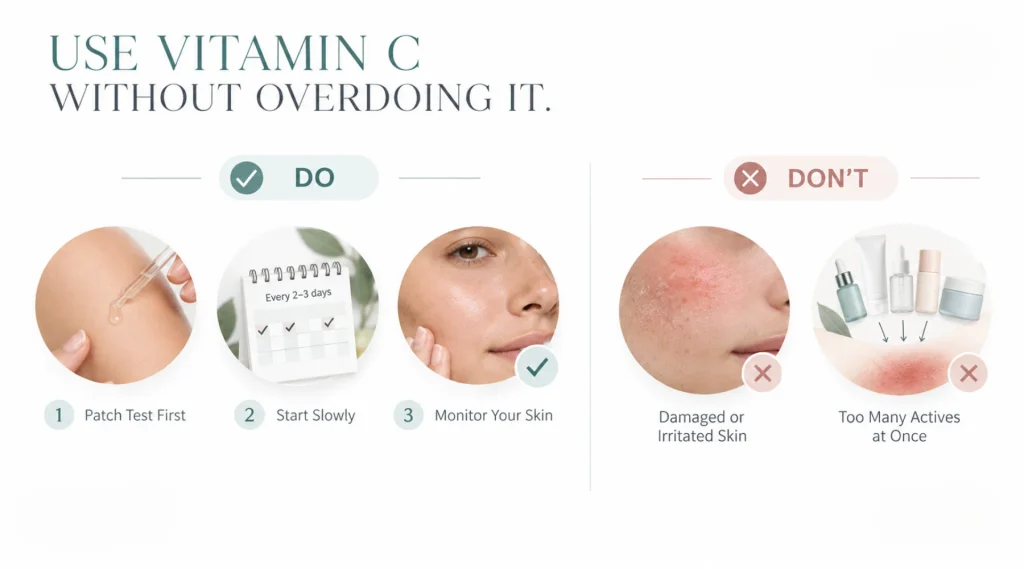
Patch Test First
Test a small amount on a small area of skin before using it on your entire face, especially if your skin is sensitive. A patch test won’t predict every reaction, but it can show if your skin doesn’t tolerate it.
Start Slowly
You don’t need to use vitamin C every day at first. Try it every second or third morning and increase use if your skin feels fine.
Avoid on Damaged Skin
Stop using vitamin C if your skin is peeling, cracked, sunburned, freshly waxed, irritated from a procedure, flaring from eczema, or burning with moisturiser. It’s not good to push products through damaged skin.
Watch for Irritation
Even if the vitamin C serum is okay, it can cause problems when used with other strong products, like exfoliating cleansers, glycolic acid toners, salicylic acid treatments, retinoids, benzoyl peroxide, facial scrubs, or home peels. Each product may be fine alone, but together they can be too much.
Can Vitamin C Make Dark Spots Worse?
Vitamin C aims to reduce uneven skin tone, but an irritating routine can make pigmentation worse, especially for skin prone to post-inflammatory hyperpigmentation.
If a strong acidic serum causes burning, redness, itching, scaling, tightness, or an eczema-like rash, it’s not smart to keep using it, hoping your skin will improve. Vitamin C doesn’t typically cause a “purge” like other ingredients that speed up skin cell turnover.
Ongoing irritation is still irritation, and inflammation can lead to more pigment.
What Does Oxidised Vitamin C Look Like?
L-ascorbic acid is very unstable. Air, heat, and light can make it oxidise faster, so good packageing and formulation are important. A fresh L-ascorbic acid serum may be clear, colourless, or pale yellow. If it turns dark yellow, orange, or brown, it may be oxidised.
Not all vitamin C products should be judged the same way, as some might have naturally coloured extracts. Packageing can help slow the breakdown.
Look for:
- Opaque or dark bottles
- Air-restrictive packageing
- Properly sealing caps
- Storage instructions to keep it away from heat and sunlight
Buying a large bottle that stays open for a year may not be a good idea. It’s better to choose a size you can realistically use up.
Common Vitamin C Mistakes That Slow Dark-Spot Results
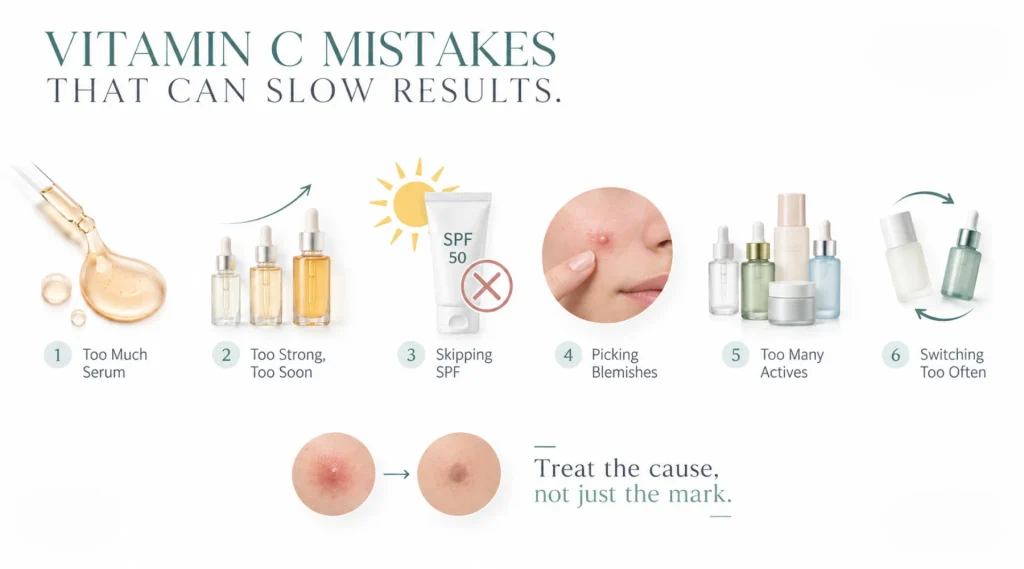
Using Too Much Serum
Using more serum won’t fade spots faster. A thin, even layer is enough.
Increasing Strength Too Quickly
Jumping from no vitamin C to a strong 20% serum can irritate. It won’t speed up results.
Skipping Sunscreen
Not using sunscreen is the biggest mistake you can make.
Treating Acne Marks without Treating Acne
If you get new inflamed spots weekly, you could create more pigmentation. Preventing new dark marks is more important than fading old ones.
Picking Blemishes
Picking at blemishes can cause more inflammation. Let them heal with minimal interference.
Combining Many Brightening Ingredients
You don’t need to use vitamin C, retinol, glycolic acid, salicylic acid, kojic acid, and azelaic acid all at once.
Changing Products Too Often
It takes time to see results from pigmentation treatments. Switching products frequently makes it hard to track progress.
Expecting Vitamin C for All Dark Marks
Not all dark marks are hyperpigmentation. Unusual or changing lesions need to be checked by a doctor instead of using stronger serums.
How to Fade Post-Acne Dark Spots More Efficiently
Post-acne pigmentation needs two main actions: stopping new breakouts and fading existing dark spots. Vitamin C can help with fading. For stopping breakouts, consider using salicylic acid, benzoyl peroxide, azelaic acid, or retinoids, depending on your skin and the acne’s severity.
Avoid picking at your skin. Always use sunscreen and keep moisturiser in your routine. Remember, a flat brown mark is treated differently than an indented acne scar. A well-planned approach to fading dark spots is often more effective than just using stronger serums repeatedly.
Using Vitamin C for Dark Spots on the Body
Hyperpigmentation can happen anywhere, not just on the face.

Common areas include:
- Shoulders
- Chest
- Back
- Arms
- Legs
- Knees
- Places with ingrown hairs
You can use Vitamin C for body pigmentation, but you need to address the cause. Dark marks from recurring acne will keep coming back unless you manage the acne. Marks from ingrown hairs need better shaving techniques and care to reduce inflammation.
Friction-related pigmentation is hard to improve if rubbing happens every day. For larger areas, using a vitamin C serum for both the face and body is more effective than applying a small facial treatment in tiny amounts.
Don’t forget to use sunscreen on exposed areas like the shoulders, chest, and hands.
Vitamin C for Melasma Needs a Different Strategy
Vitamin C can help with melasma, but it’s not the same as treating regular acne. Melasma has many causes and often comes back.
Sun protection is crucial. Tinted sunscreen with iron oxides can be particularly helpful against visible light. The British Association of Dermatologists suggests vitamin C as a topical option for melasma but emphasises the need for sun protection and acknowledges prescription treatments for more serious cases.
Other options a dermatologist may consider include:
- Azelaic acid
- Hydroquinone
- Prescription retinoids
- Combination prescription creams
- Tranexamic acid when appropriate
- Chemical peels
- Certain laser or light treatments
Melasma treatment is usually more effective as ongoing management than as a guaranteed cure.
When Professional Pigmentation Treatment Makes More Sense
Over-the-counter skincare has limits.
Think about getting professional advice for pigmentation if:
- It hasn’t improved after several months of regular care.
- It covers large, even areas on your face.
- It looks like melasma.
- It followed a serious skin condition.
- It’s very dark or grey-blue.
- It changes shape, colour, or size.
- It bleeds or has crusts.
- It looks different from your other spots.
- It significantly lowers your confidence.
- You have ongoing acne that needs treatment.
A dermatologist can tell if the pigment is mostly on the surface, deeper in the skin, or a mix. They can suggest the right treatment for you.
Chemical peels
Certain acids can help skin renew itself and reduce pigmentation issues. However, they come with risks. Strong peels can lead to increased pigmentation, especially in people with darker skin.
Prescription treatments
Prescription pigmentation treatments work better than cosmetic serums for some conditions. However, they need careful supervision since stronger treatments can cause irritation and other side effects.
Lasers and energy-based procedures
These can help with certain pigment issues but may not work for everyone.
Conditions like melasma can worsen with heat or inflammation, so it’s important to choose the right devices and settings for darker skin tones.
Professional treatment should be based on diagnosis, not just intensity.
What Vitamin C Cannot Do?
Good skincare advice has limits.
Vitamin C cannot:
- Stop new acne marks if the acne isn’t controlled.
- Remove deep acne scars.
- Guarantee lasting results for melasma.
- Replace sunscreen.
- Safely remove a suspicious mole.
- Correct all types of pigmentation.
- Fade marks overnight.
- Fix irritation from harsh skincare routines.
Vitamin C is helpful, but it’s just one part of a bigger plan for manageing skin colour. This doesn’t mean it’s not valuable; it just sets more realistic expectations.
Choosing a Vitamin C Serum for Your Skin Type
Oily or Acne-Prone Skin
Choose a lightweight product that sits well under sunscreen. Don’t assume oily skin needs the strongest formulae, as irritated skin can still show dark spots.
Dry Skin
Look for vitamin C with ingredients like:
- Glycerin
- Panthenol
- Hyaluronic acid
- Squalane
- Ceramides
You may still need a separate moisturiser.
Sensitive Skin
Start with a lower concentration or gentler version. Use it a few times a week before moving to daily use. Don’t add exfoliating acids at the same time.
Deeper Skin Tones Prone to Pigmentation
Preventing irritation is crucial, as inflammation can lead to noticeable dark spots. A gentle formula and good sun protection are better than frequent strong peels.
Experienced Active Users
If your skin tolerates acids well, higher-strength L-ascorbic acid can be suitable. However, don’t consider 20% as the minimum effective dose.
How Much Vitamin C Serum Should You Use?
Use just enough product to create a thin layer on the treatment area. For most dropper serums, a few drops for the face should be enough, but droppers can vary widely. Aim for even coverage, not a heavy layer.
If the product runs down your neck, collects around your nose, or feels sticky for a long time, you are probably using too much. This also helps with budgeting: a good routine shouldn’t use up a whole bottle in two weeks.
Should Vitamin C Go on Wet or Dry Skin?
Follow the manufacturer’s instructions. Pure acidic L-ascorbic acid feels better on dry skin.
Water left on your face can spread some low-pH products more and make them sting, especially on sensitive skin.
Vitamin C derivatives in hydrating formulae are usually easier to use.
You can safely add hyaluronic acid afterwards as part of your moisturising routine.
Can Vitamin C Be Used Every Day?
Yes, you can use it daily if your skin can handle it.
Daily use is common in skincare routines.
However, don’t push for daily use if it irritates your skin.
Using it three or four times a week might be better than using it every day and then dealing with redness, peeling, and needing a two-week break.
The goal is to be consistent, not to overwhelm your skin.
Can You Use Vitamin C Twice a Day?
You can use vitamin C twice a day, but most people don’t need to. Applying it in the morning is usually enough for skin care.
Some products may work well twice a day, but this can use up more product and might cause irritation without speeding up results.
Start by using it once a day or less. Only increase if you have a good reason.
Does Vitamin C Help Old Dark Spots?
Older pigmentation can be tougher to treat.
The age of a spot is just one factor; how deep the pigment goes is also important.
It’s usually easier to change superficial pigmentation with skincare than deeper pigmentation.
A long-lasting dark mark may take time to improve, even with a good routine.
Just because a mark stays dark doesn’t mean you need a stronger serum.
Is Vitamin C Better for Dark Spots Than Niacinamide?
Neither ingredient is necessarily better than the other. They have different roles.
Vitamin C acts as an antioxidant and affects melanin production. Niacinamide may reduce melanosome transfer and support skin barrier function.
People with sensitive, acne-prone skin might find niacinamide easier to use. Those with dull or damaged skin may benefit more from vitamin C.
Many can use both ingredients. The best choice depends on the cause of your pigmentation, your skin’s sensitivity, and your skincare routine.
Is Vitamin C Better Than Azelaic Acid for Dark Spots?
It depends on the type of dark spot.
For post-acne marks with active blemishes, azelaic acid works well because it treats both inflammation and pigmentation.
For overall dullness and sun-related uneven skin tone, vitamin C is a great option.
Using vitamin C in the morning and azelaic acid at night is a good choice for those who can handle both products.
Does Vitamin C Work Without Sunscreen?
It might still have antioxidant and colour-related effects, but the overall method is less effective if sunlight keeps causing pigmentation.
It’s like trying to empty a bathtub while the water is still running.
The serum might be working, but the trigger is still happening at the same time.
Can Vitamin C Remove Acne Scars?
Vitamin C can help improve dark spots from acne but doesn’t treat real scars. Indented scars change the skin’s structure, while raised scars have extra tissue. Vitamin C cannot fix either type of scar. Treat colour and texture as two separate issues.
Can Vitamin C Cause Purging?
Vitamin C does not usually cause a classic purge.
If you notice lasting redness, itching, burning, or many irritated bumps after starting a serum, don’t assume this is a sign of improvement.
Think about irritation, an unsuitable formula, or interactions with other products instead.
Should You Use Vitamin C Before or After Moisturiser?
Most vitamin C serums are applied before moisturiser because they are lighter and meant for treatment. However, there are exceptions. For sensitive skin, you can apply moisturiser first to reduce irritation, but this might change how well the product spreads and absorbs. Always follow the manufacturer’s instructions if they provide any.
Can Vitamin C Help Dark Spots Safely During a Sensitive-Skin Phase?
Timing is important.
If your skin is naturally sensitive, a gentle formula might be effective.
If your skin is inflamed, peeling, or damaged, focus on healing first. A simple cleanser, moisturiser, and sunscreen may be more helpful than a brightening product.
When your skin feels better, you can slowly start using vitamin C again.
How Do You Know Whether Vitamin C Is Working?
Look for trends, not daily changes.
Watch for signs like:
- The mark blends better with your skin.
- Your skin tone looks more even.
- New post-acne marks fade consistently.
- Your skin appears less dull.
- Photos over several months show improvement.
Don’t judge a pigment product just by how glowing your skin looks right after applying it. Moisturisers and shiny ingredients may create immediate brightness but don’t change melanin.
A tingling feeling doesn’t mean an active ingredient is effective. Skincare results aren’t measured by how much it stings.
When Should You Stop Using Vitamin C?
Stop and reassess if you experience:
- Lasting burning
- Significant redness
- Swelling
- Hives
- Intense itching
- Cracking
- Worsening eczema
- Ongoing irritation after each use
Mild tingling can happen with low-pH products, but discomfort shouldn’t be a normal part of your skincare routine.
If symptoms are severe or last a long time, talk to a healthcare professional.
Frequently Asked Questions About Vitamin C and Dark Spots
How long does vitamin C take to fade dark spots?
Dark spots usually fade after several weeks to months of regular treatment. Skin brightness may improve sooner than specific dark spots. Older or deeper spots take longer.
Is vitamin C good for dark spots from acne?
Yes, vitamin C can help with dark spots left by acne. However, manageing active acne is also crucial, as new inflammation can create more marks.
How do I use vitamin C serum for dark spots?
Apply a thin layer of the serum after cleansing and before moisturising. Mornings are ideal, followed by sunscreen. If you have sensitive skin, start slowly.
When should I use vitamin C serum?
Morning is a great time because vitamin C works well with sunscreen. You can also use it in the evening. Being consistent is more important than picking a “perfect” time.
Can I use niacinamide with vitamin C?
Yes, you can use niacinamide with vitamin C. You can layer them or use vitamin C in the morning and niacinamide in the evening if that’s more comfortable.
Can you use hyaluronic acid with vitamin C?
Yes, hyaluronic acid hydrates well with vitamin C and doesn’t affect its effectiveness. Apply it based on your product’s texture, usually using vitamin C first.
Does vitamin C lighten skin?
Vitamin C can reduce dark spots and even out skin tone, but it won’t bleach or change your natural skin colour.
Does vitamin C brighten skin?
Yes, vitamin C can improve skin brightness, often noticeable before stubborn dark spots fade.
Is 20% vitamin C necessary for hyperpigmentation?
No, higher concentration doesn’t guarantee better results. Stability, form, tolerability, and consistent use are key. Many effective formulae are between 10–20%.
Can I use vitamin C every morning?
Yes, if your skin tolerates it. If your skin is sensitive, start every other morning and gradually increase.
Can vitamin C make pigmentation darker?
Vitamin C shouldn’t darken pigmentation directly, but irritating formulae can cause inflammation, which may worsen dark spots in sensitive skin.
Should I put vitamin C directly on each dark spot?
You can apply it directly to dark spots, but it’s often better to spread a thin layer over your entire face to address overall tone. Avoid excessive application on one spot.
Does vitamin C work on melasma?
Vitamin C can support a melasma treatment routine, but melasma often needs multiple strategies. Consistent sun protection is crucial, and severe cases may require a dermatologist.
What should I pair with vitamin C for stubborn dark spots?
Daily sunscreen is essential. Depending on your skin’s needs, niacinamide, azelaic acid, retinoids, or other treatments may also help.
How long should I try vitamin C before deciding it does not work?
If you don’t experience irritation, use a good product consistently for several weeks to a few months with sun protection. Changes in pigmentation can take time.
Making Vitamin C for Dark Spots Work Without Overcomplicating Your Routine
The best way to use vitamin C for dark spots isn’t always the strongest method. Choose a formula that your skin can handle and use it regularly. Keep your skin barrier healthy and prevent new irritation. Treat ongoing acne or irritation instead of just the marks they leave. Most importantly, use broad-spectrum sunscreen every day, especially if you have melasma or ongoing hyperpigmentation.
Vitamin C can brighten dull skin and gradually improve excess pigmentation, but changes take time. Research shows it helps with pigmentation, and using a good-quality formula consistently is key.
If a simple vitamin C routine works, you don’t need to add more products. If it’s not working after several months, using a stronger vitamin C might not be the solution. You may need a different ingredient, better control of triggers, or a professional opinion.
Think of dark-spot skincare as a long-term effort to reduce excess pigment rather than just finding the strongest serum. Focus on minimising reasons for your skin to produce more pigment.