




Blog
Are Face Masks Good for Your Skin? Benefits, Risks and Tips

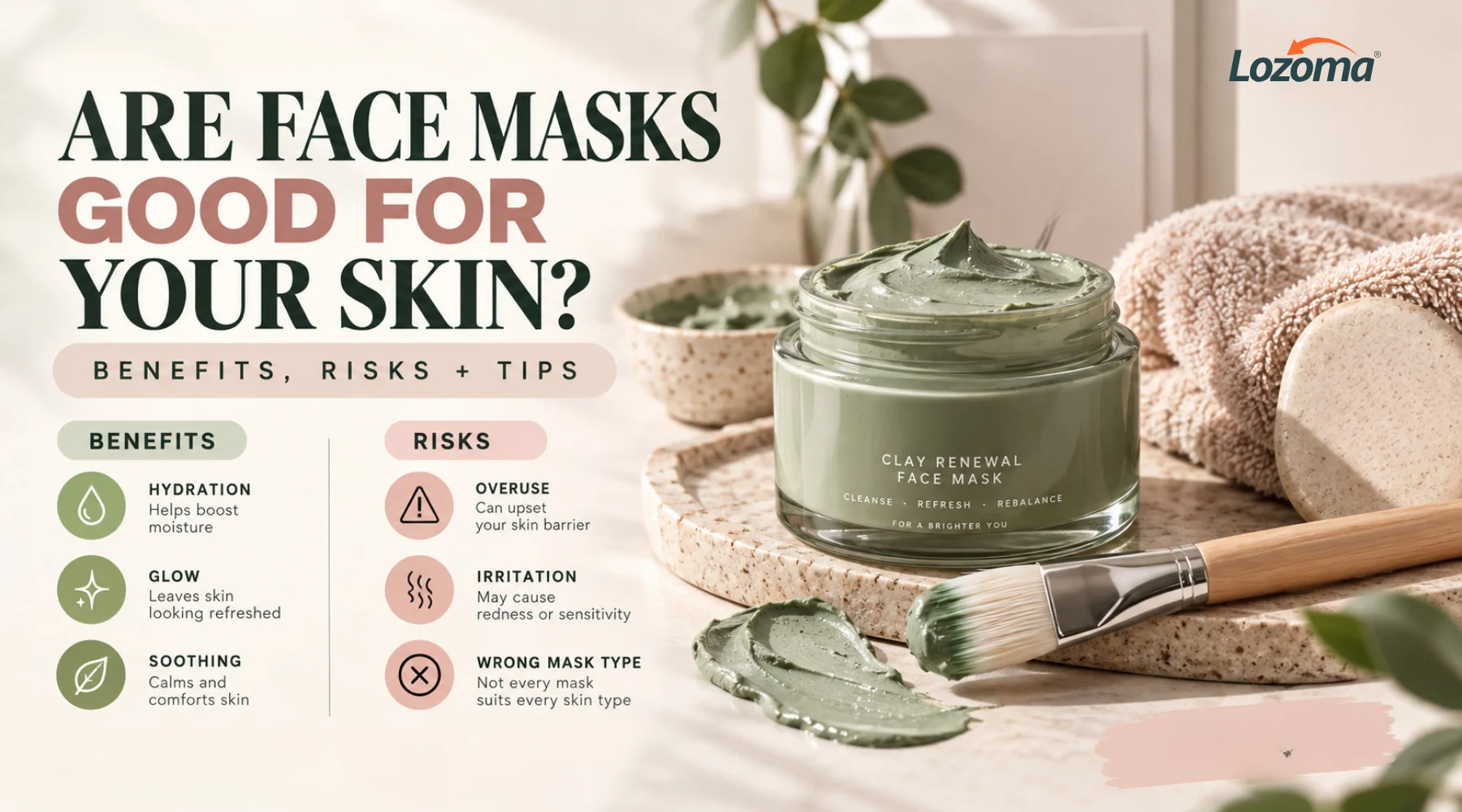
Face masks have a unique role in skincare. They can make your skin feel softer, calmer, or less oily after one use. However, many claims about them, like detoxing, shrinking pores, or instant lifting, are often exaggerated.
So, are face masks good for your skin? They can be. A good mask, suited to your specific skin issue, can boost hydration, improve smoothness, soak up extra oil, or provide helpful ingredients. On the other hand, the wrong mask may make your skin feel tight, irritated, flaky, or overly sensitive.
It’s important to realize that masks are an extra treatment, not the key to healthy skin. Proper cleansing, moisturizing, and using sunscreen are far more important than masking multiple times a week.
Dermatologists agree: masks can enhance your skincare routine, but they don’t replace cleansing, moisturizing, or sun protection. Choosing the right ingredients for your skin concern is more important than whether a product is labeled a mask.
What Does a Facial Mask Actually Do to Your Skin?
The answer depends more on the type of mask than just the word “mask.”
For example, a sheet mask filled with hydrating essence works differently than a clay mask that absorbs oil. A creamy sleeping mask acts differently from a peel-off mask, and a hydrogel mask creates a unique environment on the skin.
In general, facial masks can do one or more of four things:
- Make skincare ingredients stay on the skin longer.
- Prevent water loss for a while.
- Absorb oil and surface debris.
- Provide exfoliating, soothing, brightening, or moisturizing benefits.
That’s why there isn’t a single answer to what facial masks do.
A hydrating mask filled with glycerin and hyaluronic acid mainly increases water in the skin’s outer layer. A clay mask with kaolin focuses on removing excess oil. An acid mask helps loosen dead skin cells. A sleeping mask serves as a thicker, more moisturizing layer.
While the mask’s format affects its function, the ingredients perform the main work. Understanding what different facial masks do is more helpful than thinking they all provide the same results.
Why Some Face Masks Make Skin Look Better Almost Immediately
The main changes after using a mask come from hydration and changes in the outer layer of the skin, called the stratum corneum. When this layer gets more moisture, the skin cells swell a bit. This softens fine lines, reduces roughness, and helps the skin reflect light better. As a result, the skin can look fresher and brighter. However, this effect is temporary and doesn’t fix deeper skin issues.
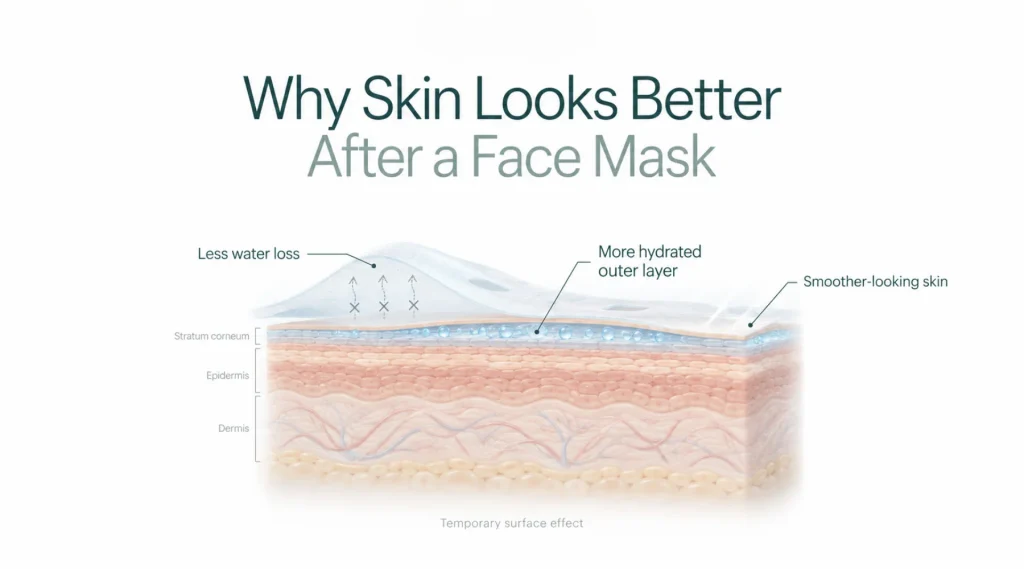
Hydration can temporarily improve the appearance of fine lines
Hydration can temporarily make fine lines look better. Sheet and hydrogel masks help by slowing down water loss while adding moisture. They can increase hydration in the stratum corneum for a short time. Studies show that wearing face masks for a shorter time can improve hydration, while wearing them too long can lead to dryness and redness. This explains why skin may look fuller right after removing a mask, but wrinkles don’t disappear.
Occlusion changes how a formula behaves
Occlusion means creating a barrier that keeps water from evaporating quickly. Masks like sheet or hydrogel types keep a watery formula close to the skin longer, enhancing hydration. Older studies on peel-off masks also found that occlusion helps with hydration. However, longer wear times don’t always mean better results. Wearing a mask for twice the recommended time doesn’t double absorption; it may irritate the skin if kept on too long.
Face Masks Good for Your Skin: Benefits and Risks Depend on the Type
Labeling a product as “good” or “bad” overlooks the main idea. Different masks work best for different issues.
| Mask type | What it tends to do best | Potential drawback |
| Sheet mask | Hydration, temporary plumping, soothing | Fragrance, prolonged wet occlusion, unnecessary actives |
| Hydrogel mask | Hydration, cooling, close skin contact | Can still irritate if the serum is unsuitable |
| Clay mask | Absorbs excess oil and reduces surface shine | Can cause tightness and dryness |
| Cream mask | Adds emollients and reduces dryness | May feel heavy on very oily skin |
| Sleeping mask | Prolongs moisturising and occlusive effects | Rich formulae may not suit everyone |
| Peel-off mask | Removes superficial material and creates smooth feel | Pulling can irritate skin and fine facial hair |
| Exfoliating mask | Helps rough texture and clogged-looking skin | Acids or enzymes can cause over-exfoliation |
| Brightening mask | Can temporarily improve radiance and support uneven tone | Strong actives may sting sensitive skin |
It’s better to choose face masks based on their purpose instead of the latest ingredients.
Sheet Masks Are Usually Better at Hydration Than Transformation
Sheet masks are popular in Korean skincare because they are an easy way to apply a hydrating serum to your skin for a set time. Their main benefit is hydration.
Humectants like glycerin and hyaluronic acid help draw water into the outer layer of your skin. Niacinamide can improve skin barrier function and even out skin tone, while calming ingredients can enhance comfort.
For example, the Bio-Collagen Real Deep Mask combines the sheet-mask style with ingredients like hyaluronic acid, collagen, and niacinamide. You can expect effects like hydration, softness, and temporary plumping, but not long-lasting lifting.
The same idea applies to more complex masks. The No.9 NAD Bio Lifting-sil Full Face Mask fits well and contains moisturising and firming ingredients. Any tightness or contouring you feel should be seen as a temporary cosmetic effect, not a change in facial structure.
Understanding this difference helps you appreciate the product without expecting impossible results.
Do Collagen Masks Work?
Collagen masks can hydrate your skin, but they can’t replace collagen lost from deep layers.
Collagen is a large protein. Regular topical collagen mainly helps with moisturising but struggles to penetrate the skin and rebuild collagen in the deeper layers. While reviews highlight its moisturising benefits, how well it can penetrate is a major limitation.
However, collagen masks still have benefits.
They can increase hydration, make fine lines less noticeable, improve softness, create a smoother feel, reduce temporary roughness, and make skin look plumper right away.
Some specialised collagen masks have shown good results in studies.
For example, one study found that a native collagen sheet mask improved hydration, reduced redness, and made wrinkles less visible compared to a regular cellulose mask. These results may not apply to all products labeled with “collagen.”
Researchers are exploring new ways to help collagen materials penetrate the skin better.
Even smaller collagen peptides still face challenges getting through, which is why claims about topical collagen reaching deeper layers should be based on specific formulae.
In summary, expect hydration and temporary plumping from collagen masks, but look for solid evidence for deeper skin benefits.
Clay Masks Can Help Oily Skin Without “Detoxing” It
Clay is very helpful for oily skin.
Clays like kaolin and bentonite can absorb extra oil. They help reduce greasiness on your face. This is especially useful for the oily T-zone or when your skin feels clogged.
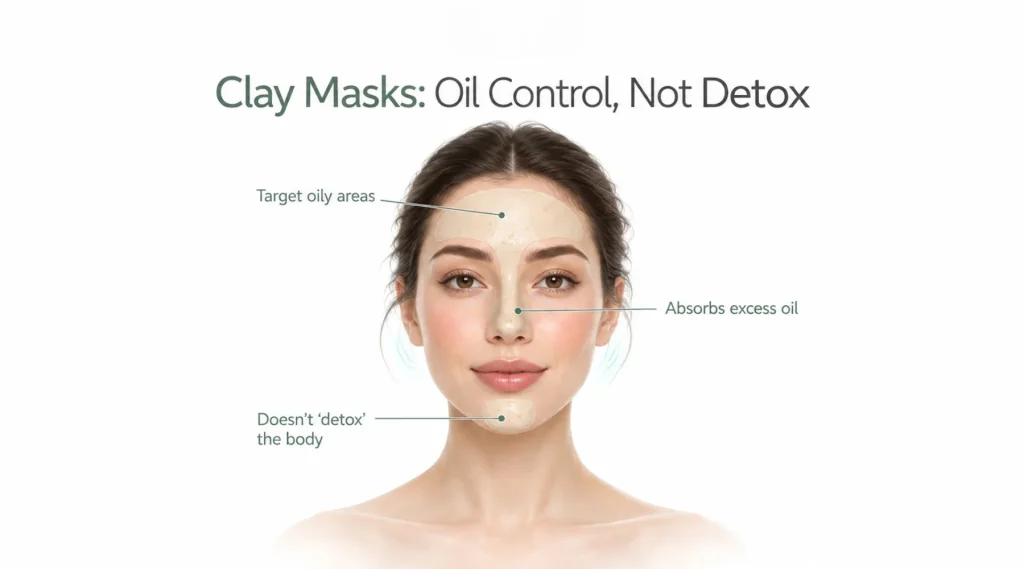
However, clay masks do not remove toxins from your body. Your kidneys, liver, lungs, and digestive system do that job. A mask only sits on the skin. Referring to this as “detoxification” makes it sound more impressive than it really is.
Are face masks good for oily skin?
Avoid treating oiliness like something to eliminate. Oily skin still needs water and natural oils. A clay mask that leaves your face too tight or flaky is too harsh for oil control.
For oily or acne-prone skin, dermatologists recommend using clay, niacinamide, and chosen alpha- or beta-hydroxy acids, along with light moisturisers to prevent dryness.
A better routine might focus on applying clay to the forehead, nose, and chin instead of covering dry cheeks. This targeted method, known as multi-masking, works better for combination skin than using one product for the whole face.
Peel-Off Masks Need More Caution Than Their Satisfying Removal Suggests
Peeling off a well-made mask can be very satisfying. It may remove dead skin cells, oil, tiny hairs, and other debris. However, it doesn’t mean all blackheads are gone from deep within the pores.
A Black Tea Extract Cleansing Mask is an example of a peel-off mask meant for occasional use. When using these masks, gentle removal is important. Don’t use them on irritated skin, freshly exfoliated areas, or around the eyes.
If peeling causes pain, stop right away. Constantly pulling off strong masks can make redness and irritation worse, especially if you’re using retinoids, exfoliating acids, or acne treatments.
Also, pores don’t physically open and close like doors when you change water temperature. Heat can soften surface material and increase redness, while cold might make them look smaller temporarily, but neither changes pore size permanently.
Sleeping and Wrapping Masks Offer Longer Contact, Not Automatically Better Results
Sleeping masks blend the features of a face mask and a moisturiser. Most are meant to stay on your skin overnight, creating a moisturising layer that helps reduce water loss while you sleep.
For example, the Medicube Kojic Acid Turmeric Night Wrapping Mask uses this overnight method along with ingredients that improve skin tone. Since long-wear masks often have more than just moisturisers, check the ingredient list carefully.
If a mask contains exfoliating or pigment-focused ingredients, don’t just layer it over other treatments in your routine. Extended use is only helpful if the formula is made for it. Never use a 15-minute exfoliating mask as a sleeping mask to get quicker results.
Are Face Masks Good for Your Skin for Sensitive Skin?
People with sensitive skin can use masks, but they need to choose carefully.
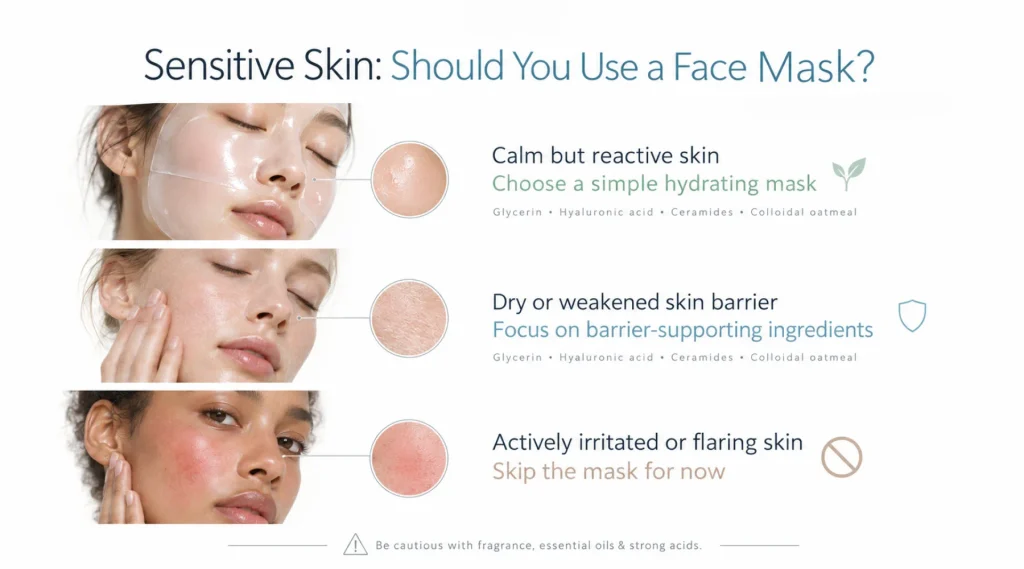
“Sensitive skin” includes different issues:
- naturally reactive skin
- skin prone to eczema
- rosacea
- a weak skin barrier
- irritation from too much exfoliation
- allergic contact dermatitis
- temporary sensitivity from sun exposure or treatments.
These conditions are not the same. Someone with mildly reactive skin might enjoy a simple hydrogel mask, while someone with active eczema or rosacea may find it uncomfortable.
A 2026 pilot study of a hydrogel mask with hyaluronic acid, ectoine, and allantoin showed good results for hydration and tolerability in people with sensitive and allergy-prone skin. However, since the study was small, it suggests that well-made masks can work for sensitive skin, but not all hydrogel masks are automatically safe.
Look for fewer irritation opportunities
Sensitive skin can benefit from masks that include:
- Glycerin
- Hyaluronic acid
- Ceramides
- Colloidal oatmeal
- Soothing humectants
- Gentle emollients
- Ingredients that support the skin barrier
Dermatologists recommend hyaluronic acid, ceramides, glycerin, and colloidal oatmeal for dry or sensitive skin.
Be cautious with:
- Strong fragrances
- Essential oils
- Strong exfoliating acids
- Harsh scrubs
- High levels of drying alcohol
- Ingredients that create a strong warming sensation
Fragrances and preservatives can cause skin reactions, and allergies can occur even after using a product without issues before.
Why a Face Mask Can Sting Even When the Ingredients Look Gentle
Stinging does not always mean an ingredient is effective. It often signals that the skin barrier is damaged. When this barrier is disrupted, substances that normally don’t cause any reaction can easily irritate exposed nerves. Even gentle products can start to burn.
This can happen due to:
- Overusing exfoliating acids
- Irritation from retinoids
- Sunburn
- Excessive cleansing
- Scrubbing the skin
- Picking or shaving
- Cold weather
- Eczema or rosacea flare-ups
Using an intensive mask at this time can make things worse. If you experience persistent burning, itching, swelling, or a rash, don’t ignore it. Stop using the product. Some cosmetics can cause irritant or allergic contact dermatitis, often triggered by fragrance and preservatives.
The Best Routine for Face Masks Good for Your Skin Is Usually Simple
How to use a face mask depends on its format, but most routines do not need elaborate preparation.
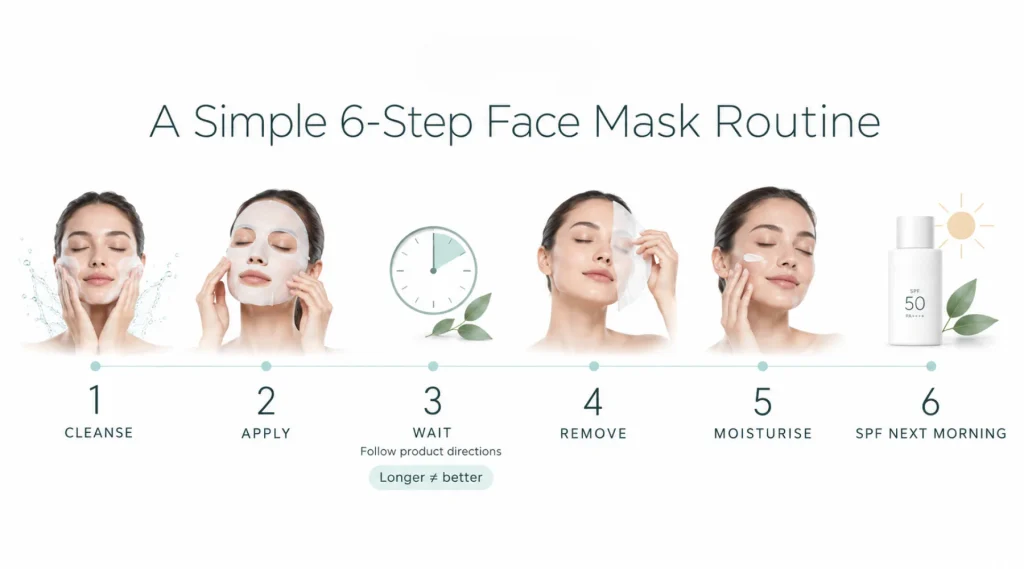
Step 1: Clean Your Face
Start by removing sunscreen, makeup, and dirt. If you wear heavy makeup or water-resistant sunscreen, consider washing your face twice. You don’t need to scrub hard before using a mask. Avoid strong exfoliating cleansers unless the instructions say it’s okay.
Step 2: Apply the Mask
For clay, cream, or exfoliating masks, your skin should be clean and dry unless the label says otherwise. For sheet or hydrogel masks, place it gently on your face without pulling. Don’t force out air bubbles or press it hard on your delicate areas.
Step 3: Follow the Recommended Time
Wearing the mask for the right amount of time is crucial. More time doesn’t always mean better results. Sheet masks usually stay on for 10–20 minutes, while some hydrogel masks can be worn longer. Always follow the specific instructions for your product.
Step 4: Remove the Mask Gently
Rinse off wash-off masks with lukewarm water. Take off sheet or hydrogel masks carefully, without rubbing. Peel off film-forming products slowly. Pat your face dry instead of scrubbing.
Step 5: Apply Moisturiser
A mask doesn’t replace your moisturiser. After hydrating masks, use a moisturiser to keep your skin soft. After clay or exfoliating masks, moisturiser helps comfort your skin. If you use an overnight mask, you might not need another cream.
Step 6: Use Sunscreen the Next Morning
Wear sunscreen the next day, especially if your mask has exfoliating ingredients. No brightening or anti-aging mask can protect your skin from UV damage.
How Often Should You Use a Face Mask?
There’s no strict rule for how often to use a mask each week.
How often you should mask depends on:
- The type of mask
- The strength of the ingredients
- Your skin condition
- Your overall skincare routine
- How often you experience irritation
Generally, a gentle hydrating mask can be used more often than a strong exfoliating treatment. If you use strong products like retinol, salicylic acid, or vitamin C, you might need to mask less than someone with a simple routine of cleanser, moisturiser, and sunscreen.
The best frequency depends on your total skincare routine, not just the number of masks you use. This is especially true for exfoliating or clay masks.
For most people, one or two masking sessions each week is enough. Some may need even less. You can use hydrating masks more often if the instructions allow and your skin feels comfortable.
Sheet Mask vs Clay Mask: The Better Choice Depends on the Problem
Sheet masks and clay masks are often seen as rivals, but they actually address different needs.
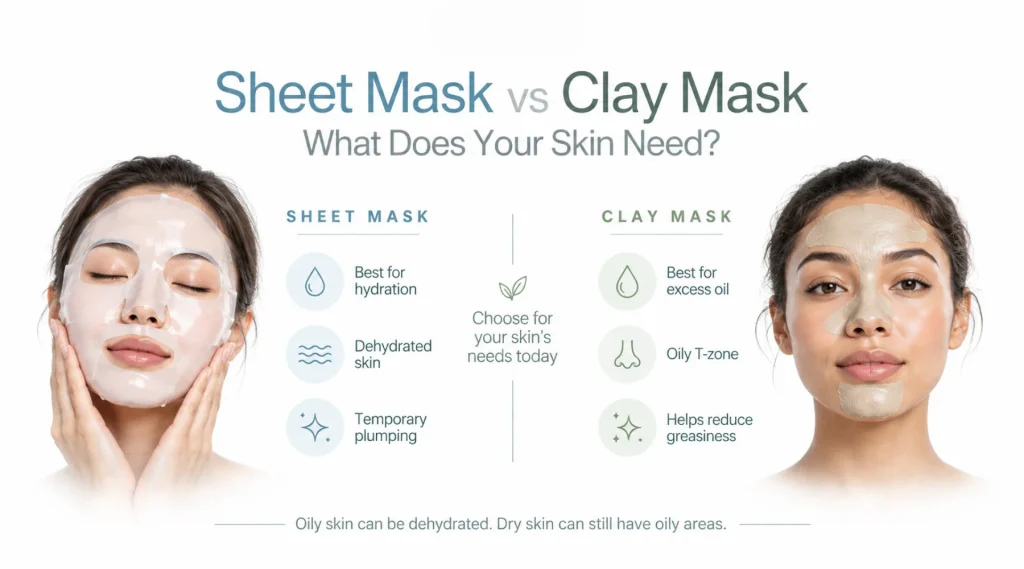
Sheet masks are great for adding moisture and hydration.
Clay masks mainly focus on soaking up excess oil.
| Skin concern | Sheet mask | Clay mask |
| Dehydration | Excellent choice | Usually not first choice |
| Dryness | Often helpful | Can worsen tightness |
| Excess surface oil | Limited | Often useful |
| Temporary plumping | Good | Limited |
| Oily T-zone | May hydrate | Useful selectively |
| Sensitive skin | Depends on serum | Requires caution |
| Before makeup | Often useful | Better used earlier |
| Congested appearance | Limited alone | May reduce oiliness |
| Compromised barrier | Simple hydrating formula only | Usually avoid |
Comparing sheet masks and clay masks shows a key idea: pick the mask based on your skin’s needs today, not just on your skin type.
Oily skin can still be dehydrated, and dry skin can sometimes have an oily nose. Skincare is more effective when it adapts to your skin’s condition rather than sticking to strict labels.
Face Masks for Dry and Dehydrated Skin Need More Than Water
Dry skin and dehydrated skin are similar but not the same.
Dehydrated skin lacks water in its outer layers. Dry skin, on the other hand, has too few lipids and oils.
This distinction matters when choosing a mask. A watery sheet mask can feel great on dehydrated skin right away. However, if dry skin is low on lipids, water alone won’t provide lasting relief.
Look for masks with:
- Humectants (like glycerin and hyaluronic acid) to attract moisture,
- Emollients to smooth out the skin,
- Occlusive ingredients to prevent water loss,
- Barrier-supporting lipids (like ceramides) when needed.
Consider a broader skin care routine to maintain benefits after using the mask. If your skin feels tight again within an hour of using a mask, the problem may be your daily cleanser or moisturizer being too drying.
Face Masks for Acne-Prone Skin Should Not Pretend to Be Acne Treatment
A mask can help with some oily skin problems, especially with excess oil and clogged pores. However, it won’t cure acne.
Useful ingredients include:
- Salicylic acid
- Niacinamide
- Clay
- Gentle alpha-hydroxy acids
- Lightweight humectants
Salicylic acid is good for oily skin because it can break down blockages in pores. Be careful not to try to “dry out” acne too much. Inflamed acne isn’t just due to excess moisture. Stripping the skin can increase irritation, making it harder to treat.
Avoid using strong peel-off, acid, or clay masks on:
- Picked spots
- Broken pimples
- Raw skin
- Healing scabs
- Areas irritated by benzoyl peroxide or retinoids
For moderate, persistent, painful, or scarring acne, seek proper treatment instead of using more aggressive masks.
Brightening Masks Can Help Dullness, but Pigmentation Takes Time
Many masks claim to brighten skin after just one use. This can happen because “brightening” means better hydration and light reflection. Smooth, hydrated skin naturally looks more luminous.
Treating actual dark spots is different. Ingredients like niacinamide, vitamin C, kojic acid, retinoids, and some exfoliating acids can help improve skin tone over time. However, noticeable changes need regular use and sun protection.
A single mask won’t remove melasma, sun spots, or persistent post-acne marks overnight. Irritation can worsen dark spots, as inflammation may cause more hyperpigmentation, especially in medium to dark skin tones.
For addressing pigmentation, a gentle routine is usually better than occasional harsh treatments that can inflame the skin.
What Does a Lip Mask Do?
A lip mask is a deep conditioning treatment for your lips.
Unlike facial skin, lips have a thinner barrier and fewer oil glands. This makes them lose moisture easily, leading to dryness from cold weather, licking, dehydration, or certain toothpastes and cosmetics.
What does a lip mask do?
Most lip masks include ingredients that help to:
- Soften dry skin
- Smooth roughness
- Slow down moisture loss
- Increase comfort
- Make lips look smoother and fuller temporarily
Hydrated lips appear plumper because the moisture smooths out dryness and wrinkles. However, a lip mask won’t permanently make lips bigger.
Research shows that regular use of moisturizing products can reduce dryness, roughness, and chapping, but results may vary based on the product.
If your lips often crack, swell, itch, or develop a rash, it may be better to seek treatment for irritant or allergic cheilitis instead of just using richer masks.
Common Mistakes With Face Masks Good for Your Skin
The biggest problems with face masks come from how people use them, not the masks themselves.
Wearing Masks Too Long
Don’t wait until your mask feels painfully tight. A clay mask doesn’t need to crack before you take it off. If your face starts to feel very tight, it doesn’t mean you’re pulling out more oil; it could just mean your skin is getting drier.
Using Multiple Masks at Once
Using an enzyme mask, followed by glycolic acid, retinol, and an exfoliating toner isn’t a good routine. It can cause irritation instead of improving your skin.
Masking After Exfoliation
When your skin is freshly exfoliated, masks can sting more. Keep your skin care routine simple after exfoliation.
Tingling Doesn’t Mean It Works
Tingling can come from acids, fragrances, or irritation. It doesn’t mean a product is better for your skin.
Applying Masks on Broken Skin
Stay away from raw spots, cuts, sunburns, and inflamed skin unless a doctor says it’s okay.
Choosing Trends Over Quality
A trendy ingredient won’t fix a poor formula. A simple mask with glycerin may work better than a fancy one with many active ingredients that your skin can’t tolerate.
Using Clay Masks for Shine
Your skin will naturally produce oil again. Trying to keep your face completely matte can lead to over-cleansing and irritation.
Sleeping in Masks
Only leave a mask on overnight if the manufacturer says it’s safe for that use.
Patch Testing Makes Particular Sense With Intensive Masks
Masks cover a large area of skin with a product, sometimes in a way that traps moisture. This makes patch testing important if you’re sensitive to reactions.
The American Academy of Dermatology suggests testing new skincare on a small area of skin twice daily for seven to ten days to check for potential reactions. For rinse-off products, only leave them on the test area as long as you normally would on your face.
A patch test can’t guarantee that your facial skin will accept the product, but it can show a clear reaction before you apply it all over your face.
Patch testing is especially useful if you have:
- eczema
- rosacea
- past cosmetic allergies
- very sensitive skin
- a history of reactions to fragrances.
What to Know Before Trying Face Masks Good for Your Skin
Before buying a mask, check the full label.
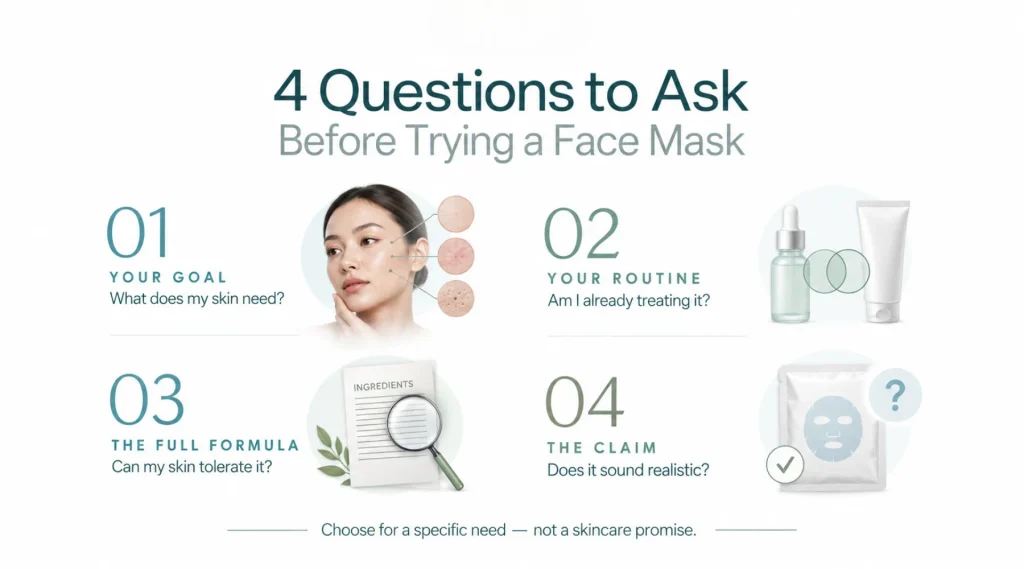
Ask yourself some key questions:
1. What problem am I trying to fix?
“Better skin” is too broad. Focus on one main issue:
- Dehydration
- Oiliness
- Temporary plumping
- Rough texture
- Dullness
- Skin barrier comfort
- The clearer your goal, the easier it is to decide if the mask is worth it.
2. Is the mask different from my current routine?
If you use glycolic acid regularly, you likely don’t need an exfoliating mask.
If you take prescription treatments, a soothing mask may be better than adding more active ingredients.
Dermatologists warn that using too many strong ingredients can cause dryness and irritation.
3. Can my skin handle all the ingredients?
Don’t judge a product just by its key ingredient.
A “hyaluronic acid mask” isn’t enough if it also has fragrances or acids that irritate your skin.
Also, just because a mask has plant ingredients doesn’t mean it’s always gentle.
4. Are the claims realistic?
Hydration in 15 minutes? Yes.
Less surface oil? Yes.
Temporary glow? Yes.
Permanent pore closure? No.
Permanent lifting? No.
Rebuilding lost collagen overnight? No.
“Detoxing” through the skin? No.
Checking these points helps you shop smarter for skincare.
Face Mask Myths That Make Simple Skincare More Confusing
“Masks open and close pores”
Masks don’t actually open or close pores. Pore visibility changes due to oil, skin congestion, hydration, collagen support, and genetics. Temperature can change how skin appears temporarily, but pores do not have doors.
“If the mask burns, it is working”
Burning is a sign to stop using the product, especially if it is strong or lasts a long time. If you feel significant burning, itching, or swelling, remove the mask.
“Natural masks are always safer”
Natural ingredients like lemon juice and essential oils can irritate your skin. Sometimes, a synthetic product is gentler than a raw plant mixture.
“Every collagen mask rebuilds collagen”
Topical collagen can moisturize your skin, but it can’t penetrate deeply. Stimulation and replacement of collagen are not the same.
“You should let sheet masks dry completely”
This isn’t always true. Letting a sheet mask dry too long can actually make your skin drier and redder instead of more hydrated.
“Clay pulls every impurity out of pores”
Clay absorbs oil and can help oily skin, but it doesn’t remove every pore blockage.
“A face mask can replace moisturiser”
Some rich sleeping masks may act as moisturizers, but most sheet, clay, and exfoliating masks cannot replace them.
“More masking gives faster results”
Using masks more often can lead to irritation. Skin improvement depends more on biology than on how often you use masks.
When a Face Mask Is Not the Right Treatment
Sometimes, adding another cosmetic product is unnecessary.
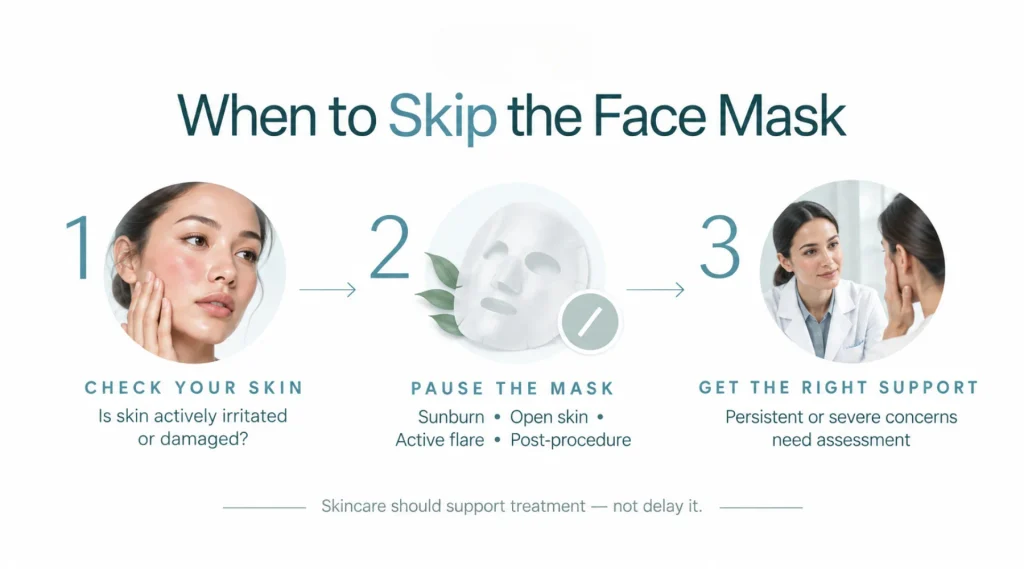
Avoid using masks if your skin is:
- badly sunburnt
- infected
- swollen with no obvious reason
- having a severe eczema flare
- irritated by retinoids or acids
- covered in open or picked acne
- recovering from a professional procedure unless your doctor says it’s okay.
If you have ongoing dermatitis, it needs proper evaluation. The NHS recommends seeing a doctor for persistent, recurring, or severe contact dermatitis, especially if you can’t find the trigger or treatment isn’t working.
Also, a mask won’t replace medical treatment for:
- nodulocystic acne
- acne scars
- constant rosacea
- melasma needing treatment
- unusual skin colour changes
- chronic eczema
- infection.
Skincare should support your skin health, not delay necessary treatment.
How Face Masks Compare With Professional Skin Treatments
Face masks are often called “facials in a packet,” but professional treatments are much stronger.
At-home masks can help with hydration, texture, oiliness, and give temporary glow.
Professional treatments include:
- Stronger chemical peels
- Microneedling
- Laser resurfacing
- Vascular or pigment lasers
- Prescription creams
- Injectable treatments
- Acne therapy directed by a clinician
These procedures can provide better results but also come with higher risks because they affect the skin more deeply.
A moisturizing mask can lessen the appearance of dehydration lines before an event, but it can’t replace injectable fillers. A brightening mask may gradually improve uneven skin tone, but it won’t treat stubborn melasma like a medical plan can. A clay mask might make pores appear cleaner, but it won’t fix acne scars.
Understanding these limits makes cosmetic masking more valuable.
Questions People Ask Before Adding a Face Mask
Are face masks good for your skin every day?
Not always. Gentle hydrating masks can be used frequently, but most masks are not needed daily. Exfoliating, clay, and active masks can irritate skin if used too often. Adjust use based on your skin and routine.
Are face masks good for sensitive skin?
Yes, if they are soothing and have simple formulae. Look for hydrating ingredients like glycerin and hyaluronic acid. Be cautious with fragrances, essential oils, and strong exfoliants. Patch test new products if your skin is sensitive.
Are face masks good for oily skin?
Yes, especially clay masks or those with niacinamide or salicylic acid. Don’t try to remove all oil; drying the skin too much can cause irritation.
Do collagen masks work for wrinkles?
They might temporarily smooth fine lines by adding hydration. However, topical collagen does not replace lost collagen in the skin. Some specialized collagen products may show results, but this doesn’t apply to all masks.
How do I get a face mask that suits my skin?
Focus on your main skin concern, not trends. Use hydrating masks for dryness, clay masks for excess oil, gentle creams for dry skin, and careful exfoliating masks for roughness. Always check the ingredient list and instructions.
How to use face mask products correctly?
First, cleanse your face, then apply the mask as directed. Respect the wear time, remove it gently, and moisturize if needed. Each mask may have different instructions.
Should I apply a face mask before or after serum?
Most wash-off masks are used after cleansing and before serums. Hydrating sheet masks can be used after cleansing and optional toner. Sleeping masks usually go on towards the end of your routine.
Can I use a face mask after retinol?
Sometimes a moisturizing mask is fine, but avoid exfoliating masks after retinol. If retinol has caused irritation, skip the mask and use a gentle moisturizer until your skin feels better.
Can face masks cause acne?
Yes, some masks can lead to breakouts. Heavy or unsuitable formulae may irritate acne-prone skin, and exfoliating masks can cause redness that looks like acne. Breaking out after a mask does not mean your skin is detoxing.
Can a mask shrink pores?
A mask can make pores look smaller temporarily by removing oil and reducing congestion, but it cannot change their permanent size.
What does a facial mask do before makeup?
A hydrating mask can smooth dry skin and prep it for foundation. Stick to familiar masks rather than trying new treatments right before an important event.
What does a lip mask do overnight?
An overnight lip mask helps reduce moisture loss and softens lips. It can make lips look smoother and fuller temporarily, but it doesn’t permanently increase volume.
Should I wash my face after a sheet mask?
Usually, no. Pat in any excess product and apply moisturizer if needed. If the mask causes itching or burning, rinse it off right away.
Can I use a clay mask and sheet mask on the same day?
Yes, but it’s usually not necessary. Using a clay mask on an oily T-zone followed by a hydrating mask is okay, but don’t make it a routine with too many treatments.
How long does it take for face masks to work?
You can see hydration and smoothness improvements within minutes. Oil reduction from clay masks is also quick. For pigmentation, acne, and fine lines, consistent use over weeks or months is needed.
Are Face Masks Good for Your Skin in the Long Run?
Face masks can be good for your skin if they address a real issue without causing other problems.
A hydrating sheet mask is helpful when your skin is dry. Clay masks work well for oily areas. A sleeping mask can keep your skin moisturized overnight. Gentle brightening or exfoliating masks can enhance your routine if used correctly.
You don’t need to believe that masks remove toxins, tighten skin permanently, or replace collagen quickly.
To get the best results, choose a mask that suits your skin’s needs, and avoid using it too often to prevent irritation.
If your regular skincare routine is effective, a mask should help you maintain healthy skin, not lead to more dryness while trying to rush results.
In conclusion, face masks can be beneficial, but the right product used at the right time is crucial.