




Blog
What Do Facial Masks Do for Skin? Benefits and Best Use


Face masks play a unique role in skincare. They can quickly make dry skin softer, reduce shine on oily areas before an event, or temporarily make tired skin look fresher and plumper. However, claims about detoxing, shrinking pores, and overnight transformations can blur the lines between real benefits and marketing hype.
What do facial masks do? Their main job is to provide a focused, short-term treatment. Depending on the type, a facial mask can boost hydration, absorb excess oil, soften dead skin, soothe irritation, or make skin look smoother and brighter.
It’s important to understand that “face mask” refers to a type of product, not just one treatment. A hydrating sheet mask and an oil-absorbing clay mask can have very different effects on the skin. A good mask starts with understanding what your skin really needs.
When used wisely, masks can enhance a balanced skin care routine. However, using them too often or choosing the wrong type can lead to dryness, sensitivity, clogged pores, or irritation.
What Do Facial Masks Do to Your Skin?
Facial masks hold skincare formulae against the skin longer than most daily products. They can create a sealing effect, boost hydration, absorb oil, or keep active ingredients in contact with the skin.
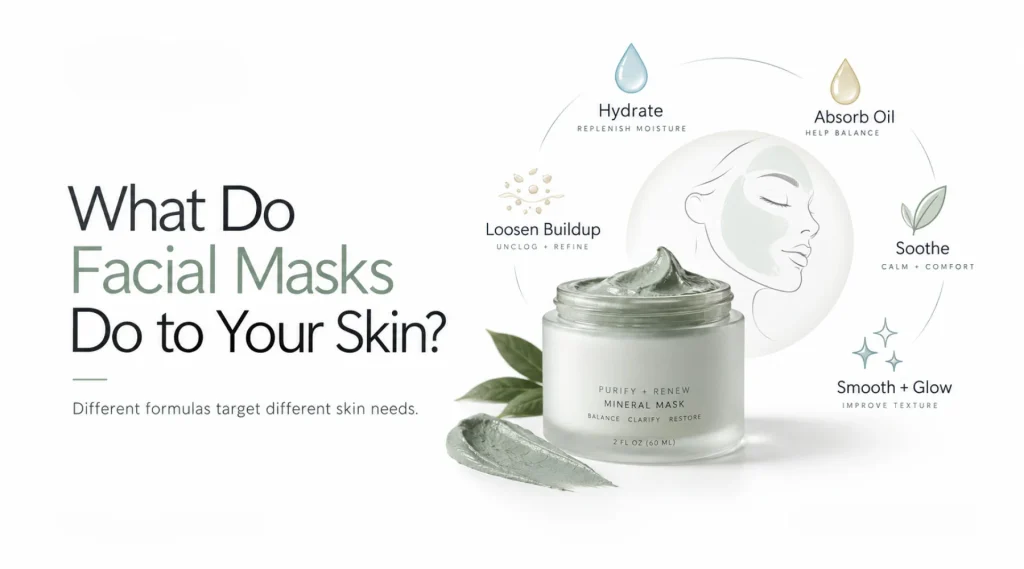
Their benefits usually fall into five areas:
- Increasing hydration in the skin’s outer layers.
- Reducing excess surface oil.
- Loosening dead skin cells and buildup.
- Delivering soothing skincare ingredients.
- Improving smoothness, softness, and glow.
The effectiveness of a mask depends more on its ingredients than on being a mask. For example, a sheet mask with glycerin and hyaluronic acid mainly hydrates, while a kaolin mask uses clay to absorb oil. A mask with salicylic acid can help with congestion, while a rich cream mask is best for dry skin.
The American Academy of Dermatology advises choosing mask ingredients based on your skin concerns, rather than assuming all masks work the same. Ingredients like hyaluronic acid, glycerin, and ceramides are great for hydration, while clay, niacinamide, and exfoliating acids suit oily or acne-prone skin.
This distinction is important because a facial mask doesn’t automatically improve a skincare routine. It’s effective only when it meets the skin’s specific needs.
Why Face Masks Can Feel More Intensive Than Everyday Skincare
Many masks are made to stay on the skin for 10, 15, or 20 minutes instead of blending in quickly. This longer contact can affect how the formula works.
Occlusion can temporarily increase hydration
Sheet masks and hydrogel masks cover the skin, slowing water loss and keeping a hydrating formula close to the outer skin layer, called the stratum corneum.
The stratum corneum is the top part of the skin. It has flat skin cells and lipids that help protect the skin. When it absorbs water, the dry cells swell a bit, making the skin feel softer, smoother, less tight, more flexible, and temporarily plumper. This can make fine dehydration lines less noticeable after using a moisturising mask.
However, this effect is not permanent. Research shows that facial sheet masks provide a quick hydration boost. A study tested different wearing times and found shorter use was beneficial, while longer use sometimes led to dryness and redness for some users. So, more time with the mask isn’t always better.
Clay can bind and absorb surface oil
Clay masks function differently than other skincare products.
Ingredients like kaolin and bentonite absorb excess oil from the skin’s surface, helping oily skin feel cleaner and look less shiny.
A study with adults who had oily or combination skin showed improvements in oil levels and acne after using a clay mask regularly for four weeks, although pore size did not change much.
This is important: a clay mask can lower oil without actually shrinking pores.
Masks can keep active ingredients in contact with the skin
Some formulae have ingredients you know from serums and moisturisers, like:
- niacinamide
- hyaluronic acid
- glycerin
- ceramides
- peptides
- salicylic acid
- alpha hydroxy acids
- antioxidants
- botanical extracts
A mask doesn’t change these ingredients; it just alters how they are applied to your skin.
In some cases, keeping them on longer can be helpful. But with exfoliating acids, scented products, or irritants, longer use may lead to skin sensitivity.
The Real Benefits of Facial Masks
A good face mask can provide many benefits. It’s important to distinguish between quick cosmetic results and long-term skin health improvements.
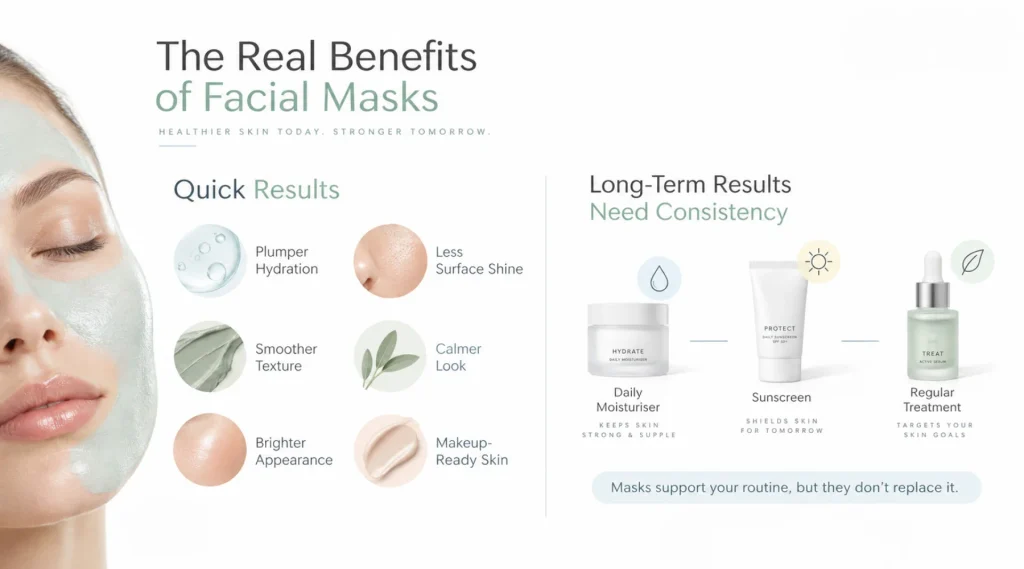
They can make dehydrated skin look plumper
Hydration is the main benefit of sheet, gel, and cream masks.
Ingredients like glycerin and hyaluronic acid attract and hold water in the skin’s top layers. Other ingredients help keep that moisture in.
Right after using a mask, your skin may look:
- smoother
- more radiant
- less wrinkled
- softer in dry areas
- ready for makeup
Well-hydrated skin reflects light better, making it look more glowing, even if the skin tone hasn’t changed.
For very dry skin, a hydrating mask shouldn’t replace your daily moisturiser. Regular moisturising is more important than using a mask occasionally.
They can temporarily reduce excess shine
Clay-based and some cleansing masks can help when your skin feels greasy. They mainly remove oil from the skin’s surface but don’t stop oil production from sebaceous glands. This is an important difference.
If your skin naturally makes more oil due to genetics, hormones, or acne, a mask won’t change that permanently. It can only absorb some surface oil to make your skin feel less greasy for a while.
This is especially helpful for combination skin, where you can apply the mask only to the forehead, nose, or chin, avoiding the drier cheeks.
They may improve the appearance of rough texture
Some masks have gentle ingredients that help remove dead skin cells. Examples are:
- Lactic acid
- Glycolic acid
- Salicylic acid
- Fruit enzymes
- Polyhydroxy acids
When used correctly, these ingredients can make rough skin smoother and reduce dullness from uneven skin. You shouldn’t feel burning, strong tingling, or tightness. If a mask makes your skin red or sore, it’s irritating, not showing that it worked.
They can support a calmer-looking complexion
Some hydrating masks include soothing ingredients like:
- colloidal oatmeal
- panthenol
- centella asiatica
- allantoin
- aloe vera
- beta-glucan
- green tea
- ceramides
These ingredients help when your skin feels slightly dry or uncomfortable.
However, don’t use a mask for persistent burning, eczema, rosacea flares, or damaged skin. In those cases, it’s better to simplify your routine instead of adding more products.
They can provide temporary brightening
“Brightening” is often misunderstood. A mask can make skin look brighter right away because smooth, hydrated skin reflects light better. Ingredients like niacinamide and vitamin C may help improve skin tone over time if used regularly. However, one mask can’t remove dark spots. To treat persistent dark spots, you usually need weeks or months of consistent treatment and regular sunscreen.
They can make skin feel smoother before makeup
A hydrating mask is helpful before an event because moist skin helps foundation go on smoothly.
Choose a simple hydrating formula instead of using strong exfoliating or peel-off masks right before applying makeup.
Skin irritated by a treatment mask can be harder to cover, not easier.
What Facial Masks Cannot Realistically Do?
Face masks are most helpful when you understand what they can and cannot do. They can’t permanently alter your skin’s structure, and many bold claims about masks often focus on temporary changes labelled as lasting effects.
They cannot permanently shrink pores
Pores don’t have muscles to open and close. Their size can change due to:
- Genetics
- Oil production
- Clogged pores
- Skin elasticity
- Sun damage
- Surface oil
A clay mask can make pores look cleaner by reducing surface oil. Exfoliation helps clear out clogged pores, and hydration can smooth the skin around them. However, none of these actions actually close the pores.
They do not pull every “toxin” out of your skin
The term “detox” is often used in beauty ads, but it doesn’t mean much in regular skincare.
The body mainly gets rid of waste through the liver and kidneys. A facial mask can soak up oil, clear dirt, or remove dead skin cells, but it doesn’t pull toxins from deep inside through the skin.
“Deep cleansing” means cleaning the skin’s surface and sometimes helping to clear oil and dead skin from pores.
They cannot replace acne treatment
A mask with clay or salicylic acid can help with acne, especially if you have oily skin or clogged pores. However, it shouldn’t replace effective acne treatments if breakouts continue.
If you have moderate to severe acne, painful bumps, cysts, or acne that might scar, you should see a doctor for proper care instead of using stronger masks.
They cannot lift sagging skin permanently
Some masks can make your face feel tighter while they dry or fit snugly around your jaw. This feeling doesn’t mean your skin is permanently lifted. Long-term firmness relies on collagen, elastin, fat, ligaments, muscles, and bones. A topical mask can help with hydration and smoothness but cannot replace medical lifting treatments.
They cannot rebuild the dermis in 20 minutes
The surface can look fuller quickly due to hydration. However, real structural changes take much longer. This point is especially important for collagen masks.
Do Collagen Masks Work?
Collagen masks can moisturise your skin, but just because it’s called a “collagen mask” doesn’t mean the collagen deeply penetrates and replaces your own collagen fibres.
Topical collagen mainly helps because it forms a film and locks in moisture. It can boost hydration and make your skin feel smoother. Reviews highlight its benefits for moisturieing.
Some modern collagen masks also include small peptides and other ingredients like hyaluronic acid or niacinamide. Studies on specific collagen sheet masks have shown improved hydration and skin appearance, but results may vary from mask to mask.
Think of collagen masks as hydrating and smoothing treatments rather than replacements for deeper collagen fibres in your skin.
Hydrogel masks, like the Bio-Collagen Real Deep Mask, provide moisture while the formula conditions your skin.
If you want to maintain collagen long-term, focus on daily UV protection, avoiding smoking, using proven ingredients like retinoids, and taking care of your skin rather than just using collagen masks occasionally.
Sheet Mask vs Clay Mask: Why the Right Format Matters
Choosing between a sheet mask and a clay mask is easier when you see them as different products.
| Mask type | Main purpose | Often useful for | Main caution |
| Sheet mask | Hydration and ingredient delivery | Dehydrated, normal or dry skin | Leaving it on too long |
| Hydrogel mask | Hydration, cooling and close contact | Dehydration and temporary plumping | Fragrance or unsuitable actives |
| Clay mask | Absorbing excess oil | Oily and combination skin | Over-drying |
| Cream mask | Emollience and barrier support | Dry or mature skin | May feel heavy on acne-prone skin |
| Peel-off mask | Film formation and surface removal | Occasional cosmetic smoothing | Pulling and irritation |
| Exfoliating mask | Loosening dead surface cells | Dull or rough texture | Over-exfoliation |
| Overnight mask | Longer-lasting occlusion | Dryness and dehydration | Too much occlusion for some skin |
| Under-eye mask | Localised hydration | Dry or puffy-looking under-eyes | Irritating the delicate eye area |
| Lip mask | Occlusion and softening | Dry lips | Fragrance and flavour irritants |
Choosing between a sheet mask and a clay mask depends on your skin problem, not on which one is better.
Applying a clay mask on dry cheeks isn’t helpful, even if it’s called purifying. Similarly, using rich sheet masks on oily skin without thinking about their thick ingredients may not be the best choice.
Sheet and Hydrogel Masks: Best for a Hydration Boost
Sheet masks are made from fibers soaked in a liquid essence or serum. Hydrogel masks use a gel that keeps water and skincare ingredients against the skin.

These masks work well because they keep the skin moist. They are especially helpful when the skin feels:
- Dehydrated
- Dull
- Tight
- Rough
- Tired from travel
- Dry from heating or air conditioning
Hydrogel masks can also feel cool, but this should not be confused with helping inflammation.
For example, the No.9 Nad Bio Lifting-sil Full Face Mask is a full-face sheet mask, while other hydrogel products focus on moisturising or temporary plumping. No matter the marketing claims, the ingredient list is what really matters.
Do sheet masks push ingredients deeper into the skin?
Occlusion can affect hydration and how some topical ingredients work, but it doesn’t make the skin fully permeable.
The skin barrier’s main job is to control what gets into the body.
Different molecules vary in size, solubility, and their ability to pass through the outer skin layer. A sheet mask may boost contact and hydration, but it shouldn’t be seen as a way for all ingredients to deeply penetrate the skin.
This is why we should be careful with strong active ingredients when using occlusion; more contact isn’t always good for sensitive skin.
Clay Masks: Useful When Oil Is the Main Concern
Clay masks remain popular because they effectively help oily skin. Kaolin and bentonite absorb excess oil, making your skin feel cleaner.
The best result from a clay mask is skin that feels balanced — not tight or flaky. A common mistake is letting the clay dry too much, thinking it removes more oil. However, drying it excessively can cause discomfort and make tightness worse, especially if your skin is oily yet dehydrated.
It’s usually better to rinse the mask off before it fully dries, following the manufacturer’s instructions. Those with combination skin can apply clay only where needed, like the nose, chin, and forehead, while avoiding dry areas like the cheeks.
Cleansing and Peel-Off Masks Need More Caution Than Their Satisfying Finish Suggests
Peeling a dried mask off your face can feel satisfying, but that doesn’t mean it’s good for your skin.
These peel-off masks create a film that sticks to your skin. When you peel it off, it can remove dirt and dead skin cells, making your face feel smooth temporarily. However, their strong stickiness can irritate sensitive skin and pull out fine hairs.
For example, the Black Tea Extract Cleansing Mask is one type of peel-off mask. The best way to evaluate a peel-off mask is not by how impressive the peeled film looks, but by whether it suits your skin and keeps it comfortable afterwards.
Avoid using peel-off masks if your skin is:
- Sunburned
- Inflamed
- Recently exfoliated
- Broken
- Experiencing eczema or dermatitis
- Irritated from retinoids or acids
Also, keep them away from your eyebrows, hairline, and the sensitive eyelid area unless the product clearly states otherwise.
Overnight and Wrapping Masks: Longer Contact Does Not Mean Unlimited Contact
Sleeping masks and wrapping masks enhance your nighttime skincare routine. Some act like rich moisturisers, while others dry into a flexible film. They’re great for those needing intense hydration overnight.
The Medicube Kojic Acid Turmeric Night Wrapping Mask 75ml is one such product. It’s important to follow the instructions for this type of mask. An overnight mask differs from a regular 15-minute exfoliating mask. Don’t assume that leaving a rinse-off mask on overnight will boost its effects; it might just irritate.
What Does an Under-Eye Mask Do?
Under-eye patches are small masks made for the delicate skin below the eyes. They mainly help with hydration and smoothing the skin. Ingredients like humectants and gel can boost moisture, making fine lines look softer. Cooling the patches can also help reduce puffiness in the morning.
Products like the Gold Gel Crystal Collagen Powder Eye Mask focus on this area instead of covering the whole face.
How to wear an under-eye mask
How to Use Eye Patches
- Clean your skin first.
- Gently dry the area under your eyes.
- Place each patch under your eye, not touching your lashes.
- Leave it on for the time recommended on the package.
- Remove the patch carefully.
- If the instructions allow, pat in any leftover serum.
- Follow up with moisturiser and sunscreen as needed.
There’s no one-size-fits-all for how to apply eye patches. Different shapes have different uses. Always follow the instructions on the product instead of trends you see online.
Keep in mind that dark circles can have many causes, like genetics, allergies, or skin anatomy. Hydration patches may not fix every issue.
What Does a Lip Mask Do?
A lip mask is a strong moisturiser for your lips.
Unlike facial skin, lips have less protection and can dry out quickly.
Lip masks often contain ingredients like:
- Petrolatum
- Lanolin
- Plant butters
- Waxes
- Oils
- Glycerin
- Hyaluronic acid
- Ceramides
These ingredients help soften dry lips and keep moisture in.
Though called a “mask,” they work like regular lip balm, using similar moisturising methods.
If your lips keep cracking, look for irritants like flavoured products, fragrances, lip licking, or certain toothpastes instead of just using thicker masks.
How to Use a Face Mask Without Disrupting Your Routine
It’s more important to know how to use a face mask than to get more masks. For most rinse-off or sheet masks, the best routine is simple.
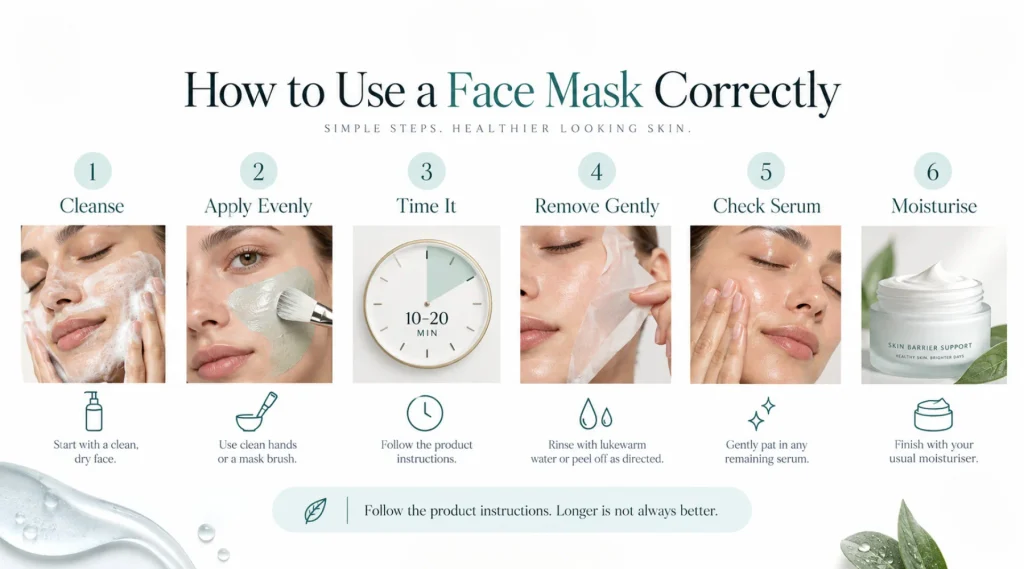
Step 1: Cleanse first
Apply the mask to clean skin unless the instructions say otherwise.
Removing makeup, sunscreen, and dirt helps the formula spread evenly on your skin.
You usually don’t need to scrub your skin before applying.
In fact, exfoliating before using an exfoliating mask can make a gentle treatment irritating.
Step 2: Apply the right amount
Creams and Clays: Use enough product to create an even layer without making it too thick.
Sheet Masks: Unfold the mask carefully and place it smoothly on your face. Keep it away from your eyes and lips.
Step 3: Respect the recommended time
More products and more time don’t always mean better results. A 15-minute mask isn’t automatically twice as effective if you leave it on for 30 minutes. For sheet masks, studies show that using them too long can cause dryness and redness instead of boosting hydration. Follow the recommended timing, but don’t think of it as a minimum.
Step 4: Remove it gently
Rinse-off formulae should be washed off with lukewarm water, not hot water.
Sheet and hydrogel masks should come off easily.
Peel-off masks require more caution. If it hurts to remove, don’t pull hard on your skin.
Step 5: Decide whether the remaining serum stays or goes
Some sheet masks are meant to be patted into the skin after you take them off. Others might feel too heavy, and you might want to wipe off the extra. Always check the packaging; don’t assume all masks are the same.
Step 6: Finish with moisturiser when appropriate
A moisturiser can keep your skin feeling hydrated after a water-based mask, especially if your skin is dry.
If you use a thick sleeping mask, you might not need another moisturiser afterwards.
The order of your skincare routine depends on the type of mask, not just the word “mask.”
Should You Use a Face Mask Before or After Serum?
Masks fit into routines in different ways, so there isn’t just one correct method.
For a clay or exfoliating mask, the order is usually:
- Cleanser
- Mask
- Rinse
- Serum
- Moisturiser
For a hydrating sheet mask, the order is:
- Cleanser
- Toner or light essence (optional)
- Sheet mask
- Serum (if needed)
- Moisturiser
An overnight sleeping mask goes near the end of your routine:
- Cleanser
- Treatment products
- Moisturiser (if needed)
- Sleeping mask
Always follow the product instructions first. For example, a wrapping mask may need to be used differently than a cream sleeping mask.
The main idea is to start with cleansing and treatment and end with moisturising, avoiding too many products that could cause irritation or pilling.
Should You Use a Mask in the Morning or at Night?
Either option can work. The timing should match the goal.
Morning masks work well when you want:
- Apply extra moisture to your skin before putting on makeup.
- Use products that smooth your skin temporarily.
- Achieve a fresh and cool look.
- Combat dryness before a big event.
Evening masks make sense when you want:
- Take your time with your skincare routine.
- Use a clay or exfoliating treatment, then apply a moisturiser.
- Try an overnight sleeping mask for extra hydration.
- Wait before applying makeup after your treatment.
Use strong exfoliating masks at night for easier skin care afterwards. If a mask makes your skin more sensitive to the sun due to ingredients like AHAs, it’s crucial to wear sunscreen during the day.
How Often Should You Use a Face Mask?
There are no strict rules about how often to use a face mask.
How often you should mask depends on:
- The type of mask
- The strength of the ingredients
- Your skin type
- Your current skincare routine
- Your skin’s condition
A basic hydrating mask is usually safe to use more often than a strong acid peel or clay mask. For most people, using a mask once or twice a week is a good starting point, but it’s not required. Some gentle hydrating masks can be used more frequently, while stronger exfoliating masks should be used less often.
It’s important to consider how often to use a mask, especially if your routine already includes retinoids, exfoliating acids, or acne treatments. Your skin doesn’t track mask usage. If your skin looks good without a mask, you don’t have to use one.
What Do Facial Masks Do for Beginners?
For beginners, a face mask should focus on one clear problem.

Avoid starting with many types like detoxifying, peeling, brightening, resurfacing, and anti-ageing masks.
Instead, focus on the most obvious need.
If your skin feels dry or tight
Begin with a fragrance-free, hydrating cream mask that has ingredients like:
- glycerin
- hyaluronic acid
- panthenol
- ceramides
- squalane
If your T-zone becomes oily
Use a gentle clay mask once a week on oily spots instead of your whole face.
If your skin looks dull
Start by improving your basic cleansing, moisturising, and sunscreen routine. If your skin can handle it, think about using a gentle exfoliating mask.
If your skin is sensitive
A face mask might not be needed.
Fewer ingredients and a simple formula make it easier to spot potential issues.
Beginners usually see better results by starting with a good cleanser, moisturiser, and sunscreen before adding specialised treatments like face masks.
What Do Facial Masks Do for Sensitive Skin?
Sensitive skin needs special care because long contact with products can make both their good and bad effects stronger.
The best masks for sensitive skin are simple and soothing.
Choose masks with moisturising and skin barrier-supporting ingredients instead of those that cause tingling or quick peeling.
Good ingredients to look for include:
- glycerin
- ceramides
- panthenol
- colloidal oatmeal
- hyaluronic acid
- beta-glucan
- centella
- allantoin
Be careful with:
- fragrances
- essential oils
- strong exfoliating acids
- harsh peel-off masks
- menthol
- intense botanical blends
- masks that cause lasting heat or tingling
If your face feels irritated from moisturiser, avoid using a mask. It’s not the right time for another strong product.
Face Masks for Oily and Acne-Prone Skin Need Balance, Not Maximum Dryness
Sebum is a normal part of your skin. The goal is to control excess oil, not to make your skin overly dry.
Clay, salicylic acid, and niacinamide are good ingredients in masks for oily skin.
Using too many products like a foaming cleanser, salicylic acid toner, acne treatment, clay mask, and exfoliating scrub all at once can irritate your skin more than help it.
If your face looks shiny but feels tight after washing, using more drying masks can make the problem worse.
Face Masks for Dry Skin Should Focus on Barrier Comfort
Masks with humectants, emollients, and occlusive ingredients are great for dry skin. Look for:
- Glycerin and ceramides
- Hyaluronic acid and squalane
- Panthenol and fatty alcohols
- Shea butter and humectants
While a mask can give quick relief, you need daily care for ongoing dryness. Think of a mask as an extra blanket, not your main heating system. Your daily moisturiser and gentle cleaning do the important work.
Can You Use Face Masks When You Have Rosacea, Eczema or Dermatitis?
People with inflammatory skin conditions shouldn’t assume that “natural,” “clean,” or “soothing” masks will be safe for them.
Plant extracts, fragrances, and essential oils can still irritate sensitive skin.
During a flare-up, a straightforward skincare routine is better than trying different masks.
If you often experience:
- burning
- redness
- swelling
- itching
- scaling
- cracked skin
talk to a GP, pharmacist, or dermatologist instead of relying on stronger cosmetic treatments to cover up the issue.
Common Face Mask Mistakes That Make Skin Worse
Most mask issues arise from intensity, not from a lack of effort.
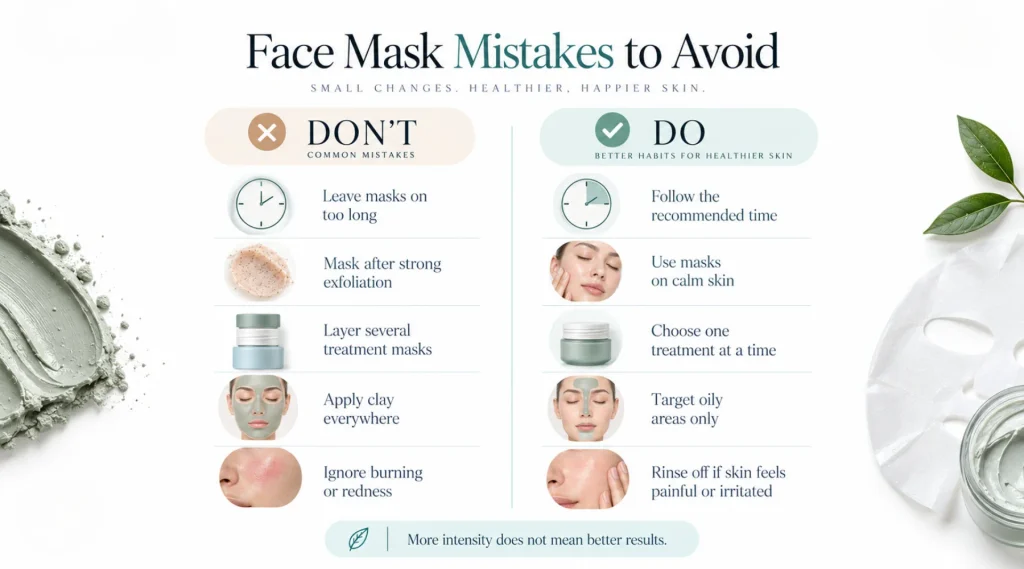
Leaving the mask on until it becomes uncomfortable
A product doesn’t have to feel tight to work well. With sheet masks, wearing them for too long can reduce hydration instead of increasing it.
Masking after aggressive exfoliation
After using an acid peel, scrub, or dermaplaning tool, your skin barrier may be weakened. Adding another strong treatment can raise the risk of irritation.
Using several masks consecutively
“Multi-masking” means using different masks on different parts of your face, which makes sense.
However, putting on a clay mask, then an acid mask, and finishing with a sheet mask is not very smart since they each offer different benefits.
Just hydrating your skin afterwards won’t fix too much exfoliation done earlier.
Applying clay everywhere
Combination skin doesn’t need the same treatment everywhere. Use oil-control products only in areas where oil is excessive.
Mistaking burning for effectiveness
A slight tingling can happen with some ingredients.
If you feel burning, pain, or notice strong redness or swelling, that’s a warning sign.
Wash the product off immediately.
Starting a new mask before an important event
Use something you know before weddings, photos, interviews, or important events. Finding out the night before that your new “glow” mask gives you a rash is not ideal.
Ignoring the rest of the routine
A great mask won’t fix the damage from over-cleansing, skipping moisturiser, or not using sunscreen.
Myths About Facial Masks That Refuse to Disappear
“Pores open when you steam your face”
Pores do not open and close like doors. Warm water can soften oil and dirt, making it easier to clean, but it doesn’t open pores. Hot steam can irritate the skin.
“Cold water closes pores after a mask”
Cold water can temporarily tighten the skin and reduce redness. It does not close pores.
“If a clay mask cracks, it has pulled out every impurity”
Cracking mostly means the mask has dried. It does not show that toxins or blackheads have been removed.
“A face mask can replace moisturiser”
Masks can moisturise the skin, but people usually use them only sometimes. Daily moisturisers offer more reliable protection.
“Natural masks are safer for sensitive skin”
Natural ingredients don’t always mean they won’t irritate.
Lemon juice is natural, as are many scented essential oils. However, this doesn’t mean they are good choices for facial treatments.
“DIY masks are gentler than formulated products”
Kitchen ingredients don’t match the pH levels or stability needed for facial skin. While some homemade treatments are safe, others like lemon juice, baking soda, undiluted essential oils, and rough scrubs can irritate the skin.
How to Get a Face Mask That Actually Matches Your Skin
If you want a face mask that fits your needs, choose based on its function, not the packaging.
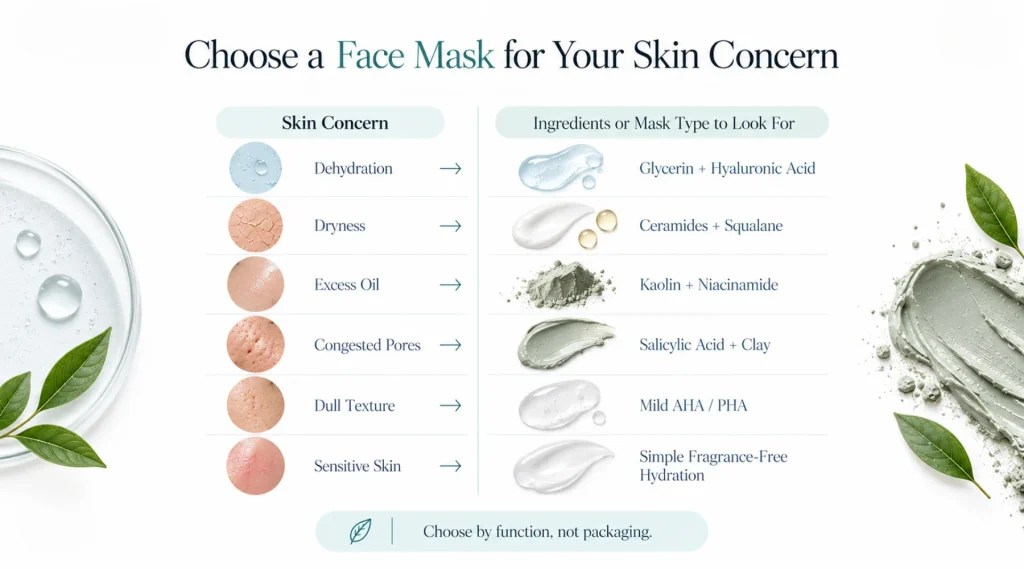
Focus on what you need.
| Your main concern | Mask features worth considering |
| Dehydration | Glycerin, hyaluronic acid, panthenol |
| Dryness | Ceramides, squalane, richer emollients |
| Excess oil | Kaolin, bentonite, niacinamide |
| Congested pores | Salicylic acid, clay |
| Dull surface texture | Mild AHA, PHA or enzymes |
| Sensitive-feeling skin | Simple fragrance-free hydrating formula |
| Temporary under-eye dryness | Hydrogel eye patches, humectants |
| Dry lips | Occlusive lip mask |
| Uneven-looking tone | Niacinamide or suitable brightening ingredients |
Check your current routine.
If you use salicylic acid every day, you don’t need a salicylic acid mask.
If you use a retinoid and your skin gets dry, a hydrating mask is better than another resurfacing product.
This way, the mask serves a purpose instead of just looking nice.
Can Facial Masks Cause Breakouts?
A breakout after using a mask doesn’t always have the same meaning. Here are some possible reasons:
- The mask may contain rich or heavy ingredients that don’t suit your skin.
- It could irritate your skin, causing acne-like bumps.
- You might be sensitive to the fragrance.
- Hair products can get on your face during use.
- Residue may be left on the skin.
- Touching your face or masks with dirty hands can cause issues.
- You might be using products that worsen existing acne.
The term “purging” is often misused. A basic moisturising sheet mask shouldn’t make your acne worse before it gets better. Real purging happens with ingredients that speed up skin-cell turnover, like certain retinoids and exfoliating acids. If a simple hydrating mask keeps causing new spots, it doesn’t make sense to think of it as a necessary detox period.
When Face Masks May Be Better Avoided Entirely
Skip masking if your skin is not doing well. Avoid it when you have:
- Fresh sunburn
- Open cuts
- Recently picked pimples
- Severe irritation
- An eczema flare-up
- Bad rosacea
- An allergic reaction
- Recent aggressive cosmetic treatments, unless your clinician says it’s okay
After treatments like chemical peels, lasers, or microneedling, follow the aftercare instructions you received from a professional.
Just because a sheet mask looks soothing doesn’t mean it’s safe after a procedure.
Do You Need to Patch Test a Face Mask?
Patch testing is a good idea when:
- Your skin reacts easily.
- The product has active ingredients.
- You’ve had cosmetic reactions before.
- You’re using a new fragrance-heavy item.
- You’re concerned about sensitivity.
Testing a small amount first won’t guarantee that your whole face will react well, but it can help spot obvious issues before applying it to a larger area.
If you have a history of severe allergic reactions to cosmetics, seek professional advice instead of just doing patch tests at home.
Are Face Masks Good for Your Skin?
They can be.
A face mask is good for your skin if its ingredients match your needs, you use it often enough, and it fits well with your other products.
Instead of asking if face masks are good for your skin in general, ask:
“Is this mask right for my skin today?”
This question helps avoid irritation.
If your face is dry, a hydrating mask can help. If it’s oily, a clay mask might be better. If your skin is irritated, it may be best to stick to gentle cleansing, moisturising, and sun protection.
Good skincare isn’t about using many products; it’s about using just the right ones to keep your skin comfortable.
Facial Mask Questions People Commonly Ask
What does a facial mask do?
A facial mask offers a focused treatment for a short time. It can hydrate the skin, remove excess oil, exfoliate dead skin cells, add soothing ingredients, or temporarily enhance smoothness and brightness, depending on the formula.
What do facial masks do for beginners?
For beginners, facial masks should be seen as optional treatments, not must-have steps. Focus on one issue, like dryness or oily skin, and pick a simple mask that addresses that concern.
How long should you leave a face mask on?
Follow the product instructions. Most rinse-off and sheet masks should be used for about 10–20 minutes, but this can vary. Keeping a mask on longer doesn’t improve results and may make your skin dry or irritated.
Can I use a face mask every day?
Gentle hydrating masks can be used often, but most people don’t need to use them every day. Masks with clay, exfoliants, or strong ingredients should be used less frequently. It’s important to pay attention to how your skin reacts rather than following a set schedule.
Is it better to use a face mask at night?
Not always. Use hydrating masks in the morning before makeup. Exfoliating, clay, and overnight masks are better for the evening. Pick the time based on what the product does.
Should I wash my face after a sheet mask?
You usually don’t need to remove sheet masks unless the instructions say so. Most sheet-mask essences are meant to stay on your skin. If you feel burning, itching, or discomfort, take it off and rinse your face instead of keeping it on.
Should I moisturise after a face mask?
Yes, often. After using a hydrating sheet mask, applying a moisturiser can help keep skin moist, especially if your skin is dry. If you’ve used a thick cream or overnight mask, you might not need extra moisturiser.
Do collagen masks work for wrinkles?
Collagen masks hydrate and temporarily plump the skin, helping to make fine lines less noticeable. However, they do not replace collagen in the deeper skin layers or permanently remove established wrinkles.
Do face masks remove blackheads?
Clay and salicylic acid masks can help reduce surface oil and keep pores clear, but they won’t get rid of blackheads forever. Ongoing comedonal acne usually improves more with a regular skincare routine than with occasional intense extraction masks.
Can face masks remove dark spots?
One mask won’t get rid of dark spots. Masks with ingredients like niacinamide can help as part of a longer skincare routine, but dark spots usually fade slowly. It’s also important to use sun protection regularly.
Can a face mask make pores smaller?
A mask can temporarily make pores less noticeable by absorbing oil, reducing congestion, or hydrating the skin around them. However, it cannot permanently shrink the size of a pore.
What does a lip mask do?
A lip mask softens dry lips and helps keep moisture in with its thick and moisturising ingredients. Overnight masks stay on longer but use the same basic moisturising methods as other lip-care products.
How do you wear an under-eye mask?
Put under-eye patches on clean skin under your eyes, staying clear of the lash line. Leave them on for the recommended time. Carefully take them off and pat in any leftover essence if instructed.
Can you use more than one face mask at once?
You can use different masks on different areas of your face. For example, use clay on an oily T-zone and a hydrating mask on dry cheeks. Applying several strong masks one after another can irritate your skin and usually doesn’t help much.
Why does my skin feel tight after a face mask?
Tightness can happen when a clay, peel-off, or exfoliating mask strips away too much oil or harms the skin barrier. Some mild tightness is normal, but if you feel ongoing dryness, burning, or flaking, the mask may be too harsh, or you’re using it too often.
What Do Facial Masks Do Best? They Solve Specific Problems, Not Every Problem
Facial masks offer practical benefits rather than dramatic results.
These masks provide short-term help. Hydrating masks can soften and temporarily plump dry skin. Clay masks absorb excess oil, while exfoliating masks can improve rough skin texture. Eye and lip masks deliver moisture where it’s needed, and sleeping masks keep skin hydrated overnight.
However, masks can’t permanently close pores, detox the body, replace prescription acne treatments, erase spots in one use, or reshape your face in 20 minutes. This doesn’t mean they’re ineffective; it just clarifies their role.
Face masks work best when added to a good skincare routine, not as a fix for a poor one. Choose a mask based on your skin’s current needs, follow the recommended time for use, and evaluate its success by how calm and healthy your skin feels afterwards, not how intense the mask seemed.