




Blog
Does Sunscreen Prevent Ageing? Benefits and Daily Use Tips

Fine lines, dark spots and changes in skin texture can appear over time. Ageing is one cause, but years of sun exposure can speed up these changes. Even brief time outdoors adds to sun exposure, with effects that may not show up until later.
So, can sunscreen help prevent skin ageing, or does it only prevent sunburn? Research shows that regular sunscreen use can slow early ageing caused by ultraviolet (UV) rays. It reduces UV exposure, helping protect collagen, limit sun spots and reduce some causes of wrinkles and uneven skin texture.
Sunscreen cannot stop natural ageing or fully undo damage that is already there. Its main benefit is helping prevent further damage while the skin continues its natural repair processes.
Using sunscreen every day matters more than using it only now and then. Applying plenty on a sunny holiday offers some protection, but a routine that covers everyday sun exposure better supports skin health over time.
Does Sunscreen Prevent Ageing or Slow Down Sun Damage?
Yes. Sunscreen can help slow premature skin ageing by reducing exposure to UVA and UVB rays. Using it regularly helps protect skin from sun damage linked to wrinkles, uneven pigmentation, roughness and reduced elasticity.
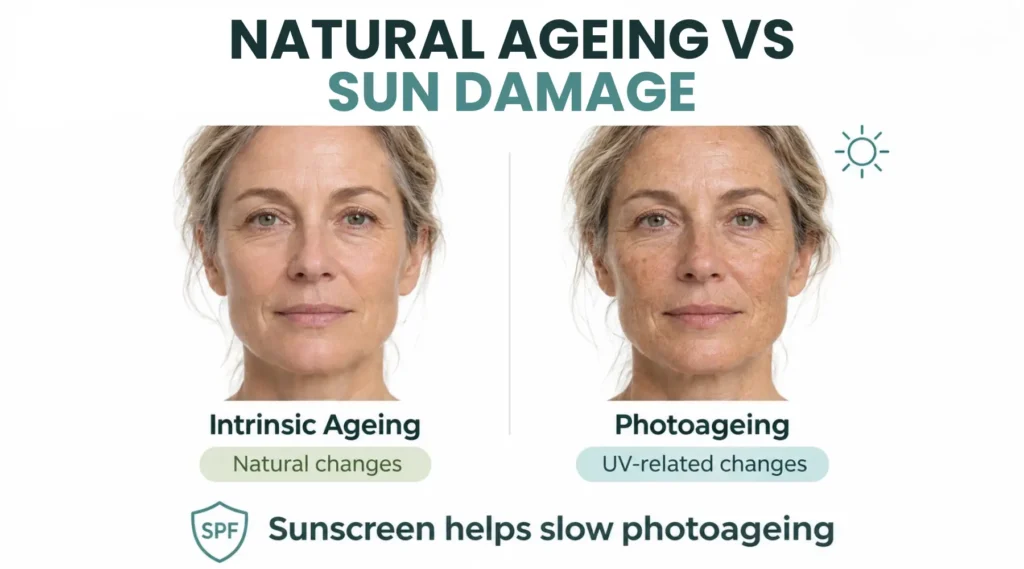
There are two types of skin ageing:
- Intrinsic ageing is the natural ageing process. Genetics, hormones, and changes in the body influence it. Over time, the skin makes less collagen, may become thinner and may hold less moisture.
- Photoageing is premature skin ageing caused by repeated exposure to sunlight. It happens alongside intrinsic ageing and can make skin look older than it otherwise would.
Sunscreen mainly helps prevent photoageing. It reduces the amount of harmful UV radiation that reaches living skin cells. This means sunlight is less likely to trigger oxidative stress, collagen breakdown and uneven pigmentation.
Which signs of ageing can sunscreen help prevent?
Regular sun protection may help reduce the development or worsening of:
- Fine lines and wrinkles linked to UV damage
- Dark spots and uneven skin tone
- Rough or uneven skin texture
- Early loss of skin firmness
- Dullness caused by sun damage building up over time
- Visible changes linked to long-term collagen breakdown
These benefits build over time; they are not immediate. Sunscreen does not temporarily soften fine lines like a moisturiser, or change skin texture like an exfoliating ingredient. Instead, it helps limit UV-related damage over months and years.
Sunscreen can still be useful if you already have visible signs of ageing. Protecting your skin from further UV damage may support the results of other skincare treatments and help maintain those improvements.
How Sunlight Accelerates Skin Ageing Beneath the Surface
To understand why sunscreen matters, it helps to know how sunlight affects the skin. Sunlight includes different types of radiation. The two most important for everyday sunscreen protection are UVA and UVB. Both can damage the skin, but in somewhat different ways.
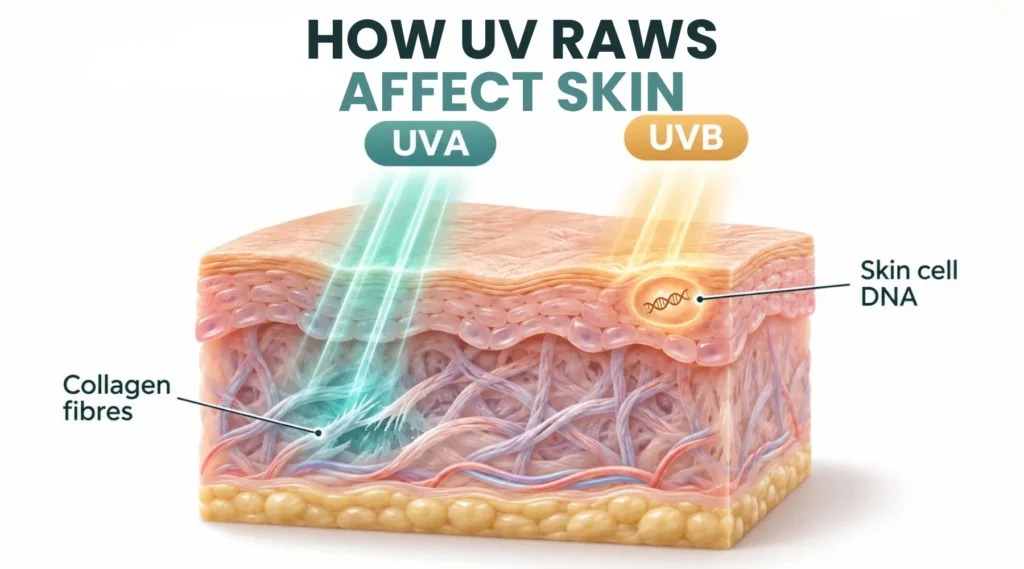
UVA radiation contributes to collagen damage
UVA makes up most of the ultraviolet radiation that reaches the Earth’s surface. It penetrates the skin and can produce unstable molecules called reactive oxygen species. These molecules may damage cells and contribute to inflammation and skin ageing.
UVA can also increase the activity of enzymes called matrix metalloproteinases (MMPs). These enzymes help maintain the skin’s support structure, including collagen. Repeated UV exposure can make them break down collagen and other structural proteins more quickly. UV exposure can also interfere with the skin’s production of new collagen.
When collagen breaks down faster than it is replaced, it may contribute over time to deeper wrinkles, less firm skin, and a less even surface.
A 2026 review in *Annals of Dermatology* describes how UV-related oxidative stress, collagen-breaking enzymes, and changes in cell signalling contribute to sun-exposure-related skin ageing.
UVB radiation damages skin cells and causes sunburn
UVB rays mainly affect the skin’s outer layers and are a major cause of sunburn. They can damage the DNA in skin cells. The body can repair some of this damage, but repeated exposure increases the chance of lasting changes in the cells.
UVB rays can also cause inflammation and changes in skin colour. Sunburn redness may fade within days, but the effects of UV damage can last longer. That’s why dermatologists advise against using sunburn as your main guide to whether you need sun protection.
Photoageing develops gradually
You can spend years walking to work, gardening or sitting outside without getting an obvious sunburn. But UV exposure can build up over time. Your skin may not show how much change is happening inside: damage to collagen and changes in skin colour can begin before you notice them. That’s why prevention matters. Sunscreen helps limit repeated UV exposure and reduce the chance of these changes building up.
What Scientific Research Actually Says About Sunscreen and Wrinkles
Evidence that sunscreen can help slow skin ageing also comes from human studies. In a 2013 Australian study, researchers followed 903 adults under 55 for about four and a half years. They compared people who used sunscreen every day with those who used it when they chose.
People in the daily-use group showed no detectable increase in the signs of skin ageing measured during the study. Their skin ageing also progressed about 24% less than in the other group, according to the study’s statistical measure.
This does not mean sunscreen makes someone look 24% younger or removes 24% of existing wrinkles. The study measured changes in skin-surface features linked with ageing.
Can sunscreen improve damage that already exists?
Some evidence suggests that using sunscreen regularly may improve the appearance of existing sun-related skin ageing. In one small study, 32 people used a broad-spectrum SPF 30 sunscreen on their face for 52 weeks. Researchers saw improvements in skin texture, clarity and uneven pigmentation.
But the study was small and had no separate group that went without sunscreen. So it is hard to know how much of the improvement was caused by sunscreen, rather than other factors. The results are encouraging, but they do not prove that sunscreen alone can reverse established sun damage.
The clearest takeaway is that regular sun protection helps prevent further UV-related skin ageing.
Why the research matters for everyday skincare
Skincare often focuses on ingredients that may show visible results within weeks. Sunscreen works differently: it helps protect skin from UV damage, one of the main causes of the concerns these ingredients aim to improve. For example, a retinoid may help reduce the appearance of fine lines, but too much UV exposure can work against those results. Prevention and treatment work best when used together.
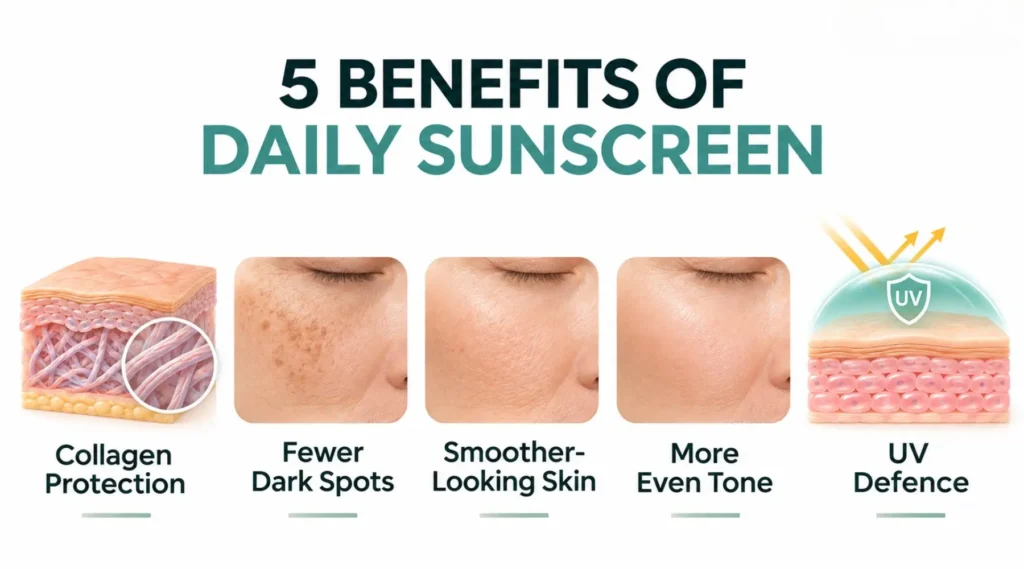
Five Ways Daily Sunscreen Helps Skin Age More Gradually
Sunscreen does more than help prevent deep wrinkles. It can also affect smaller changes in how your skin looks over time.
1. It helps preserve collagen and elasticity
Collagen supports the skin, while elastin helps it stretch and spring back. Both change with age, and sun exposure can cause further damage. Sunscreen helps limit some of this damage by reducing the effects of UV rays. It does not boost collagen production or restore lost elasticity, but it helps protect the skin over time.
2. It reduces the development of uneven pigmentation
Sunlight triggers melanocytes, the cells that make melanin. Melanin helps protect skin from UV rays, but repeated sun exposure can lead to uneven pigmentation, such as sun spots and darker patches. Using sunscreen regularly helps reduce this effect.
For melasma or ongoing pigmentation, sunscreen choice can be especially important. Tinted sunscreens with iron oxides can also help protect against visible light, which may worsen some pigmentation problems, particularly in darker skin tones.
3. It helps maintain a smoother-looking surface
Long-term sun exposure can affect how skin cells work and how the skin renews itself. Over time, this may make skin feel rougher or look uneven. Sun protection helps reduce one important cause of these changes. But sunscreen does not exfoliate skin, remove dead skin cells or smooth deep wrinkles that are already there. These concerns may need moisturising ingredients, suitable exfoliants or professional treatment.
4. It helps protect against premature changes in skin tone
Uneven skin tone can make the complexion look older, even without obvious wrinkles. This is especially true for people who develop dark marks after spots or skin irritation. Sunlight can darken these marks and make them last longer. Regular sun protection can help limit further darkening and reduce UV exposure that may interfere with suitable skincare treatments.
5. It supports skin health beyond appearance
Protecting your skin from strong sunlight is about more than appearance. UV rays can damage DNA and raise the risk of skin cancer. Using sunscreen regularly, seeking shade and wearing protective clothing can help reduce UV exposure. The NHS recommends sunscreen of at least SPF 30 with good UVA protection. In strong sunlight, sunscreen should not be your only protection. Preventing premature skin ageing is one benefit, but protecting your health matters too.
Why SPF Alone Does Not Tell You How Well a Sunscreen Prevents Ageing
SPF mainly tells you how well sunscreen protects against UVB rays, which are a major cause of sunburn. It does not, on its own, show how well it protects against UVA rays, which also contribute to skin ageing. So, when choosing sunscreen, look for protection against both. A higher SPF number does not automatically mean better protection against every type of UV ray.
SPF 30 versus SPF 50 for ageing prevention
When applied at the amount used during testing, different SPF levels provide approximately the following UVB protection:
| SPF level | Approximate UVB protection | Approximate UVB transmission |
| SPF 15 | 93.3% | 6.7% |
| SPF 30 | 96.7% | 3.3% |
| SPF 50 | 98% | 2% |
| SPF 50+ | More than 98% at a minimum | Less than 2% at a minimum |
These figures describe SPF performance in tests, not guaranteed protection in everyday life. The difference between SPF 30 and SPF 50 may look small when shown as percentages, but SPF 50 lets less UVB through when both are applied correctly. This extra protection may help people who burn easily, have ongoing pigmentation or spend a long time outdoors. SPF 50 does not last longer, so you still need to reapply.
UVA ratings deserve equal attention
In the UK, UVA protection is shown either by a star rating or by a UVA symbol inside a circle. If a sunscreen uses the UK star rating, the NHS recommends choosing one with at least four stars. A circled UVA symbol means the product meets the relevant European recommendation for UVA protection compared with its SPF. These systems differ, so you can’t compare ratings directly. Strong UVA protection is especially important if you’re concerned about wrinkles, pigmentation or long-term skin ageing caused by sun exposure.
Is broad-spectrum protection necessary?
Broad-spectrum sunscreen protects against both UVA and UVB rays. But the term doesn’t always show exactly how much UVA protection a product offers, especially when comparing products from different markets. Where available, check the UVA rating and the manufacturer’s testing information.
Which Is the Best SPF Sunscreen for Preventing Ageing?
There is no one best SPF sunscreen for everyone.
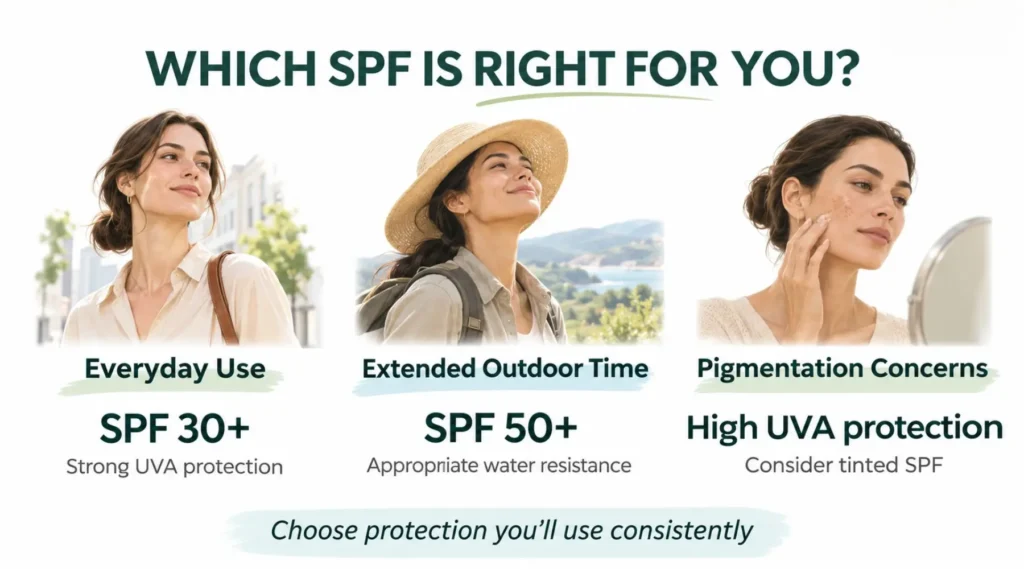
Choose one that offers suitable tested protection, feels comfortable and is easy to apply enough of, regularly.
A high price, attractive packaging, or a long list of ingredients cannot make up for poor UV protection.
For most adults in the UK, a good place to start is a broad-spectrum sunscreen with SPF 30 or higher and strong UVA protection. SPF 50 or 50+ gives extra protection and may be especially useful if you will be outside for a long time.
To choose an SPF for everyday use, consider how long you spend outdoors, how easily you burn, and whether you are concerned about pigmentation.
Choose sunscreen according to daily exposure
| Daily situation | Sensible sunscreen approach |
| Short journeys and ordinary daily exposure | Broad-spectrum SPF 30 or higher with strong UVA protection |
| Regular outdoor walking or commuting | SPF 30–50 with reliable UVA coverage |
| Gardening, outdoor work or hiking | Water-resistant SPF 50 or 50+ with regular reapplication |
| Swimming or outdoor sports | Water-resistant SPF 50 or 50+, reapplied after water exposure |
| Melasma or stubborn pigmentation | High UVA protection, often SPF 50+, with iron oxides where appropriate |
| Easily irritated skin | Fragrance-free SPF 30–50 in a well-tolerated formulation |
| Very fair or easily burned skin | SPF 50 or 50+ alongside clothing and shade |
These are helpful suggestions, not strict rules. If you have a condition that makes you sensitive to light, or have had skin cancer, you may need personal advice and stronger protection.
Texture influences whether sunscreen is used properly
A sunscreen can be technically excellent, but it may offer less help if you dislike the feel and apply only a thin layer.
Sunscreen works by forming an even layer over your skin, so comfort can make it easier to apply enough.
If you dislike heavy creams, a lightweight fluid may suit you better.
If your skin is dry, a richer lotion may feel more comfortable.
If you are concerned about white residue, a tinted sunscreen may look and feel better on your skin.
The best choice is not necessarily the one with the most skincare claims. It gives you suitable protection and feels comfortable enough to use every day.
Mineral and Chemical Sunscreens: Does One Prevent Ageing Better?
Mineral and organic-filter sunscreens use different ingredients to block UV rays. Neither type is automatically better at preventing sunlight-related skin ageing. Both can protect against UVA and UVB rays when they are properly made and tested. The main differences are the ingredients, the finished product and how it feels on your skin.
How mineral sunscreens work
Mineral sunscreens use zinc oxide, titanium dioxide or both. These ingredients mainly absorb UV rays, but they also scatter and reflect some light.
Zinc oxide can protect against both UVA and UVB rays. But the amount of zinc oxide alone doesn’t tell you a sunscreen’s SPF. Protection also depends on the particles, how they’re spread through the product, how well the sunscreen forms a layer on skin and the full formula.
For example, Beef Tallow Sunscreen with Zinc Oxide combines a mineral UV-filter with an emollient base. But zinc oxide’s presence alone doesn’t confirm how much protection the product provides. Before relying on it for sun protection, check that it has a clearly stated SPF and UVA rating, supported by appropriate testing. This is especially important for products described as natural, handmade or traditional.
How organic-filter sunscreens work
Organic UV filters, often called chemical filters, absorb UV rays and turn much of their energy into heat. Different filters protect against different wavelengths, so they’re often combined for broad-spectrum protection. Common examples include avobenzone, bemotrizinol and diethylamino hydroxybenzoyl hexyl benzoate. Their properties differ, and rules on their use vary by country and region. Modern sunscreens can offer strong protection in lightweight formulae that sit well under make-up. Some people may find certain formulae sting or irritate their skin, but that doesn’t mean all sunscreens with organic filters are unsuitable for sensitive skin.
The finished formulation matters more than the category
The names sunscreen and suncream do not tell you how much protection a product offers or what ingredients it uses. Labels such as “mineral” and “chemical” do not tell the whole story either.
When choosing a sunscreen, check whether it has a verified SPF rating and provides enough UVA protection. Think about whether you can apply enough comfortably, whether it feels comfortable throughout the day, and whether it is water-resistant if you need it to be. Also consider whether it leaves a noticeable white cast or irritates your eyes.
A suitable sunscreen should work well in tests and be comfortable enough to use as directed in everyday situations.
The Best Morning Routine for Sunscreen to Prevent Ageing
The best anti-ageing routine makes sunscreen easy to apply and helps it form an even protective layer. For most people, sunscreen should be the last skincare step before make-up. You don’t need a complicated morning routine. Using several heavy products under sunscreen can sometimes make it pill or apply unevenly.
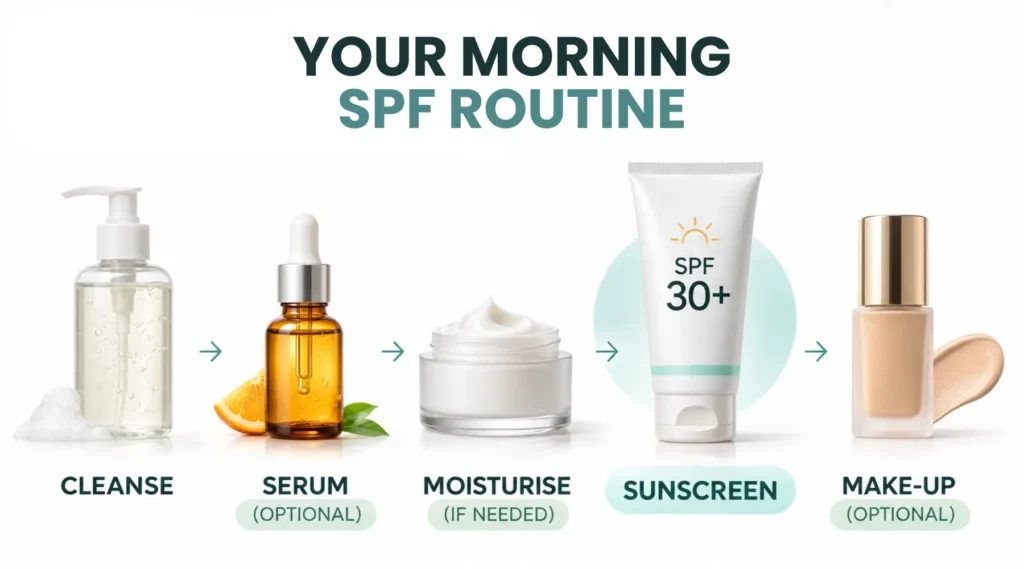
Step 1: Cleanse without stripping the skin
Choose a cleanser that suits your skin. If your skin feels comfortable and isn’t very oily overnight, a gentle morning rinse may be enough. Oily skin may suit a mild gel cleanser, while dry or sensitive skin may suit a non-foaming one. The goal is to remove residue without leaving your skin feeling tight or irritated. Washing too much can make your skin less comfortable and harder to tolerate other products.
Step 2: Apply an optional antioxidant serum
Antioxidants can work alongside sunscreen to help tackle oxidative stress. Vitamin C is one example. Depending on its type and formulation, vitamin C applied to the skin may offer antioxidant support and help improve the look of uneven pigmentation. But an antioxidant serum does not replace sunscreen. It provides reliable SPF only if the finished product has been specifically made and tested as sun protection. If your skin is sensitive, introduce antioxidant products gradually to help reduce irritation.
Step 3: Use moisturiser where needed
Moisturiser helps keep skin hydrated and supports its protective barrier. Ingredients such as glycerin, ceramides and hyaluronic acid can help skin feel more comfortable. Emollients help reduce moisture loss.
If you have dry skin, you may need a separate moisturiser before sunscreen. If you have oily skin, a moisturising sunscreen may provide enough hydration on its own. Neither option is always better.
Aim for a skin care routine that supports your skin without adding unnecessary layers that could make sunscreen harder to apply.
Step 4: Apply sunscreen generously
Apply sunscreen evenly to every exposed area of skin. On your face, cover your forehead, temples, nose, cheeks, chin and hairline. Protect your ears and neck too if they are exposed.
SPF testing uses about 2 milligrams of sunscreen per square centimetre of skin. In practise, this is more than the small amount people often use when applying sunscreen like an everyday face cream.
The two-finger method can help you picture how much to use, but it is only a rough guide. The right amount varies by product, finger size, and the area you are covering. Follow the product’s instructions and spread it evenly over your skin.
Step 5: Allow the sunscreen to settle before make-up
Let the sunscreen settle into an even layer before applying foundation or other make-up.
A few minutes may be enough for many sunscreens, but the time can vary.
Avoid rubbing hard, as this can disturb the sunscreen, especially around the nose and cheeks.
Apply make-up over the sunscreen rather than mixing it in.
Should sunscreen go before or after moisturiser?
Apply moisturiser first and let it settle.
Apply sunscreen last, as the final step in your skincare routine.
If your sunscreen gives your skin enough moisture, you may not need a separate moisturiser.
Don’t mix sunscreen into moisturiser. This can spread the UV filters unevenly and weaken the protective layer.
When Should You Apply and Reapply Sunscreen During the Day?
Apply sunscreen before you go outside, so it has time to cover your skin before you’re exposed to much UV. Many products and health authorities recommend applying it 15 to 30 minutes before going into the sun. Check and follow your sunscreen’s directions.
A realistic sunscreen schedule
| Time or activity | What to do |
| Morning skincare | Apply sunscreen after moisturiser and before makeup |
| Before leaving home | Ensure all exposed areas are covered |
| After approximately two hours outdoors | Reapply generously |
| After swimming | Reapply, even when using a water-resistant product |
| After heavy sweating | Reapply as directed |
| After towel drying | Reapply because the protective film may have been disturbed |
| Before another extended period outdoors | Check coverage and reapply as needed |
Reapply sunscreen regularly if you’re spending time outdoors. If you’re indoors for most of the day and away from windows, you may not need to reapply every two hours. The aim is to stay protected when you’re exposed to UV, rather than applying sunscreen when there’s no meaningful exposure.
Does sunscreen need reapplying every two hours indoors?
Not always. If you apply sunscreen in the morning and stay indoors, away from direct sunlight and bright windows, applying more may make little difference. Reapply when you go outside, spend a long time by a sunny window, or the sunscreen has been rubbed or wiped off. For example, if you apply it at 8 am, work indoors, and go outside at lunchtime, consider whether it still provides enough coverage. Reapply if you often touch your face, wipe away sweat, or remove make-up.
How should sunscreen be reapplied over make-up?
Reapplying sunscreen over make-up can be inconvenient, but several approaches are possible.
You can gently press a lightweight sunscreen fluid over the skin with clean fingers or a suitable applicator.
A sunscreen stick can be useful for select areas, but you may need several passes to achieve adequate coverage.
SPF sprays and mists may be convenient, but they can be difficult to apply in the quantities required for their labelled protection.
For reliable reapplication, a measured amount of lotion or fluid is generally easier to assess.
No method is perfect if you apply the product too thinly.
Is once-a-day sunscreen enough?
Even if a sunscreen is described as long-lasting or once-a-day, follow sun safety advice. Sweat, swimming, rubbing and towel drying can reduce its protection. Water-resistant sunscreen does not protect you indefinitely. The NHS recommends reapplying sunscreen often, including about every two hours in the sun and after activities that may remove it.
Does Sunscreen Prevent Ageing in the UK When It Is Cloudy or Cold?
UV exposure doesn’t depend on temperature. You can still get significant UV exposure on a cool day, especially in spring and summer. Clouds can reduce UV, but they don’t block it all. You may still be exposed even if you don’t feel hot.
Why the UV index is more useful than temperature
The UV index shows how strong the sun’s ultraviolet (UV) rays are in a particular place at a particular time. The higher the number, the greater the potential for harm from UV rays. The World Health Organization recommends using sun protection when the UV index is 3 or higher.
For people in the UK, checking the UV index can be helpful as the seasons change. A bright afternoon in April may bring more UV exposure than you expect. On a dark winter’s day, a very low UV index may mean little UV risk during a short trip outdoors.
Do you need sunscreen every day in winter?
Using facial sunscreen every day can be a simple way to protect your skin, especially if you want to reduce the risk of pigmentation and sun-related signs of ageing.
How much protection you need depends on your risk and how much time you spend outdoors. In the UK, you may get little benefit from reapplying sunscreen throughout a low-UV winter day spent mostly indoors. But if you’re skiing, hiking at altitude or spending a long time outside, you may need strong protection, even when it’s cold. Snow reflects UV rays, and UV exposure can be higher at altitude.
Choose your protection based on the conditions, not just the season.
What about sunlight through windows?
Ordinary window glass blocks most UVB rays, but some UVA rays may pass through.
How much gets through depends on the glass and any protective coating.
This may matter if you spend a lot of time near bright windows or driving. But being indoors does not automatically mean you get a significant amount of UVA.
Your exposure depends on factors such as how close you are to a window, which way it faces, the type of glazing and how long you sit in direct sunlight.
If direct sunlight hits your desk for long periods, consider using sunscreen or UV-protective window film.
In most indoor settings, ordinary artificial lights do not cause the same UV exposure concerns as sunlight.
Can Sunscreen Prevent a Tan and the Ageing That Comes With It?
Sunscreen can reduce tanning by limiting how much ultraviolet (UV) radiation reaches your skin. But it cannot stop all changes in skin colour, because no sunscreen blocks every UV ray.
A tan is your skin’s response to UV exposure, not a sign that it is becoming healthier. UV can trigger melanin production, the pigment that gives skin its colour, or darken existing pigment. These changes offer some natural protection, but they also show that your skin has reacted to UV radiation.
Does sunscreen keep you from tanning completely?
No. Properly applied broad-spectrum sunscreen can greatly reduce UV exposure and help limit tanning, but it cannot block all UV rays. How much protection you get depends on its UVA protection, how much you apply and how evenly you cover your skin. It also depends on how long you spend in direct sunlight, UV levels, whether you reapply, and whether you swim or sweat. Your skin tone and how readily you tan matter too.
You may still tan after spending several hours outdoors while wearing sunscreen. This doesn’t necessarily mean the sunscreen has failed; some UV radiation may still reach your skin.
Can you still tan with SPF 50 sunscreen?
Yes, you can still get a tan while wearing SPF 50. When tested and applied correctly, SPF 50 offers strong protection from the UV rays that cause sunburn, but it doesn’t block all UV. SPF alone also doesn’t tell you how much protection a sunscreen gives against UVA rays, which contribute to tanning and skin ageing. If you want to keep your complexion even and reduce early signs of ageing, staying in the sun to develop a tan works against that aim.
Does sunscreen stop you from tanning without stopping vitamin D production?
Sunscreen reduces UVB rays, which help the skin make vitamin D. But research has not shown that using sunscreen as people normally do necessarily causes vitamin D deficiency. In practise, people may not apply sunscreen perfectly, and vitamin D levels also depend on diet, supplements, the season and individual differences. The NHS advises balancing sun protection with getting enough vitamin D. If you’re concerned about deficiency, food and suitable supplements are safer options than deliberately getting too much sun.
Is tanning without burning safe?
Sunburn is not the only sign of UV damage. Your skin can tan without going red, but it is still being exposed to harmful UV rays. Cancer Research UK says there is no safe way to get a tan from UV rays. Sunscreen does not make sunbathing or deliberate tanning safe.
What if you prefer a tanned appearance?
Self-tanner can make your skin look darker without UV exposure. Most products contain DHA, which reacts with substances in the outer layer of skin to create a temporary colour. This is different from sunlight, which can increase melanin in your skin. Self-tanner does not provide meaningful sun protection unless it also has a tested SPF rating. You still need to use sunscreen outdoors.
Does Sunscreen Prevent Ageing for Sensitive Skin?
Sensitive skin still needs sun protection. The challenge is finding a sunscreen that protects well without irritating your skin. Sensitive skin can have different causes, such as a weakened skin barrier, eczema, rosacea, contact allergies or reactions to certain ingredients. These can affect which sunscreen feels comfortable.
Why some sunscreens cause stinging
Sunscreen can irritate skin for different reasons. Fragrance, some preservatives, solvents or UV filters may be the cause. Irritation is more likely if your skin barrier is damaged.
If your skin is sensitive, trying a fragrance-free sunscreen may be a good starting point. Some people find mineral sunscreens with zinc oxide comfortable, but they can still irritate.
The feel of the sunscreen matters too. Thick creams may feel uncomfortable in hot weather, while some lightweight products contain solvents that can sting irritated skin.
How to introduce sunscreen to reactive skin
Sunscreen can irritate skin for different reasons. Fragrance, some preservatives, solvents or UV filters may be the cause. Irritation is more likely if your skin barrier is damaged.
If your skin is sensitive, trying a fragrance-free sunscreen may be a good starting point. Some people find mineral sunscreens with zinc oxide comfortable, but they can still irritate.
The feel of the sunscreen matters too. Thick creams may feel uncomfortable in hot weather, while some lightweight products contain solvents that can sting irritated skin.
What about rosacea-prone skin?
Sunlight can trigger flushing and redness in people with rosacea, so protecting your skin from the sun is important. Use a comfortable, fragrance-free sunscreen with SPF 30 or higher. Spending time in the shade and wearing a wide-brimmed hat can also help limit UV exposure.
Sunscreen does not treat rosacea itself. If facial redness, visible blood vessels, or acne-like spots persist, you may need medical treatment in addition to a gentle skincare routine.
Does Sunscreen Prevent Ageing for Oily and Acne-Prone Skin?
Yes.
Oily skin can still age due to UV exposure. Extra sebum helps keep skin lubricated, but it does not reliably protect against UVA or UVB rays. People with oily or acne-prone skin can still develop wrinkles, dark patches and other signs of sun damage.
The main challenge is finding a sunscreen that does not feel too greasy or clog pores.
Lightweight textures can improve consistency
Gel-creams, light fluids and oil-free lotions may suit you if you dislike heavy products. Choose one that feels comfortable to wear all day.
If you have acne-prone skin, you may prefer a sunscreen labelled non-comedogenic. This doesn’t guarantee it won’t cause breakouts for some people.
Consider how easy the sunscreen is to wash off. Some water-resistant products need a more thorough cleanse, but scrubbing hard can irritate your skin. A gentle evening cleanse is usually enough if you do it properly.
Does sunscreen make acne worse?
Sunscreen does not automatically cause acne. But some products may block pores or irritate sensitive skin. If you keep getting spots after starting a new sunscreen, it may be too heavy, hard to wash off or not suit your skin. Change one product at a time, rather than your whole routine, so it is easier to spot the cause.
Why sunscreen matters when using acne treatments
Some acne treatments can irritate your skin or make it more sensitive to sunlight. Retinoid creams, some exfoliating products and prescription medicines may mean you need to take extra care in the sun. Acne can also leave dark marks on the skin. Without enough sun protection, these marks may get darker or take longer to fade. A light SPF 30–50 sunscreen with strong UVA protection can help protect your skin while managing acne and its lasting marks.
How Sunscreen Needs Change for Dry, Mature and Pigmentation-Prone Skin
Your skin type may affect how sunscreen feels, but everyone still needs protection from UVA and UVB rays. Choosing a formula that suits you can make it easier to apply sunscreen every day.
Dry skin needs comfort as well as UV protection
Dry skin can feel tight or look rough when its outer layer does not hold enough moisture.
A moisturising sunscreen may make skin feel more comfortable and temporarily soften the look of fine lines caused by dryness. Ingredients such as glycerin and squalane can help moisturise skin.
This does not mean sunscreen reverses deeper wrinkles or changes collagen levels. It may make the skin’s surface look smoother, though.
If your skin is very dry, applying a separate moisturiser before sunscreen may feel more comfortable.
Mature skin may benefit from richer formulations
As skin ages, it may produce less oil and its protective barrier may change, which can make some people feel drier. A richer sunscreen may feel more comfortable, but mature skin isn’t always dry. Some people still have combination or oily skin later in life. Choose sunscreen based on how your skin is now, not just your age. A sunscreen that spreads easily and doesn’t settle visibly into lines may also look and feel better.
Darker skin tones still require protection
Melanin gives some natural protection from UV rays, but it does not prevent sun damage or skin cancer.
Darker skin may be more likely to develop visible changes in skin colour after irritation or sun exposure.
The white cast left by some mineral sunscreens can show more clearly on deeper skin tones. Tinted or clear formulae may look less noticeable.
For melasma and long-lasting dark spots, tinted sunscreen with iron oxides can protect against visible light. This may be especially useful for people with medium to deep skin tones.
Sunscreen and Anti-Ageing Ingredients: Which Combinations Work Best?
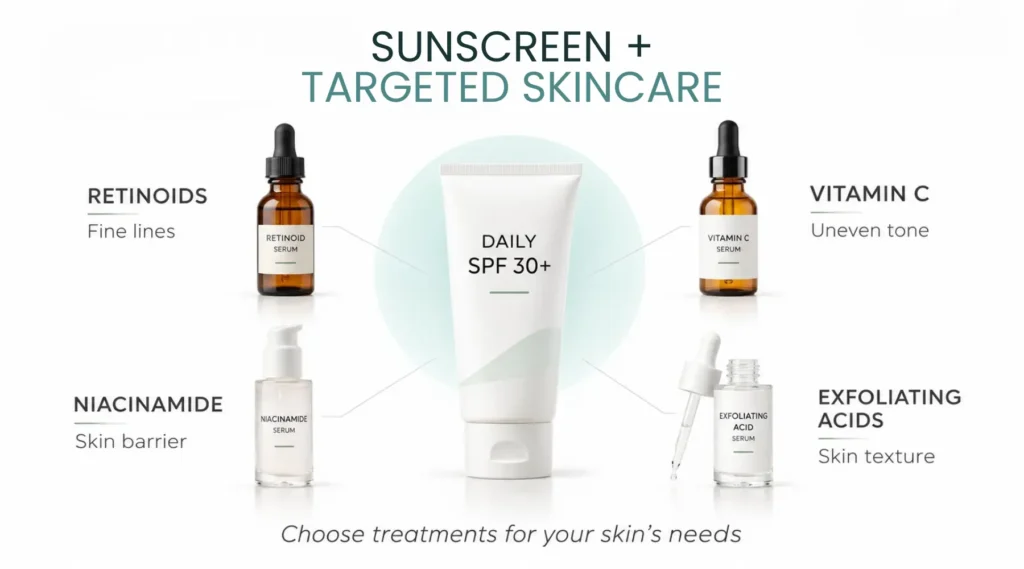
Sunscreen protects against UV rays, but it can’t tackle every sign of ageing. Other skincare ingredients may help with dryness, uneven skin tone and the look of skin texture. A practical approach is to use sun protection alongside a few carefully chosen treatments.
Sunscreen and retinoids
Retinoids are among the best-studied skin ingredients for signs of sun-related ageing. Prescription tretinoin may improve fine lines, uneven skin tone and some changes in skin texture. Over-the-counter retinol may also help, but results depend on the product, its strength and how regularly it is used.
Retinoids can dry out or irritate skin, especially in the first few weeks. Many people apply them at night. Use sunscreen during the day, as UV exposure can continue to damage the skin. Avoid topical retinoids during pregnancy or when planning a pregnancy, unless a clinician advises otherwise.
Sunscreen and vitamin C
Vitamin C helps make collagen and protects against oxidation damage. Used on the skin, it may help reduce the appearance of uneven skin tone and support protection from this damage. Results depend on the amount of vitamin C, its stability, and the type used so that serums can vary. Vitamin C and sunscreen can work well together, but vitamin C does not replace sunscreen or reliably increase its SPF.
Sunscreen and niacinamide
Niacinamide is a form of vitamin B3 used in skincare to support the skin barrier and keep skin feeling comfortable. Depending on the product, it may help make uneven skin tone look less noticeable and help manage some oiliness. It generally works well with sunscreen and may suit people who prefer a simple routine. For example, a morning moisturiser with niacinamide followed by sunscreen may feel comfortable on combination skin.
Sunscreen and exfoliating acids
Alpha hydroxy acids, such as glycolic and lactic acid, exfoliate the skin and can improve its surface texture.
Some exfoliants can make your skin more sensitive to sunlight. Using them too often may also cause irritation, dryness or discomfort.
Follow the product instructions and use exfoliants only as often as your skin can tolerate. Wear sun protection every day, especially when using products that increase sun sensitivity.
Why more ingredients do not always mean better results
A skincare routine with vitamin C, retinol, exfoliating acids and several brightening products may seem thorough. But too many active ingredients can weaken the skin’s protective barrier and cause ongoing irritation. Start with a reliable sunscreen and moisturiser. When your skin feels comfortable, add products for the specific concern you want to address. Using your routine regularly is usually more important than using lots of products.
Common Sunscreen Mistakes That Reduce Anti-Ageing Protection
Even a well-made sunscreen may not protect you as well if you use it incorrectly. Common mistakes include using too little, applying it at the wrong time or letting the protective layer wear off.
Applying too little product
This is a major issue. SPF tests use a set amount of sunscreen. If you apply much less, you will get less protection in practise. A thin layer may sit better under make-up, but it may not give the protection shown on the label. If applying enough sunscreen feels uncomfortable, try a different formula instead of using less.
Forgetting the neck, ears and hands
Sun damage over time can affect more than your face. Your neck, upper chest and the backs of your hands can get a lot of sun exposure, which may lead to uneven skin colour, roughness and visible changes in skin elasticity. Apply sunscreen to all exposed skin, not just the centre of your face. A wide-brimmed hat and protective clothing can also help.
Relying on make-up with SPF
Some foundations and powders contain SPF, but most people don’t apply as much make-up as was used to test the SPF. So a thin layer may offer much less protection than you expect. It’s often more reliable to apply sunscreen separately before your make-up.
Mixing sunscreen with serum or moisturiser
Mixing products in your hand may seem like a way to make them feel less thick. But sunscreen is tested as a finished product. Mixing it with something else can change how the sun-protective ingredients spread and how the protective layer forms. Apply skincare products one at a time instead.
Assuming SPF 50 lasts longer than SPF 30
A higher SPF gives more tested protection against UVB rays. It doesn’t mean the sunscreen lasts longer. When to reapply depends on how much sun you’re in, what you’re doing and whether the sunscreen has been rubbed off or washed off.
Using expired sunscreen
Sunscreen is designed to work properly when stored as directed, and only for a set period.
Expired sunscreen, or sunscreen exposed to too much heat, may not work as intended.
Check the expiry date and the period-after-opening symbol.
Don’t leave sunscreen in a hot car for long.
Treating sunscreen as permission to stay in the sun longer
Use sunscreen to reduce UV exposure when you need to be outdoors or are enjoying outdoor activities.
Don’t use it as an excuse to stay longer in strong sunshine.
Even high-SPF sunscreen lets some UV rays through.
Seek shade, wear protective clothing and limit time in strong sunshine.
Sunscreen Prevent Ageing Benefits and Risks: What Is Worth Considering?
For most people, sunscreen is more helpful than harmful when used correctly and tested as recommended. But it’s reasonable to consider skin sensitivity, how comfortable the product feels, and your personal circumstances.
Possible irritation and allergic reactions
Some sunscreens can cause stinging, itching or redness. This may be due to UV filters, fragrance, preservatives or other ingredients. People with eczema, rosacea or a weakened skin barrier may be more likely to feel discomfort.
If a sunscreen keeps irritating your skin, stop using it and consider trying a different formula. Seek advice from a healthcare professional if the reaction is severe or does not go away.
White cast and cosmetic discomfort
Some mineral sunscreens can leave a white mark on the skin, especially on darker skin tones.
Others may feel oily, sticky or heavy.
These issues don’t necessarily mean the sunscreen offers less UV protection, but they can make people less likely to apply enough.
Sunscreen that feels comfortable is more likely to be used regularly.
Breakouts and congestion
Some sunscreens may feel too heavy for some people’s skin. But acne can have many causes, so a breakout after using sunscreen doesn’t prove that UV filters caused it. The sunscreen’s texture, its other ingredients, how you cleanse your skin and existing acne may also play a part.
Concerns about sunscreen ingredients
Regulators are still studying and reviewing sunscreen safety. Regulators check approved UV filters against local rules, so the filters allowed can differ by region. It’s too simple to say that all chemical sunscreens are harmful or all mineral sunscreens are completely risk-free. Assess a sunscreen as a finished product that has been properly made and tested—not just by whether its ingredients are called natural or synthetic.
The risk of relying on untested protection
Ingredients such as zinc oxide and plant oils do not automatically make a cream reliable sun protection. The amount and type of each ingredient matter, but so does the finished formula. Professional testing is needed to confirm how well it protects. Don’t rely on homemade sunscreens or untested natural oils instead of products with proven SPF and UVA protection.
How Long Does It Take to See the Anti-Ageing Benefits of Sunscreen?
Sunscreen starts protecting you when you apply it properly and follow the instructions. But visible signs of ageing may take much longer to improve. That’s because sunscreen mainly helps prevent further skin damage; it doesn’t immediately change the skin’s structure.
During the first few weeks
Any noticeable change may come from the sunscreen’s moisturising ingredients, which can help skin feel smoother and more comfortable. This doesn’t mean it has restored collagen, and wrinkles are unlikely to disappear after just a few weeks.
After several months
Regular sun protection may help prevent dark patches from darkening again. If you’re using suitable treatments for dark spots, sunscreen can help protect your progress from sunlight. Over time, skin may look more even as it renews naturally and less UV-related pigmentation develops. Results depend on what is causing the pigmentation and how deep it is. Melasma and deeper pigmentation can persist and may require professional treatment.
After several years
The main long-term benefit is slowing the build-up of sun-related skin ageing. Research comparing regular sunscreen use with occasional use suggests that consistent protection can make a measurable difference over several years. But results vary from person to person. Genetics, skin tone, lifestyle, past sun exposure and how sunscreen is applied all play a part.
Can you start using sunscreen too late?
No. Starting sunscreen earlier can help prevent some damage, but starting later can still reduce future UV exposure. Sunscreen at 45 can’t undo sunlight exposure from your twenties and thirties, but it can help prevent further damage. It’s useful throughout adulthood, not only when you’re young.
Why Sunscreen Works Better Alongside Other Skin-Protective Habits
Sunscreen is one way to help keep skin healthy. Everyday habits can also affect how quickly signs of ageing appear.
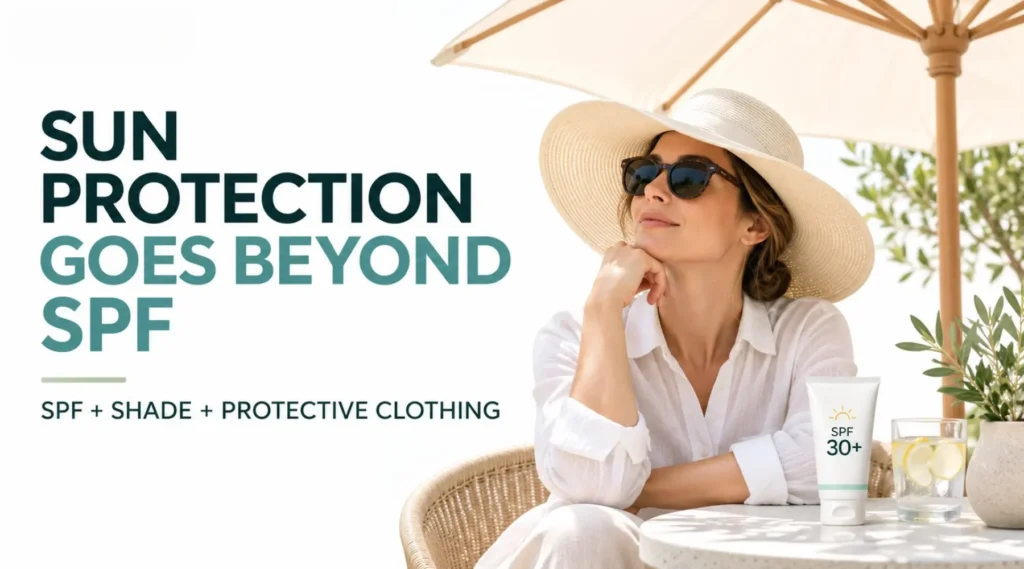
Protective clothing reduces exposed skin
Clothing helps block UV rays. Long sleeves, closely woven fabrics and clothes with a UPF rating can reduce exposure.
A wide-brimmed hat helps protect your face, ears and neck.
Sunglasses with proper UV protection help protect your eyes and the skin around them.
These steps are especially useful when you’ll be outdoors for a long time.
Shade reduces intense exposure
In the UK, UV rays are often strongest between 11 am and 3 pm in spring and summer. Staying in the shade during these hours can reduce your exposure, but it won’t block all UV rays because sunlight can bounce off nearby surfaces. For better protection, use shade alongside clothing and sunscreen.
Smoking contributes to premature ageing
Smoking can contribute to skin ageing in several ways, including by causing oxidative stress and affecting processes linked to collagen. Quitting supports your overall health and removes one avoidable source of skin damage. Sunscreen cannot protect against every environmental factor that may affect skin ageing.
Sleep and general health still matter
Getting enough sleep, eating a balanced diet and drinking enough water can support your overall health and skin. But drinking lots of water won’t replace sunscreen or undo wrinkles caused by UV rays. Foods rich in antioxidants can support your health, but they don’t protect your skin as reliably as sunscreen. For the best approach, combine healthy habits with evidence-based skincare.
Avoiding tanning beds is particularly important
Tanning beds expose your skin to artificial UV rays. They add to your UV exposure and are linked to a higher risk of skin cancer and early skin ageing. Using sunscreen outdoors while regularly using tanning beds works against reducing your overall UV damage. Avoiding intentional tanning is a more consistent way to limit it.
When Sunscreen Is Not Enough to Address Visible Skin Ageing
Sunscreen can help slow damage that could otherwise be prevented, but it cannot treat every existing skin concern. Ageing, genes or medical conditions mainly cause some changes. Others are lasting changes to the skin’s structure that products applied to the skin cannot fully correct.
Established wrinkles and loss of firmness
For deep wrinkles, significant sagging or severe sun damage, skincare alone may not be enough. Depending on the concern, a dermatologist may suggest prescription retinoids, selected skin-resurfacing treatments or other medical options. Results can vary, and all procedures carry possible risks. Using sunscreen is still important: more UV exposure can cause further damage and may affect treatment results.
Persistent or changing pigmentation
Dark patches aren’t always caused by the sun. Other causes include melasma, skin inflammation, medicines, or hormone changes. A dermatologist can help find the cause and suggest suitable treatment. If a pigmented spot is new, changing or unexplained, get medical advice before using products to lighten it.
Professional procedures require careful aftercare
Chemical peels, laser treatments and other skin-resurfacing procedures can make your skin more sensitive for a while. Some may also cause dark patches, especially in darker skin tones. Protect your skin from the sun before and after treatment. Follow your clinician’s advice, as it may differ from your usual skincare routine.
Skin changes that need medical attention
See a medical professional if you notice a new or changing mole, a sore that won’t heal, unusual bleeding or a skin mark that changes quickly.
Sunscreen helps protect you from UV rays, but it cannot remove the risk of skin cancer. Keep checking your skin for changes, even if you use sun protection carefully.
Questions People Ask About Sunscreen and Premature Skin Ageing
1. Does sunscreen prevent ageing permanently?
Sunscreen cannot stop skin ageing altogether, but it can help slow early skin changes caused by the sun, such as wrinkles, dark spots and changes in texture. Natural ageing continues, and UV rays can still damage unprotected skin. Use sunscreen regularly to keep getting this protective benefit.
2. Does sunscreen prevent wrinkles if you start using it in your twenties?
Using sunscreen in your twenties may help limit UV damage that builds up over time, before more noticeable signs of sun-related ageing appear. Results vary depending on how much sun you get, your skin type, your genes, and how regularly you use it. Sunscreen cannot prevent all wrinkles, as skin also ages naturally.
3. Can sunscreen prevent a tan completely?
No sunscreen can stop tanning completely. A broad-spectrum sunscreen with strong UVA protection can greatly reduce UV exposure and help limit skin darkening. But some UV rays may still reach your skin, especially if you spend a long time in the sun or do not apply enough sunscreen.
4. Will you still tan with sunscreen SPF 50?
You can still tan while wearing SPF 50. It offers strong protection against the UV rays that cause sunburn, but it doesn’t block all UV or prevent every bit of sun exposure. To reduce tanning further, use sunscreen with strong UVA protection, apply enough, seek shade and wear protective clothing.
5. Is SPF 30 enough to prevent premature ageing?
For everyday use in the UK, SPF 30 with good UVA protection is a sensible minimum.
SPF 50 or 50+ gives more protection from UVB rays. It may be a better choice if you’ll be outdoors for a long time or have pigmentation concerns.
Whatever SPF you choose, apply enough and make sure it offers good UVA protection.
6. Does sunscreen prevent ageing for oily skin without causing spots?
Sunscreen can help protect oily skin from UV-related ageing.
If your skin gets clogged easily, choose a lightweight sunscreen labelled non-comedogenic. Some products may cause breakouts for some people, but sunscreen does not automatically cause acne.
A texture that feels comfortable on your skin, plus gentle evening cleansing, may help.
7. Is sunscreen suitable for preventing ageing in sensitive skin?
Yes, if the sunscreen suits your skin. Fragrance-free sunscreens may be a good place to start, and some people find mineral sunscreens more comfortable. But sensitive skin can react to many ingredients, so no type is irritation-free for everyone. If reactions continue, see a dermatologist.
8. Can sunscreen reverse wrinkles and fine lines?
Sunscreen mainly helps prevent future sun damage. Using it regularly may help your skin look better over time by reducing UV exposure. Moisturising sunscreens can also temporarily soften fine lines caused by dry skin. But sunscreen alone usually won’t noticeably improve deep wrinkles or lasting changes to the skin’s structure; these may need other treatments.
9. Does sunscreen prevent ageing better than retinol?
Sunscreen helps protect your skin from UV rays that can cause signs of ageing. Retinol may help improve some signs of ageing that are already there by supporting skin renewal. For preventing sun-related skin ageing, sunscreen is essential: retinol does not protect your skin from UV rays.
10. Should sunscreen be worn indoors to prevent ageing?
It depends on how much sun you get. Sunscreen may help if you spend a long time beside a sunny window, as some UVA rays can pass through ordinary glass. If you stay indoors away from sunlight, applying more sunscreen may make little difference right away. Using sunscreen daily can be a convenient habit if you move between indoors and outdoors.
11. Can sunscreen prevent dark spots and age spots?
Sunscreen can help prevent UV light from causing pigmentation to form or become darker. It may also help treatments fade existing marks by reducing repeated stimulation of pigment. For melasma and some dark spots, tinted sunscreens with iron oxides can offer extra protection from visible light.
12. Does moisturiser with SPF work as well as sunscreen?
A moisturiser can protect you from the sun if it has been properly tested for SPF, provides enough UVA protection, and you apply enough. But many people use too little moisturiser to get the SPF protection shown on the label. A separate sunscreen may be easier to apply generously, especially if you’ll be outdoors for a long time.
13. Can you use sunscreen every day without damaging your skin?
Most people can use a suitable sunscreen every day without harming their skin. Some formulae may cause irritation, allergic reactions or spots. If discomfort continues, switch to another sunscreen instead of carrying on with one that irritates your skin.
14. What is the best routine for sunscreen to prevent ageing?
Morning:
- Gently cleanse your skin.
- Use a treatment serum if you want to.
- Apply moisturiser if needed.
- Finish with broad-spectrum sunscreen. Apply plenty before going outdoors. Reapply about every two hours while outdoors, and after swimming or heavy sweating.
Night:
- Gently cleanse your skin.
- Use any suitable treatment products as directed.
15. What are the most common mistakes when using sunscreen for ageing prevention?
Common sunscreen mistakes include:
- Using too little
- Not checking for UVA protection
- Missing your neck and ears
- Not reapplying when you’re outdoors
- Relying on make-up with SPF as your only sun protection
- Using sunscreen that has expired
- Mixing sunscreen with moisturiser
- Assuming a higher SPF makes it safe to stay in the sun for longer
Applying sunscreen properly is just as important as choosing one that suits you.
Does Sunscreen Prevent Ageing Enough to Make Daily Use Worthwhile?
Sunscreen can help prevent early skin ageing because UV rays can damage skin over time.
It cannot stop natural ageing, remove every wrinkle or replace collagen that has already been lost. But using sunscreen regularly can reduce repeated UV damage, which can contribute to uneven skin tone, changes in texture and damage to the skin’s support structures.
Research has found measurable long-term benefits from regular sunscreen use. The advice is simple: choose a broad-spectrum sunscreen of at least SPF 30 with strong UVA protection. Apply enough to cover exposed skin, reapply as needed when outdoors, and use shade and protective clothing too.
You don’t need the highest SPF or an expensive product just because it claims to prevent ageing. A sunscreen that feels comfortable and fits into your everyday routine is more useful than one you use only on sunny days.
Starting before wrinkles or uneven pigmentation appear gives prevention more opportunity to help. Skin will naturally change as you age; sunscreen helps reduce avoidable damage that could make those changes show sooner.