




Blog
Collagen Face Mask Benefits: What They Can Do for Your Skin

Collagen face masks are popular with people who want skin that feels softer, smoother, and more hydrated. They can be appealing when your skin feels dry, tired or less firm.
These masks can boost hydration, soften the look of fine lines and help skin feel more supple. But they do not replace the collagen your skin naturally loses as you age. Collagen helps keep skin firm, but applying it to the skin’s surface is not the same as increasing collagen production within the skin.
A well-made mask can still be a useful part of your skincare routine. Moisturising ingredients and time spent on the skin may help reduce moisture loss, leaving your complexion looking fresher for a while.
Results vary depending on the mask’s ingredients, your skin type and how you use it. Knowing what to expect can help you enjoy the benefits without expecting dramatic changes.
What Are the Main Collagen Face Mask Benefits?
Collagen face masks mainly make skin look and feel better by adding moisture to its surface. They may temporarily make skin look fuller, soften fine lines caused by dryness, smooth the skin and give it a fresher appearance. These effects are usually cosmetic and temporary, rather than lasting changes to the skin’s structure.
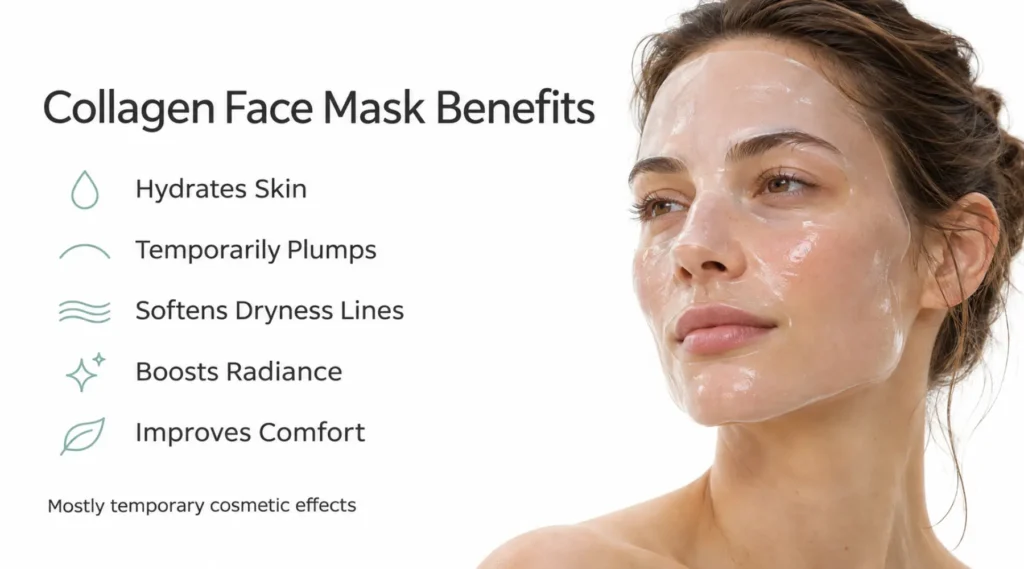
The main benefits include:
1. Hydrated, softer skin
One of the most reliable benefits of a collagen face mask is added moisture.
The outer layer of your skin needs enough water to stay flexible and smooth. When it gets dry, your skin may feel tight, look dull or show fine lines on the surface.
Many collagen masks contain ingredients called humectants. These attract and hold water, while the mask helps keep the ingredients in contact with your skin during use.
After using a suitable mask, your skin may feel softer and more comfortable because its outer layers temporarily hold more moisture.
This may be useful in winter, after time in centrally heated rooms or whenever your skin feels dry. The effect may not last all day, so applying a suitable moisturiser afterwards can help reduce further moisture loss.
2. Making Fine Lines Look Less Noticeable
Fine lines can form for different reasons. Some are linked to changes in the skin’s collagen and elastin. Others stand out more when the skin’s surface is dry.
Hydrating collagen masks mainly help with dryness. Better-hydrated skin can look fuller and smoother, so dehydration-related fine lines may look less noticeable. This may explain why cheeks or the forehead can look better straight after using a mask.
A moisturising treatment won’t make deeper wrinkles disappear.
3. Making skin look plumper temporarily
Skin that feels less firm may sometimes look that way because it is temporarily dehydrated, rather than needing an intensive anti-ageing treatment.
Collagen masks can add water to the skin’s surface, helping it look plumper and reflect light differently. This can make the skin look fresher, especially when fine lines seem more noticeable after a poor night’s sleep.
This temporary effect does not restore lost facial volume or rebuild the skin’s collagen network.
4. Improving the Appearance of Dull Skin
Dull-looking skin can happen when its surface is dry, rough or uneven. Moisturisers can soften the surface, helping light reflect more evenly so skin may look brighter and healthier.
This changes appearance, not an instant treatment for pigmentation. A collagen mask won’t remove existing sunspots, melasma or dark marks left after inflammation just by adding moisture.
Some masks also contain brightening ingredients, such as niacinamide, which may help skin look more even with regular use. How well they work depends on how much you use, the formula, and how often you apply them.
5. Supporting skin comfort
A gentle collagen mask may help skin feel more comfortable if mild dryness or tightness is the main concern. Ingredients such as glycerin, panthenol, hyaluronic acid and some moisturising oils or creams can help improve the outer layers of the skin.
But a soothing feeling does not mean the mask treats inflammation or a medical skin condition. If you have eczema, rosacea or ongoing irritation, the wrong mask could make your symptoms worse.
6. Creating a Smoother Base for Make-up
Make-up can show up more on dry patches and fine lines caused by dehydration. A moisturising collagen mask may soften the look of rough areas and help foundation sit more smoothly. Hydrating your skin before a special occasion may help.
Remove any leftover mask product and let your moisturiser sink in before applying make-up. Too many layers can make foundation slide, separate or form small rolls, known as pilling.
7. Making skincare more relaxing
Skincare doesn’t always need to change wrinkles or pigmentation visibly. A comfortable face mask can encourage you to take a little more time for your skin. A hydrogel mask may feel cool and pleasant, and resting while you wear it can make your evening routine more enjoyable. This can be worthwhile, as long as the product suits your skin.
| Collagen face mask benefit | What you may notice | What it cannot guarantee |
| Improved hydration | Softer, more comfortable skin | Permanently hydrated skin |
| Temporary plumping | Fuller-looking skin surface | Restored facial volume |
| Smoother fine lines | Reduced visibility of dehydration lines | Removal of deep wrinkles |
| Brighter appearance | Fresher, more radiant-looking complexion | Permanent pigmentation correction |
| Skin comfort | Less tightness from mild dryness | Treatment of eczema or rosacea |
| Improved texture | Smoother-looking surface | Permanent pore reduction |
| Makeup preparation | More even-looking foundation application | Flawless makeup on every skin type |
These improvements explain why collagen masks remain popular, even though their effects are less dramatic than the term collagen-boosting sometimes suggests.
Why Collagen Matters for Skin Firmness and Elasticity
Collagen is one of the main proteins that give skin its structure. It is part of the extracellular matrix, a network of proteins and other substances that supports the body’s tissues.
Most of the skin’s collagen is in the dermis, the layer beneath the epidermis. Special cells called fibroblasts make collagen and other substances that help support the skin.
Two important types are:
- Type I collagen: The most common type in skin. It provides much of the skin’s strength against stretching.
- Type III collagen: Often found with type I collagen. It helps form and repair connective tissue.
Elastin is another important protein. It helps skin stretch and return to its original shape. Together, collagen, elastin and other substances help skin stay firm, flexible and resilient.
What Happens to Natural Collagen as Skin Ages?
Collagen changes as we get older. Its fibres can break up, and the body may become less effective at making and maintaining collagen. This can lead to wrinkles, less firm skin and changes in skin texture.
Age is not the only factor. Ultraviolet (UV) rays can speed up collagen breakdown through oxidative stress and enzymes that reshape the skin’s supporting structure. When these enzymes are more active after UV exposure, they can contribute to the breakdown of proteins that support the skin.
Smoking, repeated sun exposure and other environmental factors may also speed up visible skin ageing. That is why people of the same age can have different skin textures and levels of firmness.
Can Applying Collagen Replace What Your Skin Has Lost?
Not in the simple way some skincare adverts suggest.
Collagen is a large protein. When you apply it to unbroken skin, it generally cannot pass through the skin’s outer barrier in its original form and join the collagen network deeper in the skin.
A 2024 scientific review in *Materials* explains that natural collagen molecules are too large to pass effectively through this barrier. Smaller pieces of hydrolysed collagen behave differently, but they do not simply join together to form normal collagen fibres in the skin. (PubMed Central)
That does not mean collagen in skincare is useless.
Collagen and collagen-derived ingredients can help the skin hold onto moisture, create a protective layer, and feel smoother.
Some specialist products have shown promising results in small studies. But those findings do not necessarily apply to every collagen mask.
The key difference is between using a collagen product to moisturise the skin and encouraging the skin to make more of its own collagen. These are different processes.
Do Collagen Masks Work, or Is It Mostly Skincare Marketing?
Collagen masks may hydrate your skin, make it look temporarily fuller and leave it feeling softer. But there is much less evidence that ordinary collagen face masks can significantly boost collagen deep in the skin, permanently lift your face or get rid of established wrinkles.
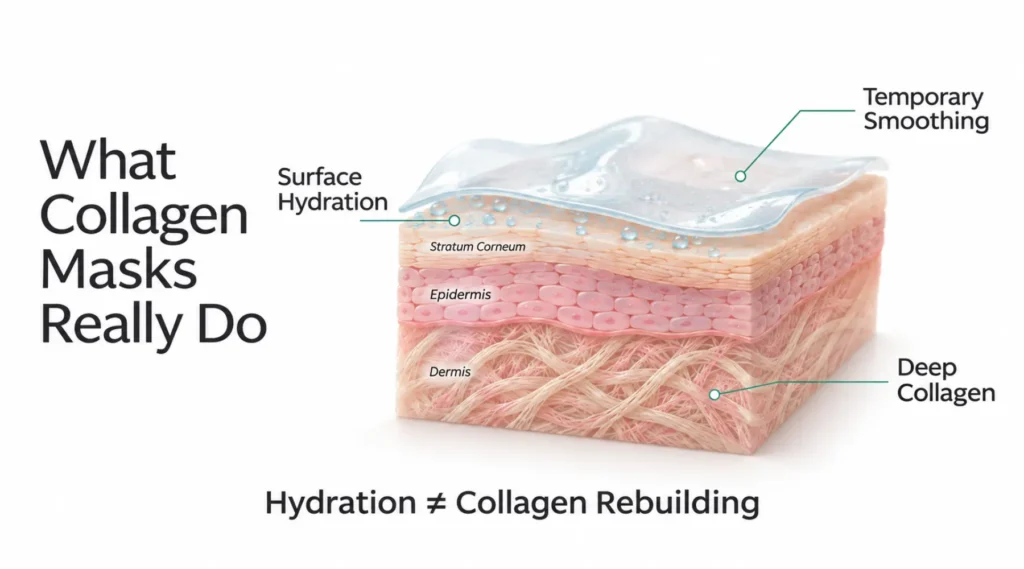
It depends on what you expect from the product. If you want your skin to feel more moisturised after using a well-made mask, that is a reasonable expectation. But no strong scientific evidence shows that a mask can rebuild collagen lost over many years.
What Research Tells Us About Facial Masks
Research suggests that how a face mask affects skin depends on its ingredients, how long it is worn and the person’s skin.
A 2024 randomised controlled study published in the *Journal of Tissue Viability* looked at different sheet masks and how long people used them. Researchers measured skin hydration, water loss through the skin and visible reactions. The results suggested that shorter applications may improve hydration, while wearing a sheet mask for longer may sometimes lead to dryness and redness.
The study was about sheet masks. It did not show that collagen itself causes anti-ageing benefits. (PubMed)
The American Academy of Dermatology says face masks can moisturise skin and help with specific skincare needs. However, they are not a substitute for a regular skincare routine or medical treatment.
Why a Collagen Mask Can Make Skin Look Firmer Immediately
Think of a dry sponge: it can feel stiff and look uneven. When it absorbs water, it softens and plumps up.
Skin is more complex, but its outer layer can respond similarly to moisture. When this layer is well hydrated, it may feel more supple, and small surface irregularities can look less noticeable.
A collagen mask may temporarily help achieve this effect, especially if it contains ingredients that attract and lock in moisture. Skin may look firmer, even though the collagen beneath the surface hasn’t changed significantly.
So, immediate results can be real, but they may not last.
Why Results Vary Between People
People with dry, dehydrated skin may notice a bigger short-term improvement than people whose skin is already well moisturised. If dehydration causes fine lines, they may look softer after using a mask. A mask is less likely to make a noticeable difference to deep wrinkles or significant loose skin.
Results can also depend on:
- The ingredients and how much of each is in the mask.
- The condition of your skin’s protective barrier.
- How well the mask fits and what it is made from.
- How long you leave it on.
- Whether it irritates your skin.
- The skincare products you use before and after it.
A collagen mask is most likely to help when it targets a concern that moisturising ingredients can realistically improve.
Which Ingredients Make a Collagen Face Mask Effective?
Collagen may get the most attention on the packaging, but other ingredients can affect how a mask feels. A mask with collagen and suitable moisturising ingredients may hydrate better than one with collagen alone. So, check the ingredient list rather than choosing a product based on its biggest claims.
Hydrolysed Collagen: Moisture Retention Rather Than Collagen Replacement
Hydrolysed collagen is collagen broken into smaller pieces. These may include peptides and amino acids. Smaller pieces can affect how the ingredient interacts with skin, but whether they can get into the skin depends on their size, the product formula and other chemical properties.
Hydrolysed collagen may help skin hold on to moisture and make a skincare product feel better. But there isn’t enough evidence to say that all products containing it significantly boost new collagen production. It’s best seen as a potentially useful skin-conditioning ingredient, not a guaranteed anti-ageing treatment.
Hyaluronic Acid: Helping Skin Hold Water
Hyaluronic acid is found naturally in the body, including the skin. It holds onto water, which is why it’s often used in hydrating masks.
In a well-made product, it can help hydrate the skin’s outer layers and make the surface look smoother. Different sizes of hyaluronic acid can behave differently: larger molecules usually work near the skin’s surface, while smaller ones may interact differently with the outer layers. But smaller doesn’t automatically mean better. A product should balance hydration with comfort and suit the skin barrier.
Glycerin: A Reliable Ingredient That Often Gets Overlooked
Glycerin may get less attention than collagen or trendy plant extracts, but it is a well-established moisturising ingredient. It helps the outer layer of skin hold onto water and can support skin comfort and flexibility. In a collagen mask, glycerin may work with other moisturisers to leave skin feeling softer and smoother. A mask with glycerin and other effective moisturisers may be a more practical choice than an expensive formula focused on a fashionable ingredient with limited evidence.
Niacinamide: Supporting the Skin Barrier and Uneven Tone
Niacinamide is a form of vitamin B3 used in some skincare products to brighten and moisturise the skin. Evidence suggests it can help support the skin’s protective barrier and improve the appearance of uneven skin tone. It may also help reduce the look of excess oil and improve skin texture.
How well it works depends on the product and how much niacinamide it contains. A face mask with only a small amount may not have the same effect as a well-made product that stays on the skin and is used regularly for several weeks. If you have sensitive skin, remember that higher concentration isn’t always better.
Ceramides: More Useful When Dryness Is Persistent
Ceramides are fats found naturally in the skin’s protective barrier.
They help form layers that reduce water loss.
If your skin is dry or its barrier is weakened, a product with ceramides may help it hold on to moisture.
Ceramides may work especially well alongside other skin-supporting fats and moisturising ingredients.
If your skin feels tight soon after you remove a collagen mask, a moisturiser with ceramides may keep it comfortable for longer than using another mask.
Peptides: Promising, but Not All Equally Effective
Peptides are small chains of amino acids.
Some peptides in skincare are intended to condition the skin. Others are promoted for their possible effects on processes linked to ageing.
Early research on some topical peptides is encouraging, but results differ depending on the peptide and the product it’s used in.
A product labelled “peptide” is not necessarily proven to boost collagen production.
What matters includes the type and amount of peptide, its stability, and whether it can reach the right layers of skin.
Fermented Ingredients: Formulation Matters More Than Popularity
Fermented ingredients are widely used in Korean skincare. Some collagen masks contain ingredients such as galactomyces ferment filtrate or other extracts made through fermentation. Depending on the formula, these may help condition the skin and keep it hydrated.
The benefits depend on the specific ingredient. Fermented ingredients aren’t always better than standard moisturisers, and products containing them aren’t automatically suitable for sensitive skin. Judge a product by how well the whole formula works, not by the popularity of one ingredient.
Collagen Sheet Masks, Hydrogel Masks and Sleeping Masks: Which Is Better?
Not all collagen masks work in the same way. The material that holds the formula against your skin can affect how long you wear it, how comfortable it feels and how it works. Understanding how facial masks work helps explain why the type of mask can matter as much as its main ingredients.
| Mask type | How it works | Best suited to | Main consideration |
| Collagen sheet mask | Fabric holds a hydrating essence against the skin | Quick hydration and surface softness | Can dry out if worn too long |
| Collagen hydrogel mask | Gel material maintains close contact with the skin | Temporary plumping and hydration | Some require specific wear times |
| Collagen cream mask | Richer formula provides humectants and emollients | Dry or rough-feeling skin | May feel heavy on oily skin |
| Collagen sleeping mask | Leave-on formula helps limit overnight moisture loss | Persistent dryness and overnight hydration | Must be designed for overnight use |
| Collagen peel-off mask | Forms a film removed after setting | Temporary surface smoothing | Removal may irritate sensitive skin |
Why Hydrogel Collagen Masks Are Popular in Korean Skincare
Hydrogel masks are popular because they feel different from fabric masks. They use a gel-like material that rests against the face, feels cooling, and fits closely to uneven areas of skin. Some masks become thinner or clearer as you wear them, but that doesn’t prove collagen has reached the deeper layers of your skin. The change may be due to moisture loss or the gel itself. What matters most is how your skin responds, not how clear the mask becomes.
When a Traditional Sheet Mask Is Enough
If you’re short on time, a traditional sheet mask may be more practical. Many stay on your skin for about 10 to 20 minutes, giving you a convenient hydration boost without a long skincare routine. If dehydration is your main concern, a simple formula with glycerin, hyaluronic acid and other moisturising ingredients may be enough. You don’t need to choose a more complicated product just because it promises deeper absorption.
Can a Sleeping Mask Replace a Collagen Sheet Mask?
A sleeping mask is made to stay on your skin overnight, helping to keep it moisturised while you sleep. It may contain ingredients that attract moisture, soften the skin or help reduce water loss. Unlike a regular sheet mask, it is designed for longer use. Don’t leave a 15-minute mask on overnight just because it contains collagen. Choose a mask that suits your skin and follow the manufacturer’s directions.
Collagen Face Mask Benefits for Different Skin Types
The same collagen mask may not work equally well for everyone. Your skin type affects how much moisture you need, which ingredients feel comfortable and whether a formula might irritate your skin.
Dry Skin: Choose Moisture and Barrier Support
Dry skin usually produces less sebum, the natural oil that helps protect its surface. It may feel rough, flaky or tight, especially in colder months.
A collagen mask with hydrating and moisturising ingredients may offer temporary relief. But dryness may not improve by adding hydration alone. Look for a mix of:
- Glycerin or hyaluronic acid to hydrate.
- Ceramides to support the skin barrier.
- Squalane or other suitable emollients to soften skin.
- Panthenol to condition the skin.
After removing the mask, apply a moisturiser that suits your skin. This is especially important if your cheeks feel dry soon after cleansing.
Dehydrated Skin: Focus on Water Retention
Dehydration is a condition, not a permanent skin type. Even oily skin can lack water.
Signs can include tightness, dullness and fine lines that look more noticeable when skin is short of water. A collagen mask may make these signs less visible for a while.
If dehydration keeps coming back, review your daily routine. Washing your face too often or too harshly, exfoliating frequently and not using enough moisturiser may contribute. Changing these habits may help more reliably than using masks repeatedly.
Oily Skin: Avoid Unnecessarily Heavy Formulas
Oily skin can still need hydration, especially if harsh cleansers leave it feeling tight. Rich masks may feel uncomfortable or clog pores for some people, so choose a lightweight mask with ingredients such as glycerin, hyaluronic acid or niacinamide. You don’t need to exfoliate heavily first: too much exfoliation can irritate skin and weaken its protective barrier. Aim to hydrate your skin, not strip away all its natural oil.
Combination Skin: Consider Different Needs Across the Face
Combination skin can be oily on the forehead, nose and chin, but drier on the cheeks. A lightweight collagen mask may suit your whole face, though some areas might need moisturiser afterwards. You could use a richer cream on your cheeks and a lighter one on your T-zone. This may work better than expecting one product to meet every skincare need.
Collagen Face Mask Benefits for Sensitive Skin
Sensitive skin needs extra care. A mask that feels fine on normal skin may cause redness or stinging on sensitive skin, especially if you leave it on too long.
Choose a collagen mask with a simple formula and familiar moisturising ingredients. Look for:
- No added fragrance.
- Glycerin or other gentle ingredients that help skin hold moisture.
- Ceramides or panthenol.
- No strong exfoliating acids.
- Clear instructions and a full ingredient list.
Be cautious with essential oils, strong fragrances, menthol and some plant extracts, as these may irritate skin.
If you have allergies, check where the collagen comes from. Some masks use collagen from marine sources. If you may be allergic to these, check the product details and seek professional advice if needed.
If you have eczema or rosacea, avoid trying new masks during a flare-up. Sensitive skin may not need extra treatments: a gentle cleanser and a suitable moisturiser may be enough.
How to Use a Collagen Face Mask Correctly
Using the mask correctly can improve comfort and results.
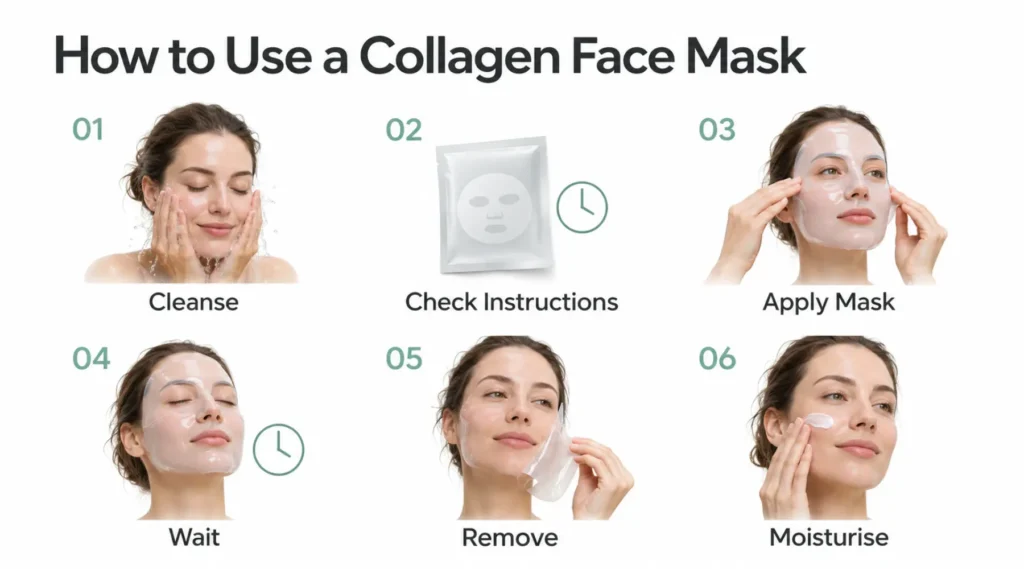
Gently cleanse your skin, spread the mask evenly, leave it on for the recommended time, then moisturise if needed.
Step 1: Start With Clean Skin
Wash your face with a gentle cleanser to remove makeup, sunscreen, extra oil and dirt.
Use lukewarm water, not hot water, especially if your skin is dry or sensitive.
Gently pat your face dry with a clean towel.
You do not need to scrub or exfoliate before every mask. Exfoliating before trying a new mask may increase the chance of irritation.
If your skin feels tight after cleansing, your cleanser may be too harsh.
Step 2: Check the Mask’s Instructions
Before opening the pack, check how long to wear the mask and follow any product instructions. Some masks are for short use, while others are made to stay on longer. Don’t assume all collagen masks should be worn for the same amount of time. Check whether to apply the mask to dry skin or after toner, as this depends on the formula and mask material.
Step 3: Position the Mask Without Pulling Your Skin
Carefully remove the mask from its packaging.
For a sheet mask, unfold it and line up the openings with your eyes, nose and mouth.
For a two-piece hydrogel mask, place the top and bottom sections as directed in the instructions.
Smooth out any large air pockets so the mask sits comfortably on your skin.
Don’t stretch the mask tightly or place it too close to your eyes. It should feel comfortable, not tight.
Step 4: Leave It On for the Recommended Time
Leave the mask on for the time stated on the packaging. You don’t need to massage your face firmly or use extra tools to push the ingredients into your skin—the formula is already in contact with your skin. If you feel strong stinging, burning or itching, remove the mask straight away. Tingling isn’t needed for a product to work.
Step 5: Remove It Gently
Remove the mask gently without pulling your skin. You usually don’t need to rinse after using a hydrating sheet mask unless the product instructions say otherwise. If a little essence is left, gently smooth it over your face with clean fingertips. You do not need to rub in every drop. If it feels uncomfortable or irritates your skin, remove it as the instructions advise. Throw away single-use masks after use.
Step 6: Follow With a Suitable Moisturiser
Moisturiser can help keep your skin feeling comfortable after a hydrating mask.
Choose a texture that suits your skin. A light lotion may be enough for oily skin, while a richer cream with moisturising and skin barrier-supporting ingredients may suit dry skin better.
If you use a mask in the morning, finish with broad-spectrum sunscreen of at least SPF 30. A collagen mask does not protect your skin from UV rays.
How Long Should You Leave a Collagen Face Mask On?
How long to leave a mask on depends on its type and material. Many regular sheet masks are used for 10 to 20 minutes, while some hydrogel masks may be designed to stay on for longer. Always follow your mask’s instructions, as timings can differ.
Is 15 Minutes Enough?
For a standard hydrating sheet mask, 15 minutes may be enough to moisturise the skin noticeably. The skin’s outer layers can respond quickly to hydration, but leaving the mask on for another hour won’t necessarily improve the results. Depending on the ingredients and how the mask dries, wearing it for longer could irritate the skin. Follow the time recommended for that specific product.
Can You Leave a Collagen Hydrogel Mask On for Several Hours?
Some hydrogel masks are made to be worn for longer. The Bio-Collagen Real Deep Mask, for example, has two parts and is marketed for extended use. Its highlighted ingredients include collagen-derived ingredients, hyaluronic acid and niacinamide.
Wearing a mask for longer does not necessarily make it work better. Limited independent evidence shows that leaving collagen hydrogel masks on for several hours leads to better long-term skin results than shorter treatments made with suitable ingredients.
If you use a mask designed for longer wear, follow the instructions on the current packaging. Patch test it first, and remove it if your skin feels uncomfortable. If you have sensitive skin, start with a shorter wear time and see how your skin responds.
Can You Sleep With a Collagen Face Mask On?
Use a mask overnight only if it is made and labelled for overnight use.
A regular sheet mask may dry out, move around or irritate your skin while you sleep.
Even with an overnight hydrogel or sleeping mask, you may not need to wear it for longer.
If your skin is sensitive or prone to acne, keeping it covered for a long time may not suit you.
A simple moisturiser may be a more reliable choice overnight.
Does a Mask Turning Transparent Mean It Has Worked?
Not necessarily. A hydrogel mask may change appearance as its water content and structure change. But this doesn’t prove collagen has reached deeper skin layers or that your skin has made new collagen. A clear mask may still have hydrated your skin, and an opaque mask may still have moisturised it effectively. A mask’s appearance alone cannot show whether its ingredients were absorbed or whether it works clinically.
How Often Should You Use a Collagen Face Mask?
Most people can start with a gentle collagen mask once or twice a week, as long as the ingredients suit their skin and they tolerate the mask. Some simple hydrating masks may be suitable for more frequent use, but you don’t need to use one every day to keep your skin healthy.
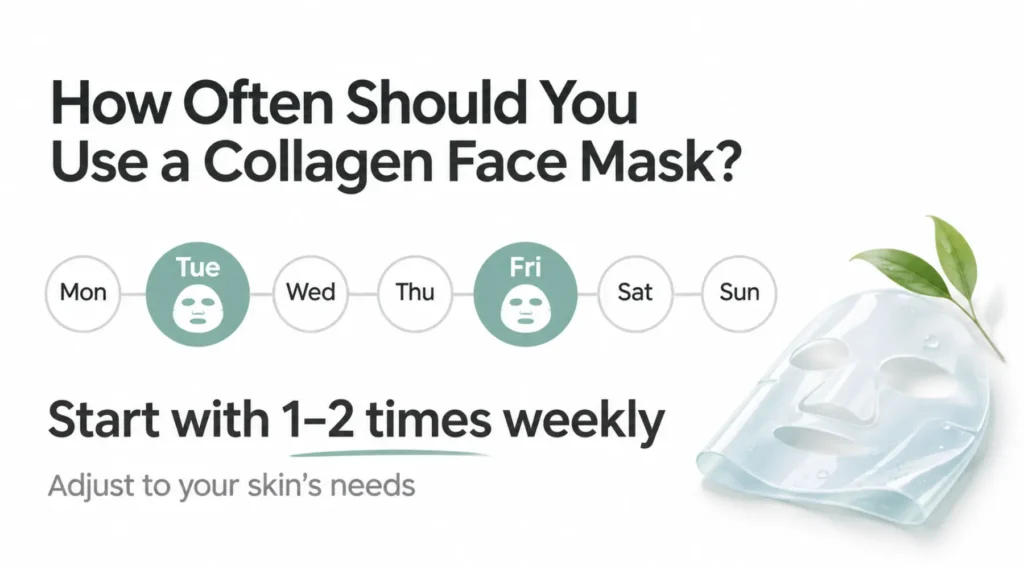
How often to use a mask also depends on the moisturisers, exfoliants and other treatments you already use.
| Skin condition | Sensible starting approach |
| Normal skin | Once or twice weekly |
| Dry skin | Once or twice weekly, adjusting if needed |
| Oily skin | Once weekly initially |
| Combination skin | Once or twice weekly |
| Sensitive skin | Start occasionally after patch testing |
| Irritated or inflamed skin | Avoid new masks until the skin has recovered |
These are practical starting points, not medical rules.
A mask with mostly gentle humectants may be tolerated more often than one combining exfoliating acids, fragrance, and multiple active ingredients.
Is Daily Collagen Masking Better?
Not always. If your daily moisturiser keeps your skin hydrated, you may not need to use a face mask often. Using masks repeatedly may irritate some people, especially if they react to preservatives, fragrances or other ingredients. Your skin barrier needs regular care, not more complicated treatments. Notice whether your skin feels comfortable, dry or red to help decide how often to use a mask. If your skin becomes more sensitive when you use masks more often, use them less or stop.
What About Using Several Masks in One Day?
Using several collagen masks in one day is usually unnecessary. There’s no convincing evidence that applying them more often rebuilds collagen faster or increases hydration proportionally. If your skin needs extra comfort, use your regular moisturiser. If you keep wanting another mask, check whether your cleanser, moisturiser or surroundings are causing ongoing dryness.
Morning or Night: When Is the Best Time to Use a Collagen Mask?
There’s no single best time to use it. In the morning, it may help your skin look smoother before makeup; in the evening, it can fit into a more relaxed skincare routine.
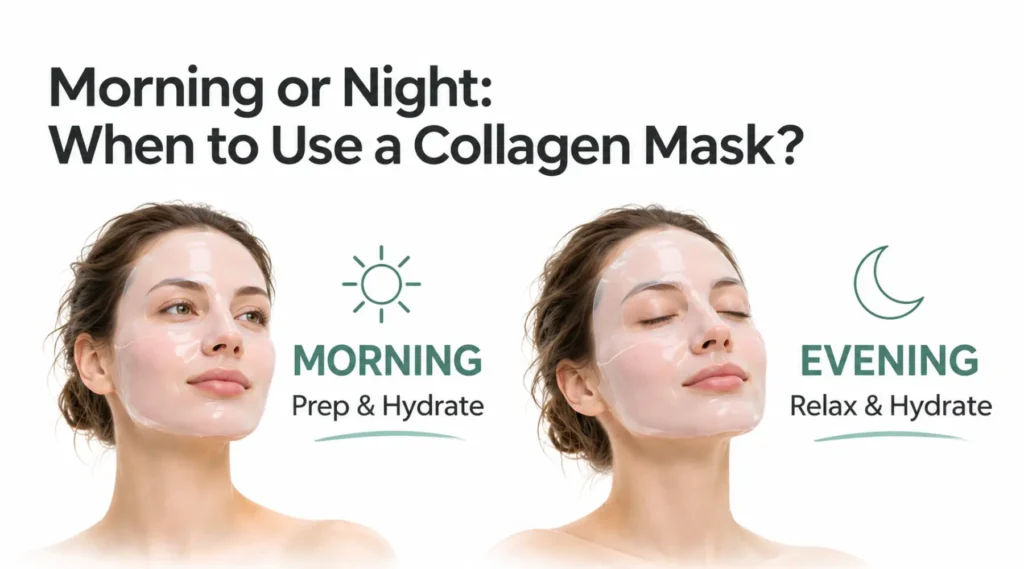
The formula and your skin’s condition matter more than the time of day.
Morning Collagen Mask Routine
A morning mask may help if your skin feels dry after a night in a centrally heated room.
- Gently cleanse, or rinse with water if that suits your skin.
- Use a hydrating collagen mask for the time stated on the pack.
- Remove it and let any comfortable residue settle into your skin.
- Apply a moisturiser that suits your skin.
- Finish with broad-spectrum SPF 30 or higher.
- If you wear foundation, let your skincare settle before applying it.
If your skin tends to get oily, avoid using a rich mask just before foundation. Too many hydrating layers can leave your skin slippery rather than creating a smooth base.
Evening Collagen Mask Routine
Applying the mask in the evening may be more convenient if you want to relax. A simple routine could be: cleanse, apply the collagen mask, then moisturise.
If you use a prescription retinoid or another strong treatment, take care when using it with a mask for a long time. Covering the skin may change how some ingredients interact and could increase irritation.
If you use retinoids, a gentle hydrating mask on a different evening may feel more comfortable than using several treatments together.
Should You Use a Collagen Mask Before or After Serum?
For most sheet masks, apply the mask after cleansing and before your moisturiser. Always follow the product’s instructions. The mask already contains essence, so you may not need to use a hydrating serum underneath. Adding extra products, especially with similar ingredients, may increase the risk of irritation. The aim is to hydrate your skin without overloading it.
The Best Routine for Getting Collagen Face Mask Benefits
A collagen mask works best alongside a good daily skin care routine. It can’t make up for skipping sunscreen, using a cleanser that doesn’t suit your skin or not using moisturiser. A good routine usually starts with three basics: gentle cleansing, moisturising and sun protection. Add other products to target specific skin concerns.
Pairing a Collagen Mask With a Hydrating Serum
A hydrating serum can add moisture between mask sessions. Ingredients such as glycerin, hyaluronic acid and panthenol may help keep the skin’s surface hydrated. You could use a 24K Gold Serum if its full formula suits your skin. But strong clinical evidence that gold itself boosts collagen or reduces wrinkles is limited. Gold in a product does not prove it has anti-ageing benefits, and it may cause a reaction in some people. Choose a serum based on all its ingredients, how well your skin tolerates it and any proven benefits not just decorative ingredients. You do not have to use a serum and a mask in the same session. For a more comfortable routine, use a serum on regular days and a mask occasionally for extra hydration.
Can You Use Collagen Masks With Retinol?
Collagen hydrating masks are not automatically unsuitable for use with retinol.
Retinol can cause dry, irritated skin, especially when you first start using it.
Leaving a mask on too long or combining several active ingredients may worsen irritation.
If your skin handles retinol well, you could use a gentle hydrating mask on a different evening.
Check the ingredients before applying a new collagen mask over a strong retinoid treatment.
Avoid retinoids during pregnancy.
Can You Use Collagen Masks With Vitamin C?
You may be able to use both products, depending on their ingredients. Vitamin C and collagen ingredients are not always incompatible. But some vitamin C products, especially those with high levels of acidic L-ascorbic acid, can sting. If you have sensitive skin, try vitamin C in the morning and a hydrating collagen mask in the evening. You don’t need to use them together to get the benefits of each.
Can You Use Collagen Masks With Niacinamide?
Generally, yes. Niacinamide is often used in collagen masks alongside moisturising ingredients. It may help support the skin barrier and improve uneven-looking skin tone over time. But using several products with high levels of niacinamide may not be necessary. Choose a routine your skin can tolerate; using more won’t necessarily give faster results.
What Do Under-Eye Collagen Masks and Lip Masks Actually Do?
Collagen-based skincare is not limited to full-face masks.
Under-eye patches and lip masks focus on smaller areas with different skincare needs.
How to Wear an Under-Eye Mask Correctly
Under-eye masks usually come as two curved patches that sit beneath your eyes.
To use them:
- Start with clean skin and clean hands.
- Carefully remove the patches.
- Place one beneath each eye, leaving space between the patch and your lashes.
- Smooth them into place gently. Don’t pull your skin.
- Leave them on for the time stated on the product.
- Carefully remove them, then apply your usual skincare.
Depending on the product and the area you want to cover, the narrow end can face either way. Keep the patches far enough from your eyes to help stop serum from getting into them.
Under-eye masks can temporarily hydrate the delicate skin beneath your eyes, which may make dehydration lines less noticeable. They can’t permanently remove dark circles caused by genetics, pigmentation, blood vessels or changes in facial structure.
What Does a Lip Mask Do?
A lip mask mainly softens your lips and helps stop them from drying out.
Many contain moisturising ingredients that soften the skin and form a protective layer.
This helps because the skin on your lips is delicate and can be affected by dry weather, lip licking, or irritating products.
Some lip masks contain collagen, but products that simply protect the lips may ease dryness just as well.
For chapped lips, a simple, fragrance-free balm containing petrolatum can be especially helpful.
If your lips often become irritated, avoid products with strong flavours or fragrances.
How Quickly Will You Notice Results From a Collagen Face Mask?
Results from collagen masks can appear at different times, depending on what you’re measuring. After one use, skin may feel more hydrated and look plumper temporarily. But changes in uneven skin tone, established wrinkles, or skin elasticity need stronger evidence and generally can’t be linked to occasional collagen mask use.
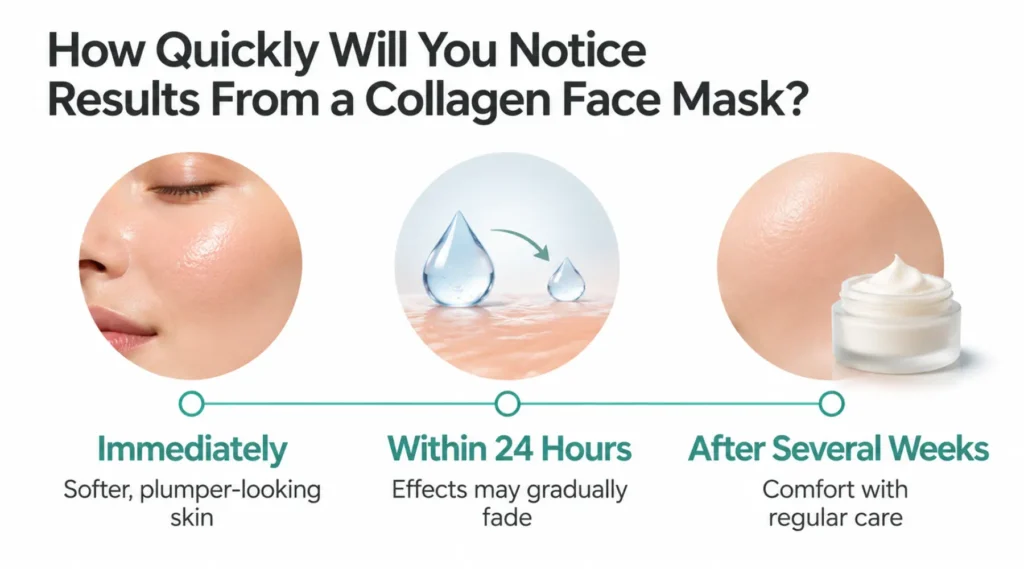
Immediately After Application
- You may notice:
- Softer skin
- Less tightness
- Smoother-looking skin
- A fresher-looking complexion
- Less noticeable dehydration lines
These changes are mainly due to hydration and skin conditioning. They do not show that new collagen has formed in the deeper layer of the skin.
During the Following 24 Hours
The improvements may slowly become less noticeable as your skin returns to its usual state. How long they last depends on the product, your surroundings and your daily skincare routine. A suitable moisturiser may help keep your skin comfortable. Claims that tests on that product should ideally support a specific mask hydrates for 24 hours.
After Several Weeks
Using a collagen mask regularly may help skin look and feel more comfortable and moisturised. The difference may be more noticeable if you didn’t use much moisturising skincare before.
But if you’re mainly concerned about deep wrinkles, sagging or pigmentation, using a collagen mask repeatedly is unlikely to make a big difference. A regular skincare routine with ingredients backed by stronger evidence may be a better fit.
How to Judge Whether Your Mask Is Worth Using
Don’t judge a skincare treatment by before-and-after photos alone. Ask yourself:
- Does your skin feel less tight?
- Are dry patches more comfortable?
- Does your moisturiser seem to work well afterwards?
- Does the treatment cause redness or breakouts?
- Would a regular moisturiser give you a similar result for less money?
These questions can help you tell whether the treatment is genuinely useful or feels exciting because it’s new.
Why Your Collagen Mask May Not Be Working
A collagen mask may not make a noticeable difference. That doesn’t necessarily mean it’s faulty; it may just not be right for the concern you want to address.
Problem 1: Your Skin Feels Dry Again Shortly Afterwards
A mask may add water to the skin’s surface but not protect it from losing moisture afterwards. A suitable moisturiser can help. Look for one with ceramides, emollients and ingredients that help seal in moisture, rather than relying only on watery essences.
It’s also worth checking your cleansing routine. If your face feels very tight every time you wash it, changing your cleanser may help more than using masks more often.
Problem 2: The Mask Makes Your Skin Red
Redness can be caused by irritation, an allergic reaction or too much exposure to certain ingredients. Common triggers include fragrance, preservatives and some plant extracts. The mask material or leaving it on too long may also cause discomfort.
- Remove the mask if irritation starts.
- Don’t apply more active ingredients to the affected area.
- Seek medical advice if redness persists, becomes painful, or is accompanied by swelling or a rash.
Problem 3: Your skin looks oily after masking
A rich or sticky mask may leave oily skin feeling greasy. This doesn’t necessarily mean your skin is healthier or more hydrated.
- Choose a lighter mask and avoid adding several heavy products afterwards.
- If the mask leaves essence on your skin, use less moisturiser afterwards if needed.
Problem 4: You Are Not Seeing Any Improvement in Wrinkles
The issue may be what you expect the mask to do, rather than how you use it. Wrinkles involve changes in the skin’s structure that hydration alone cannot undo.
If you want to improve sun-related skin ageing, daily sunscreen and evidence-backed treatments matter more. Collagen masks may feel soothing, but they are unlikely to achieve more than that.
Problem 5: Your skin breaks out after using the mask
Heavy products can clog pores for some people. You may also react to certain ingredients or develop irritation that looks like acne.
Stop using the mask for a while and see if your skin improves. Don’t keep using strong exfoliants on the area, as they may worsen irritation. If your acne is painful or doesn’t go away, speak to a healthcare professional.
Whether a mask suits your skin depends on its ingredients, what your skin needs, and whether it causes irritation or other problems with regular use.
Common Collagen Mask Mistakes That Can Reduce Their Benefits
Even a well-formulated mask can cause problems when used incorrectly.
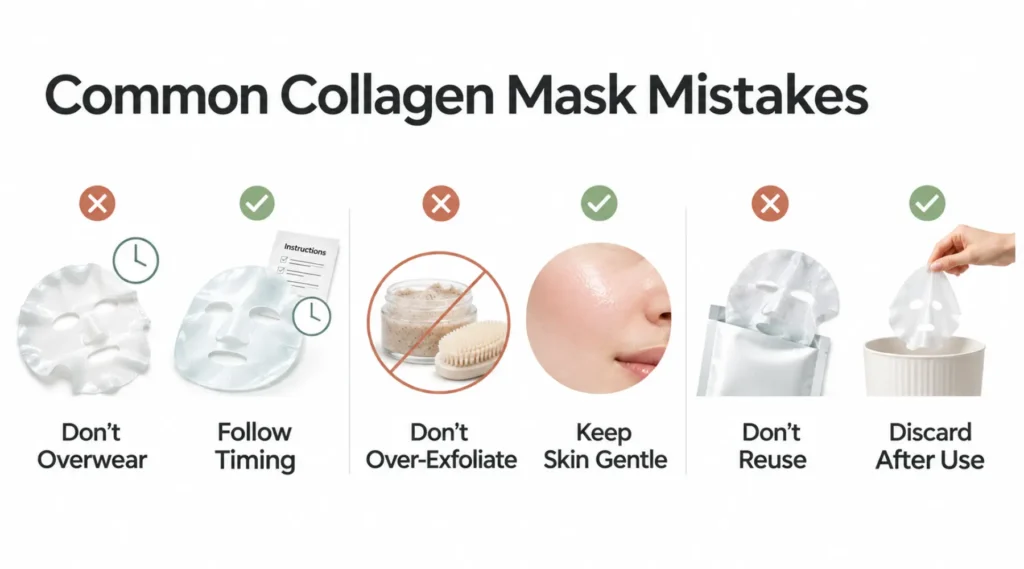
Leaving a Short-Wear Mask On Until It Dries Completely
You don’t need to leave a sheet mask on until it feels dry. As it dries, it may become less comfortable, and wearing it for too long could make your skin feel drier or irritated instead of adding more moisture. Follow the instructions and remove it sooner if it becomes uncomfortable.
Exfoliating Immediately Before Every Application
- Exfoliating is not needed for a collagen mask to work.
- Using scrubs, acids, or exfoliating tools often can damage your skin’s protective barrier.
- A mask may then sting more, especially if it contains other active ingredients.
- If you use exfoliating products, give your skin enough time to recover.
Don’t apply a mask to irritated skin
- A hydrating mask may seem soothing when your face is red or burning, but even moisturising ingredients can sting if your skin barrier is damaged.
- Avoid trying a new mask on sunburn, broken skin, active dermatitis or areas that have recently been irritated.
- In these cases, focus on gentle care for your skin barrier and seek appropriate medical advice.
Keep your routine simple afterwards
- More skincare is not always better.
- After removing a collagen mask, you may not need toner, several serums, face oil and a thick cream.
- For many people, one suitable moisturiser is enough.
- If your skin feels greasy or congested after using a mask, use fewer products.
Reusing Disposable Masks
Throw away single-use masks after use. Even if some essence is left in the packet, the used mask may have picked up germs from your skin or surroundings. Don’t save it for another use. Follow the product’s storage and expiry instructions too.
Can Collagen Masks Prevent Skin Ageing?
Collagen masks may temporarily make dryness-related fine lines look less noticeable. But there isn’t enough evidence that ordinary collagen face masks prevent skin ageing or greatly slow collagen loss.
Skin ageing affects several layers of tissue, while a moisturising treatment mainly works on the surface. So, smoother-looking skin after using a mask doesn’t mean lasting changes in the deeper layers.
Why sunscreen matters for long-term skin firmness
Ultraviolet (UV) light can contribute to skin ageing by causing stress and inflammation and increasing the breakdown of collagen and other supporting structures.
Using sunscreen regularly helps protect skin from UV damage. The American Academy of Dermatology recommends broad-spectrum SPF 30 or higher as part of an anti-ageing skincare routine.
If you’re concerned about premature ageing, sunscreen has stronger scientific support than collagen masks. A mask may improve how your skin looks today; sun protection can help reduce avoidable damage over time.
Where Retinoids Fit Into Collagen-Focused Skincare
Retinoids are among the most researched skin treatments for signs of sun-related ageing. They affect how skin cells work and may support processes linked to collagen renewal. Studies suggest that some prescription retinoids, especially tretinoin, can improve the look of sun-damaged skin over time.
Retinoids can also cause dryness, peeling and irritation, and they are not suitable for everyone. If you are concerned about more pronounced signs of ageing, ask a dermatologist whether a retinoid is right for you. Using more collagen masks may not help much. You can still use a hydrating mask for comfort.
Do You Need Professional Collagen-Stimulating Treatments?
Professional treatments may be an option for established wrinkles, acne scars or major changes in skin texture. They work differently from collagen masks.
Microneedling
Professional microneedling makes tiny, controlled punctures in the skin to encourage its natural repair process. A course of treatments may help with some acne scars and skin texture, but results vary depending on the technique, needle depth and your skin. Home devices can cause infection, scarring or changes in skin colour. Seek professional advice, especially if you have darker skin or have developed raised or unusual scars before.
Laser Treatments
Some laser treatments target signs of sun-related skin ageing and may help the skin renew itself.
Different lasers have different uses, recovery times and risks.
Not every treatment suits every skin type.
Possible problems include changes in skin colour, irritation and scarring.
A qualified dermatologist can advise whether a treatment is right for you.
Other Dermatology Treatments
Depending on the concern, a clinician may suggest prescription skincare, chemical peels, radiofrequency treatments or other procedures. These options are not interchangeable: they work in different ways and have different levels of evidence, costs and possible side effects. Collagen face masks cannot create the same structural changes as medical procedures chosen for the right person. That doesn’t mean masks are useless; it means they play a different role in skincare.
Everyday Habits That Help Maintain Healthier-Looking Skin
Skincare works alongside your daily habits. Lifestyle changes can’t stop natural ageing, but some habits can affect your skin’s health and appearance.
Consistent Sun Protection
Regular sun protection is a practical way to help reduce UV-related skin ageing.
- Use sunscreen as directed.
- Seek shade when the sun is strong.
- Consider wearing protective clothing.
A collagen mask cannot make up for repeated sun exposure without protection.
Eat a balanced diet
Your body needs enough protein and nutrients to keep tissues working normally. Vitamin C, for example, is needed for normal collagen production.
A balanced diet with enough protein, fruit, vegetables and other nutrients supports general health. But eating a particular food does not guarantee more visible collagen in your face. Research on collagen supplements taken by mouth also does not prove that collagen masks applied to the skin have the same effects.
Avoiding Smoking
Smoking can make skin age faster and change its structure.
- Avoiding tobacco supports your overall health and may help prevent some skin damage.
- No face mask can undo all the effects of smoking over a long time.
Managing ongoing dryness
Cold weather, dry air and indoor heating can make dry skin feel more uncomfortable.
- Using a gentle cleanser and moisturiser regularly often works better than using intensive treatments occasionally.
- A humidifier may help when indoor air is very dry, as long as you use and clean it properly.
Maintaining a Sustainable Routine
A simple routine you can stick to is better than a complicated one. You don’t need ten products each day. Start with a cleanser, moisturiser and sunscreen. Add other treatments if your skin needs them and can tolerate them. Use collagen masks to support your routine, not replace it.
How to Get a Face Mask That Actually Suits Your Skin
Start by choosing a collagen mask that suits your main skin concern. The packaging may promise to lift, brighten, hydrate, reduce wrinkles and refine pores, but not every promise will matter to you or be well supported.
Look Beyond the Word Collagen
Check the full ingredient list first.
If your skin lacks water, look for moisturising ingredients such as glycerin or hyaluronic acid.
If your skin is often dry, consider masks with ingredients that soften skin and help protect its outer layer.
If your skin is sensitive, a simpler, fragrance-free formula may suit you better.
A more expensive mask isn’t necessarily more effective than a cheaper one.
Consider the Mask’s Wear Time
Some people enjoy longer skincare sessions; others prefer a 15-minute treatment. Choose one that fits your routine. If a mask is inconvenient, you may not use it. An elaborate treatment offers no extra skincare benefit if a simple one already meets your needs.
Read the Instructions Before Purchasing
Check whether the mask needs rinsing off, how often to use it and whether it can be left on overnight.
Some Face masks contain ingredients that moisturise, exfoliate or brighten the skin. These may help with specific concerns, but check that the ingredients work well together.
Do not choose a mask just because it contains lots of popular ingredients.
Be Cautious With Dramatic Claims
Be cautious of claims that a product instantly replaces collagen, permanently tightens pores or removes all wrinkles.
A trustworthy product should describe realistic benefits and explain how to use it. If it makes specific clinical claims, look for details on how the results were measured.
A customer saying their skin feels softer tells you about their experience. It doesn’t prove the product increased collagen in the skin’s deeper layers.
Collagen Face Mask Questions Worth Answering Before Your Next Skincare Session
1. Do collagen masks actually work?
Collagen masks may hydrate and soften the skin and make it look plumper temporarily, if they contain suitable moisturising ingredients. But limited evidence shows that ordinary collagen masks rebuild the skin’s natural collagen or reduce wrinkles for good. Their best-supported benefit is moisturising and conditioning the skin, not reversing the deeper signs of ageing.
2. What are the best collagen face mask benefits for beginners?
Beginners may notice better hydration, softer skin and a smoother-looking complexion. A basic hydrating mask can be an easy occasional treatment. Choose one with familiar moisturising ingredients, test it on a small area of skin first, and don’t use it in the same session as several strong treatments.
3. How often should beginners use a collagen face mask?
Using the mask once a week is a good starting point for many beginners. If it’s gentle and your skin tolerates it, you can use it more often, as directed. You don’t need to use it every day, and using it more often won’t necessarily work better.
4. Can collagen masks help with wrinkles?
They may briefly make fine lines caused by dry skin look less noticeable. Deeper wrinkles stem from changes in the skin’s structure, so adding surface moisture alone won’t fix them. To manage long-term signs of sun damage, daily sun protection and evidence-backed treatments matter more.
5. Are collagen face masks suitable for sensitive skin?
Some masks may be suitable, but it depends on their ingredients. Choose products without strong fragrance or ingredients that may irritate your skin. If your skin is easily irritated, test the product on a small area first. Don’t try a new mask during an eczema or rosacea flare-up. Stop using it straight away if it causes burning, itching or redness that doesn’t go away.
6. Can collagen face masks tighten sagging skin?
A hydrating mask may make your skin look plumper and smoother for a while, but it cannot reliably fix significant sagging. Skin can become looser as collagen, elastin, connective tissue and facial structure change. These changes need approaches beyond everyday moisturisers.
7. Can collagen masks make pores smaller?
Collagen masks cannot permanently change the size of your pores. But they may hydrate the skin, making the area around pores look smoother and some pores less noticeable for a while. Oil, genetics, blocked pores, and skin elasticity also affect how visible pores are.
8. Is a collagen face mask better than hyaluronic acid serum?
Neither is always better. A hyaluronic acid serum can be an easy way to hydrate your skin every day. A collagen mask may offer an occasional moisturising treatment that stays on your skin for longer. The right choice depends on the product, how comfortable it feels and what else is in your routine. A well-made serum may be easier to use regularly.
9. Can I use a collagen face mask every day?
Some gentle hydrating masks may be fine to use every day, but most people don’t need to.
Using a mask often may expose your skin to more ingredients that could irritate it.
Start by using it now and then, and see how your skin reacts.
A suitable daily moisturiser is usually a more practical way to keep your skin hydrated.
10. Should I wash my face after using a collagen mask?
You usually don’t need to rinse off a hydrating sheet mask unless the instructions say to. Remove it, then apply moisturiser. Wash-off masks and some specialised products may have different instructions. If the mask irritates your skin, remove it straight away and rinse if needed.
11. Can I apply makeup after using a collagen face mask?
Yes.
- A hydrating mask may help soften dry patches before makeup.
- Let any leftover essence and moisturiser sink in before applying foundation.
- If your skin feels very sticky, use fewer products afterwards.
- A comfortable, balanced finish usually works better than several thick layers.
12. Do collagen masks help with acne scars?
Collagen masks may hydrate your skin for a short time, but they are not a reliable way to improve established acne scars. Indented scars involve changes beneath the skin’s surface. Depending on the scar type, dermatologist-led treatments such as certain laser procedures or microneedling may work better.
13. Can collagen masks brighten dark spots?
Hydration can help skin look more radiant, but collagen is not a proven treatment for dark spots. Face masks with suitable brightening ingredients may help even out skin tone over time. For lasting dark spots, regular sunscreen and suitable treatments are usually more important.
14. What should I do if a collagen mask burns my skin?
Remove the mask straight away.
Gently rinse the product off if needed. Don’t use strong skincare ingredients on the affected area.
Keep your routine simple and gentle while your skin recovers.
Get medical advice if the burning continues, or if you develop significant redness, blisters, swelling or a widespread rash. Get urgent medical help for severe allergic symptoms.
15. Are collagen face masks worth buying if I already use moisturiser?
A collagen mask may be worth using if you enjoy it or find it gives your skin extra hydration. But it isn’t essential. If your moisturiser already keeps your skin comfortable and hydrated, the mask may not add much. Consider whether it meets a real need before adding another step to your routine.
Making Collagen Face Mask Benefits Work for Your Skin
The benefits of a collagen face mask are best understood realistically.
A well-made mask can hydrate your skin, soften dryness, make dehydration lines less noticeable for a while and help your complexion look fresher. These can be useful cosmetic benefits, especially if your skin feels uncomfortable or looks dull.
But collagen applied to the skin’s surface does not replace collagen lost deeper in the skin. Ordinary face masks cannot reliably reverse the complex changes that affect firmness, elasticity and wrinkles over time.
For a more comfortable experience, choose a mask suited to your skin, follow the recommended application time and avoid combining it with too many strong treatments. Use a suitable moisturiser afterwards if needed, and protect your skin from the sun every day.
You do not need to use a collagen mask every day. Occasional use may be enough, particularly if your usual skincare keeps your skin healthy and comfortable.
A good mask should leave your skin feeling cared for, not irritated or overloaded. A realistic sign that it suits you is skin that feels softer, looks comfortably hydrated and responds well to your routine, not a promise of younger-looking skin overnight.