




Blog
Niacinamide for Pores: Benefits, Results and Safe Use Tips

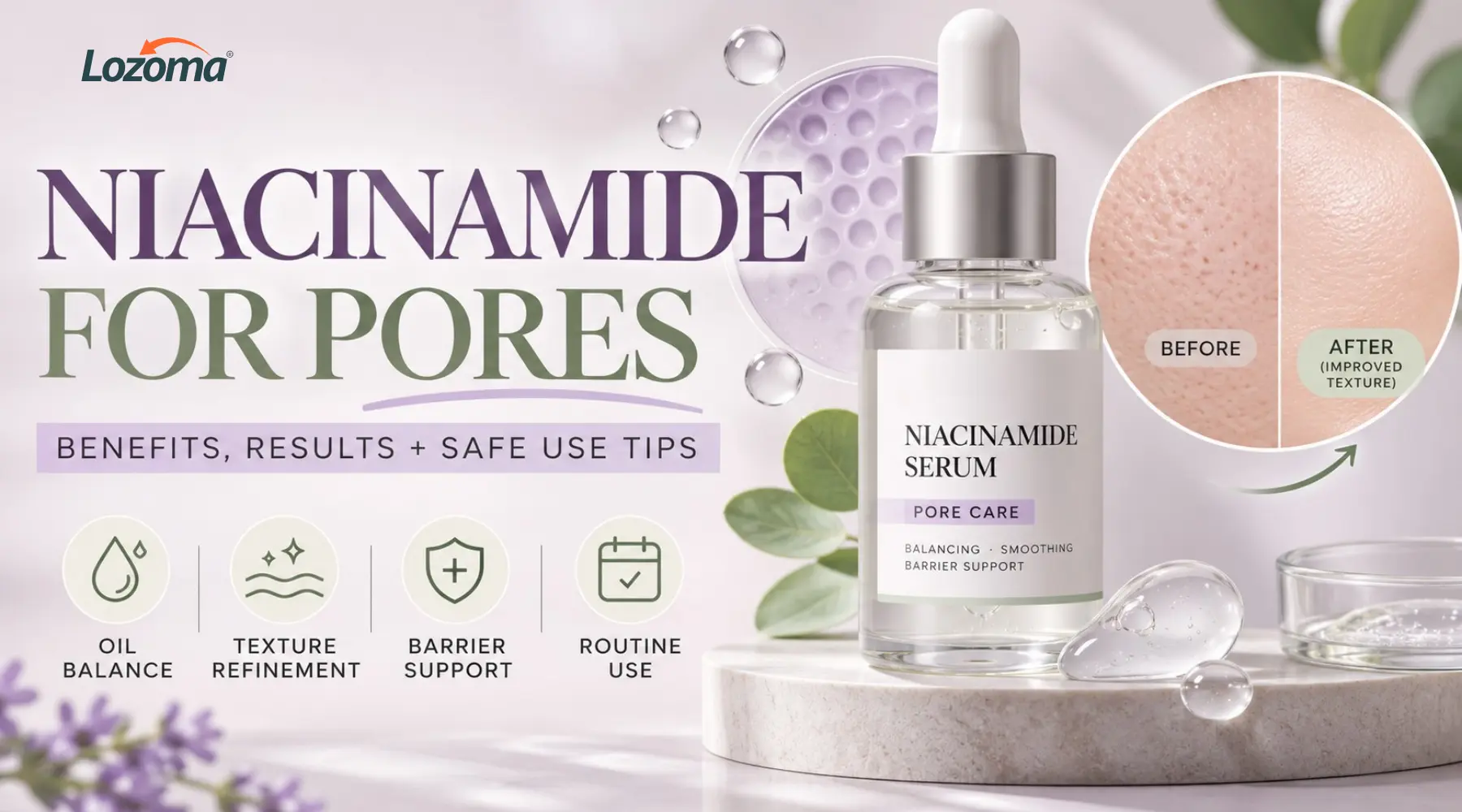
Enlarged pores can make skin look uneven, especially around the nose, forehead and cheeks. They may look more noticeable when oil builds up, makeup settles into the skin, or blackheads appear. Pores can still be visible even when your face feels clean.
Niacinamide, a form of vitamin B3, is a popular skincare ingredient for oily skin and visible pores. It may help reduce oiliness, support the skin barrier and improve skin texture. Unlike strong exfoliating treatments, it works in several ways to support the skin’s appearance.
There is a difference between making pores look smaller and actually shrinking them. Pores are a normal, permanent part of the skin. Factors such as genetics, oil production, and the condition of the surrounding skin influence their size.
Niacinamide cannot remove pores or guarantee a major reduction in their size. It may help make them less noticeable by addressing excess oil and uneven skin texture.
Results vary depending on your skin type, the product’s strength and how regularly you use it. People with an oily T-zone may notice a change sooner than those whose pores look larger because of ageing or reduced skin firmness.
Is Niacinamide Good for Pores?
Yes. Niacinamide may make pores look less noticeable, especially if oiliness, irritation or uneven skin texture makes them stand out.
Niacinamide, also known as nicotinamide, is a form of vitamin B3 used in skincare products such as serums and moisturisers. It may help by:
- Balancing oil: It may reduce some measures of facial oil, so skin looks less shiny.
- Supporting the skin barrier: It helps skin hold onto moisture and maintain its protective outer layer.
- Smoothing the look of skin: It may help skin look smoother over time.
- Calming irritation: It may ease some irritation linked to blemish-prone skin.
- Evening skin tone: It may improve uneven pigmentation, which can make skin texture look less even.
These benefits may make pores less noticeable, but niacinamide does not close them. Pores may still be visible, especially if they are naturally larger. Skin may look more refined if it becomes less oily, calmer and better hydrated.
Many people find niacinamide easier to tolerate than stronger exfoliating acids, but it can still irritate. It can be a reasonable starting point if you want to improve the look of pores without adding several strong skincare ingredients at once.
After several weeks, judge whether your skin looks more balanced rather than expecting your pores to disappear.
Why Pores Become More Noticeable in the First Place
Understanding why pores look larger helps set realistic expectations about what niacinamide may improve.
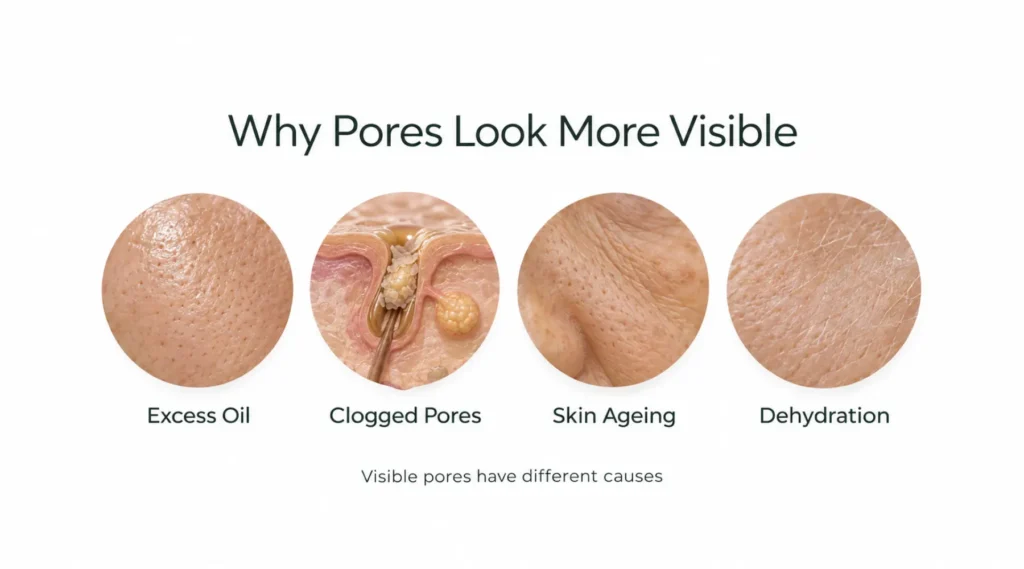
Pores are small openings linked to structures in the skin. The pores usually discussed in skincare are openings of hair follicles. Sebum, the skin’s natural oil, reaches the surface through them. Sweat glands also have openings, but they are different.
Sebum helps lubricate and protect the skin. Hair follicle openings may look different when oil production, dead skin build-up or changes in the surrounding skin affect them.
Excess oil can make pore openings more prominent
Your forehead, nose and chin have many oil glands. They’re especially active during puberty and may keep producing a lot of oil in adulthood.
When oil builds up on the skin, it can make your face look shiny and skin texture more noticeable. Pores may also look larger in these areas, where oil glands are active.
Hormones and genetics strongly affect how much oil your skin produces. Your surroundings, skincare products and individual skin also play a part.
That’s why pores may look more noticeable by the afternoon, even if your skin looked fairly smooth after washing in the morning.
Niacinamide may help: some clinical research suggests it can affect how much oil is measured on the face.
Blackheads and congestion change how pores look
A blackhead forms when oil (sebum) and dead skin cells block a hair follicle. Its dark colour comes from changes in the material at the skin’s surface—not simply from dirt. The blockage can make the pore look more noticeable.
But not every dark dot on your nose is a blackhead. Sebaceous filaments are normal parts of the skin that help carry oil through the follicles. They can look like small grey, pale yellow or darker dots, especially on the nose. They do not necessarily mean your skin is unclean or that you need treatment.
Niacinamide does not directly dissolve blackheads. If blocked follicles are the main concern, salicylic acid may be more effective.
Skin ageing changes the support around pores
Collagen and elastin help keep skin firm and supported. As skin ages, changes in these proteins can make pores look longer or more noticeable. Sun exposure can speed up signs of skin ageing, including collagen breakdown.
That is one reason cheek pores may become more noticeable with age, even if your skin is not especially oily. Niacinamide may help improve the look of ageing skin, but it has a limited effect on changes to pore structure compared with treatments designed to support collagen renewal.
Dehydration can exaggerate uneven texture
Dehydrated skin lacks enough water in its outer layers. It may feel tight, look dull or show fine lines. If the skin around pores looks rough or uneven, the pores may seem more noticeable. Dehydration does not necessarily make pores physically bigger; it can change how the surrounding skin looks. So, controlling oil alone may not help. You can have an oily forehead and dehydrated skin at the same time. Stronger oil-removing products may make the skin feel worse, not smoother.
Genetics influence the result you can achieve
Some people naturally have more visible pores because of inherited differences in their skin and oil production. No skincare ingredient can completely change these features. It helps to separate natural pore size from temporary factors that make pores look larger. Niacinamide may make a more noticeable cosmetic difference when oiliness, irritation, or uneven skin hydration contributes to the concern.
How Niacinamide for Pores Works Beneath the Skin’s Surface
Niacinamide doesn’t exfoliate the skin, physically clear pores or tighten skin for a short time. Instead, it works through processes in the skin that support the skin barrier, help manage inflammation and affect overall skin condition. Because these changes take place gradually, results usually develop over time rather than appearing overnight.
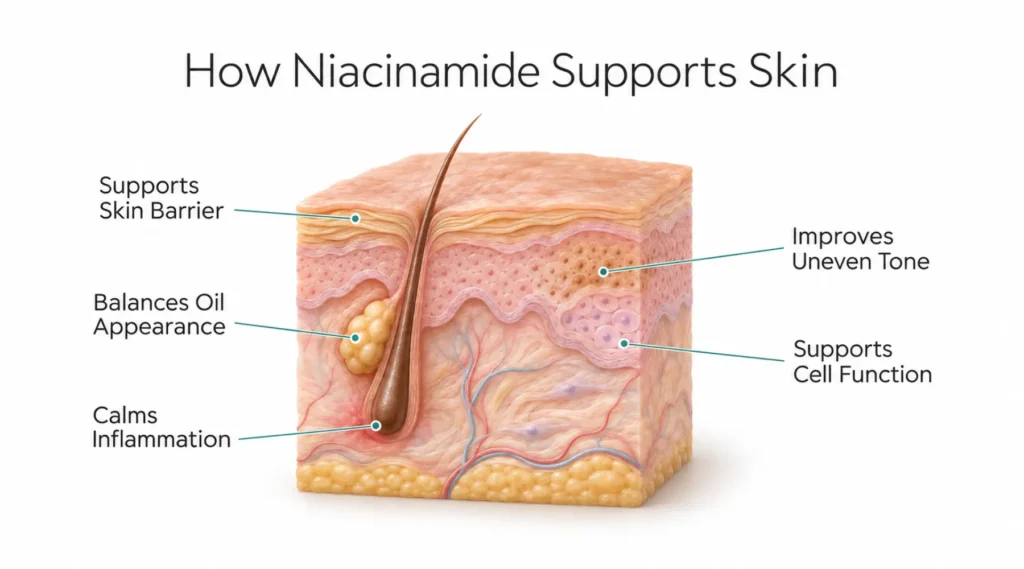
1. It may help regulate facial oiliness
Niacinamide may help reduce some measures of oil on the skin’s surface. It does not switch off the glands that make oil, and your skin needs some oil to function normally. Certain products may make skin feel less greasy. This can make pores look less noticeable because less shiny skin reflects light differently. The effect varies by person, and research findings differ depending on who took part and how researchers measured oil.
2. It supports the production of barrier-related lipids
The outer layer of your skin is called the stratum corneum. It’s made of flat skin cells surrounded by fats called lipids, which help protect the skin. Ceramides are important lipids that help this layer work properly.
Niacinamide may support the skin’s production of barrier lipids and help the outer layer function well. A healthier barrier can reduce water loss through the skin. When skin holds on to moisture better, it may look smoother and feel more comfortable.
This may be especially helpful if you’ve been using drying cleansers or strong exfoliants to try to make pores look smaller.
3. It has anti-inflammatory properties
Inflammation can make skin look red, swollen or uneven. It can occur with acne and irritation from skincare products that don’t suit your skin.
Niacinamide can help reduce inflammation, which is why it’s used in products for blemish-prone or sensitive-looking skin. By easing irritation around a hair follicle, it may help the area look calmer. It does not permanently change follicle size.
If you have a long-lasting inflammatory skin condition, niacinamide may offer support, but it is not a substitute for appropriate medical treatment.
4. It can improve the appearance of uneven tone
Dark marks left after spots can make skin tone look uneven. Niacinamide may help with some kinds of uneven pigmentation by reducing the transfer of pigment from pigment-making cells to nearby skin cells. This is different from its possible effect on oiliness. A more even-looking skin tone may also make texture less noticeable so that niacinamide may offer cosmetic benefits for people concerned about both enlarged-looking pores and post-spot marks.
5. It contributes to normal cellular metabolism
Niacinamide helps the body make NAD and related molecules, which support cells’ energy use and other processes. This doesn’t mean applying niacinamide to your skin makes it regenerate or produce new collagen right away. It helps explain why vitamin B3 supports normal skin function. A 2024 scientific review describes clinical evidence of niacinamide’s effects on the skin barrier, pigmentation, signs of ageing and some inflammatory skin conditions. This range of potential effects helps explain why it appears in many skincare products.
What Does the Research Actually Show About Niacinamide and Pore Size?
Some clinical evidence suggests niacinamide can reduce oily skin. But evidence that it permanently makes pores smaller is much less certain.
A clinical study found improvements in facial sebum measurements
A 2006 study in the *Journal of Cosmetic and Laser Therapy* looked at a moisturiser containing 2% niacinamide. It included two trials.
In Japan, 100 people used either a niacinamide or placebo moisturiser for four weeks. The niacinamide group had significantly lower sebum excretion rates after two and four weeks.
In the United States, 30 people took part in a six-week study in which each person used niacinamide on one side of the face. After six weeks, casual sebum levels fell, but the measured sebum excretion rate did not fall significantly.
The results suggest niacinamide may affect facial oiliness, although the findings differed between the two trials. The research did not show that niacinamide permanently shrinks facial pores.
Barrier research supports another potential advantage
Earlier research suggests that niacinamide applied to the skin may help support its outer barrier, reduce water loss and improve moisture levels. This matters because irritated or dry skin can look less smooth. Research also links niacinamide with ceramide production and other processes that help maintain the skin’s outer layer. But better hydration or skin texture does not mean hair-follicle openings have been shown to get smaller.
Why some product claims go beyond the evidence
Niacinamide may help reduce oiliness and improve the skin’s appearance, which can make pores look less noticeable. But smoother-looking or less oily skin does not prove that pores have physically changed. Studies measure different things, such as oil levels, hydration and appearance, and a product can improve one without affecting the others. Evidence that niacinamide permanently shrinks pores is limited. This helps set realistic expectations.
How Long Does Niacinamide Take to Work for Pores?
Use niacinamide consistently for around four to eight weeks before judging whether it has helped with oily skin or the appearance of pores. Skin may feel more hydrated sooner, but visible changes to pores usually take longer.
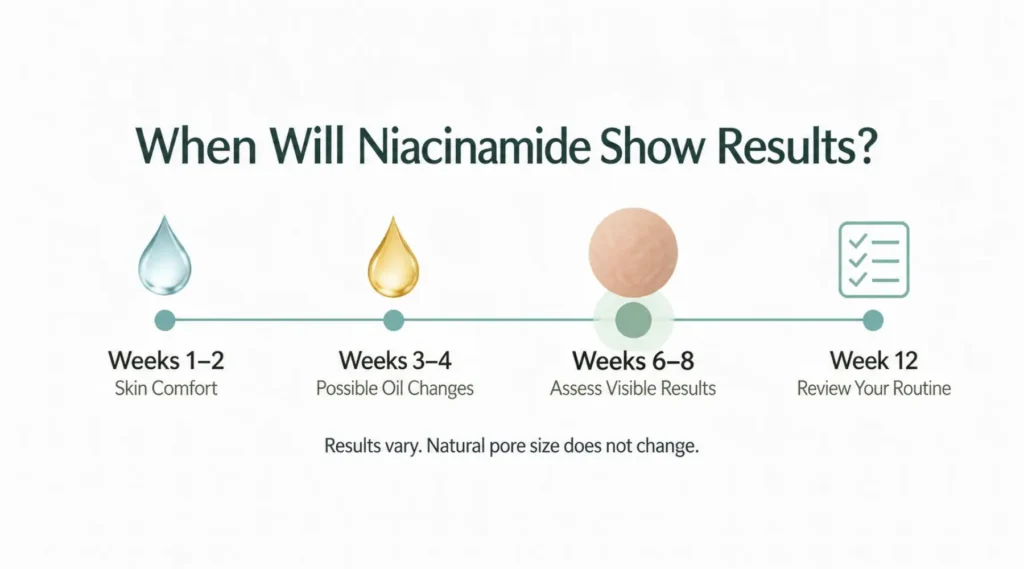
This is a guide, not a guarantee, based partly on studies that tracked oiliness and acne-related results over several weeks.
| Time using niacinamide | What you might notice | What to keep in mind |
| First few days | Softer or more comfortable skin if the formulation is moisturising | Changes are more likely due to the full formula than a proven reduction in pores |
| 1–2 weeks | Better product tolerance and possible improvements in surface hydration | Too early to judge lasting pore results |
| 2–4 weeks | Some people may notice less facial oiliness | Studies have detected changes in sebum measurements during this period |
| 4–6 weeks | More consistent improvements in shine or skin appearance may become noticeable | Natural pore size remains unchanged |
| 6–8 weeks | A useful point to assess overall results | Improvement varies according to skin type and formulation |
| 8–12 weeks | A clearer picture of whether the routine suits your skin | Persistent congestion or acne may need targeted treatment |
These are possible observation periods, not percentages of improvement or guaranteed treatment milestones.
The first two weeks are mainly about tolerance
When you first use niacinamide, your skin may feel smoother straight away. This may be due to moisturising ingredients in the product, such as glycerin or sodium hyaluronate. It does not necessarily mean niacinamide has started to affect your skin’s oil production.
Use the first two weeks to see how your skin responds. The product should feel comfortable. Ongoing burning, itching or worsening redness may be signs that it does not suit your skin.
Weeks three and four may reveal changes in oiliness
Some people may notice that their forehead looks less shiny during the day. In one group in a 2006 study, sebum levels changed after two and four weeks. But a study’s average results don’t predict exactly when you’ll see a change. If your skin is still oily after four weeks, it doesn’t necessarily mean the ingredient isn’t working. Hormones or genetics may lead your skin to produce more oil, so the product’s effect may be modest.
Weeks six to eight are better for judging visible results
By now, you may be able to see whether your skin looks more even in everyday light. Look for less shine around your nose, fewer signs of irritation or a smoother look under makeup.
If you also use salicylic acid, a retinoid or another treatment, these may have helped too. It can be hard to tell what niacinamide has done if you start using several products at once.
What if your pores still look the same after twelve weeks?
First, think about what is making the concern visible.
If your pores are naturally noticeable, you have acne scars, or your skin has lost firmness with age, niacinamide alone may have limited effect.
If blackheads are the main concern, you may need a treatment that targets blocked pores.
Using stronger niacinamide is unlikely to help just because you have not seen a big change. It may be more useful to choose an ingredient that suits the cause of the concern.
A better way to measure your results
Take a photo before you start using niacinamide, then take more after 4, 8 and 12 weeks.
For a fair comparison:
- Use similar natural light each time.
- Use the same camera and keep the same distance.
- Make sure your skin is clean and makeup-free.
- Take each photo at about the same time of day.
- Don’t use beauty filters or automatic skin smoothing.
- Keep your skincare routine similar before each photo.
Try not to judge your skin just after exfoliating, using a clay mask or applying a rich moisturiser. These can temporarily change how your skin looks.
Don’t rely on a magnifying mirror: normal pores can look much larger under magnification. Instead, check how your skin looks from a normal conversational distance.
What Strength of Niacinamide Is Best for Enlarged Pores?
Niacinamide products usually contain between 2% and 10%, or more. A higher percentage isn’t always better for your skin. For many people, a well-made product with 2% to 5% niacinamide is a sensible place to start. Research has found skin benefits at these lower levels.
2% niacinamide for beginners and sensitive skin
If you’re new to niacinamide or your skin is easily irritated by active ingredients, a 2% formula may be a good choice. It may support the skin barrier and help with oiliness, without using a high concentration.
In one study, a moisturiser with 2% niacinamide improved some measures of facial oil production. This suggests that skincare can be effective without a double-digit percentage. But a lower concentration doesn’t guarantee that a product won’t irritate your skin. The full formula matters too.
4% to 5% niacinamide for oily or combination skin
Products with around 4% to 5% niacinamide are often used to help with several skin concerns, such as excess oil, blemishes, uneven skin tone and supporting the skin barrier.
If your skin already tolerates niacinamide, a 5% product may be a reasonable choice for addressing several cosmetic concerns with one ingredient.
Some clinical research has looked at 4% niacinamide for inflammatory acne. This does not directly show that niacinamide can shrink pores.
For most people, using a well-formulated product regularly matters more than choosing the highest concentration available.
Is 10% niacinamide better for pores?
Not necessarily.
- 10% niacinamide products are common, but there isn’t enough direct evidence to show that they reduce the look of pores more reliably than products with 2% to 5% niacinamide.
- Some people use 10% without problems. Others may get redness, tingling, dryness or irritation, especially if they use several active products.
- If your 5% product works well, moving up to 10% may not make much difference.
- A stronger serum isn’t always better. Choose a concentration that helps your skin without irritating it or weakening its natural barrier.
Comparing common concentrations
| Niacinamide concentration | Who might consider it | Practical advice |
| 2% | Beginners, dry or easily irritated skin | A reasonable starting strength |
| 4–5% | Oily, combination or blemish-prone skin | Often a practical balance between strength and tolerability |
| 10% | Experienced users who already tolerate niacinamide | Not proven superior for pore size; monitor for irritation |
| Above 10% | Specialist or highly concentrated formulations | Usually unnecessary for routine pore concerns |
These are practical suggestions for choosing a product, not medically proven concentration levels. Results can vary depending on the product, how often you apply it and how well your skin tolerates it.
How to Use Niacinamide for Pores Without Irritating Your Skin
A simple routine is usually enough to make pores look less noticeable with niacinamide. You don’t need lots of toners, exfoliants, serums, or masks. A gentle cleanser, a niacinamide product, moisturiser and sunscreen are a good starting point.
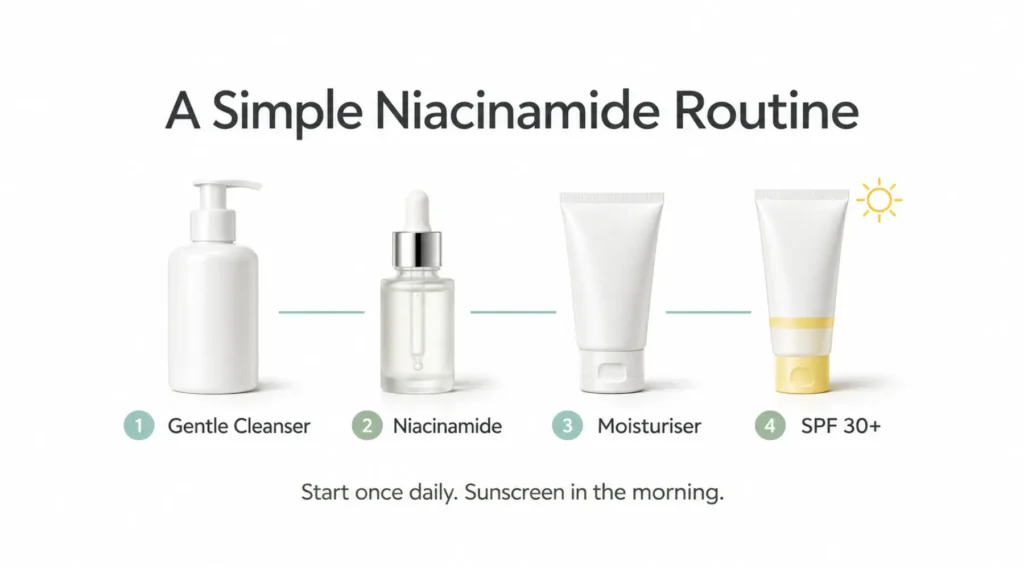
Step 1: Cleanse without stripping natural oils
Start with a gentle cleanser that suits your skin.
For oily skin, a gentle gel cleanser may feel comfortable. For dry or sensitive skin, a cream cleanser or one that does not foam much may suit you better.
Use lukewarm water. Avoid scrubbing with brushes or rough cloths.
Aim to remove oil, sunscreen, and everyday dirt without leaving your skin feeling tight.
If your face feels uncomfortable after cleansing, try changing your cleanser before adding another treatment.
Step 2: Apply a small amount of niacinamide
After cleansing, apply your niacinamide serum as directed on the label.
For many dropper serums, two or three drops are enough for the face, but the right amount depends on the product.
Gently spread it over your forehead, cheeks, nose and chin. No need to rub it hard into your pores. Niacinamide works through contact with the skin, not pressure.
Apply it to clean, dry skin unless the product instructions say you can use it on slightly damp skin.
Avoid using it on broken, very irritated or inflamed skin unless a healthcare professional has advised you to.
Step 3: Follow with a suitable moisturiser
Moisturiser can still be useful if you have oily skin. A light, non-comedogenic moisturiser can support your skin barrier without feeling too greasy.
Look for ingredients such as glycerin, ceramides or hyaluronic acid.
If your niacinamide product also moisturises, you may not need a separate rich cream. Pay attention to how your skin feels and follow the product’s instructions. Aim to keep your skin hydrated without applying a heavy layer.
Step 4: Apply sunscreen every morning
Broad-spectrum sunscreen helps protect your skin from UV damage.
UV exposure can break down collagen. As skin loses firmness, pores may look more noticeable.
In the UK, SPF 30 or higher is a sensible minimum for daily facial sun protection. SPF 50 provides more protection when applied correctly.
The American Academy of Dermatology includes sunscreen among the steps that may help make enlarged pores less noticeable over time.
Apply enough sunscreen to cover your face, including your nose and cheeks. Reapply as needed, especially if you spend a long time outdoors.
Step 5: Begin once daily rather than immediately applying it twice
Most people can start by using niacinamide once a day.
Applying it in the morning is convenient, as you can use it under moisturiser and sunscreen.
If your skin tolerates it and the product instructions allow it, you can also use it in the evening. Using it twice a day does not necessarily make it work twice as fast.
If your skin feels uncomfortable, use it less often or stop for a while.
A practical morning and evening routine
| Step | Morning | Evening |
| 1 | Gentle cleanser or water rinse | Gentle cleanser |
| 2 | Niacinamide serum | Niacinamide, if tolerated and required |
| 3 | Lightweight moisturiser | Barrier-supporting moisturiser |
| 4 | Broad-spectrum SPF 30–50 | No sunscreen needed |
| Optional | Makeup after sunscreen has settled | Targeted treatment on selected evenings |
A simple routine makes it easier to tell whether a product helps or causes problems. For many people, improving the look of pores starts with daily habits that help skin look smoother, rather than using lots of treatments.
The Best Niacinamide Routine Depends on Your Skin Type
Visible pores are common across different skin types, but they may stand out for different reasons. A routine that suits an oily forehead may not work well for dry, sensitive cheeks.
Oily skin: concentrate on shine without excessive cleansing
If your skin gets shiny a few hours after washing, niacinamide may help.
Choose a light serum with about 2% to 5% niacinamide and use it with a moisturiser labelled non-comedogenic.
Avoid washing your face repeatedly during the day. Too much cleansing can irritate and dry your skin. It may also make your skin look rougher, even if it removes oil for a while.
If you have blackheads, you could add salicylic acid as a separate product once you have a basic skincare routine.
Aim to keep your pores clear and your skin comfortable, rather than removing all its natural oil.
Combination skin: treat different areas according to their needs
Combination skin can be oily on the forehead, nose and chin, while the cheeks are normal or dry. A light niacinamide product may suit the whole face, but you can use different moisturisers on different areas for example, a light lotion on the T-zone and a richer cream on dry cheeks. This avoids treating every part of your face as if it produces the same amount of oil. Watch for irritation around your nose, as this area can be sensitive even when it is oily.
Dry skin: focus on the barrier rather than oil reduction
Yes. Niacinamide may help support the skin barrier, which can help dry skin as well as oily skin.
Dry skin may not have enough natural oils or may struggle to hold onto moisture. Niacinamide may support the skin’s barrier, which helps it stay healthy.
- Choose a moisturising product rather than one designed to leave skin matte.
- A formula with niacinamide plus ingredients that attract and seal in moisture may suit dry skin better than a very light oil-control serum.
- If your skin feels tight after washing, focus on hydration and barrier care before worrying about the look of your pores.
Sensitive skin: introduce one formula at a time
Sensitive skin may react to ingredients that suit most people.
Start with a simple product, ideally one without fragrance and with a low amount of niacinamide.
Test it on a small area of skin before using it on your whole face.
Don’t start strong exfoliating acids, retinoids or other new niacinamide products in the same week.
If redness, itching or burning doesn’t settle, stop using the product and let your skin recover.
Take extra care when trying new products if you have eczema, rosacea or recurring dermatitis.
Mature skin: combine barrier care with protection against photoageing
If pores look more noticeable because skin has lost firmness, niacinamide may improve how the skin looks and feels, but it is unlikely to solve the whole problem.
A suitable routine may include niacinamide, moisturiser and daily sunscreen. A retinoid may also suit some people. Retinoids work differently and can help with sun-related skin ageing and some texture concerns, but introduce them carefully because they can cause dryness and irritation.
For mature skin, protecting against further sun damage is at least as important as choosing a pore serum.
Does Niacinamide Help With Acne and Blackheads?
Niacinamide may help some people with acne-prone skin by reducing inflammation and affecting oiliness. But it is not a complete acne treatment and does not work like ingredients made to clear blocked pores.
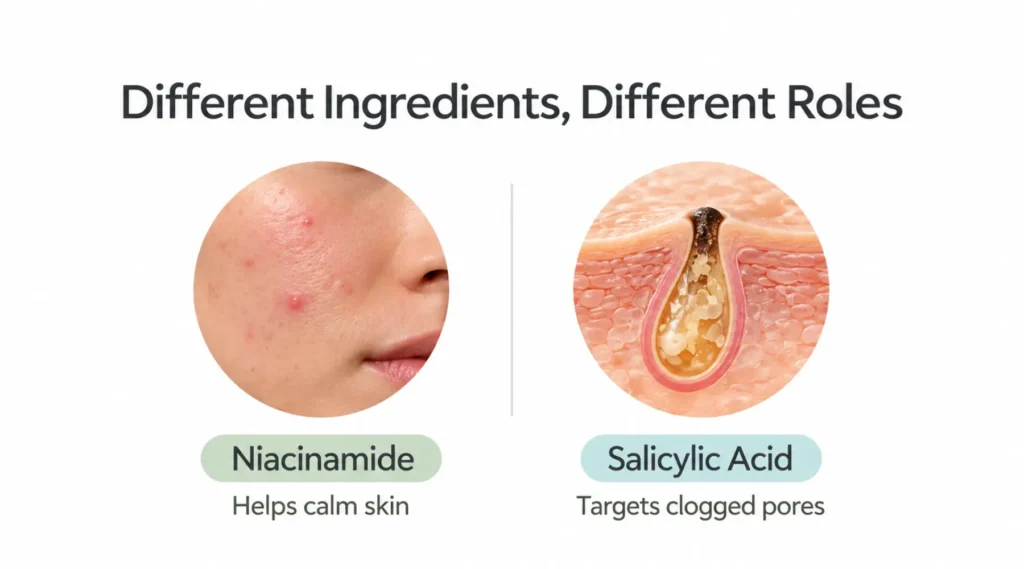
Niacinamide and inflammatory acne
Inflammatory acne causes red spots and pus-filled spots when hair follicles become inflamed. Researchers have studied whether niacinamide can help reduce these spots.
In a 1995 clinical trial, people with moderate inflammatory acne used either 4% nicotinamide gel or 1% clindamycin gel. Both groups improved over eight weeks, and the study found no statistically significant difference between the treatments on the measures it reported.
This does not show that everyday niacinamide serums work as well as prescription acne treatments. Results can vary by product, strength, and the people taking part in a study. Niacinamide may help as part of a skincare routine, but persistent acne may need treatments supported by stronger clinical evidence.
Niacinamide does not directly dissolve blackheads
Blackheads form when oil and dead skin build up in a hair follicle.
Niacinamide may help the surrounding skin, but it does not directly break down this build-up.
Salicylic acid may be more helpful for blackheads because it can exfoliate inside oily follicles.
Using both ingredients may address different concerns: niacinamide can support the skin barrier and may reduce oiliness, while salicylic acid targets blocked follicles.
What about sebaceous filaments?
Sebaceous filaments are a normal part of how your skin moves oil. They may look more noticeable when they fill with oil, but that doesn’t mean anything is wrong. Niacinamide may help make the skin around them look less oily, but it won’t remove them for good. Repeated squeezing can irritate your skin and may damage the surrounding area. A gentle skincare routine is usually better than frequent squeezing or using pore strips.
When acne requires more than niacinamide
If you have painful spots, lumps under the skin, ongoing inflamed spots or acne scars, speak to your GP or a dermatologist. NICE guidance for acne in the UK includes treatments such as retinoid creams or gels, benzoyl peroxide and other medicines. The right treatment depends on how severe your acne is. Niacinamide may be suitable as part of your skincare routine, but it should not delay effective acne treatment.
Can You Use Niacinamide With Retinol, Salicylic Acid or Vitamin C?
You can use niacinamide with several common skincare ingredients. But not every combination suits everyone. What matters most is whether your skin can handle the whole routine without becoming too irritated.
Niacinamide and retinol
Generally, yes. Niacinamide and retinol work differently so that they may complement each other.
Retinol is a form of vitamin A used to help with signs of skin ageing and uneven skin texture. Other retinoids, such as adapalene and prescription tretinoin, also treat acne and related concerns. Niacinamide supports the skin barrier and may help reduce some types of irritation. But it doesn’t guarantee retinol will not irritate your skin.
If you are new to retinol, start slowly. For example:
- Use niacinamide in the morning.
- Use retinol on two evenings a week, followed by moisturiser.
If your skin gets used to both products, you may be able to use them in the same routine, if suitable for you.
Do not use topical retinoids during pregnancy or while planning a pregnancy. Ask a health professional about alternatives and use during breastfeeding.
Niacinamide and salicylic acid
This combination may help if your pores look larger because your skin is oily and you have blackheads.
- Salicylic acid helps remove dead skin and clear blocked pores.
- Niacinamide may help support your skin’s protective barrier and reduce the appearance of oiliness.
- New to active skincare? Start with niacinamide. Once your skin has adjusted, try salicylic acid separately.
- To begin, use a salicylic acid treatment one or two evenings a week. This may be enough at first.
- Use it more often only if needed, and your skin tolerates it.
- You don’t have to use both ingredients in the same routine.
Niacinamide and vitamin C
You can usually use niacinamide and vitamin C together in modern skincare products. The advice to keep them apart comes mainly from older concerns about reactions that may not apply to everyday use.
What matters more is how the products are made and how your skin responds. Vitamin C is often used to help even skin tone and protect against environmental damage. Niacinamide can support the skin barrier.
Some acidic vitamin C products may irritate sensitive skin. If the combination feels uncomfortable, use vitamin C in the morning and niacinamide in the evening, or alternate days.
Niacinamide and hyaluronic acid
This combination may suit skin with visible pores that feels dehydrated. Hyaluronic acid helps the outer layers of skin hold on to water, while niacinamide supports the skin barrier. Together, they may help skin look smoother and more hydrated. They don’t close pores, but improved hydration may make fine unevenness look less noticeable under makeup or in natural light.
Niacinamide and azelaic acid
Azelaic acid can help manage acne and some pigmentation concerns. Prescription versions also treat rosacea symptoms.
It works differently from niacinamide. You may be able to use both in the same skincare routine, but introduce them gradually. If your skin is sensitive or prone to redness, try using them on alternate days rather than layering several active products.
Choose products that address your skin concerns without causing ongoing irritation.
Choosing Between a Niacinamide Serum, Essence and Moisturiser
Niacinamide comes in different product types, but a product’s texture doesn’t determine how well it works.
- Serums are often light and made to deliver particular ingredients.
- Essences are usually thin and hydrating.
- Moisturisers often contain ingredients that draw in water, soften the skin and help reduce moisture loss.
- The best option depends on your skin type and the other products you use.
When a serum makes sense
A niacinamide serum may be a good choice if your cleanser and moisturiser already suit your skin and you want to add one targeted ingredient. Check how much niacinamide it contains, read the full ingredient list and make sure the texture suits your skin. Lightweight serums can have different ingredients and purposes. A radiance serum may contain niacinamide and other ingredients, while a blemish serum may include exfoliating ingredients. They are not automatically interchangeable.
When a moisturising essence may be preferable
People with dehydrated or combination skin may prefer an essence with niacinamide and ingredients that help lock in moisture. For example, 24K Gold Niacinamide Essence Moisturiser combines niacinamide with sodium hyaluronate in a lightweight formula. For hydration and skin-barrier support, these moisturising ingredients are more relevant than gold. Strong clinical evidence doesn’t show that gold particles permanently reduce the appearance of pores. It’s best to assess the full formula, rather than focus on decorative or luxury ingredients.
What about gold-infused facial serums?
Gold skincare products are often linked with glowing skin and a luxurious feel. The 24K Gold Serum is promoted as containing gold and ingredients related to nicotinamide. But gold in a product doesn’t mean it will shrink pores or significantly boost collagen. If you want to improve the look of pores, focus on what each ingredient is known to do, whether the formula suits your skin, and how your skin responds over time.
How tea tree formulae differ from niacinamide
Tea tree facial serum may suit people with oily or blemish-prone skin. Tea tree oil has been studied for its effects on germs and inflammation, but it can irritate some people’s skin or cause an allergic reaction. It works differently from niacinamide. Some tea tree products also contain salicylic acid, so check the ingredients before using one with other exfoliating products. You don’t need to use all these products together. A good skin care routine fits your needs and is easy to maintain.
Can Niacinamide Cause Acne, Breakouts or Irritation?
Niacinamide is usually well tolerated, but it can affect people differently. When you start using a new niacinamide product, you might notice redness, itching, a burning feeling or small bumps. This doesn’t necessarily mean niacinamide caused the reaction. Serums contain other ingredients too, and the overall formula may cause irritation or blocked pores.
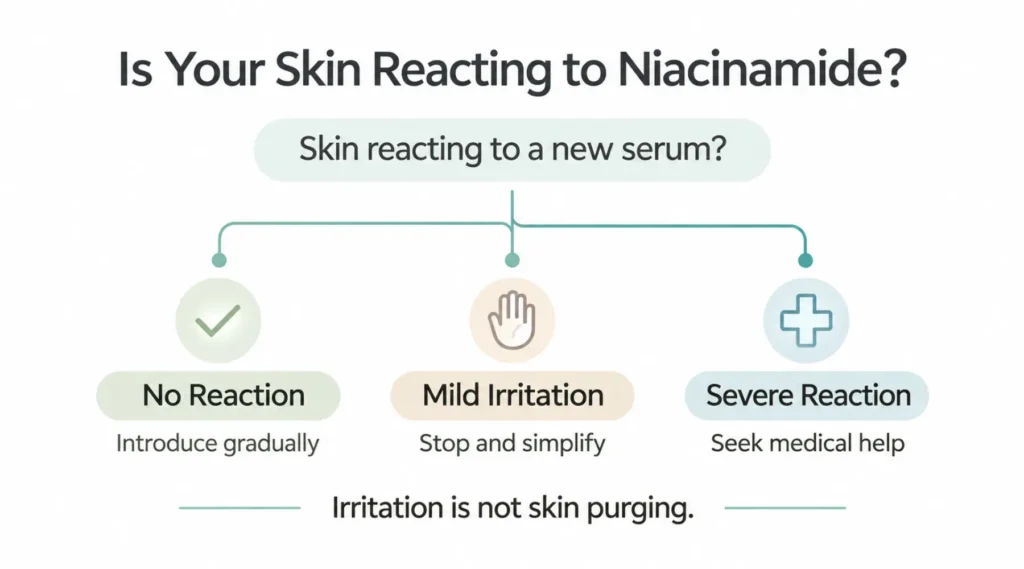
Does niacinamide cause skin purging?
Niacinamide is not usually linked to the kind of skin purging sometimes seen with treatments that speed up skin cell renewal, such as retinoids and exfoliating acids. It works differently. If you get new spots after starting a niacinamide serum, it does not necessarily mean the product is bringing impurities to the surface. The spots could be caused by irritation, another ingredient, an unrelated acne flare-up, or a product that doesn’t suit your skin.
Why a high concentration may irritate some people
Some people find that high concentrations of niacinamide cause discomfort. This may be due to their skin, the product formula or other ingredients.
Using several products with niacinamide can increase the amount you use. It may be in your cleanser, toner, serum, moisturiser and sunscreen without you realising.
This does not mean your routine is unsafe, but you may not need so many products with niacinamide. If your skin gets irritated, simplify your routine instead of adding another soothing serum.
How to patch-test a new niacinamide product
Before using a new product on your face:
- Apply a small amount to a small area, such as the inside of your arm.
- Repeat over several days, following the product instructions.
- Watch for ongoing redness, itching, swelling, or other irritation.
- Stop using the product if you have a reaction.
- If there’s no reaction, start using it on your face gradually.
- At-home testing can’t rule out every possible reaction.
- If you’ve had a serious allergic reaction to skincare before, consider asking a health professional for advice before trying products with unfamiliar ingredients.
What to do if your skin reacts
Stop using the product you think may be causing the problem.
Wash your skin gently and use a simple moisturiser you already know your skin tolerates.
While your skin is irritated, avoid exfoliating acids and retinoids.
If symptoms are severe, last a long time or get worse, speak to a healthcare professional. Get urgent medical help for major swelling, difficulty breathing or other signs of a serious allergic reaction.
Don’t keep using a product just because you think discomfort means it is working.
Your skin shouldn’t have to burn repeatedly to look better.
Why Niacinamide Sometimes Makes Pores Look Worse
Some people say their pores look bigger after they start using niacinamide. But there’s no good evidence that using it as directed usually makes pores physically larger. Other factors could explain why they look different.
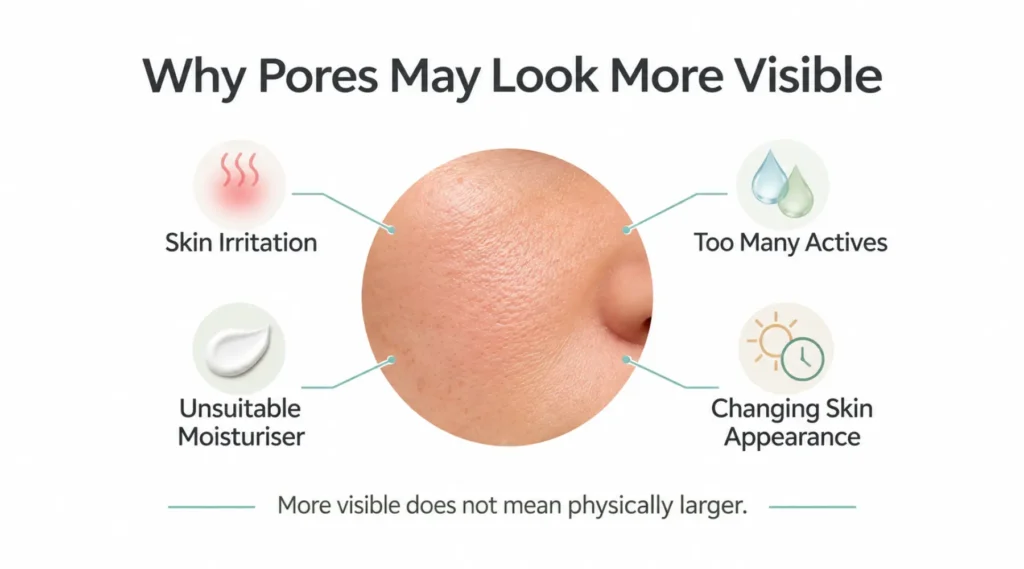
Your skin may be irritated
Irritated skin can look rough, red or uneven. A new product may cause inflammation, making the skin around pores look more noticeable. This is more likely if you use a strong serum alongside frequent exfoliation or strong acne treatments. Adding more niacinamide may not help. It is usually more useful to calm irritation and help restore the skin barrier.
You may be using too many active ingredients
A routine with retinol, glycolic acid, salicylic acid, benzoyl peroxide and strong niacinamide may be hard for sensitive skin to tolerate.
Each ingredient can be useful, but that doesn’t mean you should use them all together.
With a complicated routine, it can be harder to tell which ingredient is causing dryness or discomfort. A simpler routine can also make it easier to see whether your skin is improving.
Your moisturiser may be unsuitable
A rich cream may feel uncomfortable on oily skin, while a light gel may not moisturise dry skin enough. Neither texture is automatically bad. But the wrong formula can leave your skin too shiny, uncomfortable or with visible product build-up. Choose products based on how your skin behaves, not just the labels.
You may be expecting results too soon
Checking your pores after every use can make normal changes seem like a sign the product isn’t working. Skin texture can look different depending on the lighting, how oily or hydrated your skin is, and the time of day. Compare your skin over several weeks rather than checking it daily. If the product feels comfortable but you see little change, your pores may be less responsive to niacinamide.
Niacinamide vs Other Ingredients for Visible Pores
Different skincare ingredients address different reasons pores appear noticeable.
No single treatment is best for everyone.
| Ingredient | Main role | Most useful when | Main limitation |
| Niacinamide | Barrier support and potential oil reduction | Pores appear prominent alongside oiliness or uneven texture | Does not directly clear blackheads or permanently shrink pores |
| Salicylic acid | Exfoliation and follicular congestion | Blackheads, whiteheads and oily congestion | Can cause dryness or irritation |
| Retinoids | Regulate follicular cell turnover and improve aspects of texture | Acne, comedones and some ageing-related concerns | Require gradual use and appropriate safety precautions |
| Azelaic acid | Helps with acne, inflammation and uneven pigmentation | Blemishes and redness-related concerns | May sting or irritate initially |
| Hyaluronic acid | Surface hydration | Dehydrated skin with visible fine texture | Does not directly target pore structure |
| Glycolic acid | Surface exfoliation | Rough or dull skin | May be too irritating for sensitive skin |
| Clay masks | Temporary oil absorption | Short-term shine | No lasting effect on pore size |
When salicylic acid is more appropriate
If blackheads are your main concern, niacinamide alone may not be enough. Salicylic acid may work better to clear build-up inside pores, especially around the nose and chin, where skin is often oilier. Too much can dry or irritate your skin, so using a small amount regularly may be better than harsh daily exfoliation.
When a retinoid may help more
Retinoids may help if acne, clogged pores, or sun-related skin changes make pores more visible. They help control how skin cells grow and shed inside pores. Some may also improve skin texture over time. Results depend on the type of retinoid, the product and how often you use it. Retinoids are not right for everyone. Follow a health professional’s advice when using a prescription treatment.
When niacinamide is the better starting point
Niacinamide may suit you if your skin is sensitive, feels uncomfortable, or your main concern is shine rather than clogged pores. It may also be a good choice if you prefer a simple routine with fewer exfoliating products.
To make pores look smaller, choose a treatment that addresses what makes them more noticeable. Combining suitable treatments may help, but more ingredients aren’t always better.
Everyday Habits That Influence How Visible Your Pores Look
Skincare ingredients are only one part of maintaining a balanced complexion.
Daily habits can affect oil accumulation, irritation and the appearance of skin texture.
Avoid repeatedly touching or squeezing your pores
Squeezing blackheads or sebaceous filaments can damage the surrounding skin. Doing it repeatedly may cause irritation, broken skin or lasting marks. If clogged pores keep bothering you, targeted skincare or professional treatment is usually a better choice.
Remove makeup and sunscreen thoroughly
Leaving makeup or sunscreen on overnight may clog pores, especially if the products don’t suit your skin.
Cleanse gently in the evening.
If you wear long-lasting or water-resistant products, a suitable first cleanse followed by a mild facial cleanser may remove residue comfortably.
Avoid rubbing hard.
Consider how your environment affects your skin
Warm, humid weather can make facial oil more noticeable.
In colder months, indoor heating and dry air may leave skin feeling dry or uncomfortable.
These changes can affect how your pores look, but not their basic structure.
Adjust your moisturiser’s texture and cleansing routine if needed.
Keep hair products away from congestion-prone areas
Hair oils, styling creams and some leave-in products may cause spots around your forehead and hairline. If you often get small bumps there, check whether your hair products are touching your skin. When appropriate, gently clean the area after using styling products.
Do not rely on diet changes to shrink pores
Diet may affect acne for some people, but no diet is known to shrink pores permanently. Studies have looked at links between acne and high-sugar foods or dairy, but people can respond differently. A balanced diet supports overall health. Most people do not need to cut out whole food groups to change how their pores look.
When Professional Skin Treatments May Be More Effective Than Niacinamide
Skincare products can only do so much, especially if pores look larger because of acne scars or changes in the skin’s structure as it ages. A dermatologist can help determine whether the cause is oily skin, ongoing blocked pores, enlarged hair follicles, or scarring. These can look similar, but they need different treatments.
Professional chemical peels
Chemical peels use products that exfoliate the skin to help with concerns such as uneven texture, pigmentation or acne. Depending on their strength and ingredients, some peels can improve the appearance of uneven skin. They are not suitable for everyone and can cause irritation, burns or changes in skin colour, especially if the wrong products or techniques are used.
Microneedling
Microneedling makes tiny, controlled punctures in the skin to encourage it to repair and renew itself. It may help with some acne scars and uneven skin texture, but results vary depending on what is being treated, the device used and the practitioner’s technique. Don’t use it on active, inflamed acne without a proper assessment. Having a professional do it is generally safer than trying aggressive microneedling at home.
Laser and radiofrequency procedures
Some laser and radiofrequency treatments use controlled heat to improve skin texture and encourage collagen changes.
They may help some people whose visible pores are linked to less firm skin or uneven texture. A clinician needs to assess each person before treatment.
Possible risks include burns, scarring, skin colour changes, and irritation that lasts longer than expected. People with darker skin may need extra care when choosing the treatment and its settings, to reduce the risk of pigmentation changes.
Prescription acne treatments
If acne keeps coming back, prescription treatments may work better than cosmetic niacinamide.
A GP or dermatologist can advise whether a topical retinoid or another treatment is right for you.
Professional treatment doesn’t replace daily skincare.
Gentle cleansing, moisturising and sun protection can help keep your skin comfortable and protect your results.
Common Questions About Niacinamide, Visible Pores and Daily Use
1. Does niacinamide actually shrink pores?
Niacinamide may make pores look smaller, but there isn’t enough evidence that it permanently changes their size. It may help reduce oiliness, support the skin’s protective barrier, and improve how skin looks. If excess oil makes your pores more noticeable, reducing shine may help your skin look smoother. Your natural pore structure will remain, though. Niacinamide may have limited effect if your pores are mainly noticeable because of genetics, significant acne scarring or loss of skin firmness.
2. How long does niacinamide take for pores to look smaller?
Use it regularly for about four to eight weeks before judging whether your pores look less noticeable. Some people may notice changes in skin hydration or oiliness sooner. Research has found changes in some measures of skin oil after two to six weeks, but that doesn’t mean everyone will see smaller-looking pores. Take photos in similar lighting, and try not to change several skincare products at once. If you see little improvement after eight to twelve weeks, consider whether niacinamide is right for your main concern.
3. Can I use niacinamide every day for large pores?
Many people can use niacinamide every day. Start with once a day, especially if you have sensitive skin or are new to it. If your skin is comfortable and the product instructions allow it, you can use it twice a day. Using it more often won’t necessarily give faster results. Use it regularly, moisturise well and protect your skin from the sun. Stop or use it less often if irritation develops.
4. Is niacinamide better in the morning or at night?
You can usually use niacinamide in the morning or evening. In the morning, you can apply it under moisturiser and sunscreen. In the evening, it may suit you if you prefer fewer products before makeup. There’s no strong evidence that using it at night makes it better at reducing the appearance of pores. Choose the time that fits your routine and helps you use it regularly.
5. Can niacinamide help pores safely if I have sensitive skin?
Many people with sensitive skin can use niacinamide, especially in a simple, well-made product. But everyone’s skin is different.
Start with a low concentration, ideally 2% to 5%, and use the product gradually. Don’t combine it straight away with strong exfoliating acids or several new treatments.
Stop using it if you have ongoing burning, swelling, itching or redness. If you have active eczema or rosacea, ask a healthcare professional before trying new skincare ingredients.
6. Does niacinamide remove blackheads from the nose?
Niacinamide does not clear blackheads directly. It may help reduce oily skin, but blackheads form when oil and dead skin build up in pores. Salicylic acid is usually better at clearing this build-up.
The small dots on your nose may be sebaceous filaments, not blackheads. They may not need treatment. Try not to squeeze them repeatedly, as this can irritate the skin and make it look worse.
7. Can I use niacinamide with retinol in the same routine?
Yes, you can usually use niacinamide and retinol together if your skin tolerates both. Niacinamide helps support your skin’s protective barrier. Retinol works differently and is linked with skin renewal and texture.
If you’re new to retinol, try niacinamide in the morning and retinol on some evenings. Start retinol slowly and use moisturiser as needed.
Avoid retinoids if you’re pregnant or planning a pregnancy. If you’re breastfeeding, ask a health professional whether they’re suitable for you.
8. Is 5% or 10% niacinamide better for enlarged pores?
A 5% formula may be enough for many people.
There’s no convincing direct evidence that 10% consistently helps pores look smaller.
Some people tolerate higher strengths, while others get irritation.
The full formula matters more than the percentage alone.
If 5% makes your skin look more balanced and doesn’t irritate it, you probably don’t need a stronger formula.
9. Can niacinamide cause acne or clogged pores?
Niacinamide is not usually considered pore-clogging, but a product containing it may not suit everyone. Other ingredients, the product’s texture or irritation from the formula may contribute to breakouts.
If spots appear after you start using a new serum, don’t assume your skin is purging. If needed, stop using the product and go back to a routine you know suits you.
See a healthcare professional if your acne persists or gets worse.
10. Can niacinamide help pores on dry skin?
Niacinamide may help dry skin by supporting its barrier and helping it hold on to moisture.
For dry skin, reducing oil may not be the main aim.
Choose a moisturiser with ingredients such as glycerin, ceramides or hyaluronic acid.
Avoid strong exfoliation if your skin feels tight or flaky.
Better hydration may make skin look smoother, but it will not permanently change pore size.
11. Should I use niacinamide before or after moisturiser?
Apply a lightweight niacinamide serum after cleansing and before moisturiser. Let it settle, then apply a suitable moisturiser. Follow the product instructions, as they take priority. If your moisturiser already contains niacinamide, you do not need a separate serum. Using several products with the same ingredient is often unnecessary. Choose a routine that feels comfortable and is easy to stick to.
12. Can niacinamide reduce pores permanently?
Niacinamide cannot permanently remove pores or guarantee they will stay smaller. Any benefits may depend on ongoing skincare. If your skin becomes oilier after you stop using a product, your pores may look more noticeable again. Genetics, hormones and ageing can also affect how they look over time.
Focus on keeping your skin healthy, rather than trying to achieve poreless skin. Daily sunscreen, gentle cleansing and suitable treatments can help maintain improvements.
13. What should I do if niacinamide is not working for my pores?
First, check whether you’ve used the product regularly for at least six to eight weeks.
Think about why your pores look noticeable.
If blackheads are the main issue, salicylic acid may be a better choice.
If you have acne or skin texture changes linked to ageing, a retinoid or professional treatment may help more.
If your skin feels irritated, simplify your routine rather than adding stronger products.
Sometimes noticeable pores are simply part of your natural skin structure, which skincare cannot change much.
14. Is niacinamide suitable for teenagers with oily skin and visible pores?
Niacinamide may suit teenagers who want to support their skin barrier or manage mild oiliness.
- Start with a gentle cleanser, moisturiser and suitable sunscreen.
- If needed, gradually add a niacinamide product with a lower strength.
- If acne doesn’t clear up, don’t rely on niacinamide alone. A pharmacist, GP or dermatologist can suggest care based on the type and severity of the acne.
15. Can niacinamide make pores look smaller overnight?
A moisturiser with niacinamide may make your skin feel softer or look smoother after one use. This is more likely due to surface hydration and the product’s overall formula than a quick change in your pores. Any improvement in oiliness usually takes several weeks of regular use. Be wary of claims that a product can permanently shrink pores overnight. Visible pores are normal and don’t mean your skincare routine has failed.
Is Niacinamide for Pores Worth Adding to Your Skincare Routine?
Niacinamide may help pores look less noticeable by reducing oiliness and supporting the skin barrier. It can also help skin look more even. It cannot remove pores or permanently change their natural size.
For many people, a product with 2% to 5% niacinamide is a reasonable place to start. Use it regularly, keep the rest of your skincare routine gentle and give it several weeks before deciding whether it helps.
If blackheads, acne scarring, or age-related changes make pores look more noticeable, other treatments may be more suitable.
The goal isn’t poreless skin. It’s comfortable, healthy-looking skin with a balanced appearance and no unnecessary irritation. If niacinamide helps with that, even a small improvement in how pores look may make it a useful part of your routine.