




Blog
How to Use Pimple Patches Correctly: Best Timing and Tips

Pimple patches are easy to use: place one over a spot, leave it for a few hours, then remove it. But results can vary. Some patches absorb fluid from a spot overnight, while others seem to make little difference.
Results often depend on when you use the patch, what kind of spot you have and how you prepare your skin. Using patches correctly may help them work better without irritating your skin or disrupting your usual skincare routine.
Hydrocolloid patches can help with whiteheads, surface spots containing fluid and blemishes you want to protect from touching. They do not work like standard acne treatments, though. They cannot clear every blocked pore, prevent hormonal breakouts or make a deep cyst disappear overnight.
For best results, start with clean, completely dry skin. Make sure the patch covers the spot, and leave it on long enough to work. Moisturiser underneath, changing patches too often or using the wrong type may reduce their effectiveness.
Used properly, pimple patches can help manage individual spots while leaving the surrounding skin mostly undisturbed.
How Do Pimple Patches Actually Work on Your Skin?
Most traditional pimple patches are made with hydrocolloid, a material first developed for wound dressings to absorb moisture. On a suitable spot, it absorbs fluid from the skin and forms a protective cover.
This works differently from an exfoliating acid or antibacterial cream. Hydrocolloid acts mainly on the skin’s surface. It does not go deep into the pore to clear the blockage. Instead, it helps manage fluid and protects the area while the skin heals.
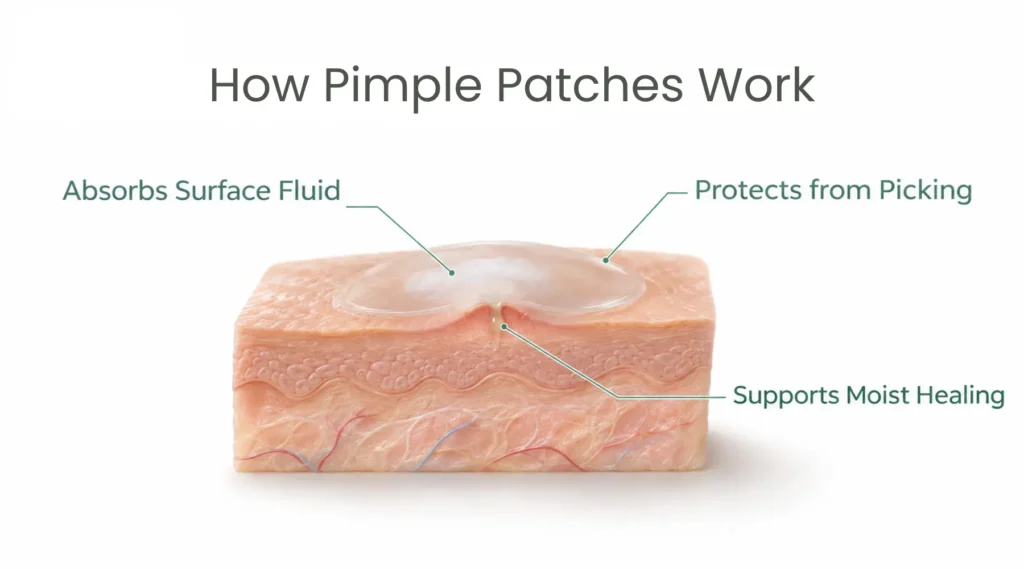
It works in three main ways.
1. Absorbing fluid from surface blemishes
A pimple with a visible white or yellow tip may contain fluid and pus. If some reaches the skin’s surface, a hydrocolloid patch can absorb it. The patch may swell and turn cloudy white.
Patches usually work best on whiteheads or surface spots that have started to drain. They can’t reliably draw fluid from a deeper, closed spot through unbroken skin.
2. Protecting irritated skin from repeated touching
One of the main benefits of pimple patches isn’t their ingredients. They cover a spot, making it harder to touch, squeeze, or pick at. Picking can make inflammation worse, harm the skin around the spot and increase the risk of lasting marks. This can be especially useful if you tend to pick without noticing, such as while working, studying or looking in the mirror.
3. Supporting a moist healing environment
Hydrocolloid dressings keep the skin around a minor surface wound moist, which can support normal healing and help prevent a hard, dry scab. But that doesn’t mean every wound should be covered with an acne patch. Infected, heavily bleeding or large areas of damage need different care.
A 2025 review found some encouraging results for hydrocolloid dressings used on acne. However, it also noted that few high-quality studies focus specifically on pimple patches. Patches may help some blemishes look better and heal, but there is not enough evidence to say they cure acne.
How to Use Pimple Patches Correctly: Step by Step
The order matters when applying a patch. If you’re new to using one, apply a suitable patch to clean, dry skin before applying moisturiser, serum, or sunscreen to that area. Leave it on for the time stated by the manufacturer, then remove it gently.
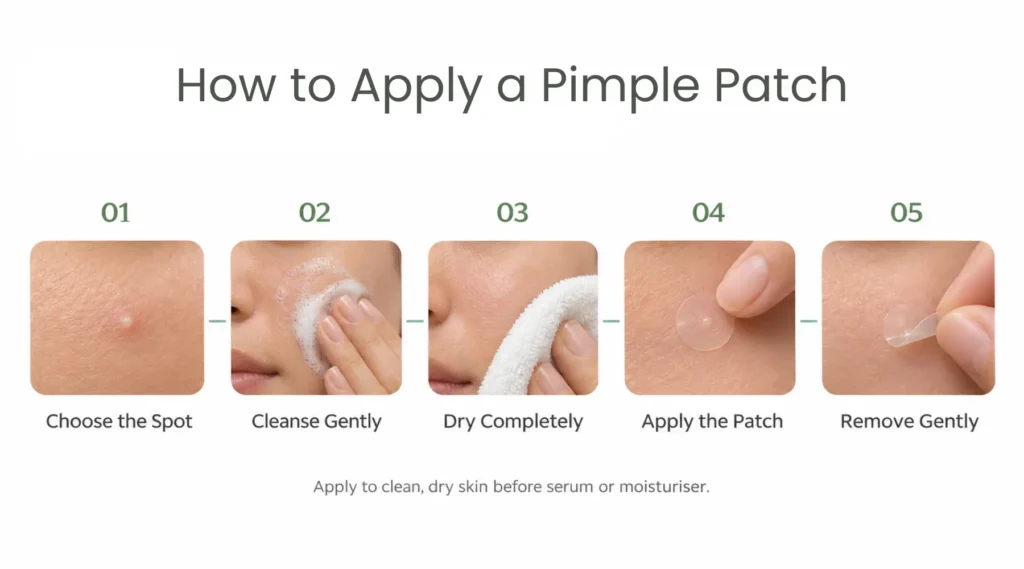
Step 1: Identify the type of pimple you want to cover
Before opening the packet, look at the spot. Is it a small whitehead with fluid near the surface, a red, sore bump with no visible centre, or a blackhead that has been there for weeks? They may all be called spots, but they are different skin concerns.
Traditional hydrocolloid patches usually work best when fluid is at or near the surface. A whitehead that has started to release fluid naturally is generally more suitable than a painful lump deep under the skin.
If you have a hard, swollen cyst, don’t press, pierce, or squeeze it to make a patch work better. Choose a patch that suits the spot; don’t try to change the spot to suit the patch.
Step 2: Wash your hands before touching your face
Wash your hands before applying a patch. This helps reduce the risk of transferring dirt or microorganisms to the skin near an inflamed hair follicle. Try not to touch the sticky side of the patch. If it falls onto an unclean surface, use a new patch instead of washing and reusing it.
Step 3: Cleanse the affected area gently
Wash your face with a mild cleanser and lukewarm water. You do not need to scrub the spot; use a cleansing brush or apply an exfoliating toner first. Harsh cleansing may make inflamed acne feel worse. A gentle cleanser removes oil, makeup, sweat and product residue that could stop the patch from sticking properly. If the spot has already opened, clean it gently without squeezing anything out. Avoid rubbing it with a rough flannel or towel.
Step 4: Allow your skin to dry completely
This step is often missed. Hydrocolloid patches stick best to clean, dry skin, not oily skin. After washing your face, gently pat it dry with a clean towel and let any leftover moisture evaporate. Check areas where water or cleanser can collect, such as the sides of your nose, your chin and your hairline.
There’s no need to wait a set number of minutes. Just make sure your skin feels dry. If a patch slides, lifts at the edges or comes off overnight, moisture or leftover skincare may be the cause.
Step 5: Choose a patch slightly larger than the blemish
Cover the whole blemish, with enough adhesive around it to stick to healthy skin.
For a small whitehead, a small round patch is usually enough.
For a larger surface blemish, use a wider patch rather than stretching a smaller one.
Acne Patch The Original has a standard spot-covering shape. Acne Pimple Master Patch comes in different sizes for individual blemishes.
You don’t need to cover a large area of clear skin. A patch that’s too big may feel uncomfortable, especially around the curves of your face.
For several nearby blemishes, consider whether one well-shaped patch or a few individual patches will feel more comfortable.
Step 6: Apply the patch directly to the dry blemish
With clean fingers, peel the patch from its backing. Place it over the spot and gently press around the edges so it sticks to your skin. Don’t press hard on an inflamed pimple or try to squeeze fluid out, the aim is just to secure the patch.
If your patch has dissolving microneedles, follow the manufacturer’s instructions. It may need different pressure or contact time than a standard hydrocolloid patch.
Once it’s on, leave it in place. Lifting the edge to check the spot can loosen the patch and irritate the surrounding skin.
Step 7: Leave the patch on for the recommended time
Most hydrocolloid acne patches can be worn for several hours, and many are suitable for overnight use. Typical wear time is about six to twelve hours, but it varies by product, so follow your patch’s instructions.
Keeping a patch on for longer isn’t always better. Replace it if it has absorbed a lot of fluid, or remove it if it becomes loose, dirty or uncomfortable. You don’t need to wait for it to turn completely white.
Step 8: Remove it slowly and examine the skin
When you’re ready to remove the patch, gently lift one edge.
Slowly peel it off, keeping it close to your skin. Don’t pull it straight up.
If it’s hard to remove, use a little lukewarm water around the edges to loosen it, but only if the product instructions say this is safe.
Once it’s off, look at the spot without squeezing it. It may look flatter or less noticeable, or it may be protected from further irritation. Any improvement may be small.
Throw the used patch away straight away. Never reuse it, even if it looks clean.
Step 9: Decide whether another patch is necessary
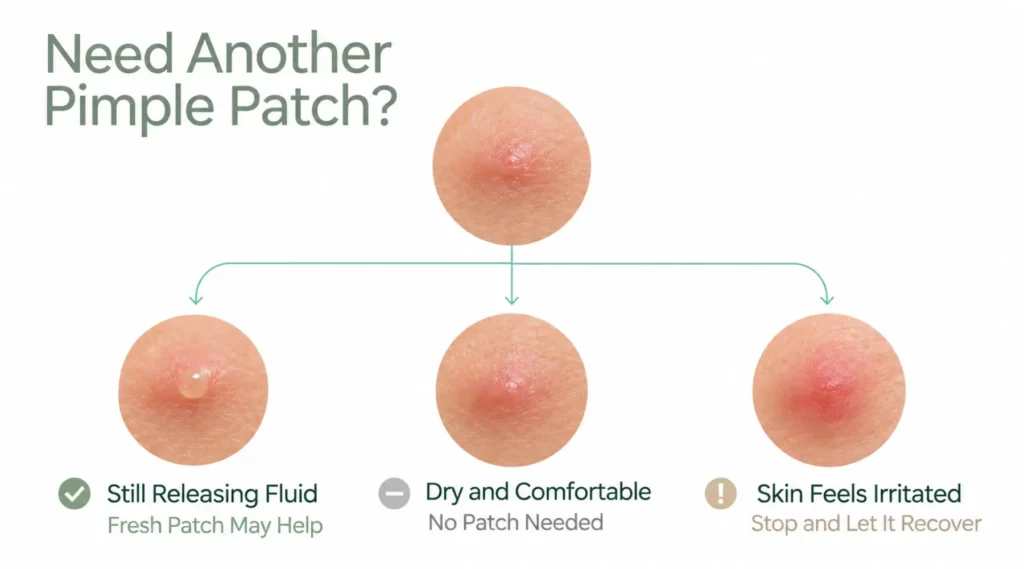
You may not need another patch.
If the spot is flatter, has stopped leaking fluid, and feels comfortable, you can return to your usual gentle skincare routine.
If it is still leaking a little fluid, you can use a fresh patch after gently cleaning and drying the area.
Stop using patches on that spot if the skin becomes red, itchy, sore or damaged from removing them. Let the skin recover rather than covering it again and again.
When Should You Use Pimple Patches for the Best Results?
The best time to use a pimple patch depends on the spot, not the time of day. Traditional hydrocolloid patches usually work best once a spot has a visible whitehead or is naturally starting to release fluid, which the patch can absorb. They may not work as well on a blocked pore at its earliest stage.
Before a whitehead appears
A red bump without a head may still be forming under the skin.
A plain hydrocolloid patch can stop you touching the area, but it may not make the bump much smaller. Medicated and microneedle patches serve different purposes, depending on their ingredients. They don’t guarantee they’ll stop a pimple from developing.
For a painful, deep spot, the American Academy of Dermatology advises against squeezing it. Try a warm compress and a suitable acne treatment.
When a visible whitehead has formed
This is often the best time to use an absorbent patch. A white or yellow centre suggests that the inflammation is close to the skin’s surface. Clean and dry the area before applying the patch. Don’t squeeze the spot first, as this can damage the skin and make a mark more noticeable. Leave the patch on without checking it repeatedly.
After a pimple has opened naturally
A hydrocolloid patch may help with a small, superficial spot that has opened and is leaking a little fluid. It can absorb the fluid and protect the area from contact. But a minor spot is different from a wound that needs medical care. Don’t use a regular acne patch on skin that is very inflamed, bleeding, infected or badly damaged.
When a pimple is already healing
Once a spot has flattened and the skin has healed, a patch may not help much. It’s usually more useful to moisturise, avoid irritating the skin and use sunscreen. If only a flat brown, red or purple mark remains, a hydrocolloid patch won’t fade it. The mark is different from the active spot that caused it.
Which Types of Acne Respond Best to Pimple Patches?
Knowing the different types of acne spots can help you avoid wasting time or unnecessarily irritating your skin.
Acne can develop when the skin makes too much oil, dead skin cells build up in hair follicles, the skin becomes inflamed, and bacteria called *Cutibacterium acnes* are active.
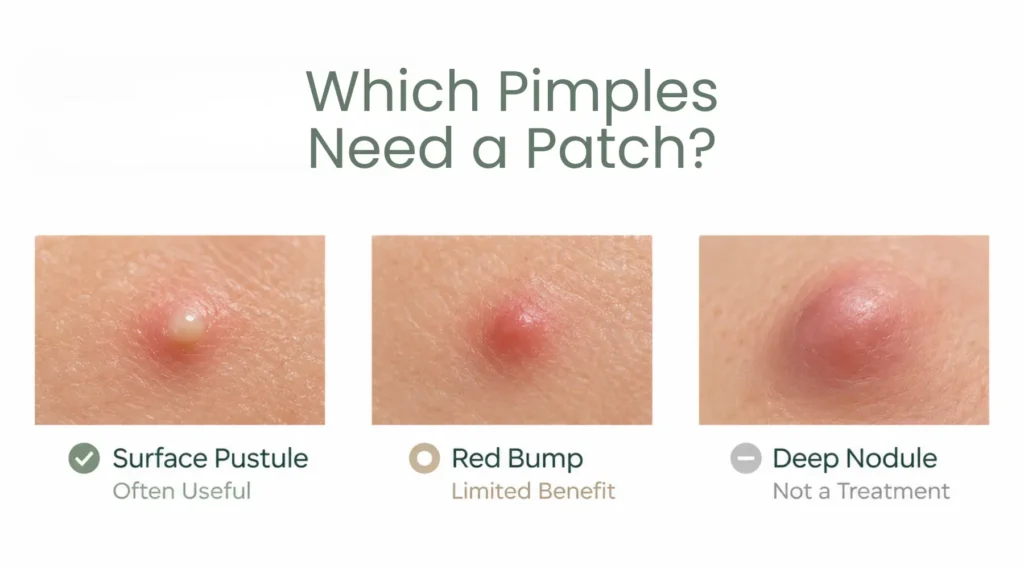
These factors help explain how acne develops, but acne spots can look quite different from one another.
| Type of blemish | How useful is a traditional hydrocolloid patch? | What to expect |
| Superficial whitehead | Often useful | May absorb fluid and make the spot look flatter |
| Small pustule | Often useful | Provides coverage and may absorb available discharge |
| Recently opened superficial pimple | Often useful with appropriate care | Protects the area and absorbs a little fluid |
| Red papulae without a head | Limited | Mainly prevents touching; little fluid may be available |
| Blackhead | Generally not useful | Does not remove the compacted material within the pore |
| Closed comedone | Generally not useful | Does not reliably clear the underlying blockage |
| Deep nodular acne | Usually unsuitable as the main treatment | Cannot reach the underlying inflammation |
| Cystic acne | Limited | May protect the surface but will not reliably resolve a cyst |
| Flat post-acne mark | Not useful | Cannot remove pigmentation or established scarring |
Whiteheads and pustules
Whiteheads and pustules are related, but they are not the same. A whitehead is a blocked pore that may look like a small, pale bump, usually without visible pus. A pustule is an inflamed spot with visible pus. Hydrocolloid patches are more likely to absorb fluid from a surface-level pustule or an open spot than from a fully closed whitehead. So spots that look alike may respond differently to a patch.
Blackheads and tiny closed bumps
Blackheads form when a blocked pore is exposed to air, which darkens the material inside. They aren’t just dirt that a patch can pull out. Small, closed spots may also stay under the skin for a while. These blemishes often respond better to regular acne treatments that help clear blocked pores, such as salicylic acid or suitable retinoids. A pimple patch can’t replace these treatments.
Deep, painful pimples
Deep, inflamed spots are different. They can feel like firm, painful lumps under the skin, sometimes with no visible white centre. Because the inflammation is deep inside the hair follicle and nearby tissue, a standard hydrocolloid patch cannot reach it well. Covering the spot may help you stop picking, but it doesn’t treat the underlying problem. If you repeatedly get nodules or cysts, seek professional advice, as they are more likely to cause scarring.
How Long Should You Leave a Pimple Patch On?
Pimple patches usually need to stay on for several hours to absorb fluid. Many are worn for 6 to 12 hours, but some have different instructions. Check the packaging and follow its recommended wear time.
| Wearing period | What it may achieve |
| Under 1 hour | Usually little absorption, although the spot remains covered |
| 2–4 hours | Some patches may begin absorbing surface fluid |
| 4–6 hours | May provide useful protection and absorption |
| 6–8 hours | A practical wearing period for many patches |
| 8–12 hours | Suitable for many overnight hydrocolloid products |
| Beyond the recommended time | Not necessarily more effective; may increase irritation or loosen adhesion |
These are general expectations, not guaranteed results. What happens can depend on the patch’s design and thickness, how much fluid is available, and the condition of the skin.
Does the patch need to turn white?
No. Patches usually turn white or cloudy as they absorb moisture and swell, but this varies between products. A patch may stay clear if the blemish is closed, there is little fluid, or it has not absorbed much moisture. This does not necessarily mean you applied it incorrectly. And a white patch does not prove it has removed all the pus, oil or bacteria.
Can you leave a pimple patch on for 24 hours?
Leave an acne patch on only for as long as the manufacturer recommends. Many are made to be worn for less time and should be changed sooner.
A patch that is full or partly coming off is unlikely to work better if you leave it on longer. If you have sensitive skin, wearing one for too long may cause redness or itching. Remove it if it feels uncomfortable, even if you have not worn it for the recommended time.
Should you replace a patch as soon as it turns cloudy?
Don’t remove a patch as soon as it starts to look lighter. Follow the product’s instructions. Remove it if it has visibly filled, is lifting at the edges or has reached the recommended wear time. Repeatedly taking it off may irritate the skin more than leaving a suitable patch on for the recommended time.
Is It Better to Use Pimple Patches in the Morning or at Night?
Both options can work. Overnight use lets the patch stay on for several hours with little interruption. Wearing it during the day can help protect the spot from touching, makeup or everyday rubbing. Neither is always more effective.
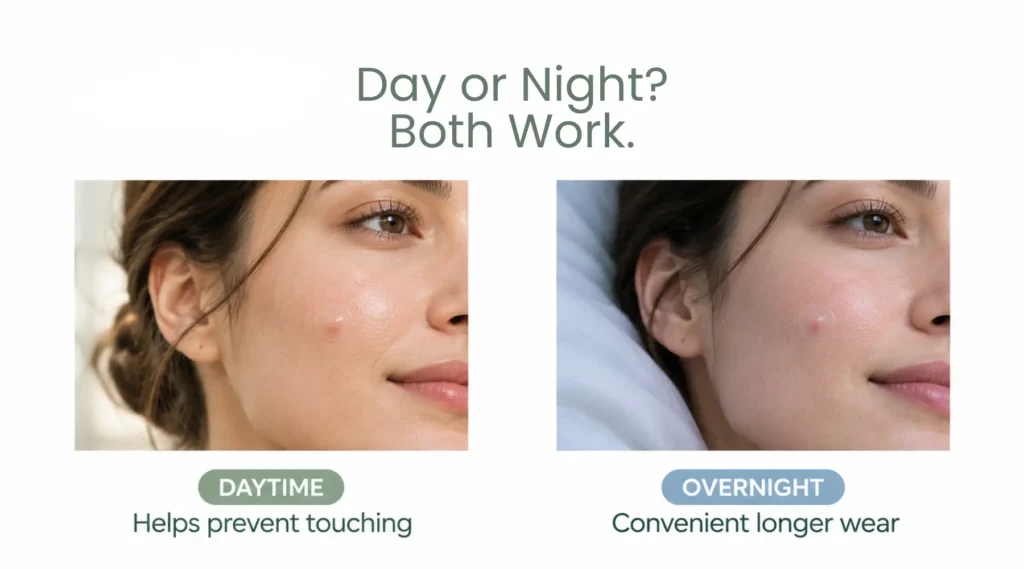
Using pimple patches overnight
Using a patch at night can be easier. Apply it after cleansing, then leave it in place while you sleep. You won’t need to worry as much about makeup, sunscreen or the patch coming off during everyday activities.
A simple evening routine:
- Remove makeup and sunscreen with a gentle cleanser.
- Pat the area dry.
- Place a hydrocolloid patch directly over the blemish.
- Apply your usual moisturiser around the patch, keeping it off the sticky edges.
- Leave the patch on for the time stated in its instructions.
- Gently remove it the next morning.
If you use prescription acne treatment, follow your prescriber’s instructions. Don’t routinely put patches over treated areas. Avoid putting strong or irritating skincare ingredients under a regular patch unless the product instructions or a healthcare professional say it’s safe. Covering treatment with a patch can change how it affects your skin.
Using pimple patches during the day
Daytime patches can help stop you from touching a spot. Thin, clear patches, such as Face Pimple Patches, may sit more discreetly on your skin. But clear does not always mean invisible. You may notice the edges in some lighting, especially on uneven skin or if makeup gathers around them.
For better daytime wear:
- Put the patch on before moisturiser and makeup.
- Choose a size that covers the spot without too much extra overlap.
- Avoid rubbing the patch when applying other skincare products.
- Keep facial oils away from the sticky edges.
- Replace the patch if sweat or movement loosens it.
- Keep protecting exposed skin with sunscreen.
A cosmetic patch does not replace broad-spectrum sun protection.
Should Pimple Patches Go Before or After Skincare?
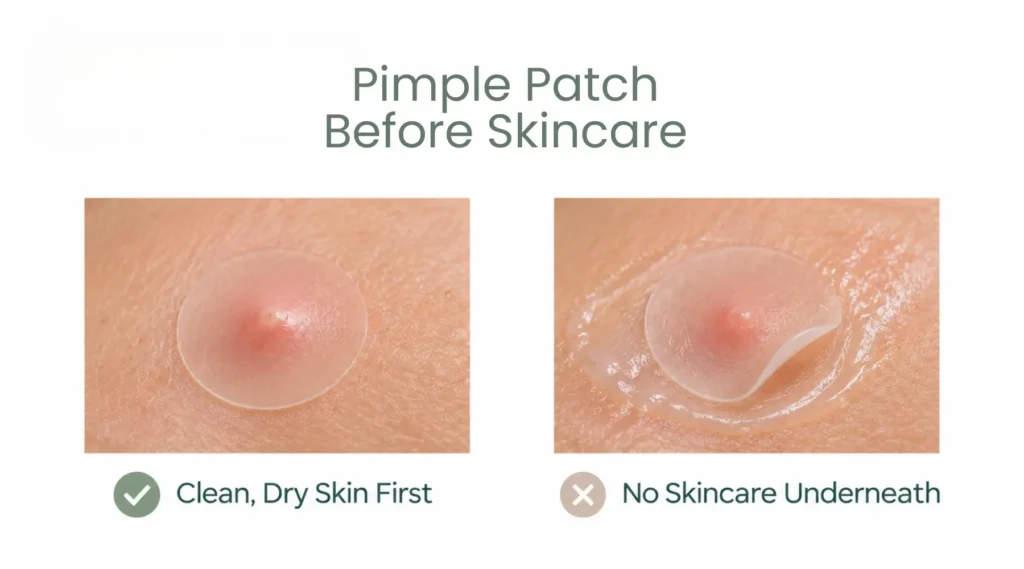
With a standard hydrocolloid patch, cleanse your skin and let it dry before applying the patch. Apply skincare around it, rather than underneath. This differs from the usual order of applying products from thinnest to thickest. The patch needs clean skin to stick properly and absorb available fluid. Moisturiser, serum or facial oil underneath may get in the way.
Can you apply niacinamide before a pimple patch?
Niacinamide may support acne-prone skin by helping protect the skin barrier, reduce the look of redness and balance oil, depending on the formula. But avoid putting a standard hydrocolloid patch over freshly applied niacinamide serum. The serum may make the patch less likely to stick and put an extra layer between the patch and your skin.
Instead, apply the patch to a clean, dry spot and use niacinamide on the surrounding skin. You don’t need to put niacinamide under the patch for it to be part of your routine. It is not a replacement for established acne treatments if breakouts are persistent or severe.
Can you use salicylic acid with pimple patches?
Salicylic acid and hydrocolloid patches can both be part of an acne routine, but they do different things.
Salicylic acid helps clear oil and dead skin from pores. It can help with blackheads and some types of acne caused by blocked pores.
Hydrocolloid patches absorb fluid from the surface and protect individual spots.
- You can use salicylic acid on suitable areas of your face.
- Keep the skin under a plain patch free from leave-on treatments.
- Don’t put a strong salicylic acid product under a patch that seals the skin, unless it’s made for that use.
- Some medicated patches already contain salicylic acid. Using extra may irritate your skin without providing more benefit.
Does retinol help with acne, and can you use it with patches?
Retinol is a type of vitamin A. It may help renew the skin and reduce mild blocked pores over time.
For preventing blocked pores, acne retinoids such as adapalene and tretinoin are better-established treatments. They work differently from pimple patches: retinoids are usually used regularly, while patches are placed on individual spots when needed.
If your skin tolerates retinoids, you may be able to use a patch on one spot and apply retinoid to other areas. Unless your prescriber advises otherwise, do not put a patch directly over retinoid you have just applied.
Retinoids can dry out or irritate skin, especially in the first few weeks. Removing a patch may irritate peeling skin.
UK NICE guidance says not to use topical retinoids during pregnancy or when planning a pregnancy.
Is glycolic acid good for acne when using patches?
Glycolic acid gently removes dead skin from the surface. It may help with roughness, dull-looking skin and some uneven marks left after spots.
Can it help acne? Sometimes. It may help if blocked pores cause mild bumps or uneven texture, but it’s usually not the best choice for deep, inflamed spots.
Using glycolic acid right before covering a spot may irritate the skin, especially if it’s broken. Use exfoliating acids carefully, keep them away from damaged skin and don’t assume that using several treatments together will work faster.
What Should You Apply After Removing a Pimple Patch?
What to use after removing a pimple patch depends on how your skin looks and feels.
- If the spot is flat and the skin is not broken, a gentle moisturiser may be enough.
- If fluid is still coming from the spot, clean the area carefully before deciding whether to use another patch.
- If the skin looks raw or irritated, avoid exfoliating acids, retinoids and strong spot treatments on that area until it has healed.
When the spot looks flatter but remains pink
A flat pink mark does not always mean the patch has failed.
Redness or irritation can take longer to settle than swelling.
Use a gentle, fragrance-free moisturiser with ingredients such as glycerin, ceramides or panthenol to support the skin barrier.
Do not squeeze the area to check whether anything is left inside.
Your skin may need a few more days to recover fully.
When there is still a small amount of discharge
If the spot is still leaking a little fluid, gently clean it and let the skin dry.
You can use a fresh hydrocolloid patch for extra protection, but only if the area is suitable for continued use and the surrounding skin isn’t irritated.
Don’t keep pressing the spot to draw out more fluid.
Get medical advice if there’s a lot of fluid, the area becomes more painful, or redness and warmth spread.
When a dry or peeling patch of skin appears
Skin can become flaky after acne treatment, especially if your routine already includes salicylic acid, benzoyl peroxide or retinoids. Adding more exfoliation is unlikely to help. A simple moisturiser is usually a better choice. If removing an adhesive has irritated your skin, stop using patches on that area and let it recover.
When a dark mark remains
A brown, purple or red mark left after a spot may be pigmentation or lasting redness. It isn’t active acne. A spot patch may help with the original spot, but it won’t remove the mark left behind. Daily sunscreen, gentle skincare and ingredients such as azelaic acid or niacinamide may help fade some marks over time. Indented or raised scars need different treatment.
Choosing Between Hydrocolloid, Medicated and Microneedle Patches
Pimple patches serve different purposes. Some absorb fluid, while others contain skincare ingredients or tiny dissolving points that help deliver ingredients into the top layers of skin. The right choice depends on what you want to treat.
| Patch type | Most suitable situation | Main limitation |
| Standard hydrocolloid | Superficial whiteheads and fluid-containing spots | Limited effect on deep congestion |
| Thicker hydrocolloid | Spots producing more surface fluid | Can be more noticeable and may not suit every location |
| Thin transparent patch | Daytime coverage and preventing picking | May absorb less fluid than thicker designs |
| Medicated patch | Selected inflamed blemishes, depending on ingredients | Greater possibility of irritation |
| Dissolving microneedle patch | Certain early inflammatory lesions, depending on formulation | Evidence and instructions vary by product |
| Larger shaped patch | Several superficial spots close together | Covers more skin and may increase adhesive contact |
When a thicker patch makes sense
A thicker hydrocolloid patch may help absorb fluid from a surface blemish if a thinner patch becomes saturated. A Thickest Absorbing Pimple Acne Patch is made in a thicker, absorbent style. But a thicker patch does not reach deeper into the skin or necessarily treat deeper acne. It may also be more noticeable during the day.
When microneedle patches may be appropriate
Microneedle patches are different from standard hydrocolloid patches. They have tiny points that reach the skin’s surface layers. These points may dissolve and release ingredients in the area. Some patches contain ingredients such as salicylic acid, niacinamide or moisturising ingredients.
Products such as Microneedle Acne Pimple Patches use this approach, rather than relying only on absorbent hydrocolloid material.
Research is still developing. Small trials of specific microneedle technologies have shown improvements in inflamed spots, but that doesn’t mean the same results apply to every product.
Unless a product is specifically approved for it, do not use microneedle patches on skin that is actively draining, infected or badly broken. Follow the manufacturer’s instructions, especially about how firmly to press the patch, how long to leave it on and how often to use it.
When larger patches are more practical
Sometimes several spots appear close together. Using a separate sticker for each one can be inconvenient, especially on your forehead or cheeks. Larger patches, including Pimple Patches for Whole Face, can cover several areas at once.
But more coverage isn’t always better. Suppose most of the area has blackheads, closed comedones, or deep inflammation; a larger hydrocolloid patch won’t address those concerns. Choose a patch based on the type and location of your spots, not just how much skin it covers.
How Often Should You Use Pimple Patches?
You can usually use a plain hydrocolloid patch on a suitable blemish if your skin tolerates the adhesive and you follow the product instructions. You don’t need to leave a set number of days between occasional uses. Let your skin guide you rather than sticking to a routine. If a patch becomes saturated and the blemish is still releasing fluid, you may be able to apply a fresh one. But repeatedly patching the same spot once the skin is dry, inflamed or irritated is unlikely to help.
Can you use a new patch every day?
Some people use plain hydrocolloid patches on consecutive days when needed, but you don’t have to. If a blemish is no longer producing fluid or doesn’t need protection, another patch may not help much. If you have sensitive skin, take extra care when removing patches repeatedly. The adhesive can irritate your skin barrier, even if the patch contains no acne medicine.
Should you use patches on every pimple?
Not always. If you have a mix of blackheads, whiteheads, blocked pores, and inflamed spots, using the same patch on every one may not help. Use patches only on spots that may benefit from absorbing surface fluid or being protected. A regular skincare routine is better for managing acne across a wider area.
Common Mistakes When Using Pimple Patches
Many disappointing results come from small mistakes when using a product, not a faulty product. Some mistakes can make it harder for the product to stick. Others can irritate the skin or lead to expectations the product may not meet.
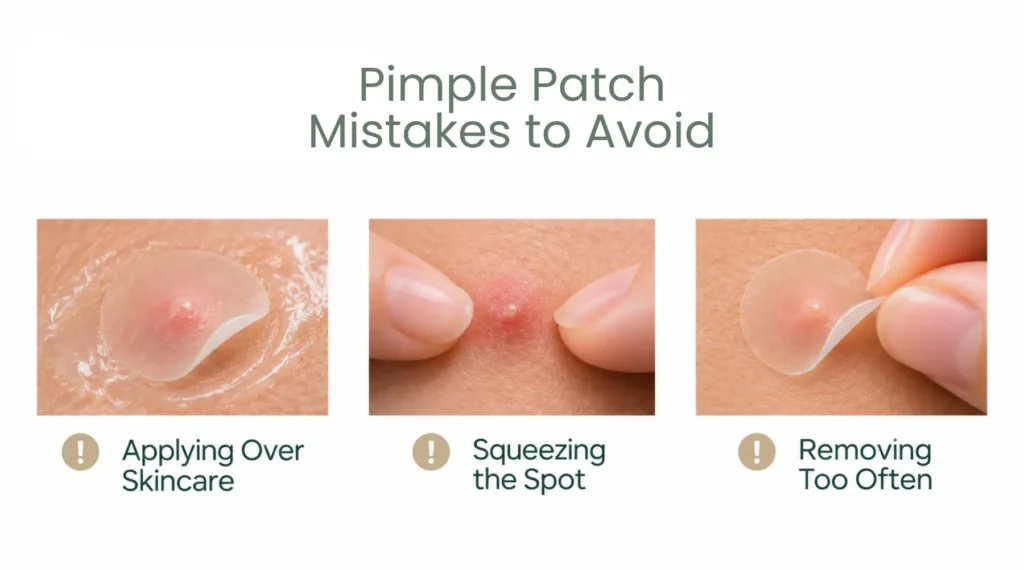
Applying patches over moisturiser or facial oil
Moisturising products and oils can stop hydrocolloid patches from sticking properly to your skin.
Even a light serum may leave residue that affects how well the patch sticks.
Apply the patch first, then moisturise around it.
Squeezing a pimple before applying the patch
Don’t squeeze a spot. It can push inflammation deeper, damage nearby skin and raise the risk of marks or scars. A patch isn’t there to help you squeeze. Use it on a suitable spot without breaking the skin first.
Using patches on blackheads and expecting extraction
A hydrocolloid patch isn’t designed to remove blackheads. Blackheads form inside blocked pores, rather than from fluid sitting on the skin’s surface. If blackheads are your main concern, a pore-targeting routine is likely to be more helpful.
Removing patches every hour to check progress
Taking the patch off often interrupts how long it stays on your skin and can tug at it each time. It also makes it harder to tell if the patch has been on long enough to work. Keep it on for the recommended time, unless it becomes uncomfortable or comes off.
Applying strong spot treatments underneath
Using an ordinary occlusive patch over benzoyl peroxide, retinoids, or exfoliating acids may cause more irritation.
A patch that covers the skin can change how these ingredients work or affect your skin.
Don’t use them together unless the product instructions or a healthcare professional recommend it.
Reusing a patch
A used patch may have absorbed fluid, skin flakes and product residue. It may also not stick properly if you reuse it. Always throw used patches away.
Ignoring redness caused by adhesive
A clear red ring around the patch may mean your skin is irritated or reacting to the patch’s adhesive or ingredients.
If you get itching, burning, swelling or a rash, remove the patch and stop using it.
If the reaction is severe or does not go away, seek medical advice.
Expecting patches to prevent future acne
A pimple patch can treat or protect a spot that’s already there, but it doesn’t address all the causes of acne. If you get breakouts often, managing acne may require a broader approach and consistent skincare.
Applying patches to every mark left by acne
Once a spot has healed and only a discoloured mark remains, a hydrocolloid patch is unlikely to help much. Covering a flat mark does not reliably make the colour fade faster. Sunscreen and suitable longer-term treatment are more useful.
How to Use Pimple Patches on Different Areas of the Face and Body
A patch that feels comfortable on your cheek may work differently on your nose, forehead or upper back. The area’s shape, sweat, hair, and movement can all affect how well it sticks.
Forehead acne
Forehead spots can appear near the hairline, where hair products, sweat and oil may build up. To help reduce them, look beyond the spot itself. Heavy conditioners, hair oils, styling products that sit on the skin and friction from hats or headbands may contribute to breakouts for some people. A hydrocolloid patch may protect a suitable pus-filled spot, but it won’t tackle these possible causes. To help the patch stay on, keep hair products away from its sticky edge and apply it to dry skin.
Nose and areas around the mouth
The nose can be tricky because it is curved. A small, flexible patch may be easier to place than a thick, stiff one. Don’t pull the patch tightly over the curves of the face, as this may make the edges lift. Speaking, eating, and drinking can also affect how well patches stick around the mouth. Keep patches away from the lips and the moist lining inside the mouth.
Chin and jawline acne
Spots on the chin and jawline can be linked to hormonal changes, but their location alone can’t show what’s causing them. A patch may help with an occasional surface-level spot with a visible head. Repeated, deep and painful spots on the lower face may need a different treatment. If spots keep coming back in the same places, consider whether they’re hormonal or follow another pattern.
How to get rid of bacne and use patches on your back
Back acne, or “bacne”, can include whiteheads, pus-filled spots, blocked pores and deeper, sore spots.
Sweat, tight clothing and rubbing can make it worse. It can also be hard to reach your back when applying treatment.
Patches may help with a few spots you can easily reach, but covering a large area with individual patches is usually impractical.
A helpful routine may include showering after sweating, changing out of damp clothes, reducing rubbing and using a suitable acne wash or prescribed treatment. Benzoyl peroxide washes and other acne treatments may help, depending on the type and severity of the spots.
Seek professional advice if the acne is widespread, painful or leaving scars. Small bumps on your back are not always acne; folliculitis and other conditions can look similar.
What Results Can You Realistically Expect from Pimple Patches?
Judge a patch by what it is designed to do. A hydrocolloid patch may absorb fluid, protect a spot and help stop you from picking at it. It may also make a suitable spot look flatter after a few hours. But one application will not always make a spot disappear.
After the first few hours
In the first few hours, the patch may stay clear or look a little cloudy. Some spots release enough fluid to make the patch swell. Others do not. A clear patch is not necessarily faulty; the blemish may have very little fluid for the patch to draw out.
The following morning
After being worn overnight, a small spot with pus near the skin’s surface may look flatter or less noticeable. The skin may still look pink or slightly inflamed as it continues to heal, even after the fluid has been absorbed. A deeper red bump may look much the same. This is not unusual.
Over the next several days
How much a spot improves depends on how it looked at the start, how inflamed it is, whether it has been picked, and how well the surrounding skin responds to treatment.
A small, controlled study published in 2025 found that unmedicated hydrogel patches improved the appearance of some acne spots. But the study was small, and hydrogel patches aren’t all the same as the hydrocolloid patches sold on the market.
The evidence is promising for some spots, but it does not mean every patch will get rid of a spot overnight.
Can pimple patches prevent acne scars?
Not picking spots can’t guarantee you won’t get scars, but it may reduce the risk of avoidable damage. Scarring depends on how severe and deep the inflammation is, how your skin heals, and other factors. Deep, inflamed acne can leave scars even if you never squeeze it. Getting suitable acne treatment early is important.
Why Pimple Patches Cannot Replace a Consistent Acne Routine
A spot patch can cover one blemish, but acne develops inside hair follicles. It can involve excess oil, abnormal skin cell shedding, blocked follicles, and inflammation. A patch on the skin’s surface cannot reliably stop these processes.
This matters especially if you get breakouts often. If a new spot appears every few days, covering each one may feel helpful but may not change the overall pattern.
To understand why acne keeps coming back, it may help to look at how your skin responds to your skincare, hormones, how regularly you use treatment and other possible triggers.
A simple acne routine might include a gentle cleanser, a suitable acne treatment, a non-comedogenic moisturiser and daily sunscreen. For persistent acne, established treatments such as benzoyl peroxide, topical retinoids or other options recommended by a clinician are more important than repeatedly using spot patches.
The American Academy of Dermatology’s acne guidelines support treatments including benzoyl peroxide and topical retinoids. Other options depend on acne severity and what suits the individual. Patches can be used alongside these treatments, but they do not replace them.
A simple routine for occasional breakouts
Morning:
- Use a gentle cleanser if needed. Then moisturise and apply broad-spectrum sunscreen with SPF 30 or higher.
- If a blemish is suitable for a patch, put it on clean, dry skin before applying other products nearby.
Evening:
- Cleanse well to remove sunscreen, makeup and surface oil.
- Follow your usual acne treatment plan. Unless you have been told otherwise, don’t apply treatment under a plain hydrocolloid patch.
- Moisturise the skin around the patch.
- Use a patch on a suitable blemish when helpful; you don’t need to cover every spot.
When Pimple Patches Are Not Enough
Treating each spot one by one may not be enough if you have acne. Consider speaking to a pharmacist, GP or dermatologist if you have:
- Deep, painful lumps or cysts
- Scars or dark marks that do not go away
- Regular breakouts despite treating your acne consistently
- Acne across your face, chest or back
- Skin irritation from skincare products
- Acne that is affecting your confidence or emotional wellbeing
- Increasing redness, warmth, swelling or pain around a spot
A dermatologist may suggest prescription creams, tablets or other treatments, depending on your needs.
For a very painful, inflamed lump, a suitably trained clinician may help reduce inflammation more quickly. Only trained professionals should carry out these treatments.
UK NICE guidance recommends checking how well first treatments are working after about 12 weeks. If your acne is severe or causing scars, seek advice sooner.
The aim is not just to clear individual spots. It is also to prevent future inflammation and lower the risk of lasting changes to your skin.
Pimple Patch Questions That Often Cause Confusion
1. How do you use pimple patches for beginners?
Wash your hands and gently clean the area. Let your skin dry fully, then choose a patch that covers the spot.
Place it on clean, dry skin and press around the edges. Leave it on for the time the manufacturer states, then peel it off slowly.
If you’re trying a patch for the first time, a plain hydrocolloid patch may be easier to understand than one with several active ingredients. It mainly absorbs fluid at the surface and protects the spot.
2. When should you use pimple patches on a new breakout?
Hydrocolloid patches work best on spots with a visible head or that have started to ooze a little. They may do little for a closed, red bump with no fluid. A plain patch can help stop you touching a spot as it develops, but it cannot guarantee that the spot will stop growing.
3. How often should you use pimple patches on the same spot?
Use a new patch when the old one has reached its recommended wear time, is full or has come off, as long as the skin still needs protection and can tolerate the adhesive.
Stop using patches once the blemish is flat and no longer releasing fluid.
If the skin around the blemish becomes sore, itchy or irritated, stop using patches on that area.
4. Can I use a pimple patch on a spot that has not popped?
Yes, but it depends on the blemish. A plain hydrocolloid patch can stop you from touching the spot. It usually absorbs more fluid if there’s some near the surface. Don’t pop a blemish before applying the patch, as this can increase inflammation and the risk of scarring.
5. Can you sleep with pimple patches on?
Many hydrocolloid patches are made to be worn overnight. Apply one to clean, dry skin before bed, then remove it as the manufacturer advises. Wearing it overnight gives the patch several hours of uninterrupted contact, but it may not make the blemish disappear by morning.
6. What happens if you leave a pimple patch on too long?
A patch left on longer than recommended may come loose, become saturated or irritate the skin around it. Prolonged contact with the adhesive may also cause redness for some people. Wearing a patch for longer does not necessarily make it work better. Follow the pack instructions and remove the patch sooner if you feel discomfort or notice itching or irritation.
7. Can you put makeup over a pimple patch?
Some thin patches can be worn with makeup, but the result may vary.
Put the patch on first. Blend makeup carefully around it, and don’t rub over the sticky part. Heavy foundation may make the edges easier to see.
Don’t put makeup under the patch. It may stop the patch from sticking properly and working as intended.
8. Why does my pimple patch turn white?
Hydrocolloid absorbs available moisture and turns into a gel. As the dressing swells, it may look white or cloudy. This usually means it has absorbed fluid, but it doesn’t prove it has drawn out every impurity. A patch may also stay clear if the blemish is closed or contains little fluid that the patch can reach. Both results are normal possibilities.
9. Do pimple patches work on cystic acne?
Traditional hydrocolloid patches often do not work well on deep cystic or nodular acne because the inflammation is under the skin. A patch may help stop you picking at the spot, but it cannot reliably clear a deep lesion. Some microneedle products have shown promise in small studies, but evidence varies by product. If you get painful cysts repeatedly, speak to a healthcare professional, as they can cause scarring.
10. Can pimple patches make acne worse?
Patches may irritate skin in some cases.
Glue, fragrances or added ingredients may cause irritation or an allergic reaction.
Removing patches can also harm sensitive skin.
Using a patch on an unsuitable skin problem, or trapping an irritating skincare product underneath, may cause further problems.
Stop using the patch if redness, itching, burning, or swelling doesn’t go away.
11. Should you wash your face after removing a pimple patch?
You don’t always need to wash your whole face straight away.
- If your skin feels clean and comfortable, carry on with your usual routine.
- If you can see residue or discharge, gently clean that area with lukewarm water and a mild cleanser.
- Don’t scrub or try to squeeze more out of the blemish.
- Pat your skin dry before applying another patch.
12. Can you use pimple patches with benzoyl peroxide?
You can use both in an acne routine, but don’t put benzoyl peroxide under a plain patch unless the product instructions or a healthcare professional say to. Benzoyl peroxide can dry out or irritate your skin, especially when used with other active ingredients. You can put the patch on the spot you’ve chosen and use other treatments on suitable areas without a patch. Follow your prescribed treatment plan.
13. What should you apply after using pimple patches?
If the spot is flat and the skin is unbroken, a gentle moisturiser is usually enough.
If there is still a little surface discharge, clean the area gently and protect it.
Don’t apply strong exfoliating acids or retinoids to raw or irritated skin.
During the day, use suitable sun protection on exposed skin to help reduce lingering dark marks after acne.
14. Are pimple patches suitable for sensitive skin?
Plain hydrocolloid patches may suit some people with sensitive skin, but they can still irritate. The adhesive or other ingredients may trigger a reaction.
Choose a patch with a simple formula, follow the instructions and watch for any skin changes. If you have eczema, an adhesive allergy or damaged skin, ask a health professional before using patches regularly.
15. Why did my pimple patch not work overnight?
There are a few possible reasons the patch may not have worked:
- The spot may have been too deep, fully closed or dry on the surface.
- Moisturiser under the patch may have stopped it from sticking properly.
- The patch may have come off while you were asleep.
- The patch may have protected your skin, but the swelling may need more time to go down.
One patch not working doesn’t mean all patches will work the same way. But ongoing acne usually needs more than patches alone.
Making How to Use Pimple Patches Part of a Better Skincare Routine
Use pimple patches gently. Choose a suitable spot, wash and dry the skin, then apply a patch that fits. Leave it on for the time recommended on the packaging. Remove it carefully and let your skin recover. Avoid squeezing, scrubbing or using strong treatments on the area unnecessarily.
Hydrocolloid patches may help absorb fluid from a surface whitehead. A deep, painful spot may need a different approach. A flat mark left after acne usually needs time, sun protection and suitable skincare, not another patch.
Different acne patches suit different needs, so one type will not treat every kind of acne. A useful result might be protecting a spot from picking or helping it heal without extra irritation. It may not be completely flat by the next morning.
Patches can be a practical addition to a consistent acne routine. Good skincare also means knowing when to treat a spot, when to protect it and when to leave it alone.