




Blog
How Often Should You Use a Face Mask? Safe Routine Tips

Face masks can make your skin feel softer, calmer, cleaner, or more hydrated quickly, so it’s tempting to use them when your face looks tired. However, not all masks work the same way. For example, a hydrating sheet mask and an exfoliating acid mask both sit on your face for 15 minutes, but they affect your skin differently.
How often should you use face masks? Generally, one to three times a week is safe, but it depends on the type of mask. A moisturising or calming mask is fine a few times a week, while clay or exfoliating masks should be used less often. If you have sensitive or irritated skin, use masks even less.
Always follow the manufacturer’s instructions instead of relying on general guidelines. The strength of the ingredients, how long the mask stays on, and the mask design all play a role.
Remember, face masks are an optional part of skincare, not a necessity. A good mask can enhance your cleansing, moisturising, and sun protection routine. However, using masks too often won’t fix issues caused by a harsh cleanser or insufficient moisturiser. Dermatologists say masks can be beneficial for specific skin concerns if the ingredients suit your skin type, but they aren’t needed in every skincare routine.
How Often Should You Use a Face Mask?
The simplest starting point is:
| Type of face mask | Sensible starting frequency | Main reason for caution |
| Hydrating sheet or hydrogel mask | 1–3 times weekly | Fragrance, botanicals or prolonged occlusion can irritate some skin |
| Soothing mask | 1–3 times weekly | Depends on the complete ingredient list |
| Clay or mud mask | 1–2 times weekly | Can remove too much surface oil and leave skin tight |
| Exfoliating AHA/BHA mask | Once weekly or less | Higher risk of stinging, dryness and over-exfoliation |
| Brightening mask with active ingredients | 1–2 times weekly initially | May duplicate acids, retinoids or brightening treatments already in the routine |
| Cream mask | 1–3 times weekly | Rich formulae may feel too occlusive for some acne-prone skin |
| Overnight or sleeping mask | 1–3 nights weekly unless directed otherwise | May be unnecessary over an already rich routine |
| Wrapping or peel-off night mask | Follow the individual product directions | Film-forming formulae vary substantially |
| Under-eye patches | 1–3 times weekly or as needed | Irritation can occur close to the eyes |
| Lip sleeping mask | A few nights weekly to nightly if simple and well tolerated | Flavourings, fragrance and irritating actives can worsen sensitive lips |
These suggestions are just guidelines, not strict rules.
A mask with mainly moisturising and soothing ingredients usually offers more options than one with strong treatments like acids or retinoids.
How your skin reacts is more important than the number of nights you use the mask.
Why Face Mask Frequency Depends More on Formula Than Skin Type
People often wonder if those with oily skin should use masks more often than those with dry skin. Skin type matters, but how the mask works is more important.
Someone with oily skin might use a hydrating sheet mask twice a week without issues, but a strong clay-and-acid mask could irritate their skin if used that often. On the other hand, a person with dry skin could handle a rich cream mask every other night but might find an exfoliating mask too harsh if used once a week.
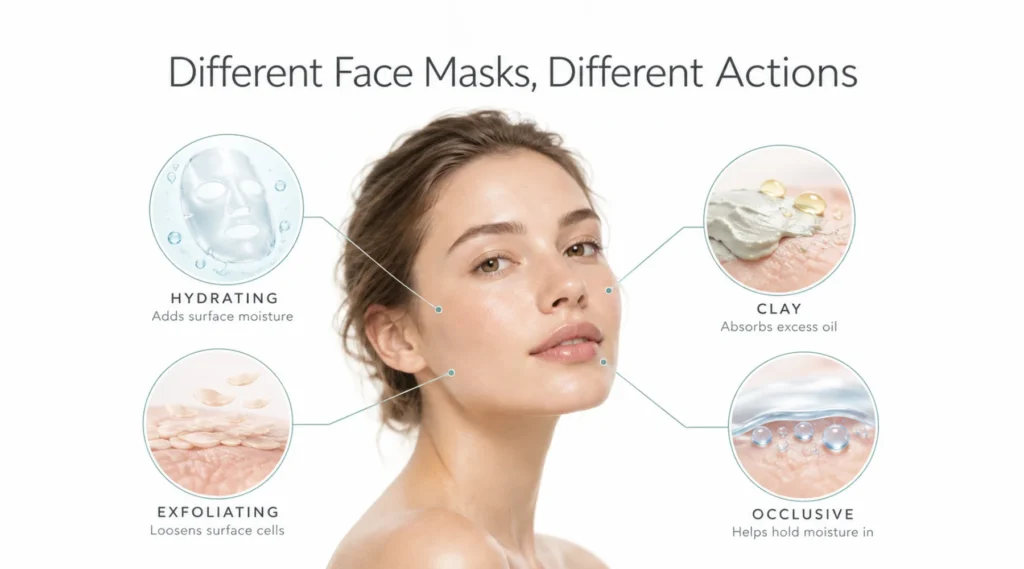
Knowing what facial masks do helps you decide how often to use them. Masks typically work in four main ways.
Hydrating masks increase water at the skin’s surface
Sheet masks, hydrogel masks, and cream masks often have humectants like glycerin, hyaluronic acid, and panthenol.
These masks also help keep moisture from escaping while they are on your face. This can make your skin hold more water, which reduces the appearance of fine lines for a short time.
While this effect is beneficial, it doesn’t mean your skin needs another mask the next morning.
Clay masks absorb surface oil
Kaolin and bentonite are popular because they soak up oil and make oily skin feel less greasy. The American Academy of Dermatology says clay can be good for oily or acne-prone skin.
However, using clay masks too often can dry out your skin, making it tight, rough, or irritated. That’s why you don’t need to use clay masks every day.
Exfoliating masks loosen surface cells
Masks with glycolic, lactic, salicylic acid, or other exfoliating ingredients are treatment products, not just for pampering. They help remove dead cells and clear pores. If you already use a lot of exfoliating products, you may not need an exfoliating mask as often.
It’s crucial to watch how often you use these products, as irritation builds up over time. A toner on Monday, a retinoid on Tuesday, and an acid mask on Wednesday can irritate, even if each one seems fine on its own.
Occlusive masks temporarily change how products sit on the skin
Some overnight masks, like hydrogel and wrapping masks, form a layer on the skin. This layer helps keep moisture in, which can boost hydration, but it can also affect how well the products beneath it work.
Using a thick mask over strong active ingredients isn’t always better. In skincare, deeper absorption can lead to more irritation.
How Often to Use Face Mask Products as a Beginner
If you’re new to face masks, start by using one once a week. This lets you see if it helps without making it hard to spot irritation.
A simple beginner routine could be:
- Pick one mask that targets your main concern.
- Use it once during the first week.
- Keep your other skincare routine the same.
- Observe how your skin feels that evening and for the next 24–48 hours.
If your skin feels good, follow the directions and only use the mask more often if needed. There’s no reward for using three masks a week. If using one mask weekly keeps your skin happy and gives results, that may be the best choice for you.
It’s wise to start slow, especially if your mask has acids, retinoids, strong vitamin C, kojic acid, essential oils, or other new ingredients. With hydrating masks, there’s less risk of over-exfoliation, but irritation from fragrance, preservatives, or plant extracts can still happen.
How Often to Use Face Mask Products for Sensitive Skin
Sensitive skin does better with fewer routines and lower frequency. Try using a mask once every seven to fourteen days, especially if your skin often stings or reacts to new products. If your skin feels comfortable, a gentle hydrating mask can be used once or twice a week.

Focus on ingredients rather than just the label “sensitive.” Good choices include:
- glycerin
- hyaluronic acid
- ceramides
- panthenol
- colloidal oatmeal
- centella
- basic emollients
Dermatologists recommend masks with hyaluronic acid, ceramides, glycerin, and colloidal oatmeal for dry or sensitive skin.
Be careful with masks that contain:
- multiple exfoliating acids
- strong fragrances
- essential oils
- high alcohol content
- harsh peel-off formulae
- physical scrubs
- retinoids with other active ingredients
Do not use masks if your skin feels uncomfortable. Signs like burning, unusual warmth, persistent redness, or tightness indicate that your skin barrier is struggling. In these cases, it’s better to simplify your routine than to add more treatments.
How Often to Use Face Mask Products for Oily Skin
Oily skin doesn’t always need clay masks every day. Using a clay mask once or twice a week is often better than daily use. The aim is to control extra oil on the surface without drying out the skin.
Clay masks work well on the oily parts of your face, like the forehead, nose, and chin, while leaving drier areas, like the cheeks, alone. This is where “multi-masking” helps. Apply the clay mask only to the oily areas and use a hydrating product on the drier spots.
People with oily skin can also benefit from hydrating masks. Oily skin can still be dehydrated. A lightweight sheet or gel mask with humectants can be more helpful after an acne treatment than using another oil-removing product.
How Often to Use a Face Mask When You Have Acne
Acne makes choosing a mask more important, but not necessarily more frequent. Look for masks with ingredients like salicylic acid, niacinamide, clay, or alpha hydroxy acids. Dermatologists say these can be helpful for blemish-prone skin, depending on how they’re used.
The issue arises when you add a mask to an already active acne treatment routine. If you’re already using a salicylic acid cleanser, benzoyl peroxide, a retinoid like adapalene, azelaic acid, or an exfoliating toner, you may not need another exfoliating mask. A simple hydrating mask might work better.
Don’t expect a mask to eliminate acne or detoxify pores forever. Acne involves blocked hair follicles, oil, inflammation, and other factors that cannot be fixed by just letting clay dry on your skin.
For persistent, painful, or scarring acne, seek proper medical treatment instead of relying on stronger masks.
How Often to Mask Dry or Dehydrated Skin
Dry, dehydrated skin can usually handle hydrating masks one to three times a week if the product is gentle. These masks can temporarily make your skin softer and fuller. For example, a product like the Bio-Collagen Real Deep Mask can be part of your hydration routine if it suits your skin’s needs.
However, what you do between masks is also important. If your skin feels comfortable for only a few hours and is tight again by morning, using masks more often won’t fix the underlying issues.
Consider whether you are:
- Cleansing too harshly
- Taking very hot showers
- Exfoliating too frequently
- Using too little moisturiser
- Applying multiple drying acne treatments
- Skipping moisturiser because your serum seems hydrating
Regular moisturising has a bigger impact on ongoing dryness than using masks occasionally.
Combination Skin Usually Benefits From Different Treatments in Different Areas
Combination skin shows why it’s hard to use one face mask for everyone. Your nose can get oily in a few hours, while your cheeks may feel tight after washing. Using a clay mask on your whole face treats both areas the same, but they have different needs.
Instead, apply clay only to oily or congested spots about once a week. Use your regular moisturiser on other areas. On another night, try a hydrating mask for your entire face. This is usually easier than searching for one mask that can control oil and nourish dry patches at the same time.
Sheet Mask vs Clay Mask: Their Frequencies Should Not Be the Same
A sheet mask and a clay mask are both face masks, but they have different purposes.
A sheet or hydrogel mask holds serum close to the skin. It mainly aims to hydrate, soothe, or add temporary glow.
In contrast, a clay mask absorbs oil and leaves the skin feeling matte.
| Question | Hydrating sheet mask | Clay mask |
| Main effect | Hydration and temporary plumping | Oil absorption |
| Good starting frequency | 1–3 times weekly | 1–2 times weekly |
| Useful for | Dehydration, dullness, temporary dryness | Oiliness and shine |
| Main risk | Irritation from formula or over-occlusion | Dryness and tightness |
| Should it dry completely? | No benefit in allowing a sheet to become bone dry | Usually remove according to directions rather than waiting for cracking |
| Best follow-up | Moisturiser if needed | Moisturiser |
Neither type is better than the other. The best mask is the one that meets your skin’s needs at that time without causing extra irritation.
How to Use a Face Mask Without Disrupting the Rest of Your Routine
Using a face mask correctly is as important as how often you use one.
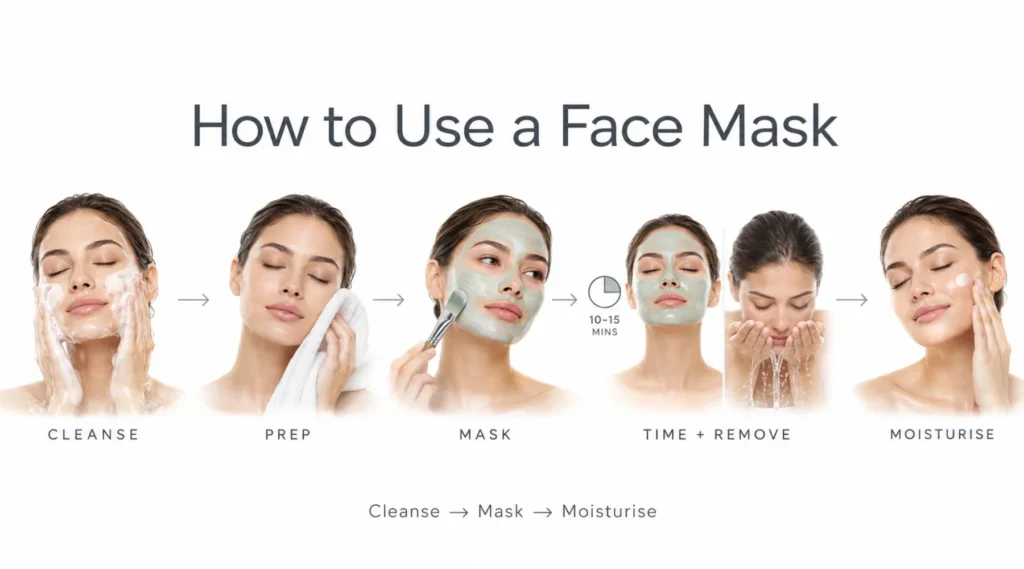
Here’s how to do it:
1. Remove Makeup and Sunscreen
Clean your face well before using a mask. Don’t let makeup, sunscreen, or dirt get in the way.
You can double cleanse if you used heavy makeup or water-resistant sunscreen, but don’t scrub hard.
2. Pat the Skin
Many masks work best on clean, dry skin, while some hydrating masks can be applied to slightly damp skin. Always follow the instructions on the mask.
3. Apply an Even Layer
Use just enough product to cover your face evenly. Don’t apply it too thick. For sheet masks, gently position the mask without pulling too hard.
4. Avoid Sensitive Areas
Keep regular masks away from your eyes, nostrils, and lips unless they’re meant for those areas. The skin there is delicate and can react differently.
5. Set a Timer
Don’t leave masks on longer than recommended. This can irritate your skin or make it too dry. Sheet masks shouldn’t be left on until they’re completely dry either.
6. Remove Gently
Use lukewarm water to rinse off masks. Don’t rub your skin with a rough cloth. Follow removal instructions for peel-off or wrap masks carefully.
7. Finish Your Routine
After masking, your routine can be simple: Mask → moisturiser.
If your skin has extra essence from the mask, gently press it in before moisturising. You don’t need to add a lot of extra products just because you’ve masked.
How Often to Use Face Mask With Other Skincare Products
To avoid problems, focus on the total treatment load.
Your skin doesn’t judge products by their labels. It feels the combined effects of everything you use.
Using an exfoliating toner, a retinoid, and a resurfacing mask means applying three potentially irritating treatments, even if they come in different forms.
Face masks and retinoids
You can usually use a simple hydrating mask with retinoids, but you don’t have to use them on the same night. If your mask has strong acids or other active ingredients, keep it separate from retinol.
A good routine could be:
- Monday: retinoid
- Tuesday: basic moisturiser
- Wednesday: hydrating mask
- Thursday: retinoid
- Friday: basic routine
- Weekend: optional exfoliating treatment, if needed
The specific days don’t matter as much as giving them space.
Face masks and glycolic or lactic acid
If you already use an AHA serum or toner, you might not need an AHA mask. If you decide to use one, think of it as your daily exfoliation step.
Don’t make the mistake of thinking that using multiple weak exfoliants will be gentler than using one strong product. Repeatedly using weak exfoliants can still irritate.
Face masks and salicylic acid
A clay mask with salicylic acid can help oily or clogged skin. However, using it right after a salicylic cleanser and another BHA product may be too much. More acne treatment doesn’t always mean better results.
Face masks and benzoyl peroxide
Benzoyl peroxide can dry out your skin, especially when you first start using it. If your skin feels tight from treatment, pick a basic hydrating mask instead of one that exfoliates or absorbs oil.
Face masks and vitamin C
A gentle hydrating mask usually works well with vitamin C. However, using acidic masks with a strong low-pH vitamin C serum can irritate sensitive skin. It’s fine to use them at different times.
Face masks and kojic acid
Kojic acid is often found in products for uneven skin tone. Since brightening masks may mix kojic acid with other ingredients, it’s important to consider the full formula.
For instance, the Medicube Kojic Acid Turmeric Night Wrapping Mask is best used as a night treatment, not just an extra step in your skincare routine. The product suggests using it every few days rather than daily.
If you use retinoids, exfoliating acids, or other treatments for pigmentation, start with the mask slowly instead of using it all at once on the first night.
What Does a Facial Mask Do That a Serum Cannot?
A facial mask mainly changes how long it stays on your skin, how much product you use, and how it traps moisture. This can help with quick hydration or absorbing oil. However, a mask isn’t always better than a serum or moisturiser.
A good serum used regularly can provide more long-term benefits than a mask with trendy ingredients used occasionally. Likewise, a moisturiser with ceramides, glycerin, and emollients can be better for ongoing dryness than a weekly sheet mask.
So, whether face masks are good for your skin depends on how well they fit into your routine. Think of a mask as a special addition, not a required step between toner and moisturiser.
Do Collagen Masks Work?
Collagen masks need careful explanation because their name can set unrealistic expectations.
Topical collagen masks can make skin feel hydrated, smoother, and temporarily plumper, but they can’t replace the collagen found deeper in the skin. Collagen is a large protein, and putting it on the surface doesn’t send new collagen into the deeper layers.
Many collagen masks work well because they contain humectants, film-formers, and other moisturising ingredients. These can increase hydration, soften fine lines, and make skin look more radiant. Experts note that these effects are temporary and don’t rebuild deeper collagen.
This distinction is important when deciding how often to use them. There’s no need to use a collagen mask every day just because ageing is ongoing. If hydration is your goal, using a mask one or two times a week is enough, and your daily moisturiser is more essential.
For long-term care against visible ageing, a more comprehensive routine is important. This includes sun protection, suitable retinoids, moisturising, and other effective treatments.
Can You Use a Face Mask Every Day?
You can find masks designed for daily use, especially hydrating sheet masks. However, not everyone needs to mask every day.
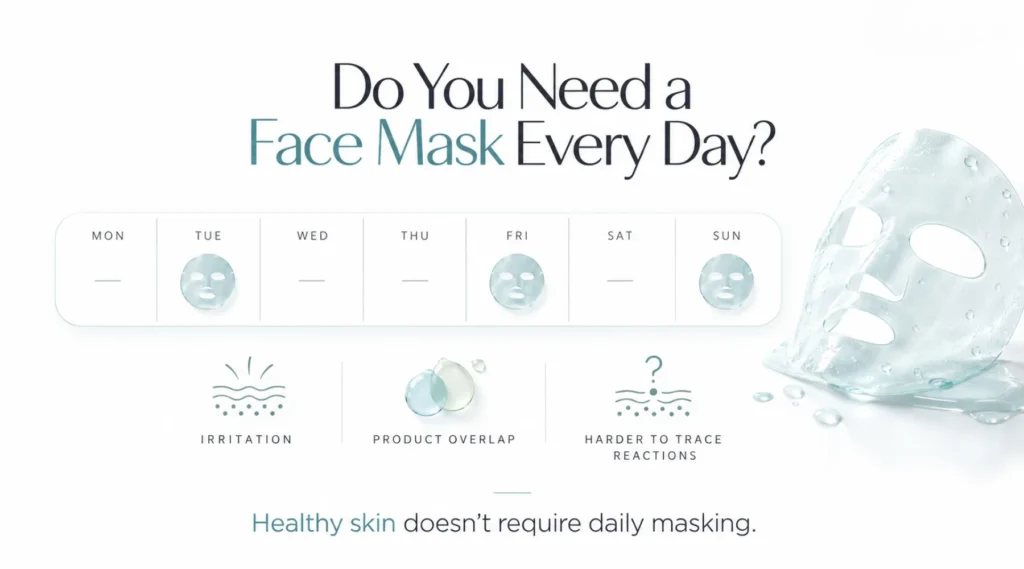
Using face masks daily can lead to three main issues:
- Increased Irritation: A mask that feels fine once a week could irritate your skin if you use it daily. Ingredients like fragrance and preservatives can cause problems with frequent use.
- Product Overlap: If your serum, moisturiser, and mask all have similar ingredients, daily masking can add confusion instead of benefits.
- Difficult Reactions: If your skin reacts negatively (like stinging or breakouts), having a simple routine helps identify the problem. With many products used every night, it’s harder to figure out what’s causing the issue.
If you like daily masking and it’s safe to do so, pick a simple hydrating formula and keep an eye on your skin. Remember, you don’t need to use a face mask every day to have healthy skin.
Can You Use Two Different Face Masks in One Day?
Usually, one mask is enough.
Using a clay mask followed by a hydrating mask is called double masking. This can be helpful if the first mask dries out your skin, but it’s better to ask if the first mask was too harsh.
Using two masks with active ingredients isn’t necessary. Avoid these combinations:
- acid mask and peel-off mask
- clay-and-salicylic mask and glycolic treatment
- exfoliating mask and retinoid sleeping mask
- scrub mask and AHA mask
If you really need different effects, it’s better to use them on separate days for your skin’s health.
How Long Should a Face Mask Stay On?
Use the time on the product, instead of assuming longer is better.
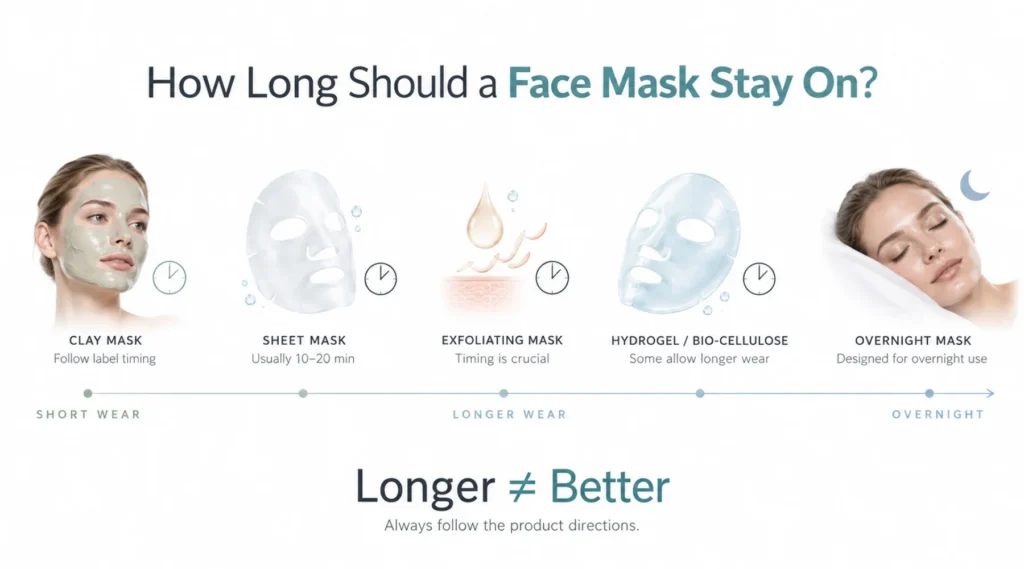
Masks have a specific time they should be used. A clay mask meant for ten minutes won’t work better if you leave it on until it cracks. A 15-minute acid mask shouldn’t be left on overnight. A sheet mask meant for 20 minutes doesn’t need to stay on until all the essence is gone.
Clay Masks
Follow the instructions for when to remove them. If your face feels painfully tight or burns before the time is up, wash it off.
Sheet Masks
Most are meant to be worn for 10-20 minutes. Some newer hydrogel masks are made for longer wear. Don’t apply the timing from one product to another.
Hydrogel and Bio-Cellulose Masks
Some can be used longer. Always check the label for directions.
Overnight Sleeping Masks
These are meant to stay on while you sleep, not like regular rinse-off masks.
Exfoliating Masks
Timing is crucial. Leaving them on longer can lead to more exfoliation and irritation.
What Happens If You Leave a Face Mask On Too Long?
It depends on the type of mask you use.
Using a clay mask too often can dry out your skin and make it feel tight or uncomfortable.
An acid mask might sting, turn your skin red, or irritate.
Leaving a sheet mask on until it’s completely dry can feel uncomfortable and doesn’t provide any extra benefits.
A peel-off mask might become hard to remove.
If a mask causes burning, strong itching, or pain, take it off right away instead of waiting for the timer, even if it says five more minutes.
Feeling discomfort from skincare doesn’t mean the product is working better.
Is Tingling Normal When Using a Face Mask?
Mild tingling can happen with some acid products, but it’s not always good. If you feel burning, intense itching, pain, swelling, or more redness, remove the product.
This is especially important for viral products that claim strong sensations or noticeable redness. A cosmetic face mask shouldn’t hurt to be effective.
After taking off an irritating product:
- Rinse your face with lukewarm water.
- Stop using other irritating treatments.
- Apply a simple moisturiser that you know works for you.
- Use sunscreen during the day.
- Wait to try new products until your skin calms down.
If you experience swelling, blistering, severe pain, or lasting dermatitis, seek medical help.
What Does a Lip Mask Do?
A lip mask is more like a thick balm than a regular facial treatment.
What does a lip mask do?
It covers your lips with moisturising ingredients that soften rough spots and reduce water loss.
You can use a lip sleeping mask more often than facial masks, even every night, if it feels good for you.
The ingredients matter.
Sensitive or chapped lips might react to:
- fragrance
- flavourings
- menthol
- peppermint
- cinnamon
- exfoliating acids
If your lips stay dry even with more products, switch to a simple, fragrance-free balm or a petrolatum-based treatment instead of using more complicated masks.
If you have persistent cracks around your lips, you should see a professional to find the cause.
How to Wear an Under-Eye Mask Correctly
Under-eye masks and patches provide temporary hydration and cooling. They can smooth the area before makeup and make tired skin feel better.
To use under-eye masks safely:
- Clean your skin and remove eye makeup.
- Gently dry the under-eye area.
- Use clean hands or a spatula to remove the patches.
- Place them around the eye area, not directly on the lashes.
- Leave them on for the suggested time.
- Take them off gently without pulling the skin.
- If instructed, pat in any leftover essence.
- Apply moisturiser if needed.
Most people can use eye patches once to three times a week. Simple hydrating patches can be used more often if the instructions allow.
Be careful with scented patches or strong ingredients near your eyes. If you experience watering, stinging, or swelling, take off the product and rinse the area.
Cleansing Masks Need Their Own Frequency
Cleansing masks come in various types. Some use clay, some have exfoliating ingredients, and others are creamy masks that you rinse off after a short time.
A Black Tea Extract Cleansing Mask works differently than a hydrating sheet mask. Always check the label and ingredient list for instructions, instead of assuming you can use every mask daily.
If a rinse-off cleansing mask makes your skin feel squeaky, tight, or uncomfortable, use it less often. Clean skin shouldn’t feel stripped.
Full-Face Lifting Masks Are Mostly About Temporary Cosmetic Effects
Masks that fit tightly around the jaw, cheeks, or face can feel good while you wear them. However, this temporary feeling is not the same as a permanent lift for your face.
The No.9 NAD Bio Lifting-sil Full Face Mask works best as an occasional skincare treatment, not as a substitute for proven methods to combat skin ageing.
You should wear it for about 20–30 minutes, once a week. Hydration and a good fit can make your skin look temporarily smoother or fresher, but that doesn’t mean it has changed deeper facial tissue.
Having realistic expectations helps you better decide if a product is worth it.
How to Tell Whether You Are Masking Too Often
Your skin often shows warning signs before it gets seriously irritated.
Watch for:
- Tightness after cleansing
- Stinging with normally comfortable products
- New flaky patches
- Unusual shininess and dryness
- Rough texture
- Ongoing redness
- Increased sensitivity to warm water
- Itching
- Small irritated bumps
- Worsening breakouts from masks
These signs don’t confirm that a mask caused the issue, but they suggest you should simplify your routine.
Stop using exfoliating masks and other optional treatments for a while.
Stick to a basic routine: gentle cleanser, moisturiser, and sunscreen during the day.
Once your skin feels normal again, gradually reintroduce products one at a time. This approach is better than applying another “repair mask” on already irritated skin.
Seven Face-Mask Mistakes That Matter More Than Frequency
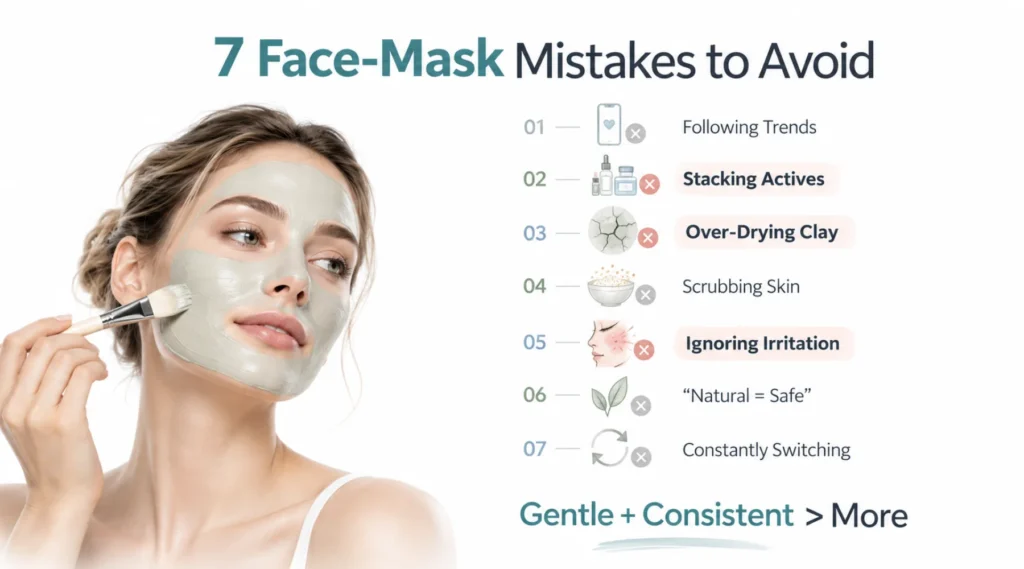
1. Choosing a mask by trend rather than skin need
A viral collagen hydrogel, a volcanic clay mask, or an overnight wrap might look great in videos. But that doesn’t mean your skin needs it.
First, ask yourself what skin issue you want to fix. Is it dryness? Then go for hydration. Is it oiliness? Look for products that absorb oil. If your skin feels dull, see if you’re missing gentle exfoliation in your routine.
If you don’t have a specific problem, enjoying the product is perfectly fine. Just keep your expectations realistic.
2. Using an active mask after several other actives
The skin goes through a complete routine.
Using an exfoliating cleanser, acid toner, treatment mask, and retinol is still harsh at night, even if each product claims to be gentle.
3. Waiting for clay to become painfully dry
The cracked-clay look in skincare images isn’t what you should aim for. Stick to the suggested contact time.
4. Scrubbing while removing the mask
A face mask has been on your skin for several minutes. You don’t need to rub it hard afterwards.
5. Trying to “purge” through irritation
Purging is often used too much to explain every bad reaction. Burning, swelling, skin rashes, and worsening irritation are not things you should ignore or tolerate.
6. Assuming natural ingredients cannot irritate
Botanical extracts, essential oils, and fragrance compounds can all trigger reactions. “Natural” means where it comes from, not that everyone can use it safely.
7. Changing masks constantly
Using a different mask every night makes it hard to see which products really help your skin. Sticking to a routine may be less fun, but it gives you better information.
When a Face Mask Is Worth Adding to Your Routine
A mask is most effective when it has a clear purpose.
For example:
- Your skin feels dry after a trip.
- You want added hydration before makeup.
- Your face gets oily in the centre.
- Your routine can handle occasional exfoliation.
- Cold weather makes your moisturiser less effective.
- You enjoy using masks as a relaxing part of your skincare.
When starting, it’s helpful to explore a range of skincare options to find your daily essentials. Once you know what you need, you can choose the right face mask. This distinction is important because masks should enhance your skincare routine, not replace it.
When You Probably Do Not Need a Face Mask
Skip the mask if:
- Your skin is sunburned
- You have a dermatitis flare
- Your skin is cracked or wounded
- You just had a professional treatment and haven’t been cleared to resume activities
- Your face is burning from over-exfoliation
- You’re trying to find out what’s causing a new rash
- Your skincare routine already provides similar benefits
After procedures like chemical peels, microneedling, or laser treatments, follow your clinician’s advice instead of your usual mask routine.
Face Masks Cannot Replace Treatment for a Skin Condition
A cosmetic mask can hydrate your skin, reduce oil, or brighten a dull complexion, but it cannot treat skin diseases. Hiding ongoing symptoms may delay proper care.
Talk to a GP, pharmacist, or dermatologist if you have:
- Painful or scarring acne
- Persistent redness on your face
- An itchy rash that keeps coming back
- Unexplained swelling
- Crusting or oozing
- Severe peeling
- Symptoms around your eyes
- Possible allergic reactions
- Skin issues that keep returning despite using the same products
Skincare should make your skin easier to manage, not create a cycle of irritation and calming.
Common Questions About Face Mask Frequency and Use
How often should beginners use a face mask?
Beginners should start using a face mask once a week. This helps you see how your skin reacts without overdoing it. If the mask feels good, you can use it more often. Be cautious with exfoliating and clay masks compared to basic hydrating masks.
How often can I use a face mask safely?
Most masks can be used one to three times a week. Hydrating masks can often be used more frequently, while clay and strong masks should be used less. Always follow the instructions on the label and consider your overall skincare routine.
How often should sensitive skin use a face mask?
If you have sensitive skin, use a mask once every one to two weeks. Start with a simple hydrating or soothing mask and increase how often you use it only if your skin tolerates it well. If your skin is irritated, it’s better to skip masking.
How often should oily skin use a face mask?
Oily skin should start with a clay mask once or twice a week. You can also use hydrating masks, especially if acne treatments dry out your skin. Daily use of oil-stripping masks is usually not needed.
Can I use a sheet mask every day?
Some hydrating sheet masks can be used daily if your skin tolerates them, but it’s not necessary. If your daily moisturiser keeps your skin comfortable, using a sheet mask a few times a week may be enough.
Should I do a face mask in the morning or at night?
You can use a face mask in the morning or at night. Hydrating masks work well in the morning before makeup, as long as they don’t leave a residue. Treatment masks are often better at night when you can complete your routine afterwards.
Should I apply serum before or after a face mask?
It depends on the mask. For rinse-off masks, cleanse first, use the mask, rinse, and then apply your serum. For sheet and hydrogel masks, use them after cleansing and toning, followed by moisturiser. Overnight masks are usually applied towards the end of your routine. Always check the mask’s instructions.
Do I need moisturiser after a face mask?
Often, yes, especially after clay, exfoliating, or rinse-off masks. A rich sleeping mask may not need an extra layer. After using a sheet mask, applying moisturiser can help lock in hydration. Adjust based on how your skin feels.
Can I use a clay mask and sheet mask on the same day?
You can, but it’s usually not necessary. If a clay mask dries your skin, you might want to use it less. Using the masks on different days can make your routine simpler.
Can face masks cause breakouts?
Yes, some masks can cause breakouts. Heavy or fragrant formulae may irritate acne-prone skin. If you notice breakouts after using a new mask, stop using it. Don’t assume your skin needs to “purge.”
Do collagen masks work if I use them more often?
Using collagen masks more often may provide temporary hydration, but it won’t rebuild skin collagen. Look for realistic results like softness and hydration, and remember that using it daily isn’t necessarily better.
How often can I wear under-eye masks?
Once to three times a week is enough for most people. You can use hydrating patches more often if they feel good. Stop if you experience itching, swelling, or irritation.
Can I sleep with a normal sheet mask on?
No, unless it’s designed for overnight use. Most regular sheet masks have a shorter recommended time. Some hydrogel or bio-cellulose masks can be worn longer, while sleeping masks are made for overnight use. Always follow the product instructions.
Can I mask after exfoliating my face?
A gentle hydrating mask can be okay after soft exfoliation, but don’t use another strong or exfoliating mask afterwards, as it may irritate your skin. Usually, there’s no need to exfoliate again if you already have.
How do I know whether my mask is helping?
Check how your skin feels after you remove the mask. A good mask should make your skin feel better or address your concerns without causing tightness, burning, peeling, or breakouts. If you need to mask frequently to see results, consider if your usual routine is solving your skin’s needs.
Finding the Right Face Mask Frequency for Your Skin
There isn’t a set number for how often to use face masks. Most people should use them one to three times a week. Hydrating masks can be used more often, while clay, exfoliating, or strong masks should be used less frequently. If you’re a beginner or have sensitive skin, start even more slowly.
Only use a mask if it works well for you. If your skin feels good with a once-a-week mask, don’t force yourself to use it daily. If an exfoliating mask makes your skin feel tight for three days, using it twice a week might not be right for you, even if the instructions say so.
Pick a mask based on its purpose, follow the recommended time, consider other products you use, and notice how your skin reacts. A mask should be a helpful addition to your skincare, not something your skin needs to recover from.