




Blog
Vitamin C vs Niacinamide: Key Differences and Best Uses


Vitamin C and niacinamide are often grouped as “brightening” agents, which makes it tough to choose between them. Both can help even out skin tone and make your skin look healthier, but they work differently and are not the same.
To decide between vitamin C and niacinamide, focus on what skin issue you want to address. Vitamin C is great for protecting against free radicals, reducing dullness, addressing sun damage, and supporting collagen. Niacinamide is useful for strengthening the skin barrier, managing oiliness, reducing redness, evening out pigmentation, and calming irritation.
Many people can safely use both vitamin C and niacinamide in their skincare routine, as long as the products are suitable for their skin and introduced carefully.
Most issues arise not from using them together but from using products that are too strong, layering too many active ingredients, or mistaking tingling and dryness for effective results.
Vitamin C vs Niacinamide at a Glance
Vitamin C and niacinamide have distinct roles, which become clearer when compared directly.
| Skin concern | Vitamin C | Niacinamide |
| Dull-looking skin | Excellent choice | Helpful |
| Dark spots and uneven tone | Very useful | Very useful |
| Antioxidant protection | Major strength | Supportive role |
| Fine lines and photoageing | Useful through antioxidant and collagen-related effects | Helpful through barrier and skin-function support |
| Excess oil | Not a primary oil-control ingredient | Often the better choice |
| Visible pores | Indirect benefit | Often useful where oiliness makes pores more noticeable |
| Weak or dehydrated skin barrier | Can sometimes sting compromised skin | Usually the stronger choice |
| Sensitive skin | Depends heavily on form and concentration | Often easier to tolerate |
| Post-acne marks | Useful | Useful |
| Active acne | Not a primary acne treatment | May be useful as part of an acne-friendly routine |
| Morning antioxidant routine | Excellent | Excellent companion ingredient |
| Beginner-friendly | Requires more attention to formulation | Usually easier to introduce |
No ingredient is universally “better.” A stable vitamin C serum is great for those worried about sun damage and dull skin. On the other hand, a moderate-strength niacinamide product can help someone with oily skin, irritation, or a weak skin barrier.
Your skin’s condition is just as important as the problem listed on the bottle.
What Vitamin C Actually Does in the Skin
Vitamin C is an antioxidant. It helps counteract harmful molecules from things like UV rays and pollution. However, it does not replace sunscreen, which is still essential for blocking UV exposure. Instead, think of vitamin C as an extra layer of protection in your daytime skincare routine.
Vitamin C also helps produce collagen, which gives skin its structure. As we age, collagen decreases, leading to fine lines and changes in skin texture. That’s why people use vitamin C to fight signs of ageing, not just to achieve a “glow.”
Vitamin C also plays a role in controlling pigmentation. It can disrupt the production of excess melanin, helping to even out skin tone and reduce dark spots from past skin issues.
So, understanding what vitamin C serum does is more helpful than just calling it a brightener. It protects against damage, helps with pigmentation, and supports collagen in the skin.
Vitamin C does not bleach healthy skin
Many people wonder: does vitamin C lighten skin?
Vitamin C can help reduce dark spots and make skin tone more even, but it won’t bleach the skin or change its natural colour. “Brightening” is a better term.
For example, someone with post-acne marks might notice the dark spots fading over time. A person with dull skin may achieve a fresher look. Both outcomes happen without altering the natural colour of unaffected skin.
Serious skin issues like persistent melasma or unusual spots should not be treated as regular dark spots. These should be evaluated by a professional.
How Niacinamide Works Differently
Niacinamide, a form of vitamin B3, works differently from vitamin C. While vitamin C is mainly known for its antioxidant properties, niacinamide plays several important roles for healthy skin. It helps strengthen the skin barrier, increases the production of barrier lipids like ceramides, and reduces water loss. It also helps skin handle everyday stress.
This makes niacinamide especially beneficial when skin feels both oily and dehydrated, a confusing situation for many. Skin can produce excess oil but still have a weak barrier. Using harsh cleansers or strong acids can make it feel tighter and shinier.
Niacinamide also affects how melanin moves between skin cells. This is one reason it can help reduce hyperpigmentation, using a different method than vitamin C. Understanding this difference is important because two ingredients can address the same skin issue but work in different ways.
Niacinamide has an advantage when barrier health is part of the problem
If your face stings, feels tight after washing, or gets red from active ingredients, it’s better to avoid a strong vitamin C serum at first.
Using a moderate-strength niacinamide product can be gentler on your skin. A moisturiser like a 24K Gold Niacinamide Essence can be easier if you don’t want multiple serums.
Always check the ingredient list instead of assuming that more niacinamide will give you quicker results.
Niacinamide is found in many products like cleansers, toners, essences, serums, moisturisers, and sunscreens. It’s easy to use it multiple times in one routine without knowing.
Remember, more isn’t always better.
Is Vitamin C Better Than Niacinamide for Dark Spots?
The best approach for treating pigmentation depends on what caused it.
Vitamin C is great for uneven skin tone, especially if you have sun damage, dullness, or signs of ageing. Niacinamide works well for irritation, acne-prone skin, or a weak skin barrier. Both can help with marks left after spots. Vitamin C reduces excess pigment formation, while niacinamide helps block pigment transfer in the skin. Using them together can be effective.
The main concern is preventing further pigmentation. If acne is still active, new marks will keep appearing. Frequent sun exposure makes it hard for brightening serums to work. If your skincare irritates your skin, it can worsen discolouration, especially in skin tones prone to dark spots.
Treating pigmentation works best with prevention. This usually means:
- Use broad-spectrum sunscreen during the day.
- Avoid picking at blemishes.
- Treat active acne as needed.
- Reduce unnecessary irritation.
- Use brightening ingredients consistently, not aggressively.
A serum alone won’t fix an irritating skincare routine.
Which Is Better for Dull, Tired-Looking Skin?
Vitamin C is best for dull skin. It boosts brightness and helps with uneven skin tone, making skin look clearer and more radiant with regular use. That’s why it’s great for morning skincare.
A 20% Vitamin C Serum might attract those familiar with strong vitamin C. However, beginners shouldn’t start with the highest concentration. Quality of the product, form of vitamin C, packaging, and stability matter as much as the percentage on the label.
Niacinamide can also help with dull skin by promoting hydration and reducing inflammation, which makes skin look smoother and healthier. But if I had to choose one key ingredient for tired and uneven skin, I would recommend vitamin C.
Which Is Better for Oily Skin and Visible Pores?
Niacinamide is often the best first choice for oily skin. It can help control excess oil and may make enlarged pores look smaller when oiliness and congestion affect their appearance.
It’s important to have realistic expectations. Niacinamide can’t actually close pores. Pores are normal openings linked to hair follicles and oil glands. Their size is affected by genetics, oil production, congestion, skin elasticity, and ageing.
When you better control surface oil and the skin around pores looks smoother, they may appear less noticeable. However, this doesn’t mean the pores permanently shrink.
You can still use vitamin C on oily skin, especially if post-acne marks are a concern. The best vitamin C for oily skin is usually lightweight, so it doesn’t make sunscreen or makeup feel heavy.
Choose your skincare product based on your skin type, not just the main ingredient.
Vitamin C vs Niacinamide for Dry or Dehydrated Skin
Dry skin benefits from niacinamide because it helps the skin’s barrier. However, it isn’t a replacement for moisturiser. Niacinamide can help skin retain moisture, but a watery niacinamide serum alone won’t meet all the needs of very dry skin. You may still need humectants, emollients, and occlusive ingredients.
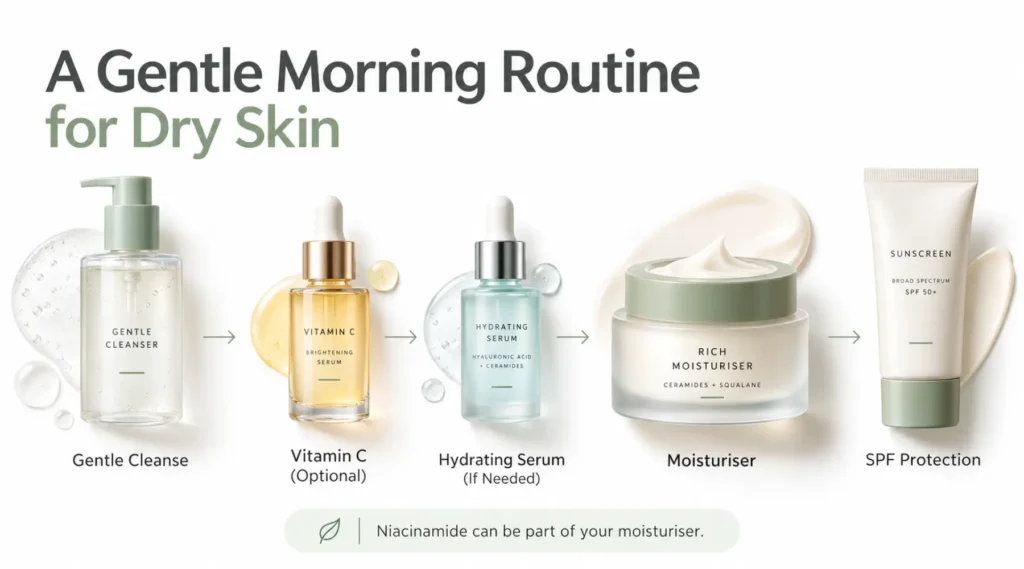
Vitamin C can also be used for dry skin, but some acidic L-ascorbic acid formulae may sting or feel drying if your skin barrier is damaged. If your skin is very dry, focus on comfort before starting an ambitious brightening routine.
A good morning routine might include:
- Gentle cleanser or a water rinse.
- Vitamin C if your skin can handle it.
- Hydrating serum if needed.
- Moisturiser.
- Broad-spectrum sunscreen.
Your moisturiser may already have niacinamide, so an extra niacinamide serum might not be needed.
Vitamin C or Niacinamide for Sensitive Skin?
For sensitive skin, niacinamide is often the best choice. However, not all niacinamide products are gentle. Some people may find high concentrations uncomfortable. Others might react to fragrances, botanical extracts, preservatives, or solvents instead of niacinamide.

Vitamin C sensitivity varies based on its form. Pure L-ascorbic acid is effective but may cause stinging, redness, or dryness on reactive skin due to its low pH. Vitamin C derivatives may be easier to handle, but they don’t work exactly like pure ascorbic acid.
When choosing between vitamin C and niacinamide for sensitive skin, I prioritise the ingredient that the skin can handle consistently without causing irritation. An ingredient that offers stronger results isn’t worth using if it only leads to peeling after a couple of applications.
Do not introduce a new active during a barrier flare.
Wait if your skin is:
- Peeling
- Burning when you apply moisturiser
- Cracked
- Recently sunburned
- Irritated after waxing or shaving
- Recovering from a strong peel
- Having an eczema or dermatitis flare
Focus on healing your skin before brightening it.
Is Vitamin C Better Than Niacinamide for Fine Lines?
Vitamin C is important for fighting photoageing because it acts as an antioxidant and helps with collagen. However, wrinkles aren’t caused by just one missing ingredient. Factors like sun exposure, ageing, facial movements, collagen breakdown, dry skin, smoking, genetics, and hormonal changes all affect how we age.
Niacinamide can help by improving the skin barrier and hydration, making fine lines less noticeable and boosting overall skin quality. However, neither vitamin C nor niacinamide can match the results of treatments that address deeper wrinkles.
For early skincare prevention, it’s better to use a mix of sunscreen, antioxidants, moisturisers, and an evidence-based retinoid when needed instead of searching for one perfect serum.
Can You Use Niacinamide With Vitamin C?
Yes, you can use niacinamide and vitamin C together. The old belief that they shouldn’t be mixed is outdated for modern skincare products.
This warning came from early chemical studies that don’t reflect how most cosmetics are made, packaged, and applied to skin today.
Niacinamide and vitamin C products can usually work well together. The real question is whether your specific products mix well and whether your skin can handle both.
If you have concerns, you don’t need to apply them together. You can use them separately to avoid irritation, stickiness, or pilling.
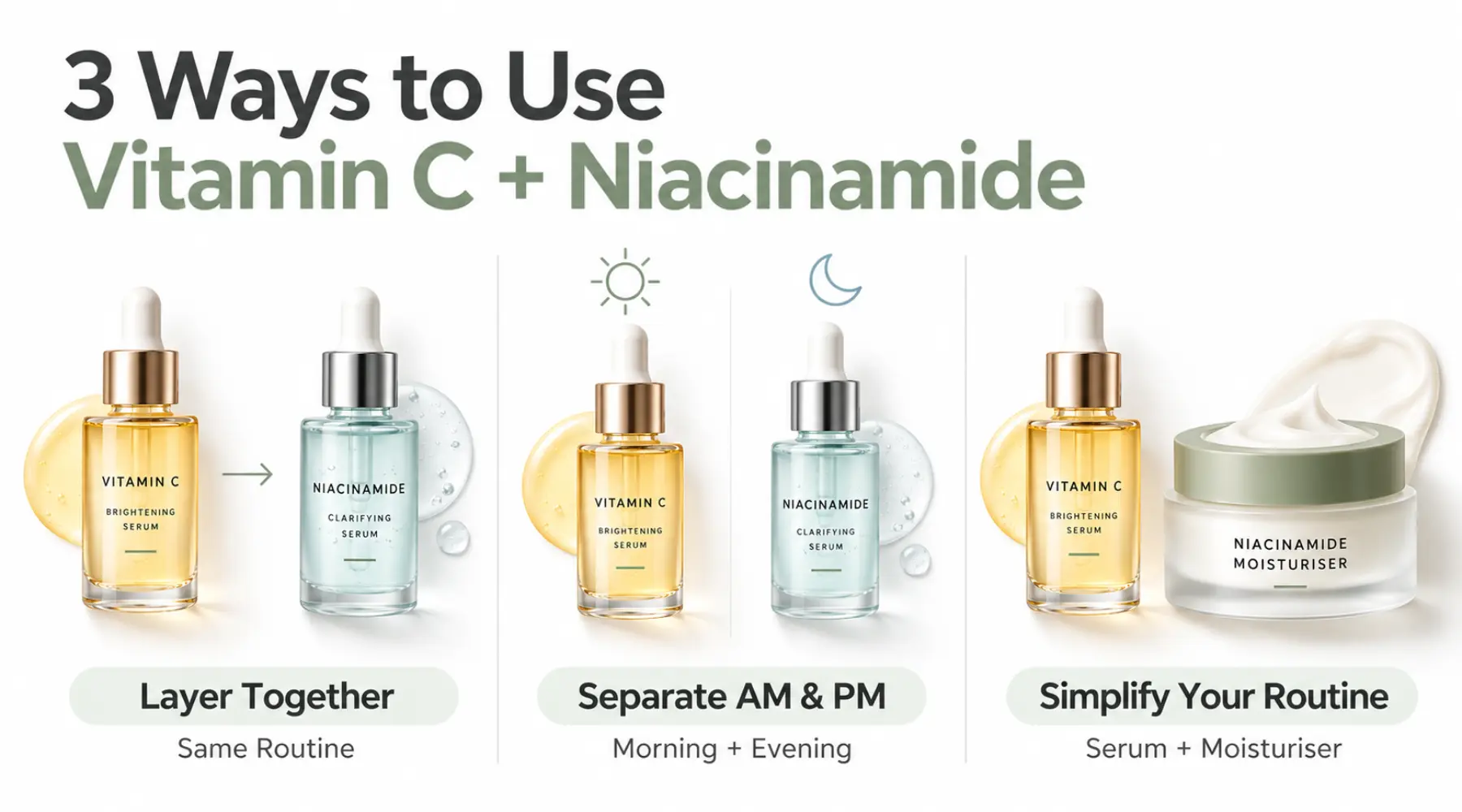
Three sensible ways to use them
Option One: Vitamin C First, Then Niacinamide
This method is great for morning routines when you use vitamin C as your main antioxidant.
Steps:
- Cleanser
- Vitamin C
- Niacinamide
- Moisturiser
- Sunscreen
Use watery serums with vitamin C first, especially if it has L-ascorbic acid. Follow the instructions for each product.
Option Two: Vitamin C in the Morning, Niacinamide at Night
This is the easiest choice for beginners.
Morning Routine:
- Cleanser
- Vitamin C
- Moisturiser
- Sunscreen
Evening Routine:
- Cleanser
- Niacinamide
- Moisturiser
Using them at different times does not mean they can’t work together; it just makes your routine simpler.
Option Three: Niacinamide in Your Moisturiser
You might not need two serums.
Put on vitamin C, then use a moisturiser that contains niacinamide, like a 24K Gold Niacinamide Essence Moisturiser. This can streamline your routine.
Always check if your sunscreen, moisturiser, or other products already have niacinamide before adding more.
How to Use Vitamin C Serum Without Making Your Routine Complicated
Many people focus on which ingredients to mix and forget the basics of using vitamin C serum. A simple morning routine works for most.
Step 1: Cleanse Your Skin
Use a cleanser that removes sweat, oil, and dirt without making your skin feel tight or rough.
Step 2: Apply Vitamin C
For most serums, a thin layer is enough. Think about coverage, not quantity. A few drops are usually enough, but follow your product’s instructions.
Step 3: Add Niacinamide or Hydration If Needed
You don’t have to add extra serums just because they are popular. Only add something if it serves a purpose.
Step 4: Moisturise
Pick a moisturiser that matches your skin type. Oily skin might like a gel-cream, while dry skin may need a richer formula.
Step 5: Use Sunscreen
Vitamin C helps protect your skin from the sun but doesn’t replace sunscreen. Apply a broad-spectrum sunscreen generously. This step is just as important as the vitamin C serum for preventing skin damage.
When to Use Vitamin C Serum: Morning or Night?
When people ask about when to use vitamin C serum, the best answer is usually in the morning. During the day, your skin faces environmental stress, making vitamin C a good partner for sunscreen. However, you can also use it at night if:
- Your morning routine has many products.
- The serum doesn’t work well under sunscreen.
- You prefer fewer layers in the morning.
- Your skin handles it better at night.
- You want to keep vitamin C separate from other morning products.
What’s most important is being consistent. Using vitamin C four or five mornings a week is better than forcing it twice daily, which could irritate your skin.
Vitamin C vs Niacinamide for Beginners
If you’re new to active skincare, niacinamide is a good starting point. You can add it to your routine without changing everything else. Vitamin C, however, needs more attention since different types and strengths can act differently.
As a beginner, you don’t need:
- 20% vitamin C right away
- 10% niacinamide just because it’s stronger
- five brightening ingredients
- daily exfoliating acids
- separate antioxidants for morning and night
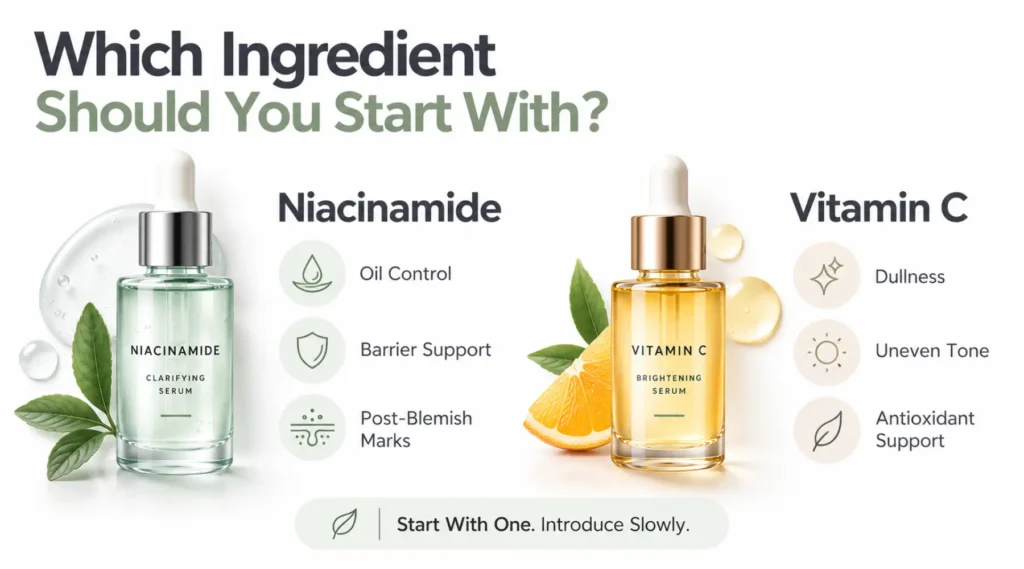
Start with your main concern. If you want to control oil, support your skin barrier, or reduce post-blemish marks, use niacinamide first. If you’re more worried about dullness, environmental damage, or uneven skin tone from the sun, start with vitamin C.
Use one product for a few weeks before adding another. This way, if you have irritation or breakouts, you’ll know what caused them.
When stronger vitamin C makes sense
A 20% Vitamin C Ampoule Serum is good for people whose skin can handle vitamin C and who want a stronger option.
“20%” does not mean it’s “20% better.”
Higher concentrations can cause more irritation without offering better results. The serum’s effectiveness also depends on the type of vitamin C, how it’s mixed, its acidity, stability, and how it’s stored.
Understanding how the serum is made is more important than just looking at the percentage on the label.
L-Ascorbic Acid and Vitamin C Derivatives Are Not the Same Thing
“Vitamin C serum” refers to a type of product rather than a single ingredient.
L-Ascorbic Acid
L-ascorbic acid is the most active and studied form of topical vitamin C. However, it can be challenging to formulate because it oxidises easily and often needs an acidic environment to work well. This makes effective L-ascorbic acid serums powerful but possibly uncomfortable for very sensitive skin.
Vitamin C Derivatives
Some skin care products use different forms of vitamin C, like:
- Sodium ascorbyl phosphate
- Magnesium ascorbyl phosphate
- Ascorbyl glucoside
- 3-O-ethyl ascorbic acid
- Tetrahexyldecyl ascorbate
These derivatives are often chosen for better stability or easier formulation. However, they may not all give the same results, even at the same concentration. Therefore, comparing two products just by their percentage of vitamin C can be misleading. Ten percent of one form is not the same as ten percent of another.
Niacinamide Concentration Matters Too
Niacinamide is often marketed as “the stronger, the better.” While you can find products with very high percentages, most people don’t need them. Moderate amounts already support skin health, and sensitive individuals may experience redness, itching, or irritation from stronger formulae.
If a 5% product works for you without causing discomfort, switching to 10% or more isn’t necessarily better.
Also, consider your entire skincare routine. Niacinamide can be found in:
- cleansers
- toners
- serums
- essences
- moisturisers
- foundations
- sunscreens
Using a powerful niacinamide serum in addition to other niacinamide products may be unnecessary. Serums are helpful for delivering specific ingredients, but they don’t always guarantee better results.
Can You Use Hyaluronic Acid With Vitamin C?
Yes, you can use hyaluronic acid with vitamin C.
Hyaluronic acid attracts and holds water in the skin. It won’t interfere with vitamin C. This mix is great if your vitamin C serum feels drying.
Here’s a simple routine:
Cleanser → vitamin C → hyaluronic acid → moisturiser → sunscreen.
You don’t need to wait for long between products. Once vitamin C feels settled, you can move on.
If your vitamin C serum has glycerin, hyaluronic acid, or other humectants, you might not need an extra hydrating serum. Check the ingredients first.
Layering Order Matters Less Than Product Compatibility
The common advice to apply skincare from thinnest to thickest is helpful, but don’t stress over it. The texture, formula, and brand guidelines can change this rule.
For example, a watery niacinamide essence can be put on before a thick vitamin C cream. An acidic L-ascorbic acid serum might work better applied directly to clean, dry skin before using other products.
You don’t need to be exact while applying in front of your mirror. Just pay attention to how the products react.
If they:
- peel or flake
- feel too sticky
- sting more when mixed
- affect sunscreen
- cause foundation to clump
then try using some products in the morning and others at night for a better routine. Good skincare should fit into your daily life.
Why Sunscreen Changes the Vitamin C vs Niacinamide Conversation
Both ingredients are popular for treating dark spots, but they won’t effectively handle pigmentation if you’re still exposing your skin to UV rays. This is especially true for conditions like post-inflammatory hyperpigmentation and melasma.
Vitamin C offers antioxidant benefits, but it is not sunscreen. Niacinamide helps improve the skin barrier and uneven pigmentation, but it also lacks SPF protection.
If your goal is an even skin tone, use sunscreen to prevent damage and brightening ingredients to fix existing issues. Trying to reduce sun-related pigmentation without sun protection is like fixing a wall while leaving the leak that caused the damage.
So, include broad-spectrum SPF in your routine whether you use vitamin C, niacinamide, or both.
Can Vitamin C and Niacinamide Help Acne?
Niacinamide shouldn’t be seen as a complete acne treatment. It can help acne-prone skin by supporting the skin barrier, controlling oil, and reducing redness. It may also help fade marks left after blemishes heal.
Vitamin C is better at reducing pigmentation from acne rather than treating the actual causes of acne.
To treat active acne, you may need ingredients like salicylic acid, benzoyl peroxide, azelaic acid, or a retinoid, based on the type and severity of the acne.
If you have moderate or severe acne, painful bumps, scarring, or acne that doesn’t improve with over-the-counter products, talk to a GP or dermatologist.
Clearing acne and fading marks are different goals, even though they are related.
Using Vitamin C and Niacinamide With Retinoids
You can use both retinoids and other products in your skincare routine, but don’t start them all at once if you’re a beginner. Here’s a simple routine:
Morning:
- Cleanser
- Vitamin C
- Moisturiser
- Sunscreen
Evening:
- Cleanser
- Retinoid
- Moisturiser
You can add niacinamide to either routine if your skin can handle it, especially if it’s already in your moisturiser.
Separating these products isn’t because they can’t work together; it just helps prevent irritation by giving each product its own time.
If your skin starts peeling, feeling shiny and tight, stinging when you moisturise, or showing redness, cut back on active products. Adding another serum won’t help if your skin barrier is damaged.
What About Vitamin C With Exfoliating Acids?
Glycolic acid, lactic acid, and salicylic acid can be helpful, but mixing strong acids with vitamin C might irritate some people.
You don’t gain any benefits by using too many active ingredients at once.
If you’re using glycolic acid, you can apply vitamin C in the morning and exfoliate on certain nights.
If you’re using salicylic acid for acne, you might use vitamin C on mornings when your skin feels good. Niacinamide is a gentler option to support your routine.
The best schedule is one that your skin can handle regularly.
Common Mistakes That Make Both Ingredients Perform Worse
Choosing strength before formulation
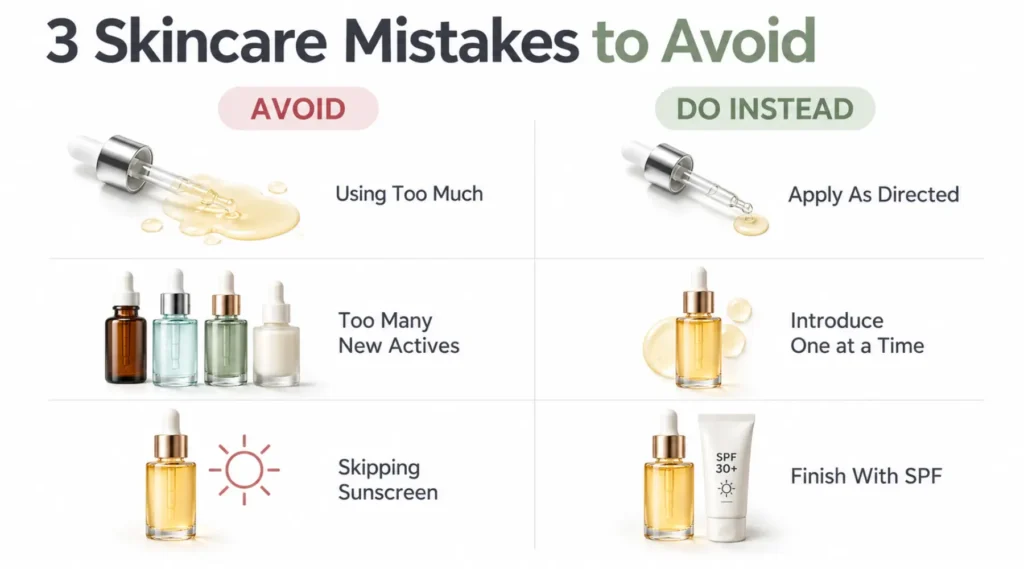
A steady, gentle 10% vitamin C product you use every morning may work better than a strong 20% formula you stop using after a week. The same idea applies to niacinamide.
Introducing Several Products Together
Starting vitamin C, niacinamide, retinol, and glycolic acid all at once can make it hard to identify any irritation. Introduce one product at a time.
Applying Too Much
Using a thick layer does not boost effectiveness. It mainly leads to waste, stickiness, and the risk of other products not applying well.
Treating Irritation as Proof of Effectiveness
Feeling a burn does not mean vitamin C is working. Niacinamide shouldn’t tingle. Continuous burning, redness, itching, scaling, or swelling means there’s a problem with the product or routine.
Ignoring Product Oxidation
Some L-ascorbic acid serums can oxidise when exposed to air, heat, and light. Dark orange or brown colours can mean significant oxidation, but not all products are the same; some have natural colours. Packaging that limits light and air can help protect sensitive antioxidants.
Neglecting Sunscreen
Skipping sunscreen is a big mistake for treating pigmentation. A brightening serum can’t replace the protection you need from UV rays.
Expecting Immediate Results
Healthy skin takes time to change. You might see some surface brightness improve, but deep or old dark spots can take months to fade and might not go away with skincare products alone.
Building a Routine Around the Skin Concern, Not the Trend
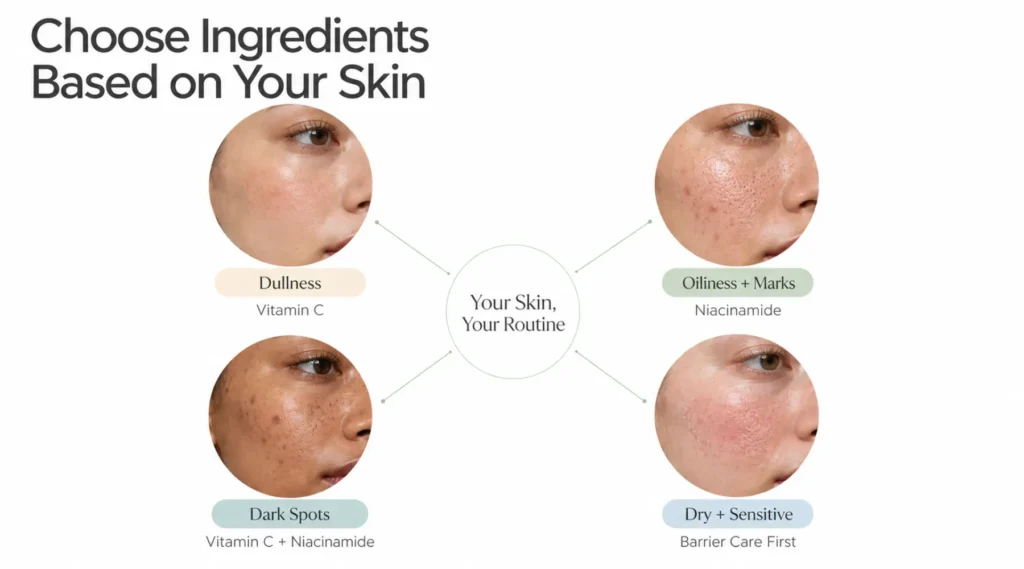
A Routine Should Meet a Specific Need
If dullness is your main issue:
Morning:
- Gently cleanse your face.
- Apply Vitamin C serum.
- Use a moisturiser.
- Put on broad-spectrum sunscreen.
If you’re interested in an antioxidant serum, you can try a 20% Vitamin C serum once your skin is used to stronger Vitamin C.
For Oiliness and Post-Acne Marks:
Morning:
- Use a gentle cleanser.
- Apply niacinamide.
- If needed, use a lightweight moisturiser.
- Don’t forget sunscreen.
Evening:
- Cleanse your face.
- Treat acne with the right product.
- Apply moisturiser.
- You can add vitamin C later for dark spots if your skin feels good.
For Pigmentation:
Morning:
- Cleanse your face.
- Use vitamin C.
- Add niacinamide if helpful.
- Apply moisturiser.
- Use broad-spectrum SPF.
Evening:
- Cleanse again.
- Apply niacinamide, azelaic acid, or another treatment for pigmentation.
- Use moisturiser.
*Avoid mixing too many ingredients for pigmentation. It’s better to have a simple routine you can stick to.*
For Dry and Reactive Skin:
Start with:
- A gentle cleanser.
- A moisturiser that supports your skin barrier.
- Sunscreen.
*Once your skin feels okay, you can add niacinamide. Introduce vitamin C later, but use it less often.*
If you already tolerate active skincare well
Experienced users might opt for a concentrated serum or ampoule.
A 20% Vitamin C Ampoule Serum can take care of the vitamin C step, while a niacinamide moisturiser can help support the skin barrier later in the routine.
Being experienced doesn’t mean you’re immune to irritation. Too many overlapping treatments can still cause problems.
What About Multi-Ingredient Glow Serums?
For instance, with a 24K Gold Serum, look at the full ingredient list instead of assuming that all “glow” ingredients work like vitamin C. This is crucial when comparing cosmetics.
A radiance serum, hydrating serum, niacinamide treatment, and vitamin C serum can all brighten skin but do so differently. Choose based on your skin’s needs.
If you want to combat uneven skin tone, choose a reliable vitamin C formula. If hydration and skin barrier comfort are your goals, opt for a moisturising treatment. If a product already includes niacinamide, adding another niacinamide serum might not add much value.
Can Vitamin C Be Used on the Body?
Yes.
Sun exposure, blemish marks, and uneven skin tone can affect your chest, shoulders, arms, and face.
Using a Vitamin C Face and Body Serum is a good idea for larger areas if your skin can handle it.
Remember these tips:
- Apply it to unbroken skin.
- Avoid freshly shaved or waxed areas if they hurt.
- Moisturise as needed.
- Use sunscreen on exposed skin.
- Start using it slowly.
While body skin may seem tougher, harsh treatments can still cause irritation and discolouration.
How Long Before Vitamin C or Niacinamide Starts Working?
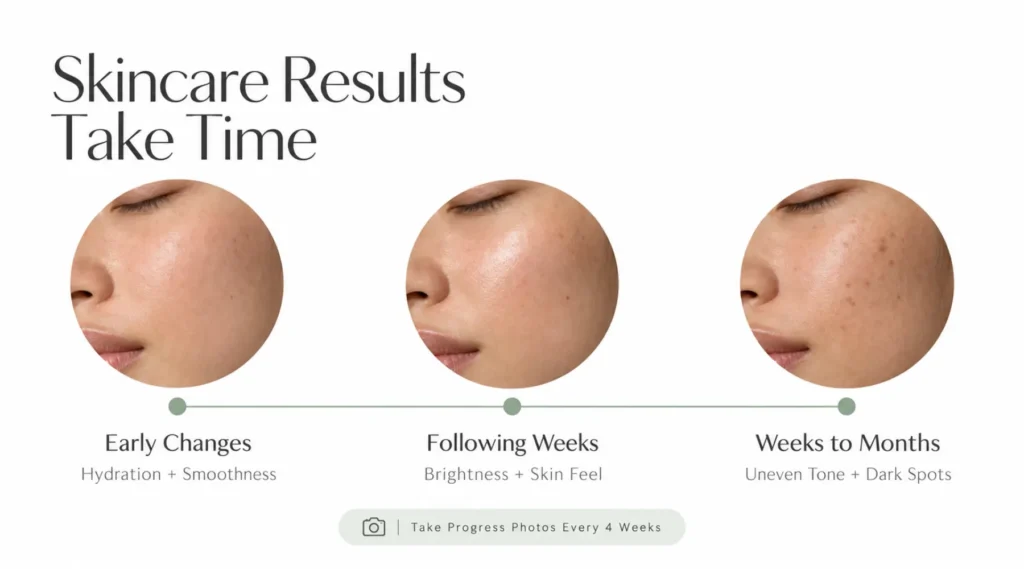
- Skincare timelines: Track your skin progress in weeks or months, not days.
- Hydration improvements: You might see quick changes in skin smoothness from hydration. But it takes longer to see changes in colour, oil control, or signs of ageing.
- General skin changes: With regular use, you may notice your skin looks brighter or feels better before stubborn spots change.
- Skin photos: Take a photo of your skin every four weeks in the same lighting. This helps more than checking it every morning, as daily changes from hydration, sleep, light, hormones, and inflammation can affect your appearance.
- Irritation warnings: If a product is causing more irritation instead of improvement, stop using it. Patience is important for pigmentation changes, but it’s not a reason to ignore skin issues like dermatitis.
When Skincare Ingredients Are Not Enough
Vitamin C and niacinamide are cosmetics, not cures for every skin issue.
Seek professional advice if your pigmentation:
- changes quickly
- shows an unusual pattern
- comes with a changing mole or lesion
- doesn’t improve with proper treatment
- worsens after inflammation
- may be melasma, which needs a detailed treatment plan.
Professional options can include prescription creams, chemical peels, lasers, or other methods based on your diagnosis and skin type. Choose treatments carefully, especially for darker skin, as too much inflammation can cause more pigmentation.
The first question should always be about the condition itself, not which strong treatment works the fastest.
Questions People Ask About Vitamin C and Niacinamide
Can you use vitamin C and niacinamide together every day?
Yes, you can use both products together if your skin can handle them. You can apply vitamin C in the morning and niacinamide at night. You don’t need to use them every day if one causes irritation. It’s better to use them less often to keep your skin comfortable.
Is vitamin C better than niacinamide?
Neither vitamin C nor niacinamide is better overall. Vitamin C is great for protecting against free radicals, dull skin, sun damage, and uneven skin tone. Niacinamide helps support the skin barrier, control oil, reduce sensitivity, and address inflammation-related pigmentation. Your main skin issue should guide your choice.
What is the main difference between vitamin C and niacinamide?
Vitamin C mainly acts as an antioxidant and supports collagen and pigmentation. Niacinamide helps with skin barrier function, oil control, and pigment movement. While they may offer similar benefits, they work in different ways.
Can I use niacinamide with vitamin C if I have sensitive skin?
You can, but don’t use both at the same time. Start with one product and see how your skin reacts before adding the other. Sensitive skin may do better using vitamin C in the morning and niacinamide at night instead of layering them.
Vitamin C or Niacinamide for Sensitive Skin: Which Should I Start With?
Niacinamide is usually a good first choice, especially in moderate amounts. L-ascorbic acid can irritate sensitive skin. However, the quality of the product is important, as both ingredients can irritate.
How Should Beginners Use Vitamin C vs. Niacinamide?
Pick one based on your main skin issue and use it regularly for a few weeks. Niacinamide is better for oiliness or barrier problems. Vitamin C helps with dullness and sun damage. Once your skin adjusts, you can add the second ingredient if needed.
How Do You Apply Vitamin C Serum Correctly?
Put on a thin layer after cleansing and before heavier moisturisers. Follow the product instructions, especially for dry skin. During the day, finish with broad-spectrum sunscreen.
When Should Vitamin C Serum Be Used?
The morning is often best since vitamin C helps sunscreen work better. Using it at night is also effective and might fit some routines better. Being consistent is more important than the exact time you use it.
Can you use hyaluronic acid with vitamin C and niacinamide?
Yes, you can use hyaluronic acid with both. It adds moisture without interfering with their main roles. Depending on the product texture, apply vitamin C first, then hyaluronic acid, and finish with a moisturiser.
Does vitamin C lighten skin?
Vitamin C can lighten dark spots and even out skin tone, but it won’t bleach healthy skin or change your natural colour. It brightens and corrects uneven skin.
Which is better for acne marks, vitamin C or niacinamide?
Both help with marks left by acne. Vitamin C targets dark spots, while niacinamide helps with pigment transfer and strengthens the skin barrier. If you’re still getting active acne, focus on treating that first.
Can vitamin C and niacinamide cause purging?
No, they don’t usually cause purging. Purging is often linked to treatments that speed up skin-cell turnover, like retinoids and exfoliants. New bumps from vitamin C or niacinamide could be due to irritation, other ingredients, or the product’s texture.
Which should go first, vitamin C or niacinamide?
When using an L-ascorbic acid serum, apply vitamin C first on clean skin, then add niacinamide. However, follow the product instructions. If using both together causes problems like pilling or irritation, try using them at different times.
Can I use vitamin C in the morning and niacinamide at night?
Yes. This schedule is great for beginners and those with sensitive skin. It allows each ingredient to work effectively without overlapping.
Do I need both vitamin C and niacinamide?
No. A good skincare routine doesn’t depend on the number of active ingredients. Use both only if they address your specific skin concerns. If your skin is healthy and you have just one issue, one product may be enough.
Vitamin C vs Niacinamide: Choosing What Your Skin Actually Needs
The debate between vitamin C and niacinamide isn’t about one being better than the other; they both tackle similar skin issues in different ways.
Choose vitamin C if you want to boost antioxidants, brighten dull skin, correct sunspots, and support collagen. Opt for niacinamide if you need to strengthen your skin barrier, control oil, reduce sensitivity, and improve daily resilience.
Using both can be beneficial if their strengths enhance your skincare routine.
It’s not about having many serums. What matters is finding a product your skin likes, applying enough for even coverage, protecting against UV rays, and giving your routine time to work.
A steady, comfortable routine usually leads to better long-term results than an aggressive one focused on strong ingredients or current trends.