




Blog
Niacinamide for Oily Skin: Benefits, Risks and Use Tips


Oily skin is often treated by trying to dry it out. This can lead to a frustrating cycle of using stronger cleansers and more scrubs, but the shine usually returns by lunchtime.
Niacinamide takes a different approach. Instead of removing oil, it helps reduce excess oil while supporting the skin barrier and calming irritation. This is especially helpful for oily skin with large pores, breakouts, redness, or dryness.
Niacinamide doesn’t instantly mattify the skin or permanently change oily skin. However, it can help the skin feel more comfortable over time if used in the right concentration and formula, along with a good skincare routine.
It’s important to note that healthy skin needs some oil. The goal isn’t to eliminate all oil; it’s to control excessive shine and irritation without harming the skin’s protective barrier.
Is Niacinamide Good for Oily Skin?
Yes, niacinamide is a great skincare ingredient for oily skin. It helps with several issues at once: excess oil, skin barrier problems, inflammation, and uneven skin tone after blemishes.

A study using 2% niacinamide showed that it can reduce facial oil after a few weeks, though results vary among different people. This means niacinamide can help balance oil, but it won’t completely stop oil production for everyone.
This is a good thing because sebum, or skin oil, is not bad; it keeps the skin lubricated and protects it. Problems occur when oil is too much, especially when it mixes with dead skin in pores.
Niacinamide is particularly helpful for oily skin that has:
- Ongoing shine
- Enlarged pores
- Mild blemishes
- Marks from acne
- Redness around spots
- Dehydration under oily skin
- Irritation from acne treatments
- Areas that get oily quickly
It’s not as effective for severe acne, persistent blackheads, deep cysts, or major hormonal breakouts.
Understanding niacinamide’s benefits helps highlight its value. It supports multiple skin functions at once instead of just focusing on one issue.
Why Oily Skin Produces More Sebum Than It Needs
Sebum comes from sebaceous glands found mainly on the forehead, nose, cheeks, and chin. This is why the central face often appears shiny first.
How oily a person gets involves more than just their cleanser. Genetics play a big role, and hormones, especially androgens, increase oil production. This is why oiliness and acne are usually more noticeable during puberty and can change throughout adulthood.
Climate also affects oiliness. Warm, humid weather can make oil feel more prominent, while cold weather may cause an oily T-zone with dry cheeks.
Skincare practises matter too. Over-cleansing doesn’t effectively balance naturally oily skin. A harsh cleanser may remove oil temporarily, making the face feel clean for a short time, but it doesn’t fix the oil production from the glands.
Dermatologists recommend gentle cleansing instead of trying to strip away all oil. The American Academy of Dermatology says oily skin still needs moisturiser and should avoid harsh products.
It’s important to distinguish between oily skin and dehydrated skin. Oily skin means excess sebum, while dehydration means a lack of water in the skin’s upper layers. Both conditions can occur at the same time. This explains why someone might have a shiny forehead but feel tight skin or see flakiness around the nose after cleansing.
Niacinamide is interesting in this context because it offers benefits beyond controlling oil.
What Does Niacinamide Do for Skin That Becomes Oily?
Niacinamide, also known as nicotinamide, is a form of vitamin B3. In skincare, it helps with several processes that keep skin healthy. Instead of acting like an exfoliating acid, it supports skin functions.
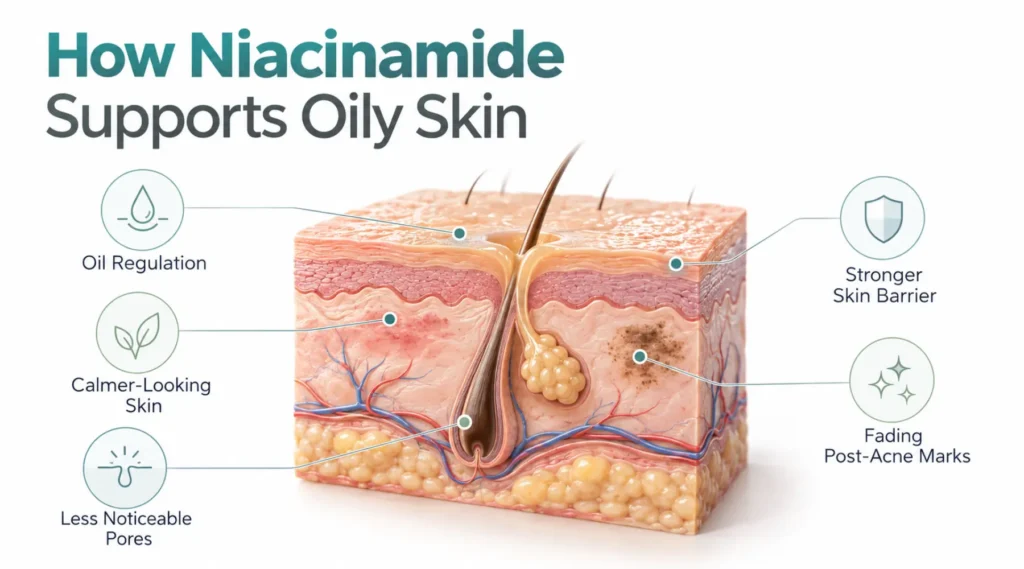
Oil Control
Niacinamide may help reduce excess oil, which is beneficial for oily skin. Research shows that using 2% topical niacinamide can lower facial oil in about four to six weeks. However, results can vary among individuals, so don’t expect dramatic “oil control” claims in marketing. Some users may notice less shine on their foreheads or better makeup wear, while others might see only slight changes. Think of niacinamide as an ingredient that helps regulate oil, not completely erase it.
Strengthening the Skin Barrier
The skin’s outer layer relies on lipids like ceramides and fatty acids to retain water and keep irritants out. Studies show that niacinamide can help produce these lipids and reduce water loss from the skin. Oily skin can still feel tight or dehydrated, especially if over-cleansed or treated with harsh products. Niacinamide supports the skin barrier instead of just hiding shine.
Anti-Inflammatory Effects
Inflammation can lead to problems like acne in oily skin. Niacinamide has anti-inflammatory properties that may help improve acne by lowering inflammation and oil levels. While it’s not a substitute for prescription acne treatments, it can help balance an acne skincare routine.
Reducing Post-Acne Marks
After a blemish fades, many people are left with dark marks. Niacinamide can influence how melanin moves between skin cells, potentially making dark spots less noticeable over time. It’s important to use sunscreen as well, since UV exposure can worsen these marks.
Minimising the Appearance of Pores
Niacinamide does not close pores; they are openings in the skin. However, large pores can appear more noticeable if they are filled with excess oil and debris or if the skin texture is uneven. By reducing shine and smoothing the skin’s surface, niacinamide can help make pores seem less prominent. This is a cosmetic improvement and does not change the actual pore structure.
How Much Can Niacinamide Realistically Reduce Oil?
Niacinamide is not like blotting powder, which quickly removes oil from the skin. It doesn’t work like medications that change how the sebaceous glands function. Its effects take time to show.
If you have slightly oily skin, you might notice a significant improvement. However, if you have very oily skin due to genetics or hormones, you may only see limited results. This doesn’t mean niacinamide isn’t effective.
If you normally blot your face three or four times a day and niacinamide reduces that to once or twice, that improvement is still worth it.
Clinical studies on 2% niacinamide showed changes in about two to six weeks, depending on the study and the participants. For daily skincare, it’s better to evaluate the product over six to eight weeks instead of just a few days. Changes in acne, pigmentation, and skin texture may take even longer.
How Long Does Niacinamide Take for Oily Skin?
Some people feel their skin is calmer and more comfortable after switching to a gentler routine. However, oil regulation takes more time.
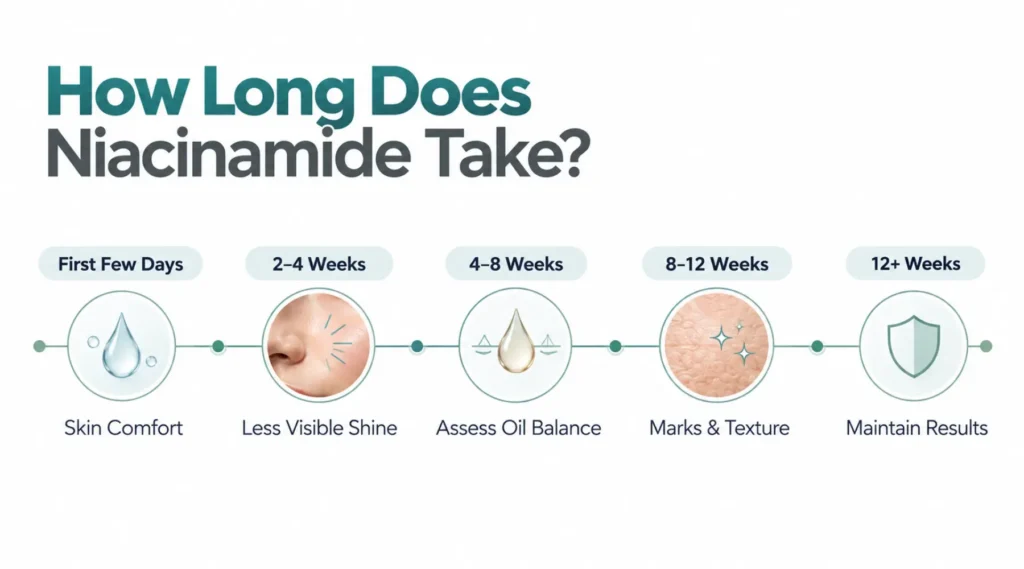
A realistic timeline looks like this:
| Time using niacinamide | What you might notice |
| First few days | Mainly how well the formula feels and layers |
| 2–4 weeks | Possible improvement in surface shine or comfort |
| 4–8 weeks | More useful point for assessing oil balance |
| 8–12 weeks | Better time to assess blemishes, marks and texture |
| Beyond 12 weeks | Maintenance rather than continually increasing strength |
Don’t expect your skin to get drier each month. That shouldn’t be your goal.
Once the shine is under control, it’s better to keep that balance rather than looking for stronger treatments.
How to Use Niacinamide for Oily Skin Without Overcomplicating Your Routine
For most people, use niacinamide serum after cleansing and before moisturising.
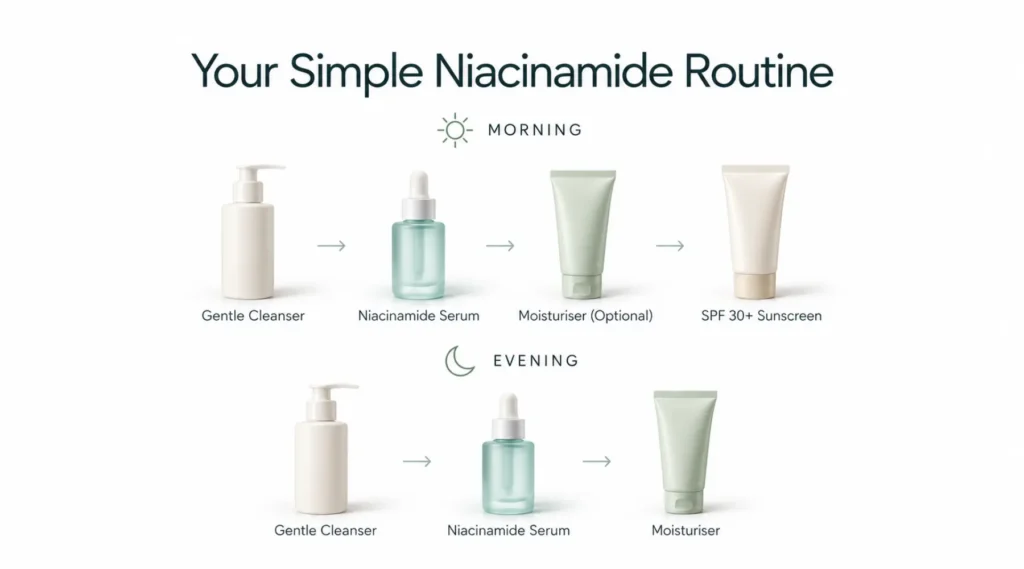
Morning Routine:
- Gentle cleanser
- Niacinamide serum
- Lightweight moisturiser (if needed)
- Broad-spectrum sunscreen
Evening Routine:
- Cleanser
- Niacinamide serum
- Moisturiser
People with oily skin usually prefer lightweight, water-based serums, essences, or gel-creams instead of thick creams. However, oily skin doesn’t have to avoid all oils or emollients.
It’s helpful to have clear instructions on using niacinamide in your skincare routine, especially when using multiple serums or treatments. The order of application can be more confusing than the ingredient itself.
Start once daily
Using niacinamide twice daily isn’t always better. If you’re new to it, start with once a day. If you have sensitive skin, try every other day at first. Once you see that it works for you, you can increase how often you use it if needed.
Use a thin, even layer
For most dropper serums, two or three drops are enough for your face, but always follow the manufacturer’s instructions. Applying a thick layer won’t make it work faster. Using too much serum can cause stickiness, pilling under sunscreen, or irritation from other ingredients.
Moisturise even when your skin is oily
Many oily-skin routines make mistakes here.
If your skin feels good after using niacinamide and sunscreen, you might not need a heavy cream in the morning.
However, if your skin feels tight, dry, or you’ve used retinoids, a moisturiser can help.
A lighter option like a 24K Gold Niacinamide Essence moisturiser may work well for those who prefer less heavy products, as long as it suits their skin.
Don’t avoid moisturisers just because you have oily skin. Choose one that keeps your skin comfortable, not greasy.
What Niacinamide Concentration Is Best for Oily Skin?
More isn’t always better.
Most cosmetic studies on niacinamide tested concentrations between 2% and 5%.
This range is a good starting point for oily skin.
| Niacinamide concentration | How to think about it |
| Around 2% | A reasonable option for beginners, sensitive skin and basic oil balance |
| 4–5% | Strong clinical precedent for several skin benefits |
| 5–10% | Common in modern serums; may suit tolerant skin |
| Above 10% | Not automatically more effective and often unnecessary |
A 10% serum isn’t necessarily bad. Many people use it without issues. The mistake is thinking that 10% works twice as well as 5%, or that 20% will have double the effect. Skincare doesn’t work like that.
A moderate product that you can use regularly is usually better than a strong one that causes redness or roughness and forces you to take breaks. The concentration doesn’t tell you about the other ingredients.
For example, a 5% niacinamide serum with an ingredient your skin doesn’t like might be less effective than a 10% serum with simpler ingredients. Always consider the whole product.
Morning or Night: When Should Oily Skin Use Niacinamide?
You can use niacinamide in the morning, evening, or both.
If you have oily skin, applying it in the morning is often best. This helps prepare your skin for the day when shine appears.
A simple routine might look like this:
Morning: Gentle cleanser → niacinamide → light moisturiser → sunscreen
Evening: Cleanser → acne treatment or retinoid → moisturiser
Using niacinamide in the morning also means fewer layers in the evening if you’re already using retinol or salicylic acid. However, this isn’t a strict rule.
If your morning routine feels sticky under sunscreen, try using niacinamide in the evening instead. If you have many products in your evening routine, it might be better in the morning.
If your skin handles it well, you can use niacinamide both in the morning and evening. The best plan is the one that fits easily into your routine without overwhelming your skin. For more guidance on using niacinamide with other active ingredients, consider additional resources.
The Best Routine Using Niacinamide for Oily Skin
There isn’t just one routine for oily skin because it can also be sensitive, dry, or prone to acne. Your routine should address your specific needs.
For oily skin without serious acne:
Morning:
- Use a gentle gel or low-foaming cleanser.
- Apply 2–5% niacinamide.
- Use a lightweight moisturiser, if needed.
- Apply broad-spectrum SPF 30 or higher.
Evening:
- Cleanse your face.
- Use niacinamide if you didn’t in the morning.
- Apply a light moisturiser.
This routine is usually enough if shine is the main concern, not clogged pores.
For oily skin with blackheads and congestion
Niacinamide does not exfoliate inside the pore. Salicylic acid is better for that. Here’s a simple routine:
Morning:
- Gentle cleanser
- Niacinamide
- moisturiser
- Sunscreen
Evening:
- Cleanser
- Salicylic acid
- moisturiser
Other evenings:
- Cleanser
- Niacinamide
- moisturiser
How often you use salicylic acid depends on its strength and how your skin reacts. You don’t need to exfoliate every night just because you have oily skin.
For oily skin with inflammatory acne
Niacinamide can help, but acne treatments should focus on the acne itself. Effective options include benzoyl peroxide, topical retinoids, salicylic acid, and azelaic acid, based on your acne type and severity. Updated dermatology guidelines recommend these treatments.
A simple routine can separate supportive and treatment steps:
Morning:
- Gentle cleanser
- Niacinamide
- moisturiser if needed
- Sunscreen
Evening:
- Cleanser
- Acne treatment
- moisturiser
This method is usually better than using all your acne products at once.
For oily but dehydrated skin
This skin type needs special care.
Morning:
- Use a gentle cleanser or rinse with water.
- Apply a hydrating niacinamide serum.
- Use a lightweight moisturiser.
- Don’t forget sunscreen.
Evening:
- Start with a gentle cleanser.
- Apply a hydrating serum or essence.
- Add niacinamide if it’s not already in the serum.
- Use a barrier-supporting moisturiser.
Occasionally, use a hydrating treatment like a Bio-Collagen Real Deep Mask for extra moisture. However, masks shouldn’t replace daily moisturising or fix ongoing irritation by themselves.
Remember, your overall skin care routine is more important than any single product.
Does Niacinamide Help With Acne When Skin Is Oily?
Niacinamide may help acne-prone skin by reducing inflammation, controlling oil, and strengthening the skin barrier. Some studies show benefits for acne, but overall evidence is weaker than for established acne treatments.
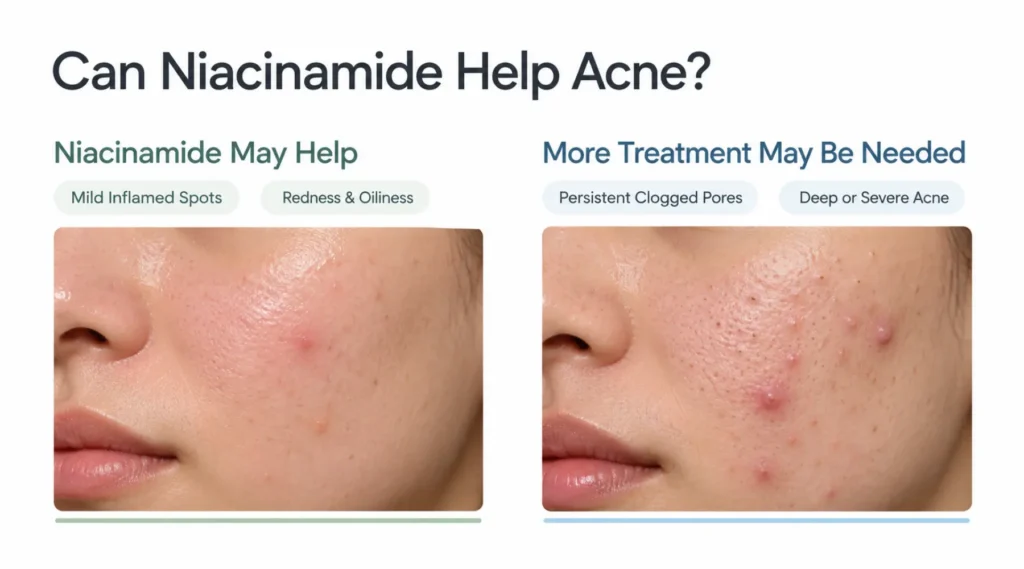
Does Niacinamide Help with Acne?
Yes, for mild, inflamed spots, it can help. It’s especially good for oily skin that becomes red around blemishes. Niacinamide may also improve the appearance of post-acne marks over time.
However, I wouldn’t rely on niacinamide alone for:
- Persistent blackheads
- Many closed comedones
- Deep nodules
- Cystic acne
- Scarring acne
- Widespread inflammatory breakouts
- Acne that hasn’t responded to over-the-counter treatments
These situations need a proper acne treatment plan. Using stronger niacinamide serums while dealing with inflammatory acne for months can delay more effective treatment.
Can Niacinamide Make Oily Skin Less Congested?
Indirectly, maybe. Directly, not really.
This difference clears up a lot of confusion.
Niacinamide may help lessen factors that worsen congestion, particularly too much oil and inflammation.
It doesn’t work like salicylic acid, which can exfoliate inside oily pores.
It also doesn’t act like a retinoid, which helps prevent blocked pores by addressing abnormal skin cell buildup.
If your main concerns are blackheads and closed comedones, niacinamide might be a helpful ingredient, but not the main one in your routine.
Think of the roles separately:
| Ingredient | Main role in oily, congested skin |
| Niacinamide | Oil balance, barrier support, inflammation |
| Salicylic acid | Exfoliation and clogged-pore management |
| Retinoids | Prevention and treatment of comedonal acne |
| Benzoyl peroxide | Particularly useful for inflammatory acne |
| Azelaic acid | Acne, inflammation and post-acne pigmentation |
Combining ingredients strategically is very different from using all of them every night.
Can I Use Niacinamide With Retinol?
Yes.
It’s a myth that niacinamide and retinol can’t be used together. The key issue is how your skin tolerates them. Retinoids can cause dryness, stinging, and peeling, especially when you start using them. Niacinamide helps support your skin barrier, making it a good addition to a retinol routine, but it doesn’t guarantee you won’t have irritation.
Recent studies show that niacinamide can be effective in acne treatments that use adapalene and benzoyl peroxide, highlighting the importance of moisturising during acne care.
If you’re new to retinol, keep your routine simple:
Morning:
Niacinamide → moisturiser → Sunscreen
Evening
Cleanse → Retinol → moisturiser
Once your skin adjusts to retinol, you can add niacinamide in the evening if you want.
When people ask if they can use niacinamide with retinol, the answer is more about skin tolerance than chemical reactions. Increase retinol use gradually instead of jumping to nightly use right away.
Niacinamide With Vitamin C, Acids and Other Serums
Niacinamide mixes well with modern skincare ingredients. The old idea that vitamin C and niacinamide cancel each other out is outdated. They can be used together.
However, just because they can be mixed doesn’t mean every skin type benefits from using multiple serums. If you’re focused on pigmentation, a vitamin-rich product like No. 5+ Vitamin Concentrated Serum might already have niacinamide. In that case, adding another niacinamide serum may not be necessary.
This also applies to any multi-ingredient serum, like a 24K Gold Serum. Always check the ingredient list instead of treating each product as separate.
Using products repeatedly matters. Someone might say, “I only use one niacinamide serum,” but their toner, moisturiser, mask, and sunscreen might also have it. This doesn’t make the routine unsafe, but it can make irritation harder to spot.
Niacinamide and salicylic acid
You can use them together. Salicylic acid focuses on reducing congestion, while niacinamide helps balance oil and strengthen the skin barrier. If you have sensitive skin, try using them at different times, like morning and night or on alternate days.
Niacinamide and glycolic acid
They can exist together. The problem isn’t that the ingredients cancel each other out; it’s that using glycolic acid often, especially with other treatments, can irritate the skin.
Niacinamide and hyaluronic acid
They work well together.
Hyaluronic acid acts as a moisturiser, while niacinamide helps strengthen the skin’s barrier and supports other functions.
For oily yet dehydrated skin, this mix feels great.
Can Niacinamide Cause Acne?
Niacinamide is usually not seen as an ingredient that causes acne. In fact, it’s been studied as a treatment for acne-prone skin. However, not every niacinamide product works for everyone. If someone breaks out after using a new serum, there are several reasons to consider.
The formula may not suit your skin
A serum has more than just its main ingredient. It includes emollients, fragrances, plant extracts, preservatives, solvents, oils, and other active ingredients that can impact how your skin reacts. So, you might handle niacinamide well in one product but have a breakout with a different product that has the same amount of niacinamide.
The concentration may be irritating
Redness and irritation can create small bumps that can be confused with acne. This often happens when you add a strong serum to a routine that already includes exfoliating acids or retinol.
You may be using too much of it
Niacinamide is now very popular, and people often use it in different products without realising it. A cleanser, toner, serum, moisturiser, mask, and sunscreen can all have niacinamide. However, using five products with niacinamide doesn’t mean you’ll get five times the benefits.
The timing may be coincidental
Acne spots start to form before you can see them.
If a new spot shows up a few days after you use a new serum, that serum might be the cause, but timing alone is not enough to confirm it.
Hormones, stress, heavy hair products, sweating, friction, and changes in your routine can all lead to breakouts.
Niacinamide should not cause a classic “purge”
This myth needs to be corrected.
Niacinamide is not mainly used for cell turnover or exfoliation.
If a niacinamide-only product causes ongoing burning, itching, redness, or new bumps, don’t assume your skin needs to “purge.”
Stop using the product, let your skin recover, and then reassess.
Signs Your Niacinamide Routine Is Too Aggressive
Oily skin usually handles active ingredients well, but that can change. Watch for these signs:
- Stinging that doesn’t go away
- Burning when you apply basic moisturiser
- Redness around your nose or mouth
- Skin feeling tight after cleansing
- Unusual flaking
- Fine, rough bumps
- Itching
- Increased sensitivity
- Makeup clinging to dry patches
- Skin feeling both oily and tight
These signs do not mean your routine is “working harder.” They may show that your skin is irritated.
Instead of adding more products, try using fewer. For a few days, stick to gentle cleansing, moisturiser, and sunscreen if your skin reacts.
If you notice serious swelling, blistering, hives, a widespread rash, or symptoms that continue after stopping the product, seek medical advice.
Common Mistakes That Make Niacinamide Less Useful for Oily Skin
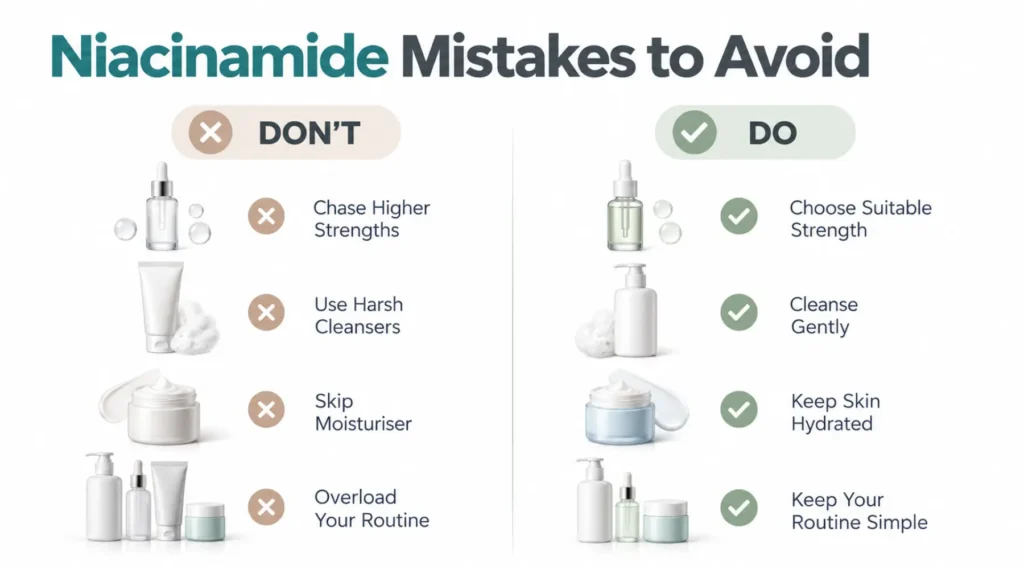
Choosing the highest percentage available
A 20% bottle might seem stronger on the label. But it doesn’t mean your sebaceous glands will work twice as well as with a 10% solution or four times better than a 5% one. Clinical evidence is more important than flashy marketing.
Using a Harsh Cleanser First
A skincare routine can include a great niacinamide serum but still be ineffective. If cleansing makes your face feel tight or uncomfortable twice a day, the serum will struggle to fix the irritation caused by the harsh cleanser.
Skipping moisturiser Because of Shiny Skin
Oil and hydration are not the same. You can have a lot of surface oil but still lack proper water retention in your skin.
Layering Multiple Oil-Control Ingredients
Using a niacinamide serum, salicylic acid toner, clay mask, strong foaming cleanser, retinol, and mattifying treatment may seem logical for oily skin. However, using all these products together can lead to irritation.
Changing Products Every Week
Niacinamide takes time to work. If you switch serums every five days, you won’t know if anything is helping.
Expecting Permanently Poreless Skin
Pores are natural. Good skincare can make them less noticeable, especially if you reduce oiliness and congestion, but healthy skin will always have pores.
Assuming a Matte Face is Automatically Healthy
Dealing with oily skin can be tough, but removing all surface oils isn’t the goal. Aim for comfortable skin with a balanced shine instead.
Is Niacinamide Good for Dry Skin Too?
Yes, that’s one reason niacinamide is good for combination skin.
Research shows that niacinamide benefits both dry and oily skin by supporting the production of ceramides and lipids, and reducing water loss.
However, a niacinamide serum isn’t the same as a moisturiser.
Dry skin often needs ingredients like humectants, emollients, and occlusives as well.
If your forehead is oily but your cheeks are dry, you don’t have to treat your whole face the same way.
You can use a lighter moisturiser on your T-zone and a richer one on your cheeks.
Combination skin usually responds better to this flexible method instead of using just one product for either oily or dry skin.
Oily Skin That Feels Tight Is Often Asking for Less, Not More
A helpful tip for skincare is to pay attention to how your face feels right after washing it. Oily skin shouldn’t feel too tight. If it does, check your cleansing and exfoliating products before thinking you need a stronger moisturiser or more niacinamide.
Signs that you might be over-treating oily skin include:
- Oil returning quickly after washing, even when your skin feels tight.
- Flaking skin near your nostrils.
- Sunscreen causing stinging.
- Red patches after washing.
- An unusually rough texture.
- Increased sensitivity to products that once felt fine.
If you notice these signs, cut back on the number of active products you use. Wash with lukewarm water, not hot. Stay away from physical scrubs and reduce exfoliation. Use a simple moisturiser. You can add niacinamide later, but don’t expect it to fix skin that gets irritated daily.
Does Diet or Lifestyle Cause Oily Skin?
Skincare talks often overstate how lifestyle impacts skin.
Oily skin is mostly from genetics and hormones. You can’t change naturally oily skin just by drinking more water or avoiding certain foods.
Lifestyle still plays a role in skin behaviour.
Heat, humidity, and sweating can make oiliness feel worse.
Some people see more acne when they are stressed.
Hair products can get on the forehead and cause breakouts.
Helmets, masks, tight hats, and friction can worsen acne-prone areas.
Sleeping in makeup or not cleaning off waterproof sunscreen can also lead to clogged pores.
Diet and acne are complicated. Don’t rely on simple ideas like “chocolate causes spots.” If you notice a link between your diet and acne, talk to a doctor instead of following a too-restrictive diet.
No lifestyle change can replace a good skincare or acne treatment plan if you have real skin issues.
When Oily Skin Needs More Than Niacinamide
If you mostly deal with mild shine and occasional blemishes, niacinamide might be a good choice.
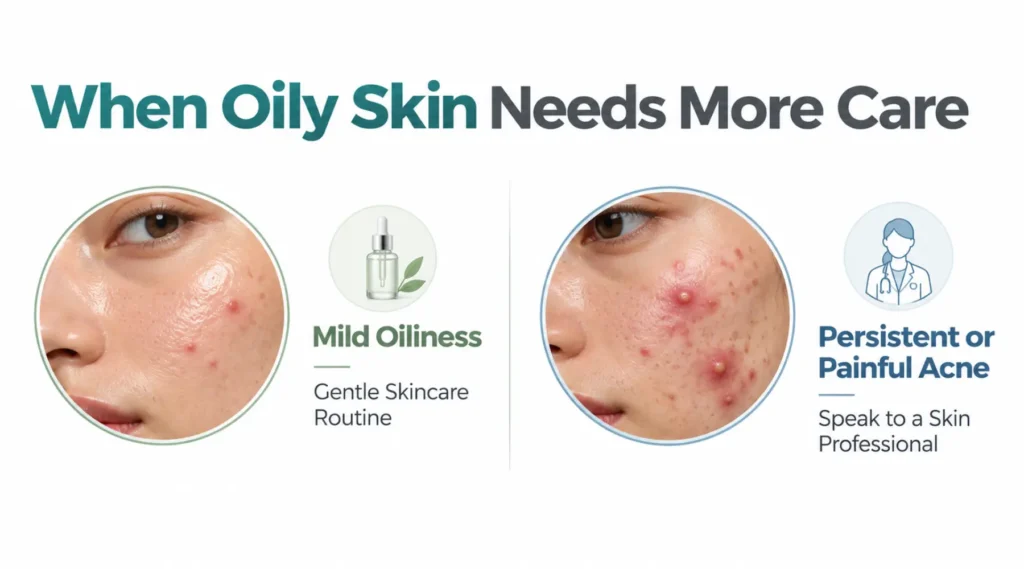
However, if you have ongoing acne, you should seek help sooner.
When to Seek Help
Talk to a pharmacist, GP, or dermatologist if you have:
- Deep, painful nodules
- Cysts
- Acne scars
- Many inflamed spots
- Acne that won’t go away with treatment
- Sudden severe acne
- Noticeable skin discolouration
- A rash you’re unsure about
- Oiliness with another skin condition
- Breakouts affecting your confidence or wellbeing
Treatment Options
Dermatology guidelines recommend treatments like topical retinoids, benzoyl peroxide, and azelaic acid, depending on the type and severity of acne. Niacinamide can be part of your skincare routine, but it shouldn’t delay effective treatment.
Myths About Niacinamide and Oily Skin That Refuse to Disappear
“Niacinamide permanently stops oil production”
No. It might help lower facial oil in some people, but it doesn’t permanently stop the sebaceous glands.
“Oily skin needs 10% or 20% niacinamide”
There is no one-size-fits-all percentage for oily skin. Moderate levels have proven to be effective in clinical studies.
“If niacinamide burns, it is working”
Burning doesn’t show how well a product works. A product shouldn’t cause pain to be effective.
“Niacinamide closes pores”
It can make pores look smaller by balancing oil and improving how the skin looks. However, it can’t actually remove or permanently close them.
“People with oily skin do not need moisturiser”
Oily skin can get dry and have barrier issues.
Choose a moisturiser based on your skin’s texture and needs, rather than avoiding it altogether.
“Niacinamide clears every type of acne”
No.
Its anti-inflammatory and oil-controlling abilities can help acne-prone skin, but serious acne usually needs specific treatment.
“Breakouts mean niacinamide is purging the skin”
Niacinamide is usually not seen as a purging ingredient.
When new bumps appear, check for irritation, intolerance to the product, other active ingredients, or normal acne development.
Questions People Ask About Niacinamide and Oily Skin
Is niacinamide good for oily skin?
Yes. Niacinamide can lower excess facial oil while helping the skin barrier and reducing inflammation. Studies show that using niacinamide on the skin can improve facial oil levels, though results can differ from person to person. It’s especially helpful for oily skin that also has mild acne, large pores, redness, or dryness.
How do I use niacinamide for oily skin?
After you cleanse your face, apply a thin layer of the product before your moisturiser. Most beginners can use it once a day. In the morning, remember to apply sunscreen afterwards. If you use salicylic acid, retinol, or other acne treatments, use them at different times; morning and evening, instead of mixing them all together.
How long does niacinamide take for oily skin?
Give it a few weeks. Changes in oil production can appear in two to six weeks. A skincare test lasting six to eight weeks shows better results. It may take longer for pigmentation, acne marks, and skin texture to improve.
Can niacinamide help oily skin safely?
For most people, yes. Moderate amounts are usually fine. Start slowly, don’t apply too much at once, and stop using the product if you experience ongoing burning, itching, swelling, or a worse rash.
What percentage of niacinamide is best for oily skin?
Start with a strength between 2% and 5%. You can use higher strengths, but 10% or more isn’t always better. Choose based on the entire formula and how your skin reacts.
Should I use niacinamide every day if I have oily skin?
Use it daily if your skin can handle it. Once a day is usually enough. Applying it twice a day is optional. If you have sensitive skin, start using it every other day.
Should oily skin use niacinamide in the morning or at night?
Both options are fine. Using it in the morning is handy because it stays under sunscreen when shine is most visible. Evening use is simpler if your morning routine already has many products.
Does niacinamide help with acne?
It can help mild acne by reducing swelling and controlling oil. Think of it as a helpful addition, not a substitute for established treatments like retinoids, benzoyl peroxide, salicylic acid, or azelaic acid when they are needed.
Can niacinamide cause acne?
Niacinamide usually doesn’t cause acne, but some products can still lead to breakouts or irritation. This might happen if a different ingredient doesn’t work for you, if the product is too strong for your skin, or if you’re using too many active ingredients at once.
Does niacinamide make oily skin purge?
A niacinamide-only product usually won’t cause a purge like some other products. Niacinamide doesn’t act like a retinoid or exfoliating acid. If you notice new bumps along with burning, itching, or redness, these signs indicate irritation rather than a successful purge.
Can I use niacinamide with retinol if I have oily skin?
Yes. You can use niacinamide and retinol together. If you’re new to retinol, try using niacinamide in the morning and retinol on some evenings. This makes your routine easier to manage.
Can I use niacinamide with salicylic acid?
Yes, they help with different issues. Salicylic acid treats clogged pores, while niacinamide helps balance oil, reduce inflammation, and support the skin barrier. If using both together irritates your skin, try using them at different times or on alternate days.
Is niacinamide good for large pores on oily skin?
Too much oil and an uneven texture can make pores look bigger. However, they cannot be permanently shrunk, removed, or closed.
Is niacinamide good for dry skin as well as oily skin?
Yes. Niacinamide helps support skin barriers and prevents moisture loss, making it good for dry or dehydrated skin. However, dry skin still needs a good moisturiser because a light niacinamide serum alone may not provide enough hydration.
What should I do if niacinamide makes my oily skin feel dry?
Cut back on how often you use your cleanser and exfoliants to see if they are causing dryness. Make sure to use a moisturiser. If you still feel burning, redness, or flaking, stop using the product and let your skin recover. When you try it again, consider a lower-strength or moisturiser-based niacinamide formula for more comfort.
Making Niacinamide for Oily Skin Work Without Over-Treating It
Using niacinamide on oily skin shouldn’t feel like fighting your skin. Oily skin needs gentle cleansing to remove oil, sunscreen, and dirt. It also needs hydration to keep its barrier healthy and targeted treatment for issues like acne.
Niacinamide is a good match for this approach. It can help reduce shine, support the skin’s barrier, calm mild redness, and improve the look of blemishes. However, it can’t change your skin type, eliminate pores, or replace proper treatment for severe acne.
Start with a moderate formula and use it regularly. Focus on how your overall skincare routine feels instead of just looking for the highest concentration of niacinamide. When oily skin feels calmer and easier to manage without feeling dry, that’s a better sign of progress than staying totally matte all day.