




Blog
Dehydrated Skin vs Dry Skin: How to Tell and What Helps

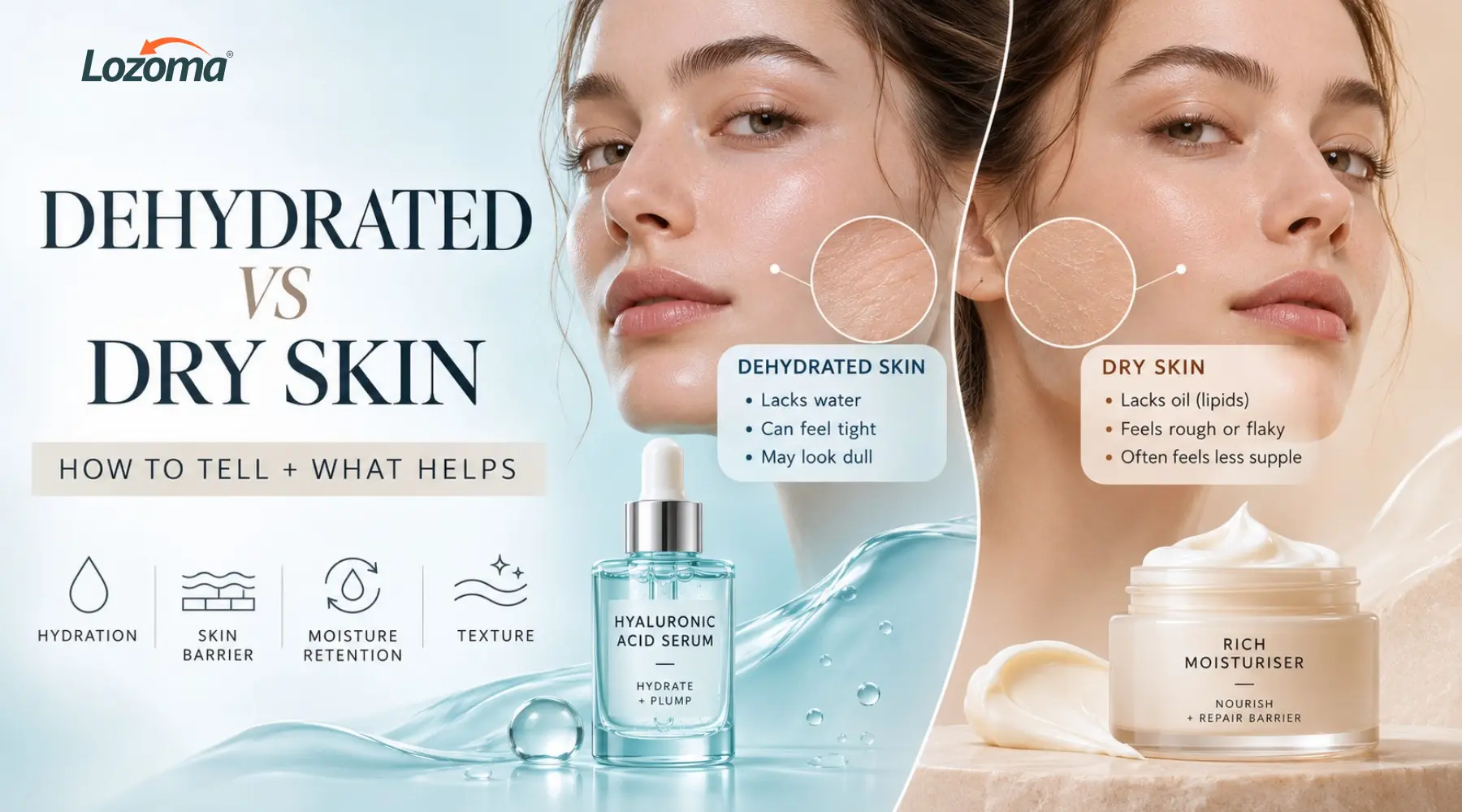
Does your face feel tight after cleansing, even though your forehead gets shiny later? Does moisturiser seem to disappear quickly, or do fine lines look more noticeable? Your skin may be dry, dehydrated, or both.
Dry and dehydrated skin can feel similar, but they do not mean the same thing. Both can make skin feel uncomfortable, rough and less smooth. The difference is often what is missing: dehydrated skin has too little water in its outer layer, while dry skin is usually linked to less oil and a reduced ability to hold onto moisture.
These can overlap. Dry skin can also be dehydrated, and oily skin can lose water too.
That is why a light hydrating serum may help for a while without easing ongoing roughness. A thick cream may not feel right either, especially if your skin feels tight but gets oily during the day.
Rather than adding more moisturiser straight away, first consider what your skin may be lacking.
Dehydrated Skin vs Dry Skin: What Is the Real Difference?
Dehydrated skin lacks enough water in its outer layers. Dry skin has trouble holding moisture and often has less natural oil, or protective fats, on the surface.
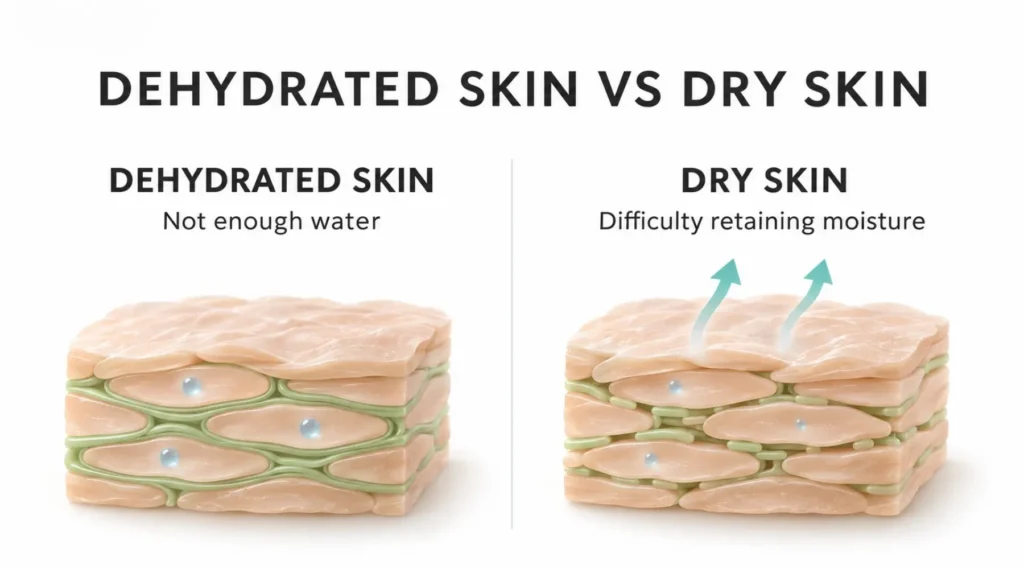
In everyday skincare, dry skin is usually described as a skin type, while dehydration is a condition that can affect any skin type. This distinction helps, but water, skin fats, and the skin’s protective barrier are closely linked. Your skin needs all three to stay comfortable.
The skin’s outermost layer contains flattened cells surrounded by fats. Together, they help limit water loss and protect the skin from irritants.
When the skin does not hold enough water, it may look less plump, tight, lined or dull. If its protective fats are disrupted, water can escape more easily, and the skin may become rough, flaky or irritated.
Both issues can involve a lack of water. One difference is why the water is missing and what else is affecting the skin.
How the signs compare
| Feature | Dehydrated skin | Dry skin |
| Main concern | Reduced water content in the outer skin | Poor moisture retention, often with reduced oils or barrier lipids |
| Classification | Temporary or recurring skin condition | Often a persistent skin tendency or type |
| Skin appearance | Dull, tight, sometimes finely creased | Rough, flaky, scaly or visibly dry |
| Oil production | Can be oily, normal or low | Often lower, although this varies |
| Common sensations | Tightness, especially after washing | Roughness, itching, tightness or discomfort |
| Fine lines | May appear more noticeable temporarily | May become more noticeable due to persistent dryness |
| Flaking | Possible, but not essential | More characteristic, especially with significant dryness |
| Common triggers | Harsh cleansing, dry air, irritating products | Genetics, ageing, environmental conditions and barrier changes |
| Most useful skincare | Gentle cleansing, humectants and moisturiser | Moisturiser containing humectants, emollients and protective ingredients |
| Can both occur together? | Yes | Yes |
This comparison is a helpful guide, not a diagnostic tool. Eczema, contact dermatitis and rosacea can cause similar symptoms.
Naturally dry skin may feel tight all year, especially in winter. Dehydrated skin can also feel tight after cleansing, even if the nose and forehead become shiny later in the day.
Both types of skin may benefit from moisturiser, but the best textures, ingredients and routine changes can differ.
What Does Dry Skin Look Like Compared to Dehydrated Skin?
You may learn more by noticing how your skin behaves over several days than by checking it in the mirror once. Poor sleep can make your face look dull. The wrong primer can make make-up cling to dry patches. If your skin feels tight after washing, your cleanser may be too harsh, you may not have naturally dry skin. Looks alone rarely tell you for sure.
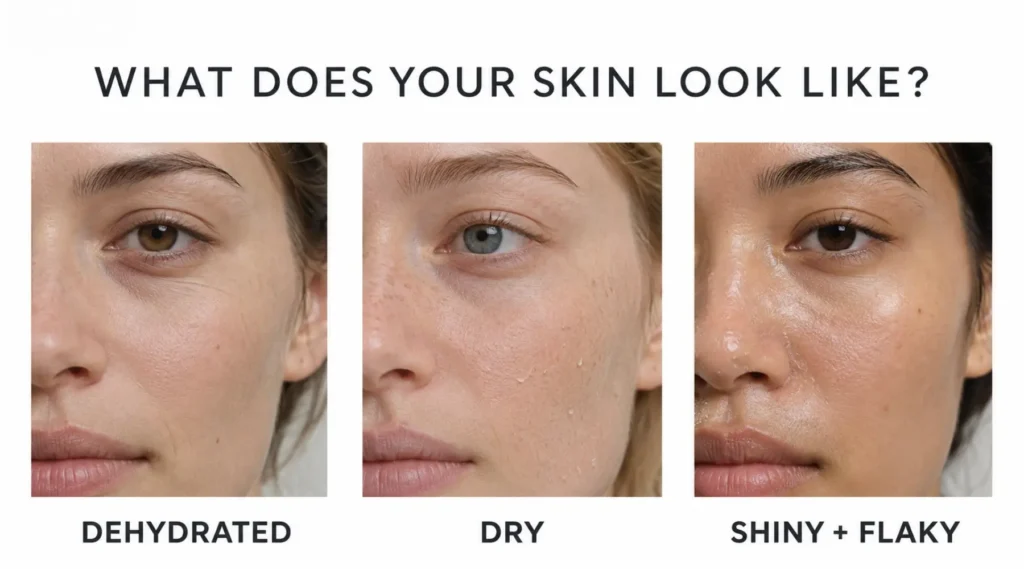
Signs that suggest your skin may be dehydrated
Dehydrated skin can feel uncomfortable before it looks different.
Your face may feel tight soon after washing, even if it isn’t flaky. You might notice faint lines when you smile, or foundation settling into fine creases.
Common signs include:
- Tightness soon after washing.
- Skin that looks dull or less plump.
- Fine lines that look more noticeable.
- Discomfort even when your skin looks oily.
- Make-up settling into fine creases.
- Feeling more comfortable for a while after applying moisturiser.
- New sensitivity to products that used to feel comfortable.
These signs can also have other causes, such as irritation, ageing or a weakened skin barrier.
A recent change in how your skin feels can be a useful clue. If your skin is usually comfortable but becomes tight after you start using a stronger cleanser, exfoliating treatment or retinoid, your routine may be the cause rather than your skin type.
Signs that suggest you have dry skin
Dry skin tends to last. It may feel rough even if you haven’t washed your face recently, and the discomfort can come back during the day.
You may notice flakes around your nose, eyebrows or cheeks. Your skin might look a little grey or dull, especially if you have a deeper skin tone. Rough patches can also make make-up harder to apply evenly.
Typical signs include:
- Roughness or flaking that keeps coming back.
- A tight feeling across several parts of your face.
- Not much oil on the skin’s surface.
- Dry patches that return regularly.
- Itching, especially in colder weather.
- Make-up gathering on flaky patches.
- Cracks or irritation if the dryness becomes more severe.
Dry skin can affect any part of the body, including the hands, arms, legs and feet. It may become more noticeable with age, as changes in the skin can make it harder to hold on to moisture.
DermNet’s clinical information explains that dry skin is linked to changes in the skin’s outer barrier, including its oils and its ability to hold water.
What if your skin is both shiny and flaky?
Shiny, flaky skin can be confusing. Oily skin is not always well hydrated. Your skin may make oil while the outer layer lacks water or is irritated.
For example, washing with a strong foaming cleanser twice a day may strip away surface oils. Your forehead may still become shiny later, while your cheeks feel tight and some areas flake.
But shine is not always caused by extra oil. Irritation, leftover products or a damaged skin surface can also make skin look glossy.
If you often have redness, burning or scaling around your nose and eyebrows, seborrhoeic dermatitis is one possibility. If symptoms persist, seek professional advice rather than washing more aggressively.
Why Your Skin Needs Water, Oils and a Healthy Barrier
The difference between dehydrated and dry skin is easier to understand when you look at how skin holds on to moisture.
Healthy skin needs more than water. Its outer layer must be organised so that enough water stays where it is needed.
Three things work together: water, natural moisturising substances and protective oils.
Water keeps the outer skin flexible
The outer layer of your skin needs enough water to stay soft and flexible. When it loses water, skin can feel rough or tight, and fine lines on the surface may look more noticeable.
This does not always mean your whole body is dehydrated. Weather, washing habits and skin treatments can affect the water in your skin, even if you drink enough. So an extra glass of water may not ease facial tightness.
Natural moisturising factors help hold water
Your skin naturally contains substances called natural moisturising factors (NMF). These include amino acids, urea and lactate, which help the outer skin cells hold on to water. If there are fewer of these substances, or the skin’s outer barrier is disrupted, the skin may have trouble staying hydrated. Ingredients such as glycerin, hyaluronic acid and urea can help support this water-holding function.
Lipids reduce excessive water loss
Between the cells in the outer layer of your skin are fats called lipids. These include ceramides, cholesterol and fatty acids. They help form a protective barrier that controls how water moves through the skin.
Think of the skin cells as bricks and the lipids as mortar holding them together. If this barrier is damaged, more water can escape from the skin. This water loss is called transepidermal water loss, or TEWL.
Some water loss is normal. But when the skin barrier is weakened, more water may escape, making the skin more prone to dryness and irritation.
If dryness comes with stinging, redness, or sensitivity, repairing the skin barrier may matter more than adding another hydrating serum. The first step may be to reduce irritation and help restore the skin’s protective barrier.
Why sebum and barrier lipids are not interchangeable
Sebum is the oil made by glands in the skin. It helps keep the skin’s surface lubricated. Barrier lipids are different: they help form the protective structure between cells in the skin’s outer layer.
So, oily skin can still have a weakened skin barrier. And skin that makes little oil can still feel comfortable if its routine provides enough moisture. That’s why oily skin can also be dehydrated.
How to Tell Whether Your Skin Is Dry, Dehydrated or Both
No single at-home test can reliably identify every type of dry skin. But noticing how your skin usually behaves can help you choose a routine. Pay attention to how long symptoms last, whether your skin tends to get oily, how it responds to moisturiser and whether anything has changed recently.
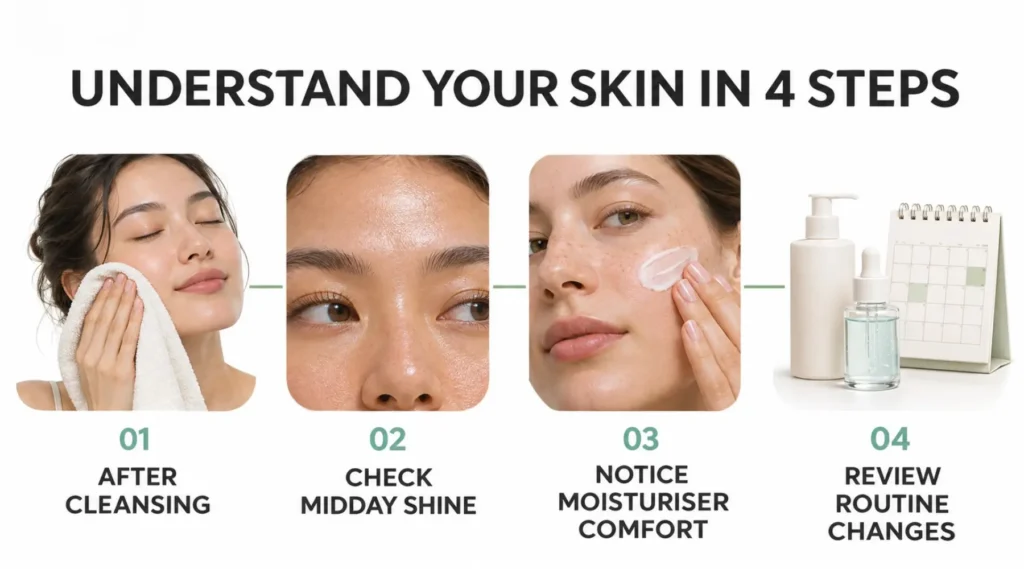
Step 1: Notice how your skin feels after gentle cleansing
Wash your face with a gentle, fragrance-free cleanser and lukewarm water. Don’t scrub or use a cleansing brush.
Gently pat your skin dry, then notice how it feels. If it feels tight soon after washing, it may be losing water quickly, or the cleanser may be removing too much of its natural protection.
If your skin is often rough, flaky, and uncomfortable even before you wash it, you may be prone to dry skin.
Don’t leave your skin without moisturiser for a long time to test it. This could make irritation worse, especially if your skin’s protective barrier is already weakened.
Step 2: Observe oil production later in the day
How your skin feels during the day can offer useful clues. If your forehead and nose get oily but your cheeks feel tight, your skin may be combination or oily but lacking moisture. If your skin produces little oil and often feels rough, it may be naturally dry. But oil levels can change with hormones, age, skincare products, temperature and your individual biology. A shiny face doesn’t mean your skin barrier is healthy.
Step 3: Pay attention to how moisturiser performs
Apply a suitable moisturiser and notice how your skin feels over the next few hours.
If a light moisturiser eases tightness, your skin may need more surface hydration or help retaining moisture.
If your skin stays rough or starts flaking again soon, you may need a richer cream or a routine that better supports your skin barrier.
If symptoms continue despite suitable skincare, there may be an underlying skin condition.
How quickly a product sinks in isn’t a reliable guide: fast absorption doesn’t automatically mean your skin is dehydrated, and a cream sitting on the skin doesn’t prove it is moisturising enough.
Step 4: Review your recent skincare changes
Think about what changed before your skin started to feel tight or rough. Have you started using a new exfoliant, used retinol more often, switched to a stronger cleanser or spent more time in a heated office? A sudden change may point to something in your surroundings or skincare products. Dry skin that has been there since childhood or gets worse most winters may be a longer-term skin tendency.
Does the skin pinch test really identify dehydration?
The pinch test involves gently pinching the skin and seeing how quickly it returns to normal. But it cannot reliably tell you whether your skin is dehydrated. Skin springiness can be affected by age, collagen, elastin, where you pinch and other factors, and the test does not directly measure water in the outer layer of skin. A review of research found important limits to using skin-pinch tests to assess dehydration in adults. If illness, heat, dizziness, reduced urination, or other symptoms make you concerned about dehydration, seek medical advice rather than relying on a facial pinch test.
Why Skin Becomes Dehydrated Even When You Drink Enough Water
Your skin’s hydration depends on more than how much water you drink. Your surroundings, skincare routine, skin barrier, and some treatments can affect how well your skin’s outer layer holds onto water.
Harsh cleansers can disrupt the skin’s balance
Cleansing removes dirt, sunscreen, make-up and extra oil, but some cleansers are harsher than others. Strong cleansing ingredients, washing often or using hot water for too long can strip away protective oils and affect the skin barrier. This may leave your skin feeling tight and uncomfortable after washing. A squeaky-clean feeling doesn’t mean a cleanser worked better; it may mean it removed too much surface oil. For many people, switching to a gentle, fragrance-free cleanser may help more than adding another treatment serum.
Over-exfoliation can increase irritation
Glycolic, lactic and salicylic acids can help with certain skin concerns when used correctly. But using them too often, choosing strong products or combining several exfoliants may irritate sensitive skin. Signs you may be exfoliating too much include ongoing tightness, stinging, redness, flaking or unusual sensitivity. Switching to a different exfoliant may not help. Your skin may need a break from non-essential active ingredients.
Retinoids can temporarily affect skin comfort
Retinol, retinal and prescription retinoids may help with acne, uneven skin texture and signs of ageing. They can also cause dryness, peeling and irritation, especially when you first start using them or use them too often.
Use a product such as Vita A Retinal Shot Tightening Booster for Firm Skin as part of a routine that considers how well your skin tolerates retinoids. It is not a moisturiser for already irritated skin.
Retinal is a form of vitamin A that affects the skin, so introduce it carefully, even if the formula also contains moisturising ingredients. If your face is already stinging or peeling, it is generally better to help your skin feel comfortable again before starting retinoids or using them more often.
Indoor heating and air conditioning can contribute
Dry air can make moisture evaporate from exposed skin more easily. This may explain why your skin feels comfortable outdoors but becomes tight after a few hours in an air-conditioned office. Indoor heating can have a similar effect in colder months. Wind, cold weather and moving between indoor and outdoor temperatures can also make dryness worse. A humidifier may help if the air indoors is very dry, but it needs to be cleaned and maintained properly.
Some skincare products provide too little protection
A watery serum may leave your skin feeling fresh, but it may not protect it enough from losing moisture. This is more likely if it contains ingredients that draw in water but few that soften the skin or help keep moisture from escaping. A balanced moisturiser is usually a better choice than applying more water-based products.
What Causes Naturally Dry Skin?
Dry skin can be linked to inherited traits, changes in the skin’s oil production, the environment and differences in the skin barrier. Some people have had dry skin for as long as they can remember, while others develop it later in life.
Genetics can influence skin barrier function
Your genes help shape your skin and its protective outer layer. Some inherited differences can affect proteins that help keep this barrier working, including filaggrin, which helps form natural moisturising factors. These differences are linked to conditions such as ichthyosis vulgaris and atopic dermatitis. But having dry skin does not necessarily mean you have a genetic skin condition.
Ageing changes how skin retains moisture
Skin can become drier with age. Hormonal changes may reduce oil production, and skin may change in ways that make it harder to retain moisture. As a result, products that once felt comfortable may no longer be enough. For example, you might prefer a richer cream instead of a light lotion. These changes are normal, but sudden or severe dryness shouldn’t automatically be blamed on age.
Hormonal changes can affect skin condition
Hormone changes can affect the skin’s oil glands and overall condition. Some women find their skin gets drier during perimenopause and after menopause. But hormones are not the only possible cause. Climate, medicines and skin conditions can also contribute.
Certain medical conditions can cause persistent dryness
Eczema, psoriasis, an underactive thyroid and some illnesses that affect the whole body can make skin dry or scaly. Some medicines, including oral retinoids, can also cause dryness.
Get medical advice if dryness starts suddenly, covers a large area, or comes with ongoing itching, unusual tiredness or major changes to your skin. Moisturisers may help you feel more comfortable, but they cannot replace treatment for an underlying condition.
How to Treat Dehydrated Skin Without Overcomplicating Your Routine
If your skin feels dehydrated, start with the basics: avoid unnecessary irritation, use ingredients that help the skin’s outer layer hold on to water, and apply a suitable moisturiser regularly. You don’t need lots of serums, face mists or overnight treatments. A simpler routine may help more than adding extra products.
Choose a cleanser that does not leave skin feeling stripped
Choose a cleanser that removes dirt and buildup without making your skin feel uncomfortable. Pick a gentle formula that suits your skin: a cream or lotion may suit dry skin, while oily skin may prefer a mild gel. If your skin is sensitive, a fragrance-free product may be a good choice.
In the morning, rinsing with water may be enough if your skin isn’t noticeably oily and you haven’t used heavy products overnight. In the evening, cleanse well enough to remove sunscreen, make-up and the day’s buildup.
Apply hydration before your skin becomes uncomfortable
Humectants help the outer layer of skin hold more water. Hyaluronic acid, glycerin and panthenol are common ingredients in hydrating skincare. Knowing how hyaluronic acid works can explain why it may temporarily make fine lines look less noticeable and help tight skin feel more comfortable.
You may not need a hydrating serum if your moisturiser already contains water-binding ingredients. A well-made cream may provide everything your skin needs in one step.
Follow with a moisturiser that reduces water loss
This is a step people often miss.
Humectants help skin hold on to water. A moisturiser with emollients and occlusive ingredients can help keep skin comfortable and hydrated for longer.
Oily skin may need only a light gel-cream. If your skin feels tight in cold weather, a cream with ceramides, squalane or dimethicone may offer more support.
The American Academy of Dermatology recommends gentle cleansing and applying moisturiser to damp skin to help reduce dryness.
Reduce unnecessary active ingredients temporarily
If your skin feels dry after a change to your routine, check whether you’re using products with exfoliating acids, retinoids, benzoyl peroxide or strong vitamin C. These ingredients can help with some skin concerns, but they may worsen irritation if your skin’s protective barrier is already damaged. Try pausing non-essential treatments for a while to see whether they’re contributing to the problem. Keep taking prescribed medication as advised by your clinician, and ask them before changing any essential treatment.
Give your skin a consistent routine
Moisturising may make your skin feel softer soon after you apply it, but ongoing discomfort can take longer to ease.
Try to follow a gentle routine consistently instead of changing products every two days. Notice how your skin responds.
If an unsuitable cleanser or dry air is the main cause, you may notice improvement relatively quickly. More serious damage to the skin barrier can take several weeks to settle. The timing depends on the cause and its severity.
How to Fix Dehydrated Skin: The Ingredients That Actually Help
The best ingredients for dehydrated skin usually fall into three groups: humectants, emollients and occlusives. Each works differently, and many effective moisturisers contain all three.
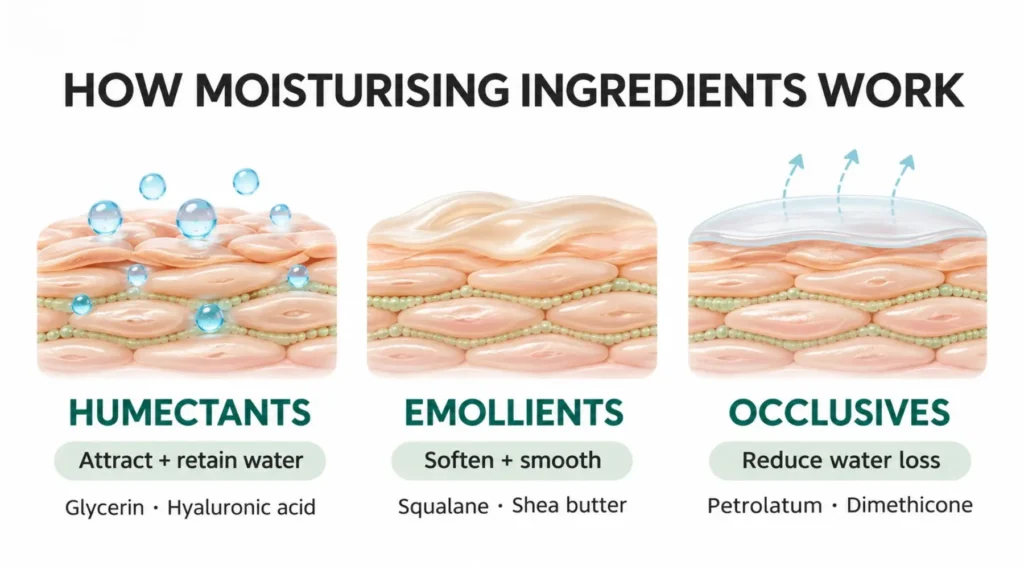
| Ingredient | Main function | Particularly useful for |
| Hyaluronic acid | Helps bind water in the outer skin | Temporary tightness and fine dehydration lines |
| Glycerin | Attracts and retains water | Most skin types, including oily skin |
| Panthenol | Supports hydration and skin comfort | Dry or mildly irritated skin |
| Urea | Helps retain water and soften rough skin | Dry, thickened or flaky areas |
| Ceramides | Support the skin’s protective lipid structure | Dry skin and impaired barrier function |
| Squalane | Softens and conditions the surface | Dry or combination skin |
| Petrolatum | Strongly reduces water evaporation | Very dry or cracked areas |
| Dimethicone | Forms a protective, water-resistant layer | Dryness and sensitivity |
| Shea butter | Softens skin and provides lipid-rich protection | Dry skin needing richer textures |
| Colloidal oatmeal | Helps soothe and protect irritated skin | Dry, itchy or eczema-prone skin |
Hyaluronic acid: useful for hydration, not a complete solution
Hyaluronic acid helps the skin hold water. It can boost moisture in the upper layers and temporarily make skin look smoother. It may help if your skin feels tight or dehydration lines are a concern.
It doesn’t provide lasting hydration or rebuild all the skin fats needed for a healthy barrier. How you apply hyaluronic acid serum matters, too. Using a small amount and following with moisturiser can help avoid stickiness and other common problems.
Glycerin: an understated ingredient with strong moisturising value
Glycerin is worth more attention than it often gets. It attracts water and helps keep skin hydrated, so it’s used in many kinds of moisturiser. It also has a long history in skincare and can work well in simple formulae. If your skin is oily but feels dehydrated, a light glycerin moisturiser may feel more comfortable than a rich oil-based serum. The amount of glycerin and the rest of the formula matter, though: products with a very high concentration can sometimes feel sticky.
Ceramides: important for a compromised skin barrier
Ceramides are natural fats in the outer layer of your skin. They help keep the skin barrier organised and reduce water loss.
Skincare with ceramides may help moisturise the skin, especially if its barrier is damaged. But ceramides are only one part of the picture: cholesterol, fatty acids and other ingredients can also affect how well a product supports the barrier.
For skin that stays flaky, a simple ceramide cream may be more useful than a serum advertised as intensely hydrating.
Panthenol: a useful ingredient for skin comfort
Panthenol, also called provitamin B5, is often used in skincare to moisturise and soothe skin.
It may help keep skin hydrated and ease discomfort from mild dryness.
Most people tolerate it well, but reactions to a particular product are still possible.
It can be especially useful alongside glycerin, emollients and a gentle moisturising base.
Urea: particularly helpful for rough, flaky areas
Urea is naturally found in the skin’s moisturising system.
In lower amounts, it helps the skin hold on to moisture. In higher amounts, it can help soften thickened skin by breaking down extra keratin on the surface.
This can make it useful for rough areas such as elbows, heels and legs.
Stronger urea products may sting if your skin is irritated or cracked. A product made for thickened heels is not necessarily suitable for your face.
If your facial skin is sensitive, choose a product made for the face and follow the manufacturer’s instructions.
Petrolatum: protection rather than instant hydration
Petrolatum helps protect the skin by slowing water loss. It can help with dry patches, lips, and skin often exposed to cold weather. But it does not do everything a moisturiser does. If your skin needs both moisture and protective oils, applying petrolatum over a suitable moisturiser may work better than using it alone. A thin layer is usually enough. If you have acne-prone skin, you may prefer to use it only on very dry areas rather than over your whole face.
Niacinamide: additional support for some skin types
Niacinamide is a form of vitamin B3 found in products for uneven skin tone, oiliness and skin-barrier support. Some research suggests it may help support the skin’s protective barrier and improve certain measures of skin function. But the amount matters, and more is not always better. No. 5+ Vitamin Concentrated Serum may suit someone who also wants to target uneven tone, but you don’t need a concentrated brightening serum to treat dry, dehydrated skin. If your skin is irritated, a simple moisturiser may be a better choice than a product with several active ingredients.
Is a Hydrating Serum or Moisturiser Better for Dry Skin?
For most people with dry skin, moisturiser matters more. A hydrating serum can add ingredients that help the skin hold water, but it may not do much to stop moisture from escaping. Moisturisers often do both jobs. Serums can still be useful, depending on what the rest of your skincare routine provides.
When a hydrating serum is worth using
A separate serum may help if your skin feels tight but heavy creams are uncomfortable, or if you want more hydration without making your routine much richer.
A light hydrating serum may suit oily or combination skin when used with a suitable moisturiser.
Look for ingredients such as glycerin, hyaluronic acid, panthenol or other ingredients that help hold moisture. Consider the whole formula, not just one ingredient named on the packaging.
When a moisturiser should take priority
If your skin often feels rough, flaky or uncomfortable, try a suitable cream or lotion. Dry skin usually needs a product that adds moisture and helps keep it in. You don’t always need a thick cream: the best texture depends on your skin, the climate and what feels comfortable. Your moisturiser should keep your skin comfortable for more than a few minutes. Stop using it if it repeatedly causes burning, itching or more redness.
Why expensive ingredients do not guarantee better hydration
Skincare products may feature gold, collagen, unusual extracts or newer cosmetic technology. These may have specific uses or make a product feel pleasant, but they are not automatically better than familiar moisturising ingredients.
For example, you might choose a 24K Gold Serum for its finish or other ingredients. But gold itself is not a proven substitute for glycerin, ceramides or moisturisers that help reduce water loss.
A PDRN Salmon DNA Regen Ampoule may be promoted for skin renewal, but research on PDRN in everyday skincare is still developing. How well it moisturises depends on the whole formula.
Rather than focusing on how advanced a product sounds, consider whether its ingredients and texture suit your skin’s current needs.
Morning and Evening Skincare Routines for Dry and Dehydrated Skin
The best routine depends on how oily or sensitive your skin usually is and which products you already use. But one thing stays the same: after adding hydration, use enough moisturiser to keep your skin comfortable.
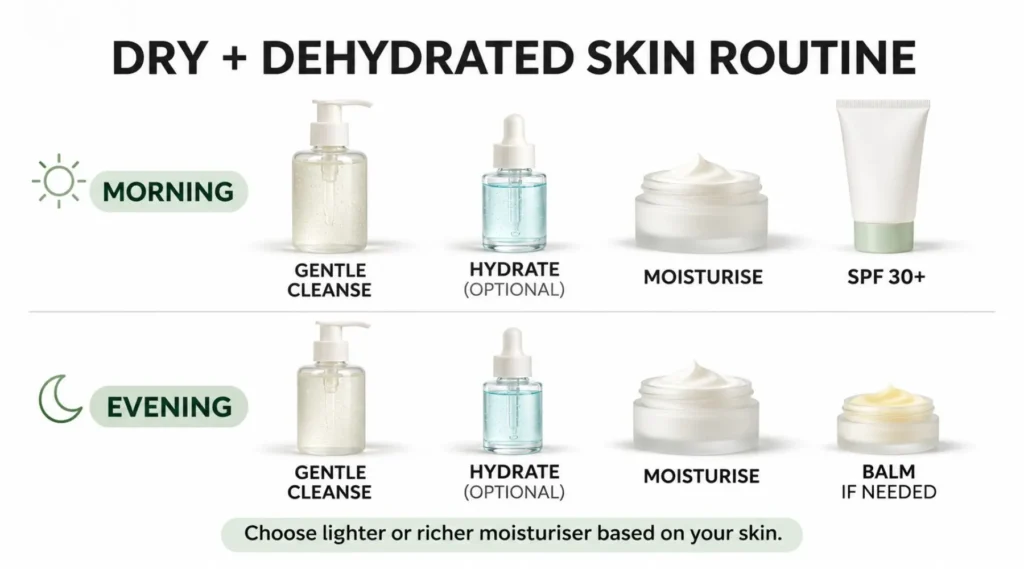
Morning routine for dehydrated skin
Morning skincare should get your skin ready for the day without taking away moisture it doesn’t need to lose.
- Cleanse gently: Use a mild cleanser, or rinse with lukewarm water if that suits your skin.
- Add a hydrating serum if needed: Choose a simple formula with glycerin or hyaluronic acid.
- Use moisturiser: Pick one that feels comfortable and not too greasy.
- Apply sunscreen: Finish with broad-spectrum SPF 30 or higher.
Hyaluronic acid doesn’t need a soaking-wet face to work. Whether to apply it to damp or dry skin mostly depends on the product and what feels comfortable. A basic hydrating serum may suit slightly damp skin, but it can also work on dry skin. The key is to follow with a suitable moisturiser.
Evening routine for dehydrated skin
In the evening, gently remove the day’s buildup and care for your skin without adding extra irritation.
A simple routine is to:
- Remove sunscreen and makeup with a gentle cleanser.
- Rinse with lukewarm water.
- Use a hydrating serum if you like.
- Apply a moisturiser that suits your skin.
- If needed, dab a little protective balm on especially dry areas.
Avoid using several exfoliating products just because your skin looks dull. If dry skin causes fine lines, helping your skin hold onto moisture may make it look smoother without exfoliating more.
Morning routine for naturally dry skin
Naturally dry skin may need a richer moisturiser. After gently cleansing, use one with ingredients that help attract and hold moisture, and soften the skin. If your skin is very dry, a cream with ceramides, fatty acids or dimethicone may feel more comfortable than a light gel. Finish with a moisturising sunscreen that protects against both UVA and UVB rays. You may not need several serums under your sunscreen; a well-formulated cream may be enough.
Evening routine for naturally dry skin
At night, wash your face with a gentle cleanser that does not leave your skin feeling dry or tight. Apply moisturiser while your skin is still a little damp.
If some areas are still rough, a thin layer of ointment or balm may help lock in moisture overnight. Do not use heavy, greasy products on active acne, infected areas or irritated skin unless a clinician has advised you to.
The goal is to make your skin comfortable, not to apply the thickest layer possible.
Oily but Dehydrated Skin: Why Your Face Feels Tight and Greasy
Oily but dehydrated skin is common, especially in people who use acne treatments or strong products to control oil.
Oil and hydration are not the same thing. Oil comes from glands in the skin. How much water the outer layer holds depends on other factors, including how well the skin barrier works. So skin can look oily on the surface but still feel tight or irritated and lose more water than usual.
Why aggressive oil control can make things worse
If your face feels oily, washing it more often may seem like a good idea. But frequent cleansing with strong products can remove the skin’s protective substances and make it feel uncomfortable.
Using alcohol-based toners, exfoliating pads and strong foaming cleansers together may make things worse. Some people notice more shine after changing their routine, but that does not prove their skin is producing extra oil to make up for dehydration.
Several factors affect oil production, especially hormones and individual biology. The idea that dehydrated skin always produces more oil is not well established.
The best approach for oily, dehydrated skin
Choose a gentle cleanser, light hydration, and a moisturiser that doesn’t feel too heavy.
Look for gel-creams or lotions with ingredients such as glycerin, panthenol, ceramides or niacinamide.
If you’re also concerned about acne, use suitable acne treatments, but don’t automatically use them more often.
A Tea Tree Facial Serum may suit people concerned about blemishes. However, tea tree oil and other acne-focused ingredients can irritate sensitive skin.
It is not a solution for everyone with dry, tight skin, especially if your skin is already stinging or peeling.
If your skin is irritated, cut back on unnecessary products before trying new treatments.
Dehydrated Skin or Dry Skin for Sensitive Skin: What Changes?
Sensitive skin needs extra care because its symptoms can look like dry or dehydrated skin. Tightness, stinging, redness and a hot feeling can happen when the skin’s protective barrier is damaged. But sensitive skin isn’t always dry: people with oily skin can be sensitive too. The key is to work out whether your skin feels uncomfortable because it lacks moisture, or is reacting to irritation, allergens or an underlying condition.
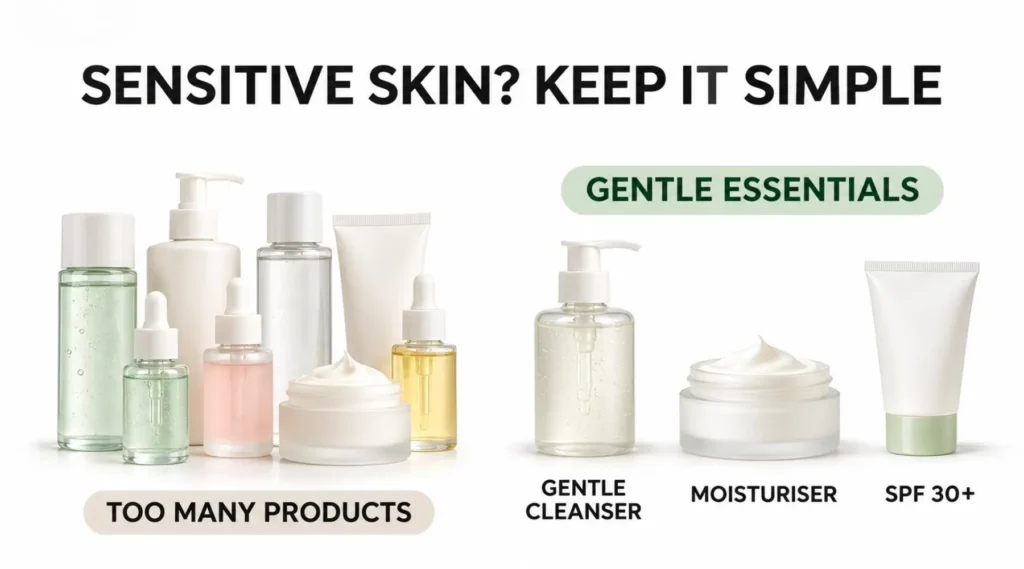
Why more skincare can sometimes mean more irritation
When your skin feels uncomfortable, it can be tempting to try several soothing serums. But each extra product adds more ingredients, which may increase the chance of irritation or an allergic reaction. Fragrance, essential oils, preservatives and some active ingredients can cause problems for people with sensitive skin. “Natural” or “botanical” products are not always suitable. A fragrance-free cleanser, a simple moisturiser and a suitable sunscreen may be enough for a complete routine.
When dryness may actually be dermatitis
Ongoing redness, itching, flaking, or burning may signal a skin condition, not just dehydration.
Atopic dermatitis can weaken the skin’s protective barrier and cause repeated dryness and inflammation. Contact dermatitis can develop after the skin touches a certain ingredient or substance. Rosacea can cause redness, burning and sensitivity on the face, often around the cheeks and nose.
These conditions need different kinds of care. If symptoms keep coming back or worsen despite gentle skincare, seek advice from a healthcare professional rather than keep trying different products.
Should You Use Vitamin C, Retinol or Exfoliating Acids on Dehydrated Skin?
Dehydrated skin doesn’t always mean you need to avoid all active skincare ingredients. What matters most is how your skin feels now, not how many products you want to use. If your face feels comfortable and isn’t irritated, you may be able to keep using suitable treatments. But if it stings when you cleanse or gets flakier, adding another strong active is unlikely to help.
Vitamin C can support other skin goals, but it is not a dehydration treatment
Vitamin C is an antioxidant. It may help with uneven skin tone and some signs of sun-related skin ageing.
Strong vitamin C products can irritate skin. The risk depends on the type of vitamin C, its strength and acidity, and the rest of the formula.
A 20% Vitamin C Serum or 20% Vitamin C Ampoule Serum may suit you if your skin is already used to strong vitamin C products. Don’t start with either if your skin is sore, peeling or unusually sensitive.
First focus on helping your skin feel comfortable. Then consider whether a vitamin C product fits your other skin concerns.
Retinoids should be introduced according to skin tolerance
Retinoids may help, but results take time and regular use. Using them too often can cause dry, irritated skin, especially when you first start. Begin gradually and follow the product instructions or advice from a healthcare professional.
If you have lasting burning, severe peeling or worsening discomfort, stop using the cosmetic retinoid and seek advice.
Topical retinoids are generally avoided during pregnancy. If you are pregnant or planning a pregnancy, talk to a healthcare professional about using them.
Exfoliation should never be used to remove every visible flake
A buildup of dead skin cells can sometimes cause flaky skin. But it may also signal irritation, dermatitis, or a weakened skin barrier. Scrubbing or using strong acids on inflamed skin can make things worse. If dryness comes with stinging or redness, focus on moisturising and calming the skin rather than trying to remove the flakes.
Can Face Masks Improve Dehydrated Skin?
Hydrating face masks can add moisture to the skin’s surface for a short time and help it feel softer. They’re an optional extra, not a replacement for moisturiser you use every day. How well they work depends on their ingredients, the mask material, how long you leave it on and your skin.
Hydrogel and collagen masks
Hydrogel masks keep a water-rich formula against your skin for a set time. They may temporarily make dryness-related fine lines look less noticeable and leave your skin feeling smoother. The Bio-Collagen Real Deep Mask is one example. But collagen applied to the skin does not necessarily rebuild collagen deeper in the skin. Depending on the formula, large collagen molecules mainly work on or near the skin’s surface. The mask’s moisturising ingredients are often more important for short-term hydration.
Firming masks and hydration are different goals
Some masks use moisturising ingredients alongside materials or technologies that aim to make skin feel temporarily firmer. The No.9 NAD Bio Lifting-sil Full Face Mask, for example, is marketed for facial firmness and a lifting effect. Any short-term smoothing of the skin’s surface does not mean lasting improvement in elasticity or support beneath the skin. If dryness is your main concern, check the mask’s moisturising ingredients rather than relying on its lifting claims.
Overnight masks need extra consideration
Overnight masks can help keep skin comfortable, especially if they contain moisturising and protective ingredients. Some are made mainly to brighten skin or exfoliate it. The Medicube Kojic Acid Turmeric Night Wrapping Mask 75ml is one example of a mask with ingredients aimed at improving the complexion. If your skin is already sensitive, a mask with ingredients that may irritate it might not be suitable. When choosing a face mask, consider whether you need hydration, soothing care, or help with another concern. Follow the stated application time, and stop using the mask if you feel burning or develop irritation.
How Long Does It Take to Improve Dehydrated or Dry Skin?
Moisturiser can make your skin feel softer within minutes. But lasting improvement depends on the cause. If your skin feels a little tight because of the weather or a cleanser that doesn’t suit you, changing your routine may help within a few days. More serious dryness or damage to your skin’s protective barrier can take longer to improve. There’s no set recovery time for everyone.
What improvement might look like during the first week?
In the first few days, your skin may feel more comfortable. It may feel less tight after washing, and moisturiser may soothe it for longer. Fine lines caused by dry skin may also look less noticeable for a while. But smoother-looking skin does not necessarily mean the underlying cause has been fixed. Keep to a suitable routine instead of quickly adding several strong treatments again.
What to expect over the following weeks
With gentle, regular skincare, rough or flaky skin may gradually improve.
If over-exfoliating irritated your skin, using fewer exfoliating products may give its outer layer time to recover.
If your skin is naturally dry, you may need to keep moisturising, as this underlying tendency has not changed.
If your skin is still uncomfortable after a few weeks of suitable care, or gets worse, see a healthcare professional for an assessment.
Seven Mistakes That Can Keep Skin Feeling Dry or Dehydrated
Some skincare habits can make dehydrated skin harder to manage, even if you use good moisturisers.
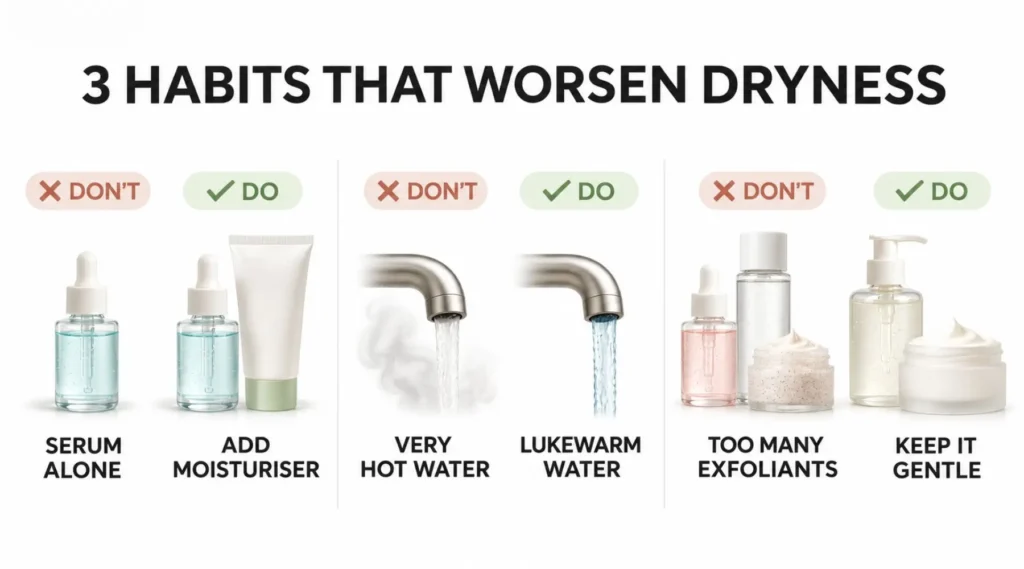
1. Applying hydrating serum without enough moisturiser
A water-based serum may add moisture to the skin’s surface, but it may not stop enough moisture from escaping. If your skin feels tight again soon, check whether your moisturiser gives it enough protection. Adding more hydrating serums may not address the underlying issue.
2. Washing your face with very hot water
Hot water and long washes can strip away the skin’s protective oils and make dry skin worse.
Use lukewarm water and wash only when needed.
This can help in winter or when your skin is already irritated.
3. Using too many exfoliating treatments
Using exfoliating toners, acid serums, scrubs and active cleansers together may irritate your skin more than help it. Check your whole routine, as several products that are fine on their own may be too much when used together.
4. Assuming a thicker product is always better
A rich balm may feel good on very dry cheeks but uncomfortable on an oily forehead. A light gel may suit oily skin but not protect very dry skin enough. Choose a texture that suits your skin and works well in the formulation.
5. Ignoring seasonal changes
A moisturiser that suits you in summer may not be enough in colder weather. Changes in indoor humidity can also affect how comfortable your skin feels. You may only need to change your moisturiser, not your whole skincare routine.
6. Confusing treatment results with hydration
A serum that brightens skin, reduces the appearance of pigmentation or smooths the skin’s surface may not relieve dryness. Skin care ingredients have different jobs, and products can target moisture, exfoliation, brightening or signs of ageing. These concerns aren’t all the same so that they may need different approaches.
7. Changing several products at once
Introducing several products at once can make it hard to tell which one is helping or causing irritation.
Introduce new products one at a time. If you have sensitive skin, test each new product on a small area first, following suitable patch-testing guidance, before using it more widely. If irritation continues, stop using the product.
How Weather, Sleep and Daily Habits Affect Skin Hydration
Your surroundings can affect your skincare routine. Everyday habits can affect your skin barrier and how comfortable your skin feels.
Cold weather and low humidity
Cold weather outside and heating indoors can dry out your skin.
Protect your skin from harsh weather, and use a richer moisturiser when needed for extra comfort.
A humidifier may help in very dry rooms. Clean it regularly to prevent germs from building up.
Long showers and frequent washing
Long, hot showers or baths can worsen dry skin. The American Academy of Dermatology recommends keeping them to about 5–10 minutes and applying moisturiser soon afterwards. This can be especially helpful for dry hands, legs and other areas washed often.
Sleep and daily routines
Too little sleep may make your skin look tired or dull, but sleep alone won’t repair a damaged skin barrier. A regular evening skincare routine, sensible sleep habits and suitable moisturiser are more realistic ways to support your skin than expecting a night cream to fix every sign of tiredness.
Drinking enough water
Drinking enough water supports your health. If you’re dehydrated, replacing lost fluids helps restore normal hydration. But drinking more water than your body needs won’t necessarily hydrate your skin more. Skin moisture also depends on your skin’s protective barrier, your surroundings and the products you use. Think of water as part of overall health, not a replacement for moisturiser.
When Persistent Dryness Needs Professional Treatment
Mild cosmetic dryness often improves with suitable skincare and by avoiding products that irritate your skin. But a moisturiser may not be enough if your symptoms are more serious.
Speak to a GP, pharmacist or dermatologist if your skin is persistently painful, very itchy, cracked, bleeding or inflamed. It’s also worth getting advice if:
- The dryness spreads or keeps getting worse.
- You have repeated rashes or marked redness.
- Your skin is crusting, oozing or showing signs of infection.
- Even gentle products cause severe stinging.
- Scaling around your eyes or mouth does not go away.
- The dryness disrupts your sleep.
- Your symptoms do not improve with suitable care.
A clinician can check whether eczema, contact dermatitis, psoriasis, rosacea or another condition may be causing the problem. Treatment might include prescription anti-inflammatory medicines, specialist moisturisers or changes to a treatment you already use. If a product repeatedly causes a reaction, a professional patch test may help determine whether you have an allergy.
Are professional facial treatments helpful?
Hydrating facials may briefly improve skin moisture and appearance, but most everyday dryness doesn’t require a cosmetic procedure.
Chemical peels, laser treatments and microneedling can temporarily affect the skin’s protective barrier, so they are usually not suitable for skin that is already irritated. Before considering one, ask a qualified practitioner to assess your skin and explain the aftercare you’ll need.
Common Questions About Dehydrated Skin and Dry Skin
1. What is the main difference between dehydrated skin and dry skin?
Dehydrated skin lacks enough water in its outer layers. Dry skin usually struggles to hold on to moisture and may also have fewer surface oils or changes in its protective lipids.
Dehydration can affect any skin type, including oily, combination, normal or dry skin.
Naturally dry skin often needs regular moisturising support. Temporary dehydration may improve when you address environmental triggers and skincare habits.
Skin can be both dry and dehydrated.
2. Is dehydrated skin better than dry skin?
Neither is automatically better or healthier. Dehydrated skin may be temporary and easier to improve if the cause is simple, such as washing too often or low humidity. Naturally dry skin may last longer and need regular moisturising. But severe irritation from dehydration can be more troublesome than mild dry skin. What matters is whether your skin works well and feels comfortable.
3. Can you have dehydrated skin and dry skin together?
Yes. Dry skin can also become dehydrated. Dry skin may have less natural oil or struggle to hold on to moisture. Harsh cleansers and dry air can make the skin lose more water. This may cause more tightness, roughness and flaking. A moisturiser with ingredients that attract water, soften the skin and help keep moisture in can be a useful place to start.
4. Can oily skin be dehydrated?
Yes. How much oil your skin makes is different from how hydrated it is. Oily skin can still feel dry or have a weakened skin barrier. You might notice shine along with tightness, sensitivity or rough patches. A gentle cleanser and a light moisturiser are usually better than repeatedly removing oil.
5. How do I know if my skin is dehydrated or just sensitive?
Dehydrated skin may feel tight or look dull, with fine lines that appear temporarily. Sensitive skin may burn, sting, itch or go red after contact with certain products or environmental triggers. These signs can overlap. If moisturiser regularly makes your skin burn, or redness lasts, it may be irritation or an underlying skin condition—not just a need for more hydration.
6. Can dehydrated skin cause wrinkles?
Dehydration can make fine lines look more noticeable because the skin’s surface becomes less plump. Adding moisture may soften their appearance for a while, but dehydration doesn’t cause all wrinkles. Ageing, repeated facial movements, genetics and sun exposure also affect the skin. A hydrating serum may improve how the skin looks on the surface, but it cannot permanently remove deeper wrinkles.
7. How long does it take to fix dehydrated skin?
Mild tightness may improve within a few days if you use a suitable moisturiser and avoid irritants. Longer-lasting symptoms may take several weeks to improve, especially if the skin’s protective barrier is damaged. The time it takes depends on the cause and how severe the dryness is. If you have strong inflammation, cracked skin or ongoing pain, seek professional advice rather than relying on a set recovery time.
8. Should I use hyaluronic acid every day for dehydrated skin?
Hyaluronic acid is usually suitable for daily use if it works well for your skin. It helps hold water and may make your skin feel smoother. But not everyone needs to use it every day. If your moisturiser already contains hydrating ingredients, a separate serum may not add much. Use it with a suitable moisturiser rather than relying on it alone to stop water loss.
9. Does drinking more water fix dehydrated skin?
Drinking enough water helps keep your body hydrated, especially if you haven’t been drinking enough. But dry facial skin isn’t always caused by dehydration. Weather, how you cleanse your skin, and how well your skin barrier works can all affect moisture levels. For most people with dry skin, moisturiser and gentle skincare are more helpful than drinking lots of extra water.
10. Can dehydrated skin cause acne?
Dehydration is not known to cause acne directly. Acne has several causes, including excess oil, blocked pores and inflammation. Strong acne treatments can dry and irritate the skin, making it feel more uncomfortable. A suitable moisturiser that won’t clog pores may help your skin tolerate treatment, but it doesn’t replace acne care.
11. Should I exfoliate dry or dehydrated skin?
Don’t exfoliate if your skin is irritated, stinging or peeling. Exfoliation may help with some skin concerns, but it isn’t the first step for dehydration. If your skin feels comfortable and you have another reason to exfoliate, choose a suitable product and use it at an appropriate frequency. Don’t use multiple exfoliating treatments at once, and stop if your skin becomes irritated.
12. Is a face oil enough for dry skin?
Face oils can soften your skin and help reduce moisture loss, but they may not contain the water-binding ingredients found in moisturisers. For dry skin, a cream with humectants and protective ingredients is usually a better place to start. You can add a face oil if it feels comfortable and suits your skin, but you don’t need to.
13. Is dry skin more likely to become sensitive?
Dry skin may be easier to irritate if its protective barrier is weakened. But dry skin isn’t always sensitive, and oily skin can be sensitive too. If your skin becomes unusually reactive, look for possible irritants and consider whether a health condition might be involved. If sensitivity continues, seek advice rather than adding more and more skincare products.
14. Can dehydration make makeup look patchy?
Yes. Skin with less surface moisture can make fine lines and uneven texture more noticeable, which may affect how foundation looks. But patchy makeup can also come from flaky skin, products that don’t work well together, or how you apply them.
Try applying a suitable moisturiser before makeup and let it sink in. Avoid strong exfoliation right before applying foundation.
15. Should dry skin and dehydrated skin use different moisturisers?
Not necessarily. Both skin types can benefit from a well-made moisturiser. Oily skin that feels dehydrated may suit a light lotion or gel-cream, while naturally dry skin may need a richer cream. Both need enough hydration and protection to prevent water loss. Choose a product based on how your skin feels and behaves, not just its label.
Dehydrated Skin vs Dry Skin: What Should You Change First?
The best change is often small.
If your face feels tight but gets oily during the day, check your cleanser and try a light moisturiser that hydrates without feeling heavy.
If your skin is often rough, flaky and not very oily, a richer moisturiser may suit you better. Look for ingredients that help attract and hold water, soften the skin and protect it.
If your skin burns, looks red or feels unusually sensitive, focus on calming irritation before trying strong treatments.
Dry and dehydrated skin are not always separate problems. Both relate to how your skin holds water, and you can have both at once.
You do not need a complicated routine. Gentle cleansing, regular moisturising, suitable sun protection and careful use of active ingredients are a good starting point for most people.
Notice how your skin feels over time, especially when the weather changes or you try a new product. Comfortable, flexible skin matters more than a constant shine or using lots of hydrating products.
When your skincare supports your skin’s natural function, hydration is less about fixing every short-term change and more about keeping your skin comfortable and protected.