




Blog
Can Retinol Cause Breakouts? What It Means and What Helps

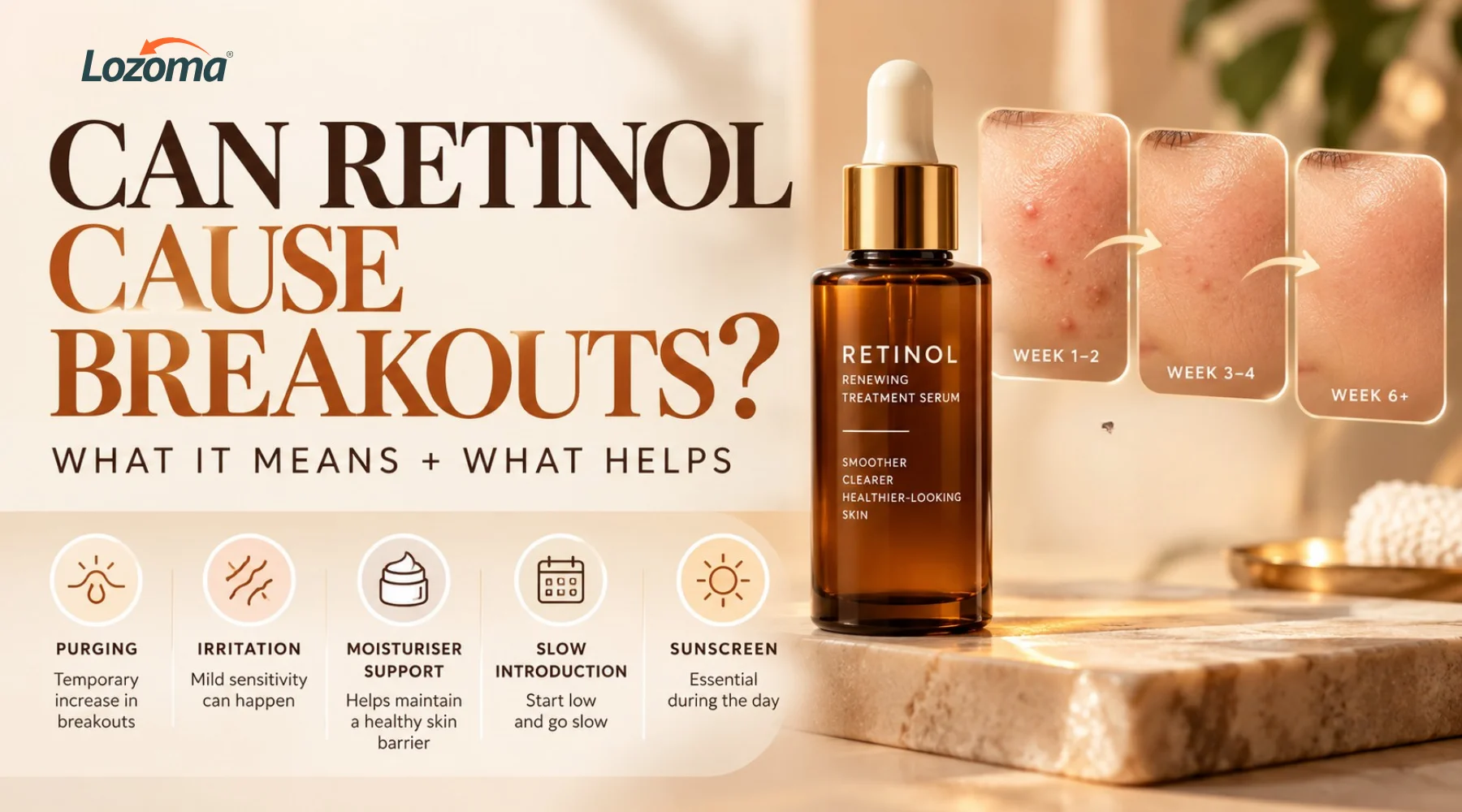
Starting retinol for clearer, smoother skin can feel confusing, especially if you wake up with more spots. Retinol is often recommended for clogged pores and acne, so why does it sometimes seem to make breakouts worse?
The answer lies in what happens when you start using it. Yes, retinol can cause breakouts, but not all breakouts are the same. Some people notice more blemishes as clogged pores become visible faster. Others might get irritation that looks like acne. Sometimes, the problem isn’t the retinol itself, but another product you’re using or a disrupted skin barrier.
Understanding the cause is important because it changes how you should respond. If your skin is adjusting to retinol, you may need to be patient and take it slow. If it’s irritation, reduce use and focus on skin barrier support. If you have persistent or severe acne, seek proper treatment instead of waiting for a so-called “purge” to end.
Knowing how retinol works makes these reactions easier to understand. Retinol isn’t just an exfoliant; it’s a vitamin A derivative that affects how skin cells grow and act. This can be beneficial, but it also explains why using too much too quickly can irritate your skin.
Can Retinol Cause Breakouts, or Is It Purging?
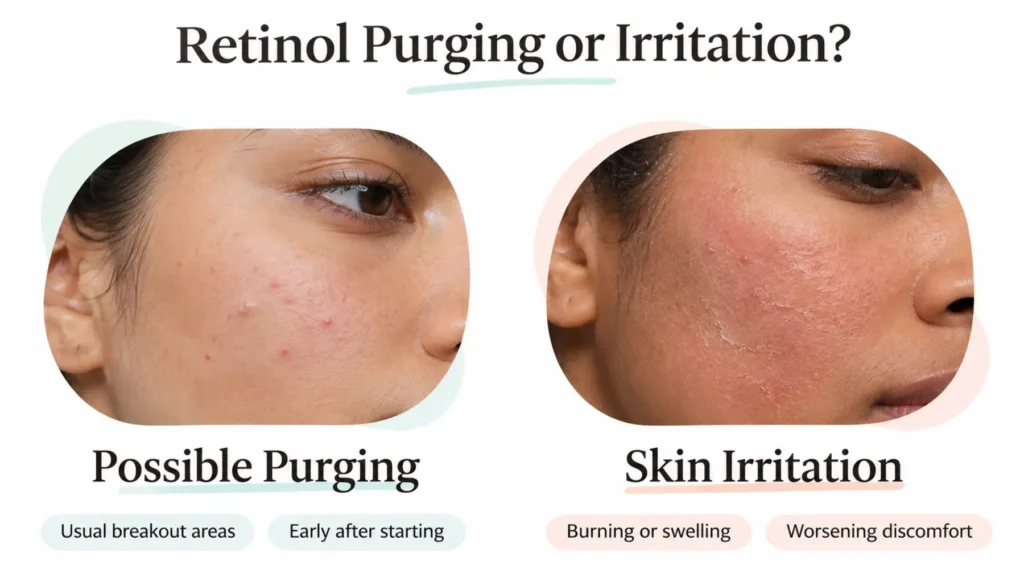
Retinol may cause more spots in the first few weeks, especially for those with skin that clogs easily. This effect is often called “retinol purging.”
However, the term “purging” can be misleading. Retinol doesn’t pull toxins from the skin. The skin doesn’t hold onto acne-causing toxins waiting to emerge.
A better explanation involves microcomedones. These are tiny blockages in pores that can turn into whiteheads, blackheads, or pimples. Retinoids speed up cell turnover, helping cells shed correctly inside the pores. As this process changes, blemishes that were already forming may show up sooner.
This can make it seem like retinol is causing new acne. But the key point is that these blemishes were already developing. Retinol doesn’t need to start a whole new acne issue for the skin to look worse temporarily.
At the same time, the term “purging” is often used too loosely online. A rash, burning, clusters of irritated bumps, or worsening acne for several months should not simply be labelled as “the purge.”
What a possible retinol purge tends to look like
A temporary change is likely when breakouts occur in areas where you usually have them. For example, if you often get closed comedones on your forehead, you might see more of them after starting retinol.
Timing is important. Changes usually start soon after you begin using retinoids, not randomly months later.
The skin around the spots may still feel comfortable. Some dryness can happen with retinoid use, but if you experience burning, swelling, or painful cracking, that indicates irritation, not just a regular acne flare.
You should also see signs of improvement over time. Retinoids work slowly, so you don’t need perfect skin in four weeks. However, continuous worsening is not acceptable just because someone said retinol has to “get worse before it gets better.”
Purging, Irritation and a Normal Breakout Can Look Surprisingly Similar
The most useful question is often not “Am I purging?” but “What else is happening to my skin?”
| Feature | Possible Retinoid Adjustment | Irritation or Barrier Damage | Ordinary Acne Flare |
| Location | Usually areas already prone to congestion | Can appear anywhere retinol is applied | Often follows your usual acne pattern |
| Sensation | Mild dryness may occur | Burning, soreness, itching or tightness more likely | Spots may be tender, but surrounding skin usually feels normal |
| Appearance | Whiteheads, blackheads or inflammatory pimples | Red patches, tiny bumps, scaling or diffuse inflammation | Typical comedones, papules, pustules or deeper lesions |
| Timing | Often begins relatively early after introduction | Can happen rapidly after excessive use | May occur independently of retinol |
| Skin barrier | Usually broadly intact | Frequently compromised | Usually intact unless other treatments are irritating it |
| Expected direction | Should gradually settle | Often worsens if retinol continues unchanged | Depends on underlying acne triggers |
No table can diagnose a skin condition just by looking at it. However, understanding the differences can help avoid a common mistake with retinol: pushing through irritation because every new bump is thought to be purging.
Signs of Irritation From Retinol That Can Look Like Breakouts
Retinoid irritation can cause more than just peeling skin. At first, mild dermatitis may show up as rough texture, redness, and tiny bumps. In acne-prone skin, irritation can make existing blemishes look worse.
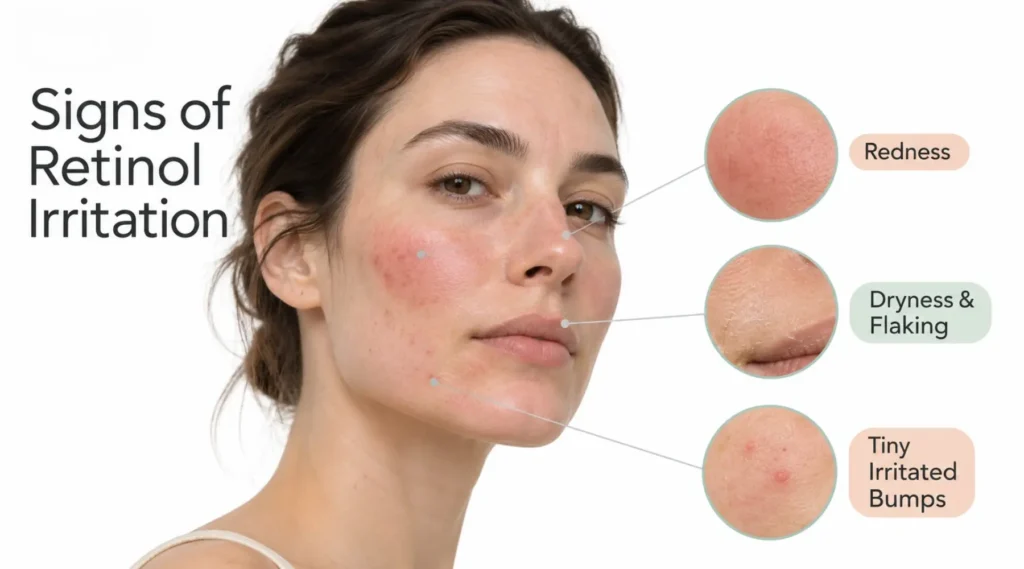
Signs of irritation include:
- Ongoing stinging, burning, or warmth
- Redness spreading beyond spots
- Skin feeling tight or shiny
- Flaking around the nose, mouth, or eyes
- Increased sensitivity to products that usually feel fine
- Many small, similar bumps
- Worse dryness after washing
- Itching
- Cracking
- New blemishes in areas where you rarely get acne
Irritated skin often can’t handle your usual routine. A cleanser that was fine may start to sting, sunscreen may feel uncomfortable, and even a simple moisturiser might burn for a few moments after you apply it.
This doesn’t mean your moisturiser is bad. A damaged skin barrier makes it easier for irritants to affect your skin. If this sounds familiar, increasing your retinol strength or using it more often probably won’t help.
Why Retinol Can Make Acne-Prone Skin Look Worse Before It Looks Better
In a hair follicle, oil and dead skin cells can build up instead of being shed normally. This creates a tiny blockage. Over time, this can turn into a closed comedone, a blackhead, or become inflamed.
Retinoids help by affecting skin cell production and preventing cells in the follicle from clumping together. This is why retinoids are important for treating acne.
Prescription retinoids like adapalene and tretinoin are more effective for acne than over-the-counter retinol. While over-the-counter retinol can help with mild issues, it’s not the same as medical retinoids.
When asked if retinol helps acne, the answer is yes, especially for mild blockages. However, the effectiveness depends on the type of retinoid, its strength, how it’s made, and the acne’s severity.
Serious acne, like deep nodules or widespread inflammation, should not be treated just with cosmetic retinol.
What Does Retinol Do for Your Skin Beyond Acne?
Knowing how retinol helps your skin clarifies its benefits and side effects.
When you apply retinol, it converts into retinaldehyde and then retinoic acid. Retinoic acid is the active form that works with skin receptors. These pathways affect skin cell behaviour and processes related to collagen, pigmentation, and hair follicle health.
With regular use and the right formula, retinol can improve uneven texture, fine lines, certain types of dark spots, and clogged pores. However, its benefits take time, as changes in collagen and skin structure don’t happen overnight.
Unlike typical exfoliating acids, retinol does not rely on flaking to be effective. You don’t need to see peeling to know that retinol is working on your skin.
This point is crucial. Some people intentionally use enough retinol to cause peeling, thinking it indicates effectiveness. However, excessive inflammation can lead to a harder routine and may increase dark spots in sensitive skin.
Retinol Purging Has a Time Limit
Deciding how long to wait before realising something is wrong with your skin can be tough. There’s no exact number of days to tell the difference between skin purging and a bad reaction. Factors like skin type, acne severity, the retinoid used, its strength, and other products can all affect this adjustment period.
As a general rule, you may notice changes in the first few weeks. If your blemishes are becoming less frequent and your skin feels good otherwise, it’s okay to keep using the product cautiously.
By 8 to 12 weeks, you should see a clearer overall trend. You might not yet see the full benefits of retinol, as improving fine lines and pigmentation can take longer, and acne often needs ongoing treatment. However, don’t use the idea of purging as an excuse to ignore worsening skin.
If after three months you notice more inflammation, clogged pores, burning, or new acne in different areas, it’s time to reconsider your routine instead of just waiting.
Retinol Can Cause Breakouts for Acne-Prone Skin: Why Formula Matters
Acne-prone skin responds to the full product, not just the word “retinol” on the bottle.
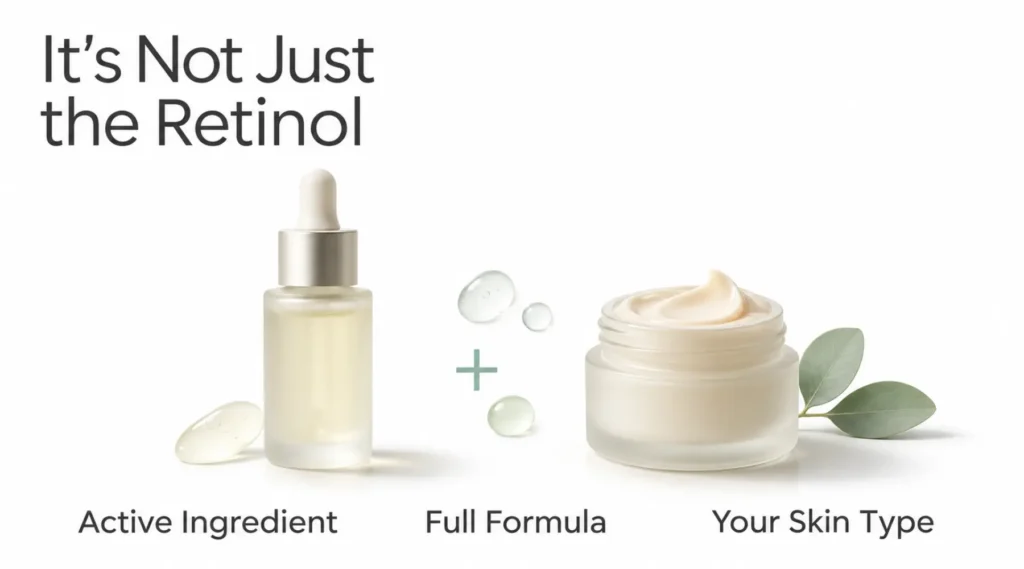
A retinol product might include other ingredients like oils, silicones, fragrances, and preservatives. These ingredients can be fine for many people, but everyone’s skin is different.
A thick cream that works well for dry skin may be too heavy for someone with acne-prone skin. On the other hand, a light formula with a lot of alcohol could irritate dry skin and make acne worse.
This shows that it’s not always fair to blame just the active ingredient.
If a new product causes closed comedones for months, especially in unexpected areas, consider the entire formula.
Also, remember that “non-comedogenic” doesn’t guarantee a product won’t cause breakouts. Comedogenicity tests have limits, and everyone’s skin reacts differently.
When picking skincare, focus on how the whole product works for your skin instead of searching for a perfect ingredient list.
The Difference Between Retinol and Retinal Matters
Retinol and retinal may sound similar, but they are different ingredients.
Retinol needs to go through two steps to become retinoic acid:
Retinol → retinal → retinoic acid.
Retinal, or retinaldehyde, is one step ahead:
Retinal → retinoic acid.
This difference affects how powerful each ingredient is and how well people can tolerate them. However, it doesn’t mean all retinal products are harsher than all retinol products. The formula is crucial.
A low-dose retinal product can be gentler than a strong retinol formula. Likewise, a mild retinol cream might be better for sensitive skin.
When comparing products like Difuman Retinol Anti-Ageing Dragon Blood Cream and Vita A Retinal Shot Tightening Booster, don’t just look at the percentages on the labels, since retinol and retinal are different substances.
Understanding the differences between retinol and retinal is helpful when deciding if you need to switch to retinal.
How to Use Retinol Without Overwhelming Your Skin
The safest retinol routine is usually simpler than what you see on social media.
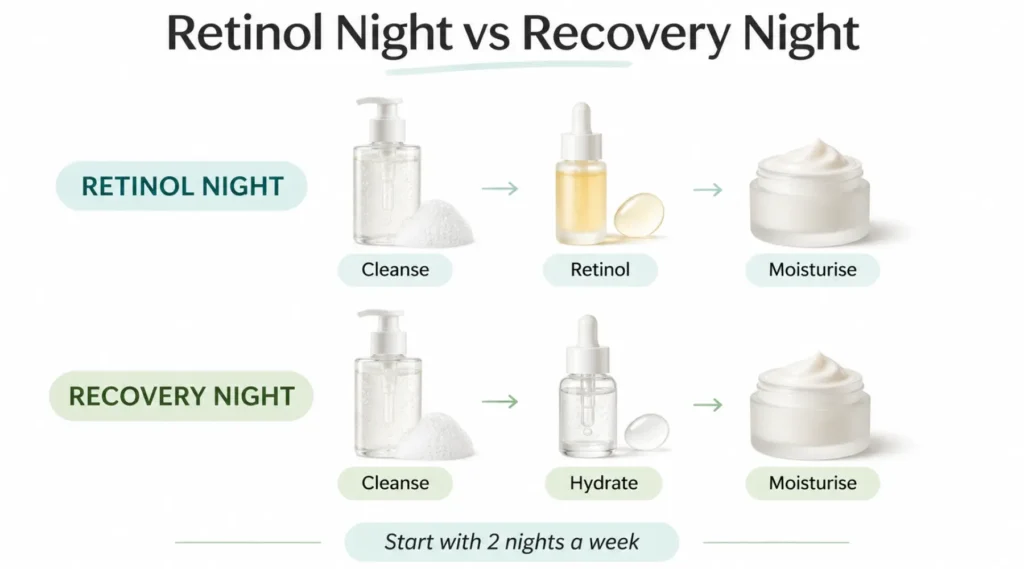
If you’re new to retinoids, start with two nights a week. Space out the applications to see how your skin reacts, instead of applying it four nights in a row and risking irritation.
Use a small amount; just a pea-sized amount is enough for your whole face. Using more won’t double the benefits; it only makes your skin work harder.
Make sure your face is dry before applying, especially if your skin is sensitive. Damp skin can increase absorption, which is good for moisturisers but not when starting an irritating product.
A simple evening routine can look like this:
| Step | Retinol Night | Recovery Night |
| Cleanse | Gentle cleanser | Gentle cleanser |
| Treatment | Small amount of retinol on dry skin | Skip retinoids and strong exfoliants |
| Hydration | Simple hydrating serum if tolerated | Hydrating serum or essence if wanted |
| Moisturise | Barrier-supporting moisturiser | Barrier-supporting moisturiser |
| Morning after | Broad-spectrum sunscreen | Broad-spectrum sunscreen |
You don’t need to use retinol every night to see benefits. Some people succeed using it three or four times a week for a long time.
Using retinol regularly at a comfortable pace is better than using it every night for ten days, hurting your skin barrier, and then taking a month off.
How Often to Use Retinol When You Are Breaking Out
If you notice blemishes but little irritation, don’t rush to use retinol more often. Some think using more will make skin issues clear up faster, but that’s not a good approach. Using retinol too frequently can cause more inflammation, making it hard to tell if you have acne or another skin issue.
For new users, start with two nights a week. If your skin feels good after a few weeks, you can switch to every other night. Only use it nightly if the formula is designed for that and your skin can handle it.
The best frequency for using retinol isn’t the same for everyone. It’s about finding a balance that keeps your skin comfortable for long-term use. If you experience breakouts along with burning or peeling, use retinol less often instead of more.
The Moisturiser Sandwich Can Be Useful, but It Is Not Mandatory
The moisturiser sandwich is simple:
Moisturiser → retinol → moisturiser.
Putting moisturiser on first helps shield your skin from retinol. The second layer slows down moisture loss and reduces dryness.
This method is great for people with dry skin, a history of retinol irritation, or sensitivity around the nose and mouth.
Buffering doesn’t make retinol useless. A routine you can stick to is better than trying to maximise results one night and then needing a week to recover.
You can also try targeted buffering. Apply moisturiser around your nose, mouth, and eyes before using retinol on the less sensitive parts of your face.
Avoid putting retinol directly on your eyelids, lip corners, or any delicate areas unless the product is specifically meant for those spots.
How to Avoid Breakouts From Retinol When Starting a New Routine
The best way to prevent skin issues is to be cautious.
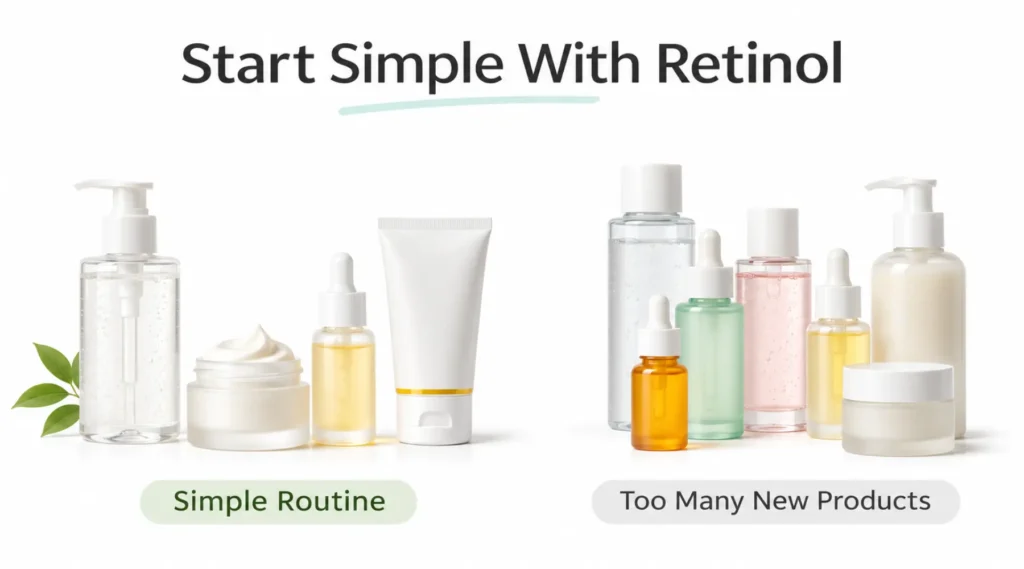
Introduce one new product at a time. Starting retinol, an exfoliating toner, vitamin C, a new cleanser, and a new moisturiser all at once can cause confusion during a breakout.
Keep your routine simple for a while. A gentle cleanser, moisturiser, and daily sunscreen create a clear starting point. Once you see that retinol works for you, you can slowly add more products.
Staying hydrated can help with retinoid use. Moisturisers and humectants won’t stop all side effects, but they can lessen the dryness that leads to sensitive skin. Use a hydrating treatment like the Bio-Collagen Real Deep Mask when your skin feels good, but avoid masks if your skin is burning or irritated. If your face feels raw, it’s safer to simplify your routine instead of layering on more treatments.
The same idea applies when choosing concentrated face serums. Using more products doesn’t always mean better skin.
Can You Use Hyaluronic Acid With Retinol?
Yes, you can usually use hyaluronic acid with retinol, and this combination is often helpful.
Hyaluronic acid is a humectant. It attracts and holds water in the skin’s outer layers. It does not exfoliate or compete with retinoids.
If your skin tolerates both products, apply a hydrating hyaluronic acid serum before your moisturiser, and keep retinol as the main treatment.
The order of application depends on the product texture and your skin’s sensitivity. A careful approach could be to cleanse, apply a hydrating layer, let your skin dry, and then apply retinol and moisturiser.
Remember, hydration is not the same as repairing your skin barrier. Hyaluronic acid can help dry skin feel better, but if you have significant irritation from retinoids, you may need to reduce use or take a break.
Can I Use Niacinamide With Retinol?
For most people, niacinamide and retinol can be used together. Niacinamide helps with skin barrier function, uneven tone, oil control, and inflammation. It does not cancel out retinol.
Combining these two is often better than mixing retinol with many strong acids. The main issue is that niacinamide serums can contain other ingredients like acids, fragrances, and plant extracts. Sensitive skin may react to the full formula, not just individual ingredients.
If you suspect retinol is causing breakouts, keep your routine simple. Add niacinamide after your retinol routine is stable.
During this adjustment period, a basic hydrating serum might be better than a complex formula. Always check the full ingredient list and your skin’s tolerance before using products labelled as serums, even something like a 24K Gold Serum.
What About Acids, Benzoyl Peroxide and Vitamin C?
These combinations need careful thought.
You can use retinol with salicylic acid, glycolic acid, lactic acid, or benzoyl peroxide, but mixing multiple irritating ingredients can lead to dryness and skin irritation. This is especially important if you’re worried that retinol is causing breakouts. Adding an acid when your skin looks congested can make the situation worse.
Spacing out strong ingredients by time or day can help your skin adjust better.
Vitamin C is a bit different. Many vitamin C versions are gentle, but low-pH L-ascorbic acid can irritate sensitive skin. A simple routine is to use retinol at night and vitamin C in the morning if your skin tolerates both.
The main idea is not that certain ingredients can’t be used together, but that skin has a limit for irritation.
Should You Stop Using Retinol if It Causes Breakouts?
Not automatically.
If you get new pimples in your usual trouble spots, and your skin feels normal otherwise, you might want to reduce how often you use retinol and see how it goes.
If your face burns, itches, swells, or has red patches that won’t go away, sticking to your routine won’t help.
Taking a short break can help your skin heal. When your skin can handle cleanser and moisturiser again without pain, you can start using retinol less often.
However, if you have a severe reaction like major swelling, blisters, a widespread rash, or symptoms of an allergy you should stop using the product and get medical help.
Persistent acne needs attention, too. If breakouts worsen, leave scars, or are deep and painful, don’t stick to the same skincare routine hoping it will fix itself.
What to Do When Your Skin Barrier Is Already Irritated
When your skin reacts to retinol, it’s better to simplify your routine. Stop using the retinoid and avoid strong acids, scrubs, and any irritating products. Use a gentle cleanser if needed and apply a basic moisturiser with soothing ingredients like ceramides, glycerin, panthenol, and squalane to help your skin heal.
Make sure to wear sunscreen during the day.
Do not aggressively scrub peeling skin; let it come off naturally. Scrubbing can damage the skin underneath before it’s ready.
Once your skin feels normal again, you can try the retinoid again but use it less often. If irritation happens again, that product may not be right for you.
Retinol Breakouts Can Leave Dark Marks if Irritation Is Ignored
A breakout doesn’t always solve the problem.
Inflammatory acne can leave red or dark spots after it heals. Irritation can make these spots more visible, especially in skin that darkens easily after irritation.
That’s why trying to ignore strong reactions isn’t a good idea. A gentler routine reduces extra inflammation. Daily broad-spectrum sunscreen is important because UV rays can worsen uneven skin tone and counteract improvements from retinol.
Popping pimples causes more damage. A breakout that could heal in a week may leave a mark that lasts much longer if you squeeze it.
Retinol can help with uneven skin tone, but preventing inflammation is a better approach than treating the spots later.
Is Retinol Always the Best Choice for Breakout-Prone Skin?
No.
Retinol is helpful, but skincare shouldn’t just focus on one trendy ingredient. If you struggle with acne, stronger treatments might work better. Depending on your acne type, consider salicylic acid, benzoyl peroxide, azelaic acid, or prescription retinoids like adapalene.
The best choice depends on whether you have comedonal acne, inflammatory lesions, hormonal issues, sensitive skin, pigmentation, or scars. A dermatologist or healthcare professional can help determine if your skin issue is actually something else, like rosacea or folliculitis.
If retinoids irritate your skin but you want to target ageing rather than acne, you might try bakuchiol. This ingredient is different from retinol and is often gentler. Using a product you can apply regularly is usually more effective than a stronger option that irritates your skin and requires breaks.
Common Retinol Mistakes That Make Breakouts More Likely
Using retinol the wrong way can lead to irritation, which users mistake for acne. They then apply more acne treatments, causing even more irritation.
One common mistake is using too much product. More doesn’t always mean better results.
Another issue is starting with nightly applications. While some users can handle daily use, it’s not the best starting point for everyone.
Over-exfoliating can also be a problem. When users see flaking from retinol, they often think they need to remove dead skin and add glycolic acid or scrubs. This can cause more inflammation and tiny bumps, which they might mistake for purging.
Changing too many products at once creates confusion. It’s hard to identify what works when everything is different.
Lastly, frequently switching between retinol strengths doesn’t give the skin time to adjust. Skincare usually requires patience to see results.
Lifestyle Factors Can Coincide With a Retinol Breakout
Not all breakouts that happen after starting retinol are due to retinol. Acne naturally changes over time. Hormonal shifts, stress, menstrual cycles, sweating, friction from headwear, hair products, birth control changes, and some medications can all affect breakouts. Even adding a heavier moisturiser with retinol can make things unclear.
This is important because people often link two events that occur close together. For example, if you start retinol on Monday and then notice a chin breakout the following week, it’s easy to blame the retinol. However, your chin may have broken out at the same time in your menstrual cycle for the past six months.
Taking a weekly photo under consistent lighting is more helpful than checking your skin repeatedly each day. It’s easier to see patterns over several weeks rather than day by day.
When a Breakout Needs Professional Assessment
Retinol adjustment shouldn’t make you overlook serious acne. If you have painful nodules, cysts, fast-forming scars, or severe inflammatory acne, see a professional. Early treatment can help prevent permanent scars.
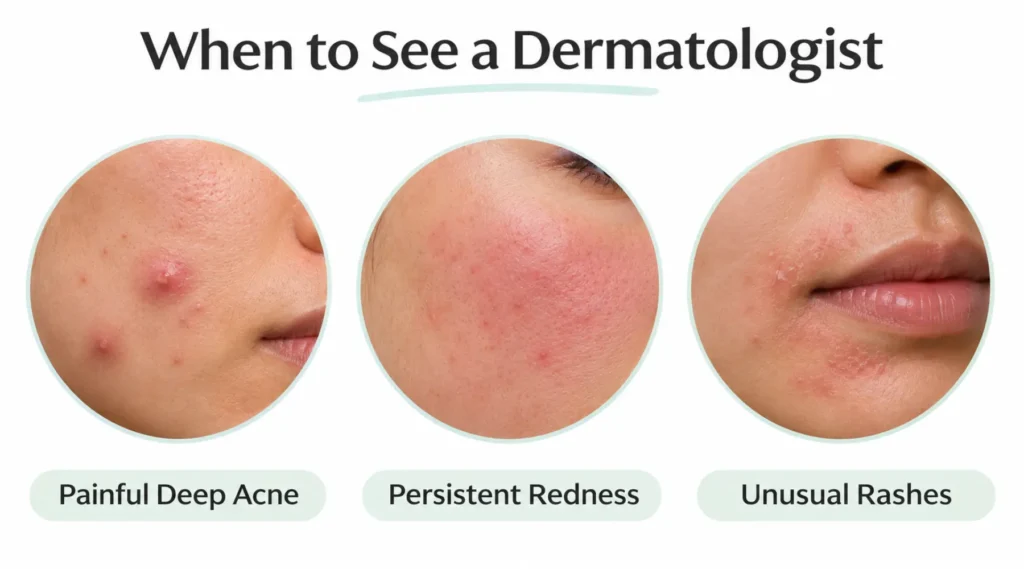
The same goes for uncertain acne. If your face is persistently red with bumps, itchy eruptions, rashes around your mouth, or recurring inflammation around your eyes, you may need a different diagnosis and treatment.
Prescription retinoids require more caution than cosmetic retinol. They can work differently and may cause more irritation. Don’t apply over-the-counter skincare advice to prescribed treatments.
Avoid topical retinoids during pregnancy. If you are pregnant, planning to become pregnant, or unsure about using retinoids while pregnant or breastfeeding, consult a healthcare professional instead of relying on cosmetics.
A Practical Retinol Timeline for Breakout-Prone Skin
Retinol results rarely follow a perfectly straight line, but thinking in phases can make the process less confusing.
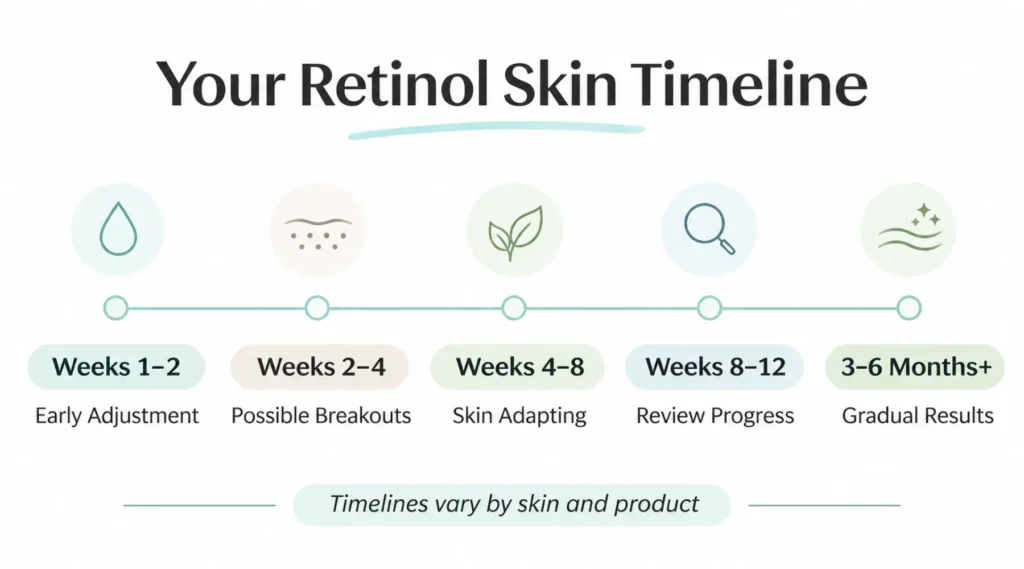
| Period | What You Might Notice | What Matters Most |
| First 1–2 weeks | Mild dryness or no visible change | Keep frequency low and routine simple |
| Weeks 2–4 | Possible increase in congestion or irritation | Distinguish spots from barrier damage |
| Weeks 4–8 | Skin may begin adapting | Increase frequency only if comfortable |
| Weeks 8–12 | Overall direction should become clearer | Reassess persistent worsening |
| 3–6 months | Texture, congestion and pigmentation may improve gradually | Consistency and sunscreen |
| Beyond 6 months | Longer-term changes become easier to judge | Use the lowest effective, tolerable routine |
These time frames are just guides, not strict deadlines.
A person using a mild cosmetic retinol twice a week may see slower results than someone using a prescription retinoid. Someone with ongoing acne might need a combination of treatments instead of just retinol.
The key question is whether your routine is improving your skin’s health without causing too much irritation.
Questions People Ask When Retinol Starts Causing Spots
Can retinol cause breakouts even if I have never had acne?
When you start using a new product, some pimples might appear. However, if someone who usually doesn’t get acne suddenly has a lot of breakouts, it shouldn’t automatically be called purging. Look for irritation from other ingredients, hormonal changes, or new products. If the breakouts continue or worsen, stop thinking it’s just purging and review your skincare routine.
How can you tell if retinol is causing your skin to purge or break out?
Pay attention to where the breakouts happen, how they feel, and how they change over time. A temporary adjustment usually affects areas that already tend to break out and should improve. A serious reaction might show up in new areas, last a long time, or come with burning, itching, redness, and scaling. No single sign can give a clear answer, so look at the overall pattern.
Does retinol help with acne after the purging phase?
Retinoids can help prevent clogged pores by normalising how skin cells behave, making them important for acne treatment. However, most strong evidence comes from prescription retinoids like adapalene and tretinoin. Regular cosmetic retinol may help with mildly congested skin but shouldn’t be relied upon to treat severe acne on its own.
How long should retinol breakouts last?
There’s no guaranteed duration. Early adjustment might take a few weeks. If you reach 8-12 weeks with no improvement or worsening acne, reconsider the product and consult a professional. Don’t accept ongoing worsening as normal.
Should you stop using retinol if it causes breakouts?
It depends on the reaction. A few temporary spots without irritation may not require stopping; reduce how often you use it. However, if your skin burns, swells, itches intensely, cracks, or becomes very inflamed, stop or pause using retinol and seek professional advice.
Can using too much retinol cause acne?
Using too much retinol usually irritates, not real acne. This irritation can lead to small bumps, redness, and inflammation that look like a breakout and can worsen existing acne. Applying more than the recommended amount won’t speed up results.
Can retinol cause tiny bumps on the forehead?
Yes, there are a few reasons this might happen. Existing closed comedones may show up more when you start using retinoids. Irritation can also cause small bumps, or the product might not suit your skin. If the bumps itch, spread quickly, or look unusual, consult a professional instead of assuming they are acne.
Can retinol cause cystic acne?
Cosmetic retinol should not cause deep cystic acne. If you notice large, painful bumps or if your acne worsens, seek proper treatment. Deep inflammatory acne can scar and should not be ignored while waiting for a cosmetic product to work.
Can I use niacinamide with retinol during breakouts?
Yes, if your skin tolerates niacinamide. It can work well with retinoids, but when dealing with breakouts, it’s best to keep your routine simple. Don’t add many new products at once.
Can you use hyaluronic acid with retinol every night?
Yes, hyaluronic acid and retinol usually work well together. You can use a hydrating hyaluronic acid product on both retinol and non-retinol nights if your skin can handle it. If your skin is irritated, even gentle products might cause stinging, so keep your routine simple.
Does retinol cause more breakouts with salicylic acid?
Not necessarily. The combination won’t automatically cause acne, but using both too aggressively can lead to irritation. Both can be part of an acne routine, but switching between them might be easier for sensitive skin.
Is peeling a sign that retinol is working?
No. Peeling can happen with retinol, especially when you first start using it, but it’s a side effect, not a sign of effectiveness. You can benefit from retinol without visibly peeling skin.
Can I restart retinol after damaging my skin barrier?
Yes, but wait until your skin has fully healed. Your cleanser and moisturiser should not sting anymore, and any redness or cracking should be gone. Start using retinol less often than before. If irritation returns, try a gentler formula or lower strength.
Will switching from retinol to retinal stop breakouts?
Not necessarily. Retinal might irritate your skin too, even at lower strengths. Just switching doesn’t guarantee better results. Other factors like formula, strength, and your skin’s condition are important too.
Can I use retinol forever if my skin tolerates it?
Yes, many people use retinoids long-term if they work for them. You don’t have to keep increasing the strength. If a moderate concentration used a few nights a week is effective, that’s fine.
Can Retinol Cause Breakouts Without Meaning You Have to Give It Up?
Yes, retinol can cause breakouts or make them look worse at first, but it’s important to understand why this happens rather than just calling it “purging.”
A temporary increase in blemishes can happen when skin that tends to get clogged begins to adjust to retinoids. This is different from burning, widespread bumps, severe peeling, or ongoing inflammation, which suggest irritation.
The goal isn’t to use the strongest retinol possible but to find a level that your skin can handle. Start slowly with a small amount and keep your routine simple. moisturise well and protect your skin from sun damage every day. Only increase use when your skin is calm, not just because a schedule says to.
If your skin isn’t improving, it’s okay to rethink using retinol. It can be a great long-term solution for skin texture, signs of ageing, and some congestion, but healthy skin shouldn’t suffer for months with burning or worsening acne to get those benefits. If the reaction doesn’t seem temporary, it’s time to reassess what your skin needs, rather than increasing retinol.