





Blog
How to Use Niacinamide in Your Routine for Better Results


Niacinamide is a popular skincare ingredient, but many people still have questions. Should you apply it before moisturiser? Can it be used with retinol? How often should you use it? Why does it sometimes cause redness or bumps?
Using niacinamide is about picking the right product and applying it correctly, not following strict rules. Most people should apply it after cleansing and before moisturiser, either in the morning, evening, or both, depending on their skin. A concentration of 2% to 5% is usually enough to support the skin barrier, improve tone, and control oil. Stronger versions aren’t always better.
With regular use, niacinamide can help calm and balance the skin, making it more tolerant of other ingredients. However, it’s not a quick fix and shouldn’t replace proper care for issues like acne, eczema, rosacea, melasma, or other skin conditions.
What Niacinamide Actually Does Once It Reaches the Skin
Niacinamide, or nicotinamide, is a form of vitamin B3 that dissolves in water. It is different from niacin, another type of vitamin B3 that can cause flushing when taken orally.
In skincare, niacinamide is a helpful ingredient, but it does not exfoliate the skin like glycolic or salicylic acid. It also isn’t a retinoid.
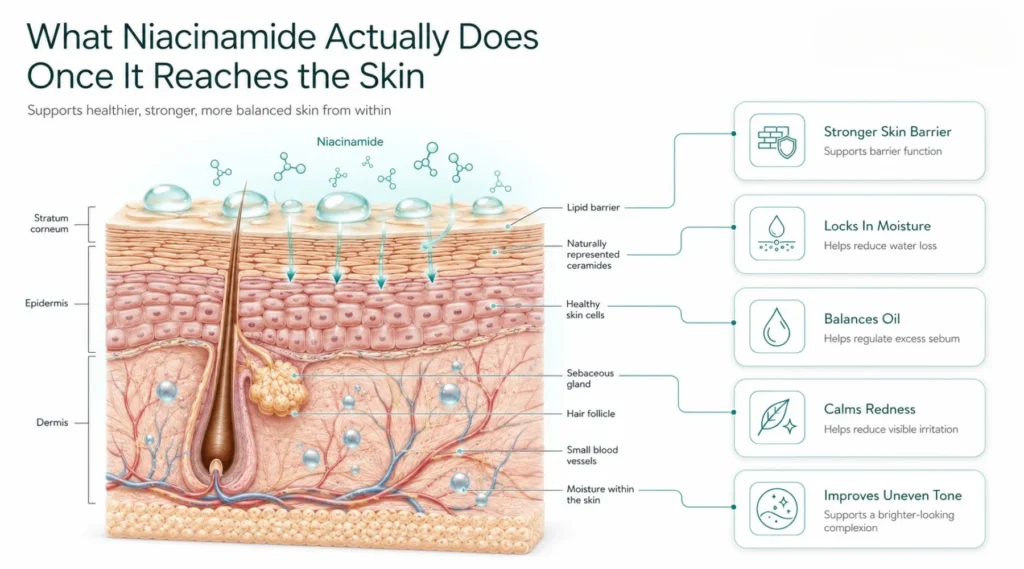
Niacinamide helps with energy and repair in skin cells. It boosts the production of barrier lipids like ceramides, which protect the skin, reduce moisture loss, and keep irritants out. Research shows that topical niacinamide can increase lipids in the skin and decrease water loss in dry skin.
Niacinamide may help control oil production. A study of a 2% niacinamide formula showed changes in facial oil output, though results varied among different groups.
For uneven skin tone, niacinamide mainly reduces the transfer of pigment from skin cells to surrounding cells. It does not bleach the skin or remove existing pigment. Clinical studies have shown that niacinamide can lower hyperpigmentation and lighten skin over time.
While niacinamide can improve skin health and address many issues gradually, it is not as powerful as prescription acne treatments or other strong skin procedures.
What Is Niacinamide Good For in a Daily Routine?
Niacinamide is great for tackling multiple skin issues at once. For example, someone might have oily skin that feels dry or post-acne marks with sensitivity from treatments.
A good niacinamide product can help with:
- A weak or irritated skin barrier
- Dryness from water loss
- Excess oil and shine
- Redness from mild irritation
- Uneven skin tone
- Marks left by blemishes
- Rough skin texture
- Enlarged pores from oil
- Fine lines and dullness from environmental damage
- Tolerance to irritating ingredients like retinoids
Clinical studies show that niacinamide can improve fine lines, wrinkles, redness, dullness, and dark spots with regular use. These results are encouraging, but they are based on entire formulations, not just individual products.
The effectiveness of a niacinamide product depends on its quality, supporting ingredients, packaging, and how consistently it is used.
How to Use Niacinamide Step by Step
The simplest way to use niacinamide serum is to apply it after cleansing and before moisturiser.
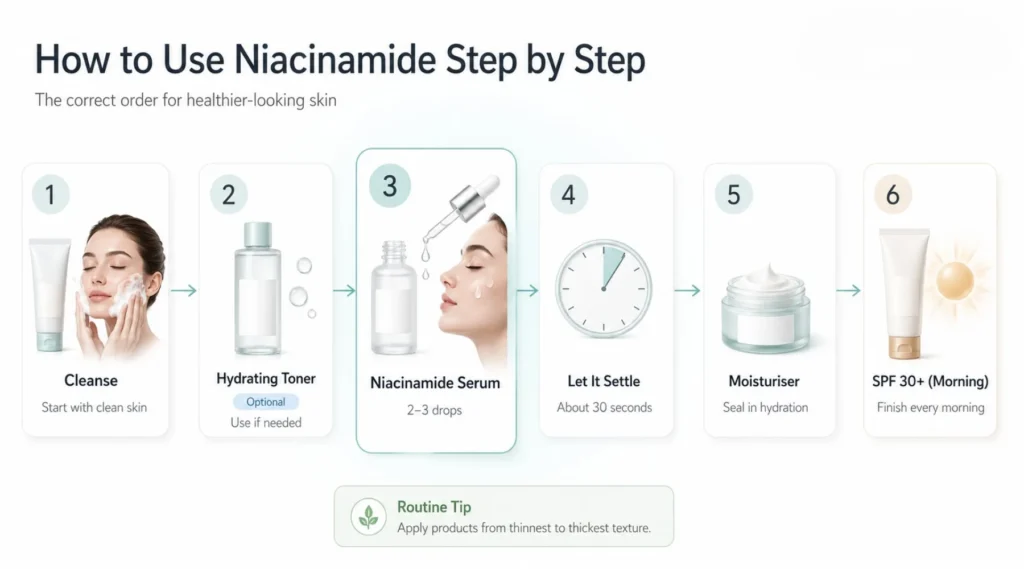
A basic routine follows this order:
- Cleanser
- Toner or hydrating mist, if used
- Niacinamide serum or essence
- Moisturiser
- Sunscreen in the morning
This order works because niacinamide is usually in lightweight, water-based products. Applying it before thicker creams helps the serum spread evenly on the skin without being blocked by a heavy layer.
The product’s texture is more important than its name. You can use a watery niacinamide toner before another serum. A niacinamide moisturiser comes later in the routine. A thick cream with niacinamide can be the last step for moisturising.
Step 1: Cleanse Without Stripping the Skin
Use a gentle cleanser to wash away sunscreen, makeup, oil, and dirt without making your skin feel tight. Niacinamide can’t fix damage from harsh cleansing. If washing disrupts your skin barrier, adding more active ingredients can lead to dryness and irritation.
For dry or sensitive skin, choose a cream, lotion, or low-foaming cleanser. Oily or acne-prone skin may do better with a light gel cleanser, as long as it doesn’t make your skin feel rough. In the evening, use an oil-based or balm cleanser first for stubborn makeup and water-resistant sunscreen, then follow with a gentle water-based cleanser.
Step 2: Use Toner When Needed
Toner is optional. You don’t need it to prepare your skin for niacinamide or to balance pH. A hydrating toner can help if your skin feels dry or if the niacinamide serum is too drying. Apply it first if it’s thin and watery.
Don’t combine multiple exfoliating toners with niacinamide just because they can work together. Daily use of glycolic acid, salicylic acid, and strong niacinamide may be too harsh, especially if you’re also using retinoids.
Step 3: Use a Small Amount of Niacinamide
For your face, just two or three drops of serum are usually enough. Apply a thin layer that covers the skin without being wet or sticky. Using too much serum won’t speed up results. It might clump under your moisturiser or sunscreen and increase your exposure to other ingredients in the formula. Gently spread the serum across your forehead, cheeks, nose, and chin. You can also put it on your neck if your skin can handle it. You don’t need to rub hard; lightly press or smooth it on.
Step 4: Let the Serum Settle
There’s no strict wait time before moving on to the next step. Just wait until the serum feels light and even, which could take 20 seconds for watery gels and a minute for thicker ones. Longer waits won’t help the serum absorb better. They’re only needed if other products tend to clump or if applying the next layer mixes them unevenly.
Step 5: Apply Moisturiser
Using a moisturiser is important to keep moisture in and can make your routine more comfortable. This is especially crucial for dry, sensitive, or retinoid-treated skin. While niacinamide helps with skin barriers, a serum alone might not provide enough moisture. Oily skin may do well with a light gel-cream, while dry skin often benefits from a cream made with glycerin, ceramides, squalane, shea butter, or fatty alcohols. If you prefer a lighter essence, try something like a 24K Gold Niacinamide Essence Moisturiser first, and then decide if you need a cream based on how your skin feels and the product’s instructions.
Step 6: Finish with sunscreen in the morning
Niacinamide doesn’t make your skin more sensitive to sunlight. However, using sunscreen every day is still important if you want to improve uneven skin tone, acne marks, or signs of ageing.
Without proper sun protection, UV rays can worsen pigmentation and damage collagen more quickly than skincare products can fix it.
Pick a broad-spectrum sunscreen with at least SPF 30. Apply it generously and reapply when you spend a long time outdoors, sweat, or swim.
Should Niacinamide Be Applied to Wet or Dry Skin?
Niacinamide works well on slightly damp or dry skin. Unlike strong acids or prescription retinoids, it doesn’t need completely dry skin for good absorption.
Applying a watery niacinamide serum to damp skin can help it spread better. This is especially helpful for dry skin, especially if the serum includes humectants like glycerin, panthenol, or hyaluronic acid.
However, your face shouldn’t be soaking wet. Too much water can dilute the serum and cause it to run or clump.
Use dry skin if:
- The serum stings on damp skin
- You’re using another irritating treatment
- You have a high-concentration product
- Your skin barrier is sensitive
- The manufacturer says to apply it to dry skin
If your skin is freshly exfoliated, over-cleansed, or irritated, even a gentle niacinamide serum can feel uncomfortable.
When Should You Use Niacinamide: Morning or Night?
Niacinamide can be used in the morning, at night, or twice a day. There’s no strict rule about when to apply it.
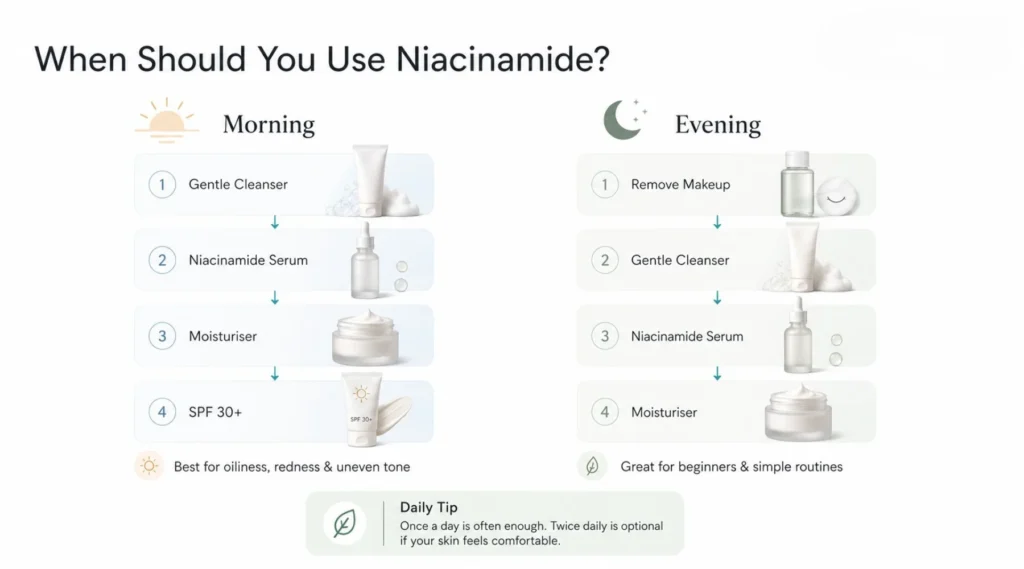
Morning use is good for those looking to reduce shine, redness, or needing extra skin protection during the day. It works well under lightweight moisturisers and sunscreen.
Evening use might be better if your morning routine includes vitamin C, acne treatments, or many product layers. Using niacinamide at night can also complement retinoids.
The best time to use niacinamide depends on its texture, your overall routine, and how your skin reacts. Understanding when to use niacinamide can help when balancing multiple active ingredients.
A simple morning routine
- Gentle cleanser or water rinse
- Niacinamide serum
- Moisturiser
- Broad-spectrum sunscreen
This routine works well for oiliness, mild redness, visible pores, or uneven tone.
A simple evening routine
- Makeup and sunscreen removal
- Gentle cleanser
- Niacinamide serum
- Moisturiser
This is a sensible starting point for beginners and sensitive skin.
Can niacinamide be used morning and night?
Yes, you can use the product regularly as long as it feels comfortable on your skin.
Not everyone needs to apply it twice a day. If using it once daily shows good results without causing irritation, there’s no need to apply it more just to use up the bottle faster.
Using niacinamide in multiple products can lead to too much exposure. For example, a cleanser, toner, serum, moisturiser, and sunscreen might all contain niacinamide. This can cause reactions, even if each product has a low concentration, like “5% niacinamide.”
How Often Should You Use Niacinamide?
Beginners can use niacinamide once a day, three to four times a week. After about two weeks, if the skin feels good, they can increase to daily use. People with tougher skin might start using it daily right away, especially if they use a moisturiser with a low concentration.
A cautious schedule looks like this:
| Stage | Suggested frequency | What to monitor |
| First week | Three applications | Stinging, itching, redness or new bumps |
| Second week | Every other day | Dryness, tightness or increased sensitivity |
| Weeks three and four | Once daily | Overall comfort and product layering |
| After one month | Once or twice daily if needed | Whether added use provides a meaningful benefit |
If your skin feels hot, itchy, tight, or rough, use the product less often. Forcing yourself to use it every day, even when it irritates your skin, won’t help. A product that you can use comfortably four times a week is better than one that you apply twice a day and harms your skin.
Choosing the Right Niacinamide Concentration
Niacinamide concentration is often used in marketing, but the highest percentage isn’t always the best choice. Most of the research on visible pigmentation, oil, and ageing has focused on concentrations between 2% and 5%.
A practical concentration guide is:
| Concentration | Often suitable for | Important considerations |
| Under 2% | Supporting formulae and sensitive routines | May still contribute when used consistently |
| 2%–5% | Most skin types, barrier support, tone and oil balance | Strong evidence base and usually good tolerance |
| 5%–10% | Experienced users or targeted formulae | May increase irritation without guaranteeing better results |
| Above 10% | Specialist or carefully formulated products | Often unnecessary for routine facial use |
Percentages alone don’t indicate if a product is gentle.
A 5% serum with fragrances, drying alcohol, and exfoliants might irritate the skin more than a well-made 10% serum. On the other hand, a simple high-strength formula can still cause redness, itching, or bumps in sensitive skin.
Focus on the full ingredient list, not just the niacinamide percentage on the front.
How to Use Niacinamide for Beginners
The safest routine for beginners is simple. Pick one niacinamide product and use it once a day or every other day. Don’t change other parts of your routine all at once.
Week One: Build Tolerance
Use a gentle cleanser, niacinamide, and moisturiser in the evening for three nights that are not in a row.
Don’t add new exfoliants, retinoids, vitamin C serums, or acne treatments this week. This way, if irritation occurs, you’ll know what’s causing it.
Week Two: Increase Use
If your skin stays calm, use the product every other evening or every morning.
Keep an eye on the areas around the nostrils, corners of the mouth, and under the eyes, as these spots may show irritation first.
Weeks Three and Four: Adjust for Your Needs
For oily skin, using it in the morning may work better under sunscreen.
For dry skin, use it in the evening with a thicker moisturiser for comfort.
For post-acne marks, use it daily with sunscreen instead of focusing on stronger formulae.
When using a retinoid, apply niacinamide before or after based on what feels best for your skin.
What Should You Apply After Using Niacinamide?
Moisturiser usually comes after a niacinamide serum.
In the morning, put on sunscreen after moisturiser. At night, moisturiser can be the last step, but you can add facial oil or a thick balm to very dry spots if needed.
Choose the next product based on your skin’s needs:
- For dehydration: Use a moisturiser with glycerin, hyaluronic acid, urea, or panthenol.
- For barrier damage: Look for products with ceramides, cholesterol, fatty acids, or colloidal oatmeal.
- For acne-prone skin: Choose a light, non-greasy moisturiser that doesn’t tighten the skin.
- For dark marks: Always finish your morning routine with a good layer of sunscreen.
- For dryness around the eyes or mouth: Use a simple cream in these areas instead of more active serums.
You can add a second active serum after niacinamide, but only if it clearly helps. Using more products should solve a problem, not just make the routine seem fancier.
Is Niacinamide Good for Dry Skin?
Niacinamide is helpful for dry skin because it supports barrier lipids and reduces water loss. Dry skin not only lacks water but may also have disorganised lipids, allowing moisture to escape and irritants to enter.
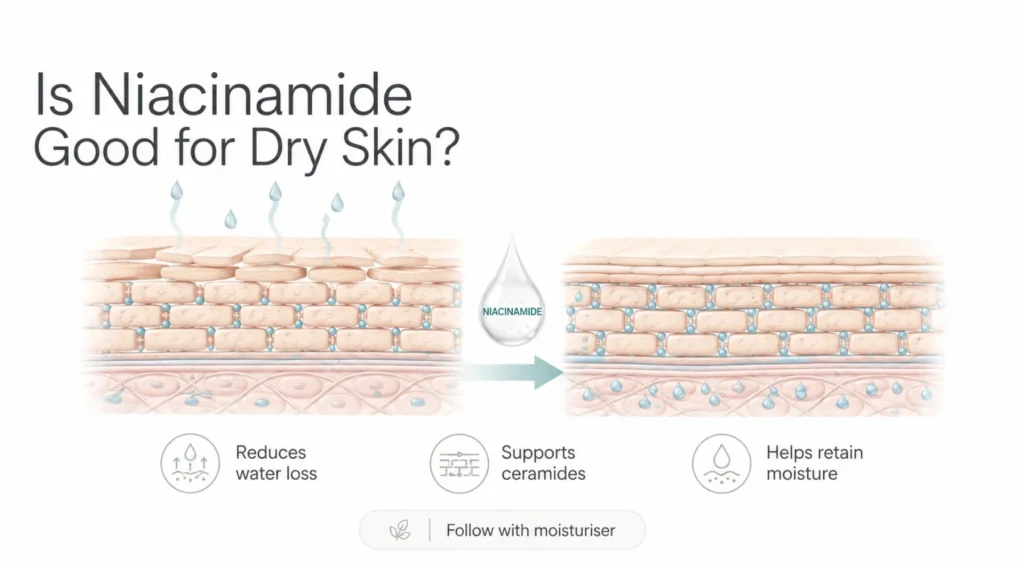
By promoting the production of ceramides and fatty acids, niacinamide helps the skin retain moisture over time. Studies show that using niacinamide topically increases skin lipids and lowers water loss in dry skin.
However, niacinamide alone isn’t enough to moisturise. A water-based serum might feel light but usually has few skin-softening ingredients. Dry skin often needs to be followed by a cream.
For very dry skin, it’s better to use a niacinamide moisturiser instead of a concentrated serum. This ensures you get humectants, emollients, and occlusives along with niacinamide.
A dry-skin routine with niacinamide
Morning
- Cream cleanser or water rinse
- Hydrating niacinamide serum
- Ceramide-rich moisturiser
- Cream or lotion sunscreen
Evening
- Gentle cleanser
- Niacinamide serum or essence
- Nourishing moisturiser
- Occlusive balm on flaky areas if needed
Avoid pairing niacinamide with astringent toners or frequent exfoliation when dryness is already present.
Does Niacinamide Help With Acne?
Niacinamide can benefit acne-prone skin, but it should be used as a helper, not a main treatment.
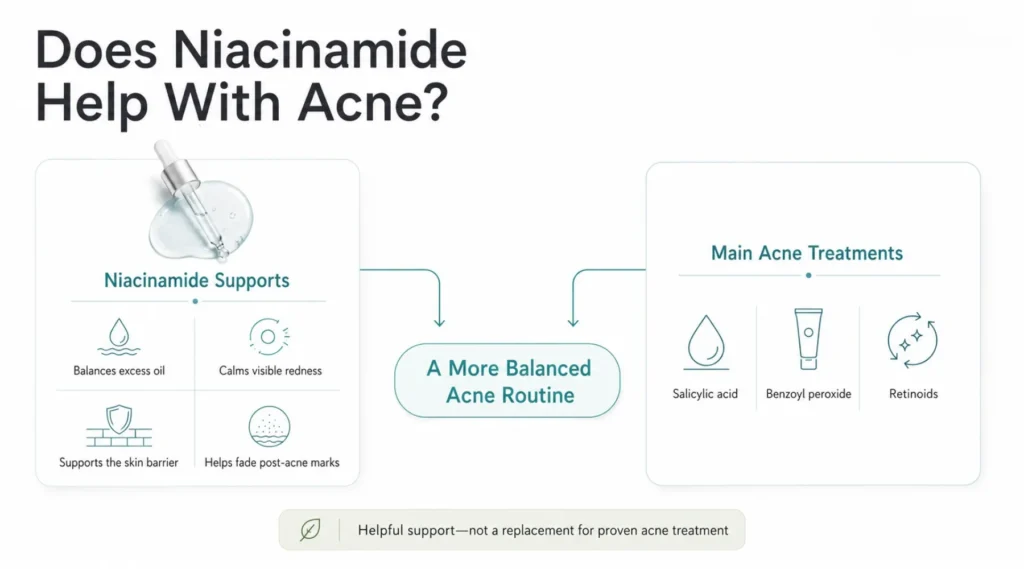
It may help by:
- Controlling excess oil
- Reducing redness
- Strengthening the skin barrier weakened by acne treatments
- Making it easier to tolerate medications like benzoyl peroxide, salicylic acid, or retinoids
- Gradually fading post-acne marks
- Offering a mild option for oily and sensitive skin
Clinical trials have compared 4% niacinamide gel with clindamycin for inflammatory acne. Some studies showed similar improvements. However, this doesn’t mean a niacinamide serum should replace prescribed antibiotics or proven acne treatments, as the studies used different conditions and patient groups.
Niacinamide alone is unlikely to clear stubborn comedonal acne because it doesn’t exfoliate pores like salicylic acid does. It’s also not as effective as topical retinoids for stopping microcomedones.
For mild oiliness and occasional blemishes, niacinamide can improve skin health. For moderate to severe acne, like cystic or scarring types, it’s best to get professional advice instead of just using stronger serums.
A balanced acne-prone routine
Morning
- Gentle gel cleanser
- Niacinamide serum
- Lightweight moisturiser
- Non-comedogenic sunscreen
Evening
- Cleanser
- Salicylic acid, benzoyl peroxide, or a retinoid according to tolerance
- Moisturiser
Niacinamide can be added to the evening routine as well, but it does not need to appear in every step.
How Niacinamide Fits Different Skin Types
Oily Skin
After cleansing, use a light, water-based serum. A 2% to 5% concentration is good for balancing oil. Don’t pick drying products just because your skin is oily; dehydrated skin can look shiny and feel tight.
Combination Skin
Apply niacinamide all over or focus on the oilier areas: forehead, nose, and chin. Use a lighter moisturiser for your T-zone and a richer one for dry cheeks.
Dry Skin
Choose a niacinamide essence, lotion, or moisturiser with humectants and barrier lipids. Apply cream after serum. Avoid strong concentrations if your skin is flaky or sensitive.
Sensitive Skin
Start with a lower concentration, two or three times a week. Use fragrance-free products with few ingredients. Patch test to check for reactions, though a successful test doesn’t mean the full face will tolerate daily use.
Acne-Prone Skin
Look for light formulae and avoid any ingredients that caused breakouts before. Niacinamide is generally safe for pores, but any product can be unsuitable for some people.
Mature Skin
Niacinamide works well with retinoids, peptides, antioxidants, and moisturisers to improve skin tone, barrier function, and reduce fine lines. It won’t work as dramatically as prescription treatments, but it helps create a comfortable and consistent skincare routine.
Can You Use Niacinamide With Retinol?
Yes, you can use niacinamide and retinol together in your routine.
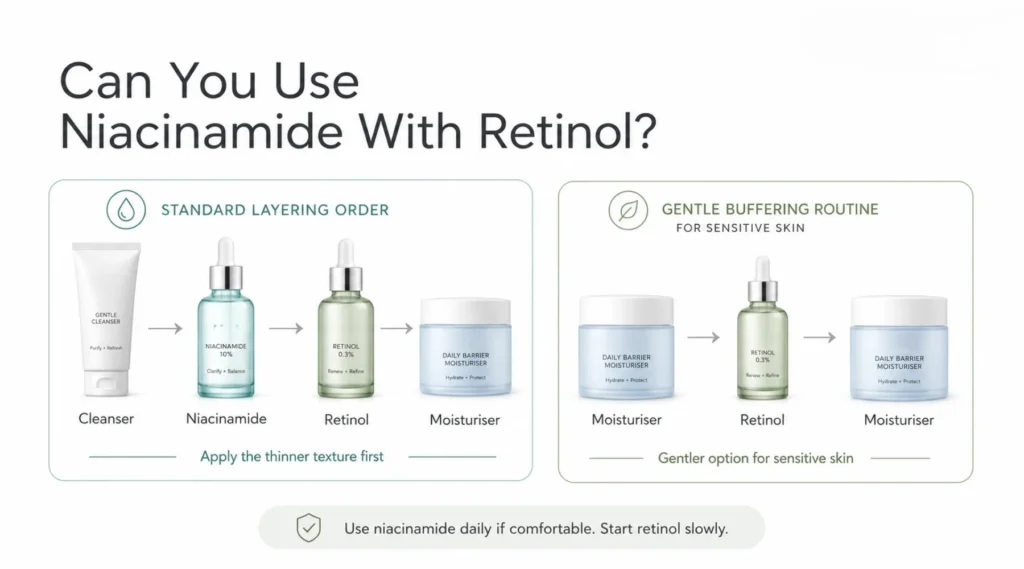
Retinol helps your skin renew itself and boosts collagen production. Niacinamide strengthens the skin barrier, reduces water loss, and may soothe irritation from retinoids.
Niacinamide does not stop retinol from working.
Which one should be applied first?
Apply products according to texture, using the thinner formula first.
When both are serums of similar consistency, a common order is:
- Cleanser
- Niacinamide serum
- Retinol serum or treatment
- Moisturiser
This order can make retinol feel more comfortable.
If the retinol is a very light serum and the niacinamide is in a cream, use the retinol first and the niacinamide cream afterwards.
How to use niacinamide with retinol for sensitive skin
Use a buffering approach:
- Cleanse and allow the face to dry
- Apply a light layer of moisturiser
- Apply the retinoid
- Finish with another layer of moisturiser if needed
Niacinamide can be present in either moisturising layer.
Another option is to use niacinamide in the morning and retinol at night. This is often the easiest arrangement for beginners.
How often should the combination be used?
You can use niacinamide every day, but introduce retinol slowly. Start with retinol once or twice a week. Increase the amount only when your skin stops peeling, burning, or becoming red.
Don’t assume niacinamide will stop all irritation from retinoids. It can help your skin adjust, but too much retinol can still harm your skin barrier.
Niacinamide and Other Skincare Ingredients
Niacinamide works well with most skincare ingredients. However, just because ingredients mix well doesn’t mean they are right for everyone.
| Ingredient | Can it be used with niacinamide? | Best approach |
| Hyaluronic acid | Yes | Apply either product first according to texture |
| Vitamin C | Yes | Layer carefully or separate by time if sensitive |
| Retinol or retinal | Yes | Use niacinamide for barrier support |
| Salicylic acid | Yes | Reduce frequency if dryness develops |
| Glycolic or lactic acid | Yes | Avoid over-exfoliating |
| Azelaic acid | Yes | Useful for redness, acne and uneven tone |
| Benzoyl peroxide | Yes | Add moisturiser to limit dryness |
| Peptides | Yes | Suitable for simple barrier-focused routines |
| Ceramides | Yes | Particularly helpful for dry or compromised skin |
| Sunscreen | Yes | Sunscreen should be the final morning step |
Niacinamide and Hyaluronic Acid
This is an easy combination to use. Hyaluronic acid draws and keeps water in the skin’s top layers, while niacinamide strengthens the barrier and reduces water loss. Apply the thinner product first, then use a moisturiser to lock in hydration.
Niacinamide and Vitamin C
You can usually use niacinamide and vitamin C together. The idea that they cancel each other out comes from old studies, not modern products. When layering, apply the thinner product first. If both have similar textures, apply vitamin C in the morning, then niacinamide and moisturiser. If your skin is sensitive, use vitamin C in the morning and niacinamide at night. This separation helps with tolerance, but it isn’t a strict rule.
Niacinamide and Salicylic Acid
This combo works well for oily, congested, or acne-prone skin. Salicylic acid exfoliates in the pores, while niacinamide helps strengthen the skin and reduce shine. Apply salicylic acid after cleaning your face, let it dry, then use niacinamide and moisturiser. Don’t use salicylic acid daily just because niacinamide feels soothing; it can still dry out your skin.
Niacinamide and Glycolic Acid
These can be used together, but glycolic acid may be tougher on your skin. Apply glycolic acid first, then niacinamide and moisturiser. Beginners may use glycolic acid two nights a week and niacinamide on other nights. Tingling doesn’t mean the acid is working better.
Niacinamide and Azelaic Acid
This combination is good for blemishes, redness, and uneven skin tone. Apply the thinner product first. If azelaic acid is a cream, it usually goes after the niacinamide serum. Introduce one product at a time, as both may cause tingling.
Niacinamide and Benzoyl Peroxide
Niacinamide can help with the dryness that benzoyl peroxide may cause. Apply benzoyl peroxide as directed. You can use niacinamide before or after it, then finish with moisturiser. For sensitive skin, use niacinamide in the morning and benzoyl peroxide at night.
Niacinamide and Peptides
These ingredients are easy to combine. A niacinamide and peptide routine is good for hydration and skin barrier support while improving signs of ageing. The product formulation is more important than potential conflicts between the ingredients.
Common Mistakes When Using Niacinamide
Choosing the Highest Percentage Available
A stronger serum isn’t always better. High concentrations can cause redness, itching, or small bumps, especially if you already use niacinamide in other products. Start with a lower concentration and monitor how your skin reacts over a few weeks.
Applying Too Much
Using too much serum, like half a dropper, can leave a heavy layer that doesn’t mix well with sunscreen. Usually, two or three drops are enough for your face.
Using Niacinamide in Every Product
It’s easy to use niacinamide in multiple products like cleansers, toners, and moisturisers. Check all your products; one good leave-on product is usually enough.
Adding Several New Ingredients at Once
Starting multiple new products like niacinamide, retinol, and vitamin C at the same time can lead to irritation that’s hard to solve. Introduce one product at a time and wait one to two weeks before adding another.
Expecting It to Exfoliate Clogged Pores
Niacinamide can help reduce oiliness and improve the look of pores, but it doesn’t clear clogged pores. For stubborn blackheads, salicylic acid or a retinoid is usually better.
Skipping Moisturiser
Even oily skin needs hydration. A niacinamide serum alone might make your skin feel tight, especially if you also use acne treatments.
Ignoring Sunscreen While Treating Pigmentation
Niacinamide can help even out skin tone, but sun exposure can worsen pigmentation. Always use sunscreen if you’re addressing dark spots or melasma.
Continuing Through Persistent Burning
Short tingling can be normal, but ongoing burning or redness is not. Stop using the product and simplify your skincare routine.
Blaming Niacinamide for Every Breakout
Breakouts may be caused by fragrances, extracts, or other ingredients, not just niacinamide. It usually doesn’t cause “purging” like retinoids or acids do. New bumps are likely due to irritation or other issues, not a necessary purge.
Can Niacinamide Cause Breakouts or Irritation?
Niacinamide is usually safe, but it may not work for everyone. Many reviews say it’s a popular cosmetic ingredient, but some people can still experience irritation.
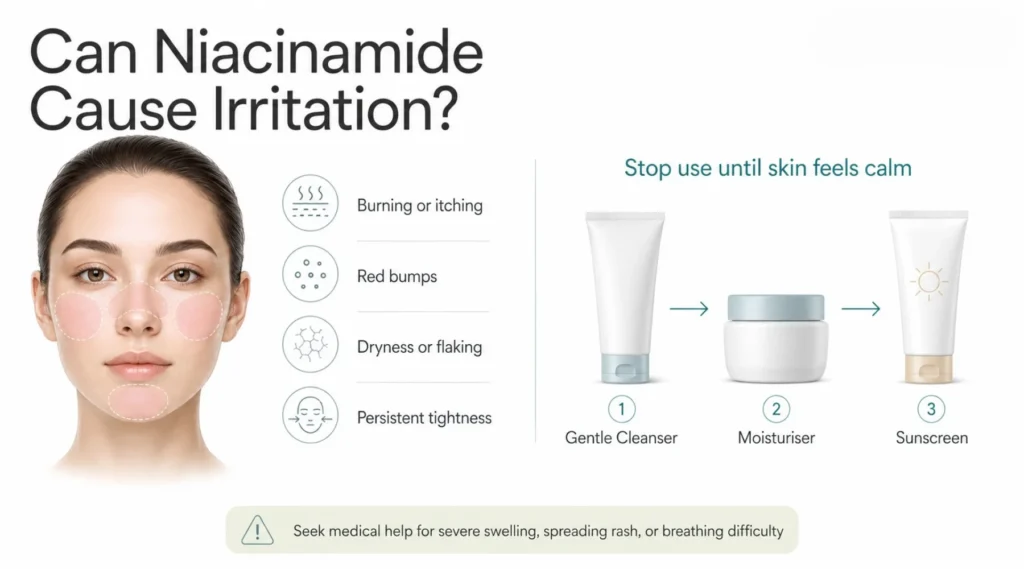
Signs that the product may not be right for you include:
- Burning that lasts after applying
- Itchy red spots
- Swelling
- Small inflamed bumps
- Increased dryness
- Persistent tightness
- Flaking around the nose or mouth
- More sensitivity to products you usually use
Irritation may be more likely with high concentrations, using too much, layering products, or frequent exfoliation.
If you notice these issues, stop using the product until your skin improves. During this time, use a gentle cleanser, a simple moisturiser, and sunscreen.
When you try niacinamide again, start with a lower concentration or a moisturiser-based formula and use it less often. If swelling is severe, the rash spreads, breathing is difficult, or symptoms don’t improve after stopping, seek medical advice.
How to Patch Test Niacinamide
Apply a small amount of the product to the side of your neck, behind your ear, or along your jaw. Use it once a day for several days as directed.
Look for signs of irritation like itching, swelling, burning, redness, or a rash. A patch test can help you see if you might have a bad reaction, but it has its limits. Your facial skin might react differently, and irritation can happen after repeated use on your whole face.
After patch testing, try the product on a small area of your face before using it everywhere.
How Long Does Niacinamide Take to Work?
Niacinamide works gradually.
Hydration and comfort can improve in days if the formula has good humectants and emollients.
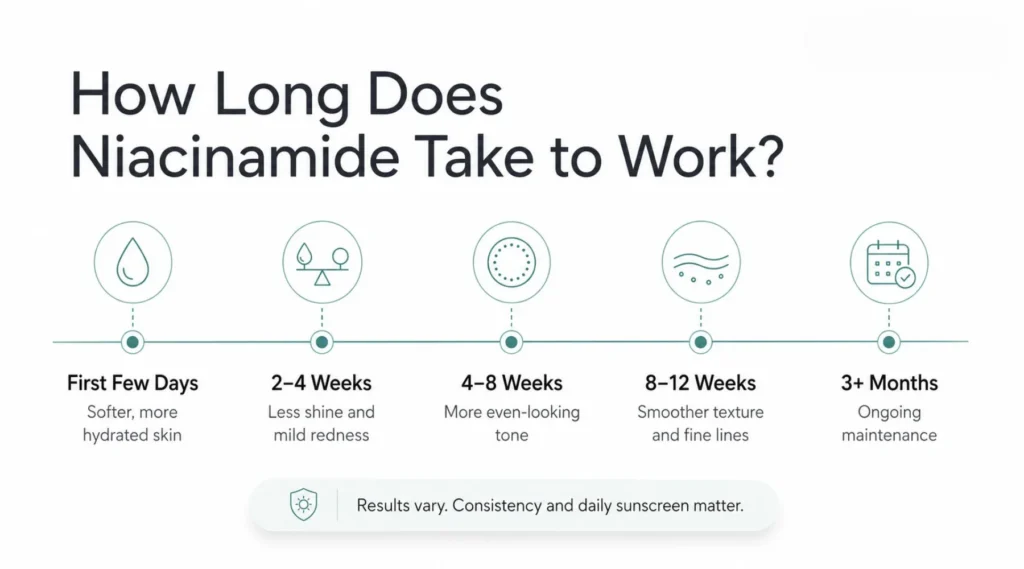
Changes in oiliness, redness, or skin texture usually take several weeks. Reducing pigmentation and fine lines often takes longer.
A realistic timeline is:
| Time using niacinamide | Changes you may notice |
| First few days | Improved softness or hydration from the formula |
| Two to four weeks | Better comfort, less visible shine or reduced mild redness |
| Four to eight weeks | More even-looking tone and gradual fading of post-blemish marks |
| Eight to twelve weeks | More noticeable improvement in texture and fine lines |
| Three months and beyond | Continued maintenance with consistent use and sun protection |
Clinical studies show that skin colour changes after about four weeks, and improvements in ageing signs appear with longer use.
Results differ based on the issue treated, the product strength, the full formulation, and whether sunscreen is used regularly.
Taking a photo of your skin every four weeks in consistent lighting is better than checking in the mirror daily. A clear timeline for niacinamide results can help you see real progress versus unrealistic claims.
How to Tell Whether Niacinamide Is Working
Focus on gradual improvements in your skin instead of expecting an instant “glass skin” look. Signs your routine is working include:
Skin feels less tight after cleansing.
- Moisturiser lasts longer.
- The T-zone is less shiny during the day.
- Mild redness fades faster.
- Post-blemish marks fade more evenly.
- Makeup goes on more smoothly.
- Skin reacts better to retinol or acne treatments.
- Pores look smaller due to better oil and texture control.
Niacinamide won’t permanently shrink pores, as they are natural openings influenced by genetics, oil, congestion, sun damage, and elasticity loss. However, it can make pores appear smaller by improving the surrounding texture and reducing excess oil.
Sample Niacinamide Routines for Common Concerns
For oily skin and visible pores
Morning
- Gentle gel cleanser
- 2%–5% niacinamide serum
- Lightweight moisturiser
- Fluid sunscreen
Evening
- Cleanser
- Salicylic acid, two or three nights a week
- Niacinamide on non-exfoliation nights or after salicylic acid if tolerated
- Moisturiser
For dry and dehydrated skin
Morning
- Cream cleanser or water rinse
- Hydrating toner
- Low-strength niacinamide serum
- Ceramide-rich moisturiser
- Moisturising sunscreen
Evening
- Gentle cleanser
- Niacinamide essence
- Rich moisturiser
- Facial oil or balm on dry areas if needed
For post-acne marks
Morning
- Cleanser
- Vitamin C or niacinamide
- Moisturiser
- Broad-spectrum sunscreen
Evening
- Cleanser
- Azelaic acid or retinoid, according to tolerance
- Niacinamide, if not already included in the moisturiser
- Moisturiser
For retinol beginners
Morning
- Gentle cleanser
- Niacinamide serum
- Moisturiser
- Sunscreen
Evening on retinol nights
- Cleanser
- Light moisturiser
- Retinol
- Moisturiser
Evening on non-retinol nights
- Cleanser
- Niacinamide
- Moisturiser
For a minimalist routine
Morning
- Cleanser
- Niacinamide moisturiser
- Sunscreen
Evening
- Cleanser
- Niacinamide moisturiser
You don’t need a separate serum if your moisturiser already has niacinamide. If you like specific products, you can find various serums. A wider range of skincare options can help you easily add the right cleanser, moisturiser, and sunscreen with the active ingredient.
When Niacinamide Is Not Enough
Niacinamide is helpful, but it is frequently asked to do jobs beyond its capabilities.
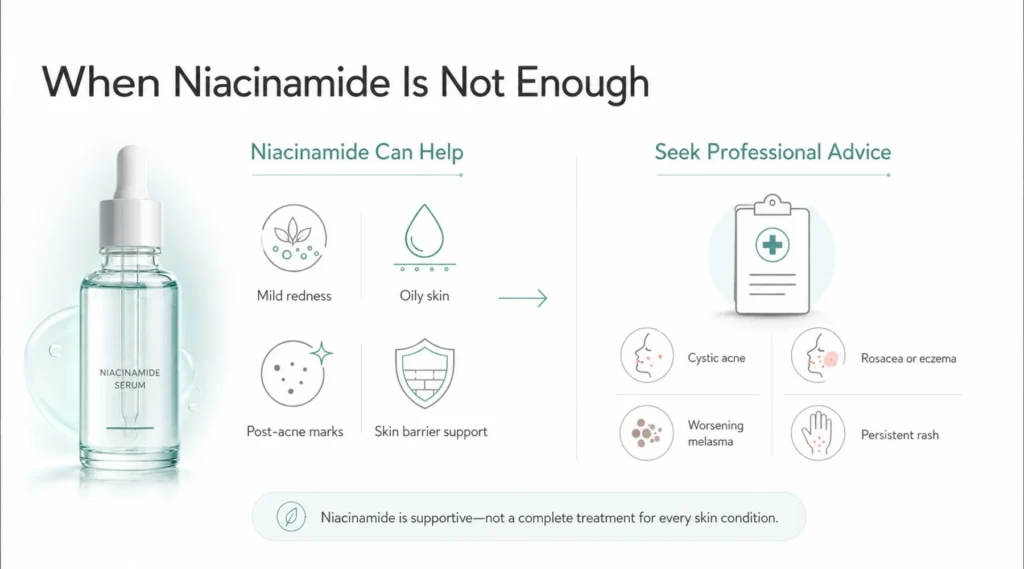
It is unlikely to be enough on its own for:
- Painful or cystic acne
- Acne that is causing scars
- Severe inflammatory redness
- Persistent facial flushing
- Suspected rosacea
- Eczema flares
- Widespread dermatitis
- Melasma that continues to worsen
- Deep wrinkles or significant skin laxity
- Sudden changes in pigmentation
- A rash that does not improve after simplifying the routine
Persistent acne may need benzoyl peroxide, a topical retinoid, azelaic acid, antibiotics, hormonal treatment, or oral medicine with a doctor’s guidance.
Melasma usually requires a mix of sun protection, visible-light protection, topical treatments, and sometimes professional procedures.
Niacinamide serum can be a helpful addition, but don’t let it postpone getting a proper evaluation.
Questions People Ask Before Adding Niacinamide
Can I use niacinamide every day?
Yes, most people can use niacinamide daily. If you’re new or have sensitive skin, start every other day and increase as your skin adjusts. You don’t need to use it daily if your skin is doing well with less.
How many drops of niacinamide should I use?
Use two or three drops for your face. If the serum is very watery or you’re applying it to your face and neck, you can use a bit more. Aim for a thin, even layer, not a wet look.
Do I apply niacinamide before or after moisturiser?
Apply niacinamide serum before your moisturiser. If your moisturiser already contains niacinamide, you can skip the separate serum unless you need it for a specific issue and your skin can handle both.
Can I use niacinamide without moisturiser?
You can, but it might not be the best choice. Oily skin might find a hydrating niacinamide serum enough under sunscreen in warm weather. Dry, sensitive, or treated skin usually benefits from a moisturiser afterwards. Pay attention to how your skin feels.
Can I use niacinamide under makeup?
Yes, apply a small amount, let it settle, then use moisturiser and sunscreen before your makeup. If you see pilling, it might be due to too much product, incompatible textures, or too much rubbing. It doesn’t mean niacinamide is reacting badly with your makeup.
Can I use niacinamide around my eyes?
You can use a gentle niacinamide product around your eyes, but avoid getting too close to the lash line unless it’s specifically made for that area. The skin around the eyes is thinner and can react more easily. Stop using it if you experience watering, burning, or swelling.
Does niacinamide make skin purge?
Niacinamide usually doesn’t cause purging. Purging happens with ingredients that speed up skin cell turnover or exfoliation. New bumps after starting niacinamide are more likely from irritation, another ingredient, or unrelated acne, not from the niacinamide itself.
Can niacinamide lighten the skin?
Niacinamide can reduce dark spots and marks from past breakouts, but it does not change your natural skin colour. Its effects on pigmentation are slow and depend on proper sun protection.
Can teenagers use niacinamide?
Teenagers can use niacinamide, especially for slight oiliness, sensitivity, or marks from breakouts. A simple routine with a gentle cleanser, niacinamide, moisturiser, and sunscreen is better than using many strong products. If acne persists, it should be assessed by a professional instead of relying solely on cosmetic treatments.
Can pregnant or breastfeeding women use niacinamide?
Topical niacinamide is usually safe, but women should still consider all ingredients in the product. It’s a good idea to check with a doctor, midwife, or pharmacist, especially when using products for acne or skin discolouration.
Can I use niacinamide after exfoliating?
Yes, if your skin can handle it. You can use niacinamide after exfoliating with salicylic, glycolic, or lactic acid, followed by a moisturiser. If your skin becomes dry, shiny, sore, or overly sensitive, cut back on exfoliation.
Can niacinamide be mixed directly with moisturiser?
It’s better to layer niacinamide and moisturiser instead of mixing them. Mixing can cause uneven application and make it hard to tell how much of each product is used. Apply niacinamide first, then the moisturiser.
Should I wash niacinamide off?
Most niacinamide products are meant to stay on your skin. Only rinse them off if the instructions say to. Niacinamide cleansers should be washed off, but they stay on the skin for less time than leave-on products.
Why does niacinamide sting my face?
Stinging can happen if the concentration is too high, your skin barrier is damaged, you apply it to freshly exfoliated skin, or if another ingredient in the product irritates your skin. Stop using it until your skin feels normal. Then, try a lower-strength formula slowly or use niacinamide in a moisturiser.
Can I use niacinamide and retinol every night?
You can likely use niacinamide nightly, but how often you use retinol depends on your skin’s tolerance. Beginners should start with retinol once or twice a week and gradually increase the frequency. Use it every night only if your skin stays calm and the product instructions allow it.
Making How You Use Niacinamide More Important Than the Percentage
The best niacinamide routine isn’t always the strongest serum or the most steps. A moderate amount used consistently usually works better than using several strong products at the same time. Gently cleanse your skin, apply niacinamide serum before your moisturiser, use sunscreen, and give your skin time to show results.
Using niacinamide also means knowing when to use less. If your skin gets irritated, cut back on how often you use it. Check for ingredient overlaps and don’t expect niacinamide to replace proven treatments for ongoing skin issues.
When used correctly, niacinamide can be a simple and reliable part of your routine. It helps strengthen the skin barrier, balances oil, improves skin tone, and makes stronger treatments easier to handle.