





Blog
What Does Niacinamide Do for Skin? Benefits and Uses Safely


Niacinamide is a popular skincare ingredient because it can solve many common skin problems without requiring an intense routine. It helps strengthen the skin barrier, reduce redness, balance oil, support acne-prone skin, and improve uneven skin tone.
So, what does niacinamide do for your skin? It helps your skin work better. Instead of just exfoliating or speeding up cell turnover, niacinamide aids in repairing the barrier, keeping moisture, distributing pigment, and controlling inflammation.
While niacinamide is helpful, some expectations are unrealistic. It can’t permanently close pores, eliminate wrinkles, or clear all types of acne on its own. It works best as part of a balanced skincare routine.
The concentration, formula, and other products you use with niacinamide are just as important as the ingredient itself. A well-formulated 4% or 5% niacinamide product may be better for sensitive skin than a harsh 10% or 20% serum used twice a day.
What Does Niacinamide Do for Skin?
Niacinamide helps improve your skin by supporting its barrier, controlling oiliness, calming inflammation, and reducing uneven pigmentation. With regular use, your skin can look smoother, calmer, more hydrated, and more even in tone.
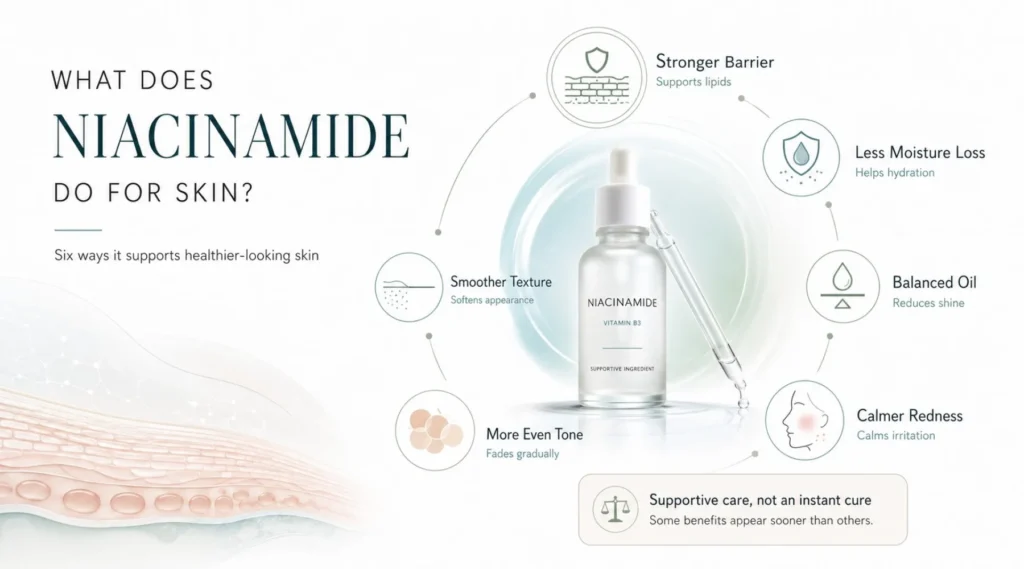
Here are its main benefits:
- Strengthens the skin’s protective barrier
- Reduces moisture loss
- Improves dryness
- Calms redness
- Supports acne-prone skin
- Controls excess oil
- Softens enlarged pores
- Gradually fades post-acne marks
- Improves rough texture and dullness
- Supports elasticity and reduces fine lines
These benefits don’t all happen at the same time. You might notice less dryness quickly, but improvements in pigmentation, blemishes, and fine lines usually take more time.
| Skin concern | How niacinamide may help | What it cannot do |
| Dryness | Supports barrier lipids and reduces moisture loss | Replace a complete moisturiser in very dry skin |
| Oiliness | May help regulate excess surface sebum | Permanently change genetically oily skin |
| Acne | Calms inflammation and may support oil control | Replace proven acne treatment for moderate or severe acne |
| Large-looking pores | Reduces oil and congestion that can exaggerate their appearance | Close or remove pores |
| Dark marks | Helps limit uneven pigment transfer | Remove deep pigmentation immediately |
| Redness | Supports the barrier and moderates inflammatory activity | Diagnose or cure rosacea, eczema or dermatitis |
| Fine lines | Supports barrier function and skin elasticity | Produce the results of prescription retinoids or professional procedures |
Niacinamide is better seen as a helpful ingredient instead of a strong treatment. It enhances the skin’s ability to be healthy but doesn’t change its basic nature.
What Niacinamide Is and Why Skin Responds to It
Niacinamide, or nicotinamide, is a form of vitamin B3. It’s different from nicotinic acid, another type of vitamin B3 that can cause flushing when taken as a supplement.
In the body, vitamin B3 helps create energy and repair cells. When used on the skin in the right formula, niacinamide supports various aspects of skin health.
Its popularity comes from its versatility. Many active ingredients target specific issues. For example, salicylic acid clears oily pores, retinoids boost cell turnover and collagen, and benzoyl peroxide fights acne bacteria. Niacinamide, on the other hand, works more broadly and usually in a gentler way.
It supports the production of barrier lipids.
The outer layer of the skin is like a brick wall. Skin cells act as the bricks, while lipids like ceramides, cholesterol, and fatty acids serve as the mortar.
When this layer is damaged, water can escape easily, and irritants can get in. This may cause the skin to feel tight, rough, itchy, sensitive, or reactive.
Niacinamide can help the skin create important barrier components. Over time, it may reduce water loss from the skin into the air.
However, niacinamide isn’t a moisturiser on its own. It works best when combined with humectants, emollients, and occlusives to help the skin hold onto moisture.
It moderates inflammatory activity.
Inflammation causes redness, tenderness, and various types of acne. Niacinamide may help reduce inflammation in the skin, which can lessen irritation and make blemishes look less angry.
This calming effect is why niacinamide is commonly found in products for acne-prone, sensitive, or damaged skin.
However, ongoing facial redness isn’t just a cosmetic problem. Conditions like rosacea, contact dermatitis, and eczema can look alike but need different treatments.
It affects the way pigment reaches surface cells.
Melanin is produced by special cells called melanocytes. This pigment is packed into structures called melanosomes and sent to nearby skin cells.
Niacinamide does not bleach the skin or stop melanin production. Instead, it may slow down the transfer of melanosomes to surface skin cells. With regular use, it can make uneven pigmentation and post-inflammatory marks less noticeable.
This effect is particularly helpful for marks left by spots, but daily sun protection is crucial. Sun exposure can create new pigment and darken existing marks faster than a brightening serum can lighten them.
It may influence visible sebum production.
Sebum is an oil that protects the skin. Problems happen when too much oil mixes with dead skin cells, leading to blockages.
Niacinamide may help some people control surface oil, but it won’t completely dry out oily skin, nor should that be the goal.
Healthy skin still needs some oil. The goal is to reduce shine and make pores less visible without damaging the skin.
Why Niacinamide Is Good for Dry and Dehydrated Skin
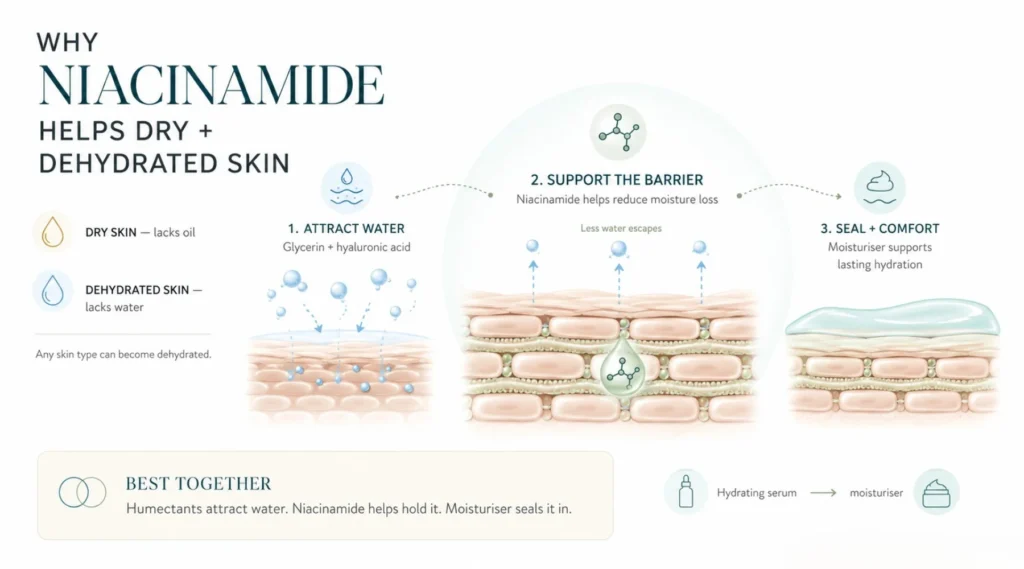
Dry skin lacks oil, and dehydrated skin lacks water. A person can have dry, oily, or combination skin and still be dehydrated.
Niacinamide helps in both cases because it strengthens the barrier that keeps moisture in the skin. When this barrier is stronger, the skin feels less tight and can better handle cleansing, weather changes, and active ingredients.
This shows that niacinamide is generally good for dry skin, but only if the overall formula is right. A niacinamide serum with alcohol, strong fragrance, or few moisturising ingredients can still feel drying. On the other hand, a lower-strength formula that includes glycerin, hyaluronic acid, panthenol, squalane, or ceramides is usually more comfortable.
For dry skin, niacinamide works best in three ways:
- A hydrating serum under a moisturiser.
- A cream with niacinamide and barrier-supporting lipids.
- An essence-moisturiser combo that reduces layers.
A product like a 24K Gold Niacinamide Essence Moisturiser may be appealing for those who want hydration and niacinamide in one step instead of using a separate serum and cream.
However, very dry skin might still need a richer moisturiser on top, especially during winter or when using prescription acne treatments that cause flaking.
Niacinamide is not primarily a humectant.
Hyaluronic acid and glycerin pull water into the upper skin layers. Niacinamide helps the skin barrier hold water better instead.
This difference is important because a serum with only niacinamide may not quickly ease tight skin. Using it with humectants and a moisturiser usually gives better results.
Does Niacinamide Help With Acne?
Niacinamide can help with acne, especially with inflammation, excess oil, and dark spots after acne. It works best for mild breakouts or as an extra ingredient with other acne treatments.
Niacinamide may reduce the red and swollen look of some pimples. It might also help control oil, making it harder for pores to get clogged again.
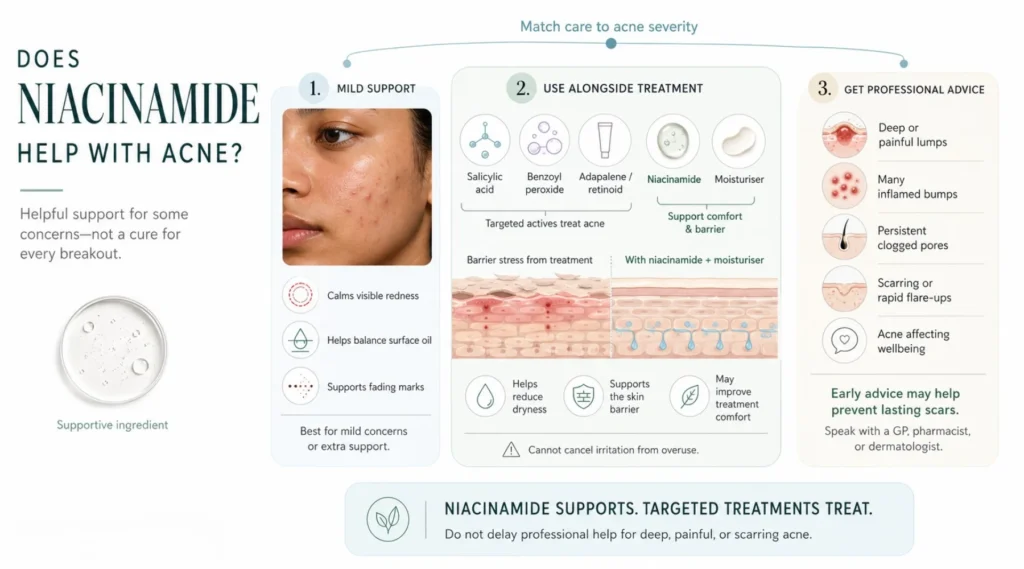
Niacinamide can also support skin that is irritated by treatments like salicylic acid, benzoyl peroxide, adapalene, or prescription retinoids. It might not fully stop irritation from overuse, but it could help the skin adjust better when used correctly.
What niacinamide can do for acne-prone skin?
Regular use may help:
- Reduce redness around blemishes.
- Control excess oil on the surface.
- Help skin recover after breakouts.
- Minimise dryness from acne treatments.
- Improve dark marks after inflammation.
- Make pores appear smaller when oil is controlled.
What can niacinamide not reliably do alone?
Niacinamide is unlikely to be sufficient for:
- Many red and swollen bumps.
- Large, painful lumps under the skin.
- Hormonal breakouts that hurt.
- Acne leaves marks on the skin.
- Ongoing blackheads and clogged pores.
- Quick and large acne flare-ups.
These issues might need treatments like topical retinoids, benzoyl peroxide, azelaic acid, antibiotics, hormonal therapies, or isotretinoin, with professional help.
Using a supportive ingredient for months while dealing with painful acne can slow down effective treatment and raise the risk of lasting scars. It’s smart to get early advice from a GP, pharmacist, or dermatologist if acne is deep, long-lasting, or causing emotional distress.
Can Niacinamide Make Pores Look Smaller?
Pores don’t open and close like doors, and no cream can remove them. Their size depends on genetics, oil production, congestion, sun damage, and the skin’s support around them.
Niacinamide can make pores look smaller by reducing excess oil and smoothing the skin’s surface. When a pore is less clogged and the skin is better hydrated, it may not cast a noticeable shadow.
This change is more about how the pore appears, not about making it disappear.
For oily and clogged skin, niacinamide works best with salicylic acid. Salicylic acid clears out the pore, while niacinamide controls oil and irritation.
Sun protection is important too. Long-term sun exposure can damage collagen, reducing support around pores and making them more noticeable over time.
How Niacinamide Helps Uneven Tone and Post-Acne Marks
Niacinamide is a brightening ingredient, but it doesn’t bleach the skin or change its natural colour. Instead, it helps reduce areas of extra pigment so that they blend better with the rest of your skin.
It can be helpful for:
- Brown marks from acne
- Uneven skin tone from irritation
- Mild sun-related discolouration
- Dull-looking skin
- Patchy areas from a damaged skin barrier
However, niacinamide alone may not work well for deep pigmentation or melasma. For these issues, a complete approach is better. This can include using daily sunscreen and other ingredients like azelaic acid, vitamin C, retinoids, and tranexamic acid, or treatments from a dermatologist.
Understanding the cause of pigmentation is important. A serum can’t fix damage caused by sun exposure, picking at the skin, or ongoing acne. It’s often more effective to prevent new marks than to try to fade existing ones.
Why sunscreen determines the result
Pigment-producing cells react to ultraviolet and, for some, visible light. Without proper protection, current spots can get darker, and new ones can appear.
Apply a broad-spectrum SPF 30 or higher every morning. The right amount and regular reapplication are more important than trendy added ingredients.
Niacinamide can help create a more even skin tone, but sunscreen is essential for maintaining results.
What Niacinamide Can Do for Redness and Sensitive Skin
Niacinamide is often recommended for sensitive skin because it helps strengthen the skin barrier and reduce inflammation. Many people notice less redness and more comfort with low to moderate-strength formulae over time.
However, “sensitive skin” isn’t a medical diagnosis. Redness can result from things like over-exfoliation, fragrance sensitivity, rosacea, eczema, seborrhoeic dermatitis, allergies, or environmental factors.
While niacinamide can help with some of these issues, it won’t fix everything. For reactive skin, it’s best to start with a product that has about 2% to 5% niacinamide. Use it two to three times a week and gradually increase the usage.
Keep the rest of the formula simple. A niacinamide serum can still cause problems if it has strong fragrances, essential oils, or many exfoliating acids.
When stinging is a warning rather than an adjustment period
Burning doesn’t mean niacinamide is effective. Redness, swelling, or itching for a long time also doesn’t show it’s working.
A mild burning feeling can happen with any water-based product on damaged skin. However, if a product keeps causing burning, it can worsen the damage.
If you feel irritation, stop using the product and make your routine simpler. Get medical help if symptoms are severe, spread, or come with swelling, blisters, or hives.
Does Niacinamide Improve Fine Lines and Skin Texture?
Niacinamide can gradually reduce fine lines, rough patches, and loss of elasticity. This happens because it helps the skin retain moisture and supports the proteins that keep skin firm.
Well-hydrated skin reflects light better, making fine lines appear softer. A stronger barrier also minimises flakiness and creasing, improving overall skin texture.
Niacinamide is not a substitute for retinoids, professional treatments, or injectables. Its effects are gentler and supportive.
For those who can’t handle strong retinoids, niacinamide is a good long-term option. If you’re already using retinol, niacinamide can help make your routine easier and reduce dryness.
Which Skin Types Usually Benefit Most?
Niacinamide suits most skin types, but the best formula varies.
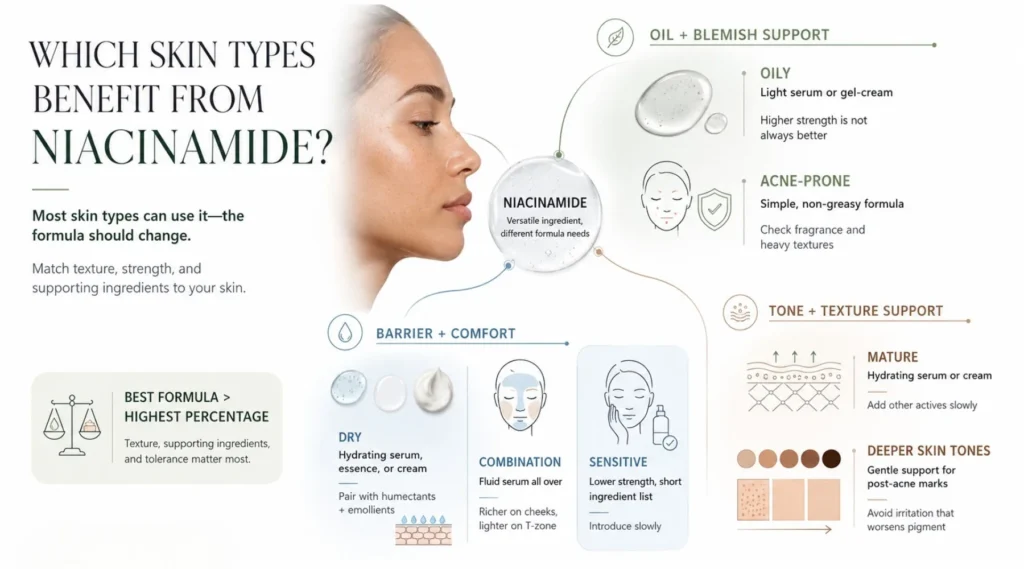
Oily skin
A lightweight serum or gel-cream can reduce shine without using strong, drying cleansers. Choose non-greasy formulae and don’t assume that a higher concentration will work better for controlling oil.
Acne-prone skin
Niacinamide helps reduce redness and boosts the skin’s barrier with acne treatments. Always check the full ingredient list, as heavier or scented products may not work for all acne-prone skin.
Dry skin
Pick a hydrating serum, essence, or cream with humectants and emollients. If the niacinamide product isn’t hydrating enough, use a moisturiser afterwards.
Combination skin
You can apply a fluid serum all over your face. Use a thicker moisturiser on drier areas, like your cheeks, while keeping it lighter on your forehead and nose.
Sensitive skin
Start with a low concentration and a short list of ingredients. Patch testing is helpful, but it can’t prevent irritation from happening later.
Mature skin
Niacinamide helps with hydration, skin texture, and an even skin tone. It works well with retinoids, peptides, antioxidants, and sunscreen if you add them to your routine slowly.
Deeper skin tones
This ingredient is useful for post-inflammatory hyperpigmentation, which can last longer and be more noticeable in darker skin. It’s important to avoid irritation, as harsh products can cause more pigmentation.
What Strength of Niacinamide Works Best?
More niacinamide is not always better. Most skin benefits come from concentrations between 2% and 5%. While 10% products are common, it’s not needed for everyone.
A 10% serum might work well for oily skin, but it could cause tightness, flushing, itching, or small bumps on sensitive or dry skin.
Products with 15% or 20% are usually not needed for beginners. Higher percentages may be useful in specially formulated products for specific issues, but they aren’t better for everyone.
| Niacinamide concentration | Who it may suit | Points to consider |
| Around 2% | Very sensitive, dry or beginner skin | Gentle support with a lower irritation risk |
| 4%–5% | Most skin types | A practical balance of efficacy and tolerance |
| 10% | Resilient, oily or experienced skin | May feel drying or irritating for some people |
| Above 10% | Selected users and specialised formulae | Greater strength does not guarantee better results |
The percentage is just one part of the formula. Delivery system, pH, extra ingredients, preservatives, and packaging can all impact how a product feels and works.
A good 5% serum used regularly is often more effective than a 20% serum that irritates the skin and is rarely used.
Serum, Essence or Moisturiser: Which Format Is Better?
Niacinamide can be used in many types of products. The best choice depends on your routine, not a one-size-fits-all ranking.
Niacinamide serum
Water-based serums have a focused concentration and fit well under moisturisers and sunscreen. They are helpful when adding niacinamide as a separate treatment.
However, serums can complicate things. If niacinamide is already in your moisturiser, toner, or sunscreen, using another serum might not be beneficial.
Niacinamide essence
Essences have a watery, hydrating feel. They are great for dry or combination skin that likes light layers.
The word “essence” doesn’t indicate how strong or effective a product is. Check the ingredient list and directions instead of relying on the name.
Niacinamide moisturiser
A moisturiser with niacinamide is great for dry and sensitive skin or simple routines. It provides niacinamide along with the moisturising ingredients needed to help skin heal.
Niacinamide cleanser
Cleansers can help a little, but they wash off quickly. For problems like acne scars or oily skin, a leave-on product is a better option.
Niacinamide sunscreen
Niacinamide can enhance sunscreen, especially for redness and uneven skin tone. However, the sunscreen’s protection level and the amount you use are more important than extra skincare ingredients.
Before getting a new product, check if you already have niacinamide in your skincare routine. Using it in multiple products can cause irritation that seems to come out of nowhere.
How to Use Niacinamide Serum Correctly
Niacinamide is easy to use, but some choices can help you tolerate it better and use it more often.
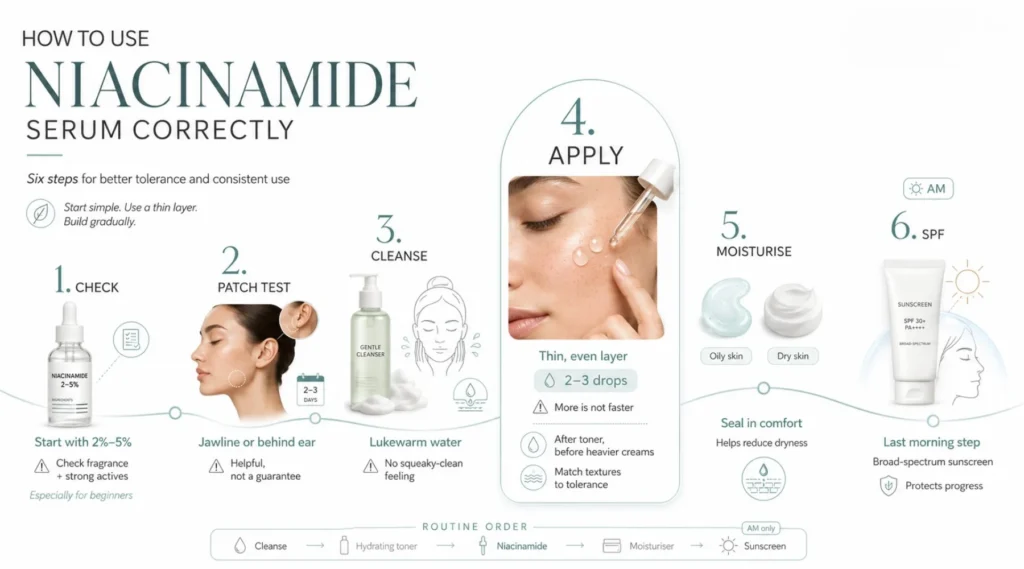
Step 1: Check the concentration and formula
Beginners and people with sensitive skin usually do well with 2% to 5%. Check the label for fragrances, exfoliating acids, or other strong ingredients.
Step 2: Patch test the product
Apply a small amount to areas like the side of your jaw or behind your ear once a day for a few days.
Patch testing can’t perfectly show how your whole face will react, but it can reveal any obvious reactions before you use the product more widely.
Step 3: Cleanse without stripping the skin
Use lukewarm water and a cleanser that matches your makeup, sunscreen, and oil.
Your face shouldn’t feel squeaky clean after washing. That feeling usually means too much oil has been stripped away.
Step 4: Apply niacinamide before heavier creams
A water-light serum should be applied after cleansing and any hydrating toner, but before moisturiser, facial oil, and sunscreen.
Use a thin, even layer. Two or three drops may work for many products, though different formulae vary. Using a full dropper won’t give faster results.
When using niacinamide, focus on matching textures and your skin’s tolerance instead of strictly following the thinnest-to-thickest order.
Step 5: Follow with moisturiser
Moisturiser helps keep skin hydrated and can make it easier to use niacinamide with retinoids, exfoliants, or acne treatments.
If you have oily skin, a gel-cream may be better for you. For dry skin, choose a thicker cream with ceramides, fatty acids, or squalane.
Step 6: Use sunscreen every morning
Niacinamide usually doesn’t make skin sensitive to the sun. However, it addresses issues like pigmentation, redness, and early ageing, which can get worse with sun exposure.
Always apply broad-spectrum sunscreen as the last step in your morning skincare routine.
When to Use Niacinamide: Morning, Night, or Both?
You can use niacinamide in the morning, at night, or both. Using it in the morning is good because it layers well under sunscreen and helps protect your skin from outside stress. Evening use is great if you pair it with retinol or a richer moisturiser. The best time to use it is whenever it fits well with your current products.
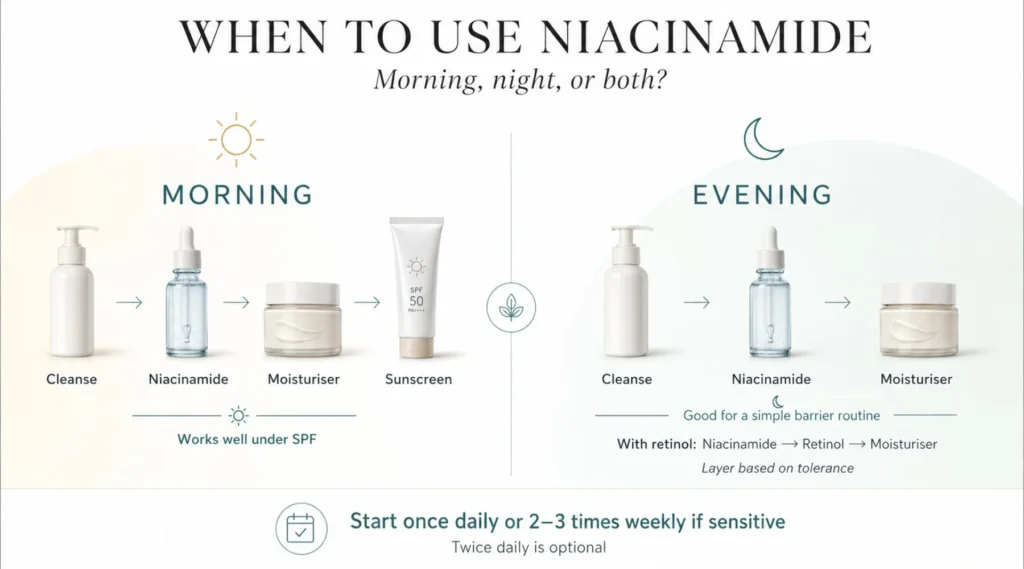
A simple morning routine
- Use a gentle cleanser or rinse with water.
- Apply niacinamide serum.
- Use moisturiser if needed.
- Apply broad-spectrum sunscreen.
A simple evening routine
- Use a cleanser to remove dirt and makeup from your skin.
- Apply niacinamide serum to brighten your skin and reduce pores.
- Finish with a moisturiser to keep your skin hydrated and soft.
An evening routine with retinol
- Use a gentle cleanser.
- Use a niacinamide serum or moisturiser.
- Apply retinol or a retinoid.
- Use a moisturiser based on your skin’s tolerance and the product’s texture.
Some people like to use retinol before moisturiser. Others use moisturiser first to avoid irritation. There isn’t one way to layer products that works for everyone.
The best time to use niacinamide serum depends on what you’re using it for, whether it’s sunscreen, retinol, exfoliation, or a simple routine focusing on skin barriers.
How often should beginners use it?
Most people can start using it once a day. If you have sensitive or weakened skin, try using it two or three times a week first, then slowly increase.
Using it twice a day is fine if the product is gentle and your skin feels good. However, it’s not necessary. Using it once a day can still give you good results.
Can You Use Niacinamide With Retinol?
Niacinamide and retinol can be used together and actually work well in the same routine.
Retinol helps with acne, fine lines, and uneven skin tone, but it can also cause dryness and irritation. Niacinamide helps strengthen the skin barrier, making it easier to use retinol.
You don’t need to wait between applying the two ingredients. Use them based on their texture: apply a thin niacinamide serum before a thicker retinol cream or a retinol serum before a niacinamide moisturiser. You can also use a niacinamide moisturiser before and after retinol to soothe your skin if it’s sensitive.
When trying these products for the first time, don’t use them on the same night. Start with one, let your skin adjust, then add the other. This helps you figure out what causes irritation if it occurs.
Niacinamide can’t completely prevent irritation from retinol. A strong retinol product or using it too often can still harm your skin barrier.
Can You Use Niacinamide With Vitamin C?
Niacinamide and vitamin C can be used together in skincare routines. The belief that they cancel each other out comes from outdated studies that don’t reflect typical use. Well-formulated products stay stable during daily application.
Here are some practical ways to use them:
- Apply vitamin C first and niacinamide second if they layer well.
- Use niacinamide first if it’s the lighter product.
- Use vitamin C in the morning and niacinamide at night.
- Alternate days if the combination irritates your skin.
The main issue isn’t that the ingredients lose their effectiveness. It’s whether the combined products suit your skin. A low-pH vitamin C serum might irritate sensitive skin. A 10% niacinamide formula may also cause discomfort. Using them separately can help improve skin tolerance, even if the ingredients work together.
Can You Use Niacinamide With Hyaluronic Acid?
Niacinamide and hyaluronic acid work well together.
Hyaluronic acid draws water into the skin’s top layers, while niacinamide helps keep that water from escaping.
You can find them in one product or use them as separate serums. When using separate serums, apply based on texture, not ingredient order.
Always apply a moisturiser afterwards, especially in dry conditions. A hydrating serum alone might not be enough for dry skin without a good seal.
Niacinamide With Salicylic Acid, Glycolic Acid, or Lactic Acid
You can use niacinamide with exfoliating acids, but how often you use them should depend on your skin’s tolerance.
Salicylic acid helps with blackheads, excess oil, and clogged pores because it dissolves in oil. Glycolic and lactic acids help exfoliate the skin’s surface, improving texture and tone.
Niacinamide helps protect the skin barrier during these treatments, but it won’t prevent over-exfoliation.
A good routine might include:
- Salicylic acid, two or three nights a week
- Niacinamide once a day
- Moisturiser after both
- Sunscreen every morning
If you have sensitive skin, you might prefer to use exfoliating acid at night and niacinamide in the morning. You usually don’t need to combine multiple acids, retinol, and niacinamide all in one session.
Niacinamide With Azelaic Acid
Niacinamide and azelaic acid are effective for acne, redness, and dark spots from past breakouts.
Azelaic acid clears clogged pores, reduces inflammation, and evens out skin tone. Niacinamide helps strengthen the skin barrier and may lower oiliness and redness.
You can use them together if your skin tolerates it. Apply a thin niacinamide serum first, then follow with an azelaic acid cream.
If you experience pilling, it’s usually due to texture rather than incompatibility. Try using less product, let one layer dry briefly, or use them at different times of the day.
Niacinamide With Benzoyl Peroxide
Niacinamide can be used with benzoyl peroxide. This combination helps because benzoyl peroxide fights inflammatory acne but can cause dryness and irritation.
Use niacinamide in the morning and apply benzoyl peroxide at night, or put on a niacinamide moisturiser after benzoyl peroxide.
Start using benzoyl peroxide slowly. Be aware that it can bleach towels, pillowcases, and clothes. If irritation continues, reduce how often you use it instead of trying to fix the issue with more soothing products.
Can Niacinamide Cause Acne?
Niacinamide doesn’t cause purging like retinoids or exfoliating acids do because it doesn’t speed up cell turnover much.
If you notice spots after starting niacinamide, here are some reasons why:
- The concentration might be too high and irritate your skin.
- Another ingredient could be clogging or irritating your skin.
- You may have introduced several new products at once.
- The product might be applied too heavily.
- Your skin barrier could already be damaged.
- The breakout might be coincidental, related to hormones, stress, or the regular acne cycle.
- Existing acne may still be present despite using the new product.
Small, consistent bumps that itch, burn, or are red likely indicate irritation, not beneficial purging.
If your breakouts worsen after using the product multiple times, stop using it. Once your skin calms down, a lower-strength formula with fewer ingredients might work better.
Check the full formula, not only the headline ingredient.
Two niacinamide serums can act quite differently. One might be a light, fragrance-free liquid. The other could have plant extracts, fragrant oils, or ingredients that exfoliate, which might feel heavy on some skin types.
If you have a reaction to a niacinamide product, it doesn’t necessarily mean your skin can’t handle niacinamide.
Can Niacinamide Damage the Skin Barrier?
Niacinamide helps the skin’s barrier, but the wrong product can cause irritation.
The risk of irritation increases when:
- The concentration is too high.
- The serum is used too many times a day.
- Multiple niacinamide products are layered.
- Exfoliating acids and retinoids are overused.
- The formula has irritating fragrances or solvents.
- The skin is already damaged.
Signs of a damaged barrier include tightness, stinging from basic products, increased redness, flaking, and new sensitivity to products that were once fine.
During recovery, stick to a gentle cleanser, moisturiser, and sunscreen. Add other active ingredients back into the routine one at a time when the skin feels better.
How Long Does Niacinamide Take to Work?
Niacinamide doesn’t deliver results right away. How quickly you see changes depends on your specific issue, the strength of the product, its formulation, and how often you use it.
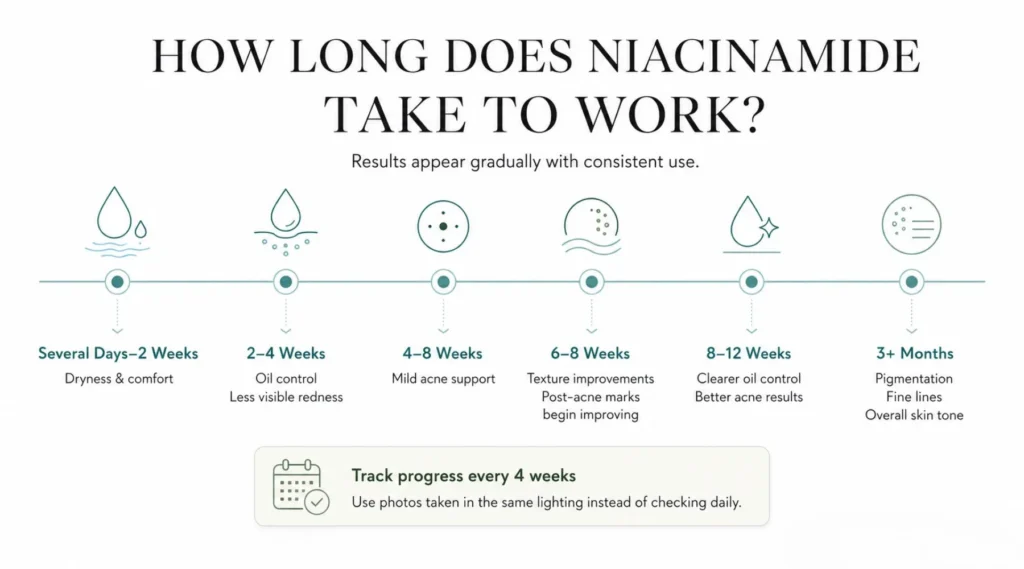
A typical timeline might look like this:
| Concern | When early improvement may appear | When a clearer change may appear |
| Dryness and tightness | Several days to two weeks | Four to eight weeks |
| Visible oiliness | Two to four weeks | Eight to twelve weeks |
| Redness | Two to four weeks | Eight weeks or longer |
| Mild acne support | Four to eight weeks | Eight to twelve weeks |
| Post-acne marks | Six to eight weeks | Three months or longer |
| Fine lines and texture | Six to eight weeks | Three months or longer |
These are rough estimates, not guarantees. Pigmentation may take longer for deeper skin tones, after inflammation, or with ongoing sun exposure.
You can better track progress by taking photos in the same lighting every four weeks. Daily mirror checks can make it hard to see gradual changes.
A clearer niacinamide results timeline should highlight early comfort improvements and the slower changes in pigmentation, acne, and texture.
Common Niacinamide Mistakes That Limit Results
Starting with the strongest percentage
A 20% formula might seem stronger on a label, but it isn’t always more effective. Irritation can worsen redness, oiliness, and pigmentation.
Applying too much product
A thick layer doesn’t push more niacinamide into the skin. It can leave residue, cause pilling, and increase the risk of irritation from other ingredients.
Using niacinamide in several steps
A cleanser, toner, serum, moisturiser, and sunscreen may all have niacinamide. Using so many mild products together can be too much.
Introducing several activities together
Starting niacinamide, retinol, and glycolic acid all at once makes it hard to know which one caused irritation. Introduce just one product at a time.
Expecting it to purge the skin
Niacinamide shouldn’t cause a breakout phase. If your skin keeps getting worse, it’s a sign to rethink the formula, not evidence that impurities are leaving your skin.
Treating it as a complete acne cure
Niacinamide can help acne-prone skin, but stubborn or scarring acne usually needs specific treatment.
Skipping moisturiser because the serum feels hydrating
A water-based serum can make your skin feel fresh for a short time, but it may not hold in enough moisture to keep your skin from drying out.
Applying it to severely irritated skin
Even gentle products can sting if your skin barrier is damaged. Focus on calming your skin first instead of adding more active ingredients to fix it quickly.
Ignoring sunscreen
Without daily sun protection, pigmentation and early signs of ageing can still occur, even with regular niacinamide use.
Changing products before enough time has passed
Switching serums every two weeks makes it hard to see results. Unless you have irritation, give the treatment enough time to work.
Misconceptions That Make Niacinamide More Confusing
“Niacinamide closes pores”
It can make pores look smaller by reducing oil and improving texture, but it can’t actually close them.
“Niacinamide always causes purging”
It usually doesn’t cause purging. New spots often come from irritation, problems with the formula, or the normal acne cycle.
“Ten per cent is the minimum effective strength”
Lower concentrations can still offer good benefits for blocking oil and improving skin tone. Sensitive skin may respond better to concentrations between 2% and 5%.
“Niacinamide cannot be used with vitamin C”
You can usually use modern formulae together. It’s best to separate them if mixing causes irritation or layering issues.
“Niacinamide and niacin are exactly the same”
Both are types of vitamin B3, but they act differently. Niacinamide doesn’t cause the flushing that nicotinic acid does.
“Niacinamide lightens natural skin colour”
It doesn’t bleach healthy skin. It may help make excessive pigment look more even by reducing uneven pigment transfer.
“A niacinamide serum replaces moisturiser”
Some formulae hydrate, but most lack the right mix of humectants, emollients, and occlusives for dry skin.
“Everyone needs niacinamide”
You don’t have to use any specific ingredient. If your routine is already effective, you don’t need to add niacinamide just because it’s popular.
Building a Niacinamide Routine Around Your Main Concern
Build your routine around your skin concern, not just on gathering ingredients.
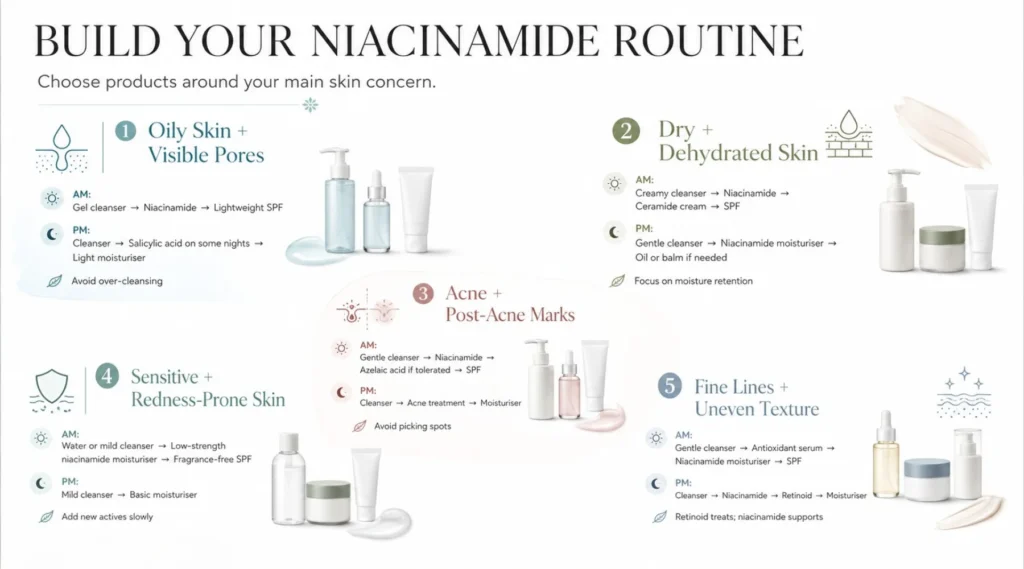
For oily skin and visible pores
Morning
- A soft gel that cleans your skin gently.
- A serum with niacinamide that helps improve your skin’s texture.
- A light sunscreen that protects your skin without feeling heavy.
Evening
- Use a cleanser to wash your face.
- Apply salicylic acid on some nights.
- Use a lightweight moisturiser.
Don’t wash your skin too much to remove oil. Over-washing can irritate your skin and make oiliness harder to manage.
For dry or dehydrated skin
Morning
- Use a water rinse or a creamy cleaner to wash your face.
- Apply a niacinamide serum or essence to hydrate your skin.
- Use a moisturiser that is rich in ceramides.
- Always apply sunscreen to protect your skin.
Evening
- Use a mild cleanser.
- Apply a moisturiser with niacinamide.
- If your skin is very dry, add a thin layer of facial oil or balm.
Using humidifiers and taking shorter, warm showers can help save water, especially in winter.
For acne and post-acne marks
Morning
- Use a soft cleanser to wash your face.
- Apply niacinamide for skin benefits.
- Use azelaic acid if your skin can handle it.
- Always wear sunscreen to protect your skin.
Evening
- Use a gentle cleanser to remove dirt and oil.
- Apply adapalene, retinol, or your chosen acne treatment.
- Finish with a moisturising cream to hydrate your skin.
Avoid picking at spots. Squeezing them more can make inflammation worse and increase the chances of scars and dark marks.
For sensitive, redness-prone skin
Morning
- Use water or a mild cleanser to wash your face.
- Apply a moisturiser with low-strength niacinamide.
- Choose a sunscreen that is free of added scents.
Evening
- A mild cleanser that is easy on the skin.
- A basic moisturiser that protects the skin barrier.
Add new active ingredients only after the skin has been stable for several weeks.
For fine lines and uneven texture
Morning
- Use a mild cleanser to wash your face.
- Apply an antioxidant serum for extra skin protection.
- Use a niacinamide moisturiser if your skin feels dry.
- Don’t forget to put on sunscreen for sun protection.
Evening
- Use a gentle cleanser to remove dirt and oil from your skin.
- Apply niacinamide serum to help brighten your skin and reduce pores.
- Use retinol or retinoids to improve skin texture and boost collagen.
- Finish with a moisturiser to keep your skin hydrated and soft.
The retinoid usually has a stronger effect, while niacinamide helps the skin tolerate treatment and improves barrier health.
How to Choose a Niacinamide Product
The best product isn’t just the one with the biggest percentage on the label.
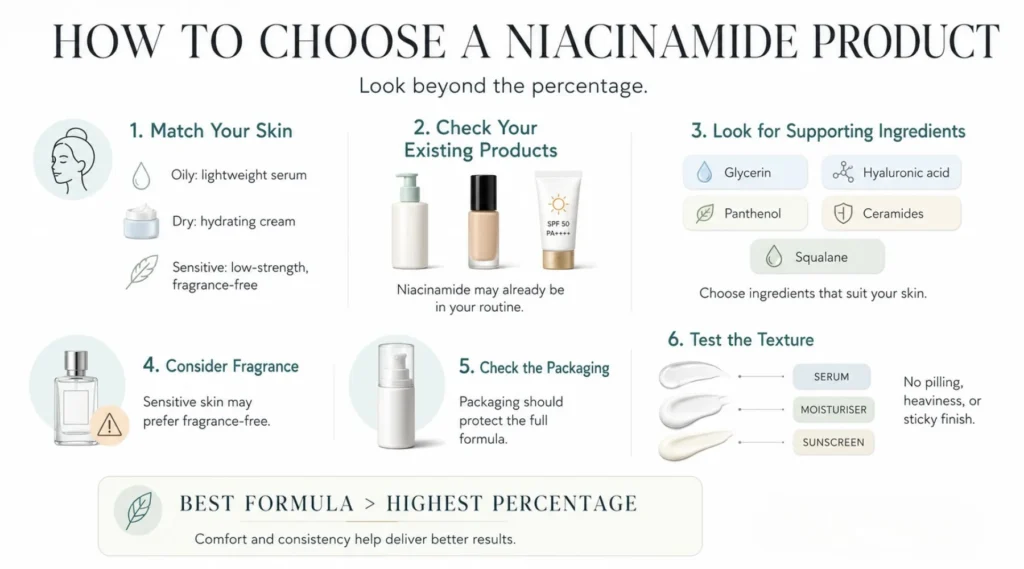
Think about:
Your main concern
If your skin is oily, a light serum might work best. For dry skin, a cream is usually better. If you have sensitive skin, choose a fragrance-free product with less strength.
The number of existing products
Check if niacinamide is already in your moisturiser, foundation, or sunscreen. You might not need to add a separate serum.
Supporting ingredients
Here are some helpful ingredients you might use:
- Glycerin
- Hyaluronic acid
- Panthenol
- Beta-glucan
- Ceramides
- Squalane
- Allantoin
- Green tea
- Zinc salts (if you can tolerate them)
Remember, not every ingredient works for everyone. Even gentle plant extracts can cause reactions in sensitive skin.
Fragrance and essential oils
Fragrance doesn’t bother everyone, but it can be a problem for people with very sensitive skin, eczema, or rosacea.
Packaging
Opaque or air-restrictive packaging can protect formulae with light- or air-sensitive ingredients. While niacinamide is stable, the overall product might not be.
How the formula behaves in a routine
A serum that peels under sunscreen is likely to be used less often. Texture, drying time, and finish are important because how people use products impacts the results.
When Niacinamide Is Not Enough
Niacinamide is helpful, but some issues need special attention. Speak to a doctor, pharmacist, or dermatologist if:
- Acne is painful, deep, or leaves scars.
- Persistent redness is present, especially with burning.
- Pigmentation changes shape, colour, or texture.
- You notice itching, swelling, or hives after using a product.
- Your skin is cracked, oozing, or very inflamed.
- A rash spreads past where you applied skincare.
- Over-the-counter products haven’t helped.
- Skin issues affect your confidence or daily life.
Getting professional help doesn’t mean you have to stop using niacinamide. A clinician may advise using it alongside prescribed treatments, especially if those treatments cause dryness. Remember, niacinamide supports skin recovery, but it can’t diagnose the underlying problem.
Questions People Ask Before Adding Niacinamide
Is niacinamide good for skin every day?
Many people can use niacinamide every day. Applying it once a day is usually enough, especially if it’s in other products too. If your skin is sensitive or the concentration is high, start using it less often. Daily use is helpful only if your skin feels comfortable.
What is niacinamide good for?
Niacinamide is helpful for weak skin barriers, dryness, oily skin, large pores, redness, mild acne, and uneven skin tone.
It works well as a supportive ingredient, but it may not be the best treatment for any serious skin issue.
How do I use niacinamide serum for the first time?
First, do a patch test. Then, apply a thin layer after cleaning your skin and before putting on moisturiser. Start using it once a day or every other day.
Don’t use retinol, exfoliating acids, or other new products in the same week.
Can I use niacinamide with retinol every night?
Yes, both products can be used together if your skin handles them well. Niacinamide can help lessen dryness from retinol.
Beginners should start using them one at a time. Use retinol two or three nights a week at first, and use niacinamide every day.
Does niacinamide help hormonal acne?
It can lower oiliness and swelling, but it doesn’t tackle the hormones that cause hormonal acne.
If you have painful, recurring spots on your jawline or lower face, you may need treatments that focus on acne and hormones.
Can niacinamide cause acne or clogged pores?
Pure niacinamide usually doesn’t clog pores, but the full product might not work for everyone. A heavy base, high concentration, or other ingredients could cause skin bumps.
If you get breakouts consistently after using it and your skin improves when you stop, stop using the product.
Does niacinamide cause purging?
Niacinamide usually doesn’t cause purging since it’s not a strong ingredient for cell turnover. Don’t accept breakouts thinking the serum is clearing hidden impurities.
Is niacinamide good for dry skin?
Yes, it helps produce ceramides and cuts down on moisture loss, which is good for dry or dehydrated skin.
Use a hydrating formula and then apply moisturiser instead of just using a thin serum.
Can niacinamide be used around the eyes?
You can use a gentle product around the bone around your eye if the manufacturer allows it, and it doesn’t sting.
Avoid putting strong facial serums directly on your lash line because the skin there is thin and sensitive. It’s better to use a special eye product or a gentle moisturiser.
Can I use niacinamide after exfoliating?
Yes, you can use both if your skin can handle it. Niacinamide may help the skin heal after exfoliation, but it won’t stop damage from too much acid.
If your skin burns or stays red, stop using the exfoliant and take a break to help your skin recover.
Should niacinamide be applied to wet or dry skin?
Both methods are effective. Applying it to slightly damp skin can help it spread better, especially if it has humectants.
Use it on dry skin if applying it to damp skin causes stinging or if you are using stronger active ingredients nearby.
How long should I leave niacinamide on my face?
A leave-on niacinamide serum should stay on your skin until your next wash. You don’t need to rinse it off after a few minutes unless the instructions say so.
Let it absorb to avoid pilling before applying your next product.
How long does niacinamide take to work for skin?
Hydration and comfort can improve in a few days or weeks. Oiliness, acne, and redness usually take four to eight weeks to improve, while pigmentation and fine lines may take three months or more.
Not using products regularly, ongoing irritation, and poor sun protection can slow down results.
Can niacinamide be used during pregnancy?
Niacinamide cream is usually safe to use during pregnancy. However, some products may have other ingredients to think about.
Check the full list of ingredients and consult a healthcare professional for personalised advice, especially if you are using prescription skincare or treating a medical issue.
Should I stop niacinamide if my face stings?
Sometimes, you might feel a light tingling, especially on damaged skin, but if you feel persistent stinging, you should stop using the product. Rinse it off, simplify your routine, and let your skin heal. If you experience swelling, blisters, hives, or trouble breathing, seek medical help.
What Does Niacinamide Do for Skin in a Well-Balanced Routine?
Niacinamide helps skin by keeping it moist, controlling oil, reducing inflammation, and evening out skin tone. When used regularly, it can lead to calmer, smoother, and healthier-looking skin.
Niacinamide supports skin health instead of causing drastic changes. It makes acne treatments easier to use, helps dry skin retain moisture, reduces the look of large pores, and gradually fades marks left by acne. However, it won’t permanently shrink pores or cure severe acne.
For most people, a product with 2% to 5% niacinamide is a good starting point. Use it once a day, apply moisturiser as needed, and always use sunscreen in the morning. Increase use only if your skin feels comfortable.
The best niacinamide routine doesn’t focus on high percentages or multiple layers. It’s about improving the skin gently without causing new issues.