




Blog
Mineral vs Chemical Sunscreen: Key Differences and Best Uses

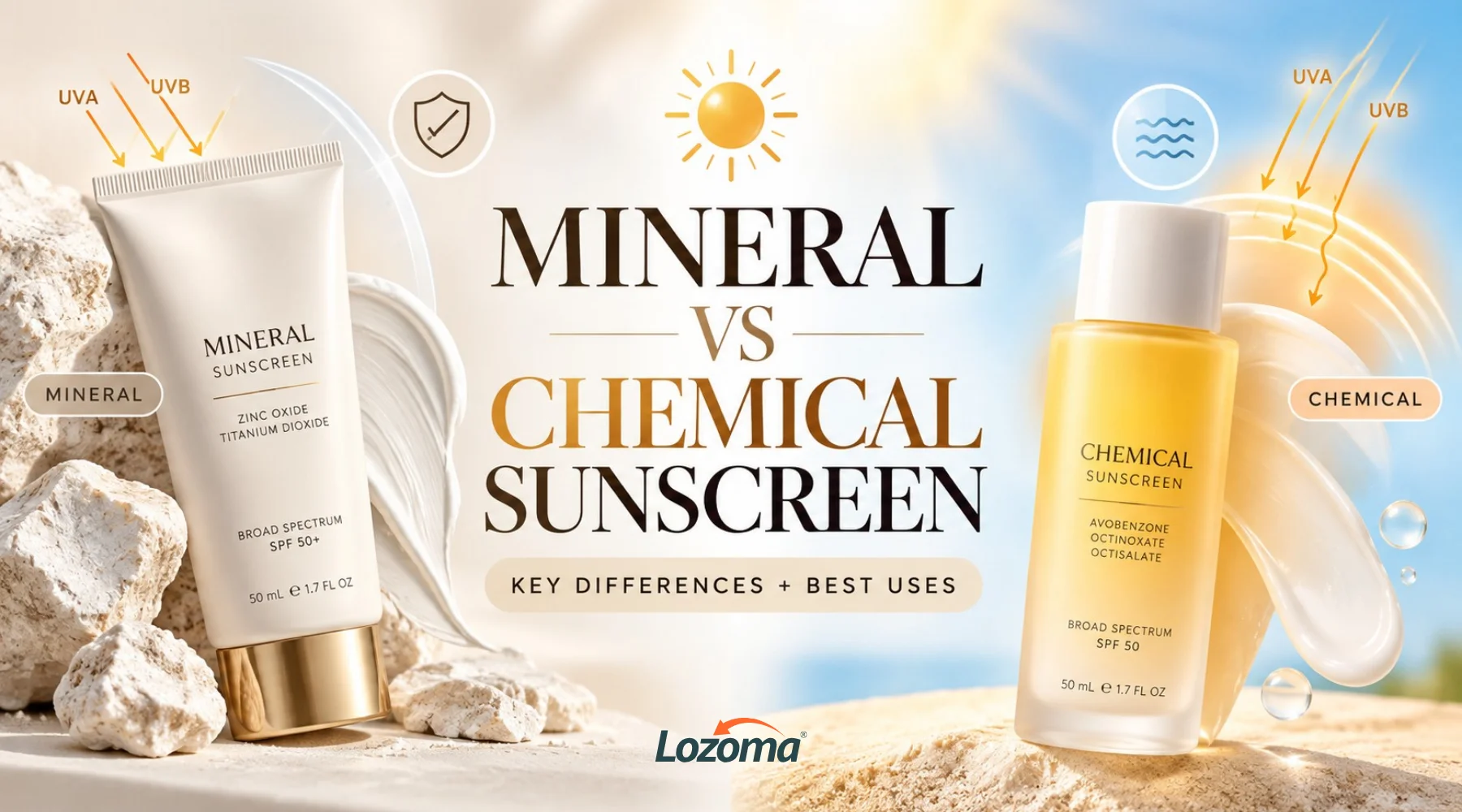
Choosing sunscreen should be simple: select a high SPF, use enough product, and reapply regularly. However, comparing different sunscreens can be tricky. Ingredients like zinc oxide and avobenzone, alongside terms like mineral, chemical, and tinted, can make sunscreens sound very different.
The choice between mineral and chemical sunscreens can be confusing. People often say that mineral sunscreens reflect sunlight, while chemical ones absorb UV rays. In reality, both types mostly absorb UV radiation to protect your skin. Mineral sunscreens can also scatter some light but aren’t just mirrors. The effectiveness of sunscreen depends on the right mix of ingredients and how much you apply, not just the filter type.
So, one type isn’t automatically better. If you have sensitive skin, a simple zinc oxide formula might be better. If you want to avoid a white cast and wear makeup, a good chemical option could work well. If you’re prone to dark spots, a tinted mineral sunscreen could help. And if you exercise outside, you might want a water-resistant option.
The best sunscreen is the one you can use comfortably, generously, and consistently.
Mineral vs Chemical Sunscreen: What Is the Actual Difference?
The main difference between sunscreens is in their UV filters.
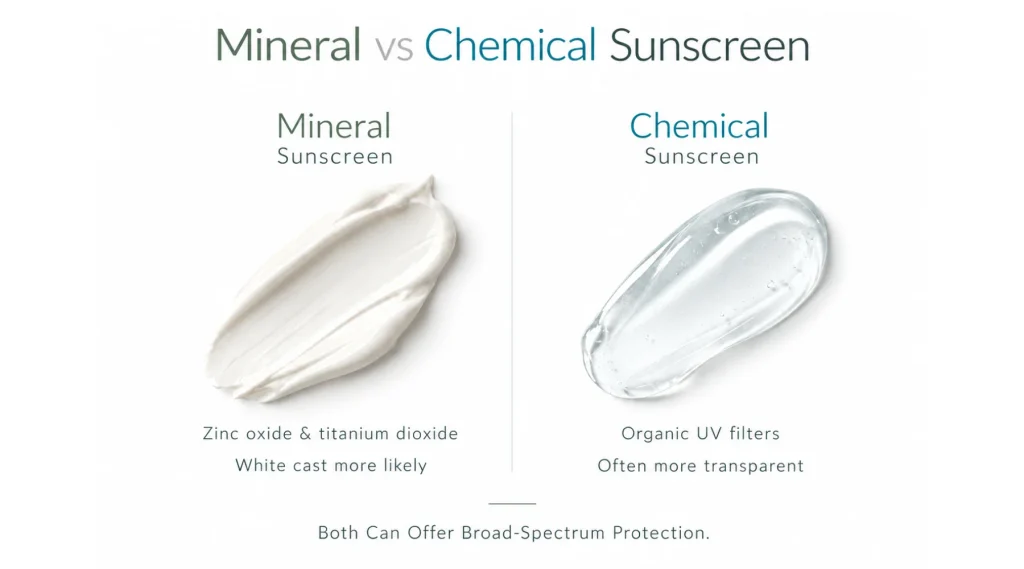
Mineral sunscreens use inorganic filters like zinc oxide and titanium dioxide.
Chemical sunscreens use organic filters, which can vary by country. Some common ones include avobenzone, octocrylene, octisalate, homosalate, Uvinul A Plus, Uvinul T 150, Tinosorb S, Tinosorb M, and ensulizole, along with other modern filters.
Different countries allow different filters, leading to varied ingredients in European and UK sunscreens compared to those in the United States.
You can also find hybrid sunscreens that combine mineral and chemical filters.
When using sunscreen, the choice between mineral and chemical often affects the texture, finish, and feel on your skin rather than the UV protection level.
| Feature | Mineral Sunscreen | Chemical Sunscreen |
| Common filters | Zinc oxide, titanium dioxide | Avobenzone and numerous modern organic filters |
| UV protection | Can provide UVA and UVB protection depending on formula | Can provide UVA and UVB protection depending on filter combination |
| White cast | More likely | Usually lower |
| Texture | Can feel thicker or drier | Often lighter and more fluid |
| Sensitive skin | Often well tolerated, especially simple zinc formulae | Also suitable for many people, but some filters or supporting ingredients may sting |
| Darker skin tones | White cast may be noticeable | Often easier to make transparent |
| Eye stinging | Often less likely with some mineral formulae | Can occur with certain formulae |
| Makeup compatibility | Depends heavily on formulation | Often cosmetically elegant |
| Best choice | Depends on skin, formula and lifestyle | Depends on skin, formula and lifestyle |
The main point in that table is that it depends on the formula.
A low-quality mineral SPF can feel rough, heavy, and hard to spread evenly. A good mineral formula, however, feels smooth and nice.
Some chemical sunscreens blend easily with the skin, but others can sting, feel greasy, or irritate sensitive eyes.
Just knowing the ingredient type doesn’t ensure you’ll like a sunscreen.
How Sunscreen Filters Actually Protect Your Skin
Sunlight has different types of radiation, but ultraviolet A (UVA) and ultraviolet B (UVB) are important for skincare.
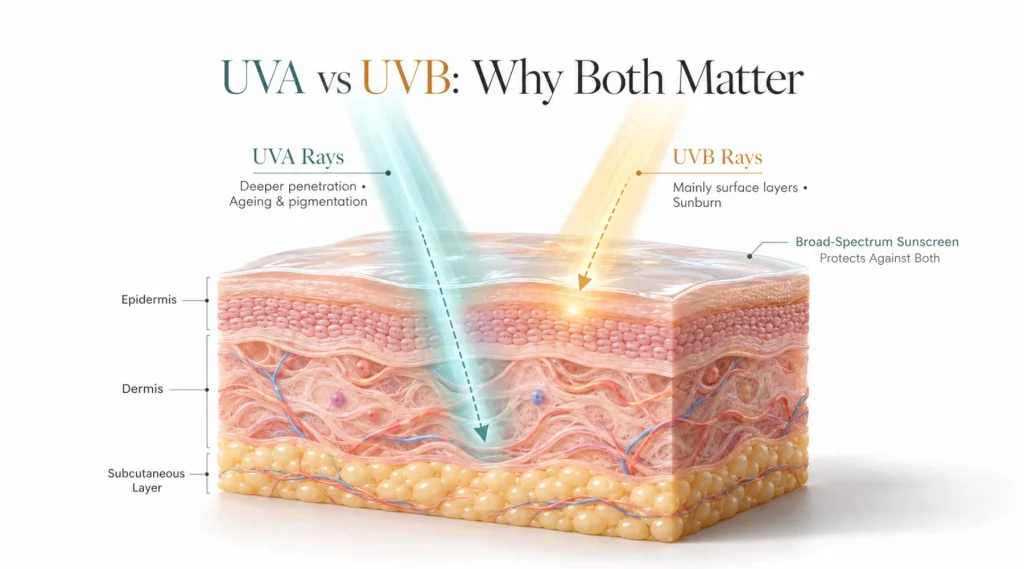
UVB causes sunburn and is linked to skin cancer. UVA penetrates deeper, leading to early ageing, changes in skin colour, and skin cancer. UVA can also pass through windows more easily than UVB.
That’s why broad-spectrum sunscreen protects against both UVA and UVB. The SPF number mainly indicates UVB protection. It shows how much UVB exposure protected skin can tolerate compared to unprotected skin in a lab, not how long you can safely stay in the sun.
UVA protection needs its own testing and labelling. You may find a UVA symbol, star rating, or PA rating depending on the brand.
This difference matters. A high SPF does not guarantee good UVA protection, which is crucial for preventing ageing and pigmentation.
Mineral Sunscreen Does More Than Reflect UV Rays
One common myth about sunscreen is that mineral sunscreen sits on the skin and reflects sunlight, while chemical sunscreen absorbs it. This idea is simple but not fully correct.
Zinc oxide and titanium dioxide do reflect some sunlight, but studies show they mainly protect by absorbing UV energy, just like chemical sunscreens. After absorbing UV rays, they release the energy in a less harmful way.
Mineral sunscreen is not a solid barrier on your skin. Its effectiveness depends on applying it evenly. If you apply it unevenly, use too little, or wipe it off, the protection weakens. That’s why how you apply sunscreen matters more than whether it’s mineral or chemical.
How Chemical Sunscreen Filters Work
Chemical sunscreen filters have molecules that absorb certain UV rays. Different filters offer protection against various types of ultraviolet light. For instance, avobenzone mainly blocks UVA rays, while other filters focus more on UVB rays. Some newer European filters provide broad and stable protection.
A good chemical sunscreen usually combines several filters. This ensures coverage against both UVA and UVB rays while manageing texture and finish.
After absorbing UV rays, the filter changes the energy into a small amount of heat that escapes. This heat is minimal, so your face won’t feel significantly warmer when using chemical sunscreen.
Does Chemical Sunscreen Need 20 Minutes to “Activate”?
The idea that chemical sunscreen takes 20 minutes to work is wrong. Both mineral and chemical sunscreens don’t start working at a specific time. What matters is applying the sunscreen evenly to form a strong protective layer. It’s best to put on sunscreen about 15 minutes before going out in strong sunlight, especially when swimming or exercising. This gives the sunscreen time to settle before it gets disturbed by clothes, sweat, or water. You don’t need to apply mineral sunscreen at the beach if you’ve already put on chemical sunscreen 20 minutes earlier, as they work differently. Good application is important for both types.
Is Mineral Better Than Chemical Sunscreen?
Not all sunscreens are the same.
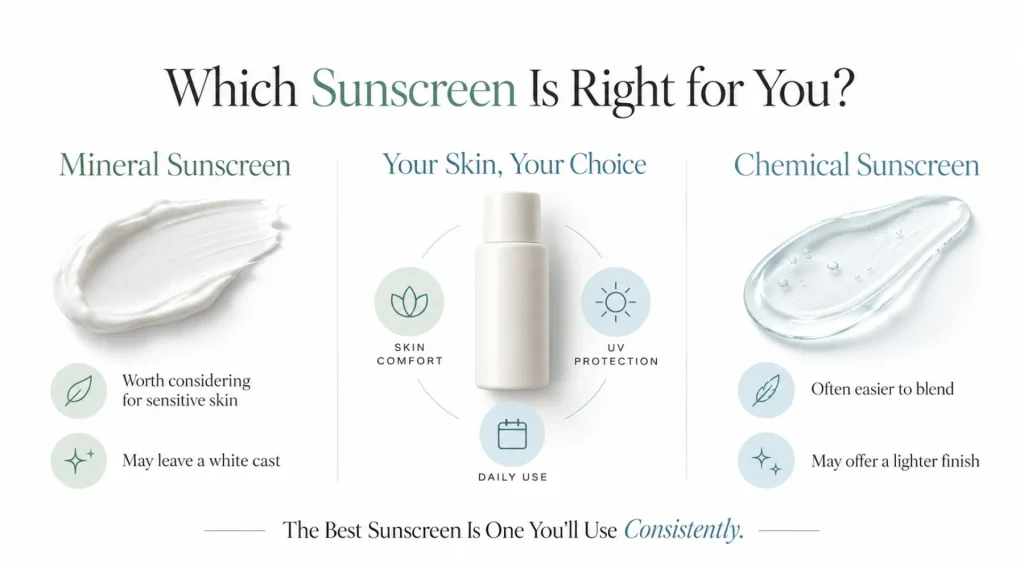
Mineral sunscreens are beneficial, especially for those with sensitive skin. Chemical sunscreens also have advantages, particularly if their appearance encourages regular use. A sunscreen you don’t like to apply won’t protect you well in real life.
When comparing sunscreens, think about:
- UVA protection
- SPF
- Skin sensitivity
- White cast
- Texture
- Oiliness
- Dryness
- Eye sensitivity
- Makeup compatibility
- Water resistance
- Outdoor exposure
- Ease of application
- Likelihood of reapplication
These factors are often more important than simply saying one type of sunscreen is better.
Why Mineral Sunscreen Can Be a Good Choice for Sensitive Skin
When choosing sunscreen for sensitive skin, many believe mineral options are always safer. This can be true, especially if it has zinc oxide and lacks irritants. Zinc oxide is gentle and often used in products for sensitive skin. Mineral sunscreens are also less likely to sting the eyes.
This makes mineral options attractive if past sunscreens have caused burning, watery eyes, or discomfort. However, the UV filter is just one part of the formula. A mineral sunscreen with fragrance or irritating ingredients can still harm sensitive skin.
Many new chemical sunscreens are designed for sensitive skin and can feel comfortable. If your skin reacts easily, look at the entire formula instead of relying solely on it being mineral.
When Rosacea-Prone Skin May Prefer Mineral Filters
Skin with rosacea can react differently to skincare products.
Many people like zinc oxide-based sunscreens because they offer protection without stinging.
Tinted mineral sunscreen can lessen facial redness.
There isn’t one perfect sunscreen for rosacea. A thick mineral sunscreen might feel uncomfortable for someone who flushes easily, while a lightweight, fragrance-free chemical sunscreen could be a good option.
It’s better to patch test and gradually check for comfort than to only use mineral sunscreens.
If a sunscreen causes burning or redness, consult a dermatologist for advice on finding a suitable product.
Why Chemical Sunscreen Often Works Better on Deeper Skin Tones
Traditional mineral sunscreens have one main issue: they leave a white cast on the skin. Zinc oxide and titanium dioxide can create a pale or grey look, especially on medium to dark skin tones.
Manufacturers try to fix this by using smaller particles, better blending, and tinted formulae, but creating truly invisible high-zinc sunscreen remains tough. Chemical sunscreens, however, often go on clear.
For many people, this means chemical formulae blend better with their skin tone without changing its colour. How sunscreen looks on the skin is important. If someone uses less mineral sunscreen to avoid a grey appearance, they may not get the full protection they need.
The best sunscreen should work well with your skin, not just look good on a list of ingredients.
Tinted Mineral Sunscreen Has an Extra Advantage for Pigmentation
Many tinted mineral sunscreens contain iron oxides. These pigments help remove the white cast and lower exposure to visible light. This is helpful for people with conditions like melasma or post-inflammatory hyperpigmentation, where visible light can worsen dark spots.
However, not all tinted sunscreens protect well against pigmentation. It’s crucial to choose a formula with sufficient SPF and UVA protection. If you’re concerned about pigmentation, look for a tinted sunscreen with iron oxides.
Ultimately, it’s better to focus on your skin’s specific protection needs instead of just comparing mineral and chemical sunscreens.
Mineral vs Chemical Sunscreen for Acne-Prone Skin
Acne-prone skin doesn’t always need mineral sunscreen. Both types can cause breakouts, depending more on other ingredients, like oils and additives, than just UV filters.
If you have oily, acne-prone skin, a lightweight chemical gel or fluid may feel better. Some people find that a zinc-based sunscreen works well for them.
Wait a few weeks to see how your skin responds before blaming UV filters for new blemishes. Also, know the difference between acne and irritation. If you get small, itchy bumps right after using sunscreen, it may be irritation, not acne.
Using lighter skin care products under your sunscreen can help if your morning routine feels too heavy.
Which Type Is Better for Dry Skin?
Dry skin needs sunscreen that moisturises.
Look for these ingredients:
- Glycerin
- Hyaluronic acid
- Squalane
- Ceramides
- Fatty alcohols
- Emollient esters
- Suitable plant oils
Some mineral sunscreens can show dry patches because they have a matte finish from zinc. Others use richer ingredients to prevent this.
Chemical sunscreens can mix better with hydrating lotions, but this can vary.
If your sunscreen makes your skin feel tight after an hour, try a different formula instead of just switching types.
Which Type Is Better for Oily Skin?
Oily skin works best with light products that don’t feel heavy.
Chemical sunscreens are great because they come in lightweight fluids, gels, and creams. However, oily skin can also benefit from mineral sunscreens.
New zinc sunscreens can feel light, and some have a matte finish, which oily skin prefers. The goal is to find a sunscreen that feels comfortable to wear all day.
For very oily skin, using fewer products in the morning can be helpful. You may not need a thick moisturiser under a hydrating sunscreen.
The Difference Between Mineral and Chemical Sunscreen Under Makeup
Sunscreen is crucial for protecting your skin. Some sunscreens work well under makeup, while others can clump or look uneven. Mineral sunscreens may hold makeup better because they have a drier finish, but those with high zinc can cause texture issues.
Chemical sunscreens feel smooth, which is why they are popular for makeup. However, very oily formulae can make foundation slide off.
Give sunscreen a few minutes to dry before applying makeup. Avoid rubbing your foundation too hard; gently press or blend it instead.
Most importantly, don’t use less sunscreen to improve your makeup. Pick a sunscreen with enough SPF for protection.
How Much Sunscreen Do You Actually Need?
SPF testing uses about 2 milligrammes of sunscreen per square centimetre of skin. Most people don’t measure this carefully at home, so it’s better to use simple application methods.
For your face and neck, use the two-finger method. Squeeze sunscreen along two fingers to apply a sufficient amount. Adjust this based on your product, finger size, and area covered.
Don’t forget spots like your ears, hairline, jaw, neck, and sides of your face. Also, remember to protect your upper chest if it’s exposed.
Adults usually need more sunscreen than they think. A quick, thin layer on your shoulders and arms often isn’t enough compared to SPF tests.
Whenever you can, apply enough sunscreen so you see an even layer before gently rubbing it in.
What SPF Should You Choose?
People often ask which SPF sunscreen is the best. But you should think about SPF along with UVA protection, how you apply it, and your daily habits.
For everyday use, SPF 30 or higher is usually good for most adults. SPF 50 is especially useful if you:
- Spend lots of time outdoors
- Are in a high UV index area
- Burn easily
- Take medications that make your skin sensitive to sunlight
- Deal with skin pigmentation issues
- Use treatments that need extra sun protection
- Don’t apply enough sunscreen
The difference in UV protection between SPF 30 and SPF 50 is small. SPF 30 blocks about 97% of UVB rays, while SPF 50 blocks 98%. However, they perform differently in real life. SPF ratings are based on a logarithmic scale. When applied correctly, SPF 50 lets in less UVB than SPF 30.
A higher SPF gives you extra protection because people often use less sunscreen than they should. Your daily routine and sun exposure are key in choosing the right SPF.
Can Sunscreen Prevent a Tan?
Sunscreen can help reduce tanning, but it won’t block all UV rays. This means you might still get a tan. Tanning occurs when UV rays make your skin produce more melanin for protection. Getting a tan doesn’t mean your sunscreen didn’t work, but it doesn’t mean you’re safe in the sun either. A tan shows that your skin reacted to UV rays. While sunscreen can lower UV exposure, it can’t guarantee your skin will stay the same colour.
Does Sunscreen Keep You From Tanning Completely?
Usually not. Even high-SPF sunscreen lets some UV rays reach your skin. In real life, several factors affect sunscreen use:
- People often use too little.
- Some areas get missed.
- Sunscreen can rub off on clothes.
- Sweat can break down the layer of sunscreen.
- Water washes away some of it.
- Reapplication can take too long.
- Different formulae offer varying UVA protection.
This means you can still get tan while wearing sunscreen. If you want to prevent tanning, use sunscreen along with shade, hats, sunglasses, and protective clothing. Don’t think SPF lets you stay out in strong sun forever.
Can You Tan Using Sunscreen?
Yes, you can still tan while using sunscreen, especially during long sun exposure. However, trying to tan on purpose with SPF isn’t completely safe. Sunscreen lowers UV exposure, but it doesn’t make intentional tanning safe. Tanning happens because your skin reacts to UV rays.
If you want a tanned look, self-tanning products can give you colour without UV exposure, making them a better choice for your skin. Just keep in mind that fake tans don’t protect you from the sun unless they have a tested SPF rating.
Can You Tan With Sunscreen SPF 50?
Yes, SPF 50 offers strong protection when used correctly, but it doesn’t block all UV rays. You can still get a tan with SPF 50, especially after being outdoors for a long time. This doesn’t mean SPF 50 doesn’t work. It just lowers your UV exposure instead of blocking it completely. That’s why you should also use shade and wear protective clothing when spending long hours outside.
Does Sunscreen Stop You From Tanning if You Reapply Regularly?
Reapplying sunscreen often is better than putting it on once in the morning and forgetting about it. This can help reduce tanning significantly, but it won’t prevent it completely. Your natural skin tone, the strength of UV rays, how long you’re exposed, the level of UVA protection, the amount of sunscreen used, and your activities all play a role. If your skin still gets darker despite using SPF, check if you’re using enough sunscreen and if it offers strong broad-spectrum protection.
When Should Sunscreen Go in Your Morning Routine?
Sunscreen should go at the end of your skincare routine and before makeup.
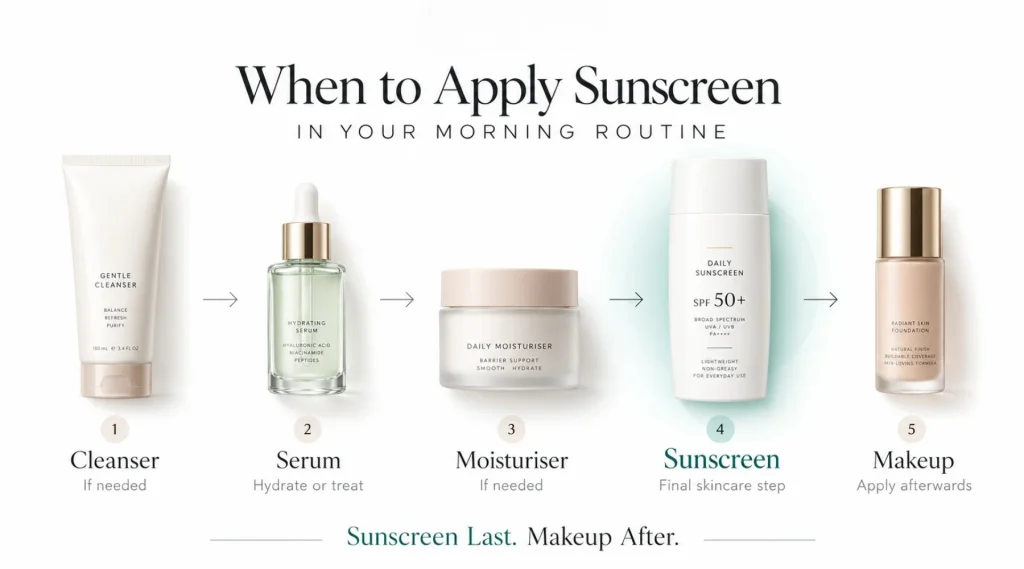
A simple morning routine can be:
- Cleanser (if needed)
- Hydrating or treatment serum
- moisturiser (if needed)
- Sunscreen
- Makeup
You don’t need many skincare layers under sunscreen. Too many layers can make the SPF clump or look uneven.
Let your moisturiser settle before applying sunscreen, especially if your products tend to slide. Give sunscreen a few minutes to dry before you put on makeup.
Whether you call it sunscreen or suncream doesn’t matter much; the two terms are often used interchangeably, though they can have different textures and finishes.
How Often Should You Reapply Mineral or Chemical Sunscreen?
Neither type of sunscreen lasts all day by itself.
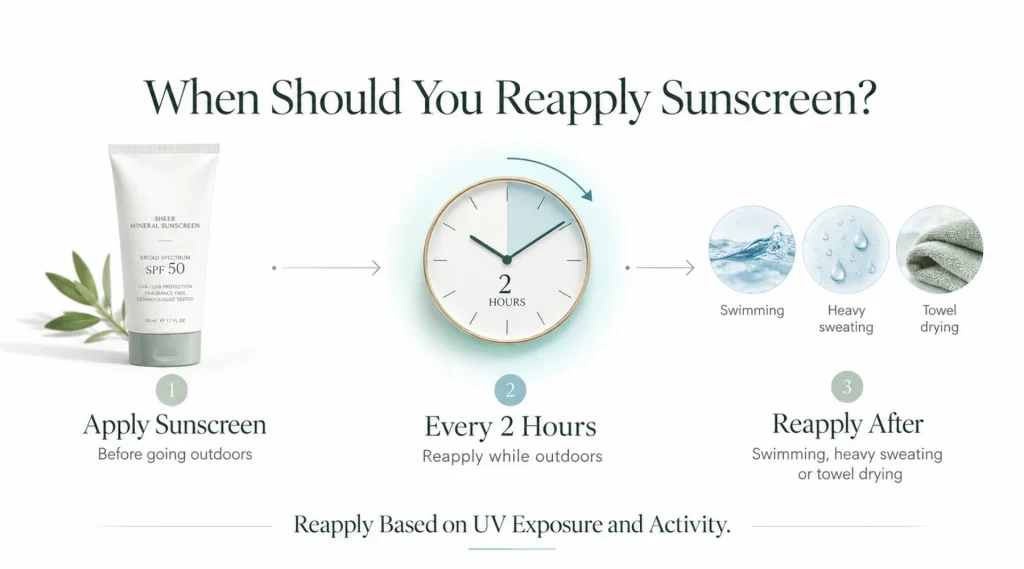
When outdoors, reapply sunscreen every two hours and after any of these activities:
- Swimming
- Heavy sweating
- Towel drying
- Rubbing your face
- Being in water
Always read the instructions on your sunscreen product.
Indoors, you may not need to reapply as often. For example, someone working away from windows may need less sunscreen than someone sitting by a sunny window, driving, or going outside frequently.
Focus on real UV exposure instead of worrying about the clock. If you’re going outdoors again after applying sunscreen at 7 a.m., it’s smart to put on another layer before heading out.
Is Mineral Sunscreen More Stable in Sunlight?
Mineral filters are often said to be stable, while chemical filters break down quickly. This view is outdated. Some older chemical UV filters can lose stability on their own, but sunscreen experts can mix compatible ingredients to stabilise them. Many new filters are now very stable.
Sunscreen is tested as a whole product, not just by looking at its individual ingredients. So, don’t think that chemical sunscreens become useless after only a few minutes in the sun while mineral ones last forever. Both types still need to be reapplied properly.
Does Chemical Sunscreen Enter the Bloodstream?
Studies have shown that some organic sunscreen ingredients can be absorbed into the body under certain test conditions. However, this finding is often misrepresented online. Just because something is detected does not mean it is harmful. Modern methods can detect very tiny amounts of substances, and finding an ingredient in blood does not necessarily mean it causes disease.
Sunscreen regulators evaluate approved ingredients based on safety data and outline how they should be used. The risks of too much UV exposure, like skin cancer and early skin ageing, are well known.
If people are still concerned about organic filters, they can choose a mineral sunscreen. There’s no need to stop using sunscreen altogether.
Is Mineral Sunscreen Automatically “Natural” or Safer?
No.
“Natural” is mostly a marketing term, not a true measure of safety. Zinc oxide and titanium dioxide come from minerals, but they are processed to work well in products. Just because an ingredient is natural doesn’t mean it’s safe, and synthetic ingredients aren’t always harmful.
What matters is the scientific evidence about toxicity, how much of an ingredient is used, how it’s formulated, how much you are exposed to it, and how you use the product.
The important question is not if an ingredient sounds natural. It is whether the final sunscreen is tested, regulated, comfortable, and suitable for your skin.
What About Nanoparticles in Mineral Sunscreen?
Manufacturers of mineral sunscreen often use tiny particles of zinc oxide or titanium dioxide to make the product clearer. This helps reduce the chalky look common in older mineral sunscreens.
The term “nano” can sound scary because it suggests the particles may move around in the body. However, safety assessments for sunscreen look at particle size and how the product is used.
For regular use on unbroken skin, approved mineral sunscreen ingredients are safe and follow cosmetic regulations.
One key difference is the risk of inhalation. Sprays and loose powders can create airborne particles, making creams and lotions more reliable for sunscreen coverage.
Powder SPF can be handy for touch-ups, but it’s hard to apply enough evenly as your main sunscreen.
Mineral vs Chemical Sunscreen Around the Eyes
Eye irritation can make a good sunscreen unbearable. Some chemical filters can sting if sunscreen gets into your eyes, especially when you sweat. Mineral sunscreens are usually more comfortable for the eyes, but this isn’t true for all. One helpful tip is to use your favourite chemical sunscreen on most of your face, and a mineral sunscreen around your eyes. Don’t mix them in your hand; apply them separately. Sunglasses also protect your eyes and help prevent squinting.
Can You Use Mineral and Chemical Sunscreen Together?
Yes, but there’s usually no need to mix sunscreens by hand. Commercial hybrid sunscreens already combine mineral and chemical filters in tested amounts. These products are made to keep the filters stable and ensure they meet their SPF and UVA protection claims.
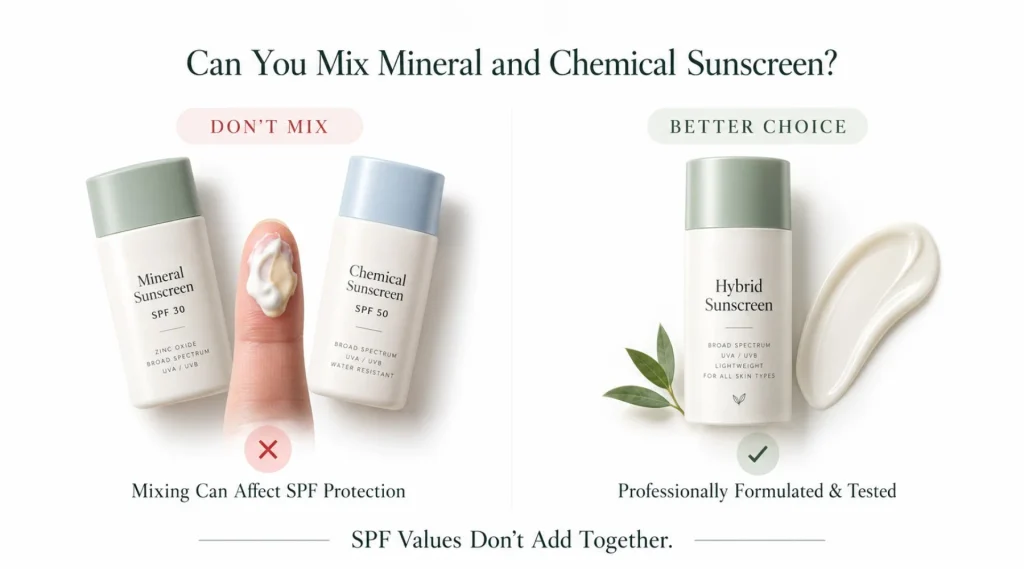
Mixing two separate sunscreens can change:
- Filter concentration
- Film formation
- Product distribution
- Texture
- Stability
You can’t assume that mixing SPF 30 mineral sunscreen with SPF 50 chemical sunscreen gives you SPF 80 or that the mixture works the same as either sunscreen. If you want to use both, it’s better to layer them instead of mixing. However, keep in mind that the SPF values do not add together.
In most cases, it’s easier to choose one well-made sunscreen you like to wear.
Can You Layer Sunscreens for Better Protection?
You can use different sunscreens together, but the outcome is not always certain. SPF numbers don’t add up. For example, SPF 30 plus SPF 30 does not equal SPF 60. It’s better to use enough of one sunscreen than too little of several types. Sometimes, layering makes sense. For instance, you might use regular sunscreen on your face and a tinted mineral sunscreen on dark spots. However, the main goal is to get good coverage, not to try to create your own SPF.
Does Mineral Sunscreen Start Working Immediately?
The filters do not need any chemicals to start working. However, sunscreen takes time to create an even layer. This is why it’s smart to apply it before going into the sun. The difference between “mineral works right away” and “chemical needs 20 minutes” isn’t as important as social media makes it seem. Use plenty of sunscreen before going into strong sunlight and let it soak in.
What Does SPF 30, 50 or 50+ Really Mean?
SPF shows how well sunscreen protects against sunburn-causing UV rays in controlled tests.
It doesn’t work as a simple percentage scale.
Generally:
- SPF 15 blocks about 93% of UVB rays
- SPF 30 blocks about 97%
- SPF 50 blocks about 98%
These numbers may seem small, but they shouldn’t be seen as just a comparison of total protection. Under ideal conditions, SPF 50 lets in about one-third less UVB than SPF 30.
In real life, conditions are not controlled. Factors like sweating, rubbing, how thickly you apply it, and spots you miss can hurt effectiveness. This is why a higher SPF can provide extra protection but doesn’t replace good sun protection habits.
Why Broad-Spectrum Protection Matters More Than an Impressive SPF Number
If you want to protect your skin from ageing, uneven colour, and sun damage, focus on UVA protection as much as SPF.
UVB causes the redness of sunburn. However, UVA goes deeper and leads to collagen breakdown, colour changes, and long-term skin damage.
Choosing SPF 50 without considering UVA is not enough. Look for broad-spectrum or UVA protection labels.
For daily facial sunscreen, prioritise strong UVA protection in a formula you like over just the highest SPF.
Which Sunscreen Is Better for Hyperpigmentation?
Both mineral and chemical sunscreens can effectively protect skin at risk for pigmentation if they offer strong broad-spectrum protection.
Tinted sunscreen is especially important. Iron oxides in tinted mineral or hybrid formulae can enhance protection against visible light that can cause pigmentation issues.
This is useful if you are dealing with:
- Melasma
- Post-inflammatory hyperpigmentation
- Dark marks
- Uneven skin tone
However, the sunscreen must still work well against UVA and UVB rays. Tint alone does not provide enough protection. Consider iron oxide tint as a bonus, not a replacement for tested SPF.
Sunscreen and Vitamin C: Do You Need Both?
Vitamin C and sunscreen have different roles.
A good vitamin C serum helps the skin fight oxidative stress.
Sunscreen protects the skin from harmful rays.
Using antioxidants like vitamin C under sunscreen is helpful, but it doesn’t replace SPF.
Other treatments, like retinol, niacinamide, and moisturisers, also can’t substitute for proper sun protection.
If you’re worried about ageing or pigmentation, sunscreen should be your top priority in the morning.
A Practical Look at Zinc Oxide Sunscreen
Zinc oxide is a very effective mineral UV filter. It protects against both UVA and UVB rays and is often used in products for sensitive skin. However, it has some cosmetic downsides.
Higher concentrations of zinc can lead to:
- White cast
- Heavier texture
- Dryness
- Visible residue around facial hair
- Makeup issues
Good formulations can lessen these problems. A zinc oxide-based tallow sunscreen might interest those who like a richer mineral option, especially when their skin is dry. However, the texture should still match your skin type and climate. Zinc oxide doesn’t make a sunscreen suitable for everyone. People with oily skin may want a lighter formula, while those with dry skin might need something more moisturising.
Why Sunscreen Texture Matters More Than People Admit
Dermatology advice often highlights ingredients and SPF ratings, but users care about texture. This gap is important.
If a sunscreen:
- Irritates your eyes
- Leaves a noticeable white cast
- Peels off when you use moisturiser
- Feels sticky all day
- Makes foundation separate
- Stains clothes
- Whitens facial hair
- Feels greasy in humidity
You are less likely to use it regularly. So, a pleasant sunscreen helps with real protection. A lightweight chemical sunscreen you apply daily is better than an ideal mineral formula that sits in your bathroom.
The Most Common Mineral Sunscreen Mistakes
Using too little sunscreen due to the white cast:
This defeats the purpose of using a protective formula. If the recommended amount makes your skin look too pale, try a different product instead of reducing the amount.
Rubbing for several minutes to make zinc disappear:
Aggressive rubbing can create an uneven layer. Apply sunscreen gently, let it settle, and switch to a different formula if the whiteness remains too strong.
Assuming all mineral sunscreens are safe for sensitive skin:
Always check the ingredient list. Fragrance and other irritants can still be in mineral products.
Relying on makeup with SPF:
A foundation with zinc oxide isn’t the same as a dedicated facial sunscreen. Most people don’t apply enough makeup to match sunscreen levels.
Believing mineral SPF never needs reapplication:
Sweat, rubbing, and water can affect all sunscreen. Reapply as needed.
Mineral vs Chemical Sunscreen for Beginners: How to Choose
If you’re new to sunscreen, don’t stress about choosing one. Start by asking these four questions:
Does it offer good broad-spectrum protection?
Pick a trusted sunscreen with a solid SPF and clear UVA protection.
Can you apply it comfortably?
This is more important than online debates about ingredients.
Does it feel good for a few hours?
If it burns, itches, or stings your eyes, try a different one.
Does it suit your daily routine?
Different people need different types of sunscreen, like an office worker versus someone running outside.
For beginners, a broad-spectrum sunscreen with SPF 30–50 and a texture you like is a good start. You can always adjust your choice later.
Choosing Between Mineral and Chemical Sunscreen by Skin Type
A simple decision guide can help.
| Your Main Concern | Often Worth Trying First |
| Very reactive skin | Simple mineral zinc sunscreen |
| White cast on deeper skin tones | Transparent chemical sunscreen |
| Melasma or visible-light pigmentation | Tinted sunscreen with iron oxides |
| Oily skin | Lightweight fluid or gel SPF |
| Dry skin | Moisturising cream sunscreen |
| Sensitive eyes | Mineral sunscreen around eye area |
| Outdoor sport | High-SPF water-resistant formula |
| Makeup wear | Fast-setting cosmetically elegant sunscreen |
| Minimal routine | Moisturising sunscreen that can replace morning moisturiser |
These are just starting points, not strict rules. What each person can handle is more important.
Does Sunscreen Replace Hats and Shade?
No.
Sunscreen is most effective when used with other sun protection methods.
Clothing and shade can help limit UV exposure without relying solely on sunscreen.
When spending a long time outdoors, use sunscreen with:
- A wide-brimmed hat when possible
- Sunglasses
- Protective clothing
- Shade
- Reduced time in strong sunlight
- Regularly reapplying sunscreen
This is especially important at beaches, outdoor events, gardening, hiking, or travelling in areas with high UV levels.
Why You Can Still Get Sunburn While Wearing Sunscreen
Sunburn with SPF often shows issues with real-world protection, not that sunscreen doesn’t work.
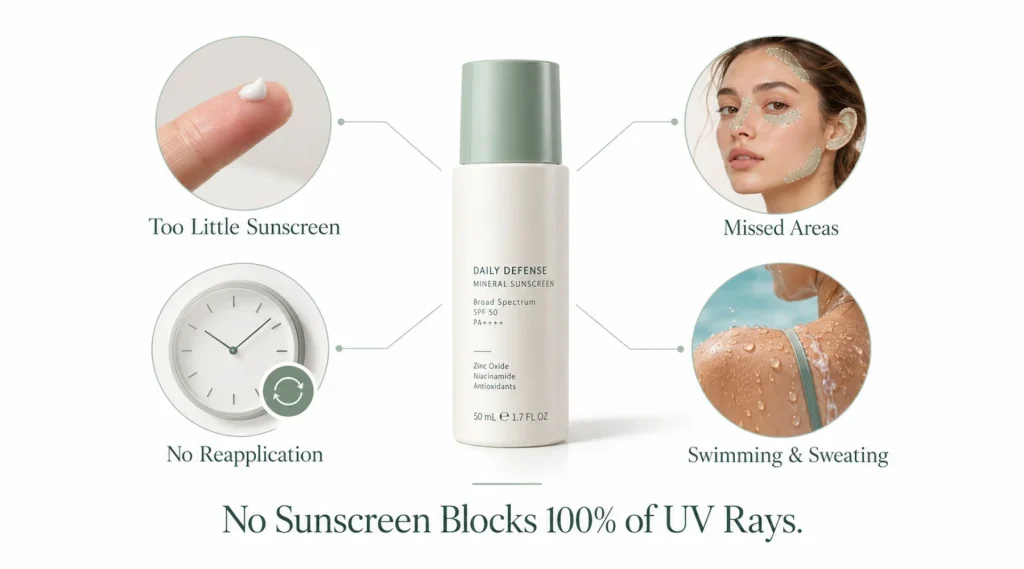
Common reasons for sunburn include:
- Applying too little sunscreen
- Missing some areas
- Not reapplying enough
- Swimming
- Sweating heavily
- Rubbing the sunscreen off
- Staying out longer than usual
- Using expired or poorly stored sunscreen
- Thinking makeup SPF is enough
No sunscreen blocks 100% of UV rays. Even good protection can fail with long exposure and not enough application. If your skin burns, get out of the sun instead of just reapplying SPF.
Does Higher SPF Cause Vitamin D Deficiency?
This question is more complicated than claims on both sides suggest.
Many factors affect vitamin D production, including the season, location, skin colour, clothing, diet, and how much time you spend outside.
Most people do not apply sunscreen perfectly, so it doesn’t block all UVB exposure.
If you’re worried about vitamin D deficiency, avoiding sunscreen is not a reliable solution.
A doctor can check your vitamin D levels and suggest diet changes or supplements without needing extra sun exposure.
Is Daily Sunscreen Necessary in Winter?
UVB levels drop a lot in winter, especially in northern areas.
UVA stays important all year, but conditions can change based on where you are, how high you are, the weather, and your daily activities.
Daily sunscreen is especially helpful if you:
- Have melasma or dark spots
- Take photosensitive medicine
- Spend a lot of time outdoors
- Sit by bright windows
- Want to prevent skin ageing
You don’t need to be overly cautious about sun protection. Just think about how much sun you actually get and create a routine that works for you.
Does Sunscreen Work Through Windows?
UVA goes through regular window glass better than UVB. How much it gets through depends on the type of glass.
A person a few metres from a small shaded window won’t get the same sun exposure as someone driving for hours or working next to big sunny windows.
Context is important here; there’s no one-size-fits-all rule. If sunlight regularly hits your face through windows, wearing sunscreen can still be helpful, even if you’re mostly indoors.
Do You Need Sunscreen on Cloudy Days?
Clouds lower some ultraviolet (UV) radiation but do not block it completely. UV rays can still hit your skin on cloudy days. Instead of just looking at the sky to decide on sun protection, check the UV index for a clearer idea of how much exposure to expect. Cloudy weather can trick people into thinking it’s safe to be outside longer since it feels cooler. Keep in mind that temperature and UV strength are not the same.
What If Every Sunscreen Breaks You Out?
First, simplify your routine.
If you test a new sunscreen along with a moisturiser, exfoliating toner, foundation, and cleansing balm, it’s hard to see what affects your skin. Stick to a simple routine with only the new sunscreen for a while to watch how your skin reacts.
Consider trying:
- Lighter fluid textures
- Fragrance-free options
- Oil-control sunscreens
- Mineral zinc formulae
- Lightweight chemical gels
- Products for acne-prone skin
Remove sunscreen properly at the end of the day.
Use a regular cleanser for most formulae, but for very water-resistant sunscreen, start with an oil-based cleanser, then use a gentle one. If you still have persistent or severe acne, the sunscreen may not be the only issue. You might want to see a professional for help.
What If Sunscreen Makes Your Skin Sting?
Awareness of a product is different from constant irritation.
If sunscreen causes serious stinging:
- Wash it off.
- Don’t use more irritating products.
- Let your skin calm down.
- Check if your skin was already irritated.
- When your skin feels normal, try a simpler sunscreen.
People using retinoids, exfoliating acids, or acne treatments may experience stinging from sunscreens when their skin barrier is damaged. The sunscreen may not be the problem — your skin is. Cutting back on harsh products for a while can help make sunscreen feel better again.
Does Sunscreen Expire?
Yes.
UV filters are in sunscreens that have been tested for stability over time.
Don’t assume sunscreen is still good just because it looks fine.
Always check the expiry date or the period-after-opening instructions on the package.
Storage is important too.
Leaving sunscreen in a hot car can damage it.
For best protection, always use fresh sunscreen that has been stored properly.
Can Children Use Mineral or Chemical Sunscreen?
Children’s sun protection should focus on shade, clothing, and reducing intense UV exposure, in addition to using sunscreen.
Mineral sunscreens, like those with zinc oxide and titanium dioxide, are often well-tolerated by kids.
However, sunscreen ingredients can differ by age and location, so always check the product label and follow local medical advice.
For very young babies, using shade and clothing is the main priority.
Do not rely on sunscreen to allow children to stay in direct midday sun longer.
What About Sunscreen During Pregnancy?
During pregnancy, many people become careful about skincare and often choose mineral sunscreen with zinc oxide or titanium dioxide. This does not mean that approved chemical sunscreens are harmful.
Regulators assess the safety of sunscreen ingredients, but it’s still crucial to avoid too much UV exposure during pregnancy. Conditions like melasma can worsen.
For those who want a cautious routine, mineral sunscreen can provide effective UV protection if it’s broad-spectrum and applied correctly. Always discuss personal health concerns with a healthcare professional.
The Questions People Ask Most About Mineral and Chemical Sunscreen
What is the main difference between mineral and chemical sunscreen?
Mineral sunscreens use zinc oxide and titanium dioxide, while chemical sunscreens use ingredients like avobenzone. Both types protect skin by absorbing UV rays, but mineral sunscreens also scatter and reflect some rays.
Is mineral better than chemical sunscreen for sensitive skin?
Mineral sunscreen, especially with zinc oxide, is often gentle on sensitive skin and less likely to sting the eyes. However, some chemical sunscreens are also made for sensitive skin.
Can you use mineral and chemical sunscreen together?
Yes, you can, but don’t mix different sunscreens in your hand. Use commercially made hybrid sunscreens instead. Layering two products does not combine their SPF ratings.
Does chemical sunscreen absorb into your skin?
Some ingredients in chemical sunscreens can be absorbed into the body, but this doesn’t always mean they are harmful. Safety assessments regulate approved filters. If you have concerns, you might prefer mineral sunscreens.
Does mineral sunscreen work immediately?
Mineral sunscreen works right away, but you should still allow time for it to spread evenly. It’s best to apply it before sun exposure.
Can sunscreen prevent a tan completely?
No sunscreen can fully prevent tanning since no SPF blocks all UV rays. Using sunscreen properly can lower your UV exposure and reduce tanning.
Will you still tan with sunscreen?
Yes, tanning can happen because some UV rays still reach the skin, especially with prolonged exposure or if you don’t apply enough sunscreen.
Can you tan with sunscreen SPF 50?
Yes, SPF 50 significantly lowers UVB exposure but doesn’t block all UV rays, so you might still tan.
Does sunscreen stop you from tanning if you reapply every two hours?
Reapplying sunscreen helps improve protection and can reduce tanning, but it can’t guarantee no tanning will happen. Factors like sun intensity, UVA protection, application thickness, and time spent outside are important.
Which is the best SPF sunscreen for everyday use?
A broad-spectrum SPF 30 or higher is a good choice for daily use. SPF 50 offers extra protection, especially in strong sun or if you have pigmentation issues. How you apply it also matters.
Is chemical sunscreen better under makeup?
Often, yes. Chemical filters can fit well under foundation in lightweight formulae, though some mineral sunscreens also work well. The product’s base is more important than the type of filter.
Is mineral sunscreen better for acne?
Not necessarily. Breakouts depend on the entire formula rather than whether the filters are mineral or chemical. Acne-prone skin often benefits from lightweight, comfortable options.
Can I apply mineral sunscreen over chemical sunscreen?
Yes, you can layer them, but their SPF levels don’t add together. Let the first layer dry before applying the second gently, avoiding too much rubbing.
Should I use mineral or chemical sunscreen for hyperpigmentation?
Both can be effective if they offer good UVA and UVB protection. For melasma and lasting pigmentation, tinted formulae with iron oxides may provide extra protection against visible light.
Is SPF 50 much better than SPF 30?
SPF 50 lets through less UVB radiation than SPF 30 when applied correctly. The difference may seem small, but SPF 50 offers additional protection. How you apply it is more important than the number alone.
Choosing Mineral vs Chemical Sunscreen Based on the Skin You Actually Have
The question of mineral versus chemical sunscreen doesn’t need a clear winner.
Mineral sunscreens are great for sensitive skin, those who experience eye stinging, and anyone who likes zinc oxide or titanium dioxide. Tinted mineral sunscreens are helpful for addressing pigmentation and visible light issues.
Chemical sunscreens have their own strengths. They are often lighter, more transparent, and easier to apply on deeper skin tones or under makeup. Modern chemical filters provide excellent broad-spectrum protection without feeling heavy, unlike some older sunscreens.
Both types of sunscreen need to be applied properly. A good sunscreen must be spread generously, cover missed spots, and be reapplied after swimming, sweating, or rubbing.
Neither type of sunscreen makes tanning safe. You can still tan with SPF 30 or 50 because no sunscreen blocks all UV rays. That’s why wearing protective clothing, seeking shade, and limiting sun exposure are still important.
Ultimately, choose a sunscreen like any daily product: based on how it performs on your skin. If one sunscreen feels good, protects well, and is easy to apply every day, that’s more important than debating whether mineral or chemical is better.