




Blog
Can Niacinamide Cause Acne? Causes, Signs and Next Steps

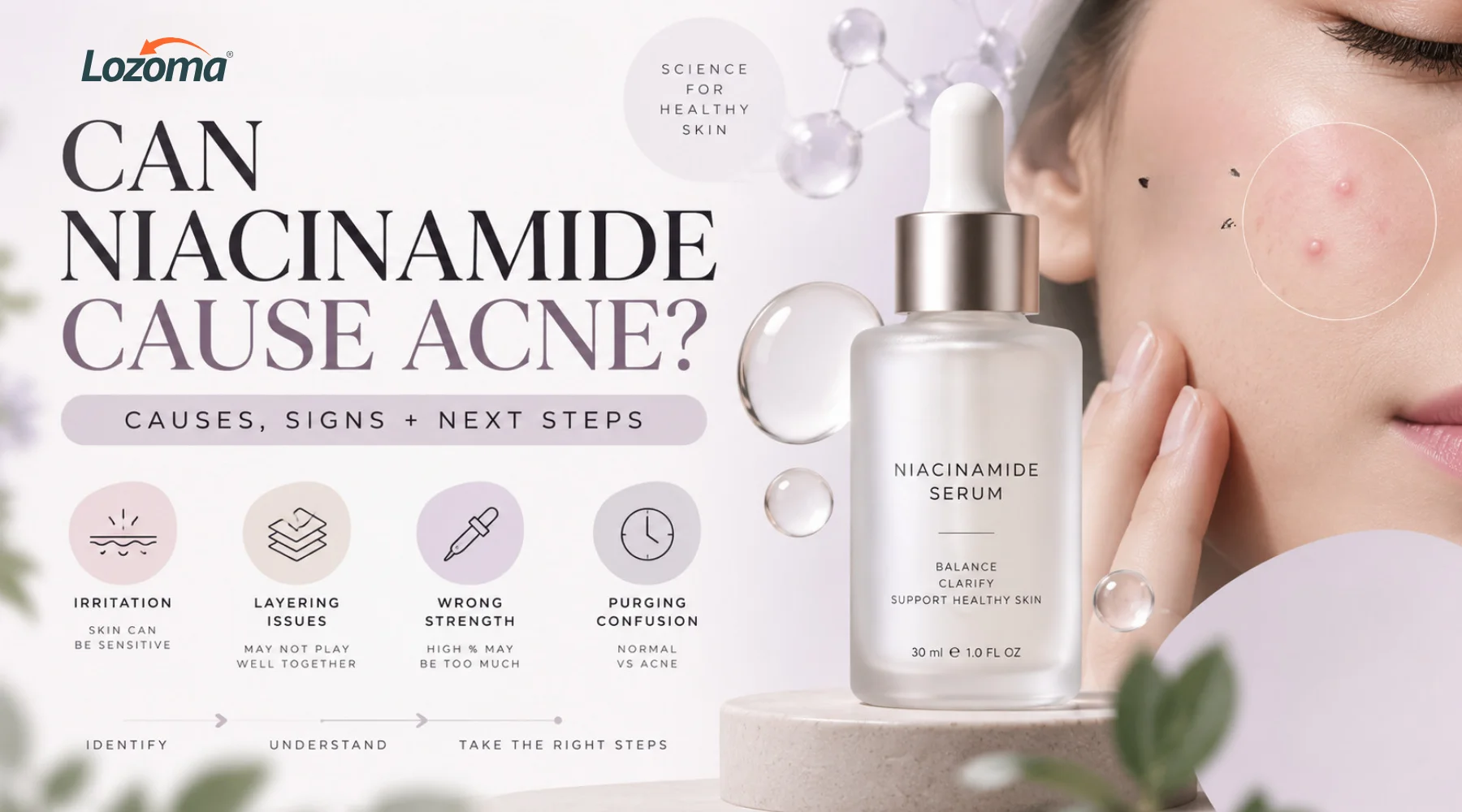
Niacinamide is known as a gentle skincare ingredient. It helps strengthen the skin barrier, reduce redness, even out skin tone, and assist acne-prone skin. So, it’s puzzling when a new niacinamide product leads to breakouts.
Can niacinamide cause acne? Generally, it is not seen as an acne trigger, and studies even suggest it can help with inflammatory acne. However, a niacinamide product can still lead to breakouts due to irritation, the concentration used, other ingredients, using too many active ingredients together, or simply a coincidental acne flare-up.
This distinction is important because assuming every new blemish is just a normal “purge” can leave irritated skin exposed to a product that doesn’t work well for it.
Niacinamide is not an exfoliant like salicylic acid or retinoids. Therefore, if you experience painful spots, itching, burning, or small bumps after starting niacinamide, it’s important to pay attention rather than just assuming your skin needs to “get through” it.
Can Niacinamide Cause Acne Directly?
Niacinamide usually does not cause acne in most people.
Niacinamide, also known as nicotinamide, is a type of vitamin B3. When applied to the skin, it has been studied for its effects on the skin barrier, inflammation, pigmentation, and acne. Research shows it helps produce barrier lipids like ceramides and reduces water loss from the skin. Clinical studies have found that using topical niacinamide can improve inflammatory acne.
However, not every niacinamide product works for everyone.
When someone says, “niacinamide broke me out,” several things might be going on.
| What may be happening | Typical clues | What usually makes sense next |
| Irritation | Burning, redness, tightness, flaking or clusters of small bumps | Stop or reduce the product and simplify the routine |
| An unsuitable formula | Spots begin after one particular serum or cream but not other niacinamide products | Review the full ingredient list and product texture |
| Too much niacinamide | Multiple serums, moisturisers, masks and sunscreens all contain it | Reduce duplicate products |
| Too many active ingredients | Breakouts appear with stinging, dryness or peeling | Reduce acids, retinoids and other strong treatments temporarily |
| Ordinary acne progression | Spots look like your usual acne and occur in your usual areas | Consider whether the timing is coincidental |
| A true acne-treatment adjustment | More likely after ingredients that affect follicular cell turnover, such as retinoids | Assess the actual active ingredient rather than blaming niacinamide |
| Contact reaction | Itching, swelling, rash-like bumps or rapidly worsening redness | Stop the product and seek medical advice if significant |
Niacinamide can be present during breakouts, but it isn’t always the main cause.
To understand this better, it helps to know what niacinamide does for the skin. Its main job is to support the skin rather than to exfoliate aggressively. It helps with barrier function, inflammation, and pigment distribution instead of quickly removing cells from clogged pores.
Can Niacinamide Cause Acne or Is It Purging?
This question causes a lot of confusion.
A niacinamide-only product usually does not lead to a traditional purge. “Purging” is a common skincare term for a temporary rise in blemishes after starting treatments that speed up skin-cell turnover or clear clogged pores. Retinoids are a well-known example. Some exfoliating acids may cause similar breakouts when first used. The Cleveland Clinic notes that breakouts may temporarily increase during the early use of retinol, even though retinol helps prevent clogged pores.
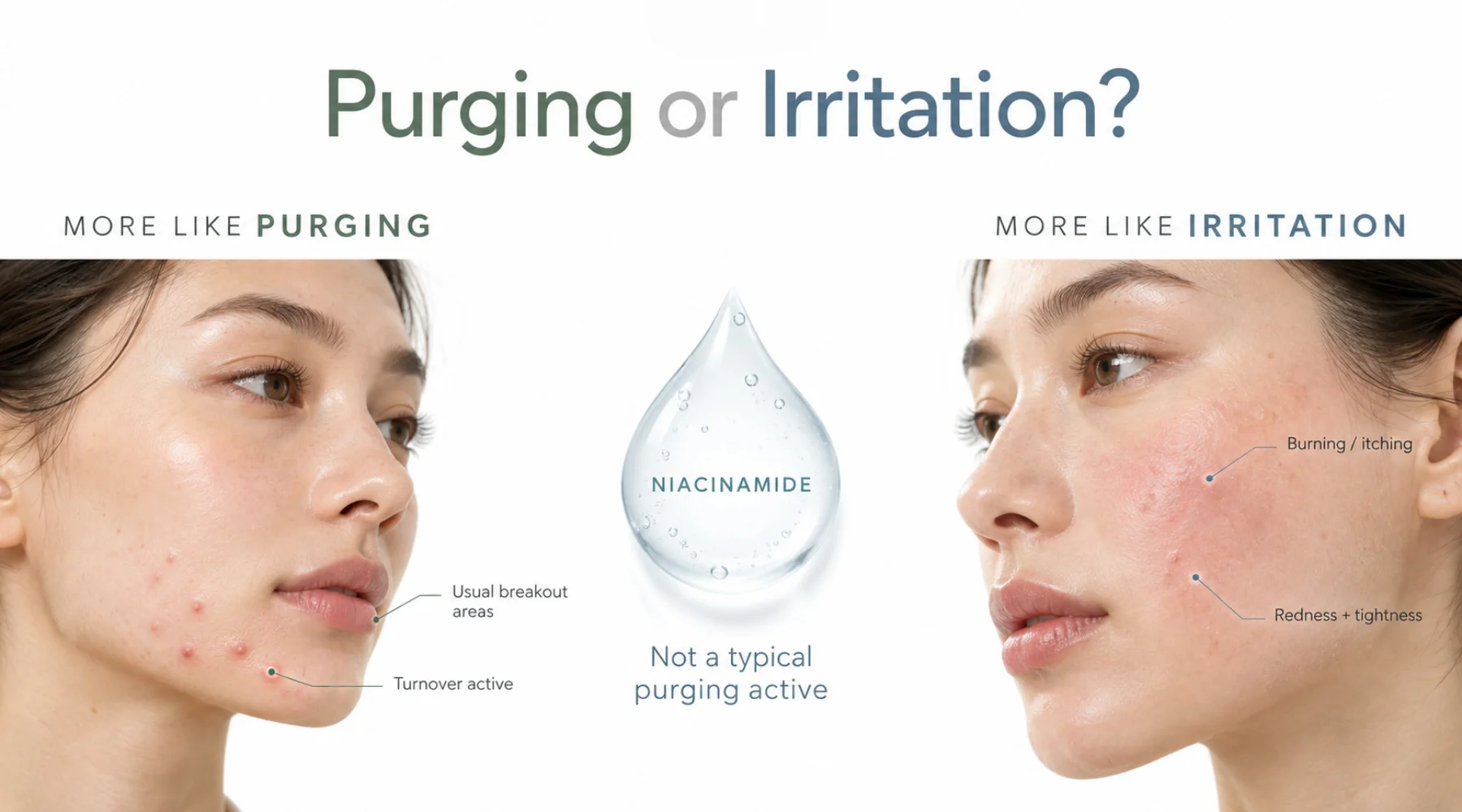
Niacinamide works differently.
While niacinamide affects skin cells, it is not typically used as an exfoliant or to clear clogged pores. Its main benefits involve supporting the skin barrier, reducing inflammation, and controlling pigmentation and oil in some products. Therefore, it doesn’t make sense to automatically call a new breakout from a niacinamide serum a “purge.”
What a more believable purge tends to look like
When a real flare happens, it usually relates to an ingredient that affects clogged pores or skin cell turnover.
You might see:
- Blemishes forming where you usually get acne.
- Blackheads or closed comedones becoming inflamed.
- A flare-up shortly after starting a retinoid or exfoliating treatment.
- Gradual improvement as your skin adjusts to the treatment.
However, don’t ignore worsening acne. If you experience severe inflammation, pain, crusting, or worsening condition, you should reassess your treatment.
What irritation tends to look like instead
Irritation can look different for everyone.
You might see:
- Small red or skin-coloured bumps
- Burning when using moisturiser or sunscreen
- Ongoing tingling
- Tightness after washing your face
- Suddenly rough skin texture
- Itching
- Redness spreading beyond spots
- Peeling around the nose or mouth
- Skin that feels hot or tender
If you notice these signs after starting niacinamide, calling it “purging” may lead you to use it longer than needed.
Why a Niacinamide Product Can Seem to Cause Breakouts
A skincare product is more than its main ingredient.
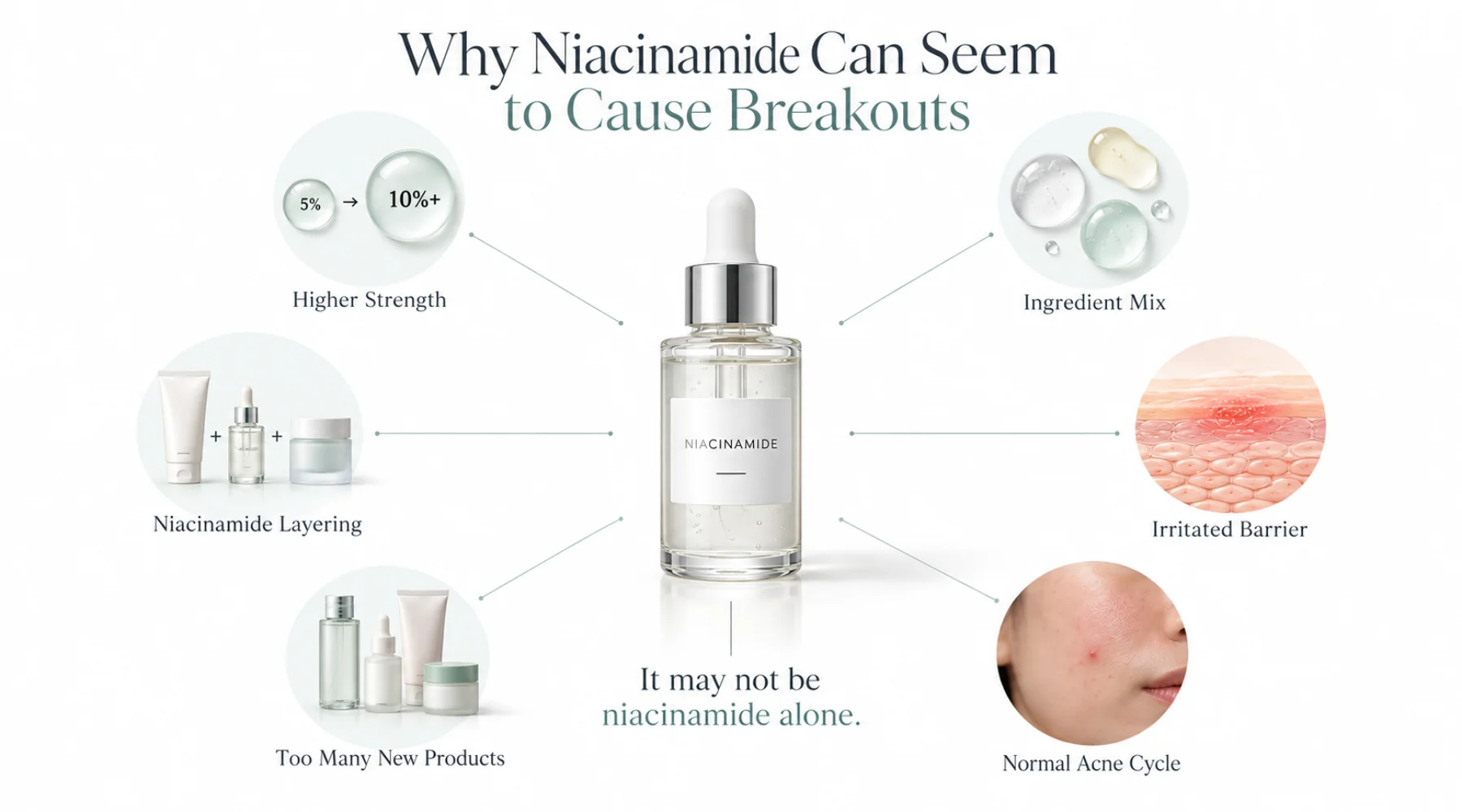
For instance, a bottle marked “10% niacinamide” may also have solvents, humectants, extracts, emollients, silicones, oils, thickeners, preservatives, and other active ingredients. Your skin feels the entire formula together.
This is why two products with the same amount of niacinamide can work very differently on the same person.
The concentration may be more than your skin needs
Niacinamide is trending in skincare, with many believing that higher percentages are better. If 5% works, then 10% should be stronger, and 15% or 20% seems even more powerful. However, skin biology isn’t so straightforward.
Research has shown that effective results from niacinamide often come from using 2% to 5%. Studies have found benefits like improved skin barriers, less pigmentation, and reduced signs of ageing at these moderate levels. Generally, niacinamide is safe to use at these amounts.
This doesn’t mean that higher-strength serums will always irritate the skin. Many people can handle 10% without issues. However, stronger doesn’t always mean better.
For people with sensitive, dry, or irritated skin, a moderate formula may be easier to use regularly.
You may be using niacinamide in more products than you realise
Niacinamide is now found in almost every type of facial product:
- cleansers
- toners
- essences
- serums
- moisturisers
- sunscreens
- masks
- acne treatments
- brightening products
Each product may be effective on its own, but using many niacinamide products together might not be necessary. This is often overlooked with products that have multiple ingredients. For instance, a 24K Gold Serum and a No. 5+ Vitamin Concentrated Serum both include niacinamide, and even a Bio-Collagen Real Deep Mask lists it among other ingredients.
Don’t worry about these multi-ingredient formulae. Instead, keep track of all the sources of niacinamide you use, rather than only counting the product labelled as “niacinamide serum.”
Another ingredient may be the real trigger
When a serum causes breakouts, people often blame niacinamide because its name is front and centre on the bottle. But another ingredient could actually be the issue.
Possible triggers include:
- A heavy emollient that clogs your skin
- Fragrance
- Essential oils
- Other active ingredients
- Botanical extracts
- Solvents
- Preservatives
- Any ingredient you may be sensitive to
That’s why ingredient lists are more important than marketing names. Additionally, be cautious about lists of “comedogenic ingredients.” A product’s ability to cause breakouts depends on its overall formula, ingredient concentration, and your individual skin, rather than just one ingredient.
Your barrier may already have been irritated
A niacinamide serum can feel very different when used in a gentle skincare routine compared to using it after nights of strong exfoliants and retinol.
If the skin barrier is damaged, even comfortable products can sting. A disrupted barrier can also make the skin look worse, with increased roughness, redness, flakiness, and inflammation, making acne appear more obvious.
Niacinamide can help strengthen the skin barrier, but it won’t quickly fix damage from a harsh routine. Studies show that topical niacinamide can boost ceramide production and reduce moisture loss, but these benefits come from proper use, not from cancelling out irritation caused by other products.
Several new products may have been introduced together
This is a common mistake.
Someone tries:
- A new cleanser
- Niacinamide serum
- Exfoliating toner
- Moisturiser
- Sunscreen
A week later, their face breaks out. Which product caused it? There’s no easy way to tell.
Adding one new product at a time may seem slow, but it makes figuring out problems much easier.
The breakout may be your normal acne cycle
Acne doesn’t show up right away. A pore can start to get blocked before you see a spot.
Several factors can affect when acne appears. Hormonal changes, stress, menstrual cycles, hair products, sweating, friction, and a tendency to get acne can all play a role.
This can create a false impression of timing. If you start using a serum on Monday and notice spots by Thursday, you might blame the serum.
Sometimes that’s fair. But often, the spots were already developing.
Signs of Irritation From Niacinamide That Can Look Like Acne
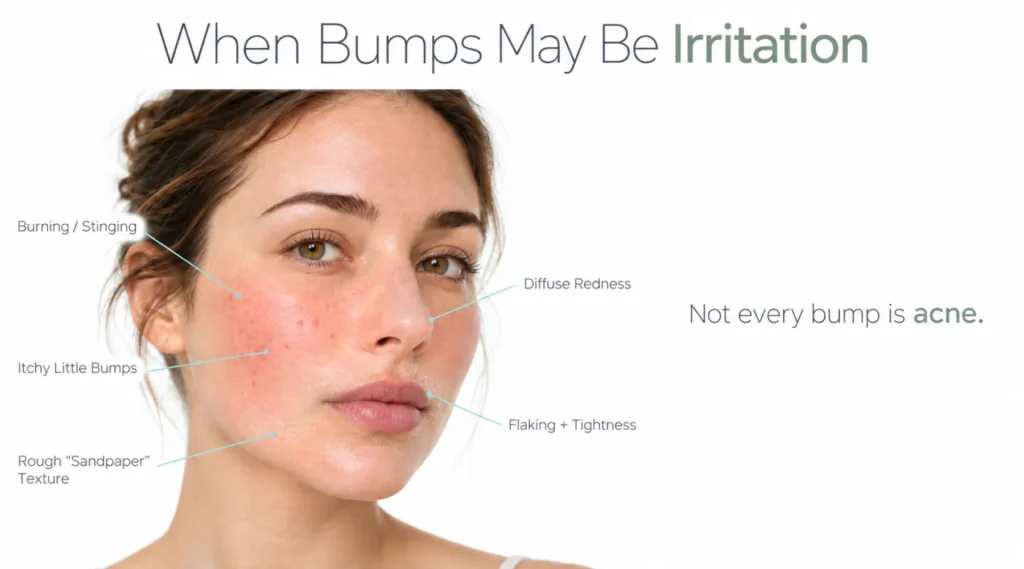
Not Every Bump is Acne
Not all bumps are acne. This is important because irritated skin may feel like it’s “breaking out,” even if it resembles a rash more than acne.
Persistent Stinging or Burning
A brief stinging or burning sensation doesn’t always mean something is wrong, especially if your skin is already dry. However, ongoing burning is concerning. Skincare shouldn’t hurt. If your skin keeps burning after using a product, it’s likely stressed.
Diffuse Redness
Acne causes redness around individual spots. In contrast, irritation can make larger areas red, especially around the nose, cheeks, and mouth. On deeper skin tones, inflammation may look warm, tender, or have darker patches rather than bright redness.
Itchy Little Bumps
Acne can itch sometimes, but widespread itching suggests irritation or dermatitis. If you notice swelling, hives, intense itching, or blisters, stop using the product and get medical advice.
Flaking and Tightness
Niacinamide is known to support the skin barrier, so dryness might seem unexpected. However, the formula could still be drying, or the ingredient concentration might not be right for you. You can’t judge a product by just one ingredient’s potential benefit.
Sudden Sandpaper-like Texture
Some people describe their skin as feeling like it’s covered in tiny bumps. This can happen when skin is inflamed and dehydrated, not necessarily because many pores are clogged. Often, reducing irritation is more helpful than adding more acne treatments.
What Does Niacinamide Do for Skin When It Is Working Well?
Niacinamide is popular because it helps the skin without strong exfoliation.
It plays a role in energy and cell functions through molecules called NAD and NADP. Studies have shown that using niacinamide can improve the skin barrier, boost important skin lipids, and decrease water loss.
Its effects are steady rather than dramatic.
A gentle product can gradually make skin look:
- Less oily
- Less irritated
- More even-toned
- Better hydrated
- Smoother
- Calmer after breakouts
For many, this consistent improvement is more beneficial than the intense peeling from stronger treatments.
Does Niacinamide Help With Acne?
Niacinamide can help with acne-prone skin, but it isn’t a universal cure.
Several studies have looked at topical nicotinamide for inflammatory acne. In one trial, a 4% nicotinamide gel was tested against topical clindamycin for moderate inflammatory acne. Another study also showed benefits from the 4% nicotinamide. A later review noted that while the results are promising, more thorough comparisons with standard acne treatments are needed.
This sets a realistic expectation.
Niacinamide may help by calming inflammation
Inflamed pimples are red, swollen, and sore because acne causes inflammation. Niacinamide can help reduce this inflammation, making some blemishes look calmer.
It may support oily skin
Niacinamide is commonly used to reduce shine on the skin.
Oil is necessary for healthy skin, but too much oil can trap dead cells and create blockages in pores.
While niacinamide won’t directly unclog pores, it can work well alongside other treatments that do.
It supports the barrier around acne treatment
Acne treatments like retinoids, benzoyl peroxide, and salicylic acid can irritate the skin if started too quickly.
Having a stronger skin barrier can help your routine feel more comfortable.
However, niacinamide can’t completely counteract every reaction to retinoids. A 2024 study found that 3% niacinamide didn’t significantly reduce discomfort from retinol in their tests, reminding us not to overstate its soothing effects.
It can help with marks left after acne
Niacinamide does not lighten the skin.
Research shows it can block the transfer of melanin, the pigment made by skin cells. Clinical studies using niacinamide have found it can reduce visible dark spots.
This makes it helpful for post-inflammatory dark spots, especially when used with sunscreen.
For ongoing acne and dark spots, azelaic acid can also help. A product like 12% Azelaic Acid Acne Cream serves a different purpose than niacinamide. It’s best to introduce one active ingredient at a time, especially if your skin is sensitive.
Is 10% Niacinamide More Likely to Cause Acne?
A 10% concentration doesn’t automatically cause acne. The important question is whether your skin can handle it. There isn’t a specific concentration of niacinamide that becomes comedogenic for everyone. Stronger formulations may affect how well your skin tolerates them.
If you’ve used a 10% serum without issues for months, there’s no reason to switch. However, if your cheeks are dry, flushed, and irritated from retinol, starting with a lower-strength niacinamide may be a better choice.
To think about concentrations practically:
| Niacinamide strength | Who may prefer it | Main consideration |
| Around 2% | Very sensitive, dry or beginner skin | Gentle introduction |
| Around 4–5% | Many skin types | Strong clinical precedent for several skin benefits |
| Around 10% | Oily or experienced skin that tolerates it | Not automatically more effective |
| Above 10% | Selected formulae and tolerant users | Greater concentration does not guarantee greater benefit |
The quality of the formula matters as much as the number on the bottle.
How to Use Niacinamide Serum Without Making Breakouts Harder to Diagnose
A good niacinamide routine is simple. The more steps you add, the harder it is to find any problems.
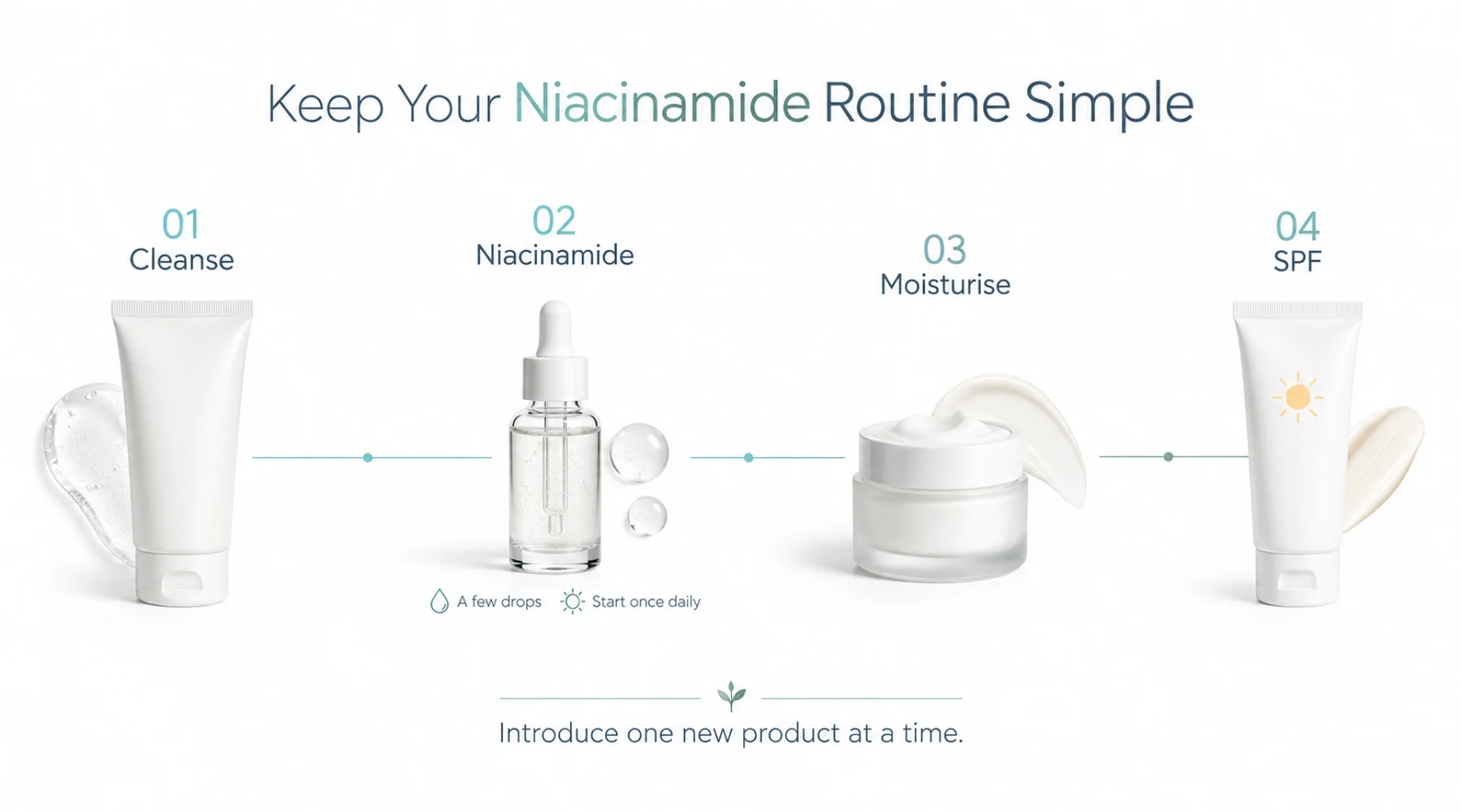
Here’s a straightforward order to follow:
- Cleanse gently.
- Apply a light niacinamide serum.
- Use moisturiser.
- Apply sunscreen during the day.
If your moisturiser contains niacinamide, use it in place of the serum. It doesn’t need to be a separate serum. For example, a 24K Gold Niacinamide Essence Moisturiser can combine hydration and niacinamide, reducing layers.
You can also simplify your routine by comparing products based on texture, concentration, and ingredients instead of assuming that more treatments are better.
Start once a day rather than twice
Many people can use niacinamide in the morning and at night. However, beginners don’t have to start that way. Begin with once a day or every other day if your skin is sensitive. If your skin adjusts well, you can use it more often.
You can use niacinamide at any time of day. It’s more important to consider what other products you are using with it than whether it’s morning or night.
Use a sensible amount
More serum won’t give you quicker results.
For most dropper formulae, just a few drops can cover your face, but always follow the product instructions first.
Using too much serum can make your skin sticky and cause pilling instead of improving it.
Keep the surrounding routine stable
When trying a new niacinamide product, don’t use three other active treatments during the same week. This helps you understand how it works for your skin.
The same goes for using niacinamide in your skincare routine. It should work alongside cleansing, moisturising, sunscreen, and any acne treatments, not clash with them.
Can I Use Niacinamide With Retinol?
Yes, you can use niacinamide and retinol together in your skincare routine. Research shows that niacinamide does not lessen the effects of retinol. Products with both ingredients have been tested in studies.
However, it’s not necessary for everyone to use both right away. If you’re new to retinol, it might be easier to start with:
Morning
- gentle cleanse;
- niacinamide;
- moisturiser if needed;
- sunscreen.
Evening
- cleanse;
- retinol on scheduled nights;
- moisturiser.
Separating them cuts down on layers and makes it easier to spot irritation. Once your skin gets used to retinol, you can add niacinamide to your evening routine if you’d like.
If you break out after combining them
Don’t assume niacinamide is the problem right away.
Retinoids often cause dryness and irritation at first, and acne can seem worse during treatment.
Simplifying your skincare routine for a short time can help identify which step is important.
Is Niacinamide Good for Dry Skin?
Yes, niacinamide is great for dry skin. Studies show that it can boost important skin oils and reduce water loss. A 2% niacinamide cream has helped people with dry skin by improving hydration and skin protection.
However, niacinamide alone is not enough to moisturise fully.
For best results, mix it with other ingredients like:
- Glycerin
- Ceramides
- Squalane
- Fatty alcohols
- Petrolatum
- Hyaluronic acid
- Panthenol
If niacinamide makes your dry skin feel tight, you don’t need to keep using it just because it’s thought to be good for skin protection. The product should fit your skin’s needs.
During times of irritation, you can use a simple hydrating essence, like COSRX Advanced Snail 96 Mucin Power Essence, if your skin tolerates it. However, adding new products while figuring out the cause of irritation is often less helpful than sticking with products your skin already likes.
What to Do If Niacinamide Seems to Be Causing Acne
When a breakout happens after starting a new serum, it’s tempting to add more acne products. This can make things harder to understand. A better way is to remove some products gradually.
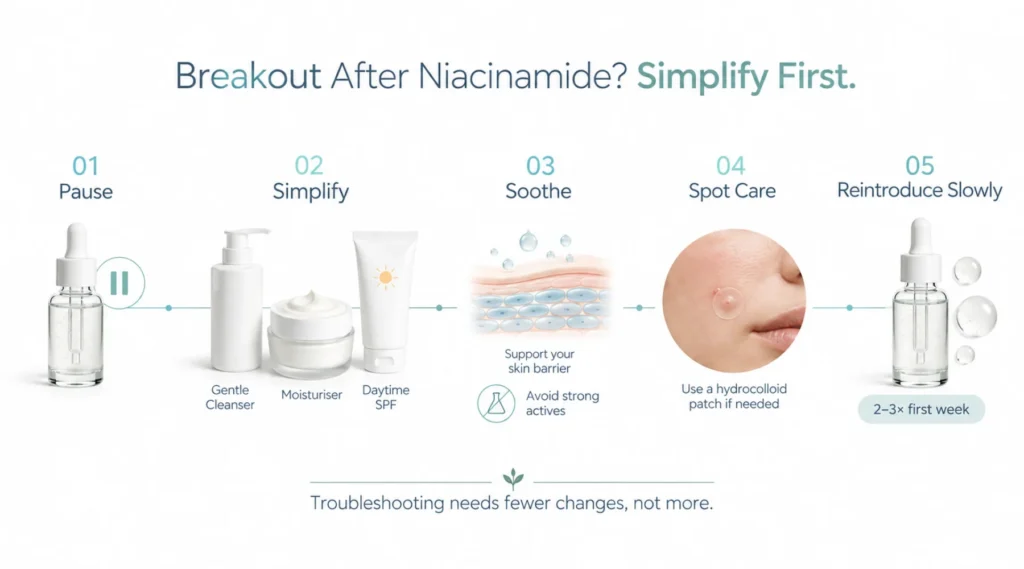
1. Stop the newest product temporarily
If the breakout started after a noticeable change, remove that product first. You don’t have to throw it away right away. Let your skin settle while keeping your routine simple.
2. Reduce the routine to the essentials
For several days, a simple routine might work:
Morning
- gentle cleanser or water rinse if appropriate;
- familiar moisturiser;
- sunscreen.
Evening
- gentle cleanser;
- familiar moisturiser.
If you are using a prescribed acne medication, do not change it without talking to your doctor.
3. Avoid treating irritation as aggressive acne
If your face is burning and peeling, using strong acids, scrubs, or many spot treatments can make it worse. The American Academy of Dermatology recommends gentle skincare for acne, as harsh products can worsen breakouts.
4. Deal with individual spots without attacking the whole face
For a whitehead, a regular hydrocolloid patch can protect the bump and absorb fluid once it is ripe. A good example is the Thickest Absorbing Pimple Acne Patch.
Another choice is Microneedles Acne Pimple Patches, which include active ingredients like niacinamide and salicylic acid. However, if you’re testing whether your skin reacts poorly to niacinamide, adding another product with the same ingredient could ruin the test.
It’s important to remember this principle: troubleshooting needs fewer changes, not more.
5. Reintroduce cautiously if the skin returns to normal
If your skin calms down after stopping the serum, you can decide to try it again.
To apply it:
- Use it two or three times in the first week.
- Apply a small amount.
- Avoid using any new active ingredients.
- Use it when your skin feels normal.
If you have the same reaction again, the product likely isn’t right for you. You don’t need to identify which ingredient caused the problem before stopping the cosmetic.
How to Avoid Breakouts From Niacinamide Products
Prevention is about making your skincare routine easier. Introduce one leave-on product at a time. Wait to see how your skin reacts before adding anything else. This is important for acne-prone skin, where regular breakouts can make it hard to tell what’s working.
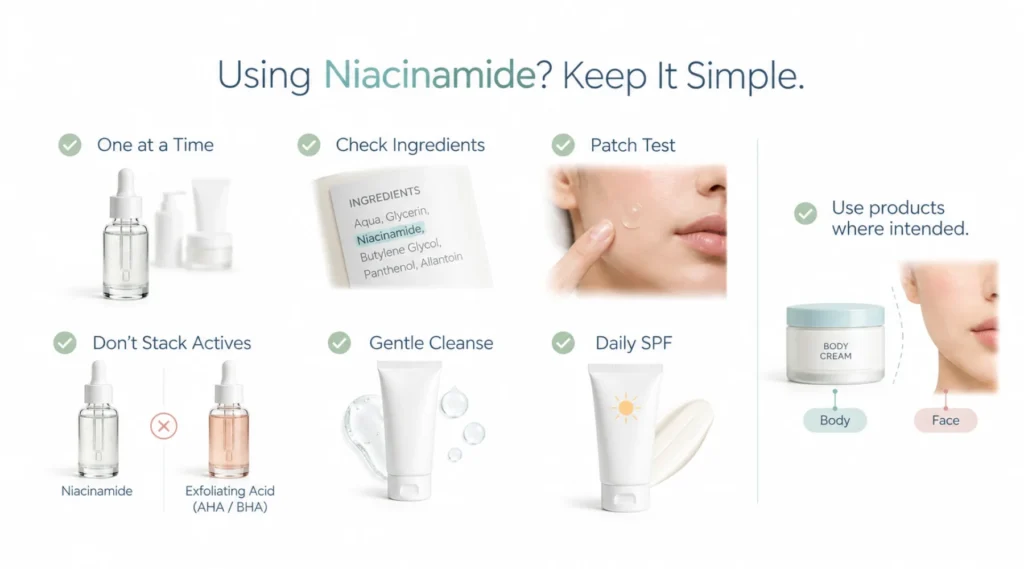
Check all the ingredient lists.
Don’t just look for “niacinamide” on the front label. A moisturiser, mask, serum, or brightening treatment might already have it. Duplication is common in complex routines.
Patch test for irritation, but know its limits.
Testing a small amount on your jaw or behind your ear can show if there’s irritation. However, this test doesn’t guarantee your whole face will be fine after weeks of use. Acne depends on many factors, so a successful patch test is helpful but not conclusive.
Be careful with combining acne treatments.
Using a new niacinamide serum with tea tree oil or salicylic acid means you have two new products. If you want to use a Tea Tree Facial Serum, let your skin adjust to one product before adding another.
Don’t use stronger cleansers to fight spots.
Acne-prone skin shouldn’t feel overly scrubbed. Harsh cleansers can dry out and irritate your skin without fixing the real causes of acne.
Use sunscreen every day.
Sunscreen doesn’t prevent acne, but it’s crucial when breakouts leave dark spots. Daily broad-spectrum sunscreen is also important if you use retinoids or exfoliants.
Don’t use face products in the wrong areas.
Products meant for thicker body skin may not work for acne-prone skin on your face. For instance, a cream for dark knees and elbows isn’t suitable for facial skin. Using body treatments on your face can irritate, even if they have “brightening” ingredients.
Should You Stop Using Niacinamide If It Causes Acne?
Stop using the product if you notice a serious skin reaction soon after using it.
Be extra careful if you experience:
- persistent burning
- strong itching
- facial swelling
- widespread redness
- flaking
- painful inflammation
- a rash beyond acne-prone areas
- worsening symptoms after reapplying
Once your skin calms down, you have two choices: try the product again slowly, or switch to something else. Don’t push your skin to tolerate niacinamide. If another ingredient or a basic moisturiser works for you without irritating you, that’s a good skincare routine.
When the Formula Matters More Than Niacinamide
Skincare talks often focus too much on ingredients. Comments like “Niacinamide broke me out” or “Coconut oil clogs pores” are common. However, skincare is more complex than that.
For example, an emollient that feels great on dry, acne-prone skin might feel too heavy for someone else. A gel serum for oily skin could have a solvent that irritates sensitive skin. Even a calming formula full of botanicals might not work for someone sensitive to fragrances.
The same ingredient can act differently depending on how it’s combined with other components. So, just because a niacinamide serum didn’t work for you doesn’t mean you need to avoid niacinamide altogether. You might do just fine with it in a moisturiser at a lower concentration.
Common Mistakes That Make Niacinamide Look Like the Problem
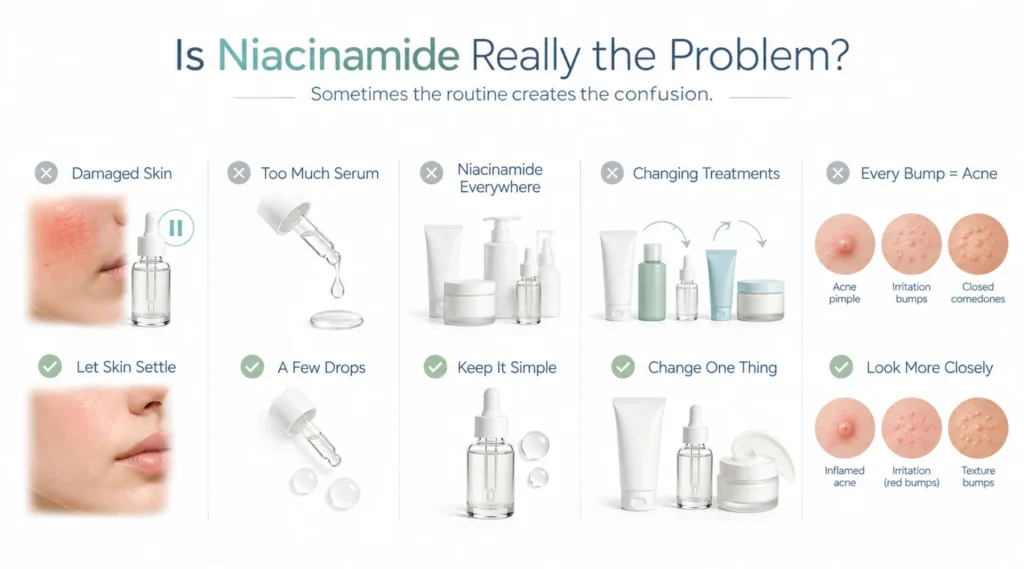
Starting Immediately After Damage
If you’ve been exfoliating, shaving, using retinol, and trying peels, a new water-based serum might sting.
Timing Makes It Look Good
Using a full dropper because “a few drops aren’t enough” means you’ll get more of all the ingredients, not just niacinamide.
Using Niacinamide Too Much
There’s usually no need to make every skincare step a niacinamide treatment by using it twice a day.
Changing Acne Treatments Together
Stopping benzoyl peroxide when starting niacinamide can worsen acne because you stopped an effective treatment, not because niacinamide causes breakouts.
Misunderstanding Bumps on the Skin
Not every bump is a clogged pore; conditions like irritant dermatitis and folliculitis can also cause bumps. Persistent or strange skin issues need proper diagnosis instead of complicated skincare.
What Else Could Be Causing the Breakout?
When acne appears, skincare is just one part of the solution.
Common causes include:
- Hormonal changes
- Menstrual cycles
- Stress
- Oily hair products on the forehead
- Heavy makeup or sunscreen not suited for your skin
- Touching or picking your face
- Hats, helmets, or straps
- Sweating and friction
- Changing acne medications
- Certain medications
- A tendency towards adult acne
Acne develops when hair follicles get blocked, leading to inflammation. Treatments like retinoids, salicylic acid, and benzoyl peroxide target different parts of this issue, while niacinamide offers support.
If your acne persists despite changing cosmetics, simply switching serums won’t fix the root problem.
When Professional Acne Treatment Matters More Than Finding the Perfect Serum
Niacinamide is a skincare product, not a replacement for medical acne treatment.
Talk to a pharmacist, doctor, or dermatologist if you have:
- deep, painful nodules or cysts
- acne that leaves scars
- widespread inflammatory acne
- sudden severe acne
- persistent acne despite using over-the-counter treatments
- noticeable skin discolouration from inflammation
- symptoms that hurt your confidence or well-being
- a rash you’re unsure is acne
Effective acne treatments can include topical retinoids, benzoyl peroxide, azelaic acid, antibiotics, hormonal treatments, or isotretinoin, based on your situation. It’s important to treat inflammatory acne early to prevent scarring.
Niacinamide Myths That Make Breakouts More Confusing
“Niacinamide has to purge before it works”
No, purging isn’t necessary when using niacinamide. A new rash or ongoing acne flare doesn’t mean the product is effective.
“If 5% works, 10% works twice as well”
There’s no proof that higher concentrations are better. A lower dose you can use regularly may be more effective than a stronger serum you can’t use often.
“Tingling means the product is active”
No, tingling is just a sensation and doesn’t indicate effectiveness. Ongoing burning is more of a warning sign than proof that it’s working.
“Niacinamide cannot irritate because it repairs the barrier”
An ingredient can support the skin barrier but still irritate certain strengths or in some formulae. While niacinamide usually works well in normal cosmetic amounts, individual reactions can still happen.
“Niacinamide and retinol should never be combined”
They can be used together. Studies have shown that products with both niacinamide and retinol are effective. The real concern is how well your skin tolerates them, not a strict rule against mixing them.
“A non-comedogenic label guarantees no acne”
No cosmetic can promise that every acne-prone person will respond well to it. Such labels can help, but your own skin’s reaction is still key.
Questions People Ask When Niacinamide Seems to Trigger Breakouts
Can niacinamide cause acne or is it purging?
Niacinamide usually doesn’t cause breakouts like traditional purging treatments, such as retinoids. New spots might indicate irritation, the product’s formulation, another product, or normal acne changes.
How long does niacinamide purging last?
Niacinamide isn’t known for purging, so there’s no set period for it. If breakouts keep happening or get worse, evaluate the product instead of waiting weeks.
What are signs of irritation from niacinamide?
Signs of irritation include consistent burning, itching, redness, tightness, flaking, tenderness, and sudden clusters of small bumps. These suggest irritation, not a healthy adjustment.
Can 10% niacinamide cause breakouts?
A 10% niacinamide product can be too strong for sensitive or dry skin. If you experience breakouts with stinging or tightness, stop using it and consider a lower strength.
Does niacinamide help with acne?
Yes, niacinamide can help acne-prone skin by reducing inflammation, supporting the skin barrier, and possibly regulating oil. There are studies showing improvements in inflammatory acne, but they’re not as extensive as for treatments like retinoids and benzoyl peroxide.
Is niacinamide good for acne-prone skin?
Generally, yes. A gentle niacinamide formula can fit well in an acne routine, but the overall product matters, so not every niacinamide serum will work the same.
How can I avoid breakouts from niacinamide?
Introduce one product at a time, start slowly, avoid high concentrations, check if other products contain niacinamide, and keep your routine stable while trying the new product.
Should you stop using niacinamide if acne appears?
If breakouts start soon after using niacinamide, especially with redness or itching, it’s wise to stop. Once the skin settles, you can reintroduce it carefully if you want to try again.
Can I use niacinamide with retinol?
Yes, they can be used together. If you have sensitive skin, use niacinamide in the morning and retinol at night until your skin adapts.
Can you use niacinamide with salicylic acid?
Yes, you can, but you don’t need to start both at the same time. Salicylic acid clears pores, while niacinamide supports the skin. If irritation occurs, cut back on active products or alternate them.
Can niacinamide make closed comedones worse?
Niacinamide isn’t known to cause closed comedones. However, a specific formula might not suit you, and regular acne can persist. If closed comedones appear with one product and improve when you stop, it may not be a good fit.
Can niacinamide cause tiny bumps?
Tiny bumps can occur with any skincare product but aren’t always acne. If they come with itching, burning, or redness, consider irritation.
Is niacinamide good for dry skin?
Yes, it helps maintain moisture and supports the skin barrier, but dry skin needs a good moisturiser. A thin niacinamide serum alone might not be enough.
Can niacinamide cause acne side effects after months of use?
If you tolerated a product for months, it’s less likely to be the cause of recent breakouts. However, reactions can develop later. Check for recent changes in product use, other ingredients, medications, weather, or hormones before blaming niacinamide.
How long should I stop niacinamide if my skin is irritated?
There’s no set time. Wait until redness, burning, tightness, and sensitivity have improved. A seriously damaged barrier may take longer to heal. If symptoms last or are severe, seek professional help.
So, Can Niacinamide Cause Acne or Is Something Else More Likely?
For most people, the question of whether niacinamide causes acne isn’t simple.
Niacinamide is usually safe for skin and can help acne-prone skin. It strengthens the skin barrier, reduces inflammation, and may fade dark spots from blemishes. Clinical studies have looked at topical niacinamide as a treatment for acne, not as a cause.
However, a niacinamide product might not be right for everyone. The concentration could be too high, another ingredient might irritate your skin, or you could be using other products that already contain niacinamide. Retinol or exfoliating acids could weaken your skin’s barrier, or you might have bad timing with breakouts.
Instead of assuming every breakout is from purging or that niacinamide is bad for everyone, simplify your routine. Give your skin time to adjust, consider the whole product, and reintroduce items slowly.
Skincare is easier to manage when you stop labelling ingredients as simply “good” or “bad.” Focus on whether a specific formula, concentration, and usage frequency feel right for your skin.